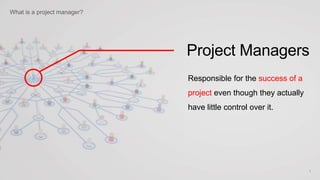
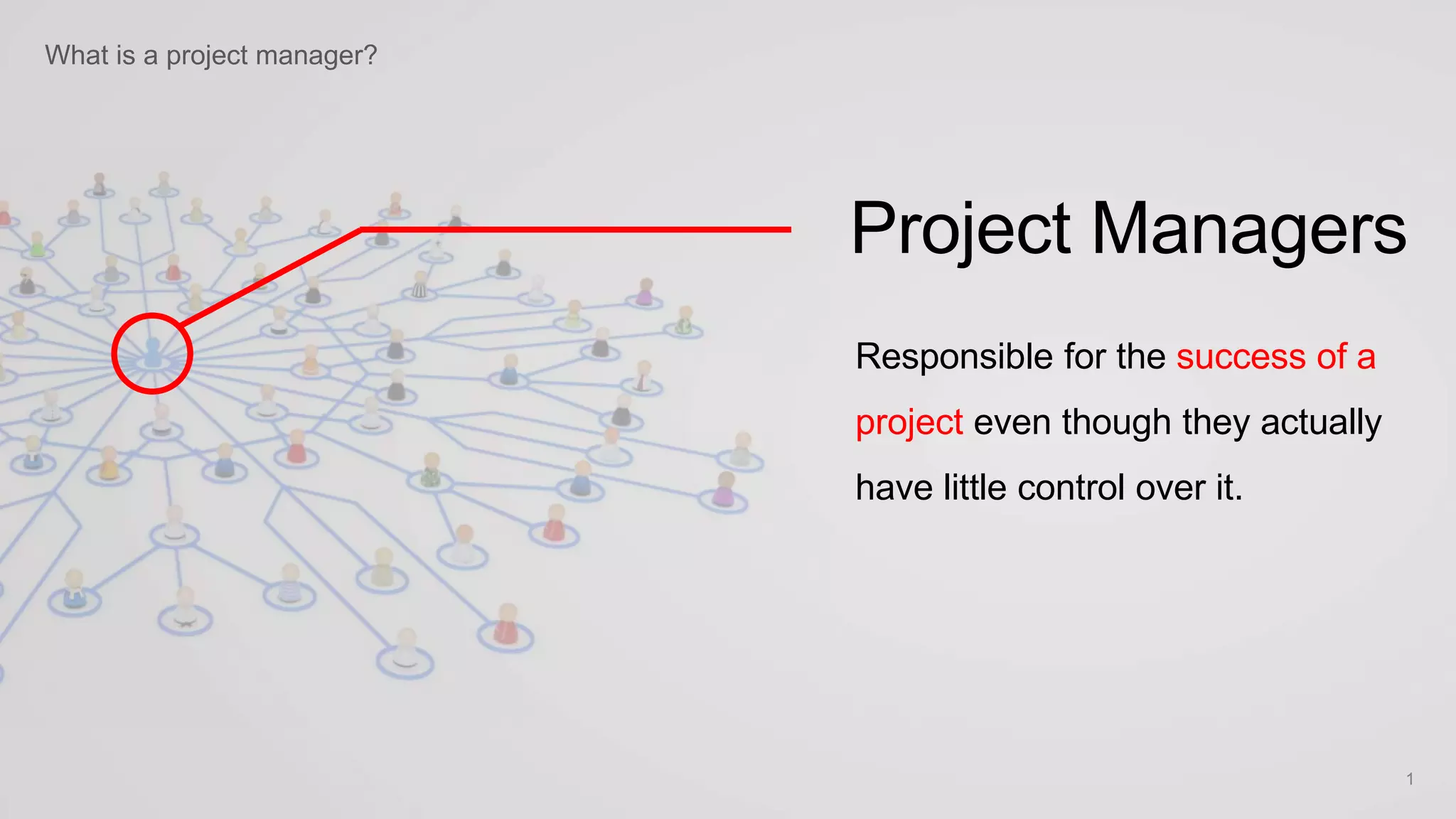
Project Managers
Responsible for the success of a
project even though they actually
have little control over it.
1
What is a project manager?
How to influence a project?
2
1.
2.
3.
4.
5.
6.
7.
8.
9.
10.
Good judgment and prioritization abilities
Effective, efficient communication skills
Empowering the individuals on the team
Strategizing the project success
Being the expert in the project’s focus
Emphasizing with team members
Providing risk management insights
Staying ahead of the curve
Having a strong business sense
Managing expectations
3
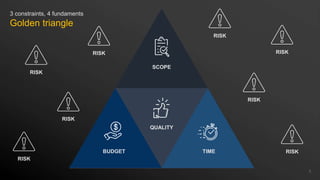
3 constraints, 4 fundaments
Golden triangle
SCOPE
BUDGET TIME
QUALITY
RISK
RISK
RISK
RISK
RISK
RISK
RISK
RISK
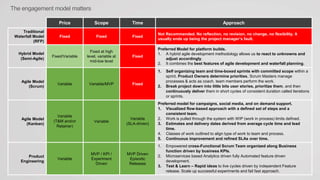
The engagement model matters
Price Scope Time Approach
Traditional
Waterfall Model
(RFP)
Fixed Fixed Fixed
Not Recommended. No reflection, no revision, no change, no flexibility. It
usually ends up being the project manager’s fault.
Hybrid Model
(Semi-Agile)
Fixed/Variable
Fixed at high
level, variable at
mid-low level
Fixed
Preferred Model for platform builds.
1. A hybrid agile development methodology allows us to react to unknowns and
adjust accordingly.
2. It combines the best features of agile development and waterfall planning.
Agile Model
(Scrum)
Variable Variable/MVP Fixed
1. Self organizing team and time-boxed sprints with committed scope within a
sprint. Product Owners determine priorities, Scrum Masters manage
processes & acts as coach, team members perform the work.
2. Break project down into little bits user stories, prioritize them, and then
continuously deliver them in short cycles of consistent duration called iterations
or sprints.
Agile Model
(Kanban)
Variable
(T&M and/or
Retainer)
Variable
Variable
(SLA-driven)
Preferred model for campaigns, social media, and on demand support.
1. Visualized flow-based approach with a defined set of steps and a
consistent team.
2. Work is pulled through the system with WIP (work in process) limits defined.
3. Estimates and delivery dates derived from average cycle time and lead
time.
4. Classes of work outlined to align type of work to team and process.
5. Continuous improvement and refined SLAs over time.
Product
Engineering
Variable
MVP / KPI /
Experiment
Driven
MVP Driven
Episodic
Releases
1. Empowered cross-Functional Scrum Team organized along Business
function driven by business KPIs.
2. Microservices based Analytics driven fully Automated feature driven
development.
3. Test & Learn – Rapid ideas to live cycles driven by independent Feature
release. Scale up successful experiments and fail fast approach.
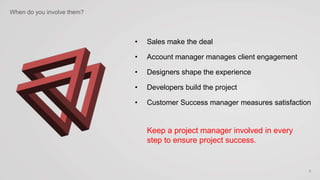
• Sales make the deal
• Account manager manages client engagement
• Designers shape the experience
• Developers build the project
• Customer Success manager measures satisfaction
5
When do you involve them?
Keep a project manager involved in every
step to ensure project success.
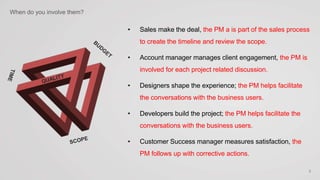
• Sales make the deal, the PM a is part of the sales process
to create the timeline and review the scope.
• Account manager manages client engagement, the PM is
involved for each project related discussion.
• Designers shape the experience; the PM helps facilitate
the conversations with the business users.
• Developers build the project; the PM helps facilitate the
conversations with the business users.
• Customer Success manager measures satisfaction, the
PM follows up with corrective actions.
6
When do you involve them?
How to achieve
(project) success
in 5 steps
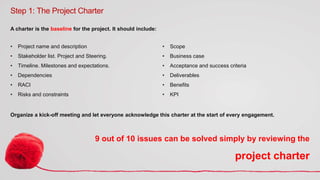
Step 1: The Project Charter
A charter is the baseline for the project. It should include:
• Project name and description
• Stakeholder list. Project and Steering.
• Timeline. Milestones and expectations.
• Dependencies
• RACI
• Risks and constraints
• Scope
• Business case
• Acceptance and success criteria
• Deliverables
• Benefits
• KPI
9 out of 10 issues can be solved simply by reviewing the
project charter
Organize a kick-off meeting and let everyone acknowledge this charter at the start of every engagement.
Step 2: Setting up the meetings
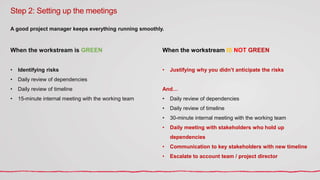
A good project manager keeps everything running smoothly.
When the workstream is GREEN
• Identifying risks
• Daily review of dependencies
• Daily review of timeline
• 15-minute internal meeting with the working team
When the workstream IS NOT GREEN
• Justifying why you didn’t anticipate the risks
And…
• Daily review of dependencies
• Daily review of timeline
• 30-minute internal meeting with the working team
• Daily meeting with stakeholders who hold up
dependencies
• Communication to key stakeholders with new timeline
• Escalate to account team / project director
Step 2.5: Going green again
RETROSPECT
• Report the issues
• Review the path to green
• Adjust your process to avoid this
from happening again…
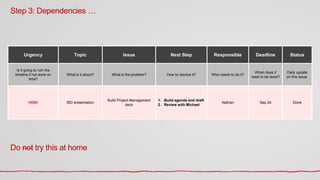
Step 3: Dependencies …
Urgency Topic Issue Next Step Responsible Deadline Status
Is it going to ruin the
timeline if not done on
time?
What is it about? What is the problem? How to resolve it? Who needs to do it?
When does it
need to be done?
Daily update
on this issue.
HIGH IBD presentation
Build Project Management
deck
1. Build agenda and draft
2. Review with Michael
Nathan Sep 24 Done
Do not try this at home
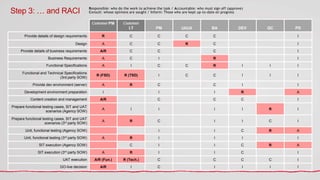
Step 3: … and RACI
Customer PM Customer
I.T PM UI/UX BA DEV QC PD
Provide details of design requirements R C C C C I
Design A C C R C I
Provide details of business requirements A/R C C C I
Business Requirements A C I R I
Functional Specifications A I C C R I I I
Functional and Technical Specifications
(3rd party SOW)
R (FSD) R (TSD) I C C I I I
Provide dev environment (server) A R C C I I
Development environment preparation I I I R A
Content creation and management A/R C C C I
Prepare functional testing cases, SIT and UAT
scenarios (Agency SOW)
A I I I I R I
Prepare functional testing cases, SIT and UAT
scenarios (3rd party SOW)
A R C I I C I
Unit, functional testing (Agency SOW) I I C R A
Unit, functional testing (3rd party SOW) A R I I I I
SIT execution (Agency SOW) C I I C R A
SIT execution (3rd party SOW) A R I I C I
UAT execution A/R (Fun.) R (Tech.) C C C C I
GO-live decision A/R I C I I I I
Responsible: who do the work to achieve the task / Accountable: who must sign off (approve)
Consult: whose opinions are sought / Inform: Those who are kept up-to-date on progress
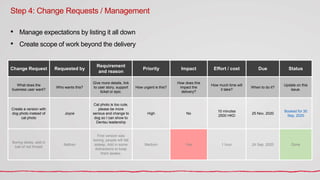
Step 4: Change Requests / Management
• Manage expectations by listing it all down
• Create scope of work beyond the delivery
Change Request Requested by
Requirement
and reason
Priority Impact Effort / cost Due Status
What does the
business user want?
Who wants this?
Give more details, link
to user story, support
ticket or epic.
How urgent is this?
How does this
impact the
delivery?
How much time will
it take?
When to do it?
Update on this
issue.
Create a version with
dog photo instead of
cat photo
Joyce
Cat photo is too cute,
please be more
serious and change to
dog so I can show to
Dentsu leadership
High No
10 minutes
2500 HKD
25 Nov, 2020
Booked for 30
Sep, 2020
Boring slides, add in
ball of red thread
Nathan
First version was
boring, people will fall
asleep. Add in some
distractions to keep
them awake.
Medium Yes 1 hour 24 Sep. 2020 Done
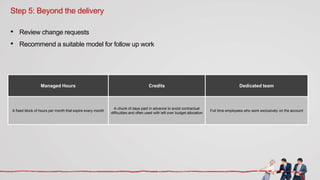
Step 5: Beyond the delivery
• Review change requests
• Recommend a suitable model for follow up work
Managed Hours Credits Dedicated team
A fixed block of hours per month that expire every month
A chunk of days paid in advance to avoid contractual
difficulties and often used with left over budget allocation
Full time employees who work exclusively on the account
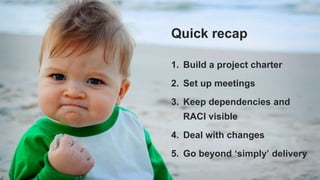
Quick recap
1. Build a project charter
2. Set up meetings
3. Keep dependencies and
RACI visible
4. Deal with changes
5. Go beyond ‘simply’ delivery
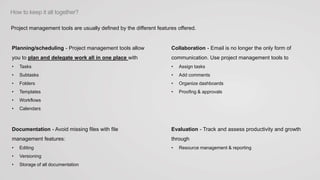
Documentation - Avoid missing files with file
management features:
• Editing
• Versioning
• Storage of all documentation
Evaluation - Track and assess productivity and growth
through
• Resource management & reporting
Collaboration - Email is no longer the only form of
communication. Use project management tools to
• Assign tasks
• Add comments
• Organize dashboards
• Proofing & approvals
Planning/scheduling - Project management tools allow
you to plan and delegate work all in one place with
• Tasks
• Subtasks
• Folders
• Templates
• Workflows
• Calendars
Project management tools are usually defined by the different features offered.
How to keep it all together?
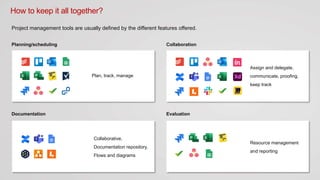
Plan, track, manage
Documentation Evaluation
CollaborationPlanning/scheduling
Project management tools are usually defined by the different features offered.
How to keep it all together?
Collaborative,
Documentation repository,
Flows and diagrams
Assign and delegate,
communicate, proofing,
keep track
Resource management
and reporting
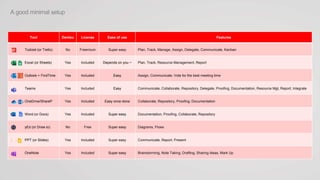
A good minimal setup
Tool Dentsu License Ease of use Features
Todoist (or Trello) No Freemium Super easy Plan, Track, Manage, Assign, Delegate, Communicate, Kanban
Excel (or Sheets) Yes Included Depends on you ~ Plan, Track, Resource Management, Report
Outlook + FindTime Yes Included Easy Assign, Communicate, Vote for the best meeting time
Teams Yes Included Easy Communicate, Collaborate, Repository, Delegate, Proofing, Documentation, Resource Mgt, Report, Integrate
OneDrive/ShareP Yes Included Easy once done Collaborate, Repository, Proofing, Documentation
Word (or Docs) Yes Included Super easy Documentation, Proofing, Collaborate, Repository
yEd (or Draw.io) No Free Super easy Diagrams, Flows
PPT (or Slides) Yes Included Super easy Communicate, Report, Present
OneNote Yes Included Super easy Brainstorming, Note Taking, Drafting, Sharing Ideas, Mark Up
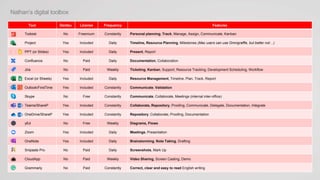
Nathan’s digital toolbox
Tool Dentsu License Frequency Features
Todoist No Freemium Constantly Personal planning, Track, Manage, Assign, Communicate, Kanban
Project Yes Included Daily Timeline, Resource Planning, Milestones (Mac users can use Omnigraffle, but better not…)
PPT (or Slides) Yes Included Daily Present, Report
Confluence No Paid Daily Documentation, Collaboration
Jira No Paid Weekly Ticketing, Kanban, Support, Resource Tracking, Development Scheduling, Workflow
Excel (or Sheets) Yes Included Daily Resource Management, Timeline, Plan, Track, Report
Outlook/FindTime Yes Included Constantly Communicate, Validation
Skype No Free Constantly Communicate, Collaborate, Meetings (internal inter-office)
Teams/ShareP Yes Included Constantly Collaborate, Repository, Proofing, Communicate, Delegate, Documentation, Integrate
OneDrive/ShareP Yes Included Constantly Repository, Collaborate, Proofing, Documentation
yEd No Free Weekly Diagrams, Flows
Zoom Yes Included Daily Meetings, Presentation
OneNote Yes Included Daily Brainstorming, Note Taking, Drafting
Snipaste Pro No Paid Daily Screenshots, Mark Up
CloudApp No Paid Weekly Video Sharing, Screen Casting, Demo
Grammarly No Paid Constantly Correct, clear and easy to read English writing
Questions?

Brief introduction to project management and project management tools

  • 1.
    Project Managers Responsible forthe success of a project even though they actually have little control over it. 1 What is a project manager?
  • 2.
    How to influencea project? 2 1. 2. 3. 4. 5. 6. 7. 8. 9. 10. Good judgment and prioritization abilities Effective, efficient communication skills Empowering the individuals on the team Strategizing the project success Being the expert in the project’s focus Emphasizing with team members Providing risk management insights Staying ahead of the curve Having a strong business sense Managing expectations
  • 3.
    3 3 constraints, 4fundaments Golden triangle SCOPE BUDGET TIME QUALITY RISK RISK RISK RISK RISK RISK RISK RISK
  • 4.
    The engagement modelmatters Price Scope Time Approach Traditional Waterfall Model (RFP) Fixed Fixed Fixed Not Recommended. No reflection, no revision, no change, no flexibility. It usually ends up being the project manager’s fault. Hybrid Model (Semi-Agile) Fixed/Variable Fixed at high level, variable at mid-low level Fixed Preferred Model for platform builds. 1. A hybrid agile development methodology allows us to react to unknowns and adjust accordingly. 2. It combines the best features of agile development and waterfall planning. Agile Model (Scrum) Variable Variable/MVP Fixed 1. Self organizing team and time-boxed sprints with committed scope within a sprint. Product Owners determine priorities, Scrum Masters manage processes & acts as coach, team members perform the work. 2. Break project down into little bits user stories, prioritize them, and then continuously deliver them in short cycles of consistent duration called iterations or sprints. Agile Model (Kanban) Variable (T&M and/or Retainer) Variable Variable (SLA-driven) Preferred model for campaigns, social media, and on demand support. 1. Visualized flow-based approach with a defined set of steps and a consistent team. 2. Work is pulled through the system with WIP (work in process) limits defined. 3. Estimates and delivery dates derived from average cycle time and lead time. 4. Classes of work outlined to align type of work to team and process. 5. Continuous improvement and refined SLAs over time. Product Engineering Variable MVP / KPI / Experiment Driven MVP Driven Episodic Releases 1. Empowered cross-Functional Scrum Team organized along Business function driven by business KPIs. 2. Microservices based Analytics driven fully Automated feature driven development. 3. Test & Learn – Rapid ideas to live cycles driven by independent Feature release. Scale up successful experiments and fail fast approach.
  • 5.
    • Sales makethe deal • Account manager manages client engagement • Designers shape the experience • Developers build the project • Customer Success manager measures satisfaction 5 When do you involve them? Keep a project manager involved in every step to ensure project success.
  • 6.
    • Sales makethe deal, the PM a is part of the sales process to create the timeline and review the scope. • Account manager manages client engagement, the PM is involved for each project related discussion. • Designers shape the experience; the PM helps facilitate the conversations with the business users. • Developers build the project; the PM helps facilitate the conversations with the business users. • Customer Success manager measures satisfaction, the PM follows up with corrective actions. 6 When do you involve them?
  • 7.
    How to achieve (project)success in 5 steps
  • 8.
    Step 1: TheProject Charter A charter is the baseline for the project. It should include: • Project name and description • Stakeholder list. Project and Steering. • Timeline. Milestones and expectations. • Dependencies • RACI • Risks and constraints • Scope • Business case • Acceptance and success criteria • Deliverables • Benefits • KPI 9 out of 10 issues can be solved simply by reviewing the project charter Organize a kick-off meeting and let everyone acknowledge this charter at the start of every engagement.
  • 9.
    Step 2: Settingup the meetings A good project manager keeps everything running smoothly. When the workstream is GREEN • Identifying risks • Daily review of dependencies • Daily review of timeline • 15-minute internal meeting with the working team When the workstream IS NOT GREEN • Justifying why you didn’t anticipate the risks And… • Daily review of dependencies • Daily review of timeline • 30-minute internal meeting with the working team • Daily meeting with stakeholders who hold up dependencies • Communication to key stakeholders with new timeline • Escalate to account team / project director
  • 10.
    Step 2.5: Goinggreen again RETROSPECT • Report the issues • Review the path to green • Adjust your process to avoid this from happening again…
  • 11.
    Step 3: Dependencies… Urgency Topic Issue Next Step Responsible Deadline Status Is it going to ruin the timeline if not done on time? What is it about? What is the problem? How to resolve it? Who needs to do it? When does it need to be done? Daily update on this issue. HIGH IBD presentation Build Project Management deck 1. Build agenda and draft 2. Review with Michael Nathan Sep 24 Done Do not try this at home
  • 12.
    Step 3: …and RACI Customer PM Customer I.T PM UI/UX BA DEV QC PD Provide details of design requirements R C C C C I Design A C C R C I Provide details of business requirements A/R C C C I Business Requirements A C I R I Functional Specifications A I C C R I I I Functional and Technical Specifications (3rd party SOW) R (FSD) R (TSD) I C C I I I Provide dev environment (server) A R C C I I Development environment preparation I I I R A Content creation and management A/R C C C I Prepare functional testing cases, SIT and UAT scenarios (Agency SOW) A I I I I R I Prepare functional testing cases, SIT and UAT scenarios (3rd party SOW) A R C I I C I Unit, functional testing (Agency SOW) I I C R A Unit, functional testing (3rd party SOW) A R I I I I SIT execution (Agency SOW) C I I C R A SIT execution (3rd party SOW) A R I I C I UAT execution A/R (Fun.) R (Tech.) C C C C I GO-live decision A/R I C I I I I Responsible: who do the work to achieve the task / Accountable: who must sign off (approve) Consult: whose opinions are sought / Inform: Those who are kept up-to-date on progress
  • 13.
    Step 4: ChangeRequests / Management • Manage expectations by listing it all down • Create scope of work beyond the delivery Change Request Requested by Requirement and reason Priority Impact Effort / cost Due Status What does the business user want? Who wants this? Give more details, link to user story, support ticket or epic. How urgent is this? How does this impact the delivery? How much time will it take? When to do it? Update on this issue. Create a version with dog photo instead of cat photo Joyce Cat photo is too cute, please be more serious and change to dog so I can show to Dentsu leadership High No 10 minutes 2500 HKD 25 Nov, 2020 Booked for 30 Sep, 2020 Boring slides, add in ball of red thread Nathan First version was boring, people will fall asleep. Add in some distractions to keep them awake. Medium Yes 1 hour 24 Sep. 2020 Done
  • 14.
    Step 5: Beyondthe delivery • Review change requests • Recommend a suitable model for follow up work Managed Hours Credits Dedicated team A fixed block of hours per month that expire every month A chunk of days paid in advance to avoid contractual difficulties and often used with left over budget allocation Full time employees who work exclusively on the account
  • 15.
    Quick recap 1. Builda project charter 2. Set up meetings 3. Keep dependencies and RACI visible 4. Deal with changes 5. Go beyond ‘simply’ delivery
  • 16.
    Documentation - Avoidmissing files with file management features: • Editing • Versioning • Storage of all documentation Evaluation - Track and assess productivity and growth through • Resource management & reporting Collaboration - Email is no longer the only form of communication. Use project management tools to • Assign tasks • Add comments • Organize dashboards • Proofing & approvals Planning/scheduling - Project management tools allow you to plan and delegate work all in one place with • Tasks • Subtasks • Folders • Templates • Workflows • Calendars Project management tools are usually defined by the different features offered. How to keep it all together?
  • 17.
    Plan, track, manage DocumentationEvaluation CollaborationPlanning/scheduling Project management tools are usually defined by the different features offered. How to keep it all together? Collaborative, Documentation repository, Flows and diagrams Assign and delegate, communicate, proofing, keep track Resource management and reporting
  • 18.
    A good minimalsetup Tool Dentsu License Ease of use Features Todoist (or Trello) No Freemium Super easy Plan, Track, Manage, Assign, Delegate, Communicate, Kanban Excel (or Sheets) Yes Included Depends on you ~ Plan, Track, Resource Management, Report Outlook + FindTime Yes Included Easy Assign, Communicate, Vote for the best meeting time Teams Yes Included Easy Communicate, Collaborate, Repository, Delegate, Proofing, Documentation, Resource Mgt, Report, Integrate OneDrive/ShareP Yes Included Easy once done Collaborate, Repository, Proofing, Documentation Word (or Docs) Yes Included Super easy Documentation, Proofing, Collaborate, Repository yEd (or Draw.io) No Free Super easy Diagrams, Flows PPT (or Slides) Yes Included Super easy Communicate, Report, Present OneNote Yes Included Super easy Brainstorming, Note Taking, Drafting, Sharing Ideas, Mark Up
  • 19.
    Nathan’s digital toolbox ToolDentsu License Frequency Features Todoist No Freemium Constantly Personal planning, Track, Manage, Assign, Communicate, Kanban Project Yes Included Daily Timeline, Resource Planning, Milestones (Mac users can use Omnigraffle, but better not…) PPT (or Slides) Yes Included Daily Present, Report Confluence No Paid Daily Documentation, Collaboration Jira No Paid Weekly Ticketing, Kanban, Support, Resource Tracking, Development Scheduling, Workflow Excel (or Sheets) Yes Included Daily Resource Management, Timeline, Plan, Track, Report Outlook/FindTime Yes Included Constantly Communicate, Validation Skype No Free Constantly Communicate, Collaborate, Meetings (internal inter-office) Teams/ShareP Yes Included Constantly Collaborate, Repository, Proofing, Communicate, Delegate, Documentation, Integrate OneDrive/ShareP Yes Included Constantly Repository, Collaborate, Proofing, Documentation yEd No Free Weekly Diagrams, Flows Zoom Yes Included Daily Meetings, Presentation OneNote Yes Included Daily Brainstorming, Note Taking, Drafting Snipaste Pro No Paid Daily Screenshots, Mark Up CloudApp No Paid Weekly Video Sharing, Screen Casting, Demo Grammarly No Paid Constantly Correct, clear and easy to read English writing
  • 20.

Editor's Notes

  • #2 A Project manager manages all the different resources and aspects of the project  He or she does that in a way that all resources will deliver all the output that is required to complete the project. The greatest challenge of the project manager is the integration and control of the three principal interrelated components of each single project.
  • #4 Here is a question for the IBD team. What are the 3 constraints to a project but also the fundaments to make up a project? [click mouse] Scope [click mouse] Time [click mouse] Budget So we have 3 constraints, but the pyramid is not complete yet. At the center there is one more fundamental point a project manager needs to keep in mind [click mouse] Projects must meet customer quality requirements. All what is outside of this is considered [click] RISK For the entire duration of the project, the project manager is and remains the central point of contact and the person to go. By definition, a good project manager will always consider the following points: To remain clear on the objectives and to align everyone involved to clearly see those objectives. In other words, to keep the 4 pillars in mind during the day to day management of the project To refer to the objectives at any point during the project and not allow the objectives to change unless it is done in a formal way, more on that later To ensure everyone knows there is a definite beginning and end to the project. It is not a continuous process, even in an agile form. To maximize the collaborative tools available to measure accomplishments and track project tasks. Most importantly, confirmed specifications, dependencies, work breakdown and timeline. To recognize and escalate when the train goes off the track or will not reach its destination on time. To align all stakeholders on the 4 pillars… I said it before but repeat it because it is so important.
  • #6 Sales made the deal Account manager manages client engagement Designers shape the experience Developers build the project Customer Success manager measures satisfaction When should you involve the project manager? At which point do you ask a project manager to involve and give comments? Keep a project manager involved in every step to ensure project success.