Goals  and  Objectives REVIEW
What is the Goal? What is the Objective?
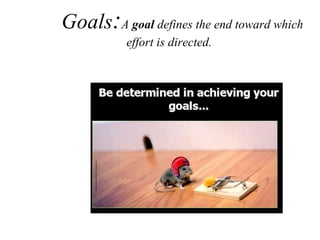
Goals : A  goal  defines the end toward which  effort is directed.
Educational Goals Expectations held for groups of students Broad Attainable Target to be reached Usually based upon state standards
SMART Method S pecific -  describe your goal in precise terms M easurable -  make sure to include the measures  that will be used to judge progress towards  achieving the goal.   A ttainable -  construct a goal that is achievable.  R elevant - Your goal should relate to attaining  something that is necessary and of value.  T ime-based -  determine a date, timeframe, or schedule for your goal.
Examples of Goals Students will inquire about electric current  and how electric circuits function.   Students will realize that lines, segments,  rays, and points exist not only on paper but  in the world around us.   Students will understand the processes that  shape the Earth, which include the water cycle and the role of evaporation in this process.
Objectives Define what you will have the students do State in terms of expected student behavior Specify condition of student performance Specify level of student performance 2 ways of remembering - ABCD  & SMART
ABCD Method A udience- Who are your learners? B ehavior- What do you expect them to do? C ondition- How will the learning take place? D egree- How much will be accomplished? http://www.personal.psu.edu/staff/b/x/bxb11/Objectives
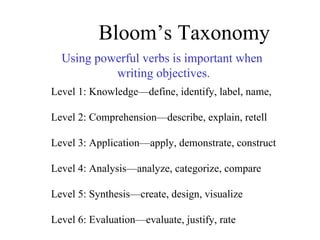
Bloom’s Taxonomy Using powerful verbs is important when  writing objectives. Level 1: Knowledge—define, identify, label, name,  Level 2: Comprehension—describe, explain, retell Level 3: Application—apply, demonstrate, construct Level 4: Analysis—analyze, categorize, compare Level 5: Synthesis—create, design, visualize Level 6: Evaluation—evaluate, justify, rate
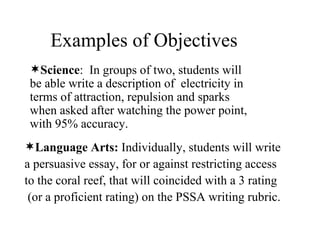
Examples of Objectives Science :  In groups of two, students will be able write a description of  electricity in terms of attraction, repulsion and sparks when asked after watching the power point, with 95% accuracy.  Language Arts:  Individually, students will write  a persuasive essay, for or against restricting access to the coral reef, that will coincided with a 3 rating (or a proficient rating) on the PSSA writing rubric.
Pick out the parts:  Science :  In groups of two, students will be able write a description of  electricity in terms of attraction, repulsion and sparks when asked after watching the power point, with 95% accuracy.  What is the  a udience?  What is the  b ehavior?  What is the  c ondition?  What is the  d egree?
Pick out the parts:  What is the  a udience?  What is the  b ehavior?  What is the  c ondition?  What is the  d egree? Language Arts:  Individually, students will write  a persuasive essay, for or against restricting access to the coral reef, that will coincided with a 3 rating (or a proficient rating) on the PSSA writing rubric.
What are the differences between  goals and objectives?  Goals are general Goals are broad Goals are not as tangible It takes many objectives to measure a goal Objectives are precise Objectives are narrow Objective are tangible One objective is measurable
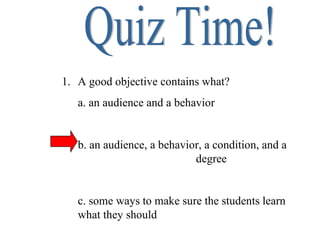
Quiz Time! A good objective contains what? a. an audience and a behavior b. an audience, a behavior, a condition, and a  degree c. some ways to make sure the students learn what they should
Quiz Time! 2. What should a goal contain? a. broad, generalized statements about what is to be learned b. specific, narrow statements about what is to be learned c. an audience, a behavior, a condition, and a degree
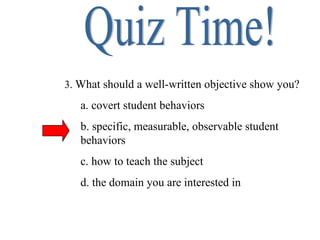
Quiz Time! 3.  What should a well-written objective show you? a. covert student behaviors b. specific, measurable, observable student behaviors c. how to teach the subject d. the domain you are interested in
Quiz Time! 4. What is the objective missing? “Individual students will be able to run the 100 yard dash in less than 50 seconds.” a. the audience b. the behavior c. the condition d. the degree
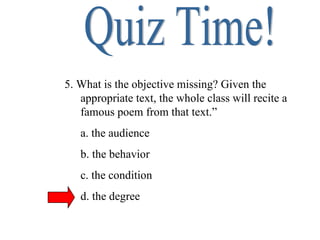
Quiz Time! 5. What is the objective missing? Given the appropriate text, the whole class will recite a famous poem from that text.” a. the audience b. the behavior c. the condition d. the degree
Now review YOUR Goals and Objectives!  Use your power point project.
Orginally made by  Melinda Stacknick And Modified by Beth Sockman

Goals&Objectives

  • 1.
    Goals and Objectives REVIEW
  • 2.
    What is theGoal? What is the Objective?
  • 3.
    Goals : A goal defines the end toward which effort is directed.
  • 4.
    Educational Goals Expectationsheld for groups of students Broad Attainable Target to be reached Usually based upon state standards
  • 5.
    SMART Method Specific - describe your goal in precise terms M easurable - make sure to include the measures that will be used to judge progress towards achieving the goal. A ttainable - construct a goal that is achievable. R elevant - Your goal should relate to attaining something that is necessary and of value. T ime-based - determine a date, timeframe, or schedule for your goal.
  • 6.
    Examples of GoalsStudents will inquire about electric current and how electric circuits function. Students will realize that lines, segments, rays, and points exist not only on paper but in the world around us. Students will understand the processes that shape the Earth, which include the water cycle and the role of evaporation in this process.
  • 7.
    Objectives Define whatyou will have the students do State in terms of expected student behavior Specify condition of student performance Specify level of student performance 2 ways of remembering - ABCD & SMART
  • 8.
    ABCD Method Audience- Who are your learners? B ehavior- What do you expect them to do? C ondition- How will the learning take place? D egree- How much will be accomplished? http://www.personal.psu.edu/staff/b/x/bxb11/Objectives
  • 9.
    Bloom’s Taxonomy Usingpowerful verbs is important when writing objectives. Level 1: Knowledge—define, identify, label, name, Level 2: Comprehension—describe, explain, retell Level 3: Application—apply, demonstrate, construct Level 4: Analysis—analyze, categorize, compare Level 5: Synthesis—create, design, visualize Level 6: Evaluation—evaluate, justify, rate
  • 10.
    Examples of ObjectivesScience : In groups of two, students will be able write a description of electricity in terms of attraction, repulsion and sparks when asked after watching the power point, with 95% accuracy. Language Arts: Individually, students will write a persuasive essay, for or against restricting access to the coral reef, that will coincided with a 3 rating (or a proficient rating) on the PSSA writing rubric.
  • 11.
    Pick out theparts: Science : In groups of two, students will be able write a description of electricity in terms of attraction, repulsion and sparks when asked after watching the power point, with 95% accuracy. What is the a udience? What is the b ehavior? What is the c ondition? What is the d egree?
  • 12.
    Pick out theparts: What is the a udience? What is the b ehavior? What is the c ondition? What is the d egree? Language Arts: Individually, students will write a persuasive essay, for or against restricting access to the coral reef, that will coincided with a 3 rating (or a proficient rating) on the PSSA writing rubric.
  • 13.
    What are thedifferences between goals and objectives? Goals are general Goals are broad Goals are not as tangible It takes many objectives to measure a goal Objectives are precise Objectives are narrow Objective are tangible One objective is measurable
  • 14.
    Quiz Time! Agood objective contains what? a. an audience and a behavior b. an audience, a behavior, a condition, and a degree c. some ways to make sure the students learn what they should
  • 15.
    Quiz Time! 2.What should a goal contain? a. broad, generalized statements about what is to be learned b. specific, narrow statements about what is to be learned c. an audience, a behavior, a condition, and a degree
  • 16.
    Quiz Time! 3. What should a well-written objective show you? a. covert student behaviors b. specific, measurable, observable student behaviors c. how to teach the subject d. the domain you are interested in
  • 17.
    Quiz Time! 4.What is the objective missing? “Individual students will be able to run the 100 yard dash in less than 50 seconds.” a. the audience b. the behavior c. the condition d. the degree
  • 18.
    Quiz Time! 5.What is the objective missing? Given the appropriate text, the whole class will recite a famous poem from that text.” a. the audience b. the behavior c. the condition d. the degree
  • 19.
    Now review YOURGoals and Objectives! Use your power point project.
  • 20.
    Orginally made by Melinda Stacknick And Modified by Beth Sockman

Editor's Notes

  • #6 http://www.buddy.k12.in.us/jfy/teachers/articles/newyears.asp
  • #14 http://edweb.sdsu.edu/courses/EDTEC540/objectives/Difference.html