Regulation of Gene Expression-1Regulation of Gene Expression-1
(In prokaryotes)(In prokaryotes)
By- Professor (Dr.) Namrata Chhabra
Biochemistry For Medics- Lecture Notes
www.namrata.co
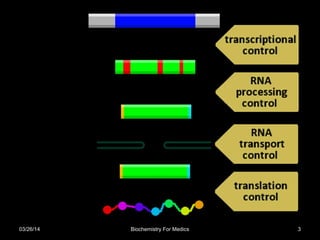
IntroductionIntroduction
o Gene expression is the combined process of
the transcription of a gene into mRNA,
o the processing of that mRNA, and
o its translation into protein (for protein-
encoding genes).
03/26/14 2Biochemistry For Medics
03/26/14 Biochemistry For Medics 3
Significance of gene ExpressionSignificance of gene Expression
Regulated expression of genes is required for
Adaptation,
Differentiation and
Development
03/26/14 4Biochemistry For Medics
1) Adaptation
1) Adaptation- Organisms adapt to
environmental changes by altering gene
expression.
a) Bacteria are highly versatile and responsive
organisms: the rate of synthesis of some
proteins in bacteria may vary more than a
1000-fold in response to the supply of
nutrients or to environmental challenges.
03/26/14 5Biochemistry For Medics
1) Adaptation
b) Cells of multicellular organisms also respond
to varying conditions.
Such cells exposed to hormones and growth
factors change substantially in shape, growth
rate, and other characteristics.
03/26/14 6Biochemistry For Medics
2) Tissue specific differentiation and2) Tissue specific differentiation and
developmentdevelopment
The genetic information present in each
somatic cell of a metazoan organism is
practically identical.
The exceptions in the genetic information are
found in those few cells that have amplified or
rearranged genes in order to perform
specialized cellular functions.
03/26/14 7Biochemistry For Medics
22) Tissue specific differentiation and) Tissue specific differentiation and
developmentdevelopment
Cells from muscle and nerve tissue show
strikingly different morphologies and other
properties, yet they contain exactly the same
DNA.
These diverse properties are the result of
differences in gene expression.
Expression of the genetic information is
regulated during ontogeny and differentiation
of the organism and its cellular components.
03/26/14 8Biochemistry For Medics
Control of gene ExpressionControl of gene Expression
• Mammalian cells possess about 1000 times more
genetic information than does the bacterium
Escherichia coli.
• Much of this additional genetic information is
probably involved in regulation of gene
expression during the differentiation of tissues
• and biologic processes in the multicellular
organism and in ensuring that the organism can
respond to complex environmental challenges.
03/26/14 9Biochemistry For Medics
How is gene expression controlled?How is gene expression controlled?
• Gene activity is controlled first and foremost
at the level of transcription.
• Much of this control is achieved through the
interplay between proteins that bind to
specific DNA sequences and their DNA binding
sites.
• This can have a positive or negative effect on
transcription.
03/26/14 10Biochemistry For Medics
How is gene expression controlled?How is gene expression controlled?
• Transcription control can result in tissue-
specific gene expression.
• In addition to transcription level controls,
gene expression can also be modulated by
gene amplification, gene rearrangement,
posttranscriptional modifications, and RNA
stabilization.
03/26/14 11Biochemistry For Medics
Types of gene regulationTypes of gene regulation
There are three types of genes regulation-
• Positive
• Negative and
• Double negative
03/26/14 12Biochemistry For Medics
Types of gene regulationTypes of gene regulation
A) Positive regulation
• When the expression of genetic information is
quantitatively increased by the presence of a
specific regulatory element, regulation is said
to be positive.
• The element or molecule mediating positive
regulation is a positive regulator or activator.
03/26/14 13Biochemistry For Medics
Types of gene regulationTypes of gene regulation
B) Negative regulation
• When the expression of genetic information is
diminished by the presence of a specific
regulatory element, regulation is said to be
negative.
• The element or molecule mediating negative
regulation is said to be a negative regulator or
repressor.
03/26/14 14Biochemistry For Medics
Types of gene regulationTypes of gene regulation
A double negative has the effect of acting as a
positive.
• An effector that inhibits the function of a
negative regulator will bring about a positive
regulation.
• Many regulated systems that appear to be
induced are in fact derepressed at the
molecular level.
03/26/14 15Biochemistry For Medics
Responses in Gene ExpressionResponses in Gene Expression
• Type A response is characterized by an
increased extent of gene expression that is
dependent upon the continued presence of
the inducing signal.
• When the inducing signal is removed, the
amount of gene expression diminishes to its
basal level,
• The amount repeatedly increases in response
to the reappearance of the specific signal.
03/26/14 16Biochemistry For Medics
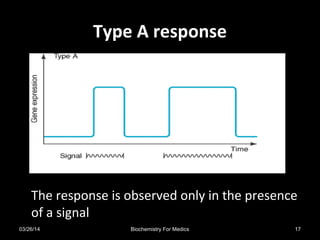
Type A response
The response is observed only in the presence
of a signal
03/26/14 17Biochemistry For Medics
Type A responseType A response
• This type of response is commonly observed
in prokaryotes in response to sudden changes
of the intracellular concentration of a
nutrient.
• It is also observed in many higher organisms
after exposure to inducers such as hormones,
nutrients, or growth factors
03/26/14 18Biochemistry For Medics
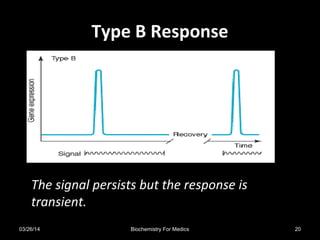
Type B ResponseType B Response
• Type B response exhibits an increased amount of
gene expression that is transient even in the
continued presence of the regulatory signal.
• After the regulatory signal has terminated and
the cell has been allowed to recover, a second
transient response to a subsequent regulatory
signal may be observed.
03/26/14 19Biochemistry For Medics
Type B ResponseType B Response
The signal persists but the response is
transient.
03/26/14 20Biochemistry For Medics
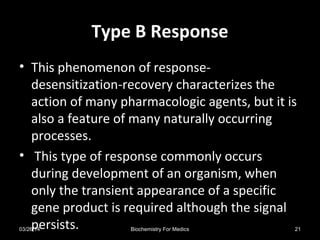
Type B ResponseType B Response
• This phenomenon of response-
desensitization-recovery characterizes the
action of many pharmacologic agents, but it is
also a feature of many naturally occurring
processes.
• This type of response commonly occurs
during development of an organism, when
only the transient appearance of a specific
gene product is required although the signal
persists.03/26/14 21Biochemistry For Medics
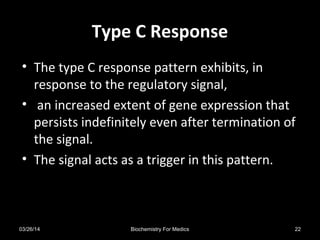
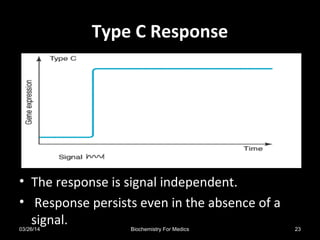
Type C ResponseType C Response
• The type C response pattern exhibits, in
response to the regulatory signal,
• an increased extent of gene expression that
persists indefinitely even after termination of
the signal.
• The signal acts as a trigger in this pattern.
03/26/14 22Biochemistry For Medics
Type C ResponseType C Response
• The response is signal independent.
• Response persists even in the absence of a
signal.03/26/14 23Biochemistry For Medics
Type C ResponseType C Response
• Once expression of the gene is initiated in the
cell, it cannot be terminated even in the
daughter cells;
• It is therefore an irreversible and inherited
alteration.
• This type of response typically occurs during
the development of differentiated function in
a tissue or organ.
03/26/14 24Biochemistry For Medics
Types of genes in Gene ExpressionTypes of genes in Gene Expression
• Inducible gene- An inducible gene is one
whose expression increases in response to an
inducer or activator, a specific positive
regulatory signal.
• Inducible genes have relatively low basal rates
of transcription.
03/26/14 25Biochemistry For Medics
Types of genes in Gene ExpressionTypes of genes in Gene Expression
• Constitutive genes-are expressed at a
reasonably constant rate and are not known
to be subjecedt to regulation.
• These are often referred to as housekeeping
genes.
03/26/14 26Biochemistry For Medics
Types of genes in Gene ExpressionTypes of genes in Gene Expression
• As a result of mutation, some inducible gene
products become constitutively expressed.
• A mutation resulting in constitutive expression
of what was formerly a regulated gene is
called a constitutive mutation.
03/26/14 27Biochemistry For Medics
Regulation of Prokaryotic GeneRegulation of Prokaryotic Gene
ExpressionExpression
• Controlling gene expression is one method of
regulating metabolism.
• Prokaryotes must use substances and
synthesize macromolecules just fast enough
to meet their needs.
03/26/14 28Biochemistry For Medics
Regulation of Prokaryotic GeneRegulation of Prokaryotic Gene
ExpressionExpression
• The genes for metabolizing enzymes are
expressed only in the presence of nutrients.
• If the enzymes are not needed, genes are
turned off.
• This allows for conservation of cell resources.
03/26/14 29Biochemistry For Medics
• In prokaryotes, the genes involved in a
metabolic pathway are often present in a
linear array called an Operon, e.g., the lac
Operon.
• An Operon can be regulated by a single
promoter or regulatory region.
• The cistron is the smallest unit of genetic
expression.
Features of Prokaryotic geneFeatures of Prokaryotic gene
ExpressionExpression
03/26/14 30Biochemistry For Medics
CistronCistron
• Some enzymes and other protein molecules
are composed of two or more non identical
subunits.
• The "one gene, one enzyme" concept is not
necessarily valid.
• The cistron is the genetic unit coding for the
structure of the subunit of a protein molecule
03/26/14 31Biochemistry For Medics
CistronCistron
• A single mRNA carries information for multiple
proteins
• This type of mRNA is called a polycistronic
mRNA and is totally unique to prokaryotes
• The polycistronic Lac Operon mRNA is
translated into three separate proteins
• In Eukaryotes the m-RNA is monocistronic
03/26/14 32Biochemistry For Medics
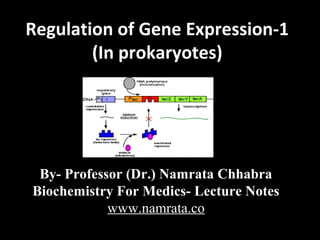
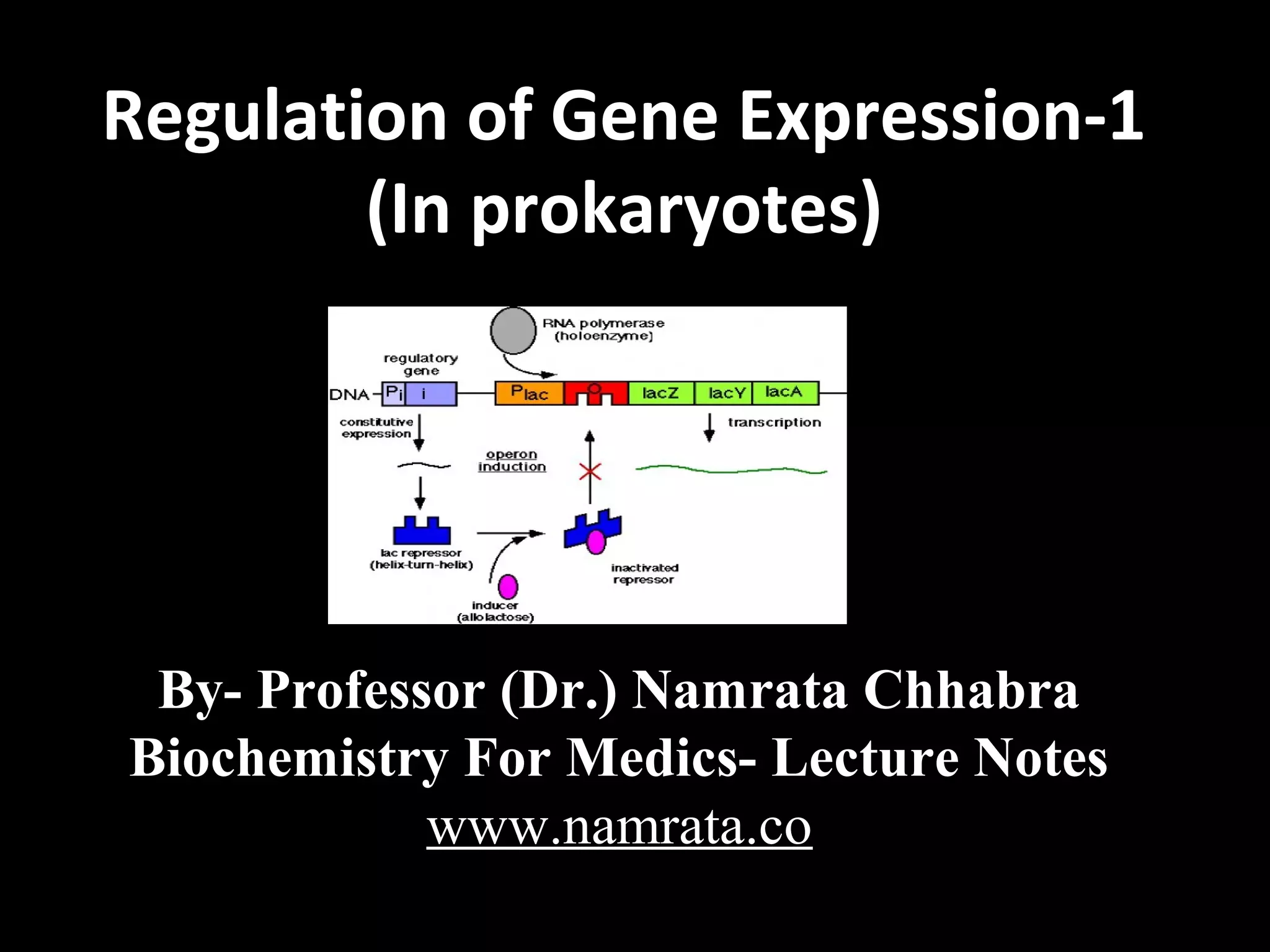
Lac Operon ModelLac Operon Model
• Jacob and Monod in 1961 described their
Operon model in a classic paper.
• Their hypothesis was to a large extent based
on observations on the regulation of lactose
metabolism by the intestinal bacterium E coli.
03/26/14 33Biochemistry For Medics
Lac Operon – Basic conceptLac Operon – Basic concept
• Bacteria such as E. coli usually rely on glucose
as their source of carbon and energy.
• However, when glucose is scarce, E. coli can
use lactose as their carbon source even
though this disaccharide does not lie on any
major metabolic pathways.
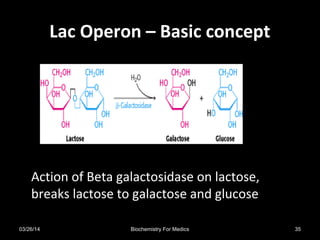
• An essential enzyme in the metabolism of
lactose is β-galactosidase, which hydrolyzes
lactose into galactose and glucose
03/26/14 34Biochemistry For Medics
Lac Operon – Basic conceptLac Operon – Basic concept
Action of Beta galactosidase on lactose,
breaks lactose to galactose and glucose
03/26/14 35Biochemistry For Medics
Inducible Lac Operon
• An E. coli cell growing on a carbon source such
as glucose or glycerol contains fewer than 10
molecules of β -galactosidase.
• In contrast, the same cell contains several
thousand molecules of the enzyme when
grown on lactose.
• The presence of lactose in the culture medium
induces a large increase in the amount of β
-galactosidase by eliciting the synthesis of new
enzyme molecules rather than by activating a
preexisting but inactive precursor.03/26/14 36Biochemistry For Medics
Components of Lac OperonComponents of Lac Operon
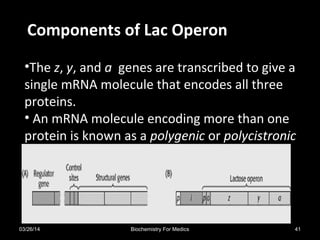
• The genetic elements of the model are a
regulator gene, a regulatory DNA sequence
called an operator site, and a set of structural
genes.
• The regulator gene encodes a repressor protein
that binds to the operator site.
• The binding of the repressor to the operator
prevents transcription of the structural genes.
• The operator and its associated structural
genes constitute the Operon.03/26/14 37Biochemistry For Medics
Components of Lac OperonComponents of Lac Operon
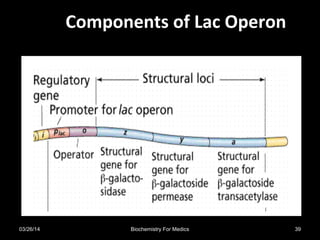
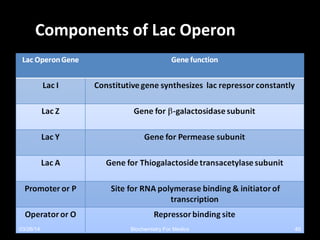
• For the lactose (lac) Operon, the i gene
encodes the repressor, o is the operator site,
and the z, y, and a genes are the structural
genes for β -galactosidase, the permease, and
the transacetylase, respectively.
• The Operon also contains a promoter site
(denoted by p), which directs the RNA
polymerase to the correct transcription
initiation site. transcript.
03/26/14 38Biochemistry For Medics
Components of Lac OperonComponents of Lac Operon
03/26/14 39Biochemistry For Medics
Components of Lac OperonComponents of Lac Operon
03/26/14 40Biochemistry For Medics
•The z, y, and a genes are transcribed to give a
single mRNA molecule that encodes all three
proteins.
• An mRNA molecule encoding more than one
protein is known as a polygenic or polycistronic
Components of Lac OperonComponents of Lac Operon
03/26/14 41Biochemistry For Medics
How does the lac repressor inhibitHow does the lac repressor inhibit
the expression of the lac Operon?the expression of the lac Operon?
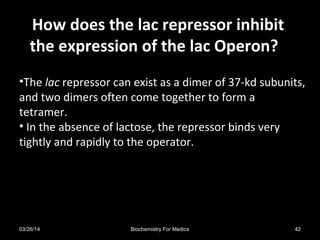
•The lac repressor can exist as a dimer of 37-kd subunits,
and two dimers often come together to form a
tetramer.
• In the absence of lactose, the repressor binds very
tightly and rapidly to the operator.
03/26/14 42Biochemistry For Medics
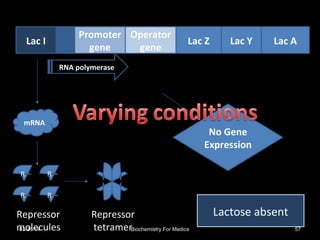
Negative Control- Repression
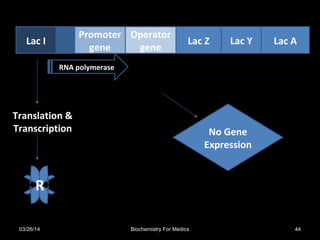
•When the lac repressor is bound to DNA, it
prevents bound RNA polymerase from locally
unwinding the DNA to expose the bases that
will act as the template for the synthesis of the
RNA strand.
•Thus, very little β-galactosidase, permease, or
transacetylase are produced.
03/26/14 43Biochemistry For Medics
Lac I
Promoter
gene
Operator
gene
Lac Z Lac Y Lac A
R
Translation &
Transcription
RNA polymerase
No Gene
Expression
03/26/14 44Biochemistry For Medics
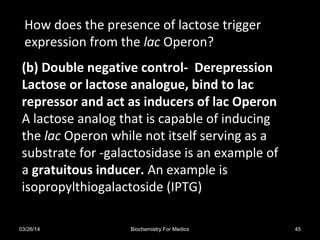
How does the presence of lactose triggerHow does the presence of lactose trigger
expression from theexpression from the laclac Operon?Operon?
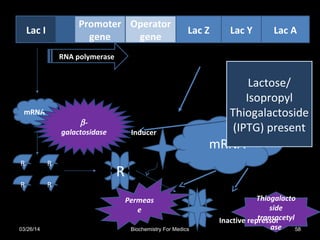
(b) Double negative control- Derepression
Lactose or lactose analogue, bind to lac
repressor and act as inducers of lac Operon
A lactose analog that is capable of inducing
the lac Operon while not itself serving as a
substrate for -galactosidase is an example of
a gratuitous inducer. An example is
isopropylthiogalactoside (IPTG)
03/26/14 45Biochemistry For Medics
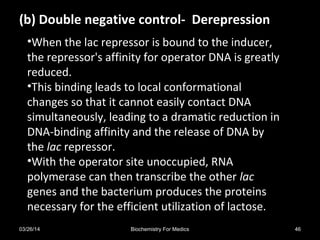
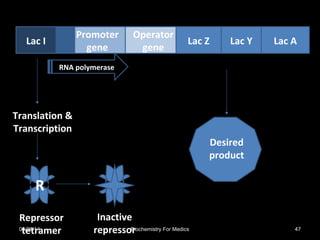
•When the lac repressor is bound to the inducer,
the repressor's affinity for operator DNA is greatly
reduced.
•This binding leads to local conformational
changes so that it cannot easily contact DNA
simultaneously, leading to a dramatic reduction in
DNA-binding affinity and the release of DNA by
the lac repressor.
•With the operator site unoccupied, RNA
polymerase can then transcribe the other lac
genes and the bacterium produces the proteins
necessary for the efficient utilization of lactose.
(b) Double negative control- Derepression
03/26/14 46Biochemistry For Medics
Lac I
Promoter
gene
Operator
gene
Lac Z Lac Y Lac A
RNA polymerase
Repressor
tetramer
R
Translation &
Transcription
Inactive
repressor
Desired
product
03/26/14 47Biochemistry For Medics
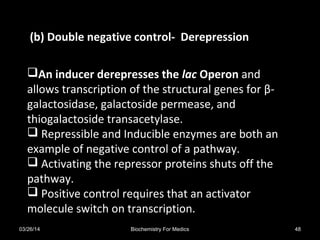
An inducer derepresses the lac Operon and
allows transcription of the structural genes for β-
galactosidase, galactoside permease, and
thiogalactoside transacetylase.
 Repressible and Inducible enzymes are both an
example of negative control of a pathway.
 Activating the repressor proteins shuts off the
pathway.
 Positive control requires that an activator
molecule switch on transcription.
(b) Double negative control- Derepression
03/26/14 48Biochemistry For Medics
(
c) Positive control- CAP-cAMPc) Positive control- CAP-cAMP
bindingbinding
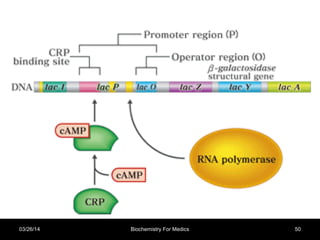
There are also DNA-binding proteins that
stimulate transcription.
One particularly example is the catabolite
activator protein (CAP), which is also known as the
cAMP response protein (CRP).
Within the lac Operon, CAP binds to an inverted
repeat that is centered near position -61 relative to
the start site for transcription
03/26/14 49Biochemistry For Medics
03/26/14 Biochemistry For Medics 50
Within the lac Operon, CAP binds to an inverted
repeat that is centered near position -61 relative
to the start site for transcription
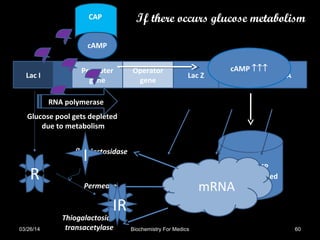
The CAP-cAMP complex stimulates the initiation
of transcription by approximately a factor of 50.
A major factor in this stimulation is the
recruitment of RNA polymerase to promoters to
which CAP is bound.
c) Positive control- CAP-cAMP bindingc) Positive control- CAP-cAMP binding
03/26/14 51Biochemistry For Medics
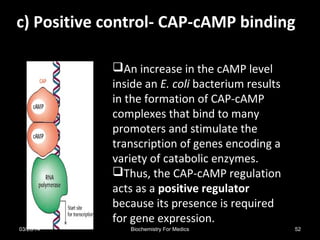
An increase in the cAMP level
inside an E. coli bacterium results
in the formation of CAP-cAMP
complexes that bind to many
promoters and stimulate the
transcription of genes encoding a
variety of catabolic enzymes.
Thus, the CAP-cAMP regulation
acts as a positive regulator
because its presence is required
for gene expression.
c) Positive control- CAP-cAMP bindingc) Positive control- CAP-cAMP binding
03/26/14 52Biochemistry For Medics
State of Lac Operon in the presenceState of Lac Operon in the presence
of only glucoseof only glucose
When grown on glucose, E. coli have a very
low level of catabolic enzymes such as β-
galactosidase.
 It would be wasteful to synthesize these
enzymes when glucose is abundant.
The inhibitory effect of glucose, called
catabolite repression, is due to the ability of
glucose to lower the intracellular
concentration of cyclic AMP.
03/26/14 53Biochemistry For Medics
State of Lac Operon in the presence ofState of Lac Operon in the presence of
only glucoseonly glucose
The bacterium accumulates cAMP only when it is
starved for a source of carbon.
 In the presence of glucose—or of glycerol in
concentrations sufficient for growth—the bacteria
will lack sufficient cAMP to bind to CAP because the
glucose inhibits adenylyl cyclase, the enzyme that
converts ATP to cAMP.
Thus, in the presence of glucose or glycerol,
cAMP-saturated CAP is lacking, so that the DNA-
dependent RNA polymerase cannot initiate
transcription of the lac Operon.
03/26/14 54Biochemistry For Medics
Maximum Expression of Lac OperonMaximum Expression of Lac Operon
The lac Operon is controlled by two
distinct DNA binding factors;
 One that acts positively (cAMP-CRP
complex) and
The other that acts negatively (LacI
repressor).
Maximal activity of the lac Operon occurs
when glucose levels are low (high cAMP
with CAP activation) and lactose is presen,t
LacI is prevented from binding to the
operator).03/26/14 55Biochemistry For Medics
Constitutive Expression andConstitutive Expression and
continuous repressioncontinuous repression
When the lacI gene has been mutated so that its product,
LacI, is not capable of binding to operator DNA, the organism
will exhibit constitutive expression of the lac Operon.
 In a contrary manner, an organism with a lacI gene
mutation that produces a LacI protein which prevents the
binding of an inducer to the repressor will remain repressed
even in the presence of the inducer molecule, because the
inducer cannot bind to the repressor on the operator locus in
order to derepress the Operon.
Similarly, bacteria harboring mutations in their lac operator
locus such that the operator sequence will not bind a normal
repressor molecule constitutively express the lac Operon
genes.03/26/14 56Biochemistry For Medics
Lac I
Promoter
gene
Operator
gene
Lac Z Lac Y Lac A
mRNA
R R
RR
Lactose absentRepressor
molecules
Repressor
tetramer
No Gene
Expression
RNA polymerase
03/26/14 57Biochemistry For Medics
Lac I
Promoter
gene
Operator
gene
Lac Z Lac Y Lac A
mRNA
R R
RR
RNA polymerase
mRNA
Thiogalacto
side
transacetyl
ase
Permeas
e
β-
galactosidase Inducer
Inactive repressor
R
Lactose/
Isopropyl
Thiogalactoside
(IPTG) present
03/26/14 58Biochemistry For Medics
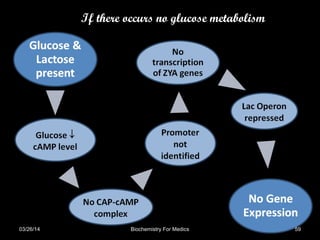
If there occurs no glucose metabolism
03/26/14 59Biochemistry For Medics
Lac I
Promoter
gene
Operator
gene
Lac Z Lac Y Lac A
cAMP ↑↑↑
Glucose pool gets depleted
due to metabolism
CAP-cAMP
complex formed
cAMP
RNA polymerase
mRNA
β-galactosidase
Permease
Thiogalactoside
transacetylase
If there occurs glucose metabolism
R
IR
I
03/26/14 60Biochemistry For Medics
Summary- Regulation of ExpressionSummary- Regulation of Expression
of Lac Operonof Lac Operon
1) In the absence of lactose- Lac Operon remains
repressed due to the presence of lac repressor at
the operator site- (Negative control).
2) In the presence of only Lactose- Lac Operon is
derepressed, the structural genes are transcribed
and the lactose metabolizing enzymes are
synthesized (Double negative control).
03/26/14 61Biochemistry For Medics
Summary- Regulation of ExpressionSummary- Regulation of Expression
of Lac Operonof Lac Operon
3) In the presence of both glucose and
lactose- CAP -cAMP complex is not formed,
RNA polymerase can not initiate the
transcription of structural genes despite the
fact that the operator site is vacant due to
the binding of lactose/allolactose with lac
repressor.
Lac Operon remains in the repressed state. It
is absence of positive regulation.
03/26/14 62Biochemistry For Medics
Revision of ConceptsRevision of Concepts
1)
http://bcs.whfreeman.com/thelifewire/content/chp13/1302
001.html
2)
http://highered.mcgrawhill.com/sites/0072556781/student_
view0/chapter12/animation_quiz_4.html
3) http://www.youtube.com/watch?
v=iPQZXMKZEfw&feature=related
03/26/14 63Biochemistry For Medics

Gene expression in prokaryotes

  • 1.
    Regulation of GeneExpression-1Regulation of Gene Expression-1 (In prokaryotes)(In prokaryotes) By- Professor (Dr.) Namrata Chhabra Biochemistry For Medics- Lecture Notes www.namrata.co
  • 2.
    IntroductionIntroduction o Gene expressionis the combined process of the transcription of a gene into mRNA, o the processing of that mRNA, and o its translation into protein (for protein- encoding genes). 03/26/14 2Biochemistry For Medics
  • 3.
  • 4.
    Significance of geneExpressionSignificance of gene Expression Regulated expression of genes is required for Adaptation, Differentiation and Development 03/26/14 4Biochemistry For Medics
  • 5.
    1) Adaptation 1) Adaptation-Organisms adapt to environmental changes by altering gene expression. a) Bacteria are highly versatile and responsive organisms: the rate of synthesis of some proteins in bacteria may vary more than a 1000-fold in response to the supply of nutrients or to environmental challenges. 03/26/14 5Biochemistry For Medics
  • 6.
    1) Adaptation b) Cellsof multicellular organisms also respond to varying conditions. Such cells exposed to hormones and growth factors change substantially in shape, growth rate, and other characteristics. 03/26/14 6Biochemistry For Medics
  • 7.
    2) Tissue specificdifferentiation and2) Tissue specific differentiation and developmentdevelopment The genetic information present in each somatic cell of a metazoan organism is practically identical. The exceptions in the genetic information are found in those few cells that have amplified or rearranged genes in order to perform specialized cellular functions. 03/26/14 7Biochemistry For Medics
  • 8.
    22) Tissue specificdifferentiation and) Tissue specific differentiation and developmentdevelopment Cells from muscle and nerve tissue show strikingly different morphologies and other properties, yet they contain exactly the same DNA. These diverse properties are the result of differences in gene expression. Expression of the genetic information is regulated during ontogeny and differentiation of the organism and its cellular components. 03/26/14 8Biochemistry For Medics
  • 9.
    Control of geneExpressionControl of gene Expression • Mammalian cells possess about 1000 times more genetic information than does the bacterium Escherichia coli. • Much of this additional genetic information is probably involved in regulation of gene expression during the differentiation of tissues • and biologic processes in the multicellular organism and in ensuring that the organism can respond to complex environmental challenges. 03/26/14 9Biochemistry For Medics
  • 10.
    How is geneexpression controlled?How is gene expression controlled? • Gene activity is controlled first and foremost at the level of transcription. • Much of this control is achieved through the interplay between proteins that bind to specific DNA sequences and their DNA binding sites. • This can have a positive or negative effect on transcription. 03/26/14 10Biochemistry For Medics
  • 11.
    How is geneexpression controlled?How is gene expression controlled? • Transcription control can result in tissue- specific gene expression. • In addition to transcription level controls, gene expression can also be modulated by gene amplification, gene rearrangement, posttranscriptional modifications, and RNA stabilization. 03/26/14 11Biochemistry For Medics
  • 12.
    Types of generegulationTypes of gene regulation There are three types of genes regulation- • Positive • Negative and • Double negative 03/26/14 12Biochemistry For Medics
  • 13.
    Types of generegulationTypes of gene regulation A) Positive regulation • When the expression of genetic information is quantitatively increased by the presence of a specific regulatory element, regulation is said to be positive. • The element or molecule mediating positive regulation is a positive regulator or activator. 03/26/14 13Biochemistry For Medics
  • 14.
    Types of generegulationTypes of gene regulation B) Negative regulation • When the expression of genetic information is diminished by the presence of a specific regulatory element, regulation is said to be negative. • The element or molecule mediating negative regulation is said to be a negative regulator or repressor. 03/26/14 14Biochemistry For Medics
  • 15.
    Types of generegulationTypes of gene regulation A double negative has the effect of acting as a positive. • An effector that inhibits the function of a negative regulator will bring about a positive regulation. • Many regulated systems that appear to be induced are in fact derepressed at the molecular level. 03/26/14 15Biochemistry For Medics
  • 16.
    Responses in GeneExpressionResponses in Gene Expression • Type A response is characterized by an increased extent of gene expression that is dependent upon the continued presence of the inducing signal. • When the inducing signal is removed, the amount of gene expression diminishes to its basal level, • The amount repeatedly increases in response to the reappearance of the specific signal. 03/26/14 16Biochemistry For Medics
  • 17.
    Type A response Theresponse is observed only in the presence of a signal 03/26/14 17Biochemistry For Medics
  • 18.
    Type A responseTypeA response • This type of response is commonly observed in prokaryotes in response to sudden changes of the intracellular concentration of a nutrient. • It is also observed in many higher organisms after exposure to inducers such as hormones, nutrients, or growth factors 03/26/14 18Biochemistry For Medics
  • 19.
    Type B ResponseTypeB Response • Type B response exhibits an increased amount of gene expression that is transient even in the continued presence of the regulatory signal. • After the regulatory signal has terminated and the cell has been allowed to recover, a second transient response to a subsequent regulatory signal may be observed. 03/26/14 19Biochemistry For Medics
  • 20.
    Type B ResponseTypeB Response The signal persists but the response is transient. 03/26/14 20Biochemistry For Medics
  • 21.
    Type B ResponseTypeB Response • This phenomenon of response- desensitization-recovery characterizes the action of many pharmacologic agents, but it is also a feature of many naturally occurring processes. • This type of response commonly occurs during development of an organism, when only the transient appearance of a specific gene product is required although the signal persists.03/26/14 21Biochemistry For Medics
  • 22.
    Type C ResponseTypeC Response • The type C response pattern exhibits, in response to the regulatory signal, • an increased extent of gene expression that persists indefinitely even after termination of the signal. • The signal acts as a trigger in this pattern. 03/26/14 22Biochemistry For Medics
  • 23.
    Type C ResponseTypeC Response • The response is signal independent. • Response persists even in the absence of a signal.03/26/14 23Biochemistry For Medics
  • 24.
    Type C ResponseTypeC Response • Once expression of the gene is initiated in the cell, it cannot be terminated even in the daughter cells; • It is therefore an irreversible and inherited alteration. • This type of response typically occurs during the development of differentiated function in a tissue or organ. 03/26/14 24Biochemistry For Medics
  • 25.
    Types of genesin Gene ExpressionTypes of genes in Gene Expression • Inducible gene- An inducible gene is one whose expression increases in response to an inducer or activator, a specific positive regulatory signal. • Inducible genes have relatively low basal rates of transcription. 03/26/14 25Biochemistry For Medics
  • 26.
    Types of genesin Gene ExpressionTypes of genes in Gene Expression • Constitutive genes-are expressed at a reasonably constant rate and are not known to be subjecedt to regulation. • These are often referred to as housekeeping genes. 03/26/14 26Biochemistry For Medics
  • 27.
    Types of genesin Gene ExpressionTypes of genes in Gene Expression • As a result of mutation, some inducible gene products become constitutively expressed. • A mutation resulting in constitutive expression of what was formerly a regulated gene is called a constitutive mutation. 03/26/14 27Biochemistry For Medics
  • 28.
    Regulation of ProkaryoticGeneRegulation of Prokaryotic Gene ExpressionExpression • Controlling gene expression is one method of regulating metabolism. • Prokaryotes must use substances and synthesize macromolecules just fast enough to meet their needs. 03/26/14 28Biochemistry For Medics
  • 29.
    Regulation of ProkaryoticGeneRegulation of Prokaryotic Gene ExpressionExpression • The genes for metabolizing enzymes are expressed only in the presence of nutrients. • If the enzymes are not needed, genes are turned off. • This allows for conservation of cell resources. 03/26/14 29Biochemistry For Medics
  • 30.
    • In prokaryotes,the genes involved in a metabolic pathway are often present in a linear array called an Operon, e.g., the lac Operon. • An Operon can be regulated by a single promoter or regulatory region. • The cistron is the smallest unit of genetic expression. Features of Prokaryotic geneFeatures of Prokaryotic gene ExpressionExpression 03/26/14 30Biochemistry For Medics
  • 31.
    CistronCistron • Some enzymesand other protein molecules are composed of two or more non identical subunits. • The "one gene, one enzyme" concept is not necessarily valid. • The cistron is the genetic unit coding for the structure of the subunit of a protein molecule 03/26/14 31Biochemistry For Medics
  • 32.
    CistronCistron • A singlemRNA carries information for multiple proteins • This type of mRNA is called a polycistronic mRNA and is totally unique to prokaryotes • The polycistronic Lac Operon mRNA is translated into three separate proteins • In Eukaryotes the m-RNA is monocistronic 03/26/14 32Biochemistry For Medics
  • 33.
    Lac Operon ModelLacOperon Model • Jacob and Monod in 1961 described their Operon model in a classic paper. • Their hypothesis was to a large extent based on observations on the regulation of lactose metabolism by the intestinal bacterium E coli. 03/26/14 33Biochemistry For Medics
  • 34.
    Lac Operon –Basic conceptLac Operon – Basic concept • Bacteria such as E. coli usually rely on glucose as their source of carbon and energy. • However, when glucose is scarce, E. coli can use lactose as their carbon source even though this disaccharide does not lie on any major metabolic pathways. • An essential enzyme in the metabolism of lactose is β-galactosidase, which hydrolyzes lactose into galactose and glucose 03/26/14 34Biochemistry For Medics
  • 35.
    Lac Operon –Basic conceptLac Operon – Basic concept Action of Beta galactosidase on lactose, breaks lactose to galactose and glucose 03/26/14 35Biochemistry For Medics
  • 36.
    Inducible Lac Operon •An E. coli cell growing on a carbon source such as glucose or glycerol contains fewer than 10 molecules of β -galactosidase. • In contrast, the same cell contains several thousand molecules of the enzyme when grown on lactose. • The presence of lactose in the culture medium induces a large increase in the amount of β -galactosidase by eliciting the synthesis of new enzyme molecules rather than by activating a preexisting but inactive precursor.03/26/14 36Biochemistry For Medics
  • 37.
    Components of LacOperonComponents of Lac Operon • The genetic elements of the model are a regulator gene, a regulatory DNA sequence called an operator site, and a set of structural genes. • The regulator gene encodes a repressor protein that binds to the operator site. • The binding of the repressor to the operator prevents transcription of the structural genes. • The operator and its associated structural genes constitute the Operon.03/26/14 37Biochemistry For Medics
  • 38.
    Components of LacOperonComponents of Lac Operon • For the lactose (lac) Operon, the i gene encodes the repressor, o is the operator site, and the z, y, and a genes are the structural genes for β -galactosidase, the permease, and the transacetylase, respectively. • The Operon also contains a promoter site (denoted by p), which directs the RNA polymerase to the correct transcription initiation site. transcript. 03/26/14 38Biochemistry For Medics
  • 39.
    Components of LacOperonComponents of Lac Operon 03/26/14 39Biochemistry For Medics
  • 40.
    Components of LacOperonComponents of Lac Operon 03/26/14 40Biochemistry For Medics
  • 41.
    •The z, y,and a genes are transcribed to give a single mRNA molecule that encodes all three proteins. • An mRNA molecule encoding more than one protein is known as a polygenic or polycistronic Components of Lac OperonComponents of Lac Operon 03/26/14 41Biochemistry For Medics
  • 42.
    How does thelac repressor inhibitHow does the lac repressor inhibit the expression of the lac Operon?the expression of the lac Operon? •The lac repressor can exist as a dimer of 37-kd subunits, and two dimers often come together to form a tetramer. • In the absence of lactose, the repressor binds very tightly and rapidly to the operator. 03/26/14 42Biochemistry For Medics
  • 43.
    Negative Control- Repression •Whenthe lac repressor is bound to DNA, it prevents bound RNA polymerase from locally unwinding the DNA to expose the bases that will act as the template for the synthesis of the RNA strand. •Thus, very little β-galactosidase, permease, or transacetylase are produced. 03/26/14 43Biochemistry For Medics
  • 44.
    Lac I Promoter gene Operator gene Lac ZLac Y Lac A R Translation & Transcription RNA polymerase No Gene Expression 03/26/14 44Biochemistry For Medics
  • 45.
    How does thepresence of lactose triggerHow does the presence of lactose trigger expression from theexpression from the laclac Operon?Operon? (b) Double negative control- Derepression Lactose or lactose analogue, bind to lac repressor and act as inducers of lac Operon A lactose analog that is capable of inducing the lac Operon while not itself serving as a substrate for -galactosidase is an example of a gratuitous inducer. An example is isopropylthiogalactoside (IPTG) 03/26/14 45Biochemistry For Medics
  • 46.
    •When the lacrepressor is bound to the inducer, the repressor's affinity for operator DNA is greatly reduced. •This binding leads to local conformational changes so that it cannot easily contact DNA simultaneously, leading to a dramatic reduction in DNA-binding affinity and the release of DNA by the lac repressor. •With the operator site unoccupied, RNA polymerase can then transcribe the other lac genes and the bacterium produces the proteins necessary for the efficient utilization of lactose. (b) Double negative control- Derepression 03/26/14 46Biochemistry For Medics
  • 47.
    Lac I Promoter gene Operator gene Lac ZLac Y Lac A RNA polymerase Repressor tetramer R Translation & Transcription Inactive repressor Desired product 03/26/14 47Biochemistry For Medics
  • 48.
    An inducer derepressesthe lac Operon and allows transcription of the structural genes for β- galactosidase, galactoside permease, and thiogalactoside transacetylase.  Repressible and Inducible enzymes are both an example of negative control of a pathway.  Activating the repressor proteins shuts off the pathway.  Positive control requires that an activator molecule switch on transcription. (b) Double negative control- Derepression 03/26/14 48Biochemistry For Medics
  • 49.
    ( c) Positive control-CAP-cAMPc) Positive control- CAP-cAMP bindingbinding There are also DNA-binding proteins that stimulate transcription. One particularly example is the catabolite activator protein (CAP), which is also known as the cAMP response protein (CRP). Within the lac Operon, CAP binds to an inverted repeat that is centered near position -61 relative to the start site for transcription 03/26/14 49Biochemistry For Medics
  • 50.
  • 51.
    Within the lacOperon, CAP binds to an inverted repeat that is centered near position -61 relative to the start site for transcription The CAP-cAMP complex stimulates the initiation of transcription by approximately a factor of 50. A major factor in this stimulation is the recruitment of RNA polymerase to promoters to which CAP is bound. c) Positive control- CAP-cAMP bindingc) Positive control- CAP-cAMP binding 03/26/14 51Biochemistry For Medics
  • 52.
    An increase inthe cAMP level inside an E. coli bacterium results in the formation of CAP-cAMP complexes that bind to many promoters and stimulate the transcription of genes encoding a variety of catabolic enzymes. Thus, the CAP-cAMP regulation acts as a positive regulator because its presence is required for gene expression. c) Positive control- CAP-cAMP bindingc) Positive control- CAP-cAMP binding 03/26/14 52Biochemistry For Medics
  • 53.
    State of LacOperon in the presenceState of Lac Operon in the presence of only glucoseof only glucose When grown on glucose, E. coli have a very low level of catabolic enzymes such as β- galactosidase.  It would be wasteful to synthesize these enzymes when glucose is abundant. The inhibitory effect of glucose, called catabolite repression, is due to the ability of glucose to lower the intracellular concentration of cyclic AMP. 03/26/14 53Biochemistry For Medics
  • 54.
    State of LacOperon in the presence ofState of Lac Operon in the presence of only glucoseonly glucose The bacterium accumulates cAMP only when it is starved for a source of carbon.  In the presence of glucose—or of glycerol in concentrations sufficient for growth—the bacteria will lack sufficient cAMP to bind to CAP because the glucose inhibits adenylyl cyclase, the enzyme that converts ATP to cAMP. Thus, in the presence of glucose or glycerol, cAMP-saturated CAP is lacking, so that the DNA- dependent RNA polymerase cannot initiate transcription of the lac Operon. 03/26/14 54Biochemistry For Medics
  • 55.
    Maximum Expression ofLac OperonMaximum Expression of Lac Operon The lac Operon is controlled by two distinct DNA binding factors;  One that acts positively (cAMP-CRP complex) and The other that acts negatively (LacI repressor). Maximal activity of the lac Operon occurs when glucose levels are low (high cAMP with CAP activation) and lactose is presen,t LacI is prevented from binding to the operator).03/26/14 55Biochemistry For Medics
  • 56.
    Constitutive Expression andConstitutiveExpression and continuous repressioncontinuous repression When the lacI gene has been mutated so that its product, LacI, is not capable of binding to operator DNA, the organism will exhibit constitutive expression of the lac Operon.  In a contrary manner, an organism with a lacI gene mutation that produces a LacI protein which prevents the binding of an inducer to the repressor will remain repressed even in the presence of the inducer molecule, because the inducer cannot bind to the repressor on the operator locus in order to derepress the Operon. Similarly, bacteria harboring mutations in their lac operator locus such that the operator sequence will not bind a normal repressor molecule constitutively express the lac Operon genes.03/26/14 56Biochemistry For Medics
  • 57.
    Lac I Promoter gene Operator gene Lac ZLac Y Lac A mRNA R R RR Lactose absentRepressor molecules Repressor tetramer No Gene Expression RNA polymerase 03/26/14 57Biochemistry For Medics
  • 58.
    Lac I Promoter gene Operator gene Lac ZLac Y Lac A mRNA R R RR RNA polymerase mRNA Thiogalacto side transacetyl ase Permeas e β- galactosidase Inducer Inactive repressor R Lactose/ Isopropyl Thiogalactoside (IPTG) present 03/26/14 58Biochemistry For Medics
  • 59.
    If there occursno glucose metabolism 03/26/14 59Biochemistry For Medics
  • 60.
    Lac I Promoter gene Operator gene Lac ZLac Y Lac A cAMP ↑↑↑ Glucose pool gets depleted due to metabolism CAP-cAMP complex formed cAMP RNA polymerase mRNA β-galactosidase Permease Thiogalactoside transacetylase If there occurs glucose metabolism R IR I 03/26/14 60Biochemistry For Medics
  • 61.
    Summary- Regulation ofExpressionSummary- Regulation of Expression of Lac Operonof Lac Operon 1) In the absence of lactose- Lac Operon remains repressed due to the presence of lac repressor at the operator site- (Negative control). 2) In the presence of only Lactose- Lac Operon is derepressed, the structural genes are transcribed and the lactose metabolizing enzymes are synthesized (Double negative control). 03/26/14 61Biochemistry For Medics
  • 62.
    Summary- Regulation ofExpressionSummary- Regulation of Expression of Lac Operonof Lac Operon 3) In the presence of both glucose and lactose- CAP -cAMP complex is not formed, RNA polymerase can not initiate the transcription of structural genes despite the fact that the operator site is vacant due to the binding of lactose/allolactose with lac repressor. Lac Operon remains in the repressed state. It is absence of positive regulation. 03/26/14 62Biochemistry For Medics
  • 63.
    Revision of ConceptsRevisionof Concepts 1) http://bcs.whfreeman.com/thelifewire/content/chp13/1302 001.html 2) http://highered.mcgrawhill.com/sites/0072556781/student_ view0/chapter12/animation_quiz_4.html 3) http://www.youtube.com/watch? v=iPQZXMKZEfw&feature=related 03/26/14 63Biochemistry For Medics