MUTAGENESIS
by
Assist .Prof
Dr. Berciyal Golda. P
VICAS
Introduction
Types of mutagenesis
Applicationof mutagenesis.
Handling of segregatingpopulation
Screening/selection
Methods for V
alidation ofmutants
 Advantagesand limitations of mutation
breeding
Contents......
2
MUTAGENESIS
⚫Mutagenesis :- is a process by which the genetic
information of an organism is changed, resulting in
a mutation. It mayoccurspontaneously in nature, or
as a resultof exposure to mutagens. Itcan also be
achieved experimentally using laboratoryprocedures.
In nature mutagenesiscan lead tocancerand
various heritablediseases, but it is alsoa driving force
of evolution.
Types of mutagenesis
⚫Directed mutagenesis
⚫Site-directed mutagenesis
⚫PCR mutagenesis
⚫Insertional mutagenesis
⚫Signature tagged mutagenesis
⚫Transposon mutagenesis
⚫Sequence saturation
mutagenesis
Directed mutagenesis
⚫Directed mutagenesis, also known as directed mutation, was
a hypothesis proposing that organisms can respond to
environmental stresses by orthogenetically directing mutations
to certain genes or areas of the genome.
⚫Different types of directed mutagenesis are
a ) oligonucleotide directed mutagenesis with M13 DNA
b) oligonucleotide directed mutagenesis with plasmid DNA
c) PCRAmplified oligonucleotide directed mutagenesis.
advantages :- Mutation rates is high
All mutations can be induced
Systematic and detailed
Investigation of the targeted mutation can be made
Site-directed mutagenesis
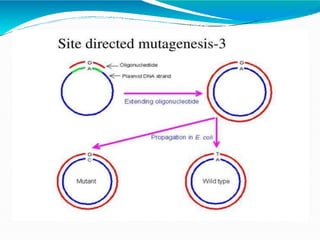
⚫Site-directed mutagenesis is a molecular
biology method that is used to make specific and
intentional changes to the DNAsequence of
a gene and any gene products. Also called site-
specific mutagenesis or oligonucleotide-directed
mutagenesis, it is used for investigating the structure
and biological activity of DNA, RNA,
and protein molecules, and for protein engineering
Conti…
⚫In molecular biology, insertional mutagenesis is the creation
of mutations of DNAby the addition of one or more base pairs.
Such insertional mutations can occur naturally, mediated by
viruses or transposons, or can be artificially created for
research purposes in the lag.
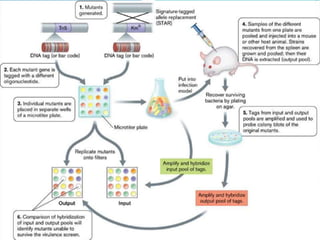
⚫Signature-tagged mutagenesis (STM) is a genetic technique
used to study gene function. Recent advances in genome
sequencing have allowed us to catalogue a large variety of
organisms' genomes, but the function of the genes they contain
is still largely unknown. Using STM, the function of the
product of a particular gene can be inferred by disabling it and
observing the effect on the organism. The original and most
common use of STM is to discover which genes in a pathogen
are involved in virulence in its host, to aid the development of
new medical therapies/drugs.
Transposon mutagenesis
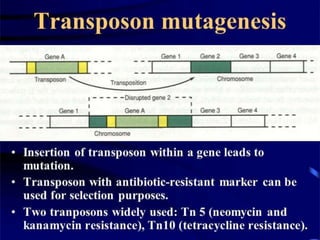
⚫Transposon mutagenesis, or transposition
mutagenesis, is a biological process that allows genes
to be transferred to a host organism's chromosome,
interrupting or modifying the function of
an extant gene on the chromosome and
causing mutation.
APPLICATION
⚫ Site directed mutagenesis is used to study changes in protein activity
that occurs as a result of the DNAmanipulation.
⚫ It is used to assess the activity of proteins containing known amino
acid substitutions.
⚫ It is used to select or screen for mutations (at the DNA, RNA or
protein level) that have a desired property; and which can be
manipulated further for enhance biological activity.
⚫ It is used to change specific amino acid in an enzyme. In this case,
the modified enzyme molecule is assayed and compared to the wild-
type enzyme molecule.
⚫ It is used to introduce or remove restriction endonuclease sites or
tags.
⚫ Site-directed mutagenesis helps scientists to study the mechanism of
action behind biological reactions catalyzed by enzymes in vivo.
APPLICATION
⚫Recombinant DNA technology and the use of synthetic DNA
molecules make it possible for molecular biology scientists to
induce specific mutations in specific genes.
⚫ In vitro mutagenesis is used to purposefully change genetic
information.
⚫The analysis of the subsequent changes in gene expression and
gene products helps elucidate the functional effect of the
mutation.
⚫There are various types of mutagenesis. Site-directed
mutagenesis, cassette mutagenesis and random mutagenesis are
some examples of mutagenesis. It is noteworthy that the
particular mutagenesis method you choose to use will depend on
the goal of the project and the information you have about the
target gene sequence to be altered
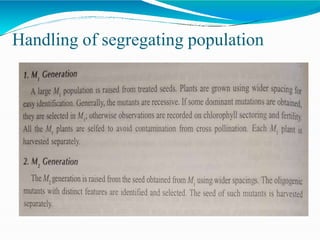
Handling of segregating population
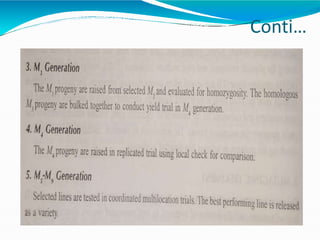
Conti…
SCREENING/SELECTION
⚫A genetic screen or mutagenesis screen is an
experimental technique used to identify and select for
individuals who possess a phenotype of interest in a
mutagenized population. Henceagenetic screen is a
typeof phenotypicscreen. Genetic screenscan provide
important information on gene function as well as the
molecular events that underlie a biological process or
pathway. While genome projects have identified an
extensive inventoryof genes in manydifferent
organisms, genetic screenscan providevaluable insight
as to how thosegenes function.
BASIC SCREENING
⚫Forward genetics (ora forward genetic screen) is an
approach used to identify genes (or set of genes)
responsible fora particularphenotypeof an
organism. Reversegenetics (ora reversegenetic screen),
on the other hand, analyzes the phenotype of an
organism following the disruption of a known gene. In
short, forward genetics starts with a phenotype and
moves towards identifying the gene(s) responsible,
whereas reverse genetics starts with a known gene and
assays the effect of its disruption by analyzing the
resultant phenotypes. Both forward and reverse genetic
screens aim todetermine gene function.
enhancer screen
⚫An enhancerscreen begins with a mutant individual that
has an affected process of interest with a known gene
mutation. The screen can then be used to identify
additional genes or gene mutations that play a role in that
biological or physiological process. A genetic enhancer
screen identifies mutationswhich enhance a phenotypeof
interest in an already mutant individual. The phenotypeof
thedouble mutant (individual with both theenhancer and
original background mutation) is more prominent than
either of the single mutant phenotypes. The enhancement
must surpass the expected phenotypes of the two
mutationson theirown, and thereforeeach mutation may
be considered an enhancerof theother. Isolating enhancer
mutants can lead to the identification of interacting genes
or genes which act redundantly with respect to one
another.
Temperature sensitive
⚫A temperature sensitive screen involves performing
temperatureshifts toenhance a mutant phenotype. A
population grown at low temperaturewould havea normal
phenotype; however, the mutation in the particular gene
would make it unstable at a higher temperature. A screen
for temperaturesensitivity in fruit flies, forexample, might
involve raising the temperature in thecage until some flies
faint, then opening a portal to let the others escape.
Individuals selected in a screen are liable to carry an
unusual version of a gene involved in the phenotype of
interest. An advantage of alleles found in this type of
screen is that the mutant phenotype isconditional and can
be activated by simply raising the temperature. A null
mutation in such a gene may be lethal to the embryo and
such mutantswould be missed in a basicscreen.
suppressor screen
⚫A suppressor screen is used to identify suppressor
mutations which alleviate or revert the phenotype of the
original mutation, in a process defined as synthetic
viability. Suppressor mutations can be described as second
mutations at a site on the chromosome distinct from the
mutation under study, which suppress the phenotype of
theoriginal mutation.If the mutation is in thesamegeneas
the original mutation it is known as intragenic
suppression, whereas a mutation located in adifferentgene
is known as extragenic suppression or intergenic
suppression. Suppressor mutations are extremely useful to
define the functions of biochemical pathways within a cell
and the relationships between different biochemical
pathways.
Screening/selection
⚫Mainly threetypes screening/selection
techniques in M2 and subsequent generation
i)Visual
ii)Mechanical/Physical
iii)Other methods
i) Visual screening
⚫most effective and efficient methodfor identifying
mutant phenotypes
⚫Visual selection often is the prime basisfor selecting for
diseaseresistance, earliness, plant height, colour changes,
ion-shattering, adaptation to soil, climate, growing period
etc.
ii) Mechanical/Physical
⚫V
ery efficient for seed size,shape,weight,density, etc.,
using appropriate sievingmachinery
⚫chemical, biochemical, physiologicaletc.
⚫E.g.-Lowalkaloid content mutants canbe
selected using colorimetrictests
⚫chromatographic or electrophoresistechniques may
be used to select isolate proteinvariants
Methods for validation of mutants
⚫Genome-wide chips
⚫Difference screening
⚫Microarray
⚫PCRscreening
⚫TILLINGand ECO-
TILLING
⚫DNA chip technology utilizes microscopicarrays
(microarrays) of molecules immobilized on solid
surfaces for biochemical analysis. Microarrays can be
used forexpression analysis, polymorphismdetection,
DNA resequencing, and genotyping on a genomic
scale. Advanced arraying technologies such as
photolithograpy, micro-spotting and ink jetting,
coupled with sophisticated fluorescence detection
systems and bioinformatics, permit molecular data
gathering atan unprecedented rate. Microarray-based
characterization of plantgenomes has the potential to
revolutionize plant breeding and agricultural
biotechnology. This review provides an overview of
DNA chip technology, focusing on manufacturing
approachesand biological applications.
TILLING and Eco-TILLING
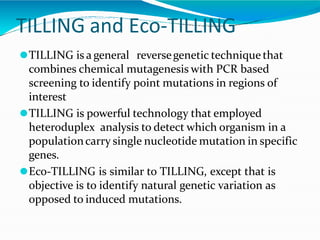
⚫TILLING is a general reversegenetic technique that
combines chemical mutagenesis with PCR based
screening to identify point mutations in regions of
interest
⚫TILLING is powerful technology that employed
heteroduplex analysis to detect which organism in a
populationcarry single nucleotide mutation in specific
genes.
⚫Eco-TILLING is similar to TILLING, except that is
objective is to identify natural genetic variation as
opposed to induced mutations.
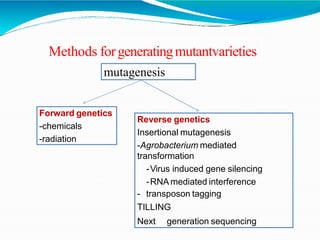
Methods forgeneratingmutantvarieties
mutagenesis
Forward genetics
-chemicals
-radiation
Reverse genetics
Insertional mutagenesis
-Agrobacterium mediated
transformation
-Virus induced gene silencing
-RNA mediated interference
- transposon tagging
TILLING
Next generation sequencing
Advantages
⚫Induced mutagenesis is used for the induction of
cytoplasmic male sterility. Ethidium bromide has been
used for induction of cytoplasmic male sterility in
perlmillet and barley
⚫ mutation breeding is cheap and repid method developing
new variety as compair to backcross, pedigree and bulk
method
⚫Mutation breeding is more effective for the improvement
of oligogenic characters such as disease resistance than
polygenic traits
⚫Mutation breeding is the simple, quick and best way when
a new character is to be include in vegetatively propagated
crops.
Disadvantages
⚫Most of the mutation are deleterious and undesirable.
⚫Identification of micro mutations, which are more
useful to plant breeder is usually very defficult.
⚫Since useful mutations are produced at a very low
frequency, a very large plant population has to be
screened to identify and isolate desirable mutants.
⚫Mutation breeding has limited scope for the genetic
improvement of quantitative or polygenic characters.
Future prospects of mutation
 The mutants which have no breeding value are generally thrown away
by the researchers, are now becoming important tool in genome
research. Damage to the DNA of particular gene sequence is now
possible in pooled samples taken from large mutated populations using
novel mutation detection technique. This technique is known as ‘targets
included local lesions in genomes’ or ‘TILLING’ (McCallum et al.,
2000a) which is gaining popularity in these days.
 ‘Denaturing high performance liquid chromatography’ or ‘DHPLC’ In
this approach point mutation of high density are required for which
highly efficient chemical mutagens and ionizing radiations are generally
used to develop of mutated generations. McCallum et al. (2000b) though
demonstrated this technique in Arabidopsis for the first time, yet it is
adopted for other plant species as well. If the sequences of the targeted
gene is known and the methodology for detection of single nucleotide
substitutions is available, TILLING can be applied successfully.
 Mutagenesis

Mutagenesis

  • 1.
  • 2.
    Introduction Types of mutagenesis Applicationofmutagenesis. Handling of segregatingpopulation Screening/selection Methods for V alidation ofmutants  Advantagesand limitations of mutation breeding Contents...... 2
  • 3.
    MUTAGENESIS ⚫Mutagenesis :- isa process by which the genetic information of an organism is changed, resulting in a mutation. It mayoccurspontaneously in nature, or as a resultof exposure to mutagens. Itcan also be achieved experimentally using laboratoryprocedures. In nature mutagenesiscan lead tocancerand various heritablediseases, but it is alsoa driving force of evolution.
  • 4.
    Types of mutagenesis ⚫Directedmutagenesis ⚫Site-directed mutagenesis ⚫PCR mutagenesis ⚫Insertional mutagenesis ⚫Signature tagged mutagenesis ⚫Transposon mutagenesis ⚫Sequence saturation mutagenesis
  • 5.
    Directed mutagenesis ⚫Directed mutagenesis,also known as directed mutation, was a hypothesis proposing that organisms can respond to environmental stresses by orthogenetically directing mutations to certain genes or areas of the genome. ⚫Different types of directed mutagenesis are a ) oligonucleotide directed mutagenesis with M13 DNA b) oligonucleotide directed mutagenesis with plasmid DNA c) PCRAmplified oligonucleotide directed mutagenesis. advantages :- Mutation rates is high All mutations can be induced Systematic and detailed Investigation of the targeted mutation can be made
  • 6.
    Site-directed mutagenesis ⚫Site-directed mutagenesisis a molecular biology method that is used to make specific and intentional changes to the DNAsequence of a gene and any gene products. Also called site- specific mutagenesis or oligonucleotide-directed mutagenesis, it is used for investigating the structure and biological activity of DNA, RNA, and protein molecules, and for protein engineering
  • 8.
    Conti… ⚫In molecular biology,insertional mutagenesis is the creation of mutations of DNAby the addition of one or more base pairs. Such insertional mutations can occur naturally, mediated by viruses or transposons, or can be artificially created for research purposes in the lag. ⚫Signature-tagged mutagenesis (STM) is a genetic technique used to study gene function. Recent advances in genome sequencing have allowed us to catalogue a large variety of organisms' genomes, but the function of the genes they contain is still largely unknown. Using STM, the function of the product of a particular gene can be inferred by disabling it and observing the effect on the organism. The original and most common use of STM is to discover which genes in a pathogen are involved in virulence in its host, to aid the development of new medical therapies/drugs.
  • 10.
    Transposon mutagenesis ⚫Transposon mutagenesis,or transposition mutagenesis, is a biological process that allows genes to be transferred to a host organism's chromosome, interrupting or modifying the function of an extant gene on the chromosome and causing mutation.
  • 12.
    APPLICATION ⚫ Site directedmutagenesis is used to study changes in protein activity that occurs as a result of the DNAmanipulation. ⚫ It is used to assess the activity of proteins containing known amino acid substitutions. ⚫ It is used to select or screen for mutations (at the DNA, RNA or protein level) that have a desired property; and which can be manipulated further for enhance biological activity. ⚫ It is used to change specific amino acid in an enzyme. In this case, the modified enzyme molecule is assayed and compared to the wild- type enzyme molecule. ⚫ It is used to introduce or remove restriction endonuclease sites or tags. ⚫ Site-directed mutagenesis helps scientists to study the mechanism of action behind biological reactions catalyzed by enzymes in vivo.
  • 13.
    APPLICATION ⚫Recombinant DNA technologyand the use of synthetic DNA molecules make it possible for molecular biology scientists to induce specific mutations in specific genes. ⚫ In vitro mutagenesis is used to purposefully change genetic information. ⚫The analysis of the subsequent changes in gene expression and gene products helps elucidate the functional effect of the mutation. ⚫There are various types of mutagenesis. Site-directed mutagenesis, cassette mutagenesis and random mutagenesis are some examples of mutagenesis. It is noteworthy that the particular mutagenesis method you choose to use will depend on the goal of the project and the information you have about the target gene sequence to be altered
  • 14.
  • 15.
  • 16.
    SCREENING/SELECTION ⚫A genetic screenor mutagenesis screen is an experimental technique used to identify and select for individuals who possess a phenotype of interest in a mutagenized population. Henceagenetic screen is a typeof phenotypicscreen. Genetic screenscan provide important information on gene function as well as the molecular events that underlie a biological process or pathway. While genome projects have identified an extensive inventoryof genes in manydifferent organisms, genetic screenscan providevaluable insight as to how thosegenes function.
  • 17.
    BASIC SCREENING ⚫Forward genetics(ora forward genetic screen) is an approach used to identify genes (or set of genes) responsible fora particularphenotypeof an organism. Reversegenetics (ora reversegenetic screen), on the other hand, analyzes the phenotype of an organism following the disruption of a known gene. In short, forward genetics starts with a phenotype and moves towards identifying the gene(s) responsible, whereas reverse genetics starts with a known gene and assays the effect of its disruption by analyzing the resultant phenotypes. Both forward and reverse genetic screens aim todetermine gene function.
  • 18.
    enhancer screen ⚫An enhancerscreenbegins with a mutant individual that has an affected process of interest with a known gene mutation. The screen can then be used to identify additional genes or gene mutations that play a role in that biological or physiological process. A genetic enhancer screen identifies mutationswhich enhance a phenotypeof interest in an already mutant individual. The phenotypeof thedouble mutant (individual with both theenhancer and original background mutation) is more prominent than either of the single mutant phenotypes. The enhancement must surpass the expected phenotypes of the two mutationson theirown, and thereforeeach mutation may be considered an enhancerof theother. Isolating enhancer mutants can lead to the identification of interacting genes or genes which act redundantly with respect to one another.
  • 19.
    Temperature sensitive ⚫A temperaturesensitive screen involves performing temperatureshifts toenhance a mutant phenotype. A population grown at low temperaturewould havea normal phenotype; however, the mutation in the particular gene would make it unstable at a higher temperature. A screen for temperaturesensitivity in fruit flies, forexample, might involve raising the temperature in thecage until some flies faint, then opening a portal to let the others escape. Individuals selected in a screen are liable to carry an unusual version of a gene involved in the phenotype of interest. An advantage of alleles found in this type of screen is that the mutant phenotype isconditional and can be activated by simply raising the temperature. A null mutation in such a gene may be lethal to the embryo and such mutantswould be missed in a basicscreen.
  • 20.
    suppressor screen ⚫A suppressorscreen is used to identify suppressor mutations which alleviate or revert the phenotype of the original mutation, in a process defined as synthetic viability. Suppressor mutations can be described as second mutations at a site on the chromosome distinct from the mutation under study, which suppress the phenotype of theoriginal mutation.If the mutation is in thesamegeneas the original mutation it is known as intragenic suppression, whereas a mutation located in adifferentgene is known as extragenic suppression or intergenic suppression. Suppressor mutations are extremely useful to define the functions of biochemical pathways within a cell and the relationships between different biochemical pathways.
  • 21.
    Screening/selection ⚫Mainly threetypes screening/selection techniquesin M2 and subsequent generation i)Visual ii)Mechanical/Physical iii)Other methods
  • 22.
    i) Visual screening ⚫mosteffective and efficient methodfor identifying mutant phenotypes ⚫Visual selection often is the prime basisfor selecting for diseaseresistance, earliness, plant height, colour changes, ion-shattering, adaptation to soil, climate, growing period etc.
  • 23.
    ii) Mechanical/Physical ⚫V ery efficientfor seed size,shape,weight,density, etc., using appropriate sievingmachinery ⚫chemical, biochemical, physiologicaletc. ⚫E.g.-Lowalkaloid content mutants canbe selected using colorimetrictests ⚫chromatographic or electrophoresistechniques may be used to select isolate proteinvariants
  • 24.
    Methods for validationof mutants ⚫Genome-wide chips ⚫Difference screening ⚫Microarray ⚫PCRscreening ⚫TILLINGand ECO- TILLING
  • 25.
    ⚫DNA chip technologyutilizes microscopicarrays (microarrays) of molecules immobilized on solid surfaces for biochemical analysis. Microarrays can be used forexpression analysis, polymorphismdetection, DNA resequencing, and genotyping on a genomic scale. Advanced arraying technologies such as photolithograpy, micro-spotting and ink jetting, coupled with sophisticated fluorescence detection systems and bioinformatics, permit molecular data gathering atan unprecedented rate. Microarray-based characterization of plantgenomes has the potential to revolutionize plant breeding and agricultural biotechnology. This review provides an overview of DNA chip technology, focusing on manufacturing approachesand biological applications.
  • 26.
    TILLING and Eco-TILLING ⚫TILLINGis a general reversegenetic technique that combines chemical mutagenesis with PCR based screening to identify point mutations in regions of interest ⚫TILLING is powerful technology that employed heteroduplex analysis to detect which organism in a populationcarry single nucleotide mutation in specific genes. ⚫Eco-TILLING is similar to TILLING, except that is objective is to identify natural genetic variation as opposed to induced mutations.
  • 27.
    Methods forgeneratingmutantvarieties mutagenesis Forward genetics -chemicals -radiation Reversegenetics Insertional mutagenesis -Agrobacterium mediated transformation -Virus induced gene silencing -RNA mediated interference - transposon tagging TILLING Next generation sequencing
  • 28.
    Advantages ⚫Induced mutagenesis isused for the induction of cytoplasmic male sterility. Ethidium bromide has been used for induction of cytoplasmic male sterility in perlmillet and barley ⚫ mutation breeding is cheap and repid method developing new variety as compair to backcross, pedigree and bulk method ⚫Mutation breeding is more effective for the improvement of oligogenic characters such as disease resistance than polygenic traits ⚫Mutation breeding is the simple, quick and best way when a new character is to be include in vegetatively propagated crops.
  • 29.
    Disadvantages ⚫Most of themutation are deleterious and undesirable. ⚫Identification of micro mutations, which are more useful to plant breeder is usually very defficult. ⚫Since useful mutations are produced at a very low frequency, a very large plant population has to be screened to identify and isolate desirable mutants. ⚫Mutation breeding has limited scope for the genetic improvement of quantitative or polygenic characters.
  • 30.
    Future prospects ofmutation  The mutants which have no breeding value are generally thrown away by the researchers, are now becoming important tool in genome research. Damage to the DNA of particular gene sequence is now possible in pooled samples taken from large mutated populations using novel mutation detection technique. This technique is known as ‘targets included local lesions in genomes’ or ‘TILLING’ (McCallum et al., 2000a) which is gaining popularity in these days.  ‘Denaturing high performance liquid chromatography’ or ‘DHPLC’ In this approach point mutation of high density are required for which highly efficient chemical mutagens and ionizing radiations are generally used to develop of mutated generations. McCallum et al. (2000b) though demonstrated this technique in Arabidopsis for the first time, yet it is adopted for other plant species as well. If the sequences of the targeted gene is known and the methodology for detection of single nucleotide substitutions is available, TILLING can be applied successfully.