FAST SCAN
Dr. Muhammad Bin Zulfiqar
PGR NEW RADIOLOGY DEPARTMENT
SIMS/SHL
What does it Mean?
FAST
Focused
Abdominal (Assessment
with)
Sonography in
Trauma
Fast Application
• Indications:
– Acute blunt or penetrating torso trauma (stable or
unstable patient )
– Trauma in pregnancy
– Pediatric trauma
– Subacute torso trauma(unexplained hypotension)
• Goal: To identify fluid in a location where it does not
normally belong and detect visceral injury.
FAST USG SCAN
• ANATOMY
• TECHNIQUE
• FAST DEMO
• FREE FLUID
• ABDOMINAL ORGAN INJURY
Where can I see FF?
• Free fluid usually appears anechoic by US
(black )
• Accumulation in area of injury
• Overflows into dependent areas (pouch of
Douglas, Morrison’s pouch) via rivers
(paracolic gutters) and into thoracic cavity
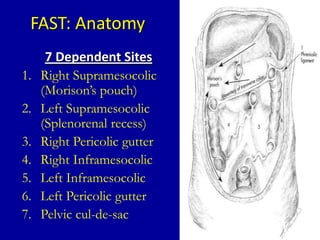
FAST: Anatomy
7 Dependent Sites
1. Right Supramesocolic
(Morison’s pouch)
2. Left Supramesocolic
(Splenorenal recess)
3. Right Pericolic gutter
4. Right Inframesocolic
5. Left Inframesocolic
6. Left Pericolic gutter
7. Pelvic cul-de-sac
FAST: Technical Considerations
Standard Views
• The Right Upper Quadrant View (Also Known as the
Perihepatic, Morison Pouch, or Right Flank View)
• The Left Upper Quadrant View (Also Known as the
Perisplenic or Left Flank View)
• The Pelvic View (Also Known as the
Retrovesical, Rectrouterine, or Pouch of Douglas View)
• The Pericardial View (Also Known as the Subcostal or
Subxiphoid View)
• The Right and Left Pericolic Gutter Views
FAST: Technical Considerations
Extended Views
• The Pleural Space Views
• The Anterior Pleural Space View
• The Parasternal View
FAST: Technical
Considerations
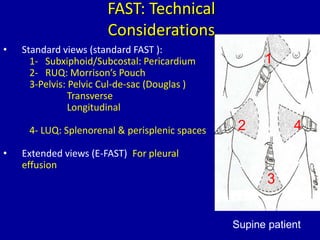
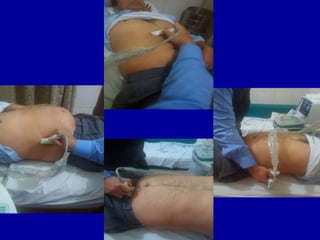
• Standard views (standard FAST ):
1- Subxiphoid/Subcostal: Pericardium
2- RUQ: Morrison’s Pouch
3-Pelvis: Pelvic Cul-de-sac (Douglas )
Transverse
Longitudinal
4- LUQ: Splenorenal & perisplenic spaces
• Extended views (E-FAST) :For pleural
effusion
Supine patient
1
42
3
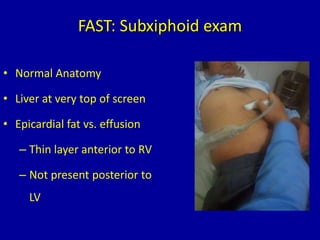
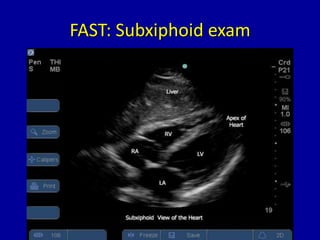
FAST: Subxiphoid exam
• Normal Anatomy
• Liver at very top of screen
• Epicardial fat vs. effusion
– Thin layer anterior to RV
– Not present posterior to
LV
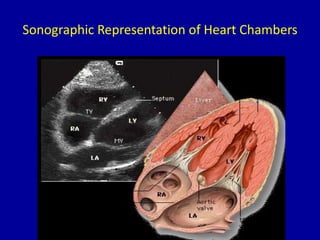
Sonographic Representation of Heart Chambers
FAST: Subxiphoid exam
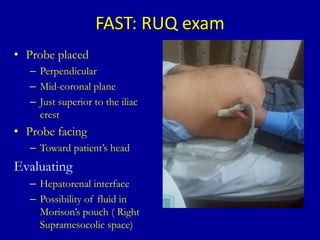
FAST: RUQ exam
• Probe placed
– Perpendicular
– Mid-coronal plane
– Just superior to the iliac
crest
• Probe facing
– Toward patient’s head
Evaluating
– Hepatorenal interface
– Possibility of fluid in
Morison’s pouch ( Right
Supramesocolic space)
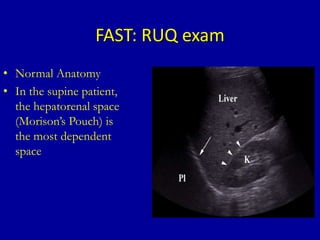
FAST: RUQ exam
• Normal Anatomy
• In the supine patient,
the hepatorenal space
(Morison’s Pouch) is
the most dependent
space
Morison’
s
Pouch
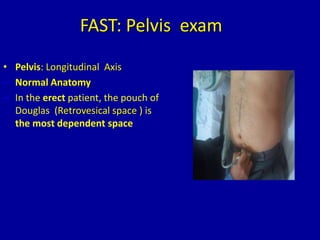
FAST: Pelvis exam
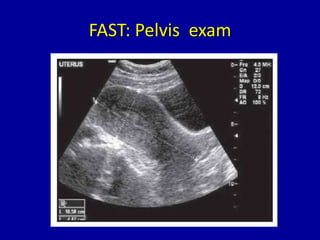
• Pelvis: Longitudinal Axis
– Normal Anatomy
– In the erect patient, the pouch of
Douglas (Retrovesical space ) is
the most dependent space
FAST: Pelvis exam
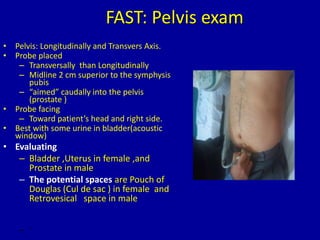
• Pelvis: Longitudinally and Transvers Axis.
• Probe placed
– Transversally than Longitudinally
– Midline 2 cm superior to the symphysis
pubis
– “aimed” caudally into the pelvis
(prostate )
• Probe facing
– Toward patient’s head and right side.
• Best with some urine in bladder(acoustic
window)
• Evaluating
– Bladder ,Uterus in female ,and
Prostate in male
– The potential spaces are Pouch of
Douglas (Cul de sac ) in female and
Retrovesical space in male
– ‘
FAST: Pelvis exam
FAST: LUQ Exam
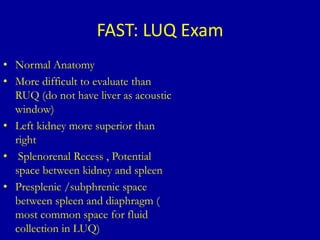
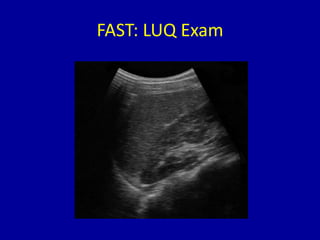
• Normal Anatomy
• More difficult to evaluate than
RUQ (do not have liver as acoustic
window)
• Left kidney more superior than
right
• Splenorenal Recess , Potential
space between kidney and spleen
• Presplenic /subphrenic space
between spleen and diaphragm (
most common space for fluid
collection in LUQ)
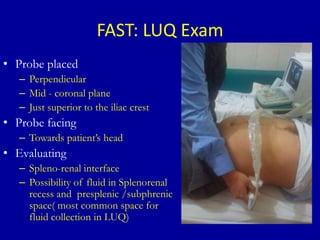
FAST: LUQ Exam
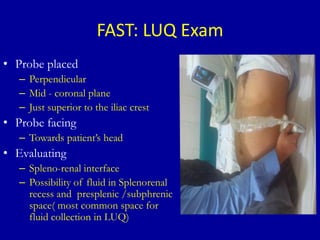
• Probe placed
– Perpendicular
– Mid - coronal plane
– Just superior to the iliac crest
• Probe facing
– Towards patient’s head
• Evaluating
– Spleno-renal interface
– Possibility of fluid in Splenorenal
recess and presplenic /subphrenic
space( most common space for
fluid collection in LUQ)
FAST: LUQ Exam
• Probe placed
– Perpendicular
– Mid - coronal plane
– Just superior to the iliac crest
• Probe facing
– Towards patient’s head
• Evaluating
– Spleno-renal interface
– Possibility of fluid in Splenorenal
recess and presplenic /subphrenic
space( most common space for
fluid collection in LUQ)
FAST: LUQ Exam
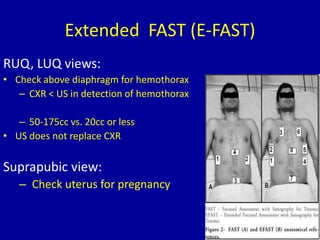
Extended FAST (E-FAST)
RUQ, LUQ views:
• Check above diaphragm for hemothorax
– CXR < US in detection of hemothorax
– 50-175cc vs. 20cc or less
• US does not replace CXR
Suprapubic view:
– Check uterus for pregnancy
FAST Demo
FAST
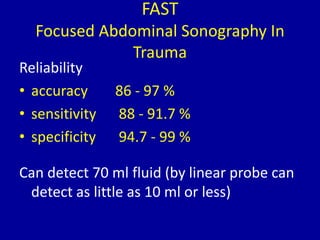
Focused Abdominal Sonography In
Trauma
Reliability
• accuracy 86 - 97 %
• sensitivity 88 - 91.7 %
• specificity 94.7 - 99 %
Can detect 70 ml fluid (by linear probe can
detect as little as 10 ml or less)
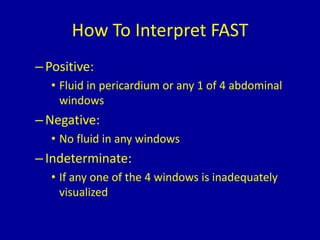
How To Interpret FAST
–Positive:
• Fluid in pericardium or any 1 of 4 abdominal
windows
–Negative:
• No fluid in any windows
–Indeterminate:
• If any one of the 4 windows is inadequately
visualized
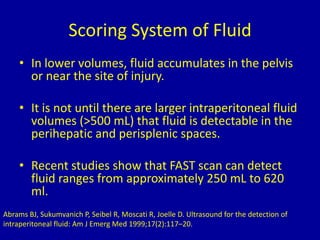
Scoring System of Fluid
• In lower volumes, fluid accumulates in the pelvis
or near the site of injury.
• It is not until there are larger intraperitoneal fluid
volumes (>500 mL) that fluid is detectable in the
perihepatic and perisplenic spaces.
• Recent studies show that FAST scan can detect
fluid ranges from approximately 250 mL to 620
ml.
Abrams BJ, Sukumvanich P, Seibel R, Moscati R, Joelle D. Ultrasound for the detection of
intraperitoneal fluid: Am J Emerg Med 1999;17(2):117–20.
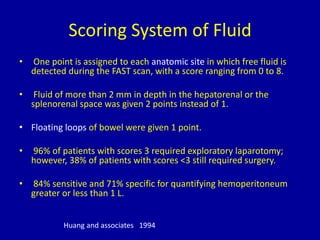
Scoring System of Fluid
• One point is assigned to each anatomic site in which free fluid is
detected during the FAST scan, with a score ranging from 0 to 8.
• Fluid of more than 2 mm in depth in the hepatorenal or the
splenorenal space was given 2 points instead of 1.
• Floating loops of bowel were given 1 point.
• 96% of patients with scores 3 required exploratory laparotomy;
however, 38% of patients with scores <3 still required surgery.
• 84% sensitive and 71% specific for quantifying hemoperitoneum
greater or less than 1 L.
Huang and associates 1994
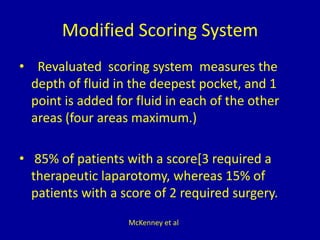
Modified Scoring System
• Revaluated scoring system measures the
depth of fluid in the deepest pocket, and 1
point is added for fluid in each of the other
areas (four areas maximum.)
• 85% of patients with a score[3 required a
therapeutic laparotomy, whereas 15% of
patients with a score of 2 required surgery.
McKenney et al
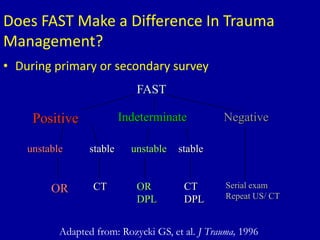
Does FAST Make a Difference In Trauma
Management?
• During primary or secondary survey
FAST
Positive NegativeIndeterminate
unstable stable
OR CT
unstable stable
OR
DPL
CT
DPL
Serial exam
Repeat US/ CT
Adapted from: Rozycki GS, et al. J Trauma, 1996
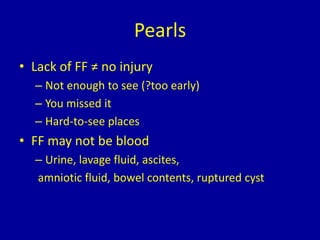
Pearls
• Lack of FF ≠ no injury
– Not enough to see (?too early)
– You missed it
– Hard-to-see places
• FF may not be blood
– Urine, lavage fluid, ascites,
amniotic fluid, bowel contents, ruptured cyst
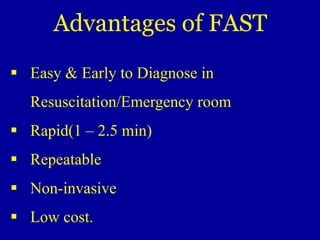
Advantages of FAST
 Easy & Early to Diagnose in
Resuscitation/Emergency room
 Rapid(1 – 2.5 min)
 Repeatable
 Non-invasive
 Low cost.
 Difficult to distinguish
 Type of fluid
 Site of bleeding ,
 Solid organ injury
 Cannot evaluate retroperitoneum
 Difficult in the obese patient ,
subcutaneous emphysema
 Examiner Dependent.
 Bowel gas interposition
 False –Negative : retroperitoneal &
Hollow viscus injury
Disadvantages of FAST
Pitfalls and limits
• -Pre existing fluid collection ( Ascites , dialysis )
• -Pelvic fluid collection (female ) .
• -Fluid filled bowel loops .
• -Contained injury (hollow viscus, bowel wall
contusion, pancreatic trauma and renal pedicle
injury)
• -Echogenic clot.
Pearls
• The scan should be repeated during the secondary
survey and also if the patient demonstrates clinical
deterioration, since free fluid may have accumulated
in the intervening time .
• The quality of images obtained may also be a limiting
factor with patient obesity , gas in the bowel leading
to degradation in image quality , subcutaneous
emphysema , non-mobile patient and penetrating
injury.
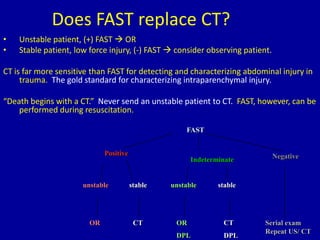
Does FAST replace CT?
• Unstable patient, (+) FAST  OR
• Stable patient, low force injury, (-) FAST  consider observing patient.
CT is far more sensitive than FAST for detecting and characterizing abdominal injury in
trauma. The gold standard for characterizing intraparenchymal injury.
“Death begins with a CT.” Never send an unstable patient to CT. FAST, however, can be
performed during resuscitation.
FAST
Positive NegativeIndeterminate
unstable stable
OR CT
unstable stable
OR
DPL
CT
DPL
Serial exam
Repeat US/ CT
FREE FLUID
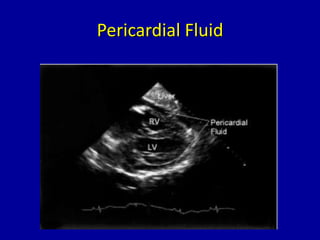
Pericardial Fluid
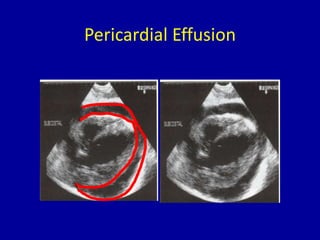
Pericardial Effusion
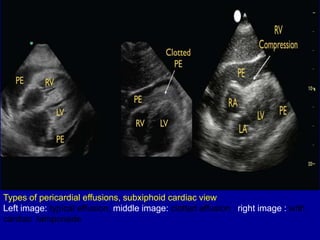
Types of pericardial effusions, subxiphoid cardiac view.
Left image: typical effusion, middle image: clotted effusion , right image : with
cardiac tamponade
.
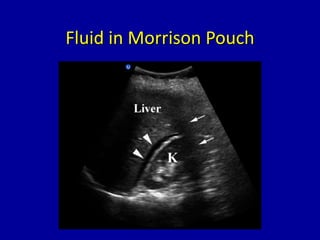
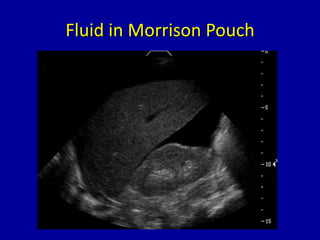
Fluid in Morrison Pouch
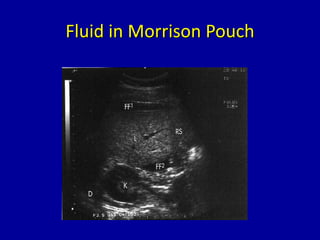
L
K
FF
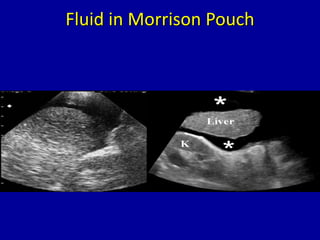
Fluid in Morrison Pouch
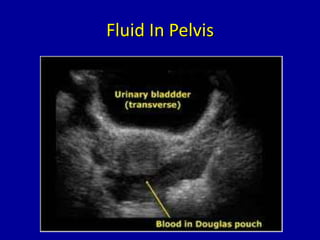
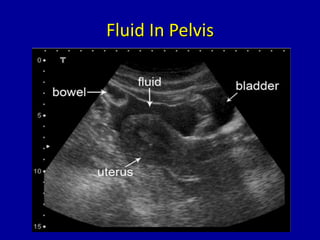
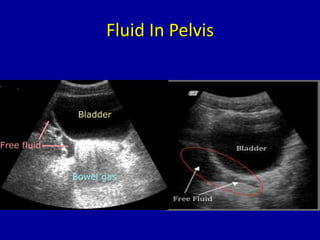
Fluid In Pelvis
Fluid In Pelvis
Fluid In Pelvis
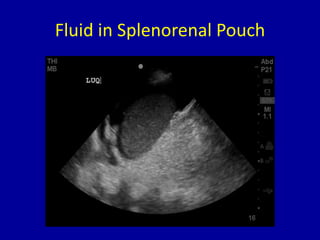
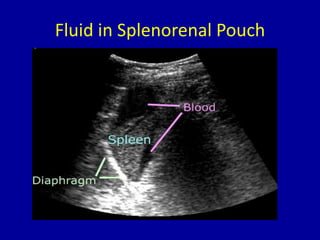
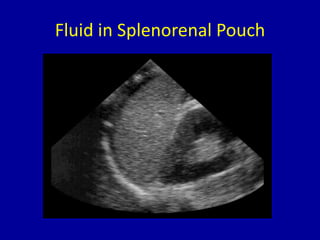
Fluid in Splenorenal Pouch
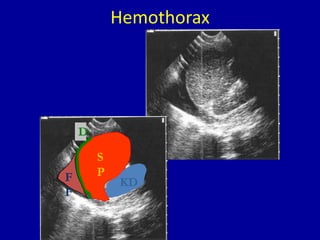
Hemothorax
KD
S
PF
F
D
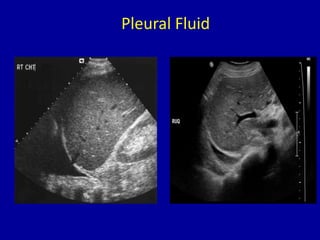
Pleural Fluid
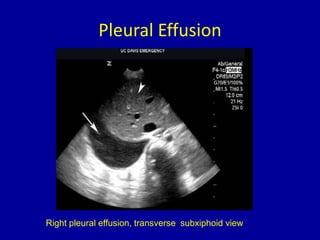
Pleural Effusion
Right pleural effusion, transverse subxiphoid view
?
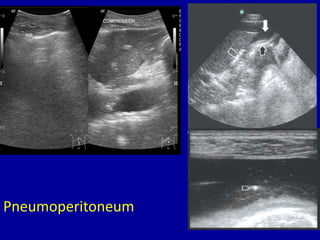
Is Pneumoperitoneum Can Be Detected
By US?
YES
Pneumoperitoneum
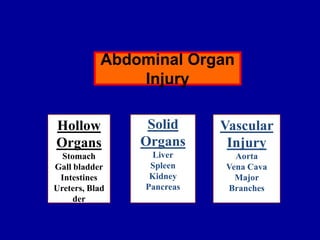
Hollow
Organs
Stomach
Gall bladder
Intestines
Ureters, Blad
der
Solid
Organs
Liver
Spleen
Kidney
Pancreas
Vascular
Injury
Aorta
Vena Cava
Major
Branches
Abdominal Organ
Injury
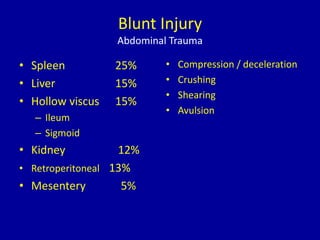
Blunt Injury
Abdominal Trauma
• Spleen 25%
• Liver 15%
• Hollow viscus 15%
– Ileum
– Sigmoid
• Kidney 12%
• Retroperitoneal 13%
• Mesentery 5%
• Compression / deceleration
• Crushing
• Shearing
• Avulsion
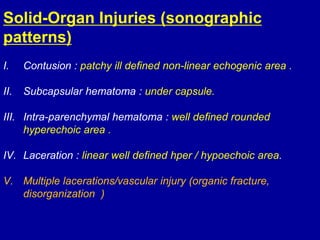
Solid-Organ Injuries (sonographic
patterns)
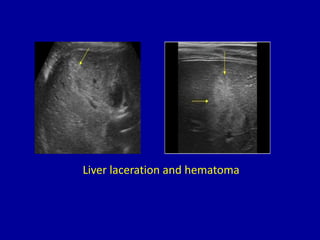
I. Contusion : patchy ill defined non-linear echogenic area .
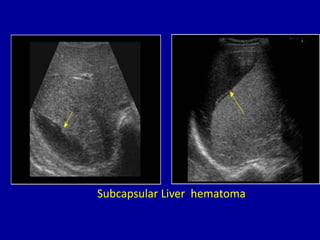
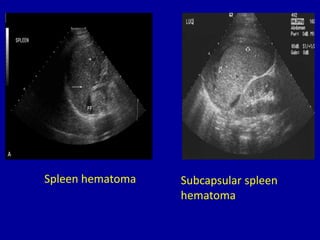
II. Subcapsular hematoma : under capsule.
III. Intra-parenchymal hematoma : well defined rounded
hyperechoic area .
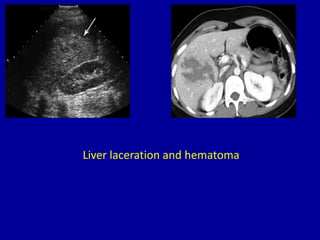
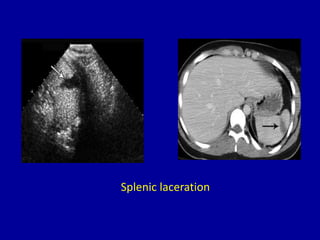
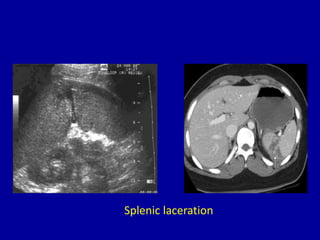
IV. Laceration : linear well defined hper / hypoechoic area.
V. Multiple lacerations/vascular injury (organic fracture,
disorganization )
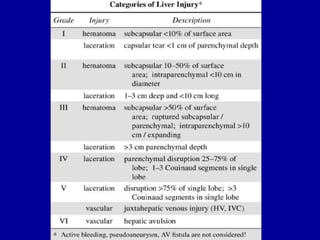
Liver laceration and hematoma
Subcapsular Liver hematoma
Liver laceration and hematoma
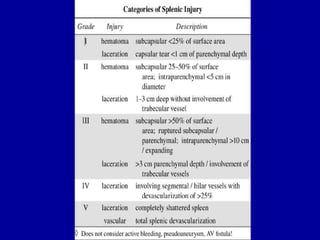
Splenic laceration
Spleen hematoma Subcapsular spleen
hematoma
Splenic laceration
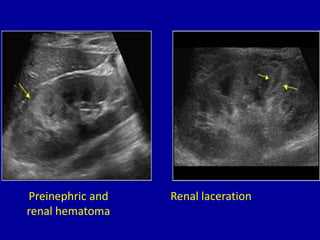
Preinephric and
renal hematoma
Renal laceration
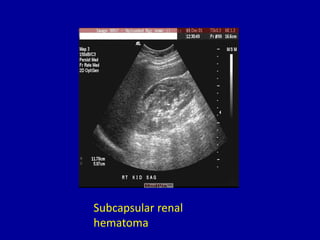
Subcapsular renal
hematoma
References
• Vicki E Nobil , Manual of emergency and critical care ultrasound , Cabridge university 2007
• Rosen, C. Ultrasound in Emergency Medicine. Emergency Medicine Clinics of North America. August
2004. Volume 22. Number 3.
• O. John Ma and James R. Mateer. Emergency Ultrasound. McGraw-Hill. Medical Publishing Division.
2003.
• Simon, B. Ultrasound in Emergency and Ambulatory Medicine. Mosby. 1997
• Temkin, BB. Ultrasound Scanning: Principles and Protocols. WB Saunders. 1993.
• AIUM Practice Guideline for the Performance of the Focused Assessment With Sonography for Trauma
(FAST) Examination
• Wolfang Dahnert
• Ppt by Dr. Derhim Alfaqeeh Radiologist Consultant HO The Radiology Dept University Of
Science And Technology Hospital - Sana’a December 17, 2013
THANX

Fast Scan

  • 2.
    FAST SCAN Dr. MuhammadBin Zulfiqar PGR NEW RADIOLOGY DEPARTMENT SIMS/SHL
  • 3.
    What does itMean? FAST Focused Abdominal (Assessment with) Sonography in Trauma
  • 4.
    Fast Application • Indications: –Acute blunt or penetrating torso trauma (stable or unstable patient ) – Trauma in pregnancy – Pediatric trauma – Subacute torso trauma(unexplained hypotension) • Goal: To identify fluid in a location where it does not normally belong and detect visceral injury.
  • 5.
    FAST USG SCAN •ANATOMY • TECHNIQUE • FAST DEMO • FREE FLUID • ABDOMINAL ORGAN INJURY
  • 6.
    Where can Isee FF? • Free fluid usually appears anechoic by US (black ) • Accumulation in area of injury • Overflows into dependent areas (pouch of Douglas, Morrison’s pouch) via rivers (paracolic gutters) and into thoracic cavity
  • 7.
    FAST: Anatomy 7 DependentSites 1. Right Supramesocolic (Morison’s pouch) 2. Left Supramesocolic (Splenorenal recess) 3. Right Pericolic gutter 4. Right Inframesocolic 5. Left Inframesocolic 6. Left Pericolic gutter 7. Pelvic cul-de-sac
  • 8.
    FAST: Technical Considerations StandardViews • The Right Upper Quadrant View (Also Known as the Perihepatic, Morison Pouch, or Right Flank View) • The Left Upper Quadrant View (Also Known as the Perisplenic or Left Flank View) • The Pelvic View (Also Known as the Retrovesical, Rectrouterine, or Pouch of Douglas View) • The Pericardial View (Also Known as the Subcostal or Subxiphoid View) • The Right and Left Pericolic Gutter Views
  • 9.
    FAST: Technical Considerations ExtendedViews • The Pleural Space Views • The Anterior Pleural Space View • The Parasternal View
  • 10.
    FAST: Technical Considerations • Standardviews (standard FAST ): 1- Subxiphoid/Subcostal: Pericardium 2- RUQ: Morrison’s Pouch 3-Pelvis: Pelvic Cul-de-sac (Douglas ) Transverse Longitudinal 4- LUQ: Splenorenal & perisplenic spaces • Extended views (E-FAST) :For pleural effusion Supine patient 1 42 3
  • 12.
    FAST: Subxiphoid exam •Normal Anatomy • Liver at very top of screen • Epicardial fat vs. effusion – Thin layer anterior to RV – Not present posterior to LV
  • 13.
  • 14.
  • 15.
    FAST: RUQ exam •Probe placed – Perpendicular – Mid-coronal plane – Just superior to the iliac crest • Probe facing – Toward patient’s head Evaluating – Hepatorenal interface – Possibility of fluid in Morison’s pouch ( Right Supramesocolic space)
  • 16.
    FAST: RUQ exam •Normal Anatomy • In the supine patient, the hepatorenal space (Morison’s Pouch) is the most dependent space Morison’ s Pouch
  • 17.
    FAST: Pelvis exam •Pelvis: Longitudinal Axis – Normal Anatomy – In the erect patient, the pouch of Douglas (Retrovesical space ) is the most dependent space
  • 18.
    FAST: Pelvis exam •Pelvis: Longitudinally and Transvers Axis. • Probe placed – Transversally than Longitudinally – Midline 2 cm superior to the symphysis pubis – “aimed” caudally into the pelvis (prostate ) • Probe facing – Toward patient’s head and right side. • Best with some urine in bladder(acoustic window) • Evaluating – Bladder ,Uterus in female ,and Prostate in male – The potential spaces are Pouch of Douglas (Cul de sac ) in female and Retrovesical space in male – ‘
  • 19.
  • 20.
    FAST: LUQ Exam •Normal Anatomy • More difficult to evaluate than RUQ (do not have liver as acoustic window) • Left kidney more superior than right • Splenorenal Recess , Potential space between kidney and spleen • Presplenic /subphrenic space between spleen and diaphragm ( most common space for fluid collection in LUQ)
  • 21.
    FAST: LUQ Exam •Probe placed – Perpendicular – Mid - coronal plane – Just superior to the iliac crest • Probe facing – Towards patient’s head • Evaluating – Spleno-renal interface – Possibility of fluid in Splenorenal recess and presplenic /subphrenic space( most common space for fluid collection in LUQ)
  • 22.
    FAST: LUQ Exam •Probe placed – Perpendicular – Mid - coronal plane – Just superior to the iliac crest • Probe facing – Towards patient’s head • Evaluating – Spleno-renal interface – Possibility of fluid in Splenorenal recess and presplenic /subphrenic space( most common space for fluid collection in LUQ)
  • 23.
  • 24.
    Extended FAST (E-FAST) RUQ,LUQ views: • Check above diaphragm for hemothorax – CXR < US in detection of hemothorax – 50-175cc vs. 20cc or less • US does not replace CXR Suprapubic view: – Check uterus for pregnancy
  • 25.
  • 26.
    FAST Focused Abdominal SonographyIn Trauma Reliability • accuracy 86 - 97 % • sensitivity 88 - 91.7 % • specificity 94.7 - 99 % Can detect 70 ml fluid (by linear probe can detect as little as 10 ml or less)
  • 27.
    How To InterpretFAST –Positive: • Fluid in pericardium or any 1 of 4 abdominal windows –Negative: • No fluid in any windows –Indeterminate: • If any one of the 4 windows is inadequately visualized
  • 28.
    Scoring System ofFluid • In lower volumes, fluid accumulates in the pelvis or near the site of injury. • It is not until there are larger intraperitoneal fluid volumes (>500 mL) that fluid is detectable in the perihepatic and perisplenic spaces. • Recent studies show that FAST scan can detect fluid ranges from approximately 250 mL to 620 ml. Abrams BJ, Sukumvanich P, Seibel R, Moscati R, Joelle D. Ultrasound for the detection of intraperitoneal fluid: Am J Emerg Med 1999;17(2):117–20.
  • 29.
    Scoring System ofFluid • One point is assigned to each anatomic site in which free fluid is detected during the FAST scan, with a score ranging from 0 to 8. • Fluid of more than 2 mm in depth in the hepatorenal or the splenorenal space was given 2 points instead of 1. • Floating loops of bowel were given 1 point. • 96% of patients with scores 3 required exploratory laparotomy; however, 38% of patients with scores <3 still required surgery. • 84% sensitive and 71% specific for quantifying hemoperitoneum greater or less than 1 L. Huang and associates 1994
  • 30.
    Modified Scoring System •Revaluated scoring system measures the depth of fluid in the deepest pocket, and 1 point is added for fluid in each of the other areas (four areas maximum.) • 85% of patients with a score[3 required a therapeutic laparotomy, whereas 15% of patients with a score of 2 required surgery. McKenney et al
  • 31.
    Does FAST Makea Difference In Trauma Management? • During primary or secondary survey FAST Positive NegativeIndeterminate unstable stable OR CT unstable stable OR DPL CT DPL Serial exam Repeat US/ CT Adapted from: Rozycki GS, et al. J Trauma, 1996
  • 32.
    Pearls • Lack ofFF ≠ no injury – Not enough to see (?too early) – You missed it – Hard-to-see places • FF may not be blood – Urine, lavage fluid, ascites, amniotic fluid, bowel contents, ruptured cyst
  • 33.
    Advantages of FAST Easy & Early to Diagnose in Resuscitation/Emergency room  Rapid(1 – 2.5 min)  Repeatable  Non-invasive  Low cost.
  • 34.
     Difficult todistinguish  Type of fluid  Site of bleeding ,  Solid organ injury  Cannot evaluate retroperitoneum  Difficult in the obese patient , subcutaneous emphysema  Examiner Dependent.  Bowel gas interposition  False –Negative : retroperitoneal & Hollow viscus injury Disadvantages of FAST
  • 35.
    Pitfalls and limits •-Pre existing fluid collection ( Ascites , dialysis ) • -Pelvic fluid collection (female ) . • -Fluid filled bowel loops . • -Contained injury (hollow viscus, bowel wall contusion, pancreatic trauma and renal pedicle injury) • -Echogenic clot.
  • 36.
    Pearls • The scanshould be repeated during the secondary survey and also if the patient demonstrates clinical deterioration, since free fluid may have accumulated in the intervening time . • The quality of images obtained may also be a limiting factor with patient obesity , gas in the bowel leading to degradation in image quality , subcutaneous emphysema , non-mobile patient and penetrating injury.
  • 37.
    Does FAST replaceCT? • Unstable patient, (+) FAST  OR • Stable patient, low force injury, (-) FAST  consider observing patient. CT is far more sensitive than FAST for detecting and characterizing abdominal injury in trauma. The gold standard for characterizing intraparenchymal injury. “Death begins with a CT.” Never send an unstable patient to CT. FAST, however, can be performed during resuscitation. FAST Positive NegativeIndeterminate unstable stable OR CT unstable stable OR DPL CT DPL Serial exam Repeat US/ CT
  • 38.
  • 39.
  • 40.
  • 41.
    Types of pericardialeffusions, subxiphoid cardiac view. Left image: typical effusion, middle image: clotted effusion , right image : with cardiac tamponade .
  • 42.
  • 43.
  • 44.
    Fluid in MorrisonPouch L K FF
  • 45.
  • 46.
  • 47.
  • 48.
  • 49.
  • 50.
  • 51.
  • 52.
  • 53.
  • 54.
    Pleural Effusion Right pleuraleffusion, transverse subxiphoid view
  • 55.
    ? Is Pneumoperitoneum CanBe Detected By US? YES
  • 56.
  • 57.
  • 58.
    Blunt Injury Abdominal Trauma •Spleen 25% • Liver 15% • Hollow viscus 15% – Ileum – Sigmoid • Kidney 12% • Retroperitoneal 13% • Mesentery 5% • Compression / deceleration • Crushing • Shearing • Avulsion
  • 59.
    Solid-Organ Injuries (sonographic patterns) I.Contusion : patchy ill defined non-linear echogenic area . II. Subcapsular hematoma : under capsule. III. Intra-parenchymal hematoma : well defined rounded hyperechoic area . IV. Laceration : linear well defined hper / hypoechoic area. V. Multiple lacerations/vascular injury (organic fracture, disorganization )
  • 63.
  • 64.
  • 65.
  • 66.
  • 67.
  • 68.
  • 69.
  • 70.
  • 71.
    References • Vicki ENobil , Manual of emergency and critical care ultrasound , Cabridge university 2007 • Rosen, C. Ultrasound in Emergency Medicine. Emergency Medicine Clinics of North America. August 2004. Volume 22. Number 3. • O. John Ma and James R. Mateer. Emergency Ultrasound. McGraw-Hill. Medical Publishing Division. 2003. • Simon, B. Ultrasound in Emergency and Ambulatory Medicine. Mosby. 1997 • Temkin, BB. Ultrasound Scanning: Principles and Protocols. WB Saunders. 1993. • AIUM Practice Guideline for the Performance of the Focused Assessment With Sonography for Trauma (FAST) Examination • Wolfang Dahnert • Ppt by Dr. Derhim Alfaqeeh Radiologist Consultant HO The Radiology Dept University Of Science And Technology Hospital - Sana’a December 17, 2013
  • 72.