FAST Exam

   Erin Carnes
September 27, 2007
FAST Exam
 Introduction
 Ultrasound Physics
 Technique
 Indications for FAST exam
 Performing a FAST exam
 Limitations
 Questions
What is the FAST exam?
   Focused Assessment by Sonography in Trauma
   Focused exam using ultrasound to diagnose
    hemorrhage in a trauma setting
   Ideally takes < 3 min
   4 primary views
       RUQ
       LUQ
       Subxiphoid
       Suprapubic
Basic Ultrasound Physics
   Ultrasound is a spectrum of sound frequencies
    above the human hearing range.
   Molecules must be present for sound to exist.
   Every object has an echogenicity. When sound
    waves hit the object some are transmitted
    through and some bounce back.
   Every substance will respond differently to the
    sound waves striking it’s surface. This occurs at
    every sound-to-sound interface and the
    reflection of sound waves can be used to create
    and image.
Technique
   Goal: to identify blood in
    body cavities where it is
    not supposed to be
       Unclotted blood appears
        black on US
       Clotted blood appears gray
   Abdominal probe with
    small footprint (between 1-
    3 cm) with range of
    frequency between 2.0 Hz
    and 5.0 Hz
   Scan 4 areas
       RUQ
       Subxiphoid
       LUQ
       Suprapubic
Indications
 Blunt thoracoabdominal trauma
 Penetrating thoracoabdominal trauma
 Suspected pericardial tamponade
 Trauma patient with hypotension on
  unknown etiology
 Thoracoabdominal trauma in a pregnant
  patient
Right Upper Quadrant
   Sagittal view obtained by
    placing probe either in the
    midclavicular line on the
    lower rib cage or below
    the right costal margin
   May have to move probe
    laterally to avoid gas in
    hepatic flexure
   Air-filled lung creates
    reflection artifact in which
    lung appears to be
    composed of liver
    parenchyma
   Scan for black fluid in
    potential spaces
Normal RUQ
Abnormal RUQ
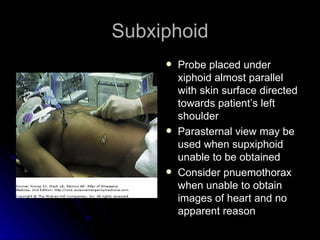
Subxiphoid
        Probe placed under
         xiphoid almost parallel
         with skin surface directed
         towards patient’s left
         shoulder
        Parasternal view may be
         used when supxiphoid
         unable to be obtained
        Consider pnuemothorax
         when unable to obtain
         images of heart and no
         apparent reason
Normal Subxiphoid
Abnormal Subxiphoid
Left Upper Quadrant
   Most technically
    difficult to obtain
   Probe placed parallel
    with ribs in posterior
    axillary line
   Scan potential spaces
    between diaphragm
    and spleen and
    spleen and kidney for
    free fluid
Normal LUQ
Abnormal LUQ
Suprapubic
      Entire pelvis should be
         scanned from top to
         bottom with transducer in
         transverse place and
         them side to side with
         transducer in sagittal
         plane
        Pouch of Douglas is the
         most dependent site in
         peritoneal cavity
        First sign of blood is often
         two small black triangles
         on either side of rectum
           “Bow tie sign”
Normal Suprapubic
Abnormal Suprapubic
Limitations
   Retroperitoneal bleeding
   Inadequate volume of fluid
   Not enough time elapsed since trauma to
    demonstrate bleeding
   Solid organ trauma with encapsulated bleeding
   Image quality dependent on quality of US
    machine and probe, body habitus of patient,
    physical injuries
   Scan and interpretation are operator dependent
Questions?

Fast exam2

  • 1.
    FAST Exam Erin Carnes September 27, 2007
  • 2.
    FAST Exam  Introduction Ultrasound Physics  Technique  Indications for FAST exam  Performing a FAST exam  Limitations  Questions
  • 3.
    What is theFAST exam?  Focused Assessment by Sonography in Trauma  Focused exam using ultrasound to diagnose hemorrhage in a trauma setting  Ideally takes < 3 min  4 primary views  RUQ  LUQ  Subxiphoid  Suprapubic
  • 4.
    Basic Ultrasound Physics  Ultrasound is a spectrum of sound frequencies above the human hearing range.  Molecules must be present for sound to exist.  Every object has an echogenicity. When sound waves hit the object some are transmitted through and some bounce back.  Every substance will respond differently to the sound waves striking it’s surface. This occurs at every sound-to-sound interface and the reflection of sound waves can be used to create and image.
  • 5.
    Technique  Goal: to identify blood in body cavities where it is not supposed to be  Unclotted blood appears black on US  Clotted blood appears gray  Abdominal probe with small footprint (between 1- 3 cm) with range of frequency between 2.0 Hz and 5.0 Hz  Scan 4 areas  RUQ  Subxiphoid  LUQ  Suprapubic
  • 6.
    Indications  Blunt thoracoabdominaltrauma  Penetrating thoracoabdominal trauma  Suspected pericardial tamponade  Trauma patient with hypotension on unknown etiology  Thoracoabdominal trauma in a pregnant patient
  • 7.
    Right Upper Quadrant  Sagittal view obtained by placing probe either in the midclavicular line on the lower rib cage or below the right costal margin  May have to move probe laterally to avoid gas in hepatic flexure  Air-filled lung creates reflection artifact in which lung appears to be composed of liver parenchyma  Scan for black fluid in potential spaces
  • 8.
  • 9.
  • 13.
    Subxiphoid  Probe placed under xiphoid almost parallel with skin surface directed towards patient’s left shoulder  Parasternal view may be used when supxiphoid unable to be obtained  Consider pnuemothorax when unable to obtain images of heart and no apparent reason
  • 14.
  • 15.
  • 17.
    Left Upper Quadrant  Most technically difficult to obtain  Probe placed parallel with ribs in posterior axillary line  Scan potential spaces between diaphragm and spleen and spleen and kidney for free fluid
  • 18.
  • 19.
  • 23.
    Suprapubic  Entire pelvis should be scanned from top to bottom with transducer in transverse place and them side to side with transducer in sagittal plane  Pouch of Douglas is the most dependent site in peritoneal cavity  First sign of blood is often two small black triangles on either side of rectum  “Bow tie sign”
  • 24.
  • 25.
  • 29.
    Limitations  Retroperitoneal bleeding  Inadequate volume of fluid  Not enough time elapsed since trauma to demonstrate bleeding  Solid organ trauma with encapsulated bleeding  Image quality dependent on quality of US machine and probe, body habitus of patient, physical injuries  Scan and interpretation are operator dependent
  • 30.

Editor's Notes

  • #5 Ultrasound is a spectrum of sound frequencies above the human hearing range. Molecules must be present for sound to exist. Every object has an echogenicity. When sound waves hit the object some are transmitted through and some bounce back. Every substance will respond differently to the sound waves striking it’s surface. This occurs at every sound-to-sound interface and the reflection of sound waves can be used to create and image.
  • #6 Unclotted blood allows passage of transmission of ultrasound waves without echoes. Clotted blood creates echoes and thus appears gray. Foot print is the area of skin that the probe covers. Good to have small probe b/c you can look b/n ribs if you need to. Generally you can use 3.5 hz. You can use higher frequencies in thinner patients. Lower frequencies will give better resolution in heavier patients. 1) subxiphoid - to visualize the heart, 2) RUQ - to visualize Morrison&apos;s pouch and paracolic gutter, 3) LUQ - to visualize the spleeno-renal recess and paracolic gutter, 4) suprapubic - to visualize Douglas&apos; pouch. Many people start in RUQ b/c this is where fluid is most likely to be. Some start subxiphoid in order to early see pericardium/tamponade also allows for adjustment of the gain. - fluid most likely to be in RUQ due to anatomical and gravitational considerations. People are generally supine. Organs in pelvis relatively well protected. Abdominal organs usually injured. Blood flows into Morrison’s pouch (space b/n liver and kidney) Generally, if hemorrhage is below the bony pelvis it will flow caudad and above it will flow cephalad.
  • #8 Usually only do below right costal margin in patients able to take deep breaths. Lung is filled with air which is highly reflective leading to artifact. Abscense of this artifact suggests hemothorax. Some sonographers as they gain experience will scan solid organs for areas of abnormal echogenicity which would suggest parenchymal injury. This is not part of FAST exam.
  • #14 Subxiphoid may be impossible due to patient’s body habitus or physical injuries.
  • #18 When having trouble getting this view, it is usually because the probe is not posterior enough or superior enough. In both the LUQ and RUQ, it is usually necessary to get multiple images in order to identify all of the required structures.Getting them all in a single image The features of the LUQ view are very similar to those of the RUQ, with the normal pleural space appearing as if there were spleen both above and below the diaphragm.
  • #22 Mesenteric artery lac
  • #24 In a normal transverse suprapubic view, the pouch of Douglas is the most dependent site (standing or supine) in the entire pentoneal cavity The first sonographic sign of blood in the pelvis is often two small black triangles on either side of the rectum the so-called bow tie sign. The entire pelvis should be scanned from top to bottom with the transducer in the transverse plane, and then from side to side with the transducer held in a sagittal plane.