A Prospective evaluation of “focused assessment with
sonography for trauma” done by Emergency Nurses and its
  comparative analysis with radiologists performance in
   identifying fluid during initial resuscitation of trauma


   Bhoi S,SoniaChauhan, Geeta A,Shakuntla , Shoukkathali V,Sinha
    Tej P, RK. Ramchandani

   Deptt. of Emergency Medicine,J P N Apex Trauma Center,AIIMS
   sonia_aiims@yahoo.co.in
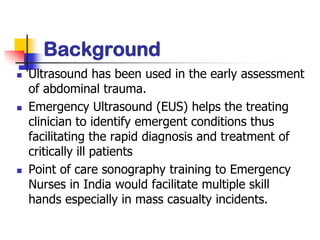
Background
   Ultrasound has been used in the early assessment
    of abdominal trauma.
   Emergency Ultrasound (EUS) helps the treating
    clinician to identify emergent conditions thus
    facilitating the rapid diagnosis and treatment of
    critically ill patients
   Point of care sonography training to Emergency
    Nurses in India would facilitate multiple skill
    hands especially in mass casualty incidents.
Objective
   To determine the accuracy of emergency
    nurses in detecting free fluid in abdomen
    when compared to radiologist during primary
    survey of trauma victims by focused
    assessment with Sonography for trauma
    [FAST] scan in the Emergency Department
    [ED].
METHODOLOGY

•   Study design- Qualitative prospective study

•   Performance centre - ED of JPN Apex
    Trauma Centre, AIIMS.

•   Study duration-January to September 2011
   The study subjects included emergency Nurses (EN)
    who underwent training at 3-day workshop on
    emergency sonography
   They performed 10 supervised positive and negative
    scans for free fluid.
    The FAST scans were first performed by the EN’s and
    then by radiology resident (RR).
    Both were blinded to each other’s sonography
    findings.
   CT scan and laparotomy findings were used as gold
    standard whichever was feasible.
    Results were compared between both groups.
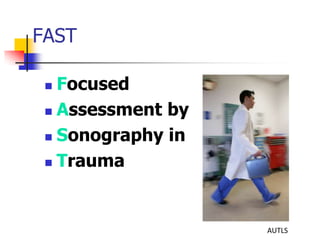
FAST

  Focused
  Assessment by

  Sonography in

  Trauma


                   AUTLS
FAST scan
   Minimal amount of fluid in abdomen detectable
    by USG ~ 200 - 650ml

   High sensitivity in detecting hemoperitoneum
    (63 -100% )
   High specificity in detecting hemoperitoneum
    (96 - 99%)100%)

    Low sensitivity in detecting specific organ lesions
    (<50%)
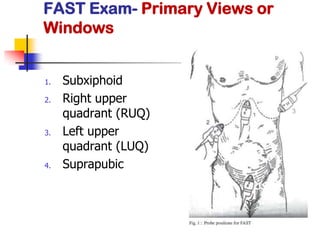
FAST Exam- Primary Views or
Windows


1.   Subxiphoid
2.   Right upper
     quadrant (RUQ)
3.   Left upper
     quadrant (LUQ)
4.   Suprapubic
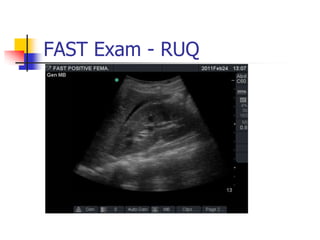
FAST Exam - RUQ
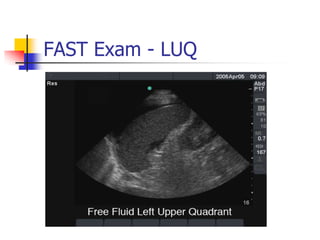
FAST Exam - LUQ
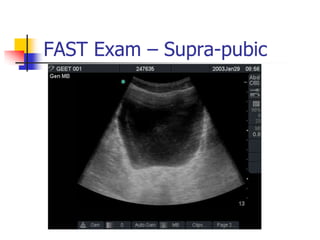
FAST Exam – Supra-pubic


       Transverse view
Results
   94 scans performed each by EN and RR were
    analysed.
   Mean age of the patients was 29 [2 - 85] years.
   Out of 23 true positive patients 18 underwent CT
    scan and exploratory laparotomy was done in 14
    patients.
   Sensitivity of FAST done by EN and RR was 90 %.
   Specificity of FAST done by EN was 94.6 %Vs RR.
   Positive predictive value and negative predictive
    values were 81.8% and 97.2% respectively
   Limitation: Inter-observer variability
    was not noted
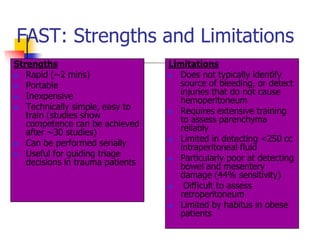
FAST: Strengths and Limitations
Strengths                         Limitations
  Rapid (~2 mins)                 Does not typically identify
 Portable                          source of bleeding, or detect
  Inexpensive                      injuries that do not cause
                                    hemoperitoneum
  Technically simple, easy to     Requires extensive training
   train (studies show              to assess parenchyma
   competence can be achieved       reliably
   after ~30 studies)
                                   Limited in detecting <250 cc
  Can be performed serially        intraperitoneal fluid
  Useful for guiding triage       Particularly poor at detecting
   decisions in trauma patients     bowel and mesentery
                                    damage (44% sensitivity)
                                    Difficult to assess
                                    retroperitoneum
                                   Limited by habitus in obese
                                    patients
Conclusion
   FAST scan performed by EN who are
    trained in short course of ultrasonography
    can be reliable and accurate when
    comparable to qualified radiologist.
   It can be helpful during crisis scenarios
    e.g. Mass casualty incidents.
Fast by nurses ppt.

Fast by nurses ppt.

  • 1.
    A Prospective evaluationof “focused assessment with sonography for trauma” done by Emergency Nurses and its comparative analysis with radiologists performance in identifying fluid during initial resuscitation of trauma  Bhoi S,SoniaChauhan, Geeta A,Shakuntla , Shoukkathali V,Sinha Tej P, RK. Ramchandani  Deptt. of Emergency Medicine,J P N Apex Trauma Center,AIIMS  sonia_aiims@yahoo.co.in
  • 2.
    Background  Ultrasound has been used in the early assessment of abdominal trauma.  Emergency Ultrasound (EUS) helps the treating clinician to identify emergent conditions thus facilitating the rapid diagnosis and treatment of critically ill patients  Point of care sonography training to Emergency Nurses in India would facilitate multiple skill hands especially in mass casualty incidents.
  • 3.
    Objective  To determine the accuracy of emergency nurses in detecting free fluid in abdomen when compared to radiologist during primary survey of trauma victims by focused assessment with Sonography for trauma [FAST] scan in the Emergency Department [ED].
  • 4.
    METHODOLOGY • Study design- Qualitative prospective study • Performance centre - ED of JPN Apex Trauma Centre, AIIMS. • Study duration-January to September 2011
  • 5.
    The study subjects included emergency Nurses (EN) who underwent training at 3-day workshop on emergency sonography  They performed 10 supervised positive and negative scans for free fluid.  The FAST scans were first performed by the EN’s and then by radiology resident (RR).  Both were blinded to each other’s sonography findings.  CT scan and laparotomy findings were used as gold standard whichever was feasible.  Results were compared between both groups.
  • 6.
    FAST  Focused  Assessment by  Sonography in  Trauma AUTLS
  • 7.
    FAST scan  Minimal amount of fluid in abdomen detectable by USG ~ 200 - 650ml  High sensitivity in detecting hemoperitoneum (63 -100% )  High specificity in detecting hemoperitoneum (96 - 99%)100%)  Low sensitivity in detecting specific organ lesions (<50%)
  • 8.
    FAST Exam- PrimaryViews or Windows 1. Subxiphoid 2. Right upper quadrant (RUQ) 3. Left upper quadrant (LUQ) 4. Suprapubic
  • 9.
  • 10.
  • 11.
    FAST Exam –Supra-pubic Transverse view
  • 12.
    Results  94 scans performed each by EN and RR were analysed.  Mean age of the patients was 29 [2 - 85] years.  Out of 23 true positive patients 18 underwent CT scan and exploratory laparotomy was done in 14 patients.  Sensitivity of FAST done by EN and RR was 90 %.  Specificity of FAST done by EN was 94.6 %Vs RR.  Positive predictive value and negative predictive values were 81.8% and 97.2% respectively
  • 13.
    Limitation: Inter-observer variability was not noted
  • 14.
    FAST: Strengths andLimitations Strengths Limitations  Rapid (~2 mins)  Does not typically identify  Portable source of bleeding, or detect  Inexpensive injuries that do not cause hemoperitoneum  Technically simple, easy to  Requires extensive training train (studies show to assess parenchyma competence can be achieved reliably after ~30 studies)  Limited in detecting <250 cc  Can be performed serially intraperitoneal fluid  Useful for guiding triage  Particularly poor at detecting decisions in trauma patients bowel and mesentery damage (44% sensitivity)  Difficult to assess retroperitoneum  Limited by habitus in obese patients
  • 15.
    Conclusion  FAST scan performed by EN who are trained in short course of ultrasonography can be reliable and accurate when comparable to qualified radiologist.  It can be helpful during crisis scenarios e.g. Mass casualty incidents.