HEME SYNTHESIS &
DISORDERS
M.Prasad Naidu
MSc Medical Biochemistry,
Ph.D.Research Scholar
HEME SYNTHESIS
 Heme is the most important porphyrin
containing compound.
 Heme is a derivative of the porphyrin.
 Porphyrins are cyclic compounds
formed by fusion of 4 pyrrole rings
linked by methenyl (=CH-) bridges.
 Metal ions can bind with nitrogen atoms of
pyrrole rings to form complexes.
 Since an atom of iron is present, heme is a
ferroprotoporphyrin.
 The pyrrole rings are named as l, ll, lll, lV and
the bridges as alpha, beta, gamma and delta.
 Naturally occurring porphyrins contain
substituent groups replacing the 8 hydrogen
atoms of the porphyrin nucleus.
 When the substituent groups have a
symmetrical arrangement (1, 3, 5, 7 and
2, 4, 6, 8) they are called the I series –type l
porphyrins.
 The lll series have an asymmetrical distribution
of substituent groups (1, 3, 5, 8 and 2, 4, 6, 7)-
type ll porphyrins.
 Type lll is the most predominant in biological
systems.
 It is also called series 9, because fischer, the
pioneer in porphyrin chemistry has placed it as
the 9th in a series of 15 possible isomers.
 Hans Fischer, the father of porphyrin chemistry,
proposed a short hand model for presentation
of porphyrin structures.
• Hans Fischer synthesised heme in laboratory in
1920(Nobel prize, 1930).
• The usual substitutions are :
a.propionyl (-CH2-CH2-COOH) group
b. acetyl (-CH2-COOH) group
c. methyl (-CH3) group
d. vinyl (-CH=CH2) group
Biosynthesis of Heme
 Heme can be synthesised by almost all the
tissues in the body.
 Heme is primarily synthesised in the liver and
the erythrocyte-producing cells of bone marrow
(erythroid cells).
 Heme is synthesised in the normoblasts, but
not in the matured ones.
 The pathway is partly cytoplasmic and partly
mitochondrial.
Step 1: ALA synthesis
 The synthesis starts with the condensation of
succinyl CoA and glycine in the presence of
pyridoxal phosphate to form delta amino
levulinic acid (ALA).
 The enzyme ALA synthase is located in the
mitochondria and is the rate-limiting enzyme of
the pathway.
Step 2: Formation of PBG
 Next few reactions occur in the cytoplasm.
 Two molecules of ALA are condensed to form
porphobilinogen (PBG).
 The condensation involves removal of 2
molecules of water and the enzyme is ALA
dehydratase.
 Porphobilinogen is a monopyrrole.
Step 3: Formation of UPG
 Condensation of 4 molecules of the PBG,
results in the formation of the first porphyrin of
the pathway, namely uroporphyrinogen(UPG).
 The pyrrole rings are joined together by
methylene bridges, which are derived from
alpha carbon of glycine.
 When the fusion occurs, the lll series of isomers
are predominantly formed; and only the lll
series are further used.
 This needs 2 enzymes which catalyse the
reactions; PBG-deaminase (Uroporphyrinogen-
l-synthase) and Uroporphyrinogen-lll-
cosynthase.
 During this deamination reation 4 molecules of
ammonia are removed.
Step 4: synthesis of CPG
 The UPG-lll is next convertedto
coproporphyrinogen (CPG-lll) by
decarboxylation.
 Four molecules of CO2 are eliminated by
uroporphyrinogen decarboxylase.
 The acetate groups (CH2-COOH) are
decarboxylated to methyl (CH3) groups.
 Step 5: synthesis of PPG
 Further metabolism takes place in the
mitochondria.
 CPG is oxidised to protoporphyrinogen (PPG-
lll) by coproporphyrinogen oxidase.
 Two propionic acid side chains are oxidatively
decorboxylated to vinyl groups.
Step 6: Generation of PP
 The Protoporphyrinogen-lll is oxidised by the
enzyme protoporphyrin-lll (PP-lll) in the
mitochondria.
 The oxidation requires molecular oxygen.
 The methylene bridges (-CH2) are oxidised to
methenyl bridges (-CH=) and coloured
porphyrins are formed.
 Protoporphyrin-9 is thus formed.
Step 7: Generation of Heme
 The last step in the formation of heme is the
attachment of ferrous iron to the protoporphyrin.
 The enzyme is heme synthase or
ferrochelatase which is also located in
mitochondria.
 Iron atom is co-ordinately linked with 5 nitrogen
atoms (4 nitrogen of pyrrole rings of
protoporphyrin and 1st nitrogen atom of a
histidine residue of globin).
 The remaining valency of iron atom is satisfied
with water or oxygen atom.
 When the ferrous iron (Fe++) in heme gets
oxidised to ferric (Fe+++) form, hematin is
formed, which loses the property of carrying the
oxygen.
 Heme is red in colour, but hematin is dark
brown.
Regulation of Heme synthesis
 ALA synthase is regulated by repression
mechanism.
 Heme inhibits the synthesis of ALA synthase
by acting as a co-repressor.
 ALA synthase is also allosterically inhibited by
hematin.
 When there is excess of free heme, the Fe++ is
oxidised to Fe+++(ferric), thus forming hematin.
 The compartmentalisation of the enzymes in
the synthesis of heme makes it easier for the
regulation.
 The rate-limiting enzyme is in the mitochondria.
 The steps 1,5,6, and 7 are taking place inside
mitochondria, while steps 2,3 and 4 are in
cytoplasm.
 Drugs like barbiturates induce heme synthesis.
 Barbiturates require the heme containing
cytochrome p450 for their metabolism.
 Out of the total heme synthesised, two thirds
are used for cytochrome p450 production.
 The steps catalysed by ferrochelatase and ALA
dehydratase are inhibited by lead.
 INH (Isonicotinic acid hydrazide) that decreases
the availability of pyridoxal phosphate may also
affect heme synthesis.
 High cellular concentration of glucose prevents
induction of ALA synthase.
 This is the basis of glucose to relieve the acute
attack of porphyrias.
Shunt Bilirubin
 When 15N or 14C labelled glycine is injected,
this is incorporated into heme and into RBCs.
 After 100-120 days, when RBCs are lysed, the
radiolabelled Hb level is decreased, along with
consequent rise in radioactive bilirubin.
 However, about 15% of radioactive bilirubin is
excreted within about 10 days.
 This is called Shunt bilirubin.
 This is the formation of bilirubin from heme in
bone marrow, without being incorporated into
Hb.
 This is the result of ineffective erythropoiesis.
 In porphyrias, especially in the erythropoietic
varieties, the shunt biliribin will be increased.
Disorders of Heme synthesis
 Porphyrias are group of inborn errors of
metabolism associated with the biosynthesis of
heme.(Greek ‘porphyria’ means purple).
 These are characterised by increased
production and production and excretion of
porphyrins and/or their precursors (ALA +
PBG).
 Many of the porphyrias are inherited as
autosomal dominant traits.
• Porphyrias may be broadly grouped into 3
types:
a. Hepatic porphyrias
b. Erythropoietic porphyrias
c. porphyrias with both erythropoietic and hepatic
abnormalities.
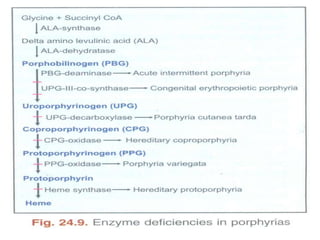
Acute intermittent porphyria
This disorder occurs due to the deficiency of the
enzyme uroporphyrinogen l synthase.
Acute intermittent porphyria is characterised by
increased excretion of porphobilinogen and δ-
aminolevulinate.
The urine gets darkened on exposure to air due
to the conversion of porphobilinogen to
porphobilin and porphyrin.
 It is usually expressed after puberty in humans.
Clinical features
 The symptoms include abdominal
pain, vomiting and cardiovascular
abnormalities.
 The neuropsychiatric disturbances observed in
these patients are believed to be due to
reduced activity of tryptophan pyrrolase
(caused by depleted heme levels), resulting in
the accumulation of tryptophan and 5-
hydroxytryptamine.
 These patients are not photosensitive since the
enzyme defect occurs prior to the formation of
uroporphyrinogen.
 The symptoms are more severe after
administration of drugs (e.g. barbiturates) that
induce the synthesis of cytochrome P450.
 This is due to the increased activity of ALA
synthase causing accumulation of PBG and
ALA.
Treatment:
 Acute intermittent porphyria is treated by
administration of hematin which inhibits the
enzyme ALA synthase and the accumulation of
porphobilinogen.
Congenital erythropoietic porphyria
 This disorder is due to a defect in the enzyme
uroporphyrinogen lll cosynthase.
 It is a rare congenital disorder caused by
autosomal recessive mode of inheritance,
mostly confined to erythropoietic tissues.
Clinical features :
 The patients are photosensitive (itching and
burning of skin when exposed to visible light)
due to the abnormal porphyrins that
accumulate.
 Increased hemolysis is also observed in the
individuals affected by this disorder.
 The individuals excrete uroporphyrinogen l and
coproporphyrinogen l which oxidize respectively
to uroporphyrin l and coproporphyrin l (red
pigments).
Porphyria cutanea tarda
 This is a chronic disease caused by a
deficiency in uroporphyrinogen decarboxylase.
 It is the most common porphyria.
 It is also known as cutaneous hepatic
porphyria.
 It is usually associated with liver damage
caused by alcohol overconsumption or iron
overload.
 Uroporphyrin accumulates in the urine.
Clinical features:
 Cutaneous photosensitivity is the most
important clinical manifestation of these
patients.
 Liver exhibits flourescence due to high
concentration of accumulated porphyrins.
Hereditary coproporphyria
 This disorder is due to a defect in the enzyme
coproporphyrinogen oxidase.
 Coproporphyrinogen lll and other intermediates
(ALA and PBG) of heme synthesis prior to the
blockade are excreted in urine and feces.
 Patients are photosensitive.
 They exhibit the clinical manifestations
observed in the patients of acute intermittent
porphyria.
Treatment :
 Infusion of hematin is used to control this
disorder.
 Hematin inhibits ALA synthase and thus
reduces the accumulation of various
intermediates.
Variegate porphyria
 It is an acute disease caused by a deficiency of
protoporphyrinogen oxidase.
 Protoporphyrinogen IX and other inermediates
prior to the block accumulate in the urine.
 The urine of these patients is coloured.
 Patients are photosensitive.
Protoporphyria
 This disorder is also known as erythropoietic
protoporphyria.
 The disease is due to a deficiency in
ferrochelatase.
 Protoporphyrin IX accumulates in erythrocytes,
bone marrow, and plasma.
 Patients are photosensitive.
 Reticulocytes and skin biopsy exhibit red
Acquired porphyrias
 The porphyrias may be acquired due to the
toxicity of several compounds.
 Exposure of the body to heavy metals (e.g. lead
), toxic compounds (e.g. hexachlorobenzene)
and drugs (e.g. griseofulvin) inhibits many
enzymes in heme synthesis.
 These include ALA dehydratase, uroporphyrin l
synthase and ferrochelatase.
 Ferrochelatase and ALA dehydratase are
particularly sensitive to inhibition by lead.
 Protoporphyrin and ALA accumulate in urine.
Diagnosis of porphyrias
 To demonstrate porphyrins, UV flourescence is
the best technique.
 The presence of porphyrin precursor in urine is
detected by Ehrlich’s reagent.
 When urine is observed under ultraviolet light;
porphyrins if present, will emit strong red
flourescence.
Thank you

Heme synthesis & disorders

  • 1.
    HEME SYNTHESIS & DISORDERS M.PrasadNaidu MSc Medical Biochemistry, Ph.D.Research Scholar
  • 2.
    HEME SYNTHESIS  Hemeis the most important porphyrin containing compound.  Heme is a derivative of the porphyrin.  Porphyrins are cyclic compounds formed by fusion of 4 pyrrole rings linked by methenyl (=CH-) bridges.
  • 3.
     Metal ionscan bind with nitrogen atoms of pyrrole rings to form complexes.  Since an atom of iron is present, heme is a ferroprotoporphyrin.  The pyrrole rings are named as l, ll, lll, lV and the bridges as alpha, beta, gamma and delta.
  • 5.
     Naturally occurringporphyrins contain substituent groups replacing the 8 hydrogen atoms of the porphyrin nucleus.  When the substituent groups have a symmetrical arrangement (1, 3, 5, 7 and 2, 4, 6, 8) they are called the I series –type l porphyrins.  The lll series have an asymmetrical distribution of substituent groups (1, 3, 5, 8 and 2, 4, 6, 7)- type ll porphyrins.
  • 7.
     Type lllis the most predominant in biological systems.  It is also called series 9, because fischer, the pioneer in porphyrin chemistry has placed it as the 9th in a series of 15 possible isomers.  Hans Fischer, the father of porphyrin chemistry, proposed a short hand model for presentation of porphyrin structures.
  • 8.
    • Hans Fischersynthesised heme in laboratory in 1920(Nobel prize, 1930). • The usual substitutions are : a.propionyl (-CH2-CH2-COOH) group b. acetyl (-CH2-COOH) group c. methyl (-CH3) group d. vinyl (-CH=CH2) group
  • 10.
    Biosynthesis of Heme Heme can be synthesised by almost all the tissues in the body.  Heme is primarily synthesised in the liver and the erythrocyte-producing cells of bone marrow (erythroid cells).  Heme is synthesised in the normoblasts, but not in the matured ones.
  • 11.
     The pathwayis partly cytoplasmic and partly mitochondrial. Step 1: ALA synthesis  The synthesis starts with the condensation of succinyl CoA and glycine in the presence of pyridoxal phosphate to form delta amino levulinic acid (ALA).  The enzyme ALA synthase is located in the mitochondria and is the rate-limiting enzyme of the pathway.
  • 13.
    Step 2: Formationof PBG  Next few reactions occur in the cytoplasm.  Two molecules of ALA are condensed to form porphobilinogen (PBG).  The condensation involves removal of 2 molecules of water and the enzyme is ALA dehydratase.  Porphobilinogen is a monopyrrole.
  • 14.
    Step 3: Formationof UPG  Condensation of 4 molecules of the PBG, results in the formation of the first porphyrin of the pathway, namely uroporphyrinogen(UPG).  The pyrrole rings are joined together by methylene bridges, which are derived from alpha carbon of glycine.
  • 15.
     When thefusion occurs, the lll series of isomers are predominantly formed; and only the lll series are further used.  This needs 2 enzymes which catalyse the reactions; PBG-deaminase (Uroporphyrinogen- l-synthase) and Uroporphyrinogen-lll- cosynthase.  During this deamination reation 4 molecules of ammonia are removed.
  • 16.
    Step 4: synthesisof CPG  The UPG-lll is next convertedto coproporphyrinogen (CPG-lll) by decarboxylation.  Four molecules of CO2 are eliminated by uroporphyrinogen decarboxylase.  The acetate groups (CH2-COOH) are decarboxylated to methyl (CH3) groups.
  • 17.
     Step 5:synthesis of PPG  Further metabolism takes place in the mitochondria.  CPG is oxidised to protoporphyrinogen (PPG- lll) by coproporphyrinogen oxidase.  Two propionic acid side chains are oxidatively decorboxylated to vinyl groups.
  • 18.
    Step 6: Generationof PP  The Protoporphyrinogen-lll is oxidised by the enzyme protoporphyrin-lll (PP-lll) in the mitochondria.  The oxidation requires molecular oxygen.  The methylene bridges (-CH2) are oxidised to methenyl bridges (-CH=) and coloured porphyrins are formed.  Protoporphyrin-9 is thus formed.
  • 19.
    Step 7: Generationof Heme  The last step in the formation of heme is the attachment of ferrous iron to the protoporphyrin.  The enzyme is heme synthase or ferrochelatase which is also located in mitochondria.  Iron atom is co-ordinately linked with 5 nitrogen atoms (4 nitrogen of pyrrole rings of protoporphyrin and 1st nitrogen atom of a histidine residue of globin).
  • 20.
     The remainingvalency of iron atom is satisfied with water or oxygen atom.  When the ferrous iron (Fe++) in heme gets oxidised to ferric (Fe+++) form, hematin is formed, which loses the property of carrying the oxygen.  Heme is red in colour, but hematin is dark brown.
  • 22.
    Regulation of Hemesynthesis  ALA synthase is regulated by repression mechanism.  Heme inhibits the synthesis of ALA synthase by acting as a co-repressor.  ALA synthase is also allosterically inhibited by hematin.  When there is excess of free heme, the Fe++ is oxidised to Fe+++(ferric), thus forming hematin.
  • 23.
     The compartmentalisationof the enzymes in the synthesis of heme makes it easier for the regulation.  The rate-limiting enzyme is in the mitochondria.  The steps 1,5,6, and 7 are taking place inside mitochondria, while steps 2,3 and 4 are in cytoplasm.
  • 25.
     Drugs likebarbiturates induce heme synthesis.  Barbiturates require the heme containing cytochrome p450 for their metabolism.  Out of the total heme synthesised, two thirds are used for cytochrome p450 production.  The steps catalysed by ferrochelatase and ALA dehydratase are inhibited by lead.
  • 26.
     INH (Isonicotinicacid hydrazide) that decreases the availability of pyridoxal phosphate may also affect heme synthesis.  High cellular concentration of glucose prevents induction of ALA synthase.  This is the basis of glucose to relieve the acute attack of porphyrias.
  • 27.
    Shunt Bilirubin  When15N or 14C labelled glycine is injected, this is incorporated into heme and into RBCs.  After 100-120 days, when RBCs are lysed, the radiolabelled Hb level is decreased, along with consequent rise in radioactive bilirubin.  However, about 15% of radioactive bilirubin is excreted within about 10 days.  This is called Shunt bilirubin.
  • 28.
     This isthe formation of bilirubin from heme in bone marrow, without being incorporated into Hb.  This is the result of ineffective erythropoiesis.  In porphyrias, especially in the erythropoietic varieties, the shunt biliribin will be increased.
  • 30.
    Disorders of Hemesynthesis  Porphyrias are group of inborn errors of metabolism associated with the biosynthesis of heme.(Greek ‘porphyria’ means purple).  These are characterised by increased production and production and excretion of porphyrins and/or their precursors (ALA + PBG).  Many of the porphyrias are inherited as autosomal dominant traits.
  • 31.
    • Porphyrias maybe broadly grouped into 3 types: a. Hepatic porphyrias b. Erythropoietic porphyrias c. porphyrias with both erythropoietic and hepatic abnormalities.
  • 33.
    Acute intermittent porphyria Thisdisorder occurs due to the deficiency of the enzyme uroporphyrinogen l synthase. Acute intermittent porphyria is characterised by increased excretion of porphobilinogen and δ- aminolevulinate. The urine gets darkened on exposure to air due to the conversion of porphobilinogen to porphobilin and porphyrin.
  • 34.
     It isusually expressed after puberty in humans. Clinical features  The symptoms include abdominal pain, vomiting and cardiovascular abnormalities.  The neuropsychiatric disturbances observed in these patients are believed to be due to reduced activity of tryptophan pyrrolase (caused by depleted heme levels), resulting in the accumulation of tryptophan and 5- hydroxytryptamine.
  • 35.
     These patientsare not photosensitive since the enzyme defect occurs prior to the formation of uroporphyrinogen.  The symptoms are more severe after administration of drugs (e.g. barbiturates) that induce the synthesis of cytochrome P450.  This is due to the increased activity of ALA synthase causing accumulation of PBG and ALA.
  • 36.
    Treatment:  Acute intermittentporphyria is treated by administration of hematin which inhibits the enzyme ALA synthase and the accumulation of porphobilinogen.
  • 37.
    Congenital erythropoietic porphyria This disorder is due to a defect in the enzyme uroporphyrinogen lll cosynthase.  It is a rare congenital disorder caused by autosomal recessive mode of inheritance, mostly confined to erythropoietic tissues.
  • 38.
    Clinical features : The patients are photosensitive (itching and burning of skin when exposed to visible light) due to the abnormal porphyrins that accumulate.  Increased hemolysis is also observed in the individuals affected by this disorder.  The individuals excrete uroporphyrinogen l and coproporphyrinogen l which oxidize respectively to uroporphyrin l and coproporphyrin l (red pigments).
  • 39.
    Porphyria cutanea tarda This is a chronic disease caused by a deficiency in uroporphyrinogen decarboxylase.  It is the most common porphyria.  It is also known as cutaneous hepatic porphyria.  It is usually associated with liver damage caused by alcohol overconsumption or iron overload.
  • 40.
     Uroporphyrin accumulatesin the urine. Clinical features:  Cutaneous photosensitivity is the most important clinical manifestation of these patients.  Liver exhibits flourescence due to high concentration of accumulated porphyrins.
  • 41.
    Hereditary coproporphyria  Thisdisorder is due to a defect in the enzyme coproporphyrinogen oxidase.  Coproporphyrinogen lll and other intermediates (ALA and PBG) of heme synthesis prior to the blockade are excreted in urine and feces.  Patients are photosensitive.  They exhibit the clinical manifestations observed in the patients of acute intermittent porphyria.
  • 42.
    Treatment :  Infusionof hematin is used to control this disorder.  Hematin inhibits ALA synthase and thus reduces the accumulation of various intermediates.
  • 43.
    Variegate porphyria  Itis an acute disease caused by a deficiency of protoporphyrinogen oxidase.  Protoporphyrinogen IX and other inermediates prior to the block accumulate in the urine.  The urine of these patients is coloured.  Patients are photosensitive.
  • 44.
    Protoporphyria  This disorderis also known as erythropoietic protoporphyria.  The disease is due to a deficiency in ferrochelatase.  Protoporphyrin IX accumulates in erythrocytes, bone marrow, and plasma.  Patients are photosensitive.  Reticulocytes and skin biopsy exhibit red
  • 45.
    Acquired porphyrias  Theporphyrias may be acquired due to the toxicity of several compounds.  Exposure of the body to heavy metals (e.g. lead ), toxic compounds (e.g. hexachlorobenzene) and drugs (e.g. griseofulvin) inhibits many enzymes in heme synthesis.
  • 46.
     These includeALA dehydratase, uroporphyrin l synthase and ferrochelatase.  Ferrochelatase and ALA dehydratase are particularly sensitive to inhibition by lead.  Protoporphyrin and ALA accumulate in urine.
  • 47.
    Diagnosis of porphyrias To demonstrate porphyrins, UV flourescence is the best technique.  The presence of porphyrin precursor in urine is detected by Ehrlich’s reagent.  When urine is observed under ultraviolet light; porphyrins if present, will emit strong red flourescence.
  • 49.