Downloaded 11 times



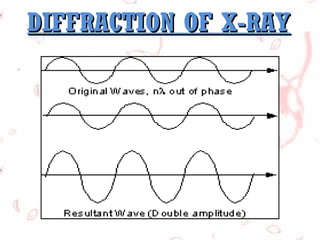
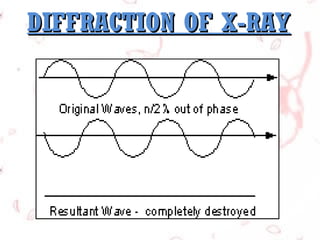
![DIFFRACTION OF X-RAY
DESTRUCTIVE INTERFERENCE
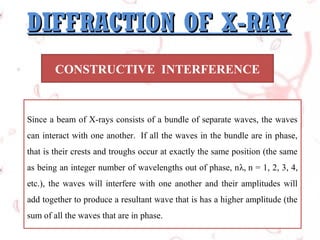
If the waves are out of phase, being off by a non-integer number of
wavelengths, then destructive interference will occur and the amplitude
of the waves will be reduced. In an extreme case, if the waves are out of
phase by an odd multiple of 1/2l [(2n+1)/2l ], the resultant wave will
have no amplitude and thus be completely destroyed.](https://image.slidesharecdn.com/chapter6x-ray-131102033648-phpapp01/85/Chapter-6-x-ray-24-320.jpg)
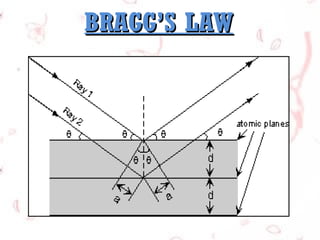
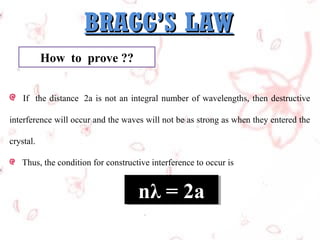
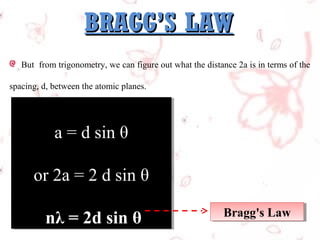
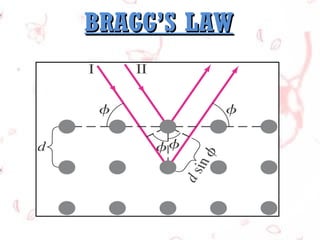



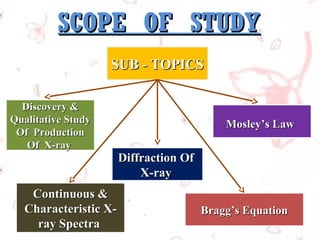
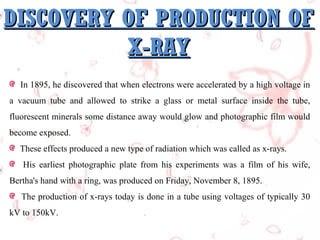
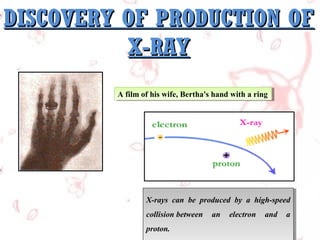
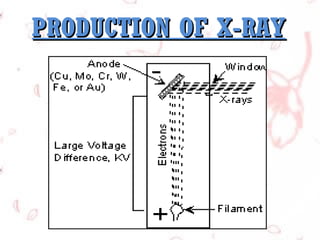
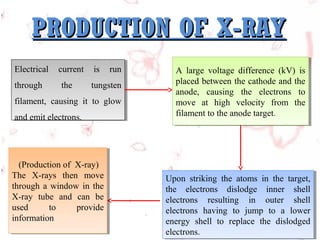
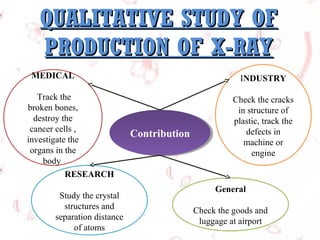
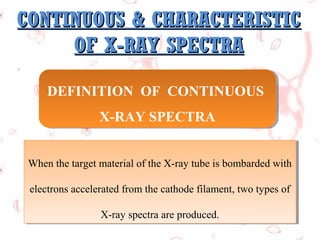
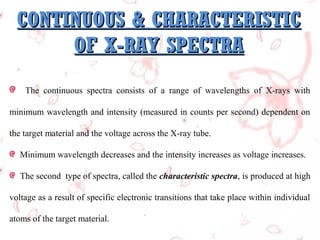
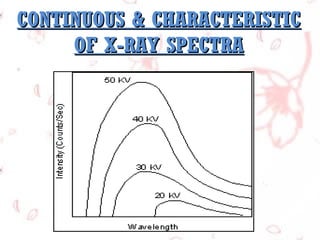
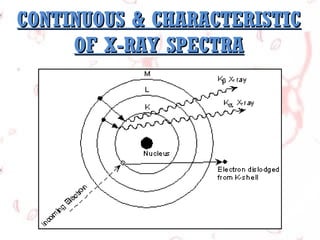
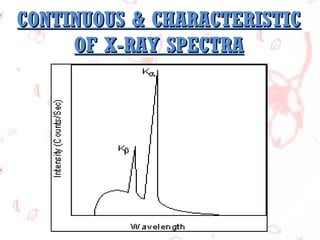
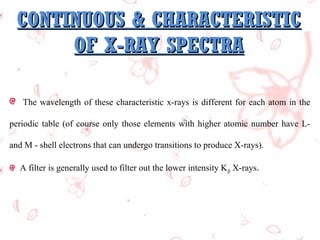
This document provides information on x-rays, including their discovery, production, properties, and applications. It discusses: - Wilhelm Roentgen's 1895 discovery of x-rays from vacuum tube experiments. - How x-rays are produced when high-speed electrons collide with atoms, ejecting inner shell electrons. - The two types of x-ray spectra produced: continuous spectra and characteristic spectra consisting of peaks corresponding to electronic transitions. - How x-rays can diffract from the planes of atoms in crystalline structures, leading to Bragg's law relating diffraction angle and plane spacing.


![Xrd presentation [autosaved] [autosaved] copy (2)](https://cdn.slidesharecdn.com/ss_thumbnails/xrdpresentationautosavedautosaved-copy2-190813130515-thumbnail.jpg?width=640&height=640&fit=bounds)


