EXTRAOCULAR MUSCLES
IMPORTANT LANDMARKS
CONTENTS OF ORBIT
 Eyeball
 Fascia bulbi
 Muscles
 Vessels
 Nerves
 Lacrimal gland
 Orbital fat
EXTRAOCULAR MUSCLES
Voluntary
muscles
Involuntary
muscles
Extraocular
muscles
LPS
Recti muscles
Oblique muscles
Superior tarsal muscle
Inferior tarsal muscle
Orbitalis muscle
• ANNULUS OF ZINN -
common tendinous ring
• Attachments
• Forms a muscle cone
RECTI MUSCLES - origin
Medial Rectus
Lateral Rectus
Superior Rectus
Inferior Rectus
RECTI MUSCLES - origin
RECTI MUSCLES - Insertion
 Inserted into sclera
 In front of equator
• Distance from cornea
MR = 5.5mm
IR = 6.5mm
LR = 6.9mm
SR = 7.7mm
5mm
6 mm
8 mm
7 mm
Superior Oblique
SUPERIOR OBLIQUE - origin
SUPERIOR OBLIQUE – Insertion
Behind the equator on sclera in posterosuperior
quadrant, between the superior and lateral rectus
Inferior Oblique
INFERIOR OBLIQUE - origin
INFERIOR OBLIQUE – Insertion
Behind the equator on sclera in posterior quadrant,
between the superior and lateral rectus
Three cranial nerves
3. Trochlear nerve2. Abducent nerve1. Oculomotor nerve
Superior obliqueLateral rectus
1. Superior rectus
2. Medial rectus
3. Inferior rectos
4. Inferior oblique
5. Levator pelpebrae
NERVE SUPPLY OF EOM
ACTION OF INDIVIDUAL MUSCLES
 Adduction-MR
 Abduction-LR
 In Abducted eye
Elevation-SR
Depression-IR
 In Adducted eye
Elevation-IO
Depression-SO
MOVEMENTS-DUCTIONS
Elevation
Depression Abduction
Adduction Intorsion
Extorsion
• Elevation & Depression – Around the transverse axis
• Adduction & Abduction – Around the vertical axis
• Intortion & Extortion – Around the anteroposterior axis
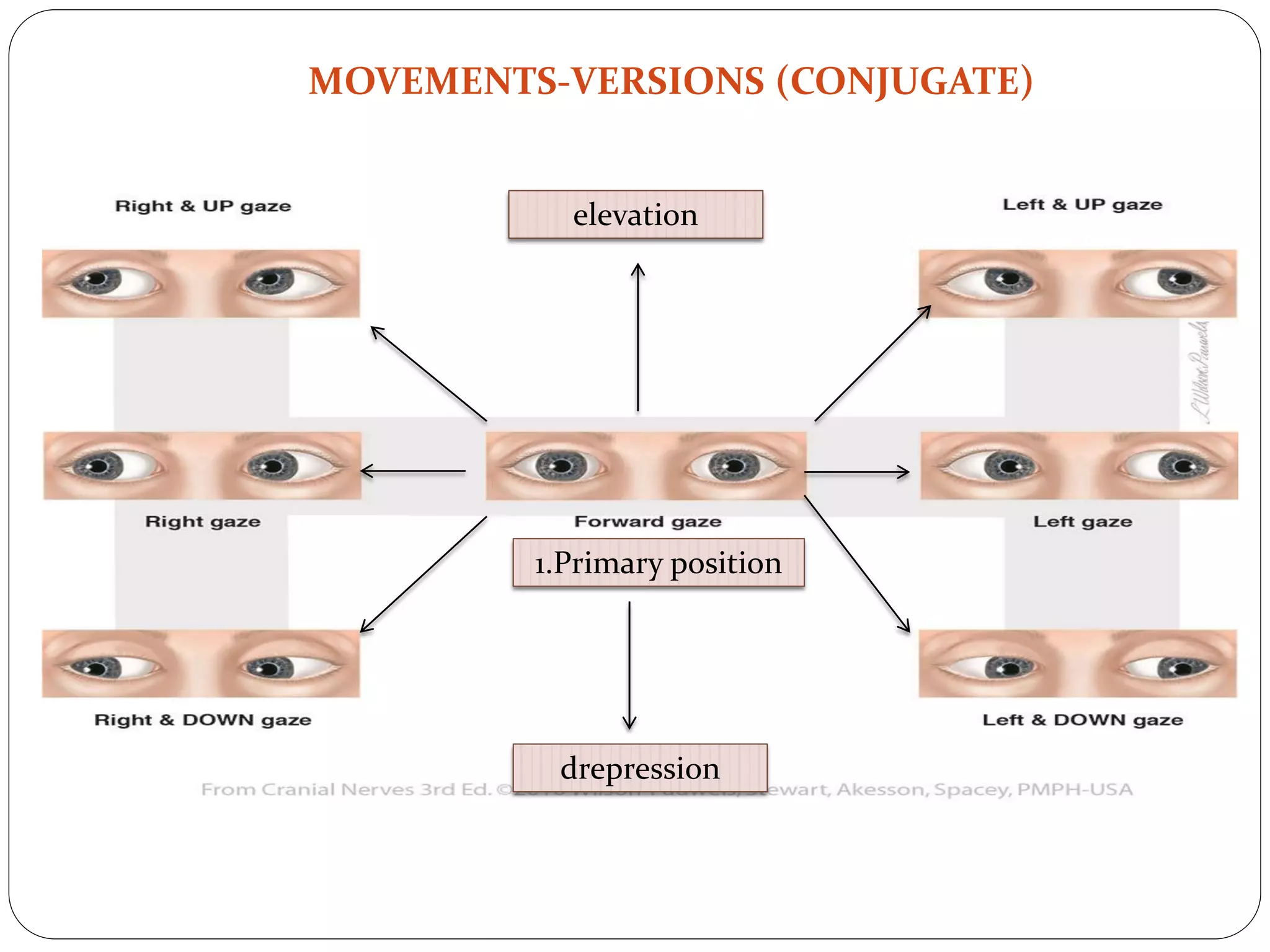
drepression
elevation
1.Primary position
MOVEMENTS-VERSIONS (CONJUGATE)
 Convergence (simultaneous movement nasally)
 Divergence (simultaneous temporal movement)
MOVEMENTS-VERGENCE
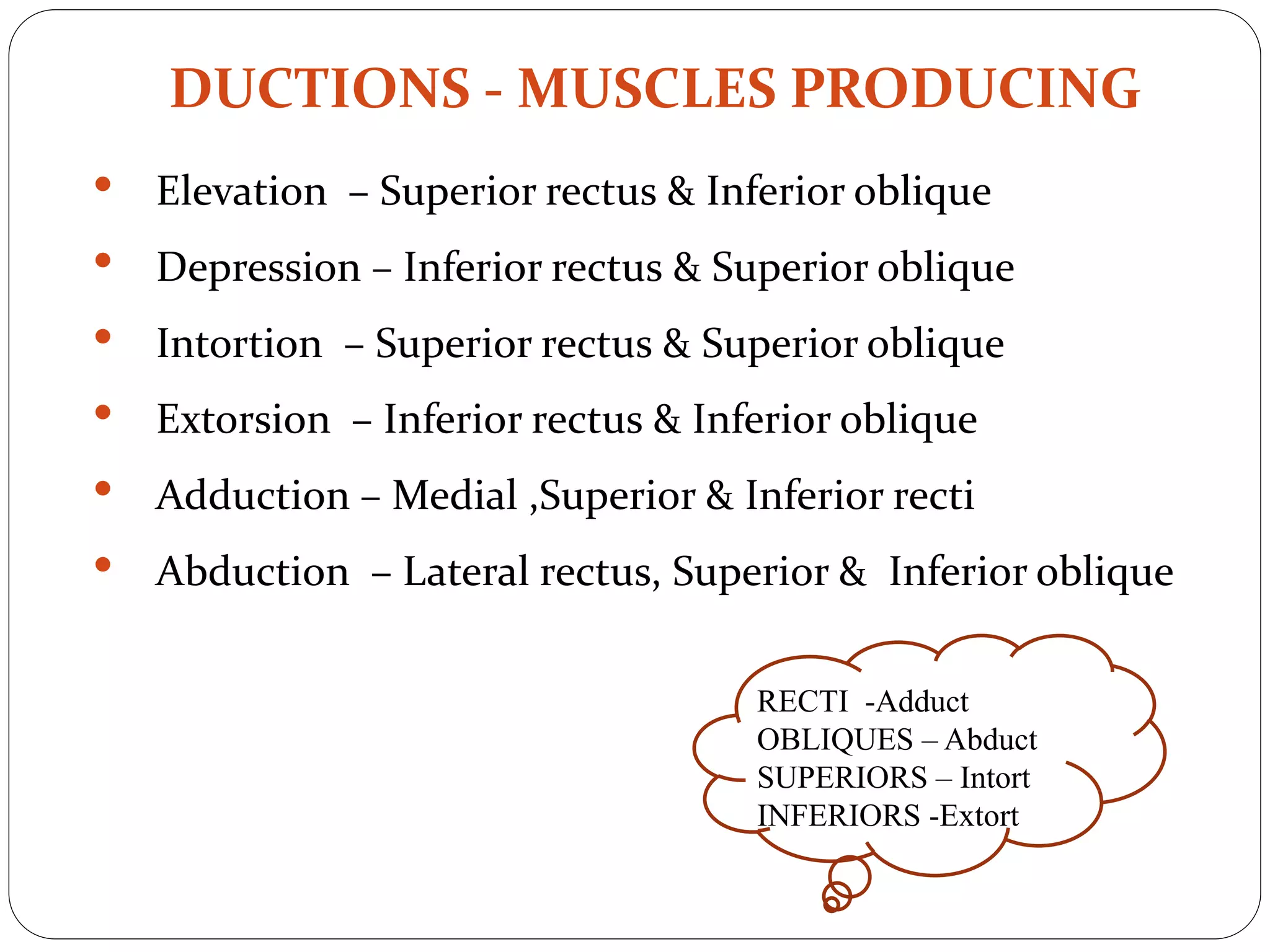
DUCTIONS - MUSCLES PRODUCING
• Elevation – Superior rectus & Inferior oblique
• Depression – Inferior rectus & Superior oblique
• Intortion – Superior rectus & Superior oblique
• Extorsion – Inferior rectus & Inferior oblique
• Adduction – Medial ,Superior & Inferior recti
• Abduction – Lateral rectus, Superior & Inferior oblique
RECTI -Adduct
OBLIQUES – Abduct
SUPERIORS – Intort
INFERIORS -Extort
Levator palpebrae superioris
LEVATOR PALPEBRAE SUPERIORIS - Origin
 Undersurface of
lesser wing of
sphenoid
• Upper lamina : Skin of
upper eyelid
• Middle lamina: Superior
tarsus(Muller’s)
• Lower lamina: Superior
conjunctival fornix
LEVATOR PALPEBRAE SUPERIORIS - Insertion
Nerve Supply :
 Voluntary part – Oculomotor Nerve
 Involuntary part – Sympathetics
Action :
Elevation of upper eye lid
LEVATOR PALPEBRAE SUPERIORIS
CINICAL TESTING
 Abnormal deviation of eyeball is known as
Squint (Strabismus)
 Damage to Abducent nerve - Medial
Squint
 Damage to Occulomotor nerve - Lateral
Squint and Ptosis-Dropping of Eyelid
 Damage to Trochlear nerve - diplopia
while looking downwards
Medial Squint
Lateral Squint and Ptosis
PTOSIS
Drooping of upper eyelid
• Complete ptosis
• Partial ptosis
Extraocular muscles

Extraocular muscles