
ANATOMY OF
DR ASHISH BADGUJAR
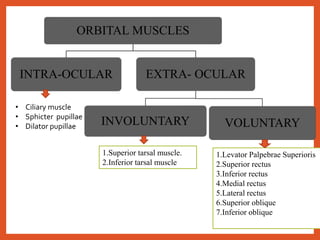
ORBITAL MUSCLES
INTRA-OCULAR EXTRA- OCULAR
INVOLUNTARY VOLUNTARY
1.Superior tarsal muscle.
2.Inferior tarsal muscle
1.Levator Palpebrae Superioris
2.Superior rectus
3.Inferior rectus
4.Medial rectus
5.Lateral rectus
6.Superior oblique
7.Inferior oblique
• Ciliary muscle
• Sphicter pupillae
• Dilator pupillae
EMBRYOLOGY
• EOM develop from mesodermal derived mesenchyme
• Myoblasts which form EOM arise from cranial
paraxial mesoderm
• Orbital connective tissue - neural crest cells
EMBRYOLOGY
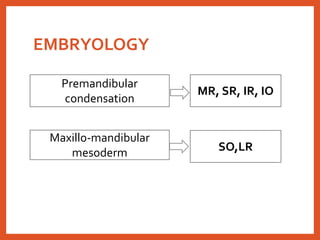
Premandibular
condensation
MR, SR, IR, IO
Maxillo-mandibular
mesoderm SO,LR
EMBRYOLOGY
•Development begins from muscle cone(annulus
of Zinn) at apex & proceeds anteriorly.
•Originally represented as a single mass of
mesenchyme.
•Later separate into distinct muscles.
EMBRYOLOGY
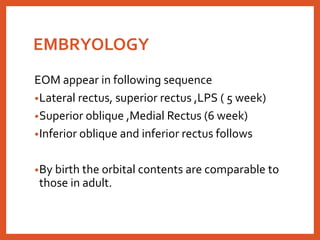
EOM appear in following sequence
•Lateral rectus, superior rectus ,LPS ( 5 week)
•Superior oblique ,Medial Rectus (6 week)
•Inferior oblique and inferior rectus follows
•By birth the orbital contents are comparable to
those in adult.
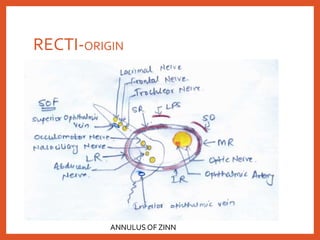
RECTI-ORIGIN
ANNULUS OF ZINN
RECTI
•Origin of superior &medial rectus are slightly at
anterior plane to others d/t slope of orbital roof
•SR&MR are closely attached to the dural sheath
of optic nerve at their origin
•In RBN pain upward & inward movement causes
pain
RECTI- COURSE
•Divergent from origin
•In front of the equator they turn towards the
eyeball & get inserted on sclera
•MR & LR follow the corresponding walls of the
orbit for most of the part
•IR remains in contact with floor for only half of
its length
•SR separated from roof by LPS
RECTI- INSERTION
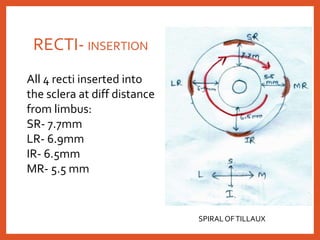
SPIRALOFTILLAUX
All 4 recti inserted into
the sclera at diff distance
from limbus:
SR- 7.7mm
LR- 6.9mm
IR- 6.5mm
MR- 5.5 mm
RECTI- INSERTION
•Medial rectus inserts closest to the limbus and is
therefore susceptible to injury during ant.
segment surgery.
•Inadvertent removal of the MR is a well known
complication of Pterygium removal
•The Scleral thickness behind the rectus insertion
is the thinnest, being only 0.3 mm thick ->
chances of scleral perforation while suturing
SUPERIOR RECTUS
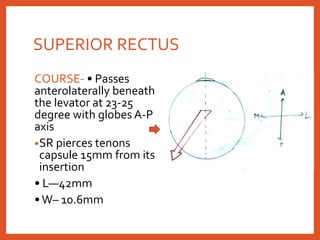
COURSE- • Passes
anterolaterally beneath
the levator at 23-25
degree with globes A-P
axis
•SR pierces tenons
capsule 15mm from its
insertion
• L—42mm
•W– 10.6mm
SUPERIOR RECTUS- RELATIONS
•Superiorly LPS & frontal nerve which separate SR
from roof of orbit
• Inferiorly ophthalmic A, nasociliary A & nerves are
separated by orbital fat
reflected tendon of SO passes bet SR & globe
• Laterally lacrimal artery &nerve are bet SR & LR
• Medially ophthalmic artery & nasociliary nerve
bet SR above and MR & SO below
SUPERIOR RECTUS
•NERVE SUPPLY- Sup div of oculomotor nerve,
entering ocular surface at junction of middle &
post 1/3rd
•BLOOD SUPPLY-The lateral muscular branch of
the ophthalmic artery
SUPERIOR RECTUS-ACTIONS
•PRIMARY- Elevation
•SECONDARY- adduction & intortion
•Globe abducted 230-VA & OA coincide
acts only as elevator, optimal posn to test fn
•Globe adducted 670-VA & OA at 900
acts only as intorter
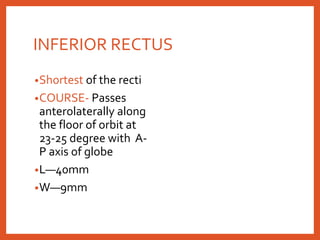
INFERIOR RECTUS
•Shortest of the recti
•COURSE- Passes
anterolaterally along
the floor of orbit at
23-25 degree with A-
P axis of globe
•L—40mm
•W—9mm
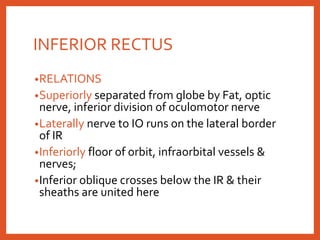
INFERIOR RECTUS
•RELATIONS
•Superiorly separated from globe by Fat, optic
nerve, inferior division of oculomotor nerve
•Laterally nerve to IO runs on the lateral border
of IR
•Inferiorly floor of orbit, infraorbital vessels &
nerves;
•Inferior oblique crosses below the IR & their
sheaths are united here
INFERIOR RECTUS
•NERVE SUPPLY by branch of inf div of
oculomotor nerve, entering ocular surface
about 15 mm from its posterior end
•BLOOD SUPPLY medial muscular branch of
ophthalmic artery
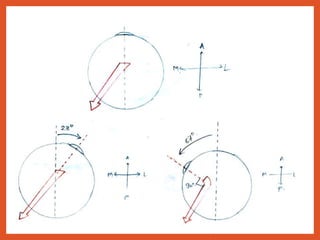
INFERIOR RECTUS- ACTIONS
•PRIMARY- Depression
•SECONDARY- adduction & extortion
•Globe abducted 230-VA & OA coincide
acts only as depressor, optimal posn to test fn
•Globe adducted 670-VA & OA at 900
acts only as extorter
MEDIAL RECTUS
•Largest ocular muscle
• Stronger than LR
•40mm long & thicker than other EOM
•COURSE- passes along the medial wall of the
orbit inserts into the sclera 5.5mm from limbus
MEDIAL RECTUS
RELATIONS
•Superiorly is SO & between MR & SO,
Ophthalmic artery &its ethmoidal branch,
ethmoidal & infratrochlear nerves
•Inferiorly floor of the orbit
•Medially peripheral fat, orbital plate of the
ethmoid & ethmoidal sinuses
•Laterally is the central orbital fat & optic nerve
MEDIAL RECTUS
•NERVE SUPPLY a branch from inf div of the
oculomotor nerve enters the lateral surface
about 15mm from the orbital attachment of the
muscle
•BLOOD SUPPLY the medial muscular branch of
the ophthalmic artery
•Action adduction of the globe in the primary
position
LATERAL RECTUS
•Takes origin asTWO HEADS from lateral ends
of upper & lower tendon ring & adjoining part of
greater wing of sphenoid
•Two heads unite & run forwards along lateral
orbital wall
•Inserted into sclera 6.9mm from limbus
•The LR is often visible through the conjunctiva
& tenon’s capsule.
LATERAL RECTUS- RELATIONS
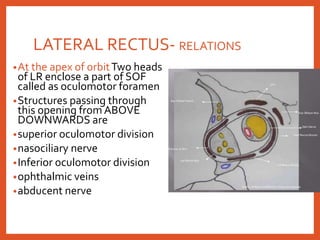
•At the apex of orbitTwo heads
of LR enclose a part of SOF
called as oculomotor foramen
•Structures passing through
this opening from ABOVE
DOWNWARDS are
•superior oculomotor division
•nasociliary nerve
•Inferior oculomotor division
•ophthalmic veins
•abducent nerve
LATERAL RECTUS
•Superiorly lacrimal artery(ant 2/3rd ) & nerve
(whole of its upper border)
•Inferiorly floor of orbit & tendon of IO passing
inferiorly & then medial to LR to its attachment
•Medially near apex abducent nerve, ciliary
ganglion, ophthalmic A are present btw LR &
optic nerve
•Nerve to IO lies btw LR & IR
•Laterally Periorbita, perimuscular fat, lacrimal
gland
LATERAL RECTUS
•NERVE SUPPLY- Abducent nerve enters ocular
aspect just post to its midpoint
•BLOOD SUPPLY- lateral muscular branch of
ophthalmic artery & lacrimal artery
•ACTION- Abduction of the globe in horizontal
plane
SUPERIOR OBLIQUE
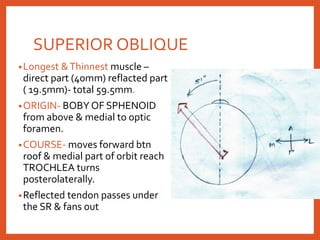
•Longest &Thinnest muscle –
direct part (40mm) reflacted part
( 19.5mm)- total 59.5mm.
•ORIGIN- BOBY OF SPHENOID
from above & medial to optic
foramen.
•COURSE- moves forward btn
roof & medial part of orbit reach
TROCHLEA turns
posterolaterally.
•Reflected tendon passes under
the SR & fans out
SUPERIOR OBLIQUE
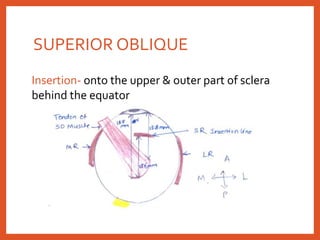
Insertion- onto the upper & outer part of sclera
behind the equator
SUPERIOR OBLIQUE
•NERVE SUPPLY-Trochlear nerve, after dividing
into 3-4 branches, enters SO superiorly & near
its lateral border in post half of its belly
•BLOOD SUPPLY- lateral muscular branch of the
ophthalmic artery
SUPERIOR OBLIQUE
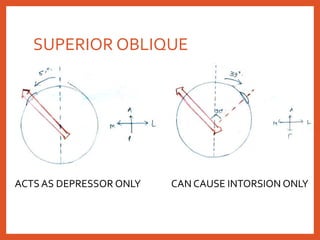
ACTIONS-
•PRIMARY- intorsion
•SECONDARY- depression & abduction
ANTERIORFIBRES INTORSION
POSTERIOR FIBRES DEPRESSION
SUPERIOR OBLIQUE
ACTS AS DEPRESSOR ONLY CAN CAUSE INTORSION ONLY
INFERIOR OBLIQUE
•Shortest muscle- 37mm long
•Only EOM attached near front of the orbit
•ORIGINE- Originate as a rounded tendon from
the orbital plate of maxilla just lateral to orifice
of naso-lacrimalduct
•COURSE- It arcs laterally & posteriorly around
the globe passes btw IR & floor of the orbit
INFERIOR OBLIQUE
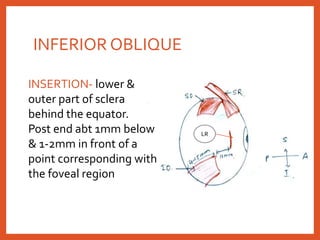
INSERTION- lower &
outer part of sclera
behind the equator.
Post end abt 1mm below
& 1-2mm in front of a
point corresponding with
the foveal region
LR
INFERIOR OBLIQUE
RELATIONS
•Superiorly fat & IR
•Inferiorly periosteum of the orbital floor
•Laterally LR & fascia bulbi
NERVE SUPPLY- Inf div of oculomotor which
crosses the midpt of its post border to enter IO
on sup surface
INFERIOR OBLIQUE
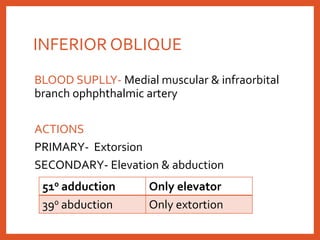
BLOOD SUPLLY- Medial muscular & infraorbital
branch ophphthalmic artery
ACTIONS
PRIMARY- Extorsion
SECONDARY- Elevation & abduction
510 adduction Only elevator
390 abduction Only extortion
BLOOD SUPPLY
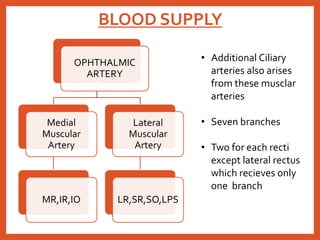
OPHTHALMIC
ARTERY
Medial
Muscular
Artery
MR,IR,IO
Lateral
Muscular
Artery
LR,SR,SO,LPS
• Additional Ciliary
arteries also arises
from these musclar
arteries
• Seven branches
• Two for each recti
except lateral rectus
which recieves only
one branch
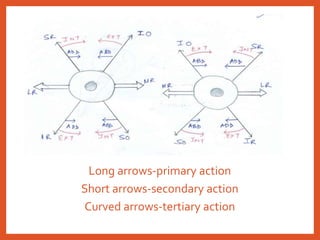
Long arrows-primary action
Short arrows-secondary action
Curved arrows-tertiary action
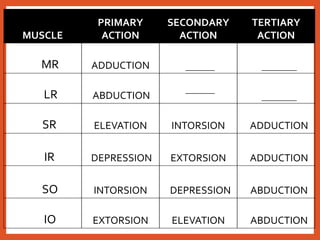
MUSCLE
PRIMARY
ACTION
SECONDARY
ACTION
TERTIARY
ACTION
MR ADDUCTION __________ ____________
LR ABDUCTION
__________
____________
SR ELEVATION INTORSION ADDUCTION
IR DEPRESSION EXTORSION ADDUCTION
SO INTORSION DEPRESSION ABDUCTION
IO EXTORSION ELEVATION ABDUCTION
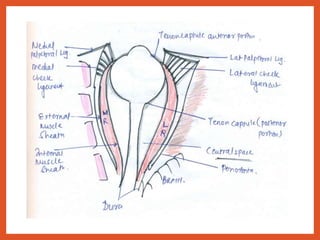
Fascial sheaths of extraocular
muscles
•Separate membranous lining of the muscles
which blend anteriorly with the tenon’s capsule.
(OR)
•Parts of the orbital fascia, where the fascia bulbi
is pierced by an extraocular muscle which
clothes the muscle like a glove.
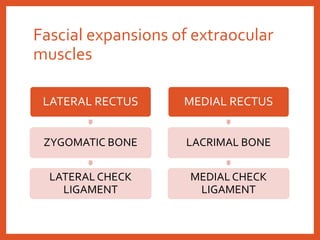
Fascial expansions of extraocular
muscles
LATERAL RECTUS
ZYGOMATIC BONE
LATERAL CHECK
LIGAMENT
MEDIAL RECTUS
LACRIMAL BONE
MEDIAL CHECK
LIGAMENT
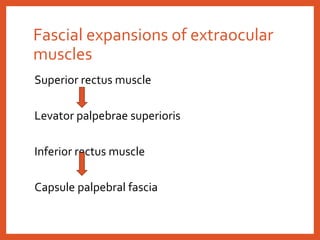
Fascial expansions of extraocular
muscles
Superior rectus muscle
Levator palpebrae superioris
Inferior rectus muscle
Capsule palpebral fascia
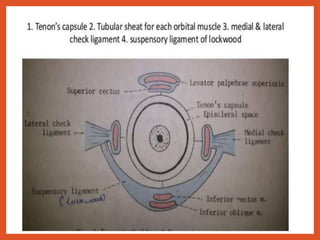
Suspensory ligament of Lockwood
Fusion of medial rectus, inferior rectus,
inferior oblique and lateral rectus muscle
sheaths
It extends from posterior lacrimal crest to
lateral orbital tubercule
Superior transverse ligament of
whitnall
•condensation of superior sheaths of LPS with
reflected tendon of superior oblique muscle.
•It extends from trochlear pulley to the lacrimal
gland and its fossa.
Suspensory ligament of the fornices
•Superior is formed by superior rectus and LPS
•Inferior is formed by forward continuation of lid
retractors
PULLEY SYSTEM
•High resolution MRI
• Dense band of collagen & elastin
• Contain smooth muscle
• Capable of adjusting vector forces of EOM on
globe in various gazes
CLASSIFICATION
•Location: orbital or global
• Colour : red, intermediate or pale
• Innervational pattern: singly or multiple
innervation
Porter et all classification
•Orbital singly innervated fibres OSIF
•Orbital multiple innervated fibres OMIF
•Global red singly innervated fibres GRSIF
•Global intermediate singly innervated fibres
GISIF
•Global pale singly innervated fibres GPSIF
•Global multiply innervated fibres GMIF
BasicKinematics
 Positions of gaze
 Primary
 Secondary
 Tertiary
 Cardinal
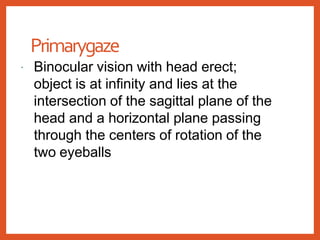
Primarygaze
 Binocular vision with head erect;
object is at infinity and lies at the
intersection of the sagittal plane of the
head and a horizontal plane passing
through the centers of rotation of the
two eyeballs
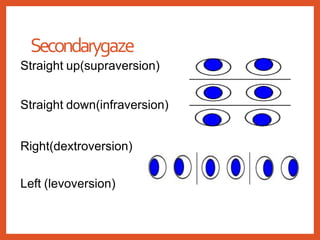
Secondarygaze
Straight up(supraversion)
Straight down(infraversion)
Right(dextroversion)
Left (levoversion)
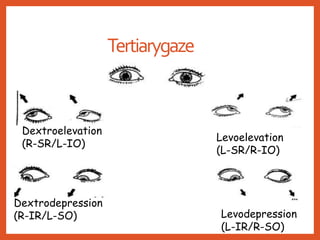
Tertiarygaze
Levoelevation
(L-SR/R-IO)
Dextroelevation
(R-SR/L-IO)
Dextrodepression
(R-IR/L-SO) Levodepression
(L-IR/R-SO)
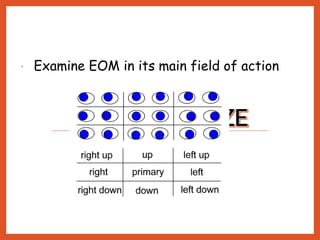
 Examine EOM in its main field of action
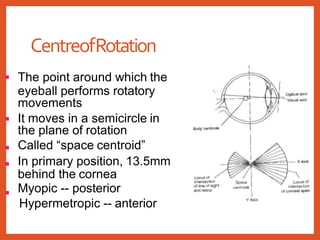
CentreofRotation





The point around which the
eyeball performs rotatory
movements
It moves in a semicircle in
the plane of rotation
Called “space centroid”
In primary position, 13.5mm
behind the cornea
Myopic -- posterior
Hypermetropic -- anterior
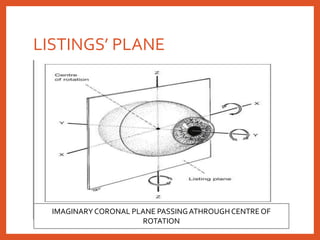
LISTINGS’ PLANE
IMAGINARY CORONAL PLANE PASSINGATHROUGH CENTRE OF
ROTATION
FICK’S AXES
• X ( horizontal) axis
•Lies horizontally when head is
upright
•Elevation / Depression
•Y ( antero-posterior) axis
•Torsional movements
•Extorsion / Intorsion
•Z ( vertical axis)
•Adduction / Abduction
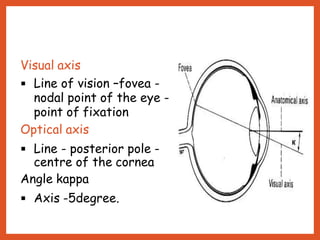
Visual axis
 Line of vision –fovea -
nodal point of the eye -
point of fixation
Optical axis
 Line - posterior pole -
centre of the cornea
Angle kappa
 Axis -5degree.



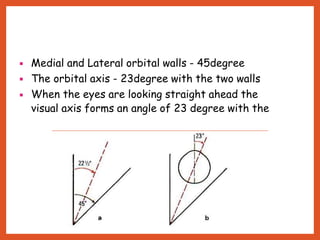
Medial and Lateral orbital walls - 45degree
The orbital axis - 23degree with the two walls
When the eyes are looking straight ahead the
visual axis forms an angle of 23 degree with the
orbital axis
•Agonist- Particular muscle - specific ocular
movement.Eg: Abduction in right eye-right
lateral rectus muscle
•Synergists- Muscles- same eye move the eye in
same direction.Eg: superior rectus and inferior
oblique as elevators.
•Antagonists- Muscles of the same eye - opposite
direction Eg: medial and lateral rectus
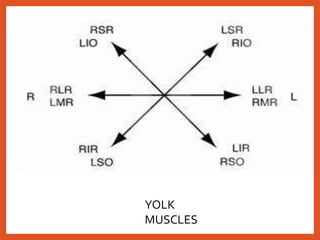
Yoke muscles
•These are pairs of muscles, one in each eye,
which contract simultaneously during version
movements.
Eg: right lateral rectus and left medial rectus –
dextroversion
YOLK
MUSCLES
Hering’s law of equal innervation
•For any binocular movement the
corresponding(YOKE) muscles receive equal and
simultaneous innervation
Sherrington’s law of reciprocal
innervation
•States that for any binocular movement the
direct antagonist recieves an equal and
simultaneous inhibition of its innervation
Ocular movements
 Monocular (Duction)
 Binocular
 Version
 Vergence
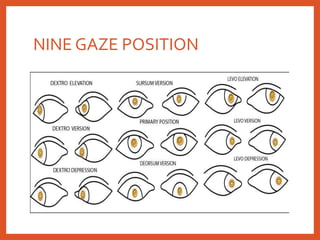
NINE GAZE POSITION
APPLIED ANATOMY
•Sclera is thinnest just behind insertion of recti
0.3mm
• All muscles are innervated from intraconal side
of belly of muscle except trochlear nerve which
supplies SO from extraconal side .so this nerve is
not affected in retrobulbar block
• MR only muscle with no fascial connections to
adjacent oblique muscles
APPLIED ANATOMY
• During strabismus surgery if MR is disinserted
& released from globe it can retract completely
behind the globe making retrieval difficult
•SR recession will pull levator also posteriorly
causing upperlid retraction &fissure widening
.so removal of fascial connections are important
during surgery
APPLIED ANATOMY
•The muscle cone divides the retrobulbar area
into intra conal and extra conal spaces.(Axial
proptosis/para axial proptosis).
•Paralytic squint- ocular deviation due to
complete or incomplete paralysis of one or
more EOM
Extraocular muscles

Extraocular muscles

  • 1.
  • 2.
    ORBITAL MUSCLES INTRA-OCULAR EXTRA-OCULAR INVOLUNTARY VOLUNTARY 1.Superior tarsal muscle. 2.Inferior tarsal muscle 1.Levator Palpebrae Superioris 2.Superior rectus 3.Inferior rectus 4.Medial rectus 5.Lateral rectus 6.Superior oblique 7.Inferior oblique • Ciliary muscle • Sphicter pupillae • Dilator pupillae
  • 4.
    EMBRYOLOGY • EOM developfrom mesodermal derived mesenchyme • Myoblasts which form EOM arise from cranial paraxial mesoderm • Orbital connective tissue - neural crest cells
  • 5.
    EMBRYOLOGY Premandibular condensation MR, SR, IR,IO Maxillo-mandibular mesoderm SO,LR
  • 6.
    EMBRYOLOGY •Development begins frommuscle cone(annulus of Zinn) at apex & proceeds anteriorly. •Originally represented as a single mass of mesenchyme. •Later separate into distinct muscles.
  • 7.
    EMBRYOLOGY EOM appear infollowing sequence •Lateral rectus, superior rectus ,LPS ( 5 week) •Superior oblique ,Medial Rectus (6 week) •Inferior oblique and inferior rectus follows •By birth the orbital contents are comparable to those in adult.
  • 8.
  • 9.
    RECTI •Origin of superior&medial rectus are slightly at anterior plane to others d/t slope of orbital roof •SR&MR are closely attached to the dural sheath of optic nerve at their origin •In RBN pain upward & inward movement causes pain
  • 10.
    RECTI- COURSE •Divergent fromorigin •In front of the equator they turn towards the eyeball & get inserted on sclera •MR & LR follow the corresponding walls of the orbit for most of the part •IR remains in contact with floor for only half of its length •SR separated from roof by LPS
  • 11.
    RECTI- INSERTION SPIRALOFTILLAUX All 4recti inserted into the sclera at diff distance from limbus: SR- 7.7mm LR- 6.9mm IR- 6.5mm MR- 5.5 mm
  • 12.
    RECTI- INSERTION •Medial rectusinserts closest to the limbus and is therefore susceptible to injury during ant. segment surgery. •Inadvertent removal of the MR is a well known complication of Pterygium removal •The Scleral thickness behind the rectus insertion is the thinnest, being only 0.3 mm thick -> chances of scleral perforation while suturing
  • 13.
    SUPERIOR RECTUS COURSE- •Passes anterolaterally beneath the levator at 23-25 degree with globes A-P axis •SR pierces tenons capsule 15mm from its insertion • L—42mm •W– 10.6mm
  • 14.
    SUPERIOR RECTUS- RELATIONS •SuperiorlyLPS & frontal nerve which separate SR from roof of orbit • Inferiorly ophthalmic A, nasociliary A & nerves are separated by orbital fat reflected tendon of SO passes bet SR & globe • Laterally lacrimal artery &nerve are bet SR & LR • Medially ophthalmic artery & nasociliary nerve bet SR above and MR & SO below
  • 15.
    SUPERIOR RECTUS •NERVE SUPPLY-Sup div of oculomotor nerve, entering ocular surface at junction of middle & post 1/3rd •BLOOD SUPPLY-The lateral muscular branch of the ophthalmic artery
  • 16.
    SUPERIOR RECTUS-ACTIONS •PRIMARY- Elevation •SECONDARY-adduction & intortion •Globe abducted 230-VA & OA coincide acts only as elevator, optimal posn to test fn •Globe adducted 670-VA & OA at 900 acts only as intorter
  • 18.
    INFERIOR RECTUS •Shortest ofthe recti •COURSE- Passes anterolaterally along the floor of orbit at 23-25 degree with A- P axis of globe •L—40mm •W—9mm
  • 19.
    INFERIOR RECTUS •RELATIONS •Superiorly separatedfrom globe by Fat, optic nerve, inferior division of oculomotor nerve •Laterally nerve to IO runs on the lateral border of IR •Inferiorly floor of orbit, infraorbital vessels & nerves; •Inferior oblique crosses below the IR & their sheaths are united here
  • 20.
    INFERIOR RECTUS •NERVE SUPPLYby branch of inf div of oculomotor nerve, entering ocular surface about 15 mm from its posterior end •BLOOD SUPPLY medial muscular branch of ophthalmic artery
  • 21.
    INFERIOR RECTUS- ACTIONS •PRIMARY-Depression •SECONDARY- adduction & extortion •Globe abducted 230-VA & OA coincide acts only as depressor, optimal posn to test fn •Globe adducted 670-VA & OA at 900 acts only as extorter
  • 22.
    MEDIAL RECTUS •Largest ocularmuscle • Stronger than LR •40mm long & thicker than other EOM •COURSE- passes along the medial wall of the orbit inserts into the sclera 5.5mm from limbus
  • 23.
    MEDIAL RECTUS RELATIONS •Superiorly isSO & between MR & SO, Ophthalmic artery &its ethmoidal branch, ethmoidal & infratrochlear nerves •Inferiorly floor of the orbit •Medially peripheral fat, orbital plate of the ethmoid & ethmoidal sinuses •Laterally is the central orbital fat & optic nerve
  • 24.
    MEDIAL RECTUS •NERVE SUPPLYa branch from inf div of the oculomotor nerve enters the lateral surface about 15mm from the orbital attachment of the muscle •BLOOD SUPPLY the medial muscular branch of the ophthalmic artery •Action adduction of the globe in the primary position
  • 25.
    LATERAL RECTUS •Takes originasTWO HEADS from lateral ends of upper & lower tendon ring & adjoining part of greater wing of sphenoid •Two heads unite & run forwards along lateral orbital wall •Inserted into sclera 6.9mm from limbus •The LR is often visible through the conjunctiva & tenon’s capsule.
  • 26.
    LATERAL RECTUS- RELATIONS •Atthe apex of orbitTwo heads of LR enclose a part of SOF called as oculomotor foramen •Structures passing through this opening from ABOVE DOWNWARDS are •superior oculomotor division •nasociliary nerve •Inferior oculomotor division •ophthalmic veins •abducent nerve
  • 27.
    LATERAL RECTUS •Superiorly lacrimalartery(ant 2/3rd ) & nerve (whole of its upper border) •Inferiorly floor of orbit & tendon of IO passing inferiorly & then medial to LR to its attachment •Medially near apex abducent nerve, ciliary ganglion, ophthalmic A are present btw LR & optic nerve •Nerve to IO lies btw LR & IR •Laterally Periorbita, perimuscular fat, lacrimal gland
  • 28.
    LATERAL RECTUS •NERVE SUPPLY-Abducent nerve enters ocular aspect just post to its midpoint •BLOOD SUPPLY- lateral muscular branch of ophthalmic artery & lacrimal artery •ACTION- Abduction of the globe in horizontal plane
  • 29.
    SUPERIOR OBLIQUE •Longest &Thinnestmuscle – direct part (40mm) reflacted part ( 19.5mm)- total 59.5mm. •ORIGIN- BOBY OF SPHENOID from above & medial to optic foramen. •COURSE- moves forward btn roof & medial part of orbit reach TROCHLEA turns posterolaterally. •Reflected tendon passes under the SR & fans out
  • 30.
    SUPERIOR OBLIQUE Insertion- ontothe upper & outer part of sclera behind the equator
  • 31.
    SUPERIOR OBLIQUE •NERVE SUPPLY-Trochlearnerve, after dividing into 3-4 branches, enters SO superiorly & near its lateral border in post half of its belly •BLOOD SUPPLY- lateral muscular branch of the ophthalmic artery
  • 32.
    SUPERIOR OBLIQUE ACTIONS- •PRIMARY- intorsion •SECONDARY-depression & abduction ANTERIORFIBRES INTORSION POSTERIOR FIBRES DEPRESSION
  • 33.
    SUPERIOR OBLIQUE ACTS ASDEPRESSOR ONLY CAN CAUSE INTORSION ONLY
  • 34.
    INFERIOR OBLIQUE •Shortest muscle-37mm long •Only EOM attached near front of the orbit •ORIGINE- Originate as a rounded tendon from the orbital plate of maxilla just lateral to orifice of naso-lacrimalduct •COURSE- It arcs laterally & posteriorly around the globe passes btw IR & floor of the orbit
  • 35.
    INFERIOR OBLIQUE INSERTION- lower& outer part of sclera behind the equator. Post end abt 1mm below & 1-2mm in front of a point corresponding with the foveal region LR
  • 36.
    INFERIOR OBLIQUE RELATIONS •Superiorly fat& IR •Inferiorly periosteum of the orbital floor •Laterally LR & fascia bulbi NERVE SUPPLY- Inf div of oculomotor which crosses the midpt of its post border to enter IO on sup surface
  • 37.
    INFERIOR OBLIQUE BLOOD SUPLLY-Medial muscular & infraorbital branch ophphthalmic artery ACTIONS PRIMARY- Extorsion SECONDARY- Elevation & abduction 510 adduction Only elevator 390 abduction Only extortion
  • 38.
    BLOOD SUPPLY OPHTHALMIC ARTERY Medial Muscular Artery MR,IR,IO Lateral Muscular Artery LR,SR,SO,LPS • AdditionalCiliary arteries also arises from these musclar arteries • Seven branches • Two for each recti except lateral rectus which recieves only one branch
  • 39.
    Long arrows-primary action Shortarrows-secondary action Curved arrows-tertiary action
  • 40.
    MUSCLE PRIMARY ACTION SECONDARY ACTION TERTIARY ACTION MR ADDUCTION ______________________ LR ABDUCTION __________ ____________ SR ELEVATION INTORSION ADDUCTION IR DEPRESSION EXTORSION ADDUCTION SO INTORSION DEPRESSION ABDUCTION IO EXTORSION ELEVATION ABDUCTION
  • 41.
    Fascial sheaths ofextraocular muscles •Separate membranous lining of the muscles which blend anteriorly with the tenon’s capsule. (OR) •Parts of the orbital fascia, where the fascia bulbi is pierced by an extraocular muscle which clothes the muscle like a glove.
  • 43.
    Fascial expansions ofextraocular muscles LATERAL RECTUS ZYGOMATIC BONE LATERAL CHECK LIGAMENT MEDIAL RECTUS LACRIMAL BONE MEDIAL CHECK LIGAMENT
  • 44.
    Fascial expansions ofextraocular muscles Superior rectus muscle Levator palpebrae superioris Inferior rectus muscle Capsule palpebral fascia
  • 45.
    Suspensory ligament ofLockwood Fusion of medial rectus, inferior rectus, inferior oblique and lateral rectus muscle sheaths It extends from posterior lacrimal crest to lateral orbital tubercule
  • 47.
    Superior transverse ligamentof whitnall •condensation of superior sheaths of LPS with reflected tendon of superior oblique muscle. •It extends from trochlear pulley to the lacrimal gland and its fossa.
  • 48.
    Suspensory ligament ofthe fornices •Superior is formed by superior rectus and LPS •Inferior is formed by forward continuation of lid retractors
  • 49.
    PULLEY SYSTEM •High resolutionMRI • Dense band of collagen & elastin • Contain smooth muscle • Capable of adjusting vector forces of EOM on globe in various gazes
  • 50.
    CLASSIFICATION •Location: orbital orglobal • Colour : red, intermediate or pale • Innervational pattern: singly or multiple innervation
  • 51.
    Porter et allclassification •Orbital singly innervated fibres OSIF •Orbital multiple innervated fibres OMIF •Global red singly innervated fibres GRSIF •Global intermediate singly innervated fibres GISIF •Global pale singly innervated fibres GPSIF •Global multiply innervated fibres GMIF
  • 52.
    BasicKinematics  Positions ofgaze  Primary  Secondary  Tertiary  Cardinal
  • 53.
    Primarygaze  Binocular visionwith head erect; object is at infinity and lies at the intersection of the sagittal plane of the head and a horizontal plane passing through the centers of rotation of the two eyeballs
  • 54.
  • 55.
  • 56.
     Examine EOMin its main field of action
  • 57.
    CentreofRotation      The point aroundwhich the eyeball performs rotatory movements It moves in a semicircle in the plane of rotation Called “space centroid” In primary position, 13.5mm behind the cornea Myopic -- posterior Hypermetropic -- anterior
  • 58.
    LISTINGS’ PLANE IMAGINARY CORONALPLANE PASSINGATHROUGH CENTRE OF ROTATION
  • 59.
    FICK’S AXES • X( horizontal) axis •Lies horizontally when head is upright •Elevation / Depression •Y ( antero-posterior) axis •Torsional movements •Extorsion / Intorsion •Z ( vertical axis) •Adduction / Abduction
  • 60.
    Visual axis  Lineof vision –fovea - nodal point of the eye - point of fixation Optical axis  Line - posterior pole - centre of the cornea Angle kappa  Axis -5degree.
  • 61.
       Medial and Lateralorbital walls - 45degree The orbital axis - 23degree with the two walls When the eyes are looking straight ahead the visual axis forms an angle of 23 degree with the orbital axis
  • 62.
    •Agonist- Particular muscle- specific ocular movement.Eg: Abduction in right eye-right lateral rectus muscle •Synergists- Muscles- same eye move the eye in same direction.Eg: superior rectus and inferior oblique as elevators. •Antagonists- Muscles of the same eye - opposite direction Eg: medial and lateral rectus
  • 63.
    Yoke muscles •These arepairs of muscles, one in each eye, which contract simultaneously during version movements. Eg: right lateral rectus and left medial rectus – dextroversion
  • 64.
  • 65.
    Hering’s law ofequal innervation •For any binocular movement the corresponding(YOKE) muscles receive equal and simultaneous innervation Sherrington’s law of reciprocal innervation •States that for any binocular movement the direct antagonist recieves an equal and simultaneous inhibition of its innervation
  • 66.
    Ocular movements  Monocular(Duction)  Binocular  Version  Vergence
  • 67.
  • 68.
    APPLIED ANATOMY •Sclera isthinnest just behind insertion of recti 0.3mm • All muscles are innervated from intraconal side of belly of muscle except trochlear nerve which supplies SO from extraconal side .so this nerve is not affected in retrobulbar block • MR only muscle with no fascial connections to adjacent oblique muscles
  • 69.
    APPLIED ANATOMY • Duringstrabismus surgery if MR is disinserted & released from globe it can retract completely behind the globe making retrieval difficult •SR recession will pull levator also posteriorly causing upperlid retraction &fissure widening .so removal of fascial connections are important during surgery
  • 70.
    APPLIED ANATOMY •The musclecone divides the retrobulbar area into intra conal and extra conal spaces.(Axial proptosis/para axial proptosis). •Paralytic squint- ocular deviation due to complete or incomplete paralysis of one or more EOM