ANATOMY OF RETINA
DR.SHAH-NOOR HASSAN
FCPS,FRCS(Glasgow)
 The retina is the internal layer of the eyeball ,
which is a thin membrane having a purplish
red color in living subject.
 This is responsible for various kinds of visual
function –
1. Detail discrimination.
2. Color perception.
3. Vision is dim illumination.
4. Peripheral vision.
Development of the Retina
 Develops from optic cup.
 Pigment epithelial layer developes from
the outer layer of the optic cup.
 Neuroretinal layer develops from the inner
layer.
Gross anatomy of Retina
 Extend – from scalloped
margin of the ora
serrata anteriorly, upto
optc disc posteriorly.
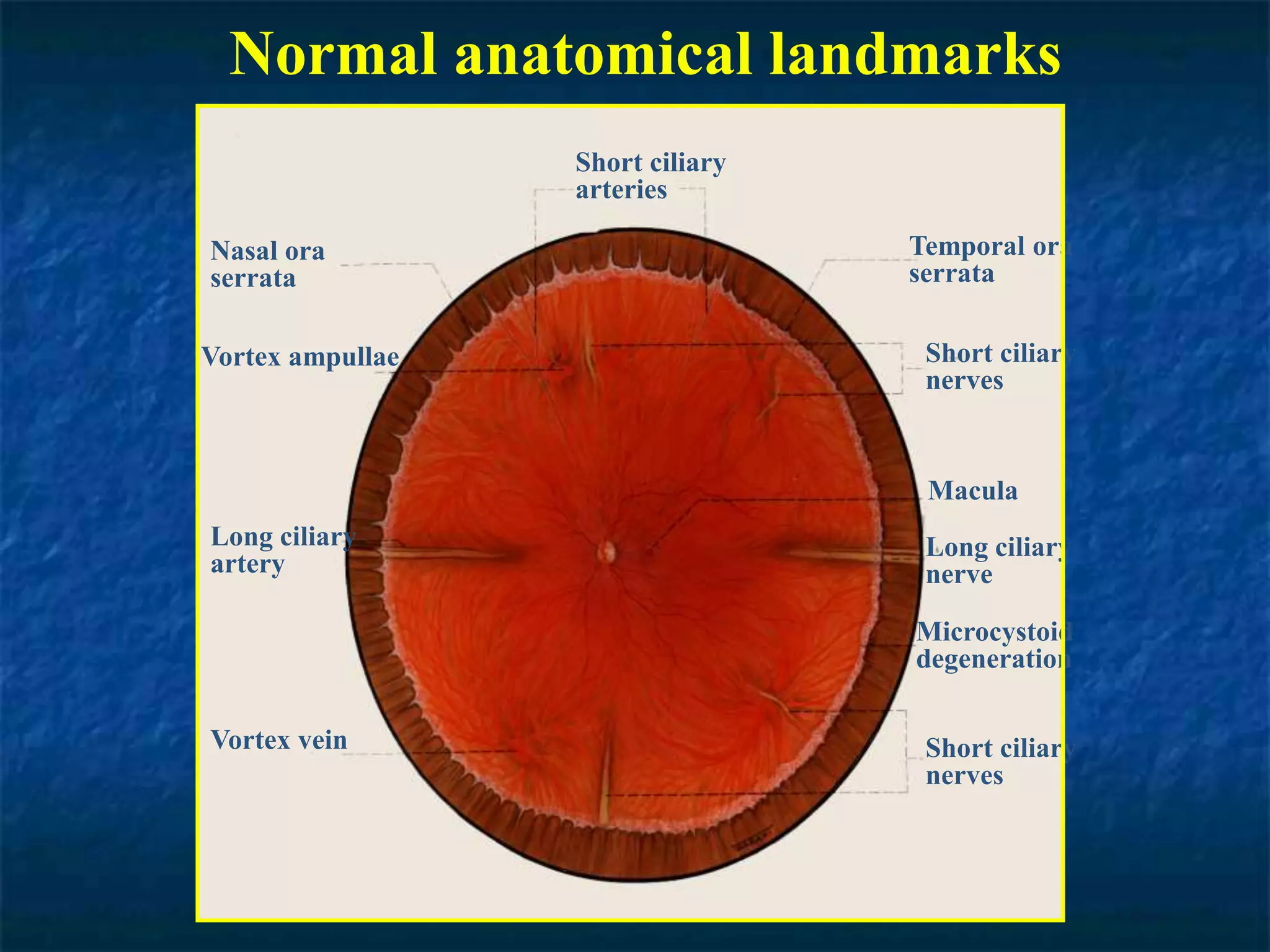
Normal anatomical landmarks
Short ciliary
arteries
Temporal ora
serrata
Short ciliary
nerves
Macula
Long ciliary
nerve
Short ciliary
nerves
Microcystoid
degeneration
Nasal ora
serrata
Vortex ampullae
Long ciliary
artery
Vortex vein
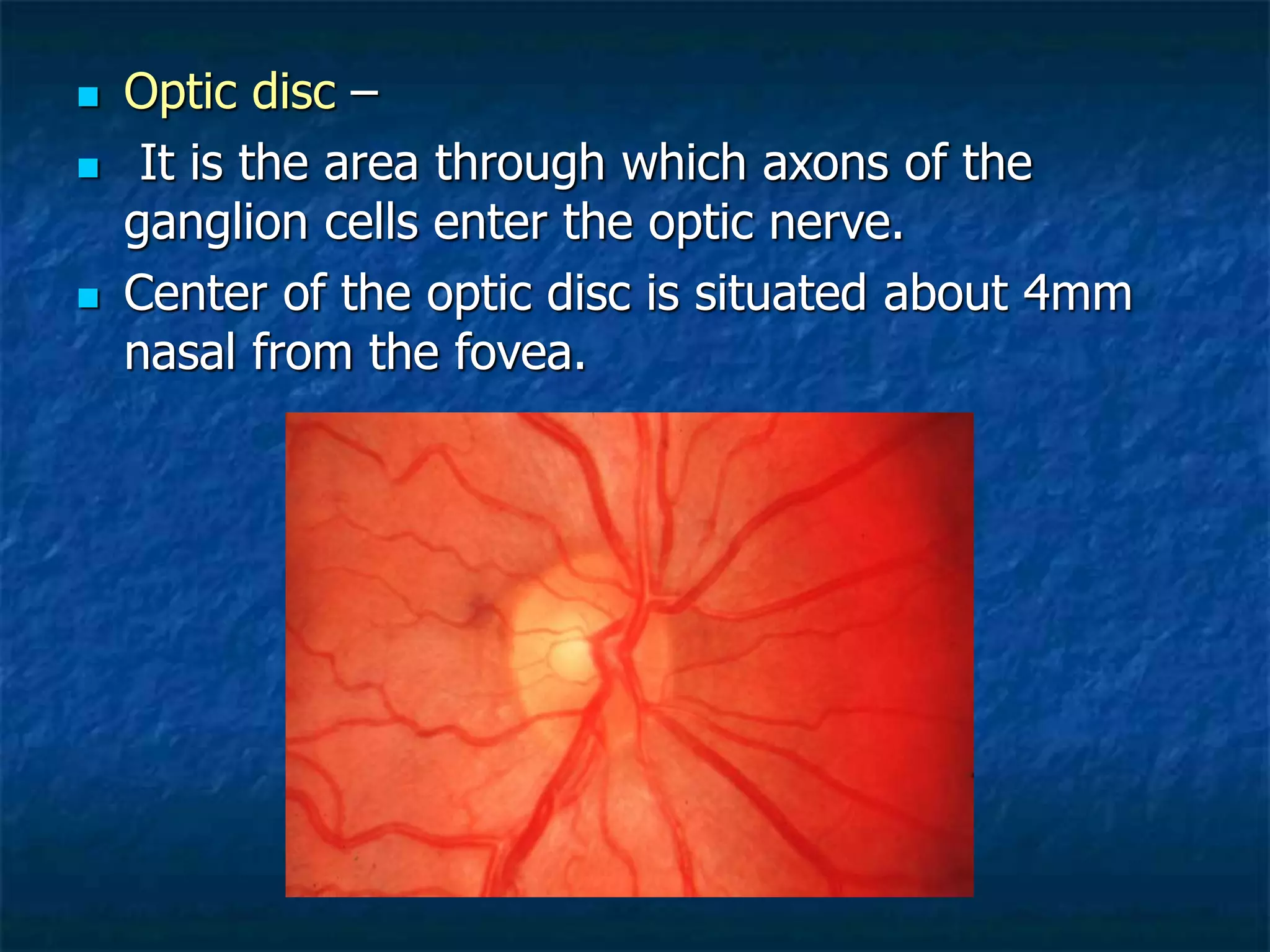
 Optic disc –
 It is the area through which axons of the
ganglion cells enter the optic nerve.
 Center of the optic disc is situated about 4mm
nasal from the fovea.
 Area centralis – an oval zone 5 to 6 mm in
diameter centered vertically between the
temporal vascular arcade. It includes-
 Fovea
 Foveola
 Foveal avascular zone.
 Peri foveal area
 Para foveal area
 Umbo
Peripheral retina –
devided into 4 regions
1. Near periphery
2. Mid periphery
3. Far periphery
4. Ora serrata.
 Ora serrata –
 The most anterior region of the retina
which consists of a dentate fringe which
denote the termination of the retina.
 It is situated –
6mm from the temporal limbus.
7mm from the nasal limbus
6 to 8mm from the equator
25 mm from the optic disc (nasal).
Layers of The Retina
 Histologically the retina consists of 10
layers from outward to inward –
1. Retinal pigment epithelium.
2. Photoreceptor layer of rods and cones.
3. External limiting membrane
4. Outer nuclear layer.
5. Outer plexiform layer.
6. Inner nuclear layer.
7. Inner plexiform layer.
8. Ganglion cell layer.
9. Nerve fiber layer.
10. Internal limiting membrane.
Retinal Pigment Epithelium
 Single layer of approximately 5 million
cells, hexagonal on cross section.
 Firmly attached to the Bruch’s membrane.
 Losley adherent to the sensory retina .
 Forms zonula adherence and zonula
occludence with adjacent cells .
 Presencence of microvilli at the apex.
 Abundent melanin granule are present.
 Function –
1. Renewal of photoreceptors.
2. Recycling of vitamin A.
3. Absorption of scattered light by the
melanin granules.
4. Transport of nutrient and metabolites.
5. Elaboration of extra cellular matrix.
Photoreceptors
 Rods –
 Approximately 92 million rods are present
 Absent in fovea, rising rapidly in number
towards the periphery ,then slowly
diminishing in extreme periphery.
 responsible for vision in dim light.
 Produce images of varying shades of black
and white.
 Contains rodopsin.
 Cones –
 Ave 4.6 million in number.
 Maximum density at the fovea.
 Decreases towards the periphery.
 Again increases at extreme periphery.
 These are responsible for – Photophic
vision , color vision , resolving fine details.
 Contains iodopsin of 3 different types.
 External limiting membrane –
 Composed of – terminal bars between adj.
Muller cells and photoreceptors.
 Function – selective barrier for nutrients
between adj Muller cells.
Stabiliztion of the position of the
photoreceptors.
 Outer nuclear layer.
 Contain soma and nuclei of photoreceptor
cells.
 Outer plexiform layer –
 Composed of inner fibers of the
photoreceptors, processes of muller cells,
dendrites of bipolar and horrizontal cells
and their synapses.
 Inner nuclear layer –
 Consists of 8 to 12 rows of closely packed
nuclei of bipolar cells , horizontal cells,
amacrine cells, interplexiform cells and
supporting muller cells.
 Among the many types of bipolar cells-
rod bipolar cells connect several rod cells
to 1-4 diffuse ganglion cells and amacrine
cells.
Midget bipolar cells connect a single cone
cell with a single midget ganglion cell.
 Amacrine cells – They synapse with each
other and with the dendrites of ganglion
cells and axons of the bipolar cells.
 They secrete GABA and glycine and have
inhibitory actions on ganglion cells thus
modulating photoreceptor signals.
 Ganglion cell layer –
 Composed mostly of cell bodies of
ganglion cells , processes of Muller cells
and other neuroglia , branches of retinal
vessels.
 Single layer at periphery , increasing
towards the margin of the foveola (6-
8)and absent at the foveola.
 1.2 million in number.
 Types-
1. M cells – axons end in the magnocellular
layer of the LGB. Subserve motion
perception at low contrast.
2. P cells – axons project to the parvo -
cellular layer of the LGB.
Carry information on –
• Color
• Fine details
• Spatial resolution.
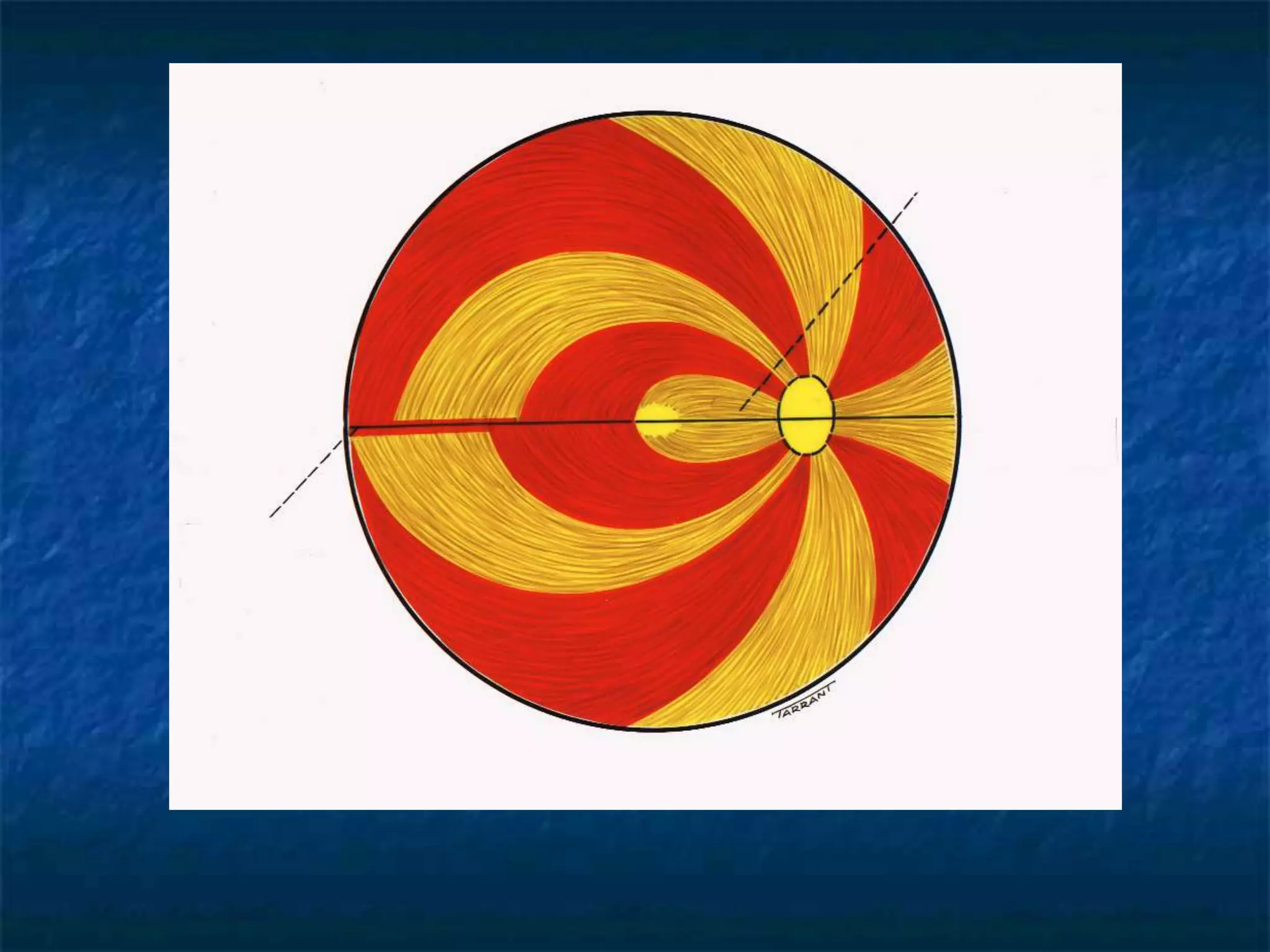
 Nerve fiber layer –
 Composed of the axons of the Ganglion
cells , glial cells , a rich capillary bed and
efferent fibers .
 The afferent fibers converge radially to
enter the optic disc to form the optic
nerve
 Internal limiting membrane- composed of
processes of Muller cell , basement
membrane, collagen fibril , proteoglycans.
Blood supply of the retina
 The outer laminae upto outer nuclear
layer are supplied by choroidal capillaries
by diffusion.
 The inner laminae supplied by the central
retinal artery and drained by central
retinal vein.
 cilio retinal artery in some cases.
 Outer blood retinal barrier.
 Inner blood retinal barrier.
Thank You All
Anatomy of Retina

Anatomy of Retina

  • 1.
    ANATOMY OF RETINA DR.SHAH-NOORHASSAN FCPS,FRCS(Glasgow)
  • 2.
     The retinais the internal layer of the eyeball , which is a thin membrane having a purplish red color in living subject.  This is responsible for various kinds of visual function – 1. Detail discrimination. 2. Color perception. 3. Vision is dim illumination. 4. Peripheral vision.
  • 3.
    Development of theRetina  Develops from optic cup.  Pigment epithelial layer developes from the outer layer of the optic cup.  Neuroretinal layer develops from the inner layer.
  • 5.
    Gross anatomy ofRetina  Extend – from scalloped margin of the ora serrata anteriorly, upto optc disc posteriorly.
  • 6.
    Normal anatomical landmarks Shortciliary arteries Temporal ora serrata Short ciliary nerves Macula Long ciliary nerve Short ciliary nerves Microcystoid degeneration Nasal ora serrata Vortex ampullae Long ciliary artery Vortex vein
  • 7.
     Optic disc–  It is the area through which axons of the ganglion cells enter the optic nerve.  Center of the optic disc is situated about 4mm nasal from the fovea.
  • 8.
     Area centralis– an oval zone 5 to 6 mm in diameter centered vertically between the temporal vascular arcade. It includes-  Fovea  Foveola  Foveal avascular zone.  Peri foveal area  Para foveal area  Umbo
  • 10.
    Peripheral retina – devidedinto 4 regions 1. Near periphery 2. Mid periphery 3. Far periphery 4. Ora serrata.
  • 11.
     Ora serrata–  The most anterior region of the retina which consists of a dentate fringe which denote the termination of the retina.  It is situated – 6mm from the temporal limbus. 7mm from the nasal limbus 6 to 8mm from the equator 25 mm from the optic disc (nasal).
  • 12.
    Layers of TheRetina  Histologically the retina consists of 10 layers from outward to inward – 1. Retinal pigment epithelium. 2. Photoreceptor layer of rods and cones. 3. External limiting membrane 4. Outer nuclear layer. 5. Outer plexiform layer. 6. Inner nuclear layer. 7. Inner plexiform layer.
  • 13.
    8. Ganglion celllayer. 9. Nerve fiber layer. 10. Internal limiting membrane.
  • 15.
    Retinal Pigment Epithelium Single layer of approximately 5 million cells, hexagonal on cross section.  Firmly attached to the Bruch’s membrane.  Losley adherent to the sensory retina .  Forms zonula adherence and zonula occludence with adjacent cells .  Presencence of microvilli at the apex.  Abundent melanin granule are present.
  • 17.
     Function – 1.Renewal of photoreceptors. 2. Recycling of vitamin A. 3. Absorption of scattered light by the melanin granules. 4. Transport of nutrient and metabolites. 5. Elaboration of extra cellular matrix.
  • 18.
    Photoreceptors  Rods – Approximately 92 million rods are present  Absent in fovea, rising rapidly in number towards the periphery ,then slowly diminishing in extreme periphery.  responsible for vision in dim light.  Produce images of varying shades of black and white.  Contains rodopsin.
  • 19.
     Cones – Ave 4.6 million in number.  Maximum density at the fovea.  Decreases towards the periphery.  Again increases at extreme periphery.  These are responsible for – Photophic vision , color vision , resolving fine details.  Contains iodopsin of 3 different types.
  • 21.
     External limitingmembrane –  Composed of – terminal bars between adj. Muller cells and photoreceptors.  Function – selective barrier for nutrients between adj Muller cells. Stabiliztion of the position of the photoreceptors.
  • 22.
     Outer nuclearlayer.  Contain soma and nuclei of photoreceptor cells.  Outer plexiform layer –  Composed of inner fibers of the photoreceptors, processes of muller cells, dendrites of bipolar and horrizontal cells and their synapses.
  • 24.
     Inner nuclearlayer –  Consists of 8 to 12 rows of closely packed nuclei of bipolar cells , horizontal cells, amacrine cells, interplexiform cells and supporting muller cells.  Among the many types of bipolar cells- rod bipolar cells connect several rod cells to 1-4 diffuse ganglion cells and amacrine cells. Midget bipolar cells connect a single cone cell with a single midget ganglion cell.
  • 26.
     Amacrine cells– They synapse with each other and with the dendrites of ganglion cells and axons of the bipolar cells.  They secrete GABA and glycine and have inhibitory actions on ganglion cells thus modulating photoreceptor signals.
  • 27.
     Ganglion celllayer –  Composed mostly of cell bodies of ganglion cells , processes of Muller cells and other neuroglia , branches of retinal vessels.  Single layer at periphery , increasing towards the margin of the foveola (6- 8)and absent at the foveola.  1.2 million in number.
  • 28.
     Types- 1. Mcells – axons end in the magnocellular layer of the LGB. Subserve motion perception at low contrast. 2. P cells – axons project to the parvo - cellular layer of the LGB. Carry information on – • Color • Fine details • Spatial resolution.
  • 29.
     Nerve fiberlayer –  Composed of the axons of the Ganglion cells , glial cells , a rich capillary bed and efferent fibers .  The afferent fibers converge radially to enter the optic disc to form the optic nerve  Internal limiting membrane- composed of processes of Muller cell , basement membrane, collagen fibril , proteoglycans.
  • 31.
    Blood supply ofthe retina  The outer laminae upto outer nuclear layer are supplied by choroidal capillaries by diffusion.  The inner laminae supplied by the central retinal artery and drained by central retinal vein.  cilio retinal artery in some cases.  Outer blood retinal barrier.  Inner blood retinal barrier.
  • 32.