Sources of Microorganisms in Air
Dr C R Meera
Assistant Professor & HOD
Department of Microbiology
St. Mary’s College, Thrissur-20,
Kerala, India
Sources of Microorganisms in Air; Dr C R Meera, Assistant Professor & HOD, Department of Microbiology, St Mary’s College, Thrissur-20, Kerala
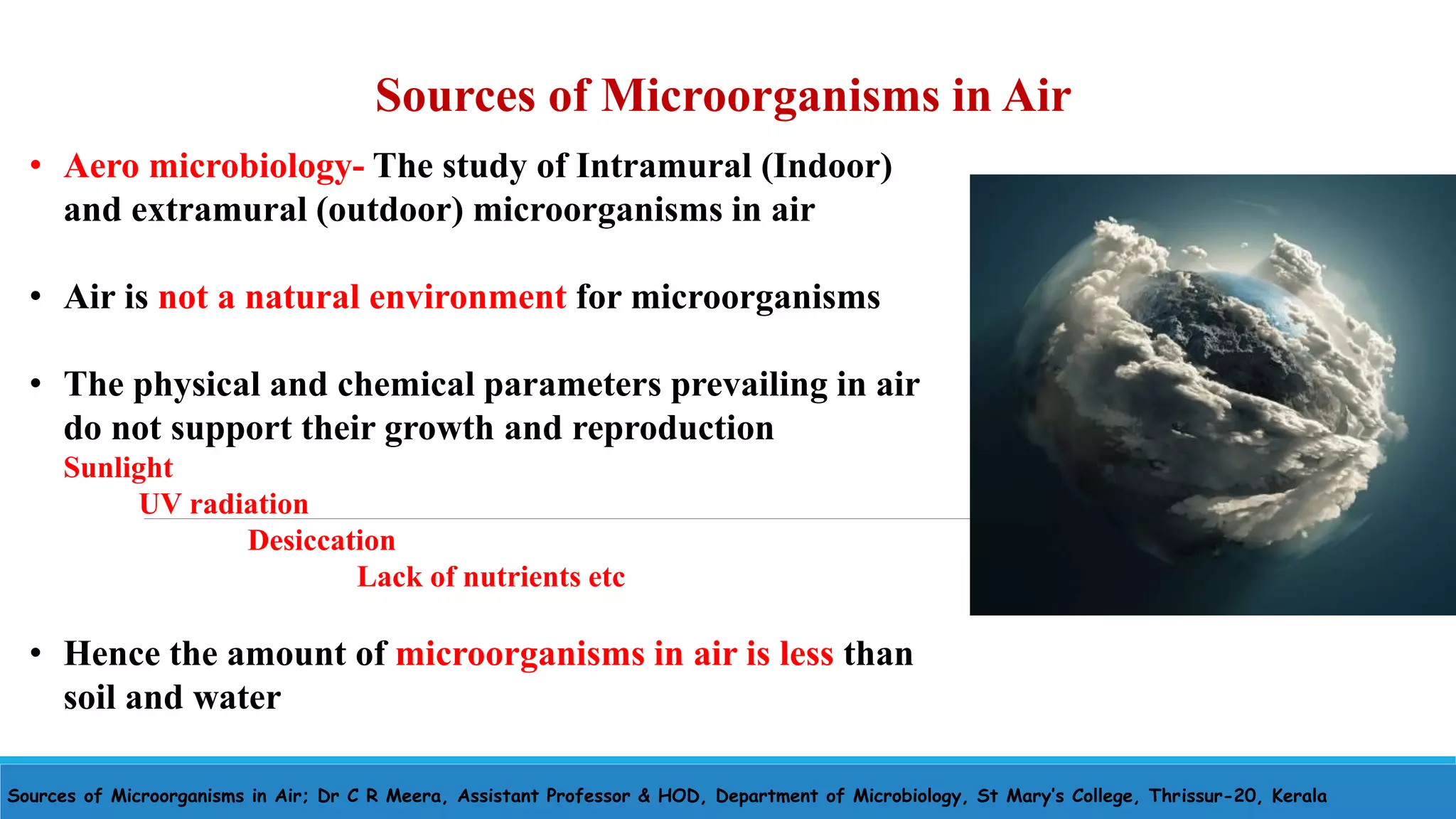
Sources of Microorganisms in Air
• Aero microbiology- The study of Intramural (Indoor)
and extramural (outdoor) microorganisms in air
• Air is not a natural environment for microorganisms
• The physical and chemical parameters prevailing in air
do not support their growth and reproduction
Sunlight
UV radiation
Desiccation
Lack of nutrients etc
• Hence the amount of microorganisms in air is less than
soil and water
Sources of Microorganisms in Air; Dr C R Meera, Assistant Professor & HOD, Department of Microbiology, St Mary’s College, Thrissur-20, Kerala
• Troposphere – High load of microorganisms
• Vertical distribution of microorganisms -air currents, wind flow etc.
• Horizontal distribution -physical and chemical factors
• Microorganisms considerably reduces as the altitude increases
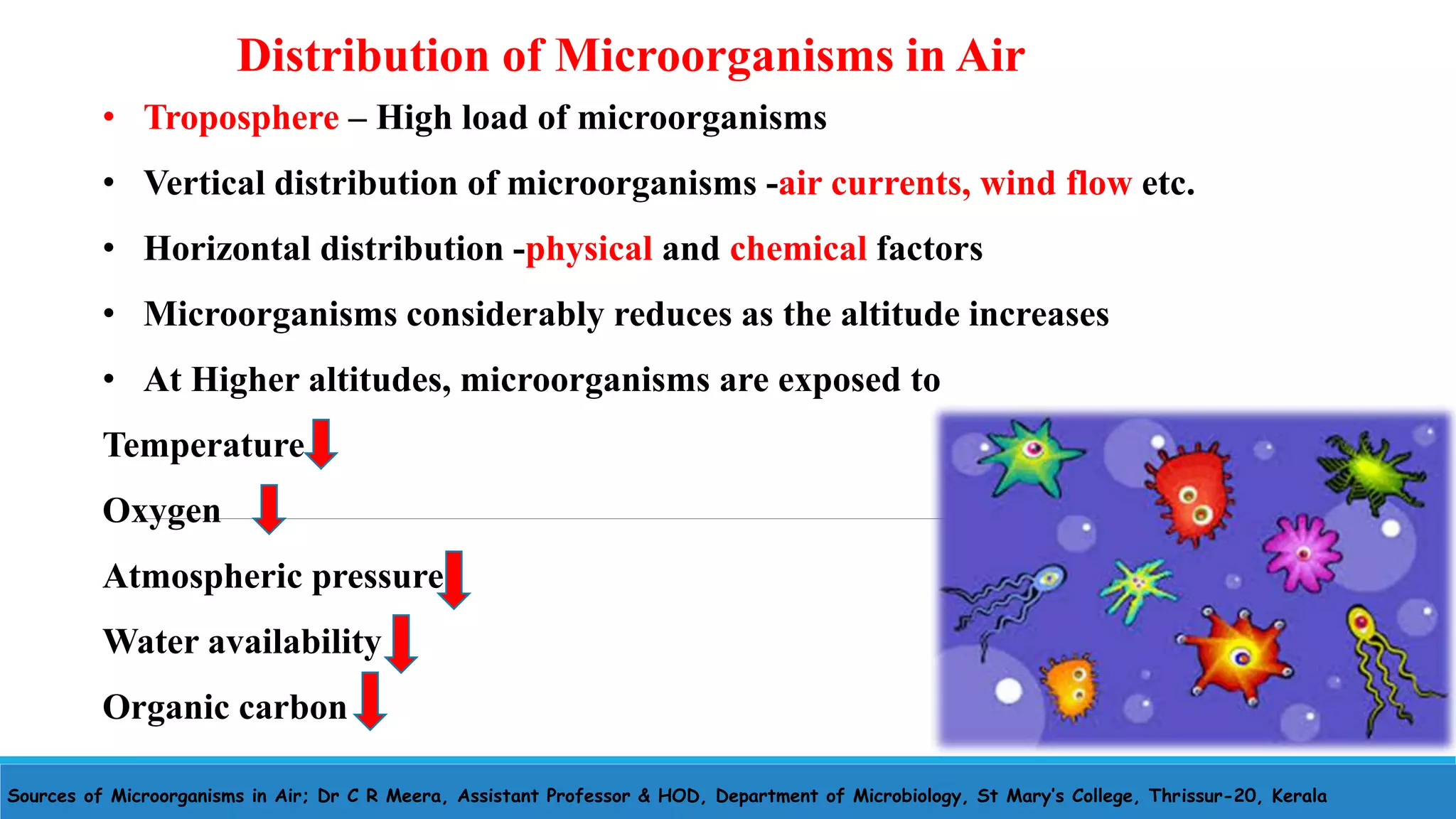
• At Higher altitudes, microorganisms are exposed to
Temperature
Oxygen
Atmospheric pressure
Water availability
Organic carbon
Distribution of Microorganisms in Air
Sources of Microorganisms in Air; Dr C R Meera, Assistant Professor & HOD, Department of Microbiology, St Mary’s College, Thrissur-20, Kerala
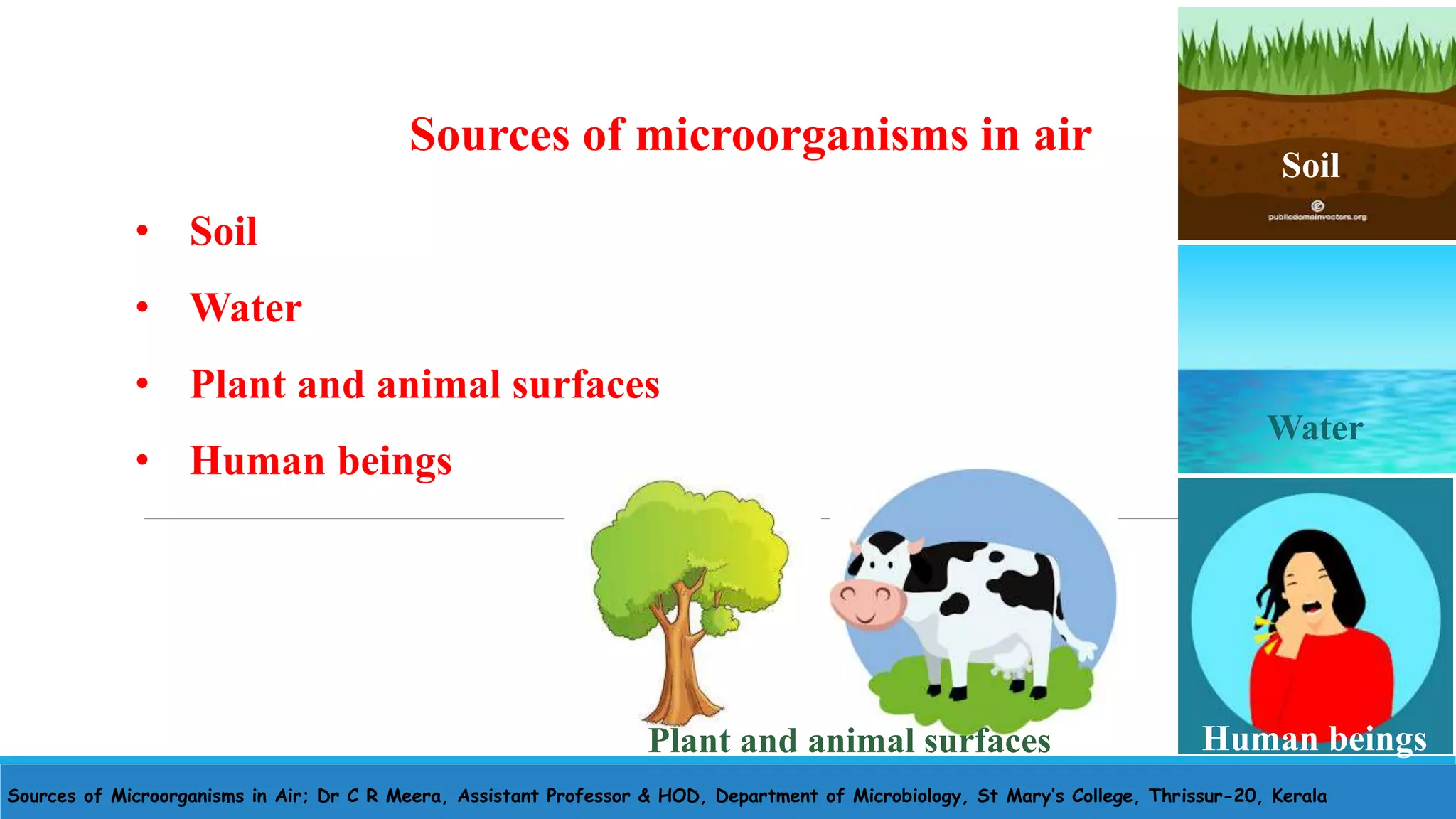
• Soil
• Water
• Plant and animal surfaces
• Human beings
Sources of microorganisms in air
Soil
Water
Plant and animal surfaces Human beings
Sources of Microorganisms in Air; Dr C R Meera, Assistant Professor & HOD, Department of Microbiology, St Mary’s College, Thrissur-20, Kerala
Suspension of microorganisms in air
Microorganisms remain in the air for varying time periods depending upon
• Speed of air currents
In still air microbes settle easily whereas a gentle air current keeps the microbes
suspended
• Size of particles
Organisms attached to dust particles or droplets settle out faster
Free organisms remain suspended for longer periods
• Humidity of the atmosphere
Less amount of organisms in humid conditions than a dry atmosphere
Sources of Microorganisms in Air; Dr C R Meera, Assistant Professor & HOD, Department of Microbiology, St Mary’s College, Thrissur-20, Kerala
• Soil-The most common source of microorganisms in air
• Liberation of microbes to air from soil by
Environmental activities (wind blow, air currents )
Human activities (digging, ploughing )
• An active soil environment liberates more
microorganisms
• Rich, fertile and cultivated soil shows a higher viable
count than sandy and uncultivated soil
• Soil covered with vegetation liberates less amount of
microorganisms than bare surfaces which are easily acted
upon by wind and air currents.
1. Soil
Digging
Ploughing
Sources of Microorganisms in Air; Dr C R Meera, Assistant Professor & HOD, Department of Microbiology, St Mary’s College, Thrissur-20, Kerala
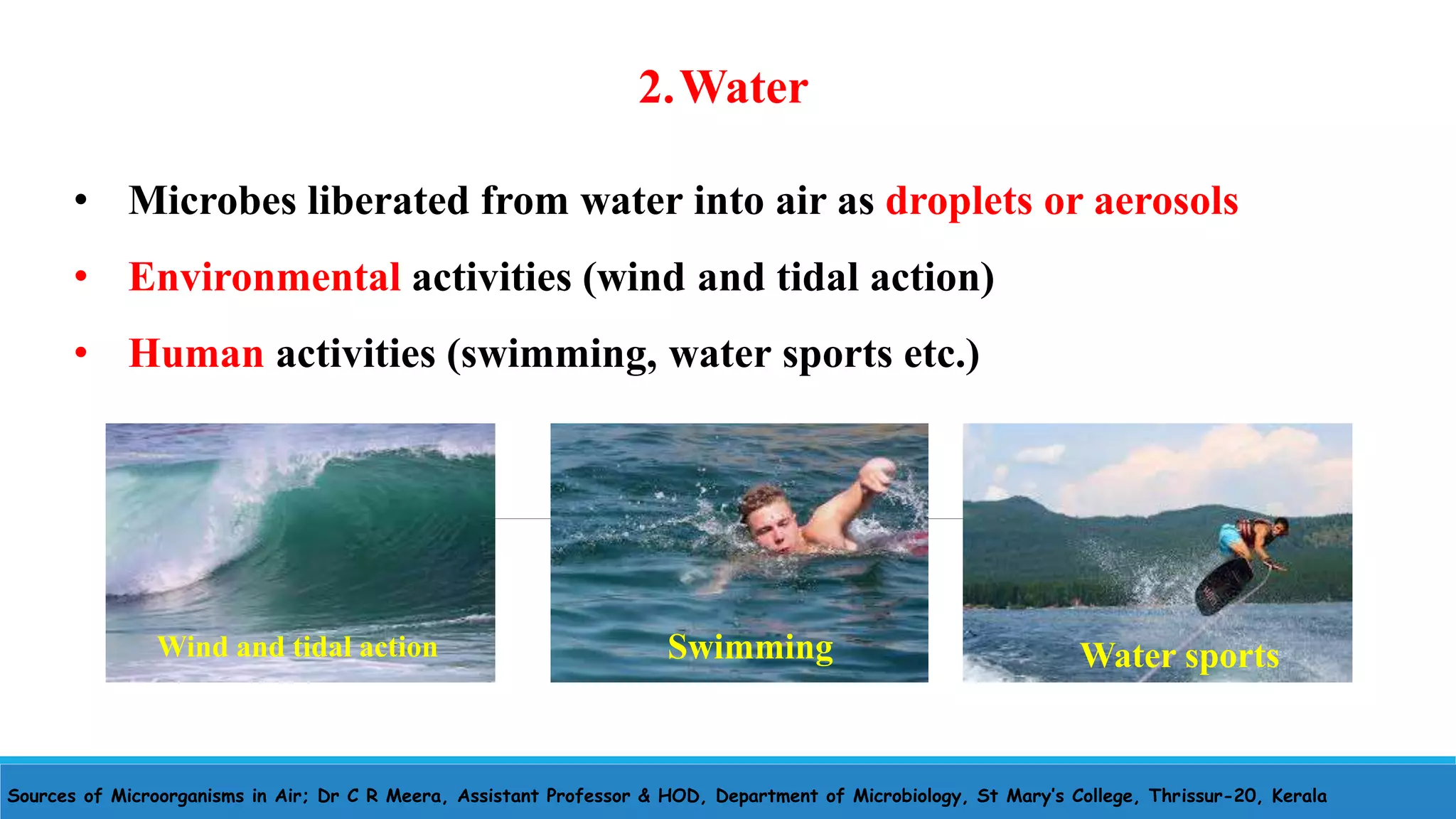
• Microbes liberated from water into air as droplets or aerosols
• Environmental activities (wind and tidal action)
• Human activities (swimming, water sports etc.)
2.Water
Wind and tidal action Swimming Water sports
Sources of Microorganisms in Air; Dr C R Meera, Assistant Professor & HOD, Department of Microbiology, St Mary’s College, Thrissur-20, Kerala
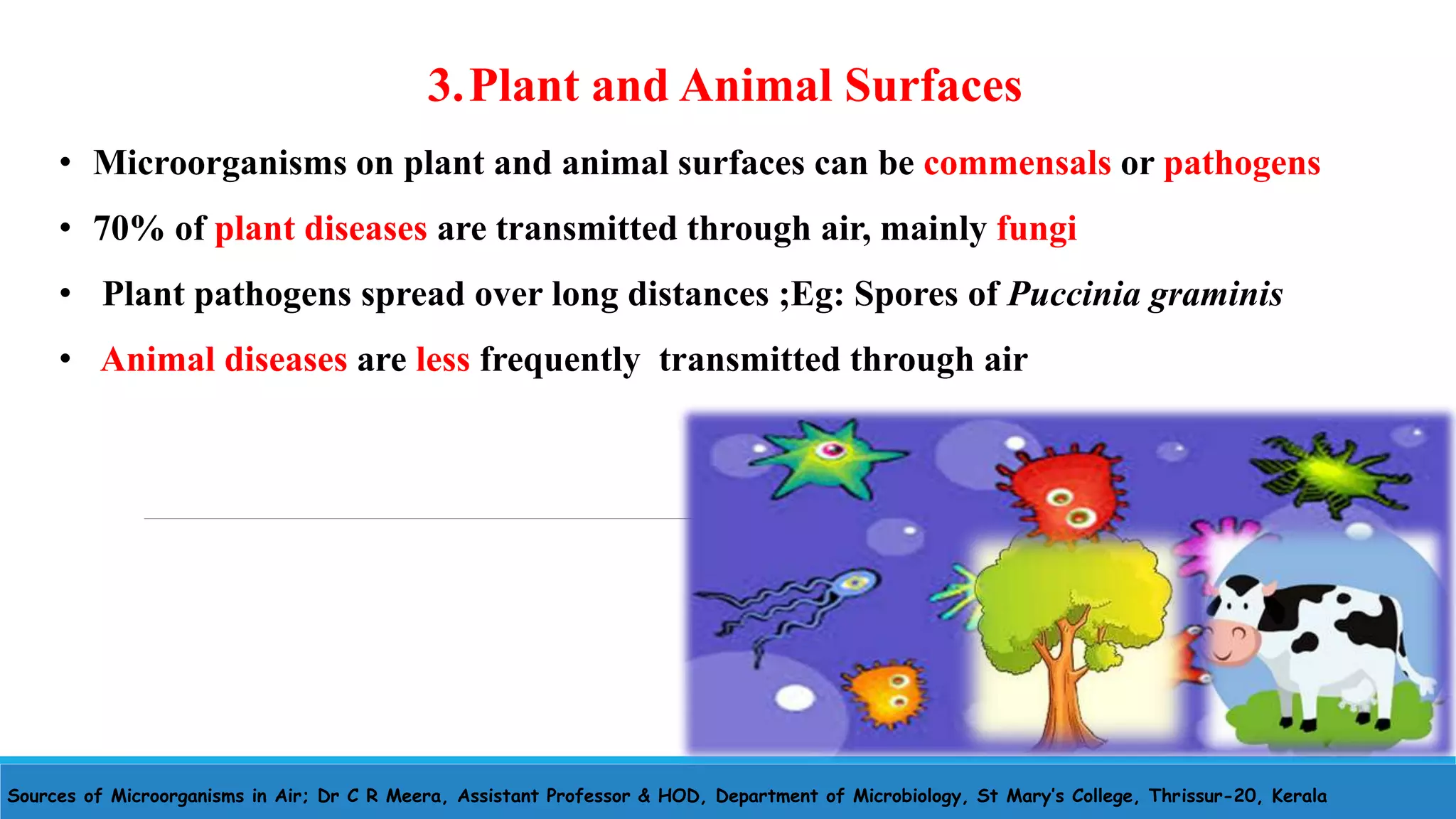
• Microorganisms on plant and animal surfaces can be commensals or pathogens
• 70% of plant diseases are transmitted through air, mainly fungi
• Plant pathogens spread over long distances ;Eg: Spores of Puccinia graminis
• Animal diseases are less frequently transmitted through air
3.Plant and Animal Surfaces
Sources of Microorganisms in Air; Dr C R Meera, Assistant Professor & HOD, Department of Microbiology, St Mary’s College, Thrissur-20, Kerala
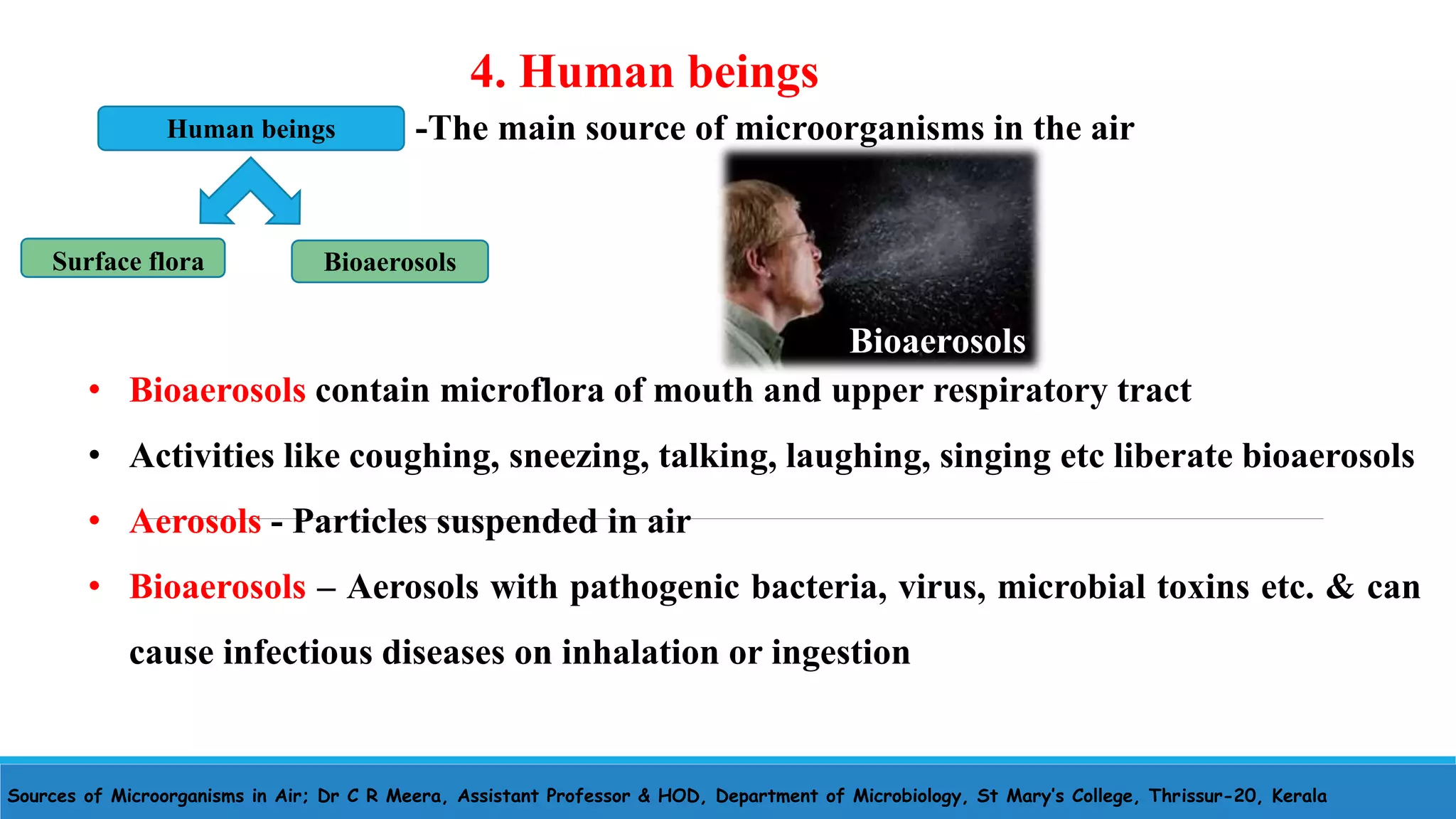
-The main source of microorganisms in the air
• Bioaerosols contain microflora of mouth and upper respiratory tract
• Activities like coughing, sneezing, talking, laughing, singing etc liberate bioaerosols
• Aerosols - Particles suspended in air
• Bioaerosols – Aerosols with pathogenic bacteria, virus, microbial toxins etc. & can
cause infectious diseases on inhalation or ingestion
4. Human beings
Human beings
Surface flora Bioaerosols
Bioaerosols
Sources of Microorganisms in Air; Dr C R Meera, Assistant Professor & HOD, Department of Microbiology, St Mary’s College, Thrissur-20, Kerala
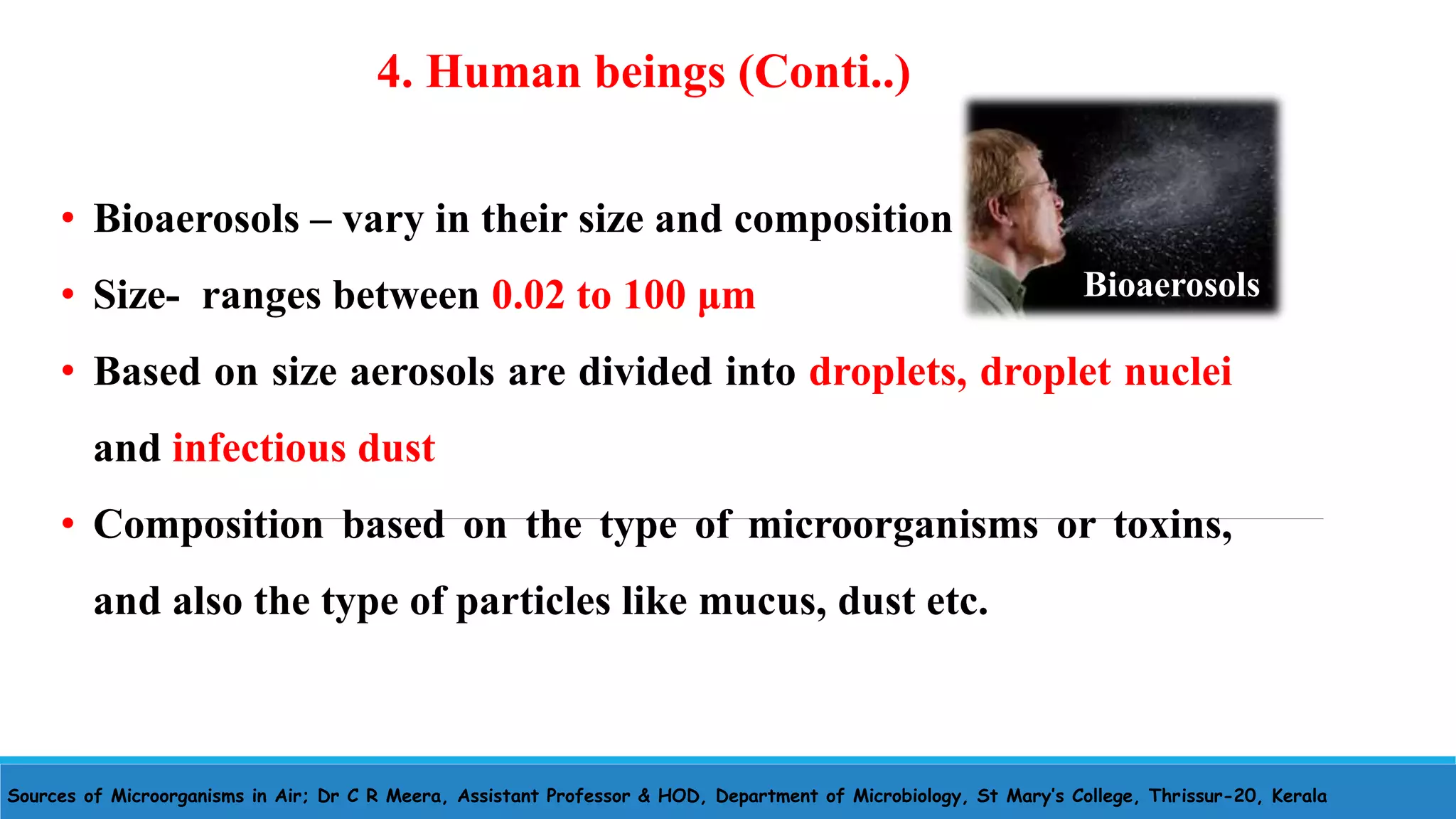
• Bioaerosols – vary in their size and composition
• Size- ranges between 0.02 to 100 μm
• Based on size aerosols are divided into droplets, droplet nuclei
and infectious dust
• Composition based on the type of microorganisms or toxins,
and also the type of particles like mucus, dust etc.
4. Human beings (Conti..)
Bioaerosols
Sources of Microorganisms in Air; Dr C R Meera, Assistant Professor & HOD, Department of Microbiology, St Mary’s College, Thrissur-20, Kerala
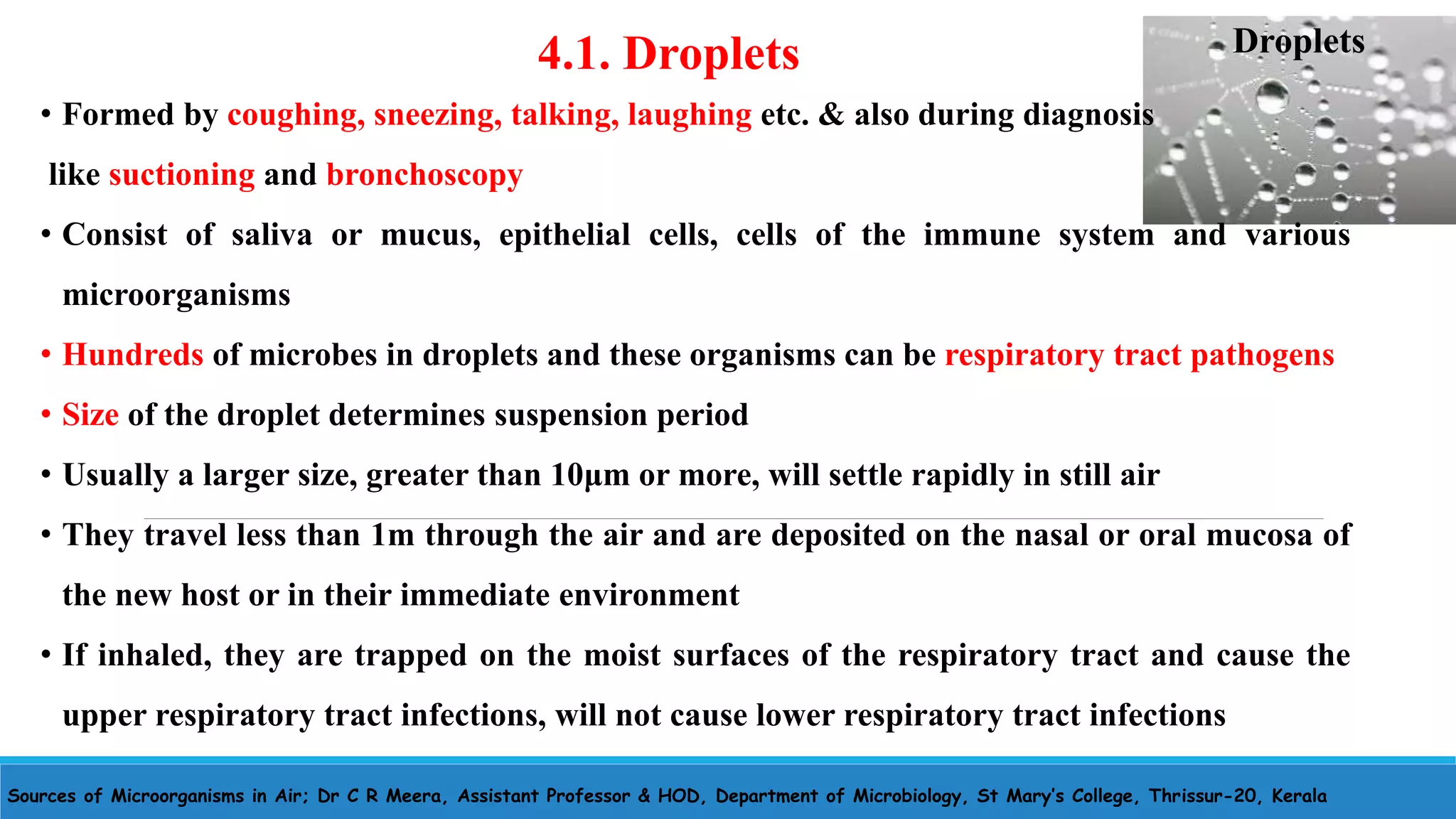
4.1. Droplets
• Formed by coughing, sneezing, talking, laughing etc. & also during diagnosis
like suctioning and bronchoscopy
• Consist of saliva or mucus, epithelial cells, cells of the immune system and various
microorganisms
• Hundreds of microbes in droplets and these organisms can be respiratory tract pathogens
• Size of the droplet determines suspension period
• Usually a larger size, greater than 10μm or more, will settle rapidly in still air
• They travel less than 1m through the air and are deposited on the nasal or oral mucosa of
the new host or in their immediate environment
• If inhaled, they are trapped on the moist surfaces of the respiratory tract and cause the
upper respiratory tract infections, will not cause lower respiratory tract infections
Droplets
Sources of Microorganisms in Air; Dr C R Meera, Assistant Professor & HOD, Department of Microbiology, St Mary’s College, Thrissur-20, Kerala
• Droplet nuclei- originate from droplets by the evaporation
• Droplets in a warm and dry atmosphere evaporate rapidly and the solid material
left after drying up is called droplet nuclei
• Size- Less than 5 μm (1-4μm) and contain microorganisms, dust particles, skin cells
and other debris
• True aerosolization takes place and remain suspended in the air for longer periods
of time
4. 2. Droplet Nuclei
Sources of Microorganisms in Air; Dr C R Meera, Assistant Professor & HOD, Department of Microbiology, St Mary’s College, Thrissur-20, Kerala
• Widely dispersed by air currents, remain for hours or days
• Can escape the mechanical traps of the upper respiratory tract and enter the lungs
• More potential agents of infection and important role in airborne transmission of
diseases, particularly respiratory infections
• Droplet nuclei in airborne transmission of diseases was first studied by Wells in
1955
• Microorganisms present in droplet nuclei should be viable to cause an infection
• Viability is determined by atmospheric conditions like humidity, sunlight,
temperature, size of particles bearing the organisms and degree of susceptibility or
resistance of microbial species to the new physical environment.
4. 2. Droplet Nuclei (Conti..)
Sources of Microorganisms in Air; Dr C R Meera, Assistant Professor & HOD, Department of Microbiology, St Mary’s College, Thrissur-20, Kerala
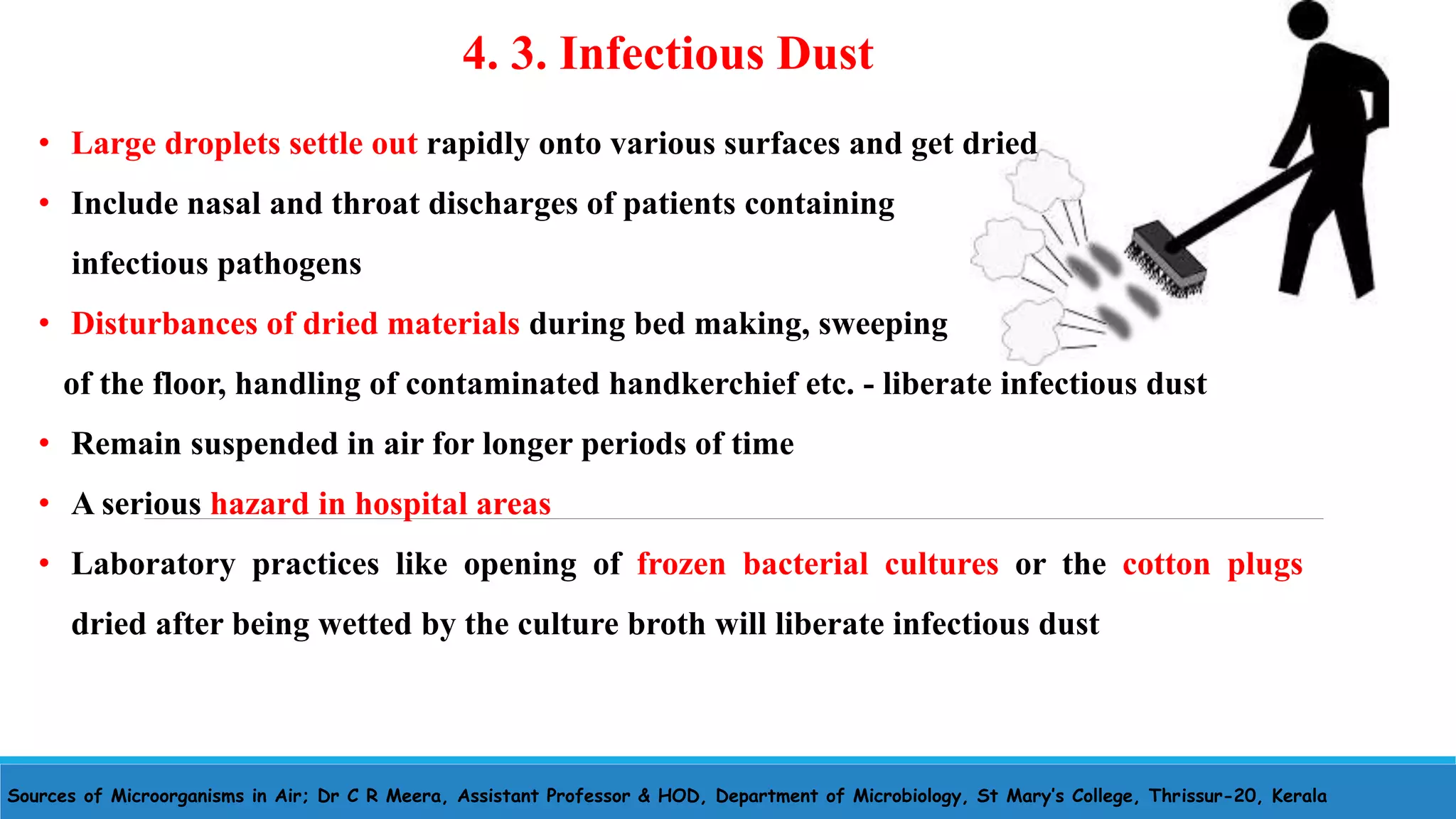
4. 3. Infectious Dust
• Large droplets settle out rapidly onto various surfaces and get dried
• Include nasal and throat discharges of patients containing
infectious pathogens
• Disturbances of dried materials during bed making, sweeping
of the floor, handling of contaminated handkerchief etc. - liberate infectious dust
• Remain suspended in air for longer periods of time
• A serious hazard in hospital areas
• Laboratory practices like opening of frozen bacterial cultures or the cotton plugs
dried after being wetted by the culture broth will liberate infectious dust
Sources of Microorganisms in Air; Dr C R Meera, Assistant Professor & HOD, Department of Microbiology, St Mary’s College, Thrissur-20, Kerala
Sources of Microbes in Air
Soil Water Plant & Animal Surfaces Humans
Bio aerosols
Droplets Droplet
Nuclei
Infectious
Dust
Sources of Microorganisms in Air; Dr C R Meera, Assistant Professor & HOD, Department of Microbiology, St Mary’s College, Thrissur-20, Kerala

Sources of microorganisms in air

  • 1.
    Sources of Microorganismsin Air Dr C R Meera Assistant Professor & HOD Department of Microbiology St. Mary’s College, Thrissur-20, Kerala, India
  • 2.
    Sources of Microorganismsin Air; Dr C R Meera, Assistant Professor & HOD, Department of Microbiology, St Mary’s College, Thrissur-20, Kerala Sources of Microorganisms in Air • Aero microbiology- The study of Intramural (Indoor) and extramural (outdoor) microorganisms in air • Air is not a natural environment for microorganisms • The physical and chemical parameters prevailing in air do not support their growth and reproduction Sunlight UV radiation Desiccation Lack of nutrients etc • Hence the amount of microorganisms in air is less than soil and water
  • 3.
    Sources of Microorganismsin Air; Dr C R Meera, Assistant Professor & HOD, Department of Microbiology, St Mary’s College, Thrissur-20, Kerala • Troposphere – High load of microorganisms • Vertical distribution of microorganisms -air currents, wind flow etc. • Horizontal distribution -physical and chemical factors • Microorganisms considerably reduces as the altitude increases • At Higher altitudes, microorganisms are exposed to Temperature Oxygen Atmospheric pressure Water availability Organic carbon Distribution of Microorganisms in Air
  • 4.
    Sources of Microorganismsin Air; Dr C R Meera, Assistant Professor & HOD, Department of Microbiology, St Mary’s College, Thrissur-20, Kerala • Soil • Water • Plant and animal surfaces • Human beings Sources of microorganisms in air Soil Water Plant and animal surfaces Human beings
  • 5.
    Sources of Microorganismsin Air; Dr C R Meera, Assistant Professor & HOD, Department of Microbiology, St Mary’s College, Thrissur-20, Kerala Suspension of microorganisms in air Microorganisms remain in the air for varying time periods depending upon • Speed of air currents In still air microbes settle easily whereas a gentle air current keeps the microbes suspended • Size of particles Organisms attached to dust particles or droplets settle out faster Free organisms remain suspended for longer periods • Humidity of the atmosphere Less amount of organisms in humid conditions than a dry atmosphere
  • 6.
    Sources of Microorganismsin Air; Dr C R Meera, Assistant Professor & HOD, Department of Microbiology, St Mary’s College, Thrissur-20, Kerala • Soil-The most common source of microorganisms in air • Liberation of microbes to air from soil by Environmental activities (wind blow, air currents ) Human activities (digging, ploughing ) • An active soil environment liberates more microorganisms • Rich, fertile and cultivated soil shows a higher viable count than sandy and uncultivated soil • Soil covered with vegetation liberates less amount of microorganisms than bare surfaces which are easily acted upon by wind and air currents. 1. Soil Digging Ploughing
  • 7.
    Sources of Microorganismsin Air; Dr C R Meera, Assistant Professor & HOD, Department of Microbiology, St Mary’s College, Thrissur-20, Kerala • Microbes liberated from water into air as droplets or aerosols • Environmental activities (wind and tidal action) • Human activities (swimming, water sports etc.) 2.Water Wind and tidal action Swimming Water sports
  • 8.
    Sources of Microorganismsin Air; Dr C R Meera, Assistant Professor & HOD, Department of Microbiology, St Mary’s College, Thrissur-20, Kerala • Microorganisms on plant and animal surfaces can be commensals or pathogens • 70% of plant diseases are transmitted through air, mainly fungi • Plant pathogens spread over long distances ;Eg: Spores of Puccinia graminis • Animal diseases are less frequently transmitted through air 3.Plant and Animal Surfaces
  • 9.
    Sources of Microorganismsin Air; Dr C R Meera, Assistant Professor & HOD, Department of Microbiology, St Mary’s College, Thrissur-20, Kerala -The main source of microorganisms in the air • Bioaerosols contain microflora of mouth and upper respiratory tract • Activities like coughing, sneezing, talking, laughing, singing etc liberate bioaerosols • Aerosols - Particles suspended in air • Bioaerosols – Aerosols with pathogenic bacteria, virus, microbial toxins etc. & can cause infectious diseases on inhalation or ingestion 4. Human beings Human beings Surface flora Bioaerosols Bioaerosols
  • 10.
    Sources of Microorganismsin Air; Dr C R Meera, Assistant Professor & HOD, Department of Microbiology, St Mary’s College, Thrissur-20, Kerala • Bioaerosols – vary in their size and composition • Size- ranges between 0.02 to 100 μm • Based on size aerosols are divided into droplets, droplet nuclei and infectious dust • Composition based on the type of microorganisms or toxins, and also the type of particles like mucus, dust etc. 4. Human beings (Conti..) Bioaerosols
  • 11.
    Sources of Microorganismsin Air; Dr C R Meera, Assistant Professor & HOD, Department of Microbiology, St Mary’s College, Thrissur-20, Kerala 4.1. Droplets • Formed by coughing, sneezing, talking, laughing etc. & also during diagnosis like suctioning and bronchoscopy • Consist of saliva or mucus, epithelial cells, cells of the immune system and various microorganisms • Hundreds of microbes in droplets and these organisms can be respiratory tract pathogens • Size of the droplet determines suspension period • Usually a larger size, greater than 10μm or more, will settle rapidly in still air • They travel less than 1m through the air and are deposited on the nasal or oral mucosa of the new host or in their immediate environment • If inhaled, they are trapped on the moist surfaces of the respiratory tract and cause the upper respiratory tract infections, will not cause lower respiratory tract infections Droplets
  • 12.
    Sources of Microorganismsin Air; Dr C R Meera, Assistant Professor & HOD, Department of Microbiology, St Mary’s College, Thrissur-20, Kerala • Droplet nuclei- originate from droplets by the evaporation • Droplets in a warm and dry atmosphere evaporate rapidly and the solid material left after drying up is called droplet nuclei • Size- Less than 5 μm (1-4μm) and contain microorganisms, dust particles, skin cells and other debris • True aerosolization takes place and remain suspended in the air for longer periods of time 4. 2. Droplet Nuclei
  • 13.
    Sources of Microorganismsin Air; Dr C R Meera, Assistant Professor & HOD, Department of Microbiology, St Mary’s College, Thrissur-20, Kerala • Widely dispersed by air currents, remain for hours or days • Can escape the mechanical traps of the upper respiratory tract and enter the lungs • More potential agents of infection and important role in airborne transmission of diseases, particularly respiratory infections • Droplet nuclei in airborne transmission of diseases was first studied by Wells in 1955 • Microorganisms present in droplet nuclei should be viable to cause an infection • Viability is determined by atmospheric conditions like humidity, sunlight, temperature, size of particles bearing the organisms and degree of susceptibility or resistance of microbial species to the new physical environment. 4. 2. Droplet Nuclei (Conti..)
  • 14.
    Sources of Microorganismsin Air; Dr C R Meera, Assistant Professor & HOD, Department of Microbiology, St Mary’s College, Thrissur-20, Kerala 4. 3. Infectious Dust • Large droplets settle out rapidly onto various surfaces and get dried • Include nasal and throat discharges of patients containing infectious pathogens • Disturbances of dried materials during bed making, sweeping of the floor, handling of contaminated handkerchief etc. - liberate infectious dust • Remain suspended in air for longer periods of time • A serious hazard in hospital areas • Laboratory practices like opening of frozen bacterial cultures or the cotton plugs dried after being wetted by the culture broth will liberate infectious dust
  • 15.
    Sources of Microorganismsin Air; Dr C R Meera, Assistant Professor & HOD, Department of Microbiology, St Mary’s College, Thrissur-20, Kerala Sources of Microbes in Air Soil Water Plant & Animal Surfaces Humans Bio aerosols Droplets Droplet Nuclei Infectious Dust
  • 16.
    Sources of Microorganismsin Air; Dr C R Meera, Assistant Professor & HOD, Department of Microbiology, St Mary’s College, Thrissur-20, Kerala