1 Amjad Khan Afridi
AERO-MICROBIOLOGY
“Study of living microbes suspended in air”
Transmission of airborne microorganisms.
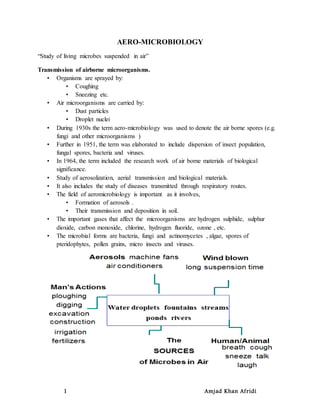
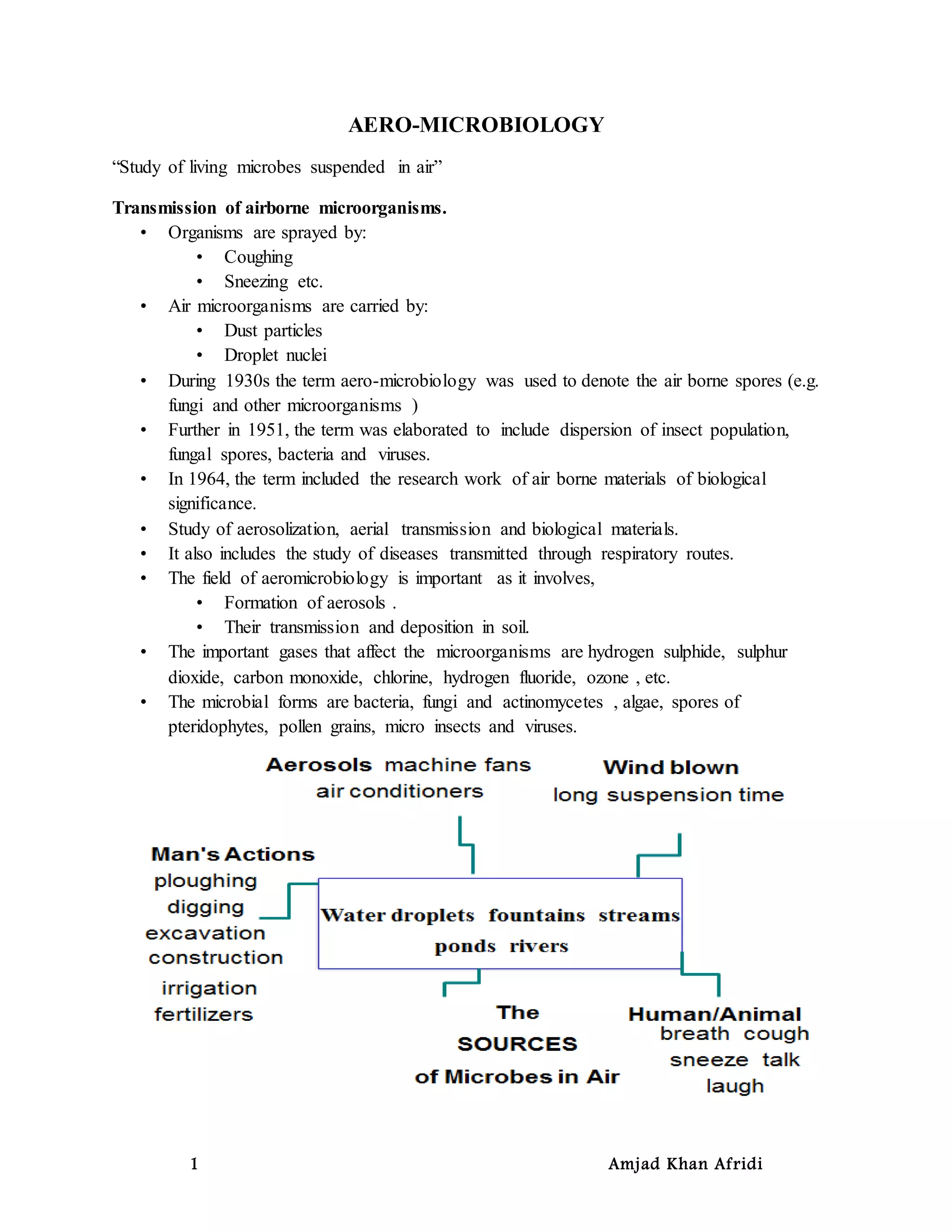
• Organisms are sprayed by:
• Coughing
• Sneezing etc.
• Air microorganisms are carried by:
• Dust particles
• Droplet nuclei
• During 1930s the term aero-microbiology was used to denote the air borne spores (e.g.
fungi and other microorganisms )
• Further in 1951, the term was elaborated to include dispersion of insect population,
fungal spores, bacteria and viruses.
• In 1964, the term included the research work of air borne materials of biological
significance.
• Study of aerosolization, aerial transmission and biological materials.
• It also includes the study of diseases transmitted through respiratory routes.
• The field of aeromicrobiology is important as it involves,
• Formation of aerosols .
• Their transmission and deposition in soil.
• The important gases that affect the microorganisms are hydrogen sulphide, sulphur
dioxide, carbon monoxide, chlorine, hydrogen fluoride, ozone , etc.
• The microbial forms are bacteria, fungi and actinomycetes , algae, spores of
pteridophytes, pollen grains, micro insects and viruses.
2 Amjad Khan Afridi
INDOOR AERO-MICROBIOLOGY
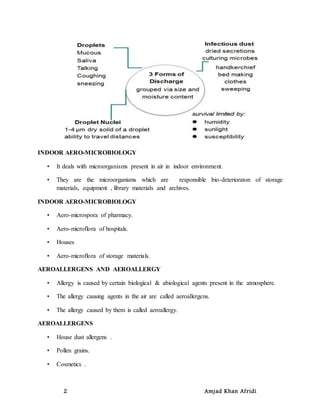
• It deals with microorganisms present in air in indoor environment.
• They are the microorganisms which are responsible bio-deterioraton of storage
materials, equipment , library materials and archives.
INDOOR AERO-MICROBIOLOGY
• Aero-microspora of pharmacy.
• Aero-microflora of hospitals.
• Houses
• Aero-microflora of storage materials.
AEROALLERGENS AND AEROALLERGY
• Allergy is caused by certain biological & abiological agents present in the atmosphere.
• The allergy causing agents in the air are called aeroallergens.
• The allergy caused by them is called aeroallergy.
AEROALLERGENS
• House dust allergens .
• Pollen grains.
• Cosmetics .
3 Amjad Khan Afridi
PHYSICAL ENVIRONMENT STRESS
• Desiccation
• Humidity
• Temperature
• Radiation
OUTDOOR AIR
• Algae
• Protozoa
• Yeasts
• Molds
o Mold spore are predominant, e.g. clasdosporium
o Bacterial species are
 Spore forming
 Non-spore forming
BACTERIAL SPECIES
• Micrococcus
• Sarcina
• Gram negative rods
• Gram positive rods
• Aerobic spore forming bacteria
FUNGAL SPECIES
• Clasdosporium
• Alternaria
• Pullularia
• Penicillium
• Batrytis
• Stemphylium
4 Amjad Khan Afridi
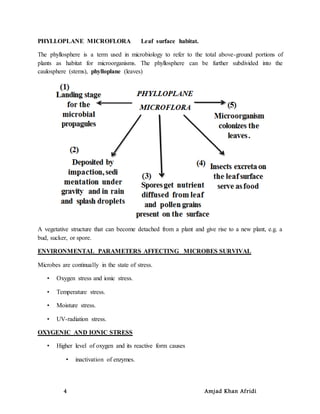
PHYLLOPLANE MICROFLORA Leaf surface habitat.
The phyllosphere is a term used in microbiology to refer to the total above-ground portions of
plants as habitat for microorganisms. The phyllosphere can be further subdivided into the
caulosphere (stems), phylloplane (leaves)
A vegetative structure that can become detached from a plant and give rise to a new plant, e.g. a
bud, sucker, or spore.
ENVIRONMENTAL PARAMETERS AFFECTING MICROBES SURVIVAL
Microbes are continually in the state of stress.
• Oxygen stress and ionic stress.
• Temperature stress.
• Moisture stress.
• UV-radiation stress.
OXYGENIC AND IONIC STRESS
• Higher level of oxygen and its reactive form causes
• inactivation of enzymes.
5 Amjad Khan Afridi
• Damage to DNA
• Inactivation of nucleic acids
• Naturally occurring ions causes ionic stress
• Water shearing
• Ions displacement
TEMPERATURE STRESS
• Both higher and lower temperature causes damage to the microbes.
• High temperature causes deactivation of proteins and enzymes
• Lower temperature causes ice crystal formation.
MOISTURE STRESS
• High moisture causes death
• Low moisture causes damage to the lipid bilayer .
RADIATION STRESS
• Shorter wavelength and X-ray causes damage to DNA by
• Single strand breaks.
• Double strand breaks
• Alteration in structure of DNA and also effects
• Genome replication
• Transcription
• Translation
BIOAEROSOLS
• Biological contaminants occurring as solid or liquid particles in air.
• Size :0.1 -100µ
• May be single or aggregate form
• May adhere to dust particles or surrounded by a film of organic or inorganic matter.
6 Amjad Khan Afridi
• Pathogenic for plants, animal and human and also damage inanimate materials.
AIRBORNE BACTERIAL DISEASES
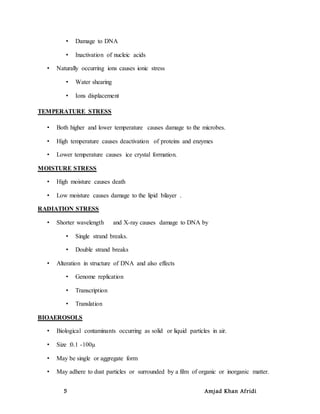
DIPHTHERIA
• Acute contagious disease caused by
cornynebacterium diphtheriae
• Formation of fibrous pseudo membrane on
respiratory mucosa, myocardial and neural tissue
damage.
• Symptoms:
• Sore throat
• Low fever
• Cutaneous lesions etc.
TUBERCULOSIS
• Caused by Mycobacterium tuberculosis,
• Initiated by inhalation
SYMPTOMS
• Chronic cough
• Blood tinged sputum
• Night sweats
• Weight loss etc.
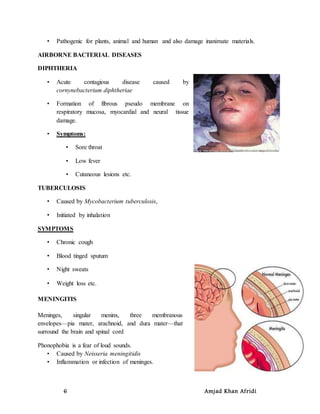
MENINGITIS
Meninges, singular meninx, three membranous
envelopes—pia mater, arachnoid, and dura mater—that
surround the brain and spinal cord
Phonophobia is a fear of loud sounds.
• Caused by Neisseria meningitidis
• Inflammation or infection of meninges.
7 Amjad Khan Afridi
SYMPTOMS
• Headache
• Neck stiffness
• Fever
• Confusions
• Photophobia
• Phonophobia
AIRBORNE VIRAL DISEASES
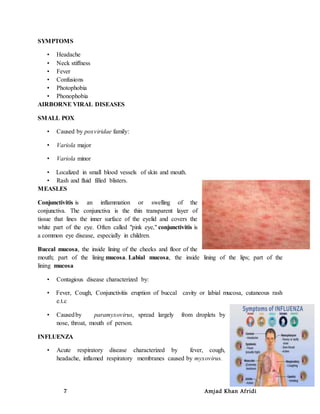
SMALL POX
• Caused by poxviridae family:
• Variola major
• Variola minor
• Localized in small blood vessels of skin and mouth.
• Rash and fluid filled blisters.
MEASLES
Conjunctivitis is an inflammation or swelling of the
conjunctiva. The conjunctiva is the thin transparent layer of
tissue that lines the inner surface of the eyelid and covers the
white part of the eye. Often called "pink eye," conjunctivitis is
a common eye disease, especially in children.
Buccal mucosa, the inside lining of the cheeks and floor of the
mouth; part of the lining mucosa. Labial mucosa, the inside lining of the lips; part of the
lining mucosa
• Contagious disease characterized by:
• Fever, Cough, Conjunctivitis eruption of buccal cavity or labial mucosa, cutaneous rash
e.t.c
• Causedby paramyxovirus, spread largely from droplets by
nose, throat, mouth of person.
INFLUENZA
• Acute respiratory disease characterized by fever, cough,
headache, inflamed respiratory membranes caused by myxovirus.
8 Amjad Khan Afridi
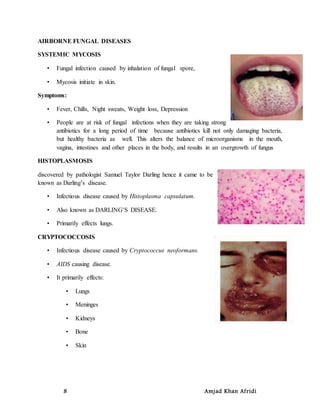
AIRBORNE FUNGAL DISEASES
SYSTEMIC MYCOSIS
• Fungal infection caused by inhalation of fungal spore,
• Mycosis initiate in skin.
Symptoms:
• Fever, Chills, Night sweats, Weight loss, Depression
• People are at risk of fungal infections when they are taking strong
antibiotics for a long period of time because antibiotics kill not only damaging bacteria,
but healthy bacteria as well. This alters the balance of microorganisms in the mouth,
vagina, intestines and other places in the body, and results in an overgrowth of fungus
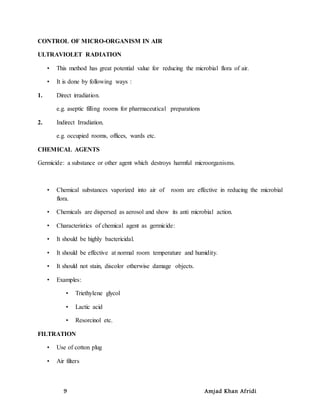
HISTOPLASMOSIS
discovered by pathologist Samuel Taylor Darling hence it came to be
known as Darling’s disease.
• Infectious disease caused by Histoplasma capsulatum.
• Also known as DARLING’S DISEASE.
• Primarily effects lungs.
CRYPTOCOCCOSIS
• Infectious disease caused by Cryptococcus neoformans.
• AIDS causing disease.
• It primarily effects:
• Lungs
• Meninges
• Kidneys
• Bone
• Skin
9 Amjad Khan Afridi
CONTROL OF MICRO-ORGANISM IN AIR
ULTRAVIOLET RADIATION
• This method has great potential value for reducing the microbial flora of air.
• It is done by following ways :
1. Direct irradiation.
e.g. aseptic filling rooms for pharmaceutical preparations
2. Indirect Irradiation.
e.g. occupied rooms, offices, wards etc.
CHEMICAL AGENTS
Germicide: a substance or other agent which destroys harmful microorganisms.
• Chemical substances vaporized into air of room are effective in reducing the microbial
flora.
• Chemicals are dispersed as aerosol and show its anti microbial action.
• Characteristics of chemical agent as germicide:
• It should be highly bactericidal.
• It should be effective at normal room temperature and humidity.
• It should not stain, discolor otherwise damage objects.
• Examples:
• Triethylene glycol
• Lactic acid
• Resorcinol etc.
FILTRATION
• Use of cotton plug
• Air filters
10 Amjad Khan Afridi
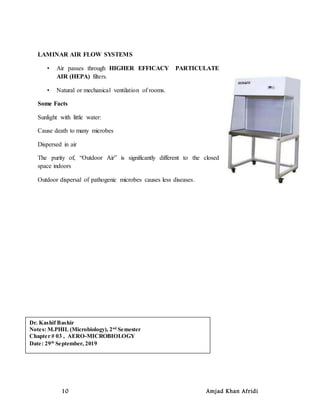
LAMINAR AIR FLOW SYSTEMS
• Air passes through HIGHER EFFICACY PARTICULATE
AIR (HEPA) filters.
• Natural or mechanical ventilation of rooms.
Some Facts
Sunlight with little water:
Cause death to many microbes
Dispersed in air
The purity of, “Outdoor Air” is significantly different to the closed
space indoors
Outdoor dispersal of pathogenic microbes causes less diseases.
Dr. Kashif Bashir
Notes: M.PHIL (Microbiology), 2nd
Semester
Chapter # 03 , AERO-MICROBIOLOGY
Date: 29th
September, 2019

Airborne a Disease

  • 1.
    1 Amjad KhanAfridi AERO-MICROBIOLOGY “Study of living microbes suspended in air” Transmission of airborne microorganisms. • Organisms are sprayed by: • Coughing • Sneezing etc. • Air microorganisms are carried by: • Dust particles • Droplet nuclei • During 1930s the term aero-microbiology was used to denote the air borne spores (e.g. fungi and other microorganisms ) • Further in 1951, the term was elaborated to include dispersion of insect population, fungal spores, bacteria and viruses. • In 1964, the term included the research work of air borne materials of biological significance. • Study of aerosolization, aerial transmission and biological materials. • It also includes the study of diseases transmitted through respiratory routes. • The field of aeromicrobiology is important as it involves, • Formation of aerosols . • Their transmission and deposition in soil. • The important gases that affect the microorganisms are hydrogen sulphide, sulphur dioxide, carbon monoxide, chlorine, hydrogen fluoride, ozone , etc. • The microbial forms are bacteria, fungi and actinomycetes , algae, spores of pteridophytes, pollen grains, micro insects and viruses.
  • 2.
    2 Amjad KhanAfridi INDOOR AERO-MICROBIOLOGY • It deals with microorganisms present in air in indoor environment. • They are the microorganisms which are responsible bio-deterioraton of storage materials, equipment , library materials and archives. INDOOR AERO-MICROBIOLOGY • Aero-microspora of pharmacy. • Aero-microflora of hospitals. • Houses • Aero-microflora of storage materials. AEROALLERGENS AND AEROALLERGY • Allergy is caused by certain biological & abiological agents present in the atmosphere. • The allergy causing agents in the air are called aeroallergens. • The allergy caused by them is called aeroallergy. AEROALLERGENS • House dust allergens . • Pollen grains. • Cosmetics .
  • 3.
    3 Amjad KhanAfridi PHYSICAL ENVIRONMENT STRESS • Desiccation • Humidity • Temperature • Radiation OUTDOOR AIR • Algae • Protozoa • Yeasts • Molds o Mold spore are predominant, e.g. clasdosporium o Bacterial species are  Spore forming  Non-spore forming BACTERIAL SPECIES • Micrococcus • Sarcina • Gram negative rods • Gram positive rods • Aerobic spore forming bacteria FUNGAL SPECIES • Clasdosporium • Alternaria • Pullularia • Penicillium • Batrytis • Stemphylium
  • 4.
    4 Amjad KhanAfridi PHYLLOPLANE MICROFLORA Leaf surface habitat. The phyllosphere is a term used in microbiology to refer to the total above-ground portions of plants as habitat for microorganisms. The phyllosphere can be further subdivided into the caulosphere (stems), phylloplane (leaves) A vegetative structure that can become detached from a plant and give rise to a new plant, e.g. a bud, sucker, or spore. ENVIRONMENTAL PARAMETERS AFFECTING MICROBES SURVIVAL Microbes are continually in the state of stress. • Oxygen stress and ionic stress. • Temperature stress. • Moisture stress. • UV-radiation stress. OXYGENIC AND IONIC STRESS • Higher level of oxygen and its reactive form causes • inactivation of enzymes.
  • 5.
    5 Amjad KhanAfridi • Damage to DNA • Inactivation of nucleic acids • Naturally occurring ions causes ionic stress • Water shearing • Ions displacement TEMPERATURE STRESS • Both higher and lower temperature causes damage to the microbes. • High temperature causes deactivation of proteins and enzymes • Lower temperature causes ice crystal formation. MOISTURE STRESS • High moisture causes death • Low moisture causes damage to the lipid bilayer . RADIATION STRESS • Shorter wavelength and X-ray causes damage to DNA by • Single strand breaks. • Double strand breaks • Alteration in structure of DNA and also effects • Genome replication • Transcription • Translation BIOAEROSOLS • Biological contaminants occurring as solid or liquid particles in air. • Size :0.1 -100µ • May be single or aggregate form • May adhere to dust particles or surrounded by a film of organic or inorganic matter.
  • 6.
    6 Amjad KhanAfridi • Pathogenic for plants, animal and human and also damage inanimate materials. AIRBORNE BACTERIAL DISEASES DIPHTHERIA • Acute contagious disease caused by cornynebacterium diphtheriae • Formation of fibrous pseudo membrane on respiratory mucosa, myocardial and neural tissue damage. • Symptoms: • Sore throat • Low fever • Cutaneous lesions etc. TUBERCULOSIS • Caused by Mycobacterium tuberculosis, • Initiated by inhalation SYMPTOMS • Chronic cough • Blood tinged sputum • Night sweats • Weight loss etc. MENINGITIS Meninges, singular meninx, three membranous envelopes—pia mater, arachnoid, and dura mater—that surround the brain and spinal cord Phonophobia is a fear of loud sounds. • Caused by Neisseria meningitidis • Inflammation or infection of meninges.
  • 7.
    7 Amjad KhanAfridi SYMPTOMS • Headache • Neck stiffness • Fever • Confusions • Photophobia • Phonophobia AIRBORNE VIRAL DISEASES SMALL POX • Caused by poxviridae family: • Variola major • Variola minor • Localized in small blood vessels of skin and mouth. • Rash and fluid filled blisters. MEASLES Conjunctivitis is an inflammation or swelling of the conjunctiva. The conjunctiva is the thin transparent layer of tissue that lines the inner surface of the eyelid and covers the white part of the eye. Often called "pink eye," conjunctivitis is a common eye disease, especially in children. Buccal mucosa, the inside lining of the cheeks and floor of the mouth; part of the lining mucosa. Labial mucosa, the inside lining of the lips; part of the lining mucosa • Contagious disease characterized by: • Fever, Cough, Conjunctivitis eruption of buccal cavity or labial mucosa, cutaneous rash e.t.c • Causedby paramyxovirus, spread largely from droplets by nose, throat, mouth of person. INFLUENZA • Acute respiratory disease characterized by fever, cough, headache, inflamed respiratory membranes caused by myxovirus.
  • 8.
    8 Amjad KhanAfridi AIRBORNE FUNGAL DISEASES SYSTEMIC MYCOSIS • Fungal infection caused by inhalation of fungal spore, • Mycosis initiate in skin. Symptoms: • Fever, Chills, Night sweats, Weight loss, Depression • People are at risk of fungal infections when they are taking strong antibiotics for a long period of time because antibiotics kill not only damaging bacteria, but healthy bacteria as well. This alters the balance of microorganisms in the mouth, vagina, intestines and other places in the body, and results in an overgrowth of fungus HISTOPLASMOSIS discovered by pathologist Samuel Taylor Darling hence it came to be known as Darling’s disease. • Infectious disease caused by Histoplasma capsulatum. • Also known as DARLING’S DISEASE. • Primarily effects lungs. CRYPTOCOCCOSIS • Infectious disease caused by Cryptococcus neoformans. • AIDS causing disease. • It primarily effects: • Lungs • Meninges • Kidneys • Bone • Skin
  • 9.
    9 Amjad KhanAfridi CONTROL OF MICRO-ORGANISM IN AIR ULTRAVIOLET RADIATION • This method has great potential value for reducing the microbial flora of air. • It is done by following ways : 1. Direct irradiation. e.g. aseptic filling rooms for pharmaceutical preparations 2. Indirect Irradiation. e.g. occupied rooms, offices, wards etc. CHEMICAL AGENTS Germicide: a substance or other agent which destroys harmful microorganisms. • Chemical substances vaporized into air of room are effective in reducing the microbial flora. • Chemicals are dispersed as aerosol and show its anti microbial action. • Characteristics of chemical agent as germicide: • It should be highly bactericidal. • It should be effective at normal room temperature and humidity. • It should not stain, discolor otherwise damage objects. • Examples: • Triethylene glycol • Lactic acid • Resorcinol etc. FILTRATION • Use of cotton plug • Air filters
  • 10.
    10 Amjad KhanAfridi LAMINAR AIR FLOW SYSTEMS • Air passes through HIGHER EFFICACY PARTICULATE AIR (HEPA) filters. • Natural or mechanical ventilation of rooms. Some Facts Sunlight with little water: Cause death to many microbes Dispersed in air The purity of, “Outdoor Air” is significantly different to the closed space indoors Outdoor dispersal of pathogenic microbes causes less diseases. Dr. Kashif Bashir Notes: M.PHIL (Microbiology), 2nd Semester Chapter # 03 , AERO-MICROBIOLOGY Date: 29th September, 2019