MICROBIOLOGY
OF AIR
INTRODUCTION
• Study of living microbes suspended in air is simple called air microbiology.
• Different types of air microbes organisms are :
• Blastomyces dermatitidis
• Coccidioides immitis
• Cryptococcus neoformans
Source of microbes
in air
water Animals&plants humans
soil
Droplet nuclei
Bio-aerosol
Infections dust
Droplet
DROPLET NUCLEI
• DROPLET NUCLEI originate from the evaporation.
• It is present in a warm and dry atmosphere evaporate rapidly and the
solid material left after drying up is know as DROPLET NUCLEI.
• Microorganism present in a droplet nuclei should be visible that cause
the infection.
• Visibility is determined by atmospheric conditions like humidity,
sunlight, temperature, size of particles bearing the organism.
BIOAEROSOL
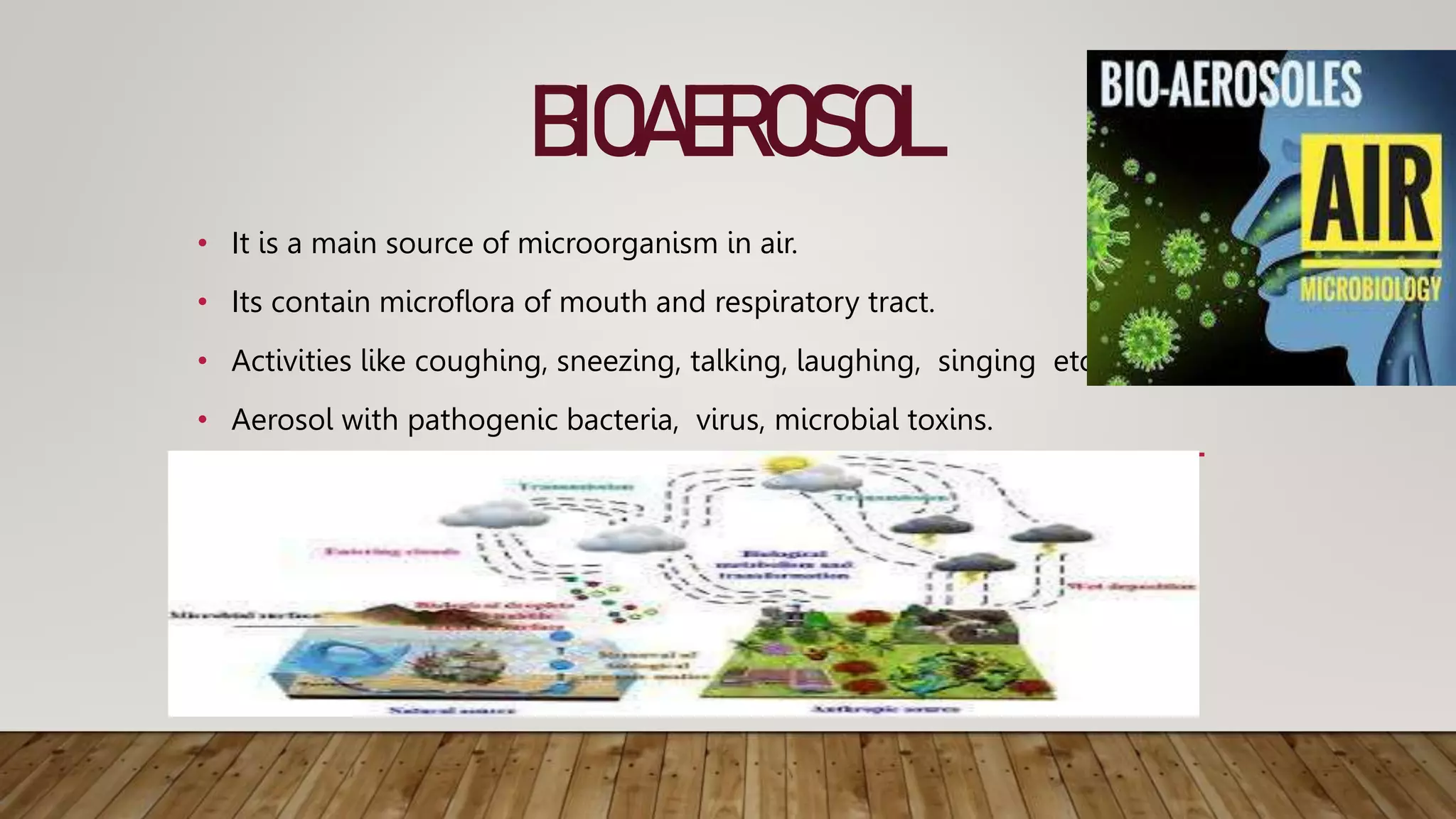
• It is a main source of microorganism in air.
• Its contain microflora of mouth and respiratory tract.
• Activities like coughing, sneezing, talking, laughing, singing etc.…..
• Aerosol with pathogenic bacteria, virus, microbial toxins.
AIRBORNE MICROLBES
• Airborne microbes are biological airborne contaminants (also
known as bioaerosols) like bacteria, viruses or fungi as well as
airborne toxins passed from one victim to the next through the
air, without physical contact, causing irritation at the very least.
• This usually happens when an infected subject sneezes, coughs,
or just plain breathes.
• It is hard to prevent such a method of transmission.
• Airborne microbes are a major cause of respiratory ailments
such as allergies and pathogenic infections (virus or bacteria).
IMPACT ON HUMAN HEALTH &
ENVIROMENTAL
• A major risk for human health is airborne fungi that can exacerbate
diseases including allergies and asthma.
• Exposure to some Gram-negative and Gram-positive bacteria,
endotoxin, and actinomycetes when dispersed through the air can result
in disease following inhalation.
• Air is an unfavorable environment for microorganisms, in which they
cannot grow or divide.
• Viable airborne microorganisms are not air pollutants, but should be
considered as a factor affecting air quality.
SAMPLING OF AIR
In active monitoring a microbiological air sampler physically draws
a known volume of air through or over a particle collection device
which can be a liquid or a solid culture media or a nitrocellulose
membrane and the quantity of microorganisms present is
measured in CFU (colony forming units)/m3 of air.
CONTROL OF AIR
MICROFLORA & ITS
IMPORANTANCE
• Indoor air-borne microbial population can be effectively reduced
by vaporizing or spraying certain chemical substances into the air.
• . Some of such chemical substances are propylene glycol, triethylene
glycol, resorcinol, hypochlorous acid and β-propiolactone.
• The significance of air microflora in human health relies on the fact
that air acts as a medium for the transmission of infectious agents.
• stop decomposition and spoilage, and prevent unwanted microbial
contamination
AIRBORNE TRANSMISSION OF
MICROBES
• Airborne diseases are bacteria or viruses that are most commonly
transmitted through small respiratory droplets.
• These droplets are expelled when someone with the airborne disease
sneezes, coughs, laughs, or otherwise exhales in some way.
• Airborne transmission are anthrax, chickenpox, influenza, measles,
smallpox, pneumonia, and tuberculosis.
PREVENTIVE CONTROL
MEASURE
•Stay away from the diseased person.
•Wear a mask when you need to contact a diseased person.
•Cover your mouth and nose while coughing or sneezing to prevent the
spread of the disease.
THANK YOU

Microbiology of air.pptx

  • 1.
  • 2.
    INTRODUCTION • Study ofliving microbes suspended in air is simple called air microbiology. • Different types of air microbes organisms are : • Blastomyces dermatitidis • Coccidioides immitis • Cryptococcus neoformans
  • 3.
    Source of microbes inair water Animals&plants humans soil
  • 4.
  • 5.
    DROPLET NUCLEI • DROPLETNUCLEI originate from the evaporation. • It is present in a warm and dry atmosphere evaporate rapidly and the solid material left after drying up is know as DROPLET NUCLEI. • Microorganism present in a droplet nuclei should be visible that cause the infection. • Visibility is determined by atmospheric conditions like humidity, sunlight, temperature, size of particles bearing the organism.
  • 6.
    BIOAEROSOL • It isa main source of microorganism in air. • Its contain microflora of mouth and respiratory tract. • Activities like coughing, sneezing, talking, laughing, singing etc.….. • Aerosol with pathogenic bacteria, virus, microbial toxins.
  • 7.
    AIRBORNE MICROLBES • Airbornemicrobes are biological airborne contaminants (also known as bioaerosols) like bacteria, viruses or fungi as well as airborne toxins passed from one victim to the next through the air, without physical contact, causing irritation at the very least. • This usually happens when an infected subject sneezes, coughs, or just plain breathes. • It is hard to prevent such a method of transmission. • Airborne microbes are a major cause of respiratory ailments such as allergies and pathogenic infections (virus or bacteria).
  • 8.
    IMPACT ON HUMANHEALTH & ENVIROMENTAL • A major risk for human health is airborne fungi that can exacerbate diseases including allergies and asthma. • Exposure to some Gram-negative and Gram-positive bacteria, endotoxin, and actinomycetes when dispersed through the air can result in disease following inhalation. • Air is an unfavorable environment for microorganisms, in which they cannot grow or divide. • Viable airborne microorganisms are not air pollutants, but should be considered as a factor affecting air quality.
  • 9.
    SAMPLING OF AIR Inactive monitoring a microbiological air sampler physically draws a known volume of air through or over a particle collection device which can be a liquid or a solid culture media or a nitrocellulose membrane and the quantity of microorganisms present is measured in CFU (colony forming units)/m3 of air.
  • 10.
    CONTROL OF AIR MICROFLORA& ITS IMPORANTANCE • Indoor air-borne microbial population can be effectively reduced by vaporizing or spraying certain chemical substances into the air. • . Some of such chemical substances are propylene glycol, triethylene glycol, resorcinol, hypochlorous acid and β-propiolactone. • The significance of air microflora in human health relies on the fact that air acts as a medium for the transmission of infectious agents. • stop decomposition and spoilage, and prevent unwanted microbial contamination
  • 11.
    AIRBORNE TRANSMISSION OF MICROBES •Airborne diseases are bacteria or viruses that are most commonly transmitted through small respiratory droplets. • These droplets are expelled when someone with the airborne disease sneezes, coughs, laughs, or otherwise exhales in some way. • Airborne transmission are anthrax, chickenpox, influenza, measles, smallpox, pneumonia, and tuberculosis.
  • 12.
    PREVENTIVE CONTROL MEASURE •Stay awayfrom the diseased person. •Wear a mask when you need to contact a diseased person. •Cover your mouth and nose while coughing or sneezing to prevent the spread of the disease.
  • 13.