Morphology
Prepared by:
Marvin D. Nacionales
Outline of Presentation
A. Brief History of Morphology
B. Importance of Studying Morphology
C. Definition of Morphology, Morpheme, and Word
D. Kinds of Words according to Morpheme
Structure
E. Bound and Free Morphemes
F. Inflection and Derivation
G. Types of Word-Formation Processes
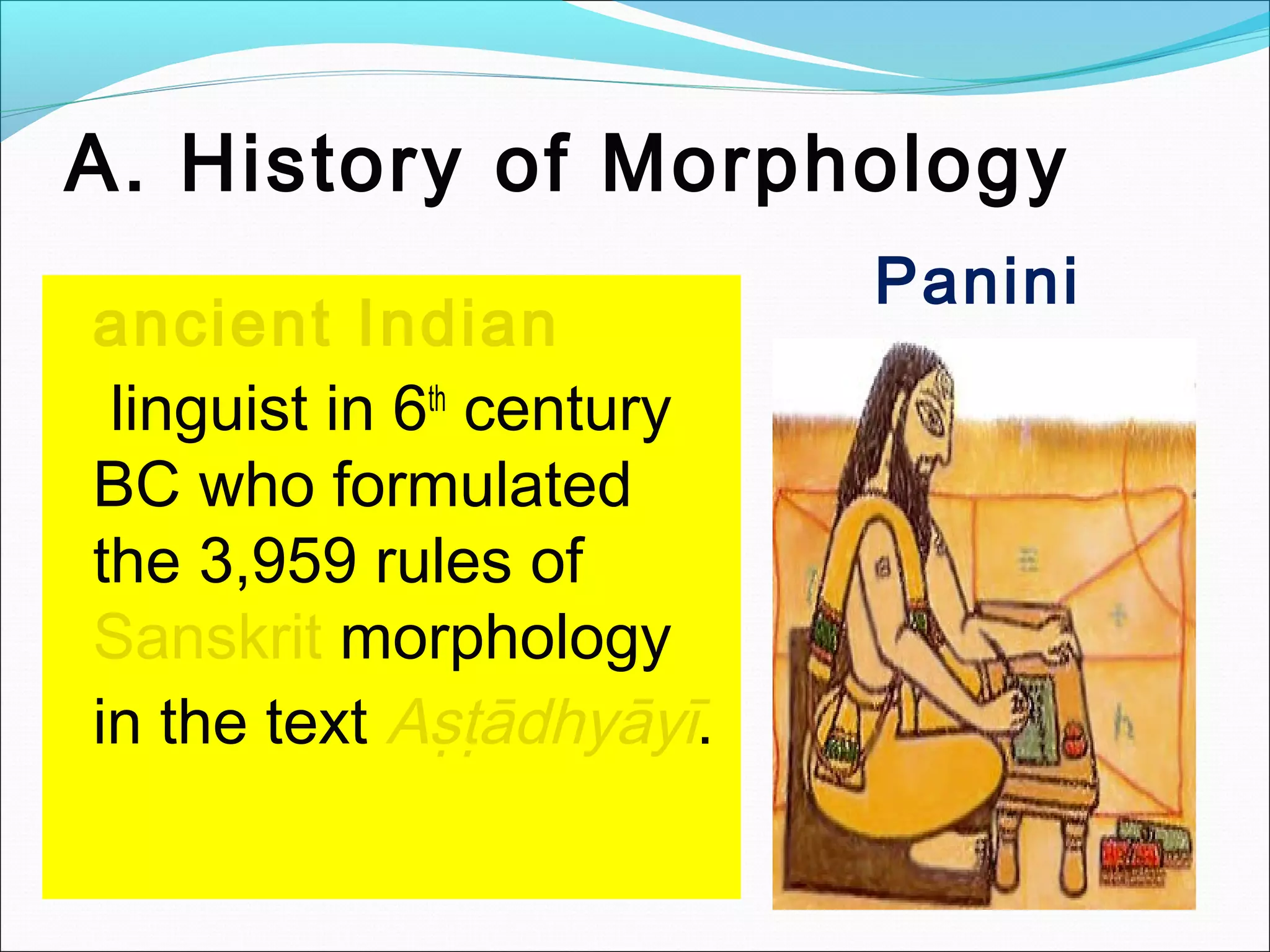
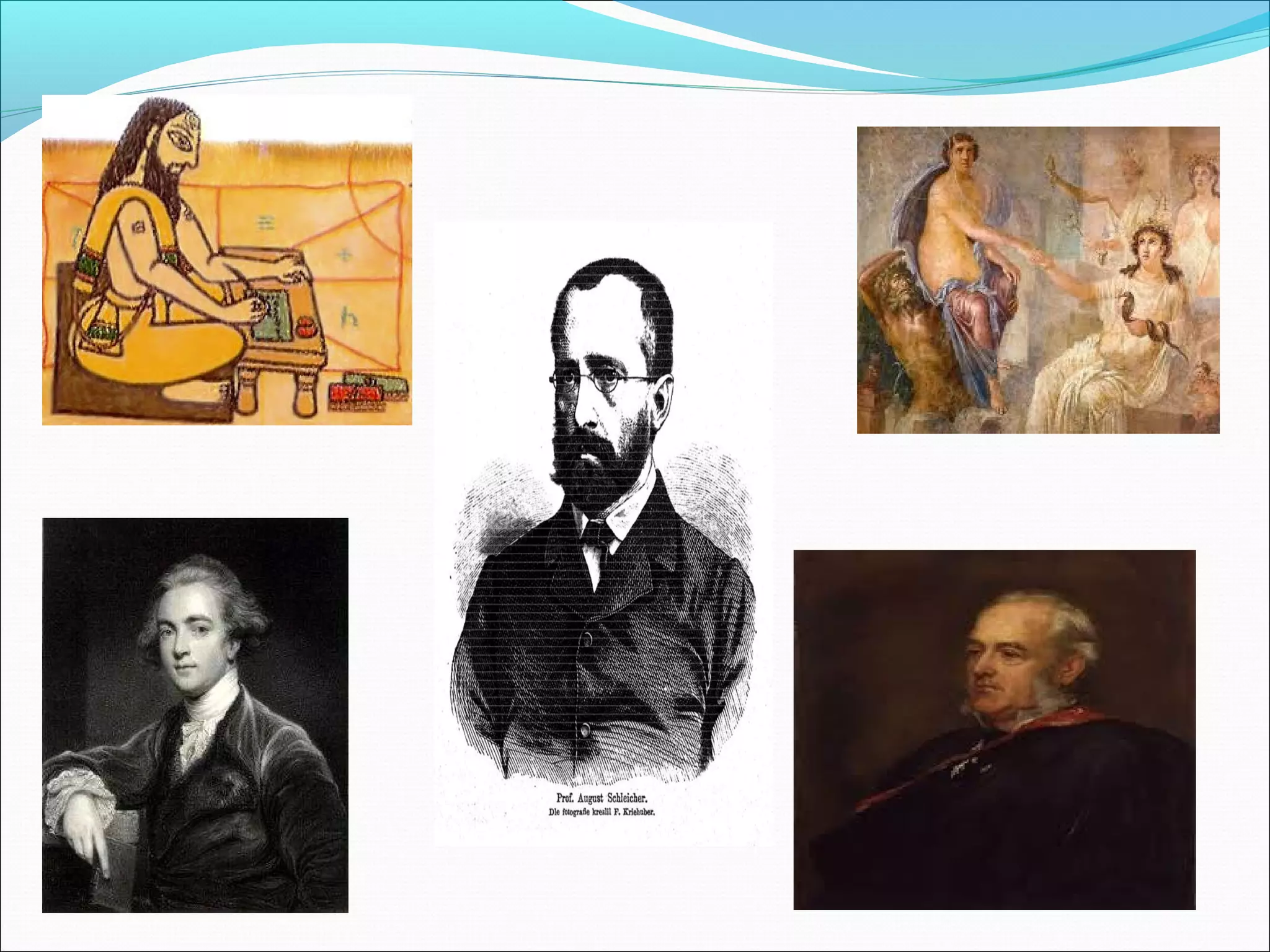
  ancient Indian
 linguist in 6th
century
BC who formulated
the 3,959 rules of
Sanskrit morphology
in the text Aṣṭādhyāyī.
A. History of Morphology
Panini
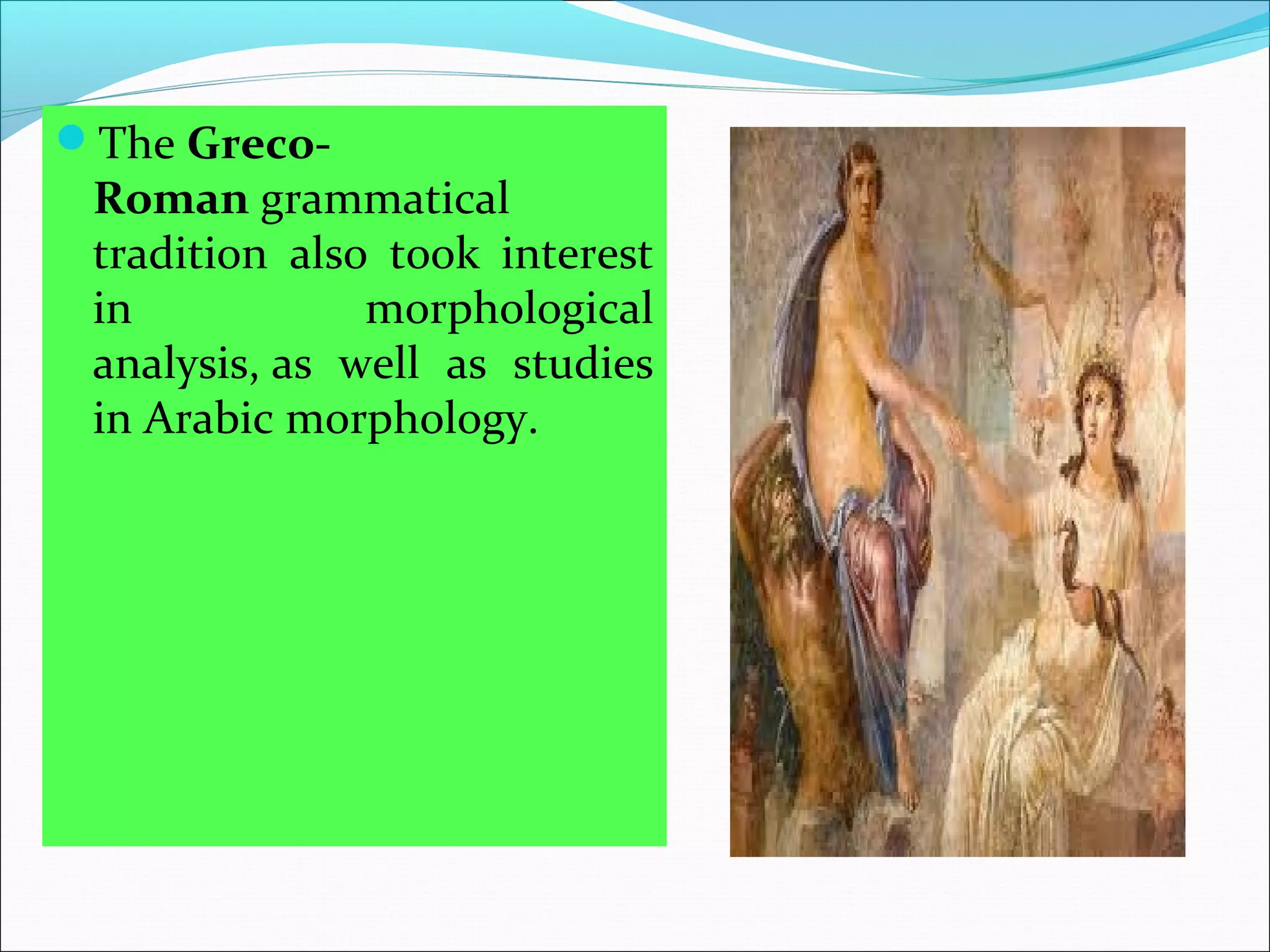
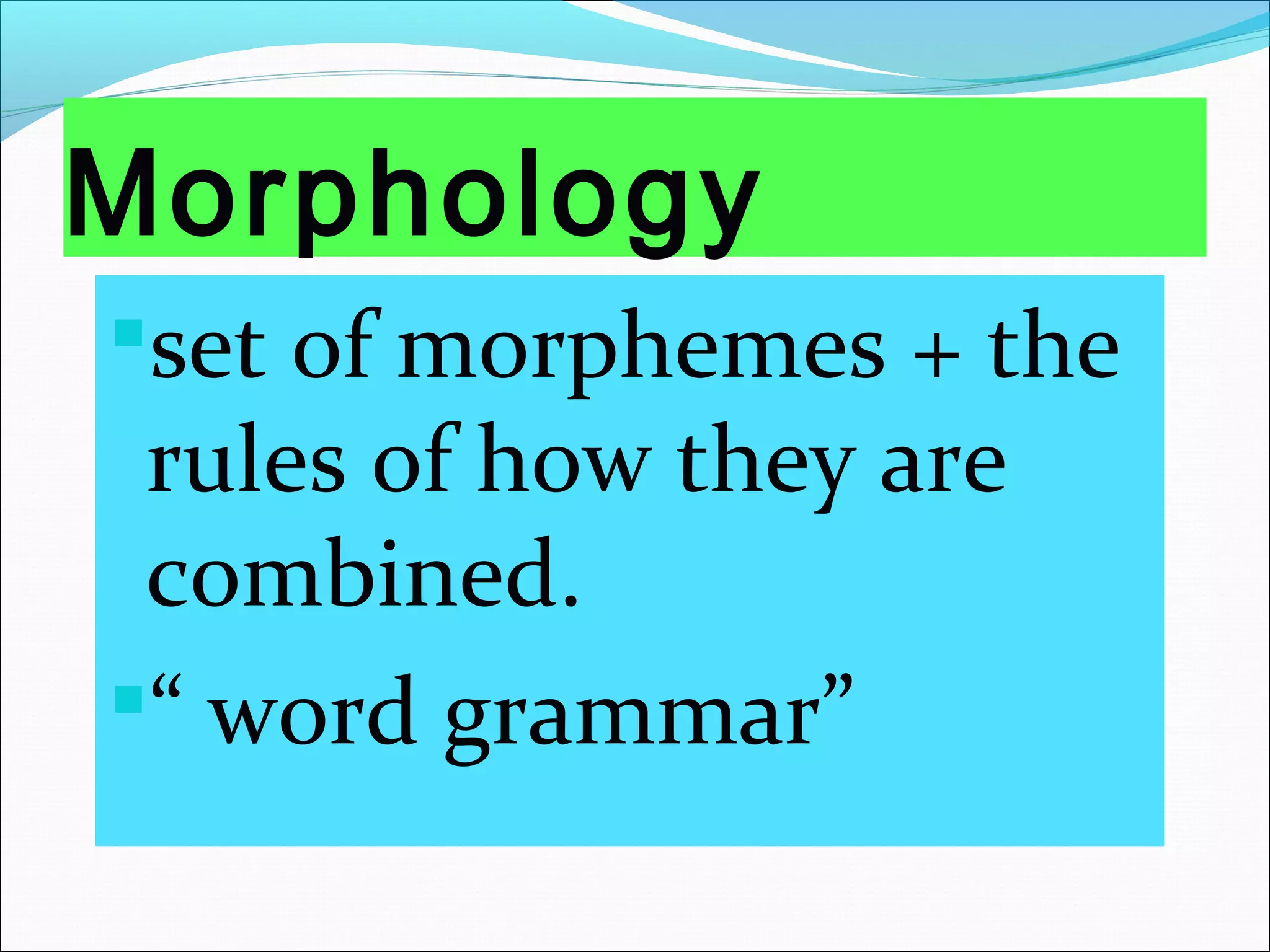
The Greco-
Roman grammatical 
tradition  also  took  interest 
in  morphological 
analysis, as  well  as  studies 
in Arabic morphology.
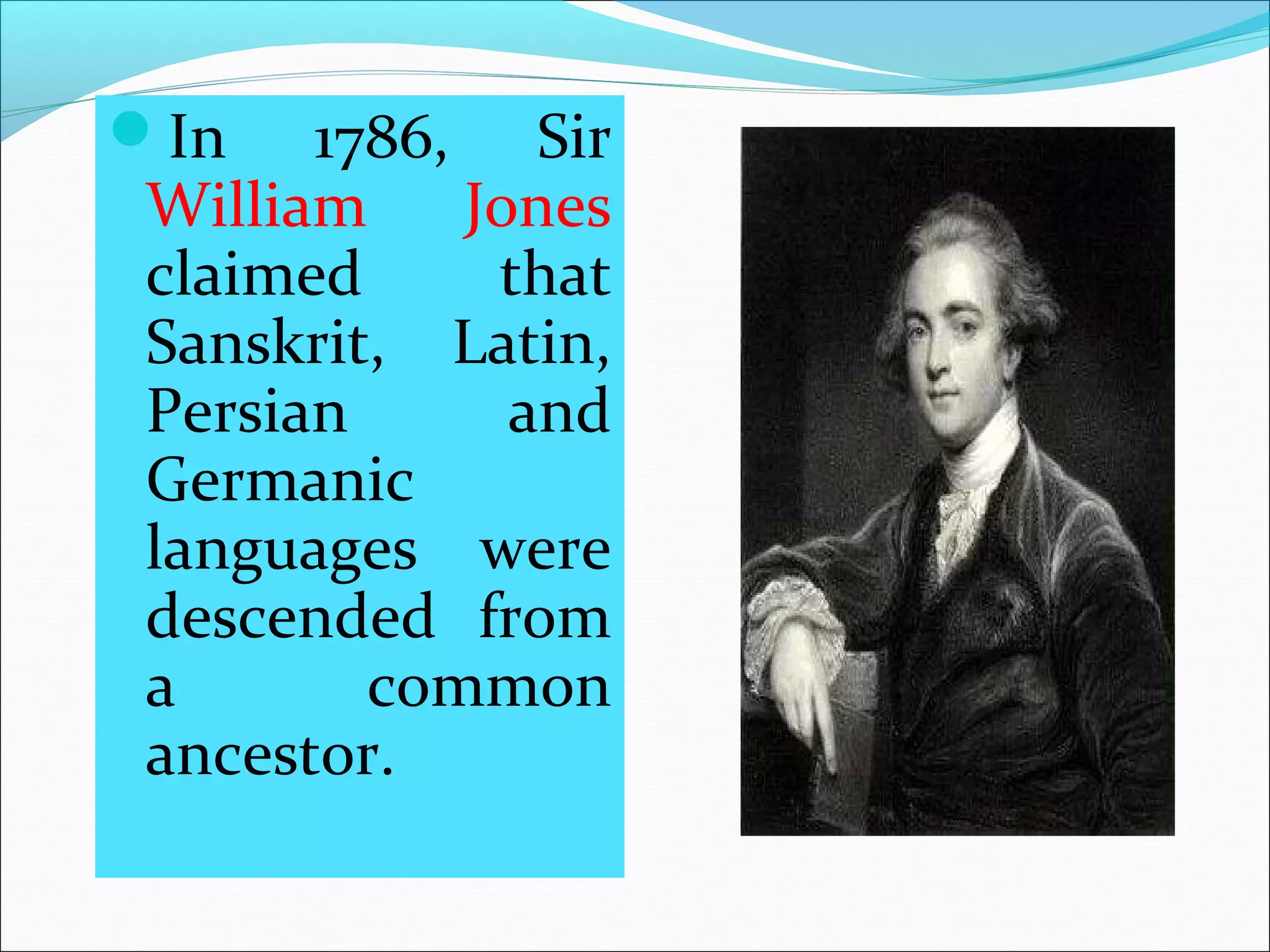
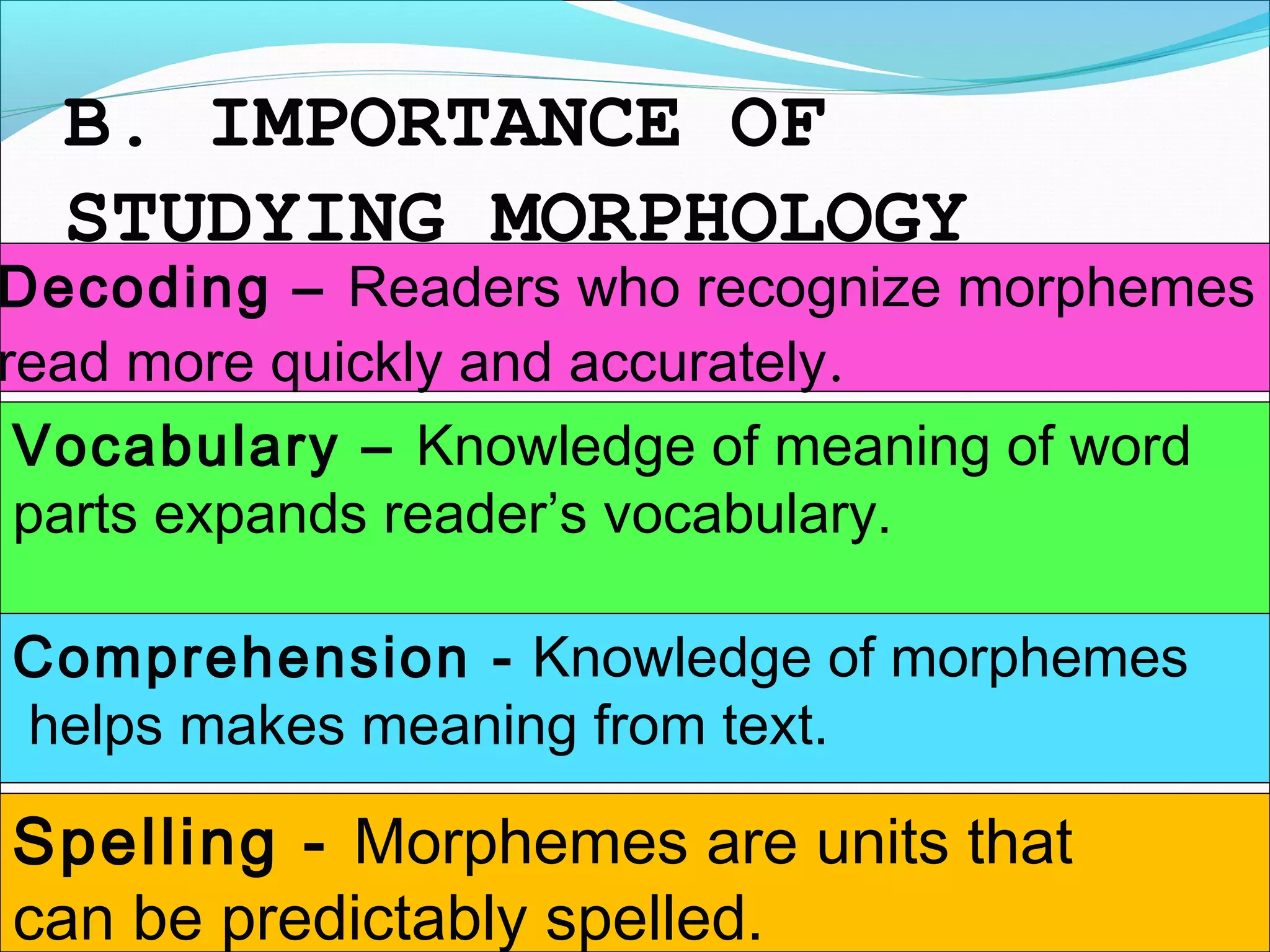
In  1786,  Sir 
William  Jones 
claimed  that 
Sanskrit,  Latin, 
Persian  and 
Germanic 
languages  were 
descended  from 
a  common 
ancestor. 
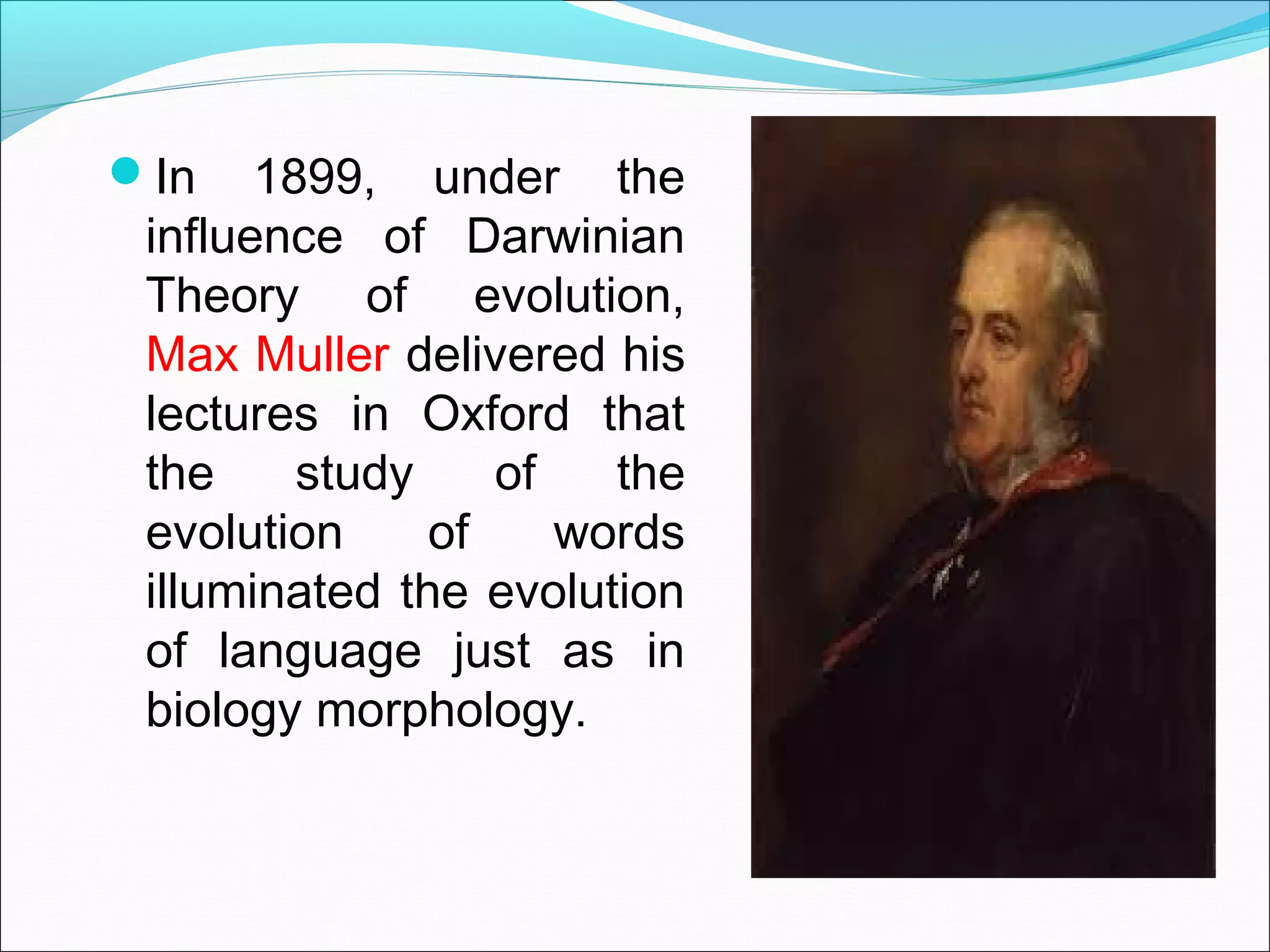
In 1899, under the
influence of Darwinian
Theory of evolution,
Max Muller delivered his
lectures in Oxford that
the study of the
evolution of words
illuminated the evolution
of language just as in
biology morphology.
His specific claim was that
the study of the 400-500
basic roots of the Indo-
European ancestors of many
of the languages of Europe
and Asia was the key to
understanding the origin of
human language.
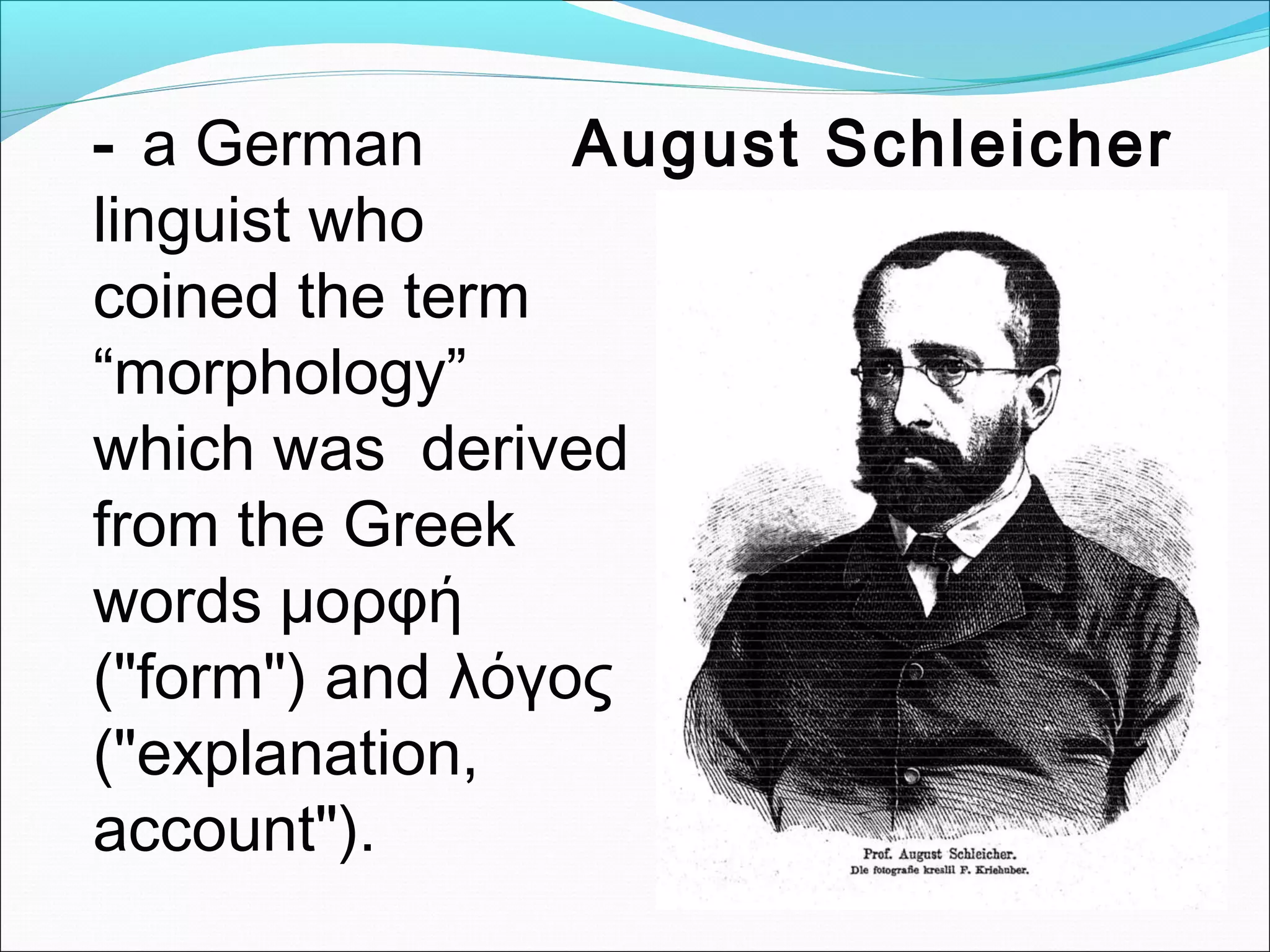
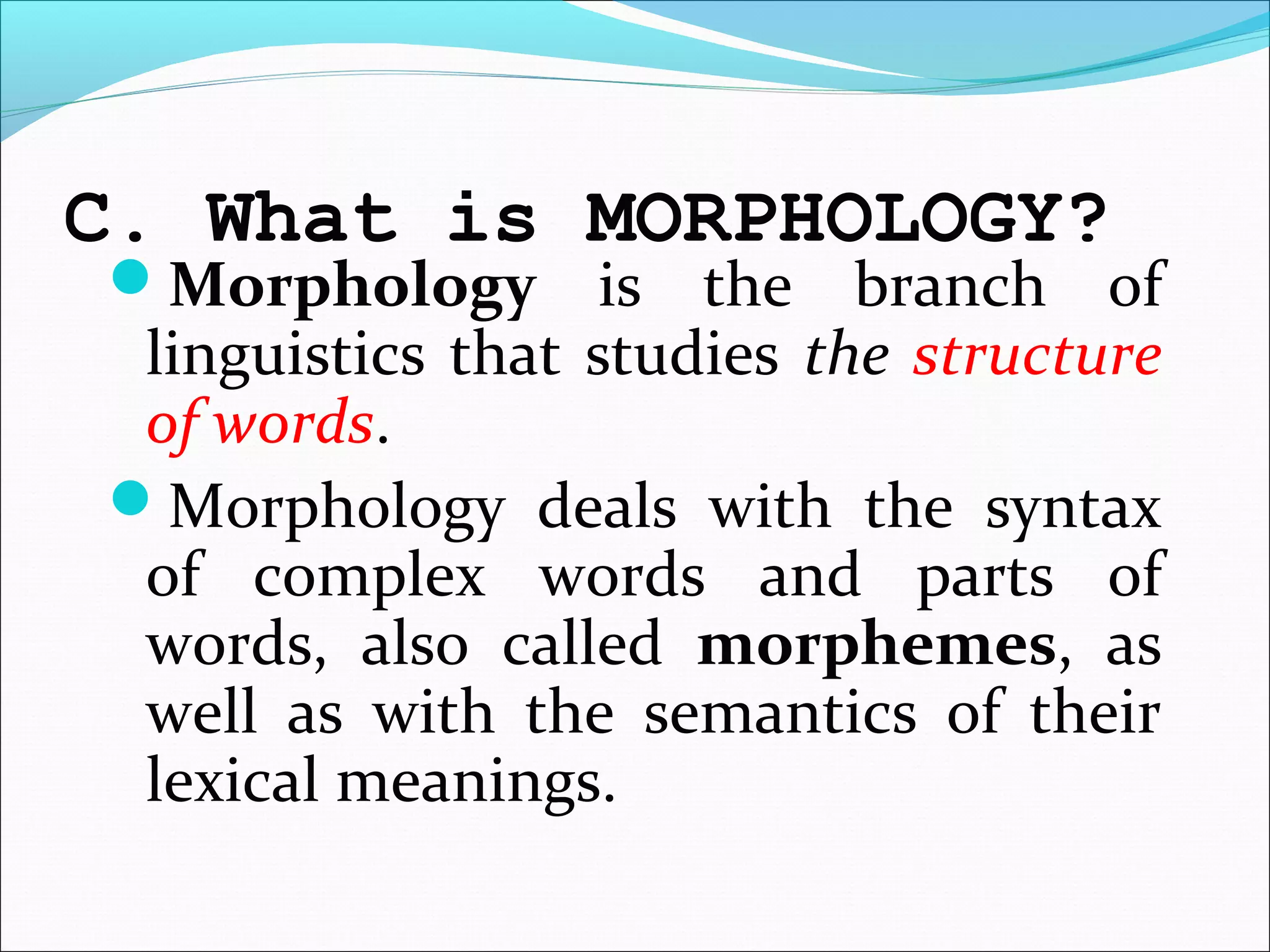
- a German
linguist who
coined the term
“morphology”
which was derived
from the Greek
words μορφή
("form") and λόγος
("explanation,
account").
August Schleicher
B. IMPORTANCE OF
STUDYING MORPHOLOGY
Decoding – Readers who recognize morphemes
read more quickly and accurately.
Comprehension - Knowledge of morphemes
helps makes meaning from text.
Vocabulary – Knowledge of meaning of word
parts expands reader’s vocabulary.
Spelling - Morphemes are units that
can be predictably spelled.
C. What is MORPHOLOGY?
Morphology  is  the  branch  of 
linguistics that studies the structure
of words.
Morphology  deals  with  the  syntax 
of  complex  words  and  parts  of 
words,  also  called  morphemes,  as 
well  as  with  the  semantics  of  their 
lexical meanings. 
Morphology
set of morphemes + the 
rules of how they are 
combined.
“ word grammar”
Understanding how words are
formed and what semantic
properties they convey through
their forms enables human
beings to easily recognize
individual words and their
meanings in discourse.
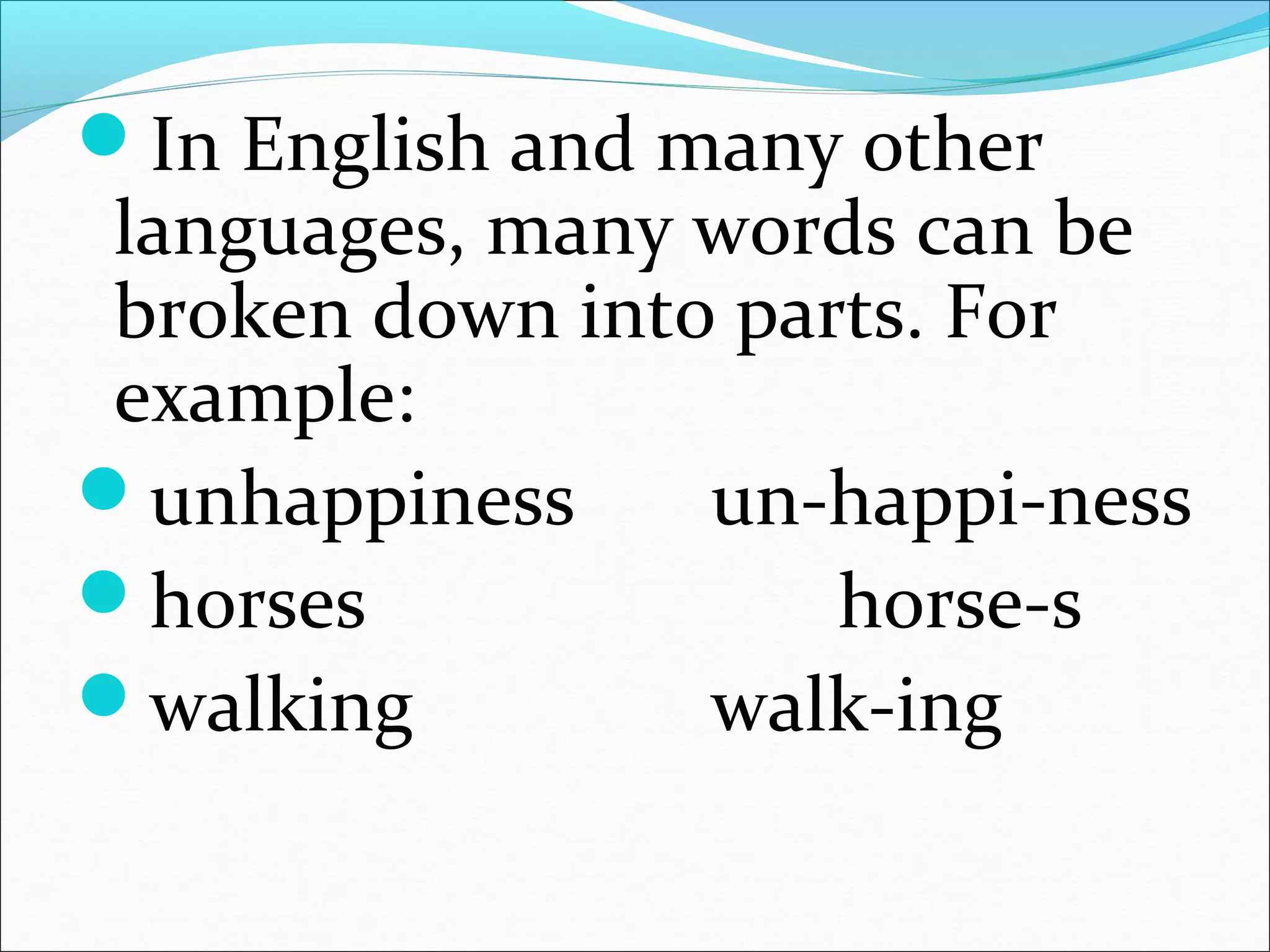
In English and many other 
languages, many words can be 
broken down into parts. For 
example:
unhappiness  un-happi-ness
horses horse-s
walking walk-ing
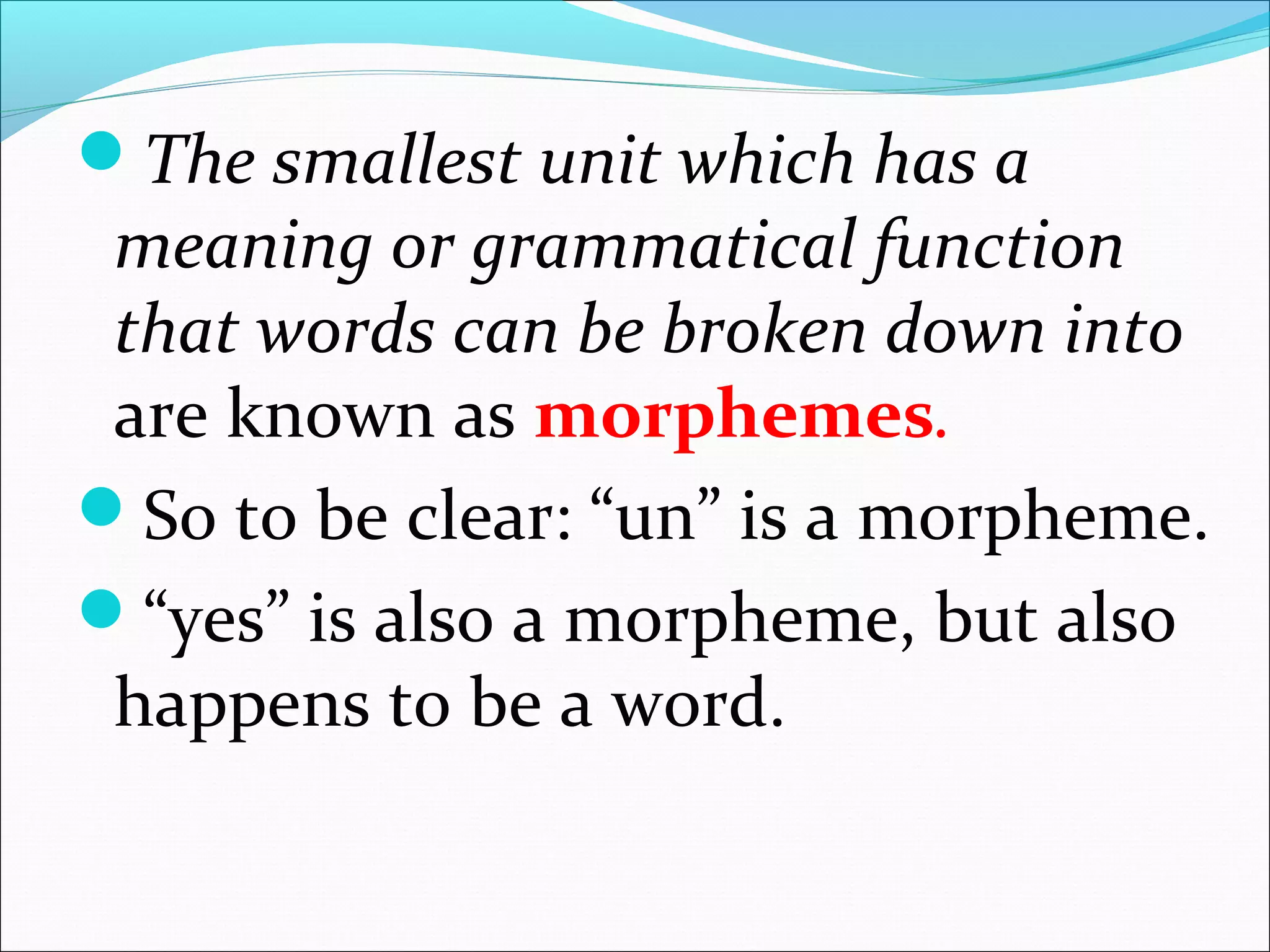
The smallest unit which has a
meaning or grammatical function
that words can be broken down into 
are known as morphemes.
So to be clear: “un” is a morpheme.
“yes” is also a morpheme, but also 
happens to be a word. 
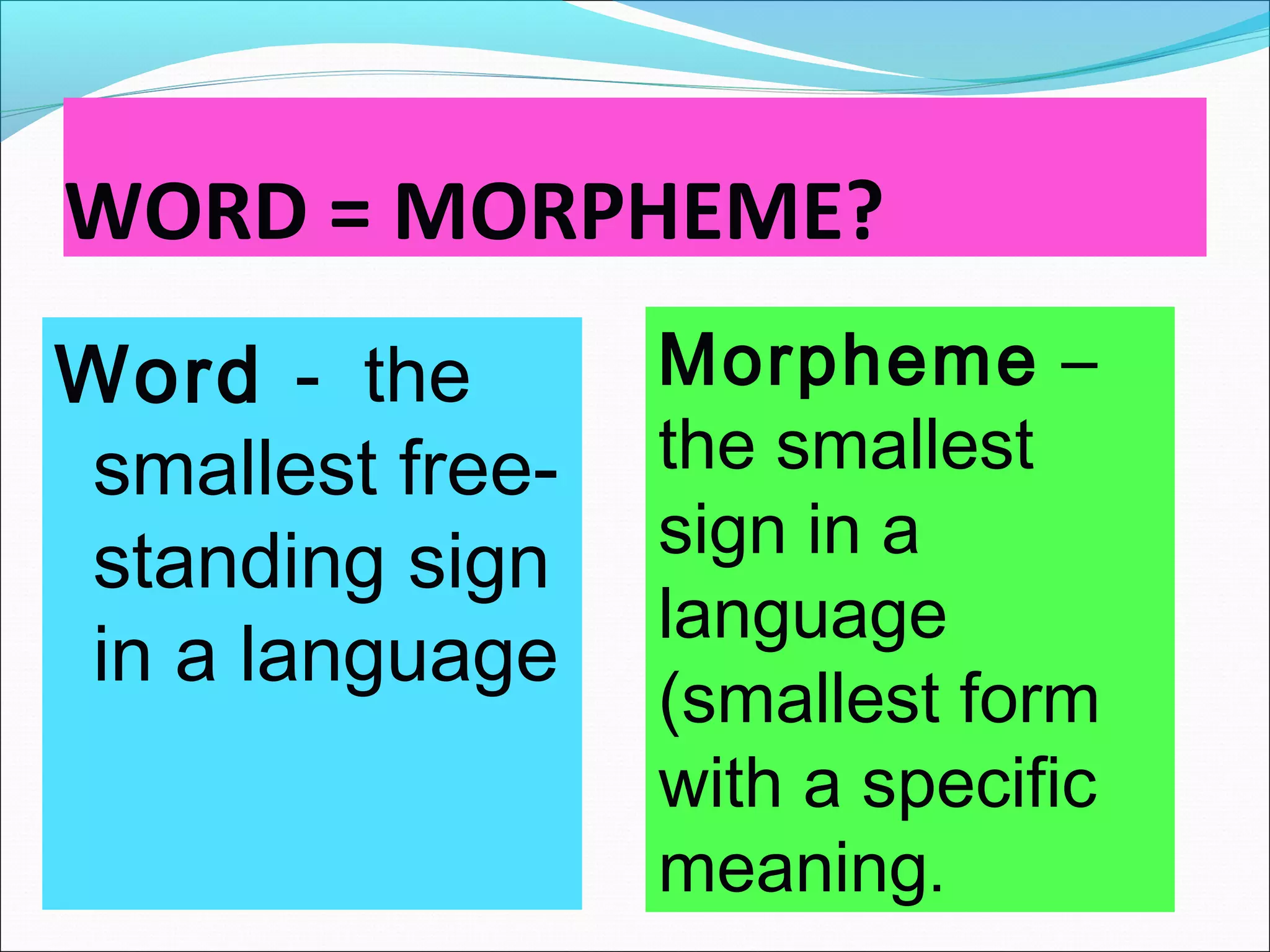
WORD = MORPHEME?
Word - the
smallest free-
standing sign
in a language
Morpheme –
the smallest
sign in a
language
(smallest form
with a specific
meaning.
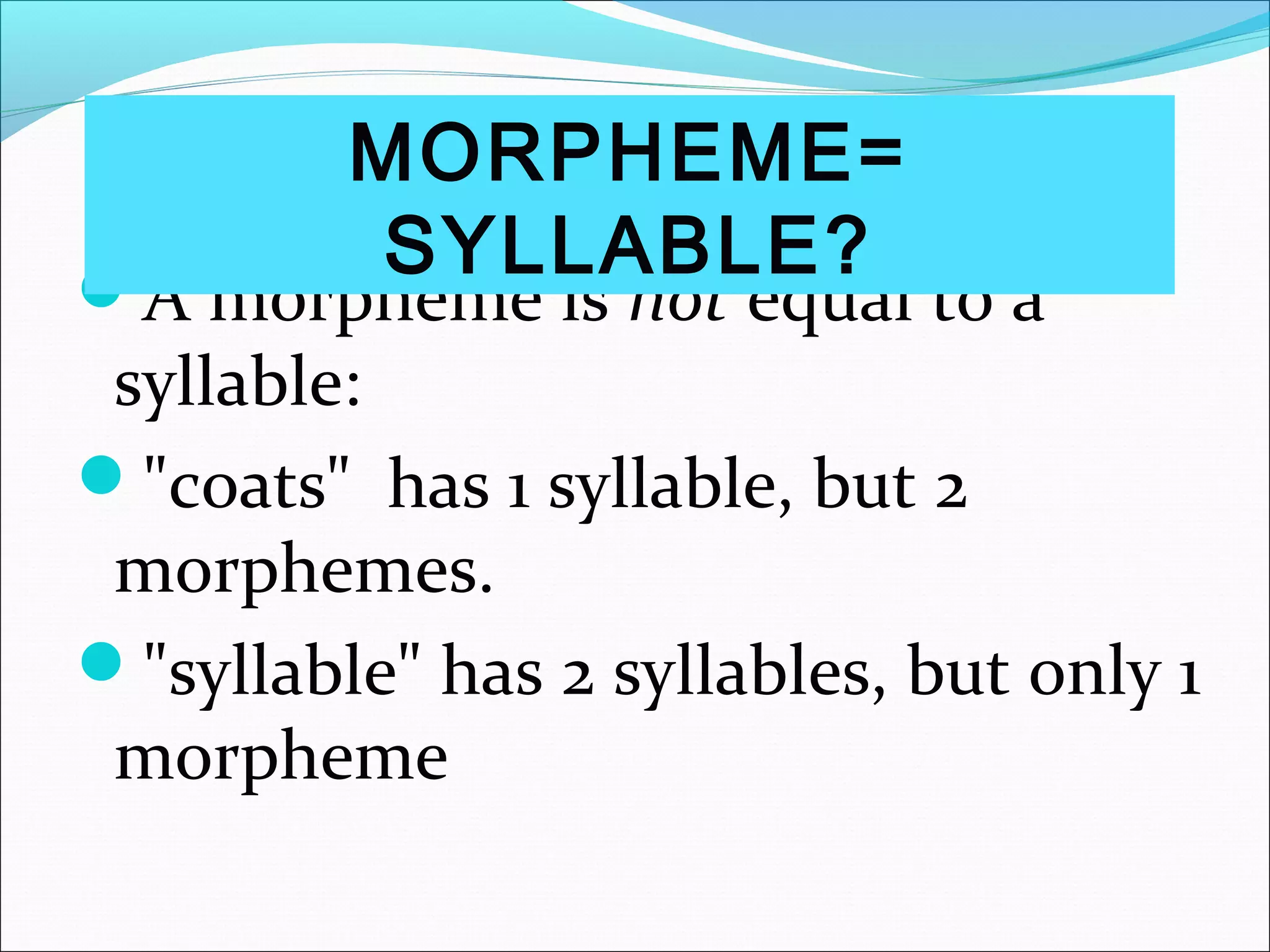
A morpheme is not equal to a
syllable:
"coats" has 1 syllable, but 2
morphemes.
"syllable" has 2 syllables, but only 1
morpheme
MORPHEME=
SYLLABLE?
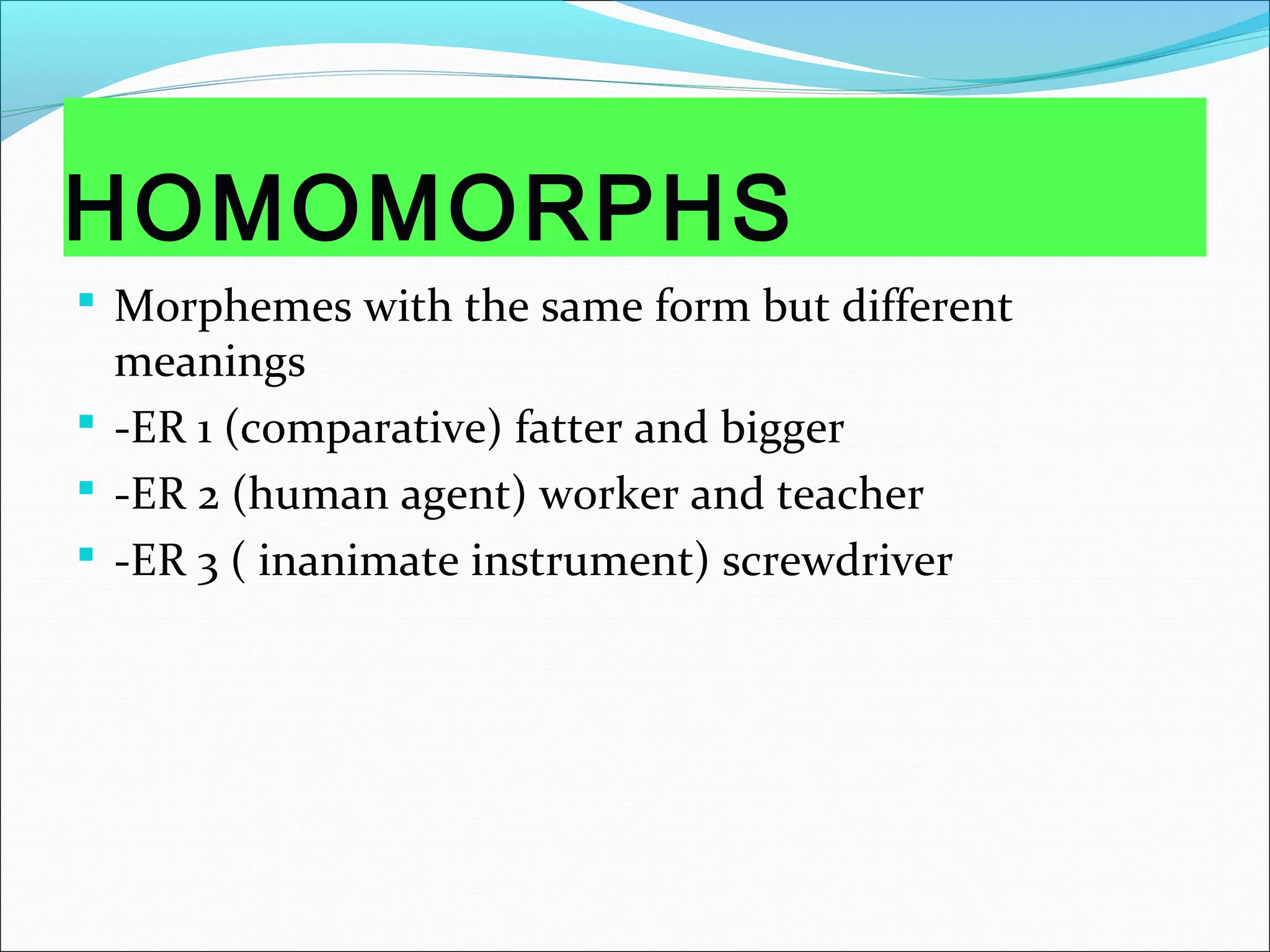
HOMOMORPHS
 Morphemes with the same form but different
meanings
 -ER 1 (comparative) fatter and bigger
 -ER 2 (human agent) worker and teacher
 -ER 3 ( inanimate instrument) screwdriver
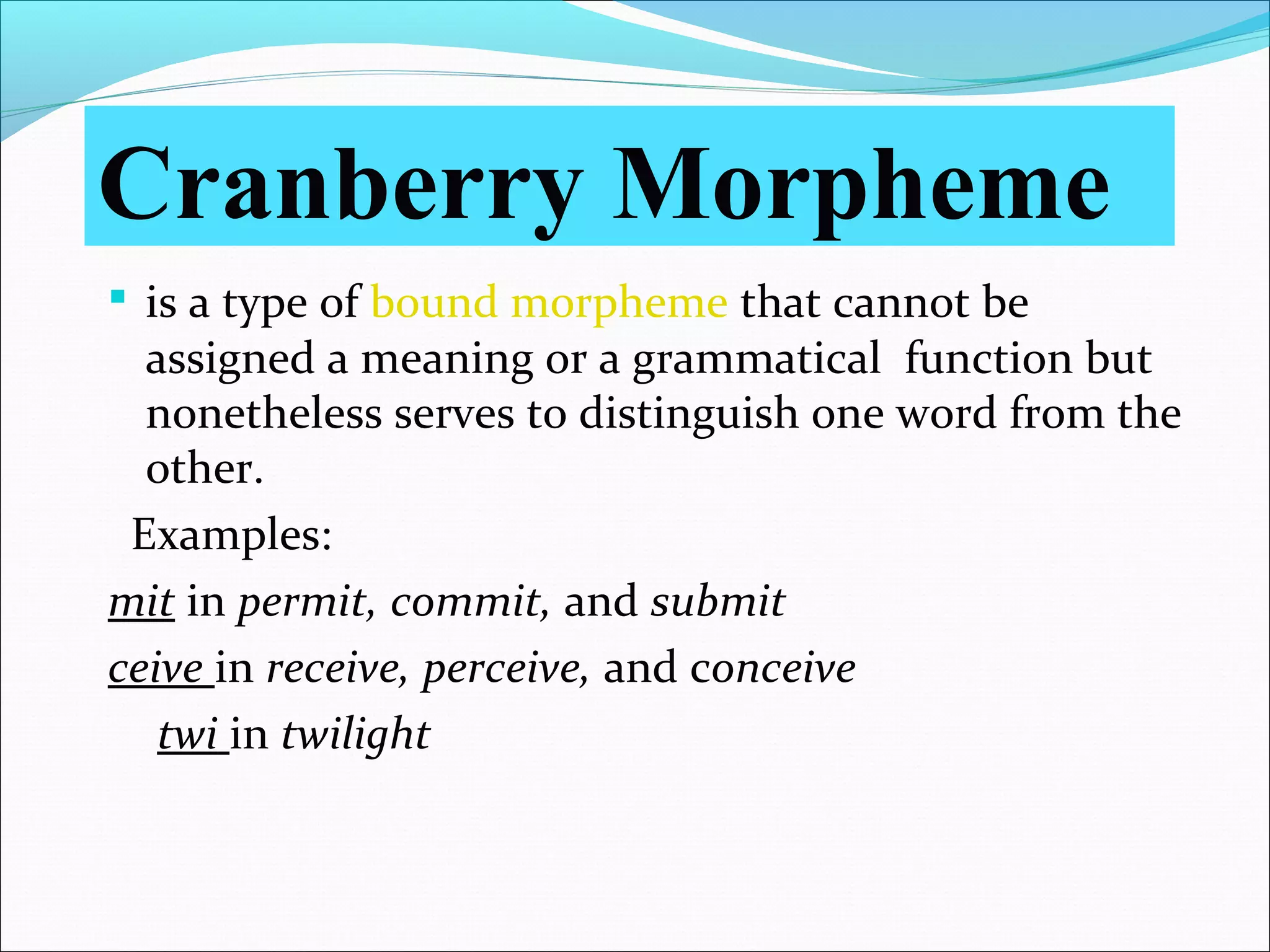
 is a type of bound morpheme that cannot be
assigned a meaning or a grammatical function but
nonetheless serves to distinguish one word from the
other.
Examples:
mit in permit, commit, and submit
ceive in receive, perceive, and conceive
twi in twilight
Cranberry Morpheme
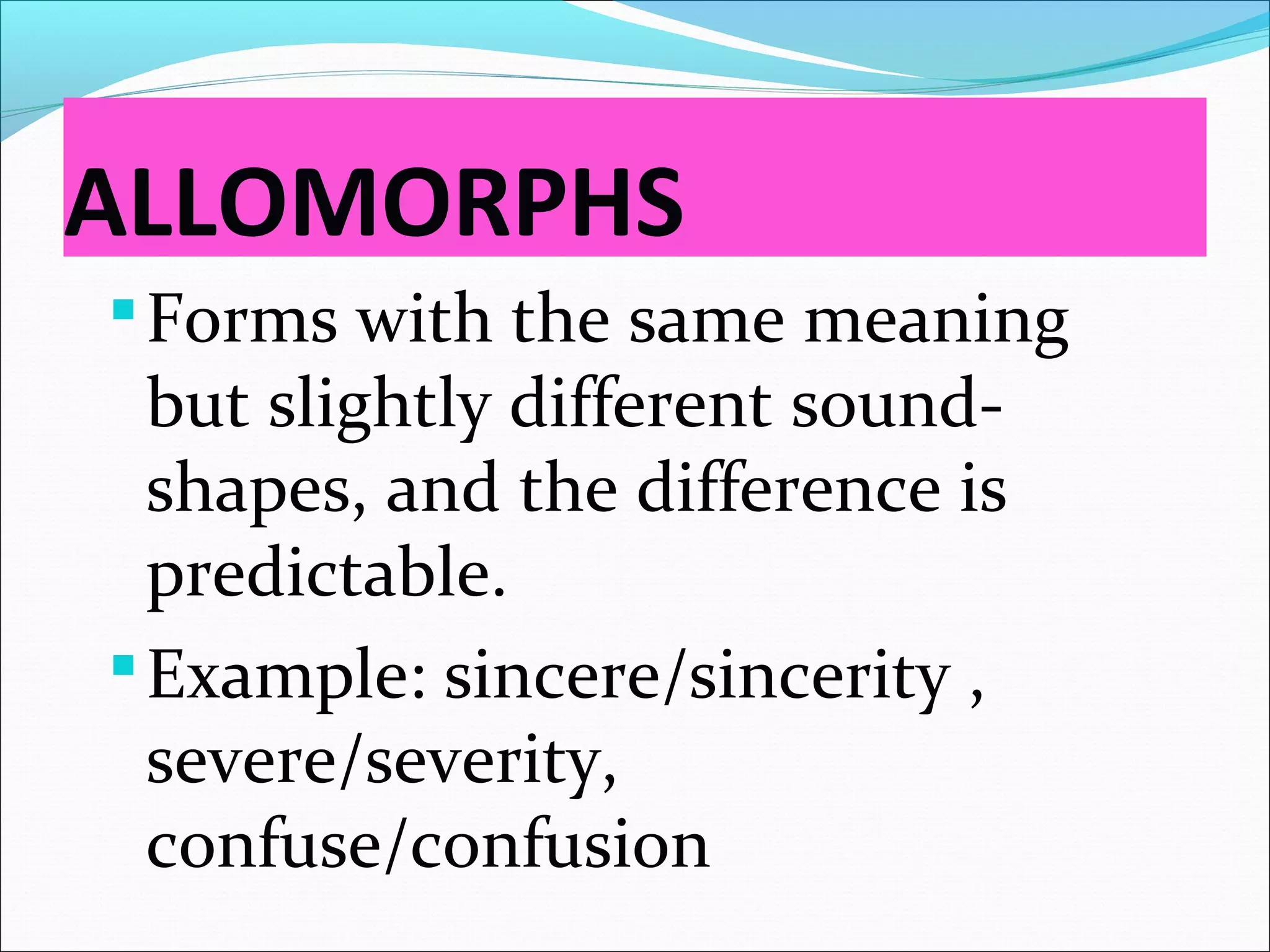
ALLOMORPHS
Forms with the same meaning
but slightly different sound-
shapes, and the difference is
predictable.
Example: sincere/sincerity ,
severe/severity,
confuse/confusion
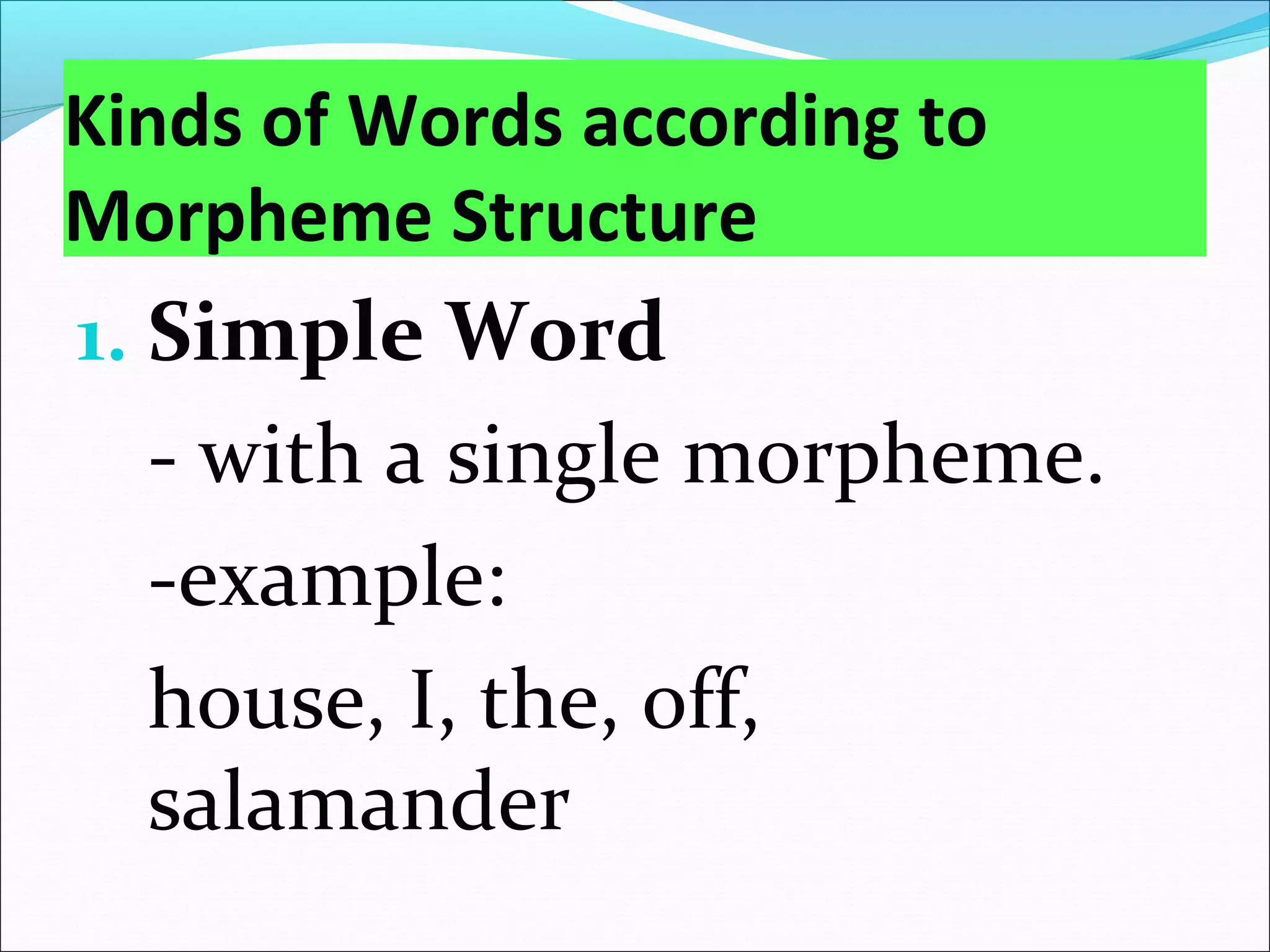
Kinds of Words according to
Morpheme Structure
1. Simple Word
- with a single morpheme.
-example:
house, I, the, off,
salamander
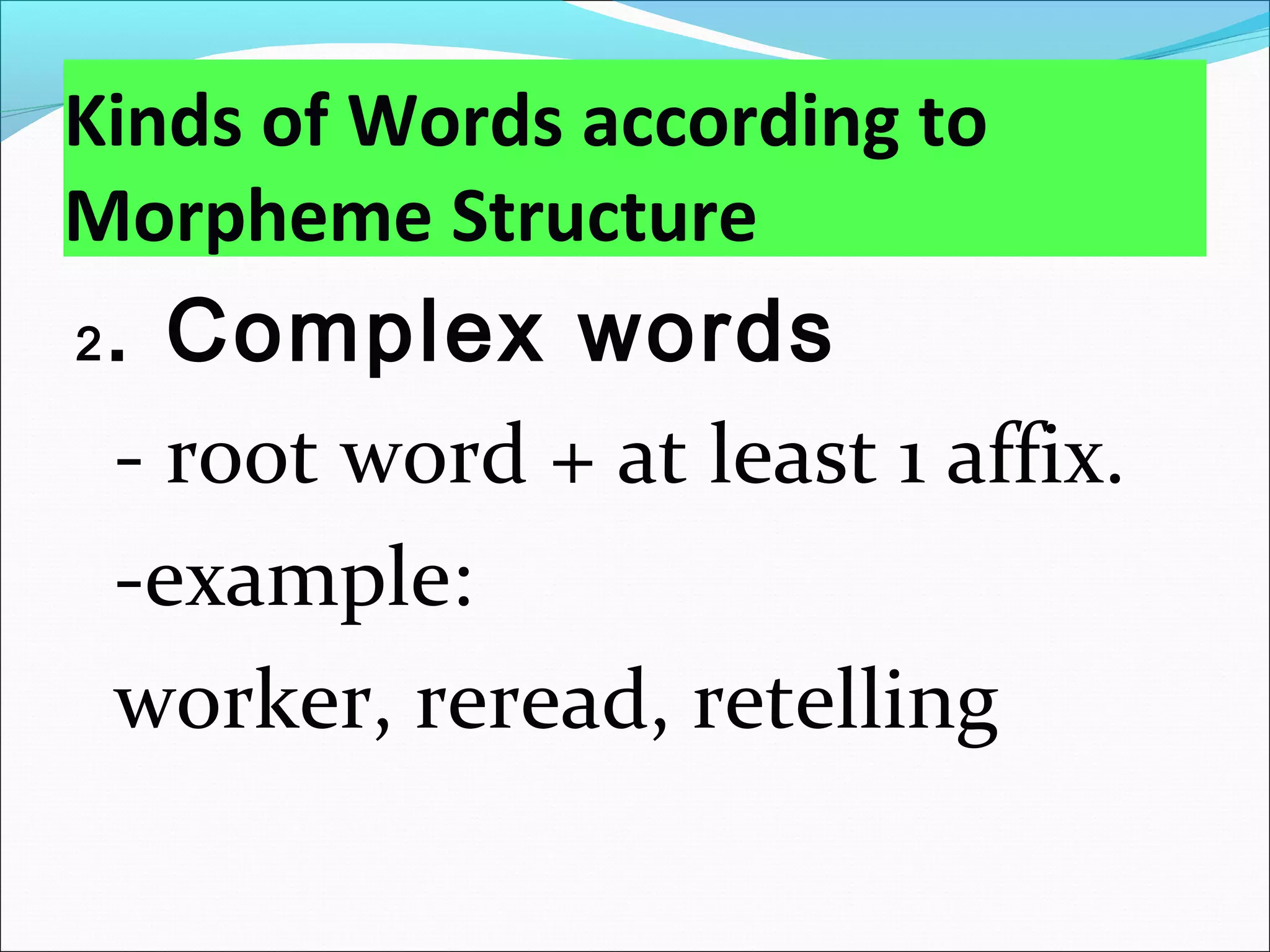
Kinds of Words according to
Morpheme Structure
2. Complex words
- root word + at least 1 affix.
-example:
worker, reread, retelling
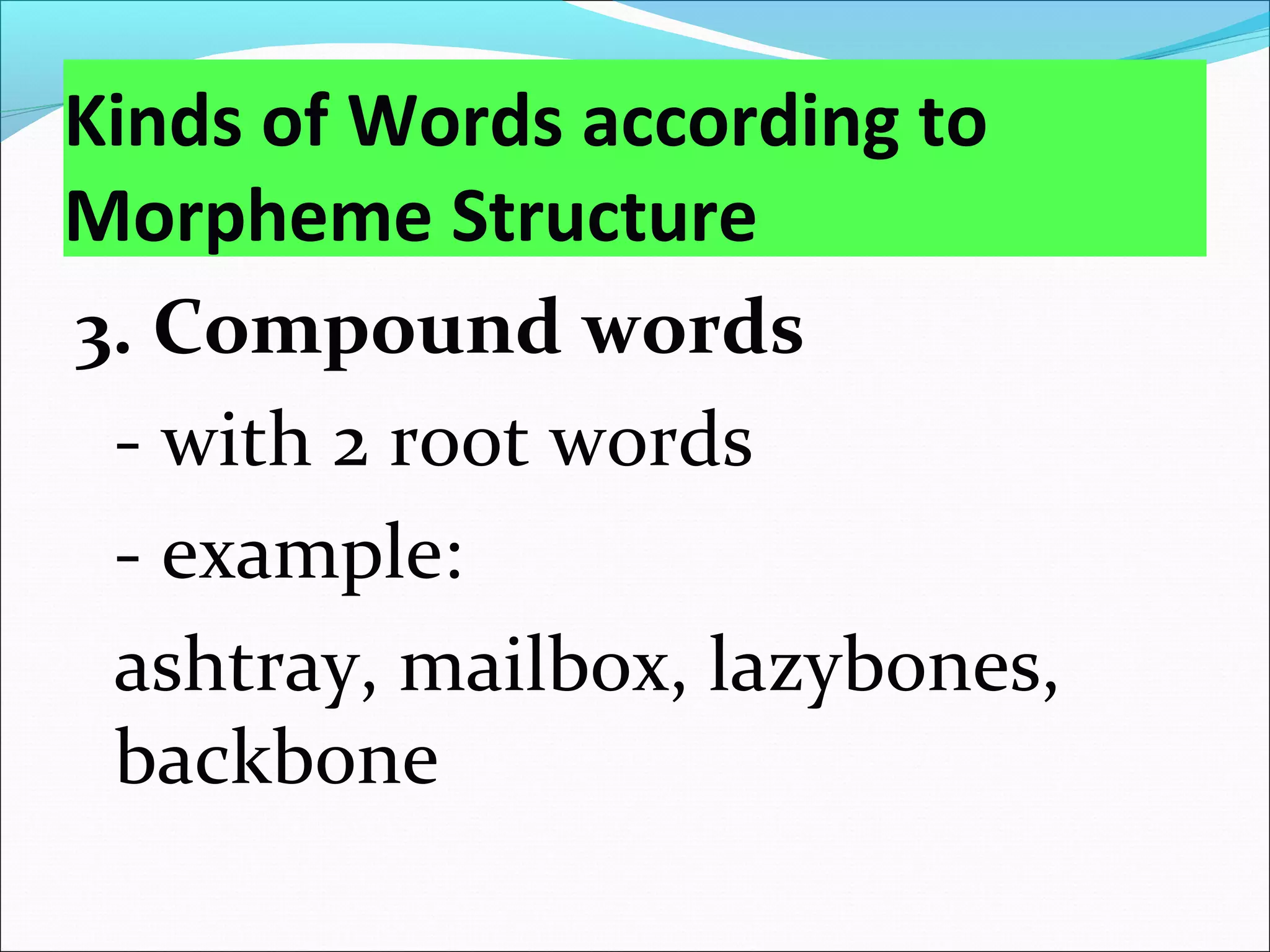
Kinds of Words according to
Morpheme Structure
3. Compound words
- with 2 root words
- example:
ashtray, mailbox, lazybones,
backbone
D. Free vs. Bound Morphemes
There are several
important distinctions
that must be made when it
comes to morphemes:
Free vs. Bound Morphemes
also known as “unbound
morphemes”
are those which can stand by
themselves or alone as words
of a language.
Free Morphemes
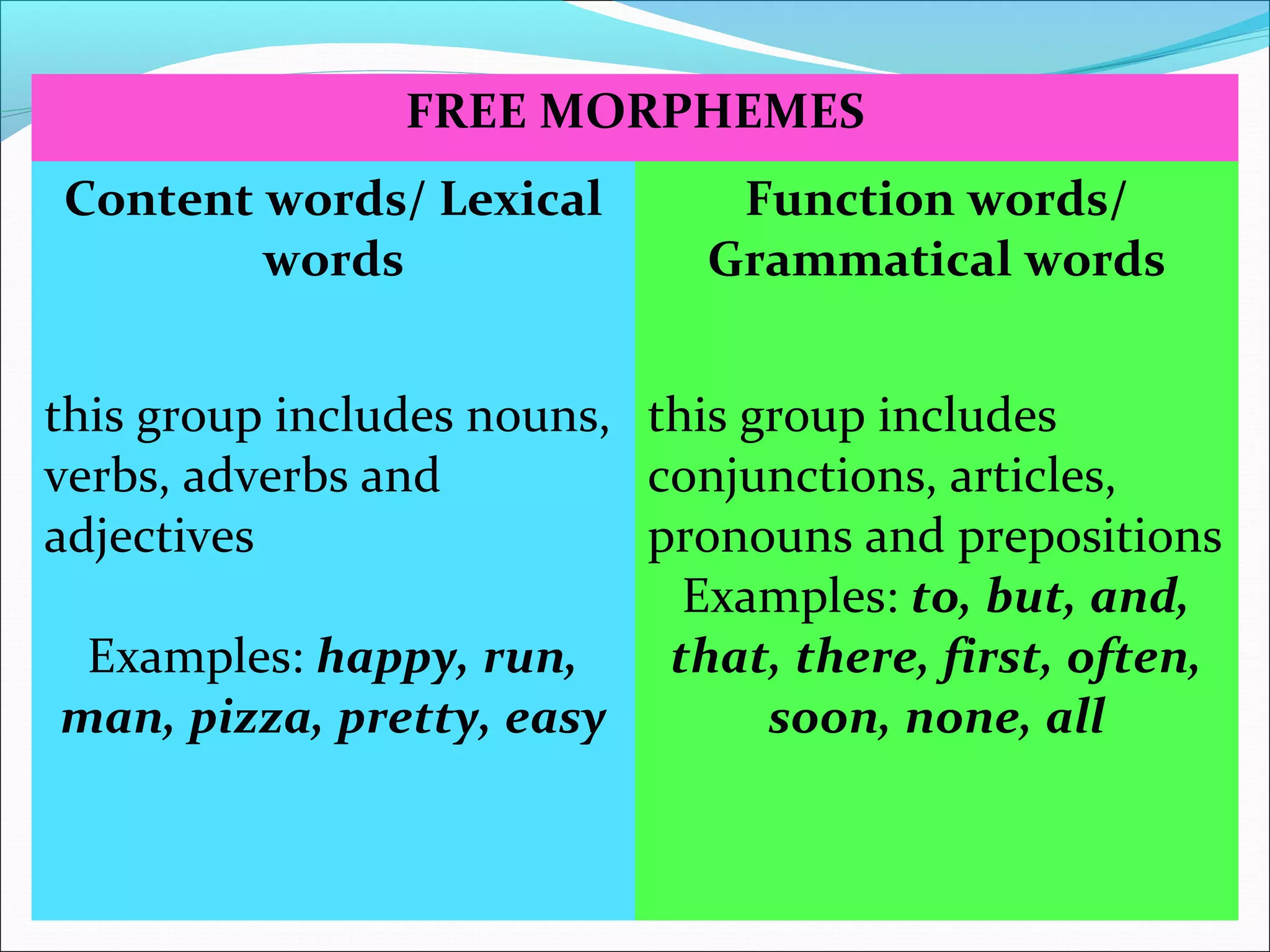
FREE MORPHEMES
Content words/ Lexical
words
Function words/
Grammatical words
this group includes nouns,
verbs, adverbs and
adjectives
Examples: happy, run,
man, pizza, pretty, easy
this group includes
conjunctions, articles,
pronouns and prepositions
Examples: to, but, and,
that, there, first, often,
soon, none, all
Bound Morphemes
never exist as words themselves, but
are always attached to some other
morpheme. We have already seen the
example of “un”.
When we identify the number and
types of morphemes that a given word
consists of, we are looking at what is
referred to as the structure of a word.
Every word has at
least one free
morpheme, which is
referred to as the root,
stem, or base.
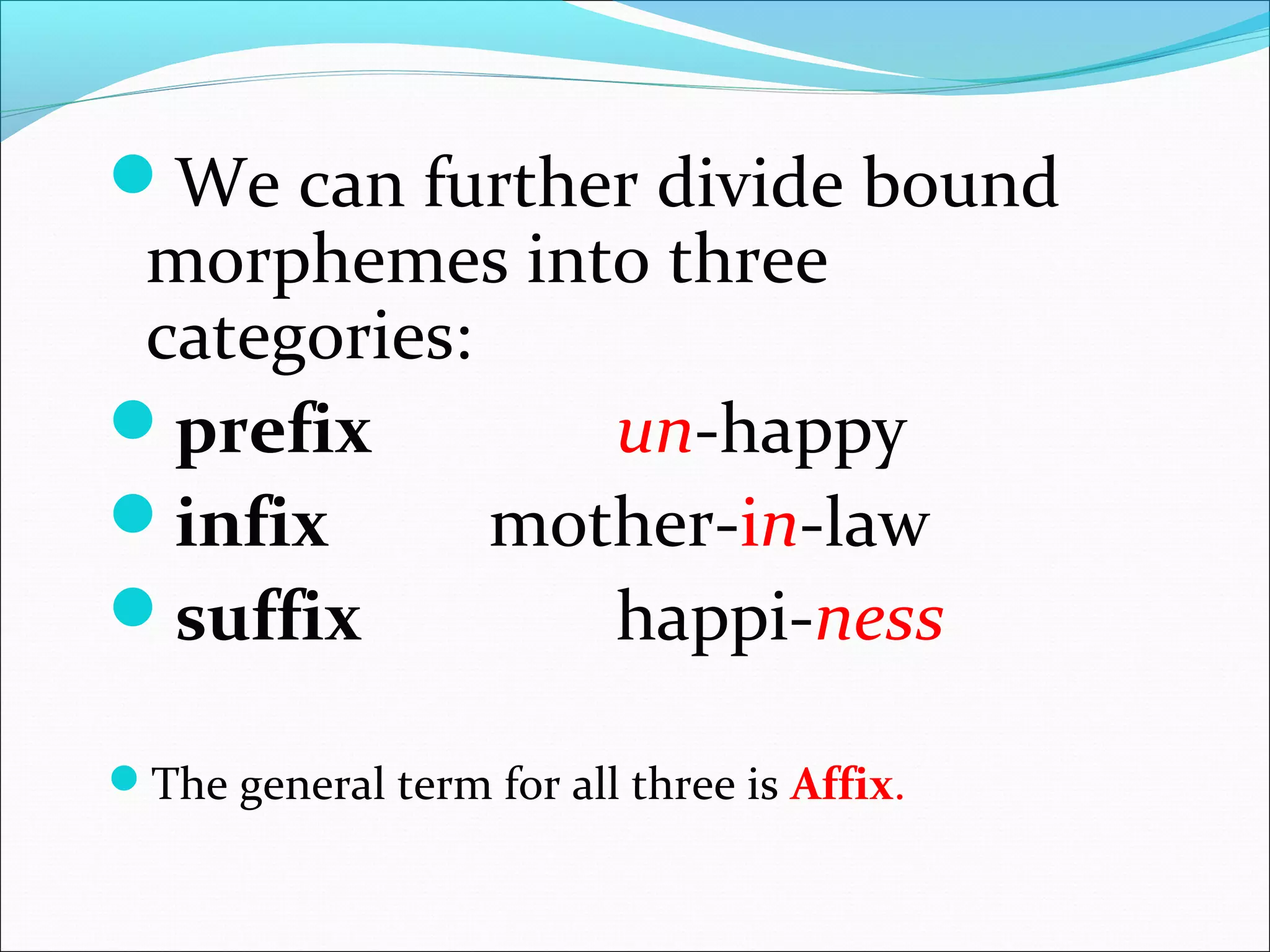
We can further divide bound
morphemes into three
categories:
prefix un-happy
infix mother-in-law
suffix happi-ness
The general term for all three is Affix.
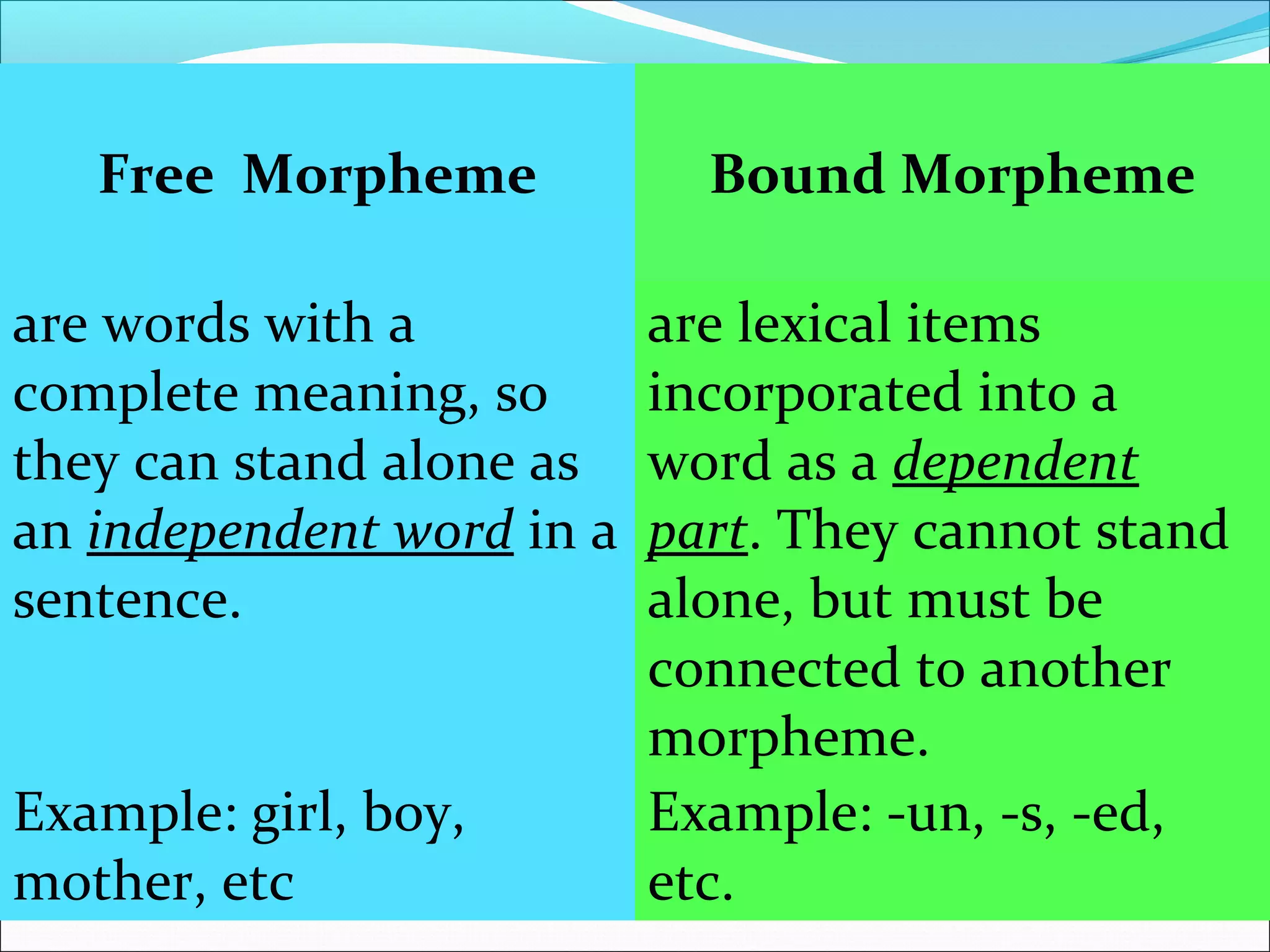
Free Morpheme Bound Morpheme
are words with a
complete meaning, so
they can stand alone as
an independent word in a
sentence.
are lexical items
incorporated into a
word as a dependent
part. They cannot stand
alone, but must be
connected to another
morpheme.
Example: girl, boy,
mother, etc
Example: -un, -s, -ed,
etc.
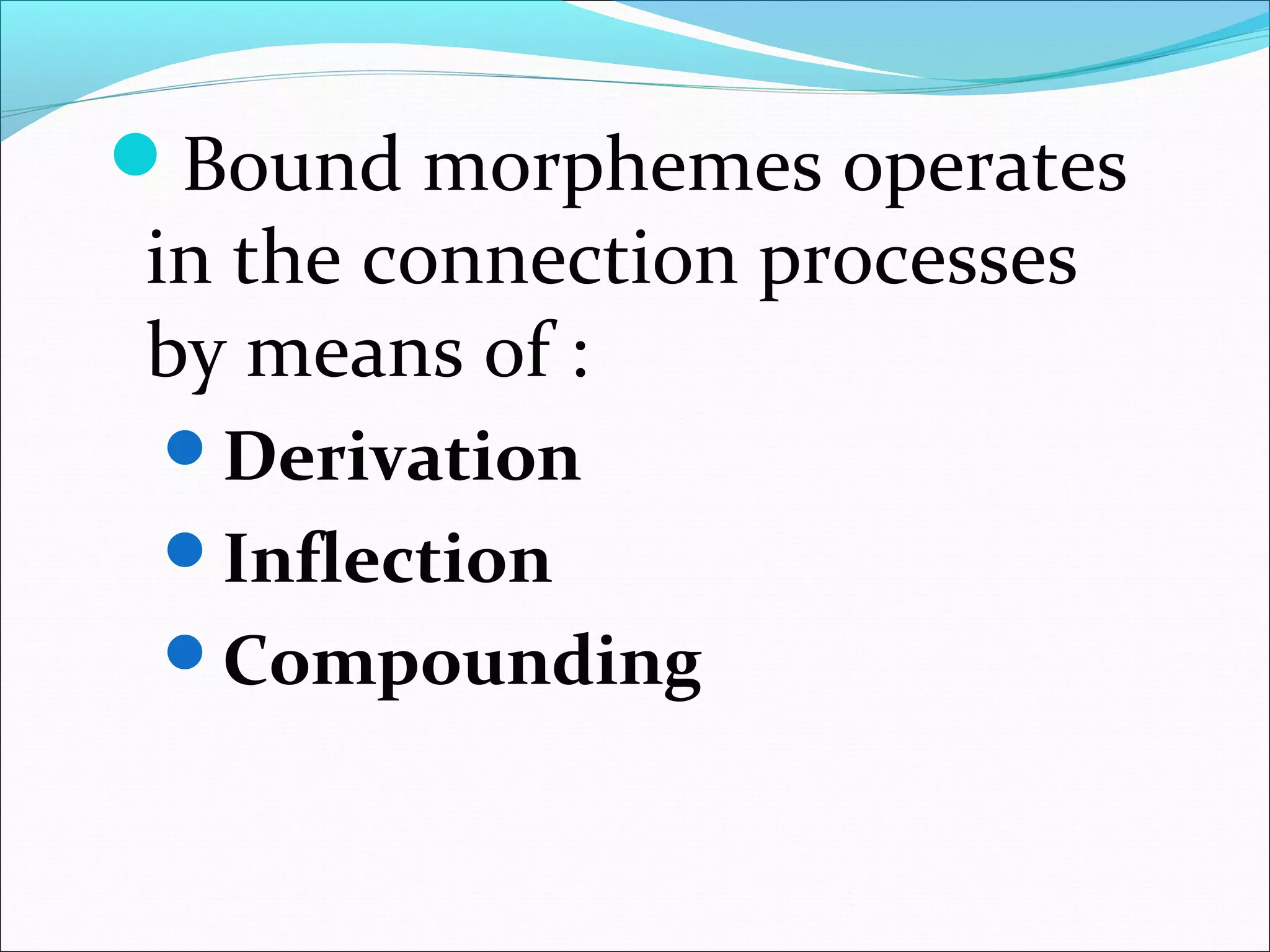
Bound morphemes operates
in the connection processes
by means of :
Derivation
Inflection
Compounding
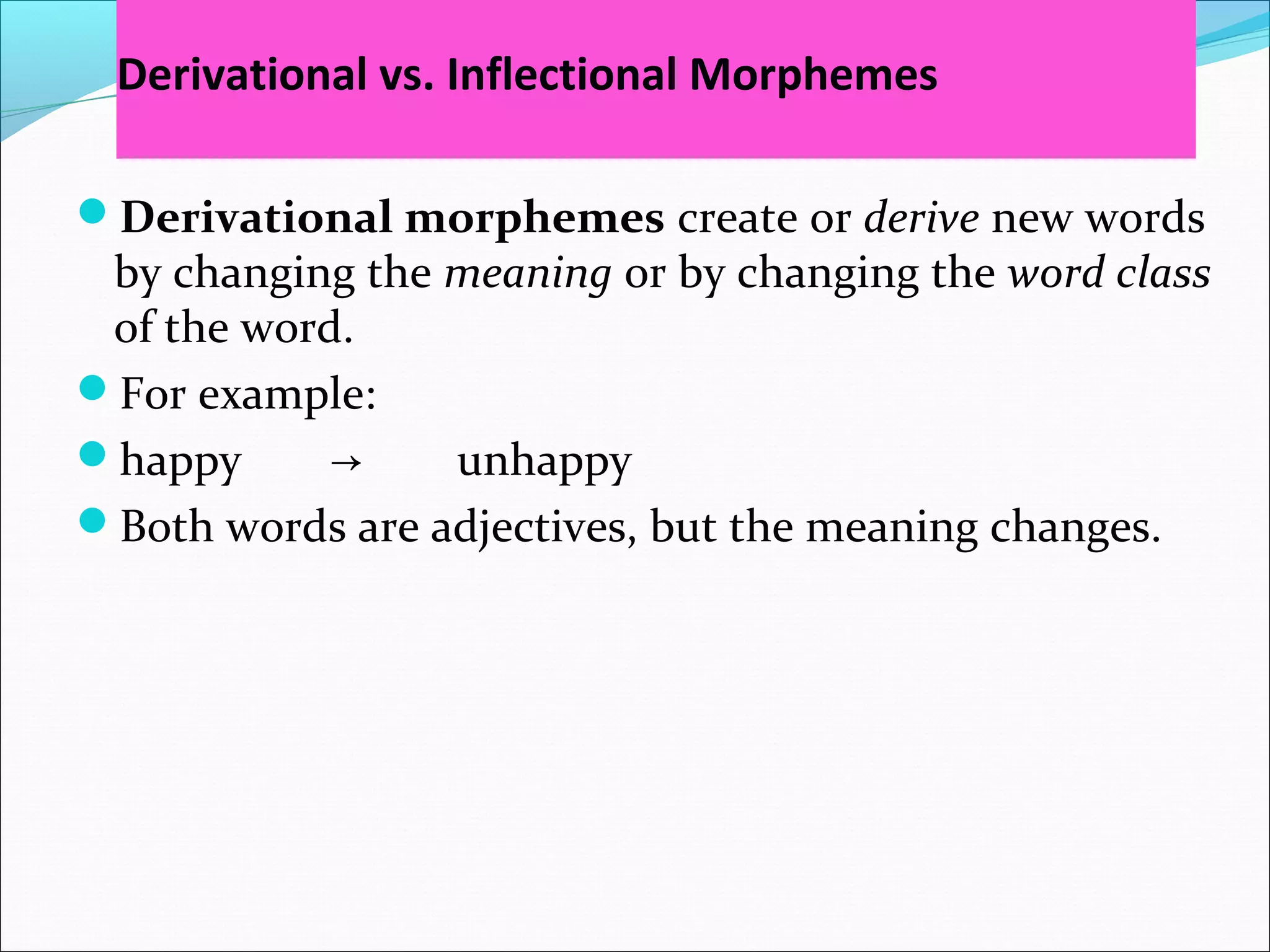
Derivational vs. Inflectional Morphemes
Derivational morphemes create or derive new words
by changing the meaning or by changing the word class
of the word.
For example:
happy → unhappy
Both words are adjectives, but the meaning changes.
quick → quickness
The affix changes both meaning
and word class - adjective to a
noun.
In English: Derivational
morphemes can be either prefixes
or suffixes.
Inflectional morphemes don’t alter
words the meaning or word class of a
word; instead they only refine and give
extra grammatical information about
the word’s already existing meaning.
For example:
Cat → cats
walk → walking
In English: Inflectional
morphemes are all suffixes (by
chance, since in other languages
this is not true).
There are only 8 inflectional
morphemes in English:
1.-s 3rd person sg. present
“He waits”
2. -ed past tense
“He waited”
3.-ing progressive
“He is waiting”
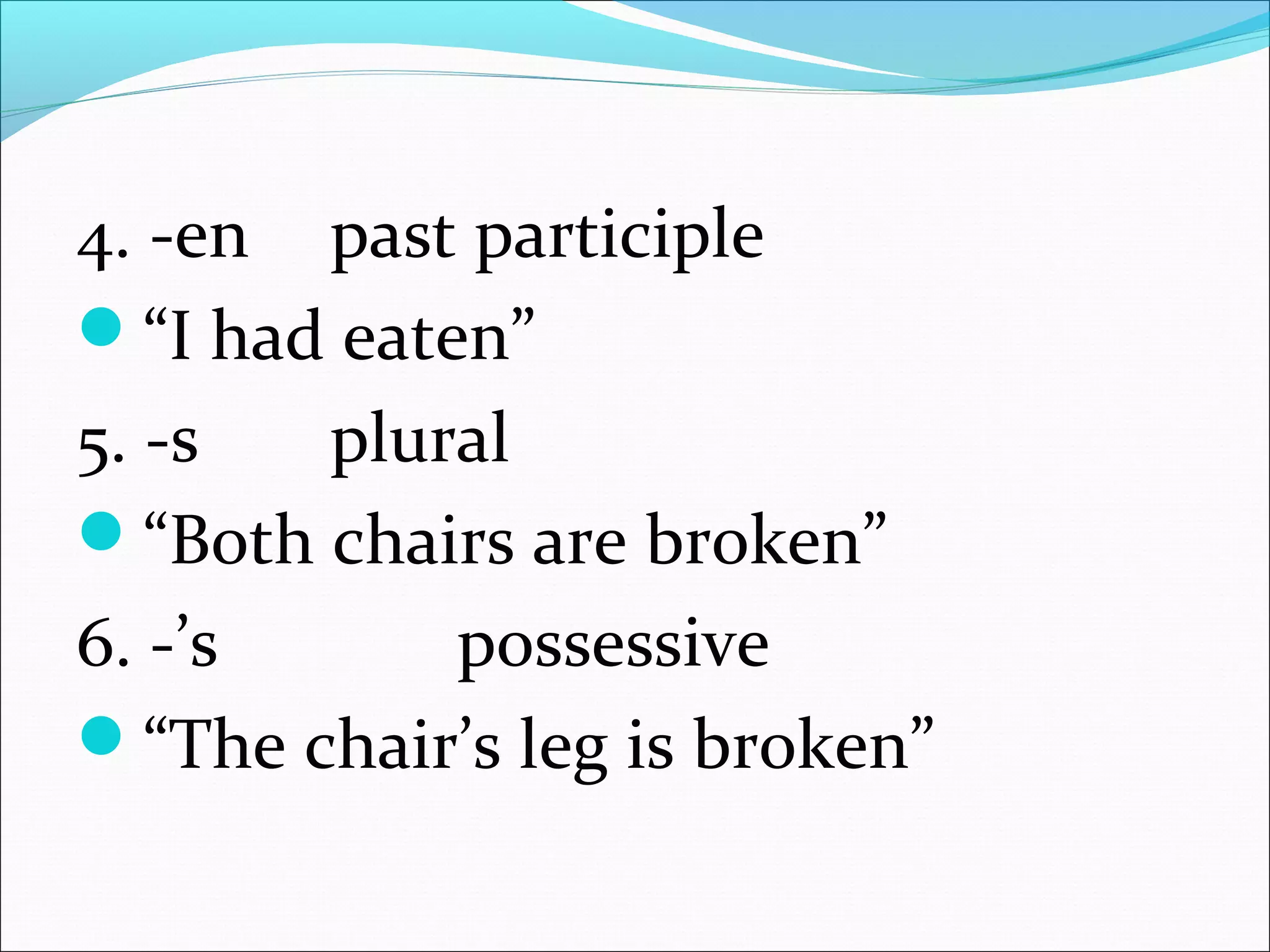
4. -en past participle
“I had eaten”
5. -s plural
“Both chairs are broken”
6. -’s possessive
“The chair’s leg is broken”
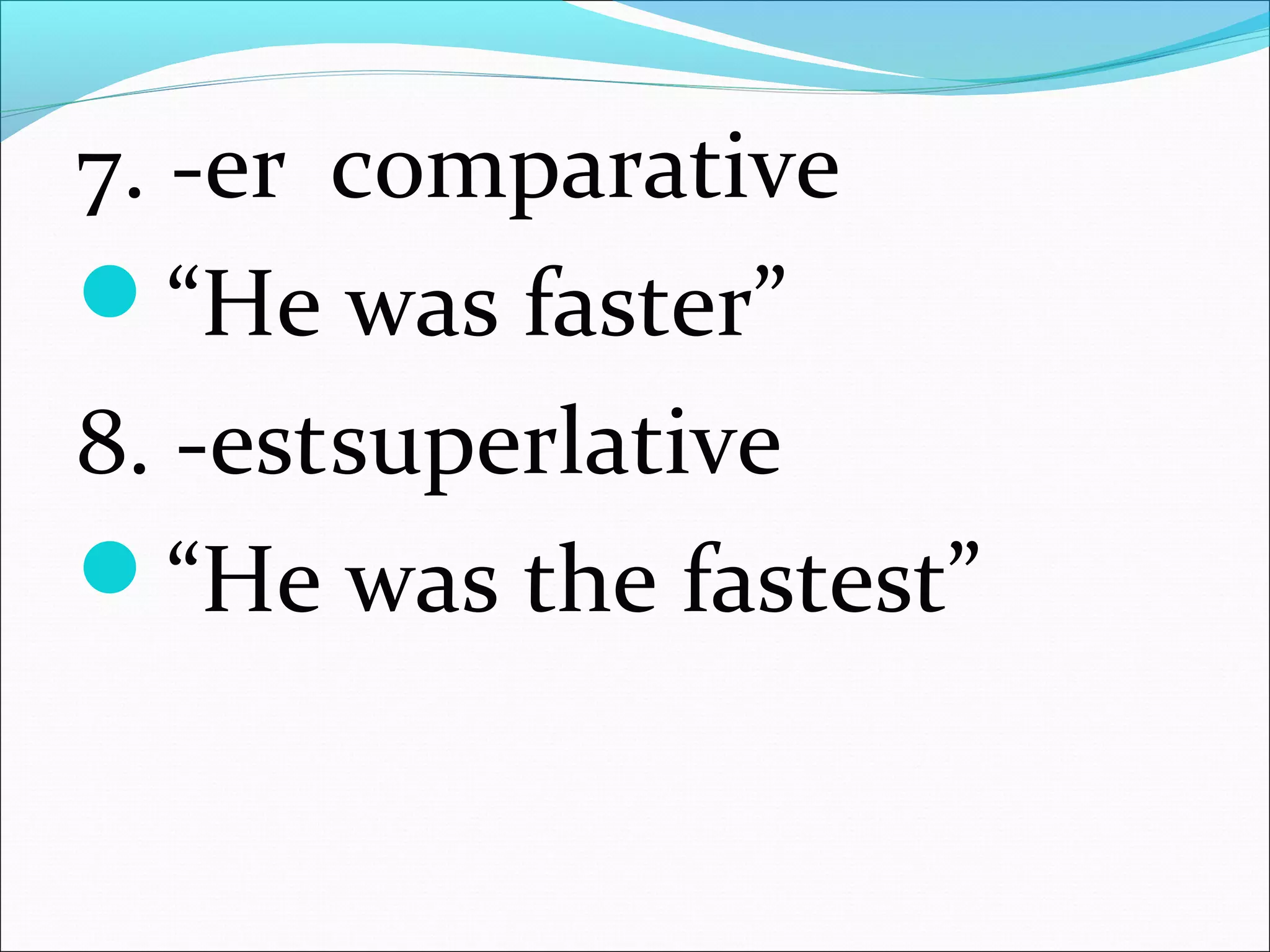
7. -er comparative
“He was faster”
8. -estsuperlative
“He was the fastest”
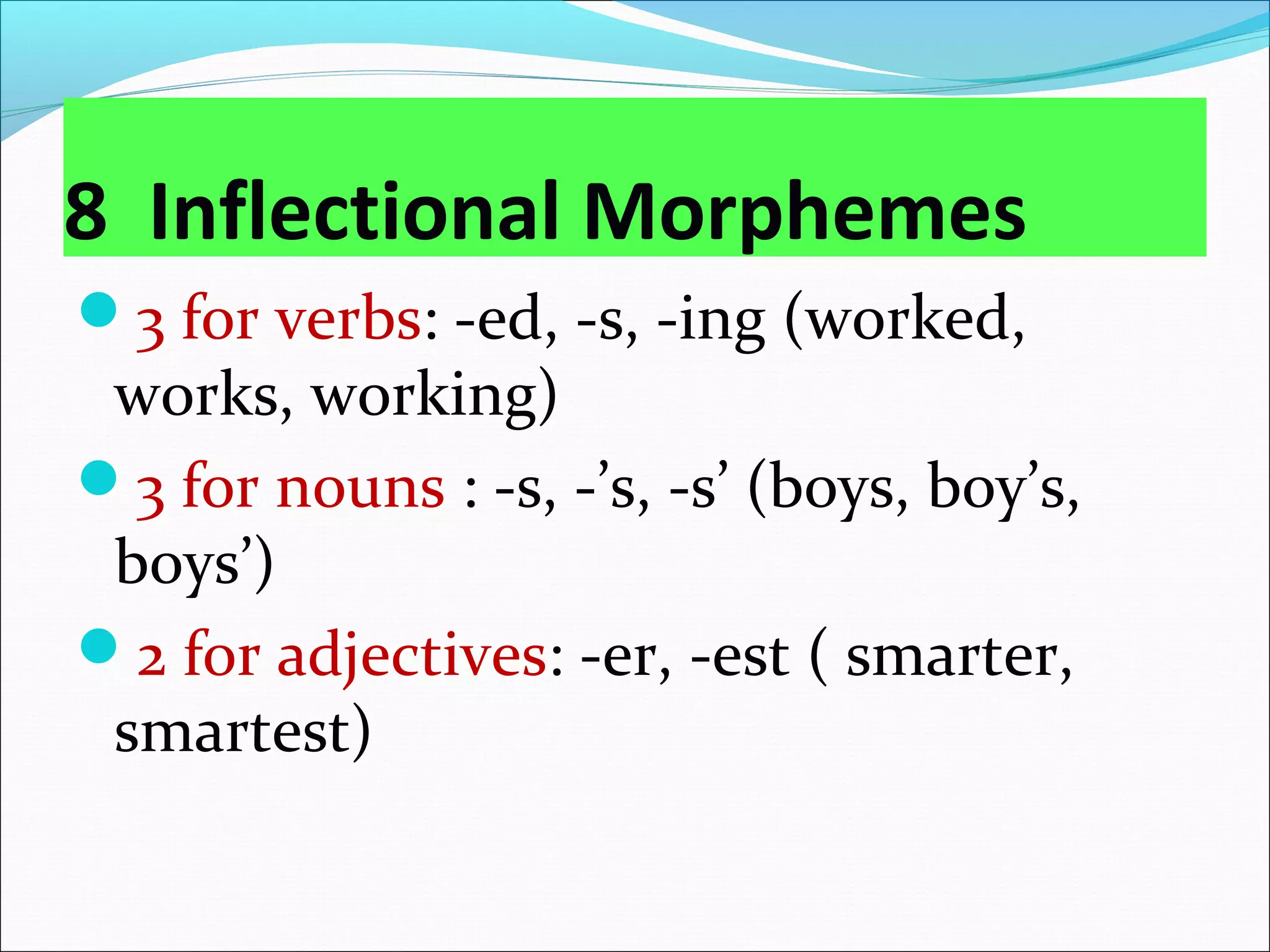
8 Inflectional Morphemes
3 for verbs: -ed, -s, -ing (worked,
works, working)
3 for nouns : -s, -’s, -s’ (boys, boy’s,
boys’)
2 for adjectives: -er, -est ( smarter,
smartest)
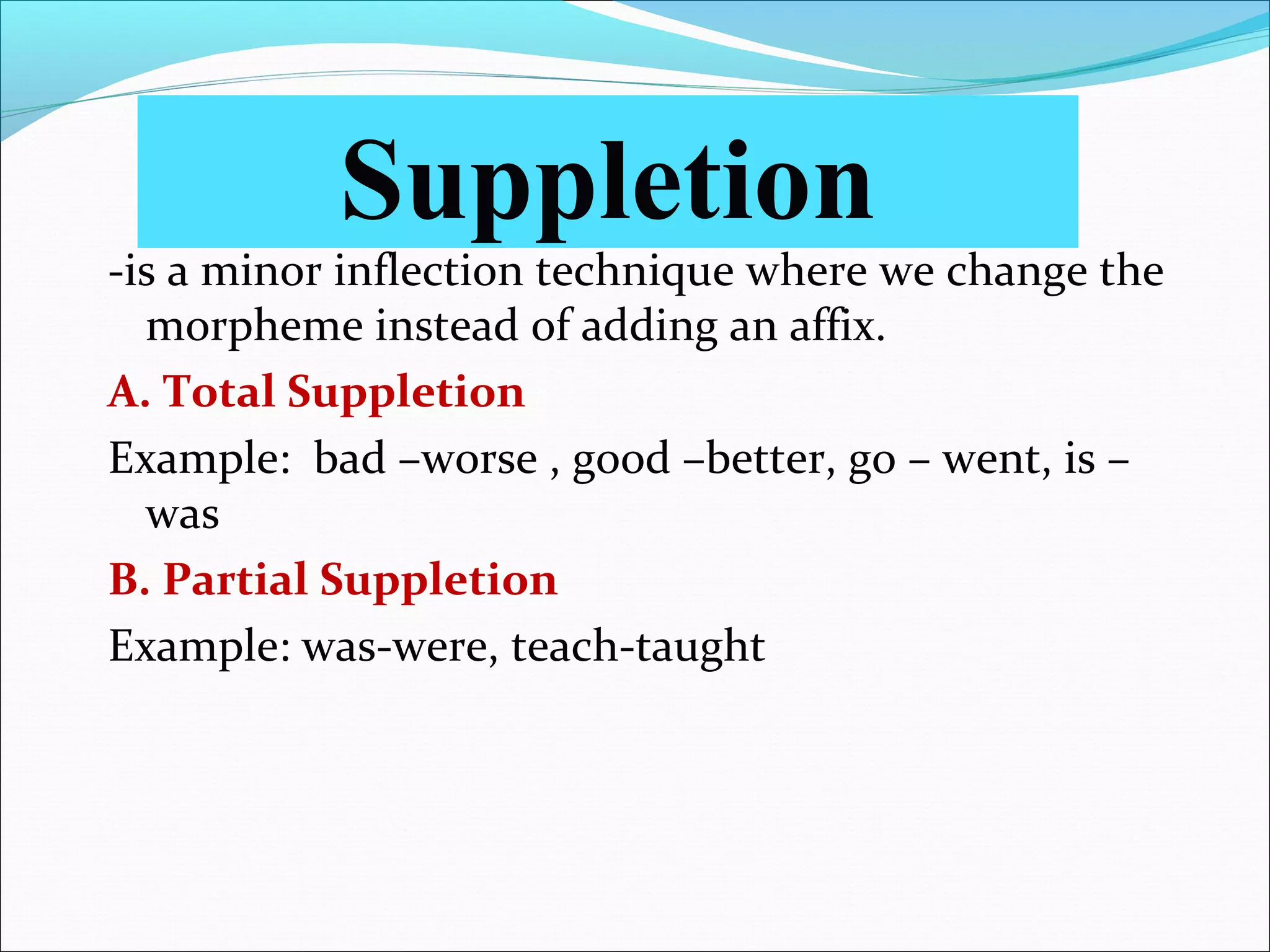
-is a minor inflection technique where we change the
morpheme instead of adding an affix.
A. Total Suppletion
Example: bad –worse , good –better, go – went, is –
was
B. Partial Suppletion
Example: was-were, teach-taught
Suppletion
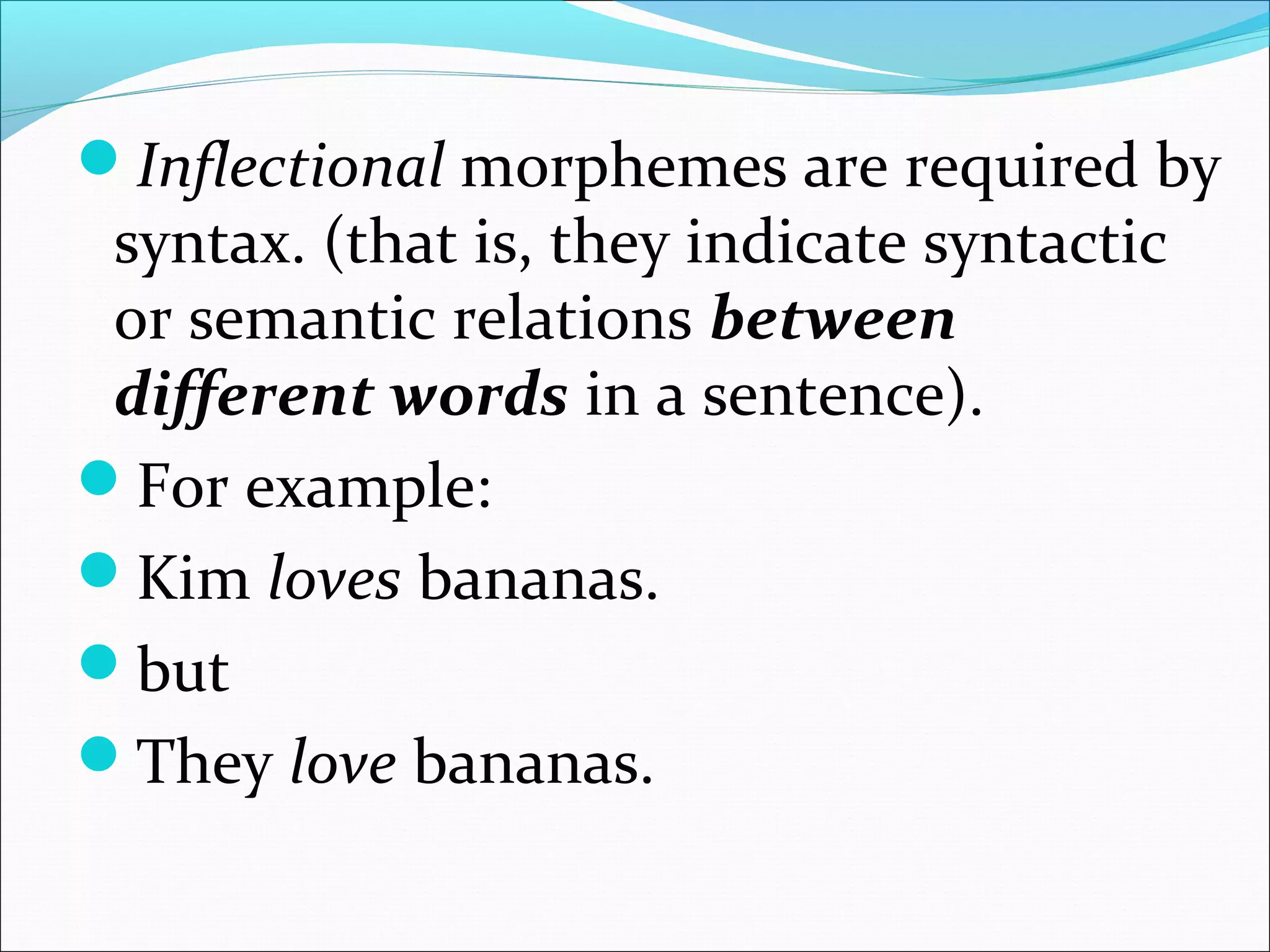
Inflectional morphemes are required by
syntax. (that is, they indicate syntactic
or semantic relations between
different words in a sentence).
For example:
Kim loves bananas.
but
They love bananas.
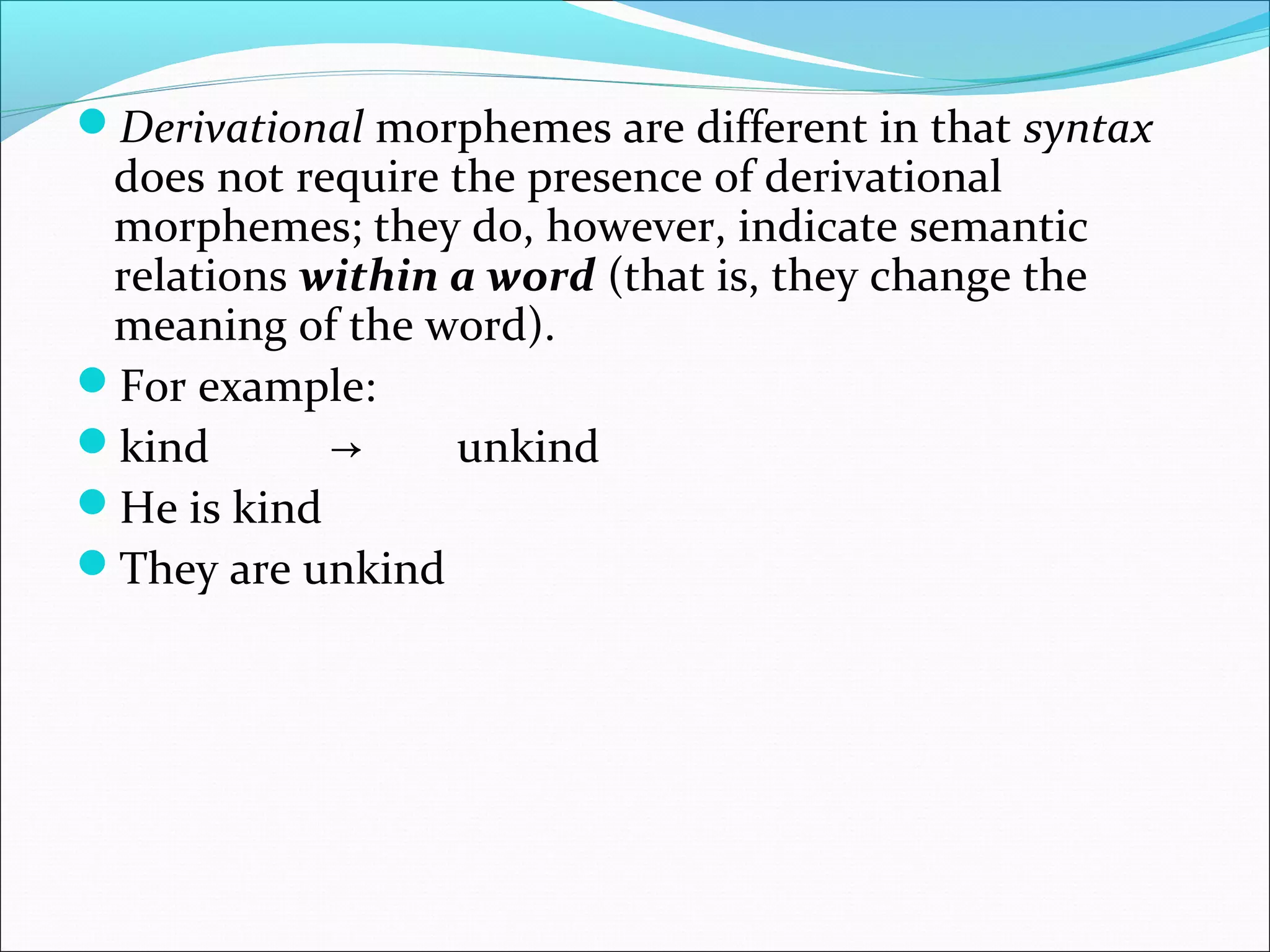
Derivational morphemes are different in that syntax
does not require the presence of derivational
morphemes; they do, however, indicate semantic
relations within a word (that is, they change the
meaning of the word).
For example:
kind → unkind
He is kind
They are unkind
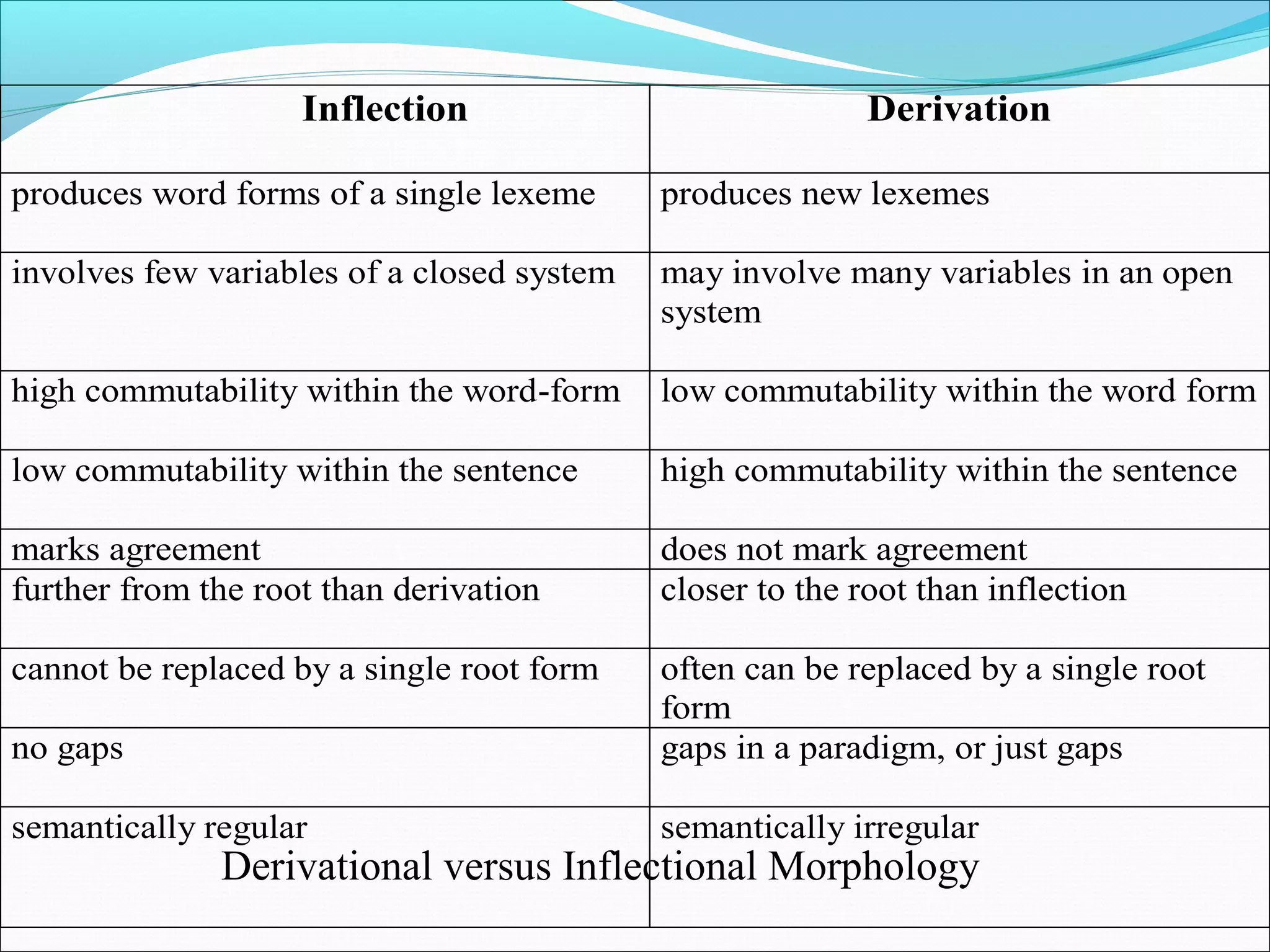
Inflection Derivation
produces word forms of a single lexeme produces new lexemes
involves few variables of a closed system may involve many variables in an open
system
high commutability within the word-form low commutability within the word form
low commutability within the sentence high commutability within the sentence
marks agreement does not mark agreement
further from the root than derivation closer to the root than inflection
cannot be replaced by a single root form often can be replaced by a single root
form
no gaps gaps in a paradigm, or just gaps
semantically regular semantically irregular
Derivational versus Inflectional Morphology
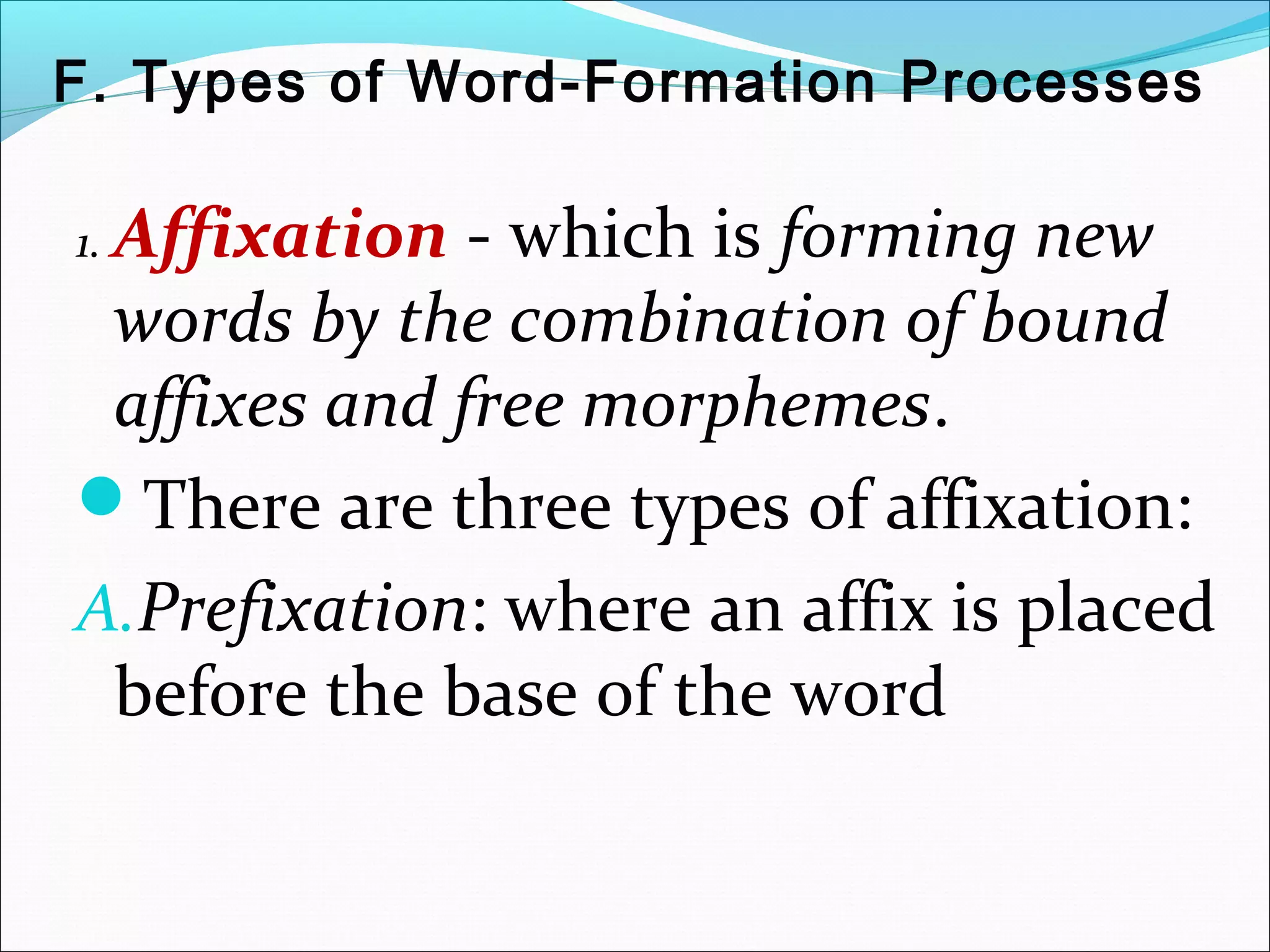
F. Types of Word-Formation Processes
1. Affixation - which is forming new
words by the combination of bound
affixes and free morphemes.
There are three types of affixation:
A.Prefixation: where an affix is placed
before the base of the word
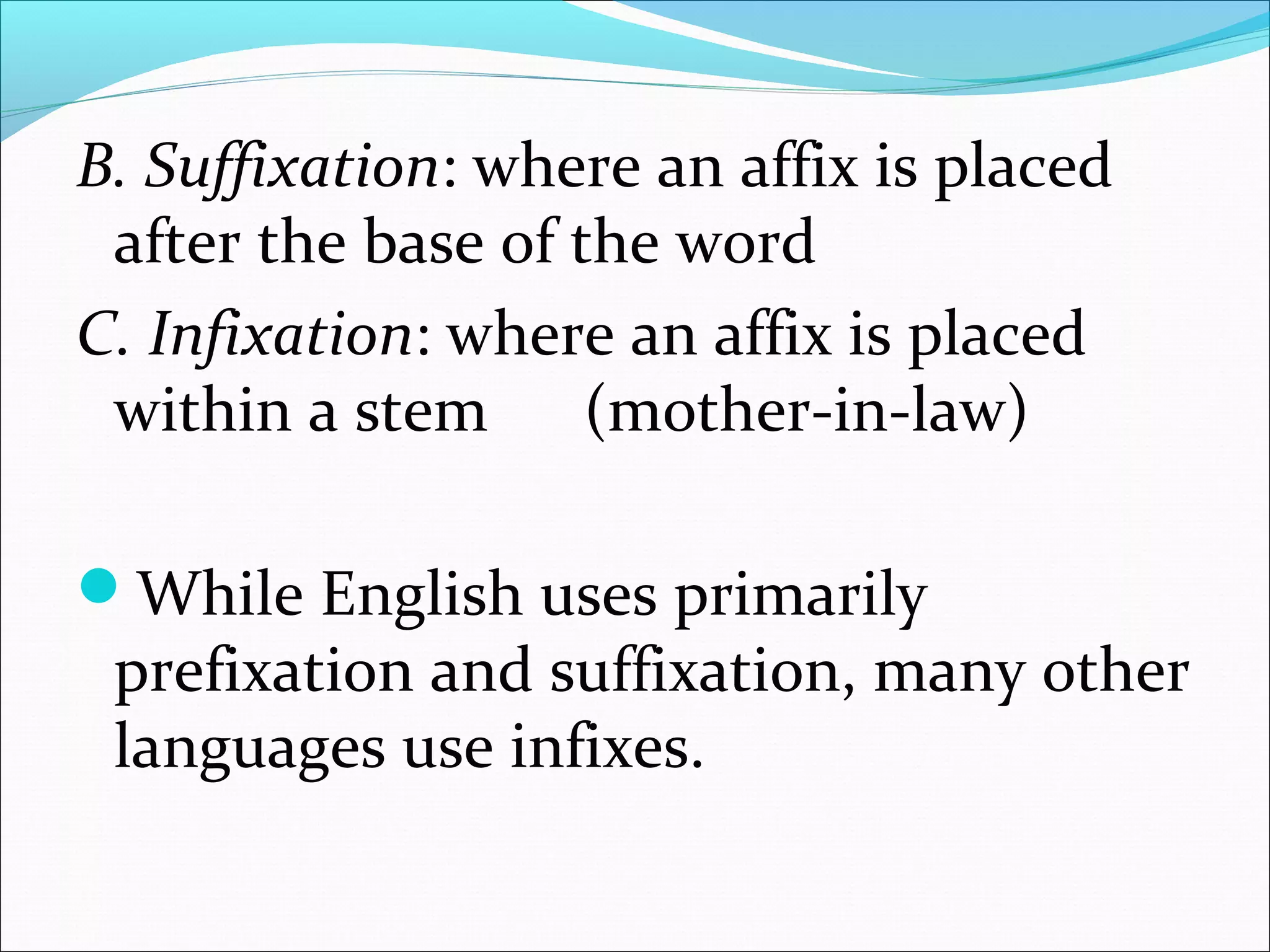
B. Suffixation: where an affix is placed
after the base of the word
C. Infixation: where an affix is placed
within a stem (mother-in-law)
While English uses primarily
prefixation and suffixation, many other
languages use infixes.
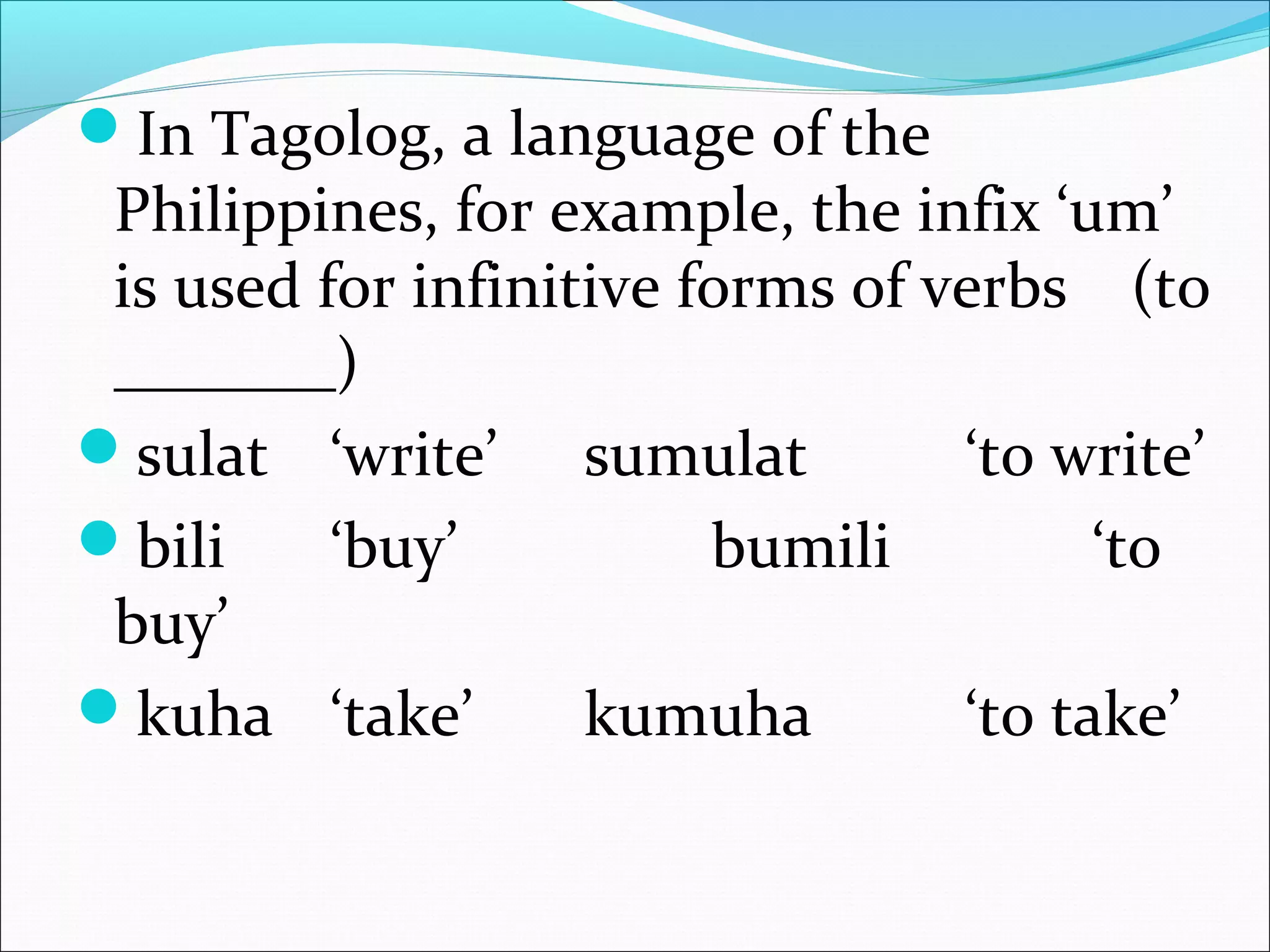
In Tagolog, a language of the
Philippines, for example, the infix ‘um’
is used for infinitive forms of verbs (to
_______)
sulat ‘write’ sumulat ‘to write’
bili ‘buy’ bumili ‘to
buy’
kuha ‘take’ kumuha ‘to take’
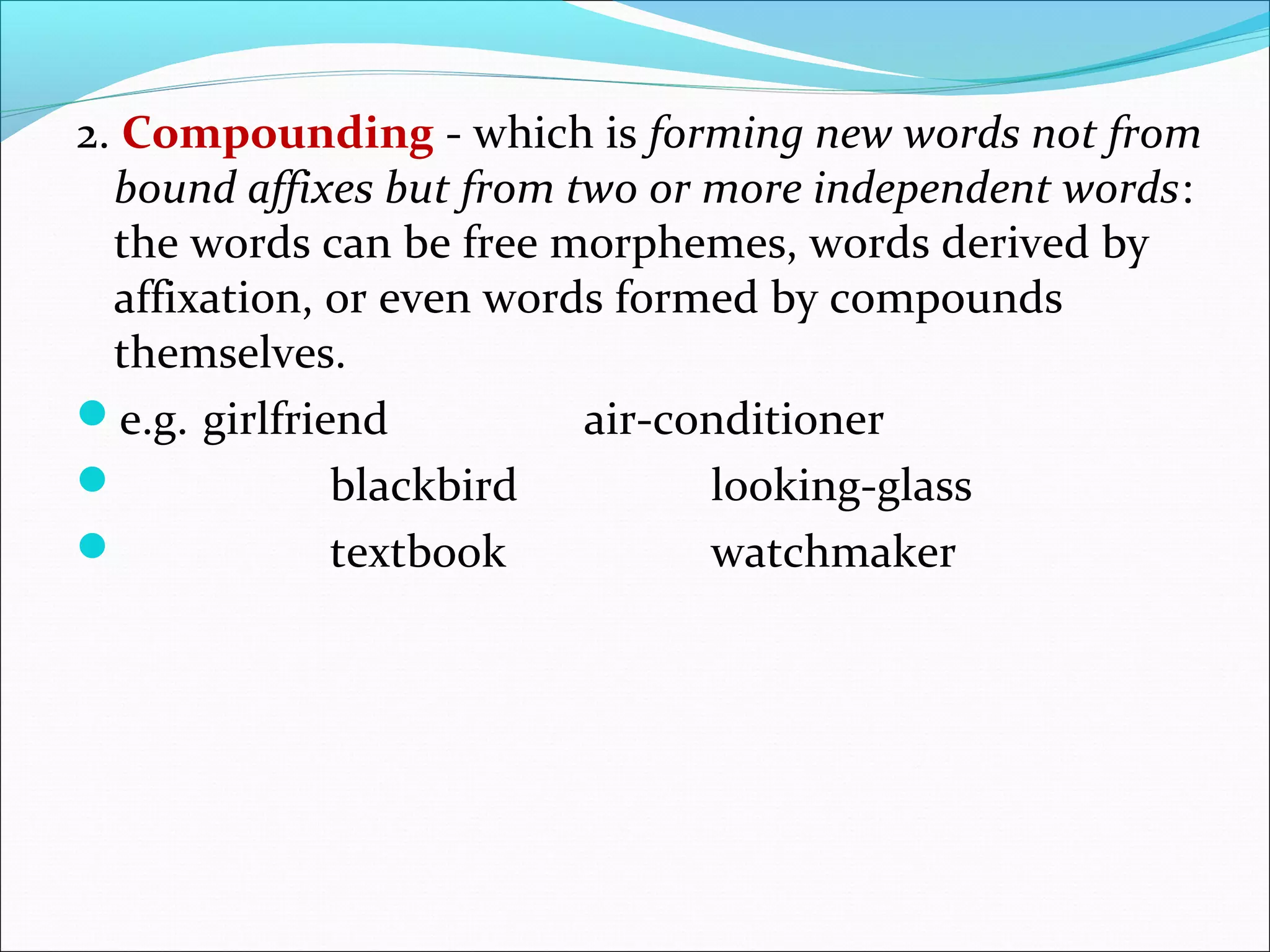
2. Compounding - which is forming new words not from
bound affixes but from two or more independent words:
the words can be free morphemes, words derived by
affixation, or even words formed by compounds
themselves.
e.g. girlfriend air-conditioner
 blackbird looking-glass
 textbook watchmaker
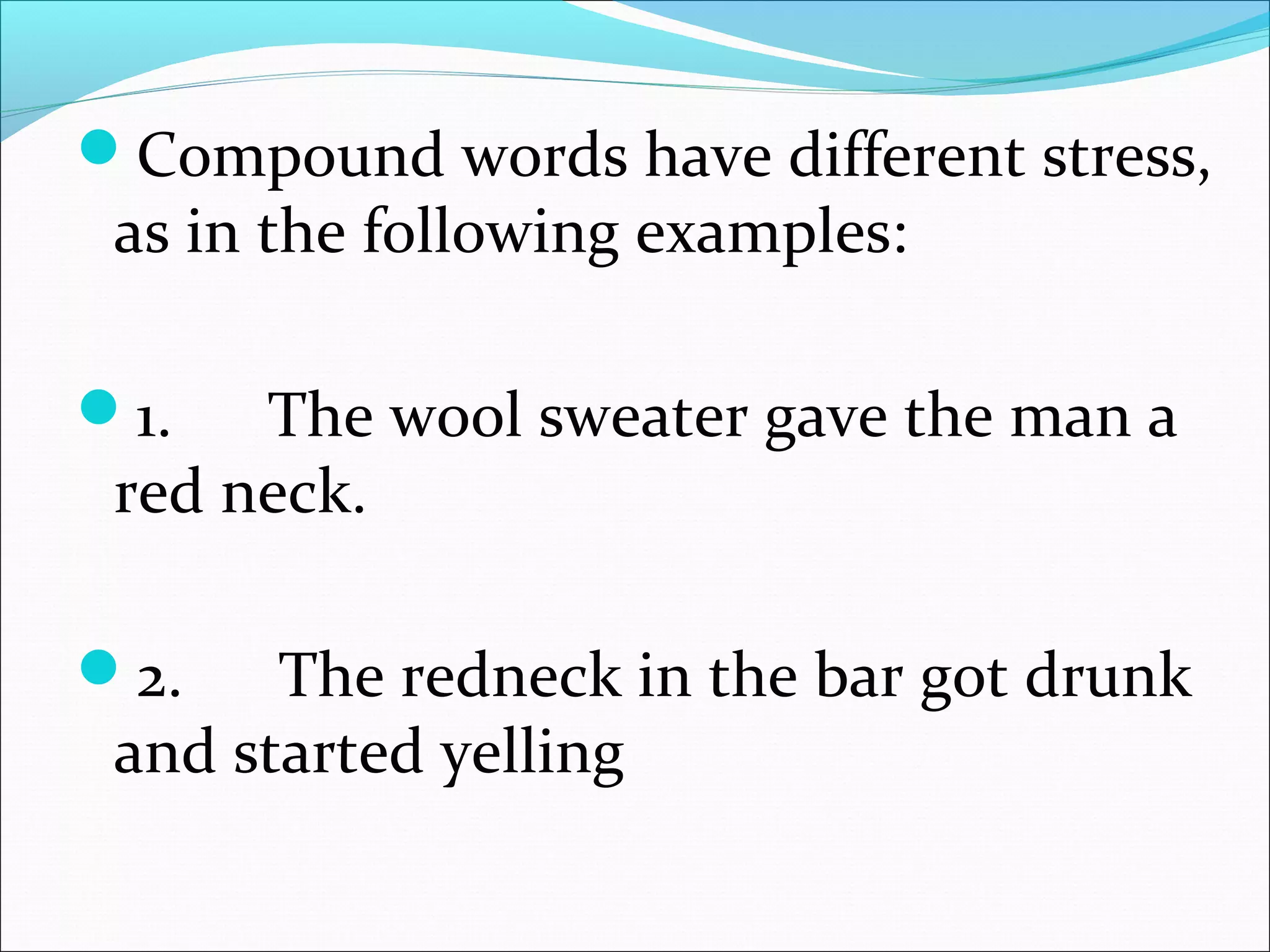
Compound words have different stress,
as in the following examples:
1.      The wool sweater gave the man a
red neck.
2.      The redneck in the bar got drunk
and started yelling
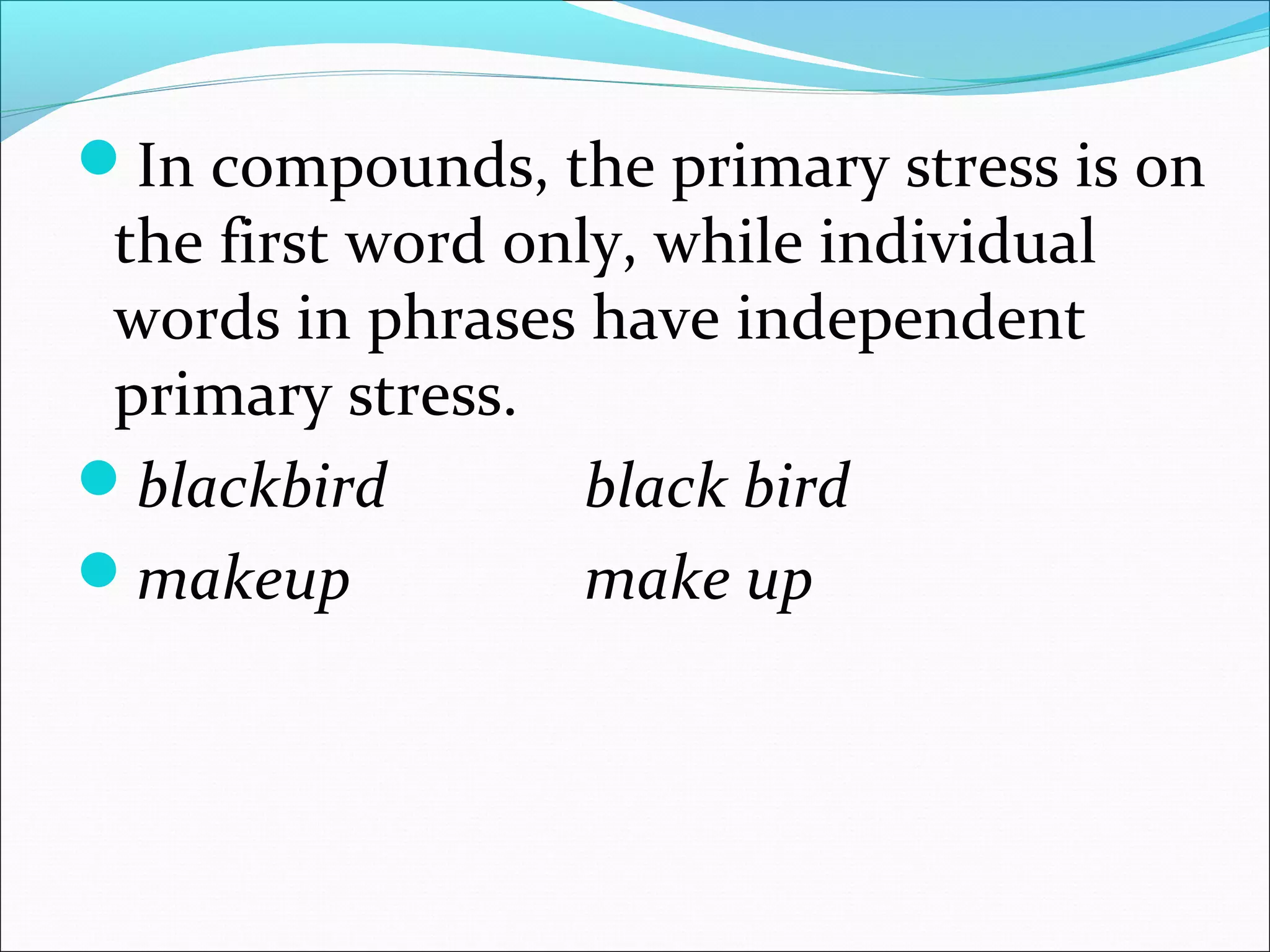
In compounds, the primary stress is on
the first word only, while individual
words in phrases have independent
primary stress.
blackbird black bird
makeup make up
Morphology
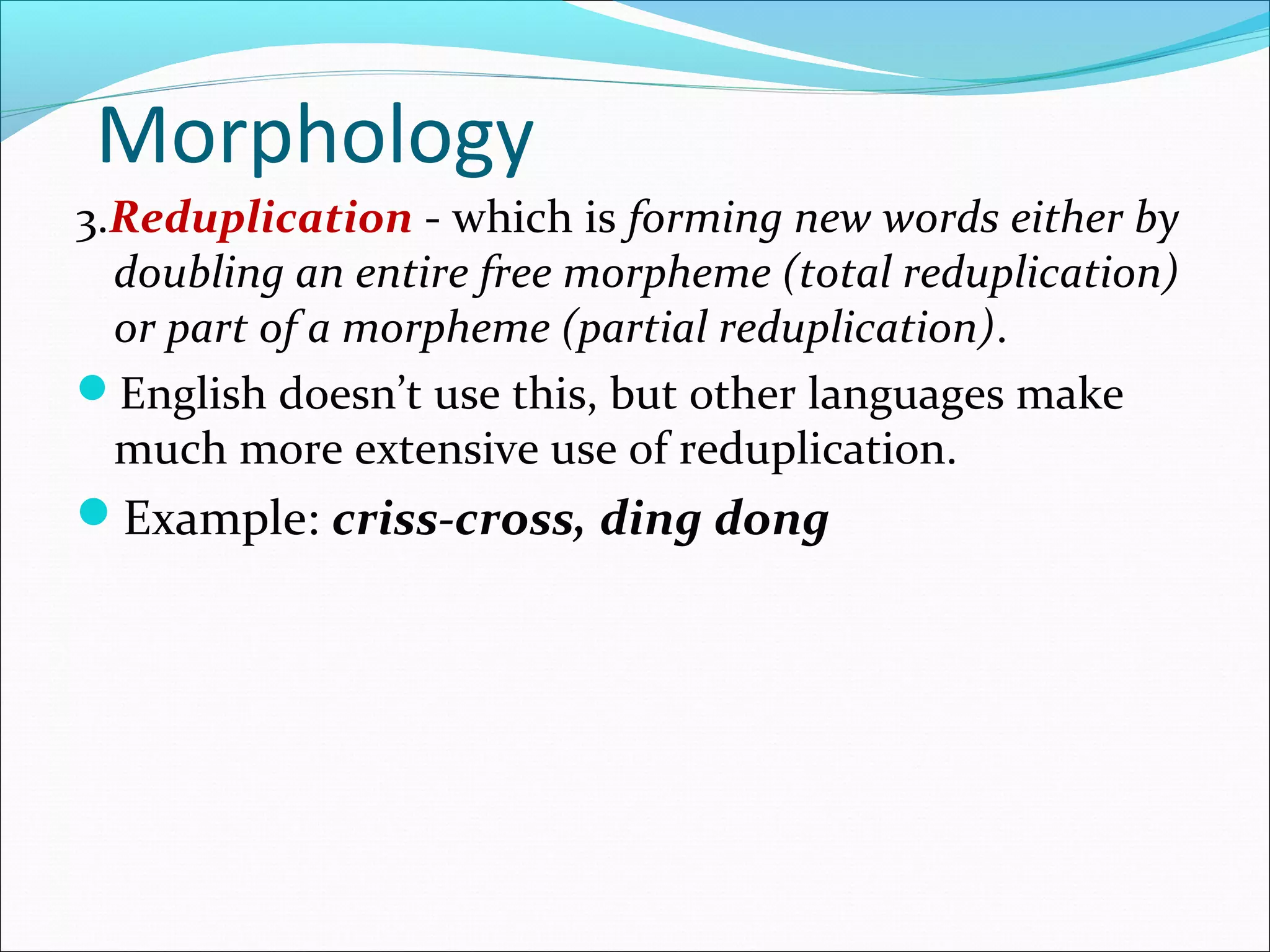
3.Reduplication - which is forming new words either by
doubling an entire free morpheme (total reduplication)
or part of a morpheme (partial reduplication).
English doesn’t use this, but other languages make
much more extensive use of reduplication.
Example: criss-cross, ding dong
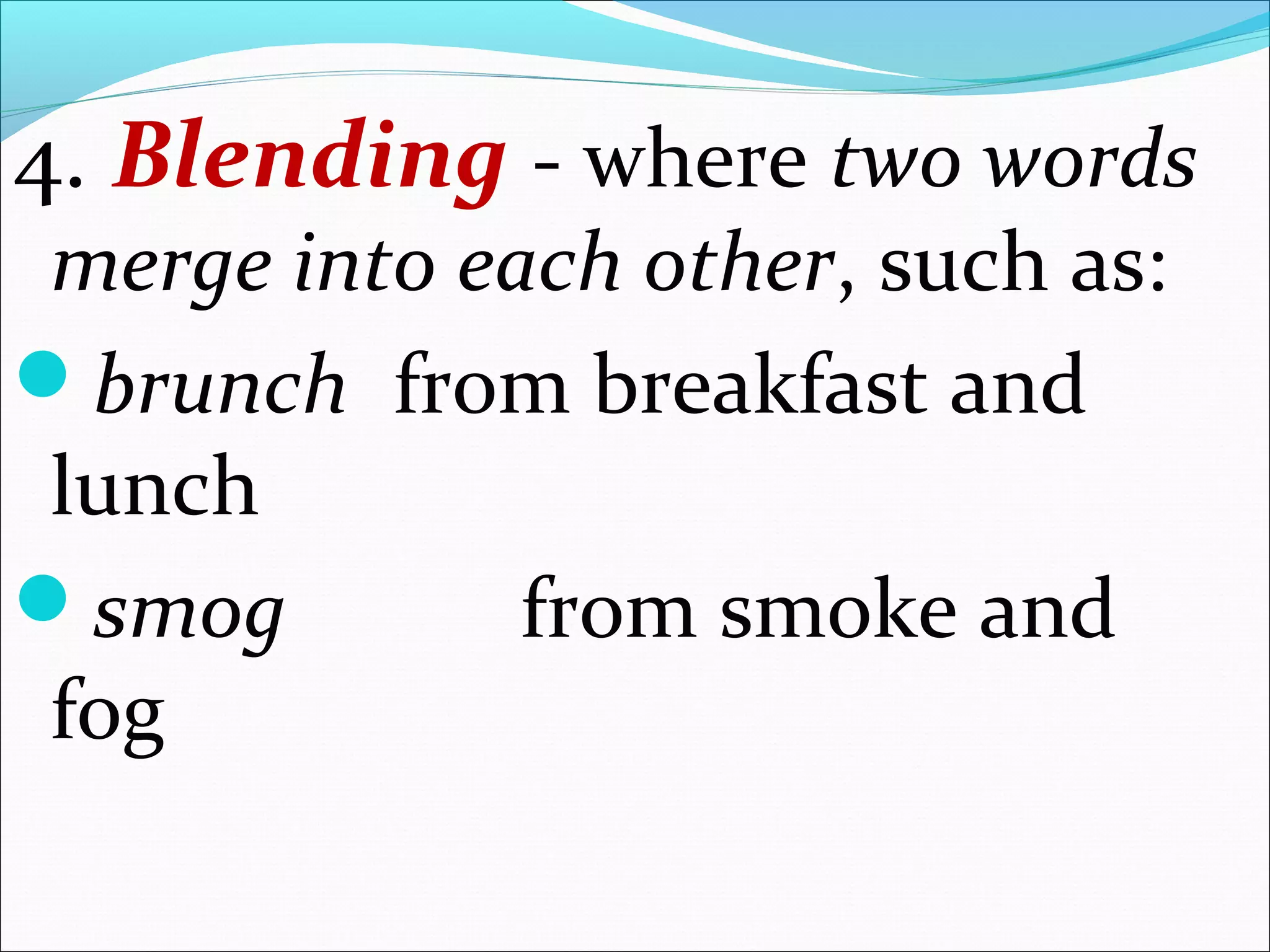
4. Blending - where two words
merge into each other, such as:
brunch from breakfast and
lunch
smog from smoke and
fog
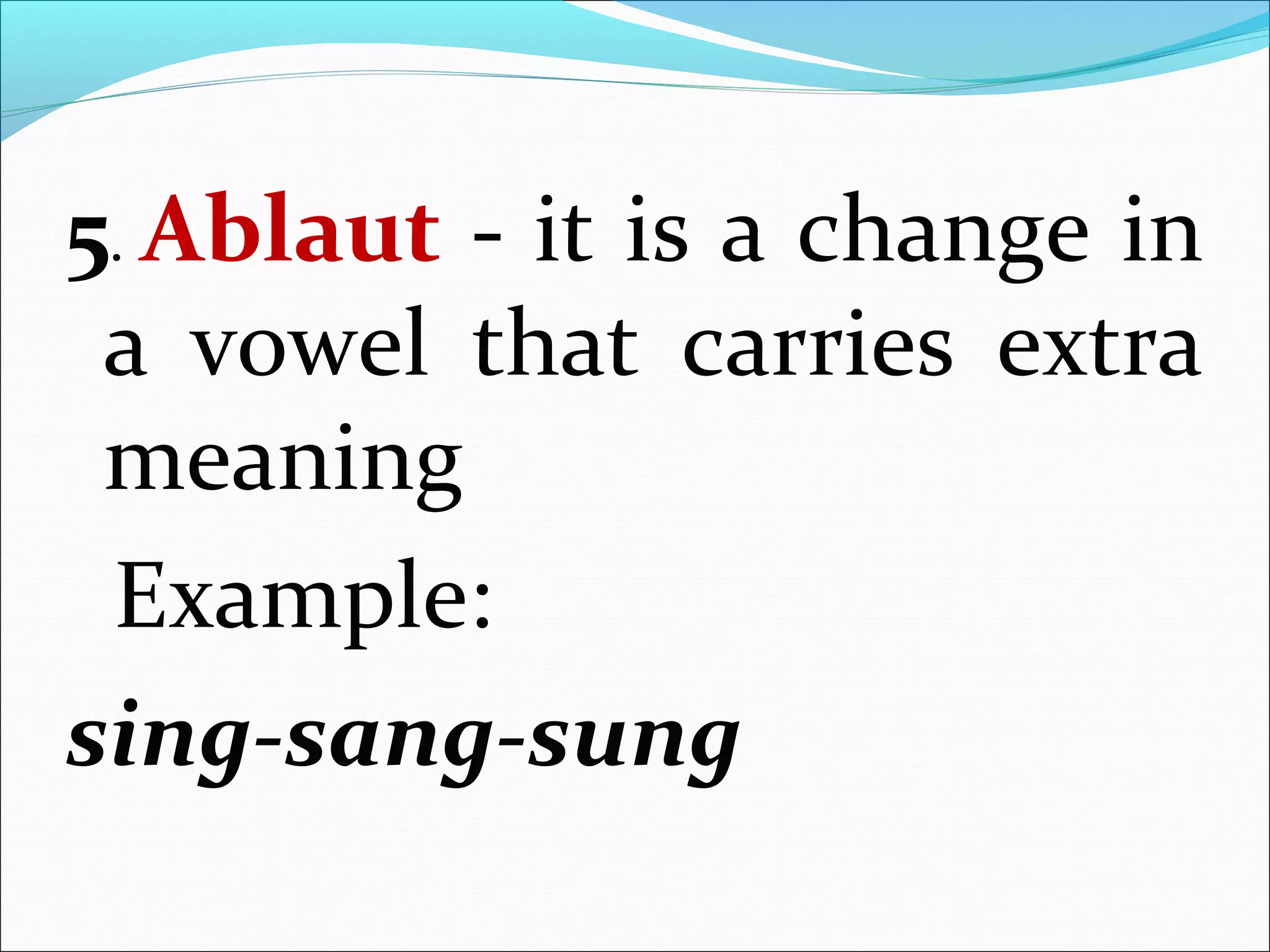
5. Ablaut - it is a change in
a vowel that carries extra
meaning
Example:
sing-sang-sung
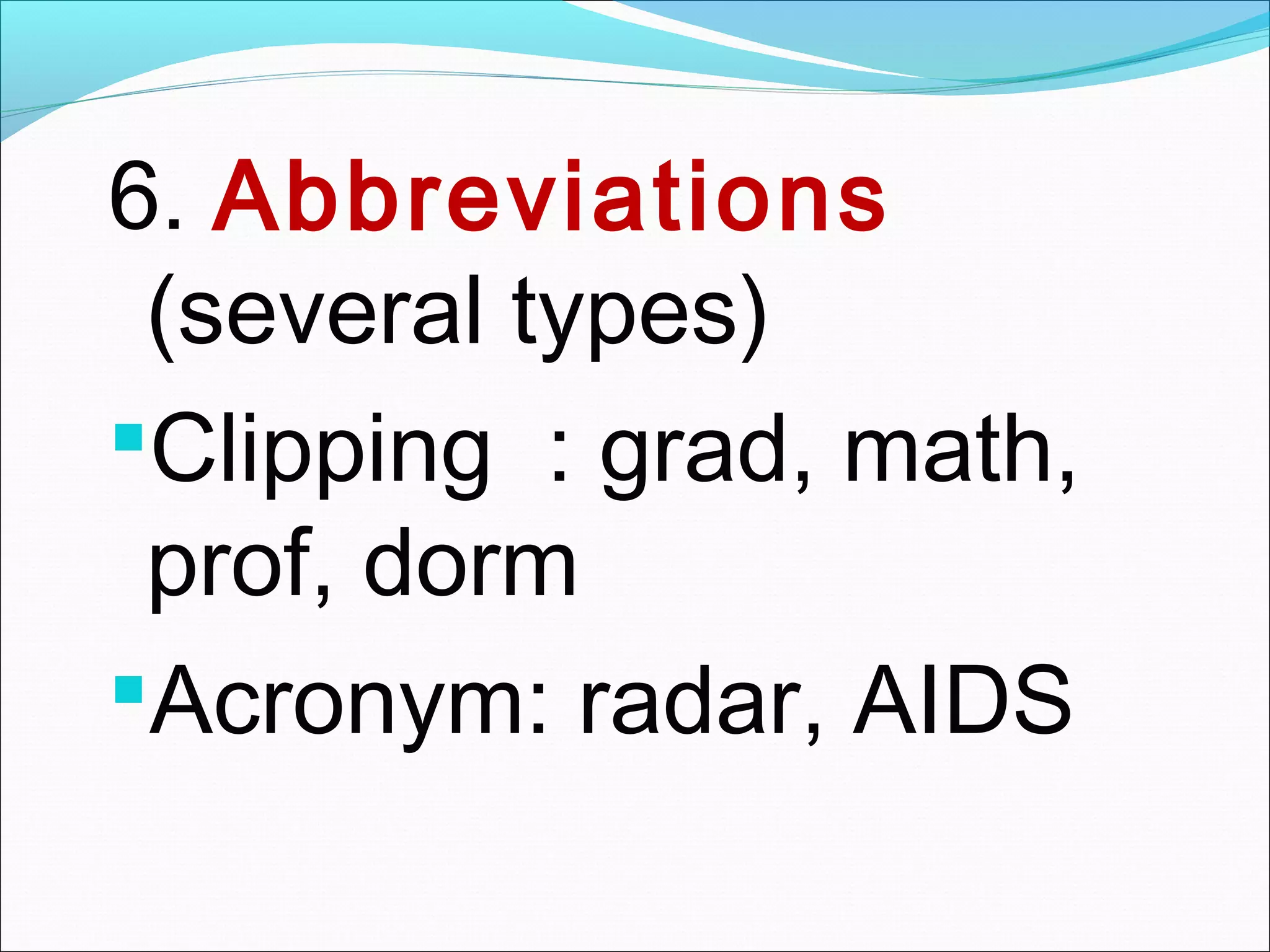
6. Abbreviations
(several types)
Clipping : grad, math,
prof, dorm
Acronym: radar, AIDS
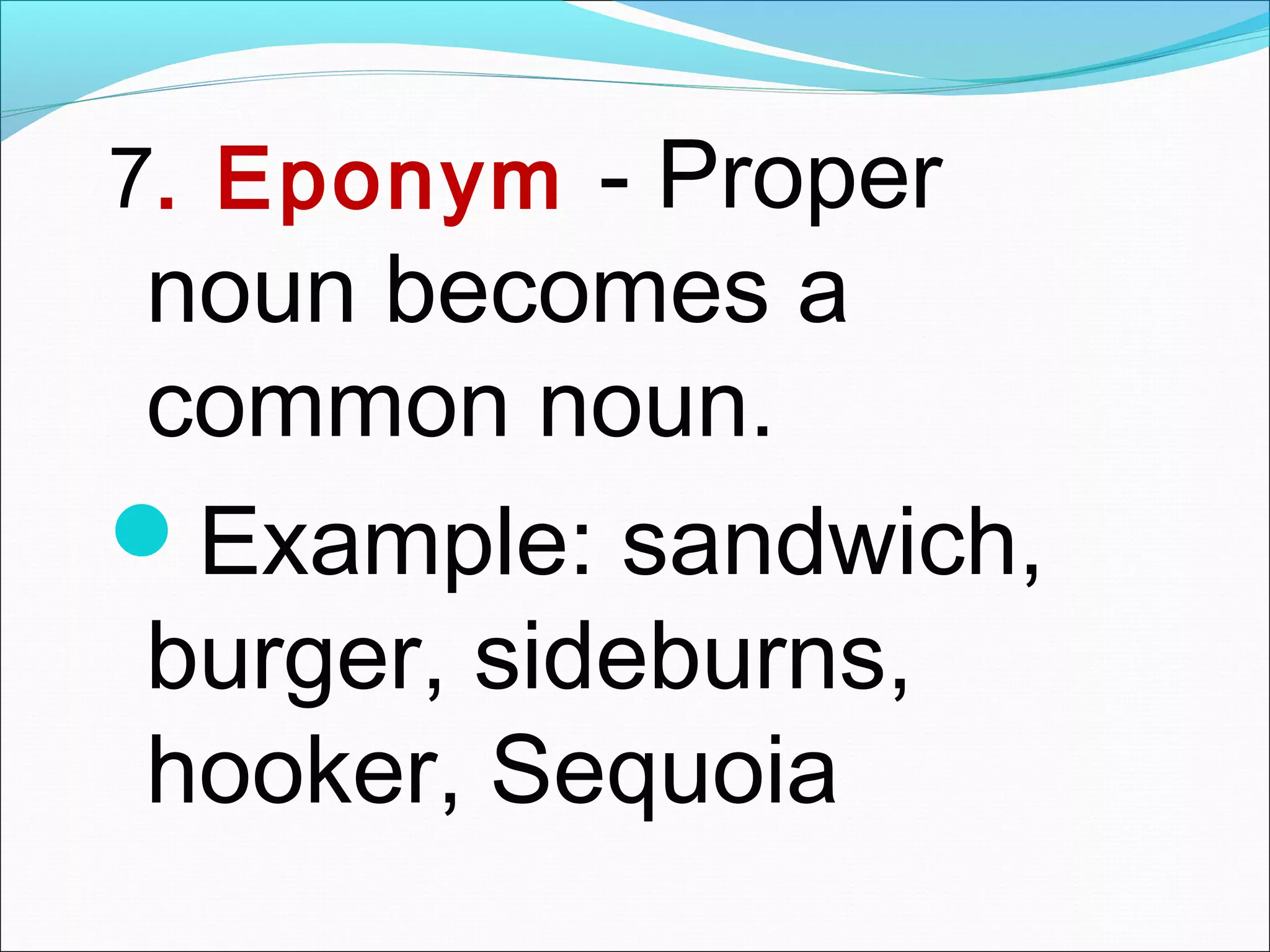
7. Eponym - Proper
noun becomes a
common noun.
Example: sandwich,
burger, sideburns,
hooker, Sequoia
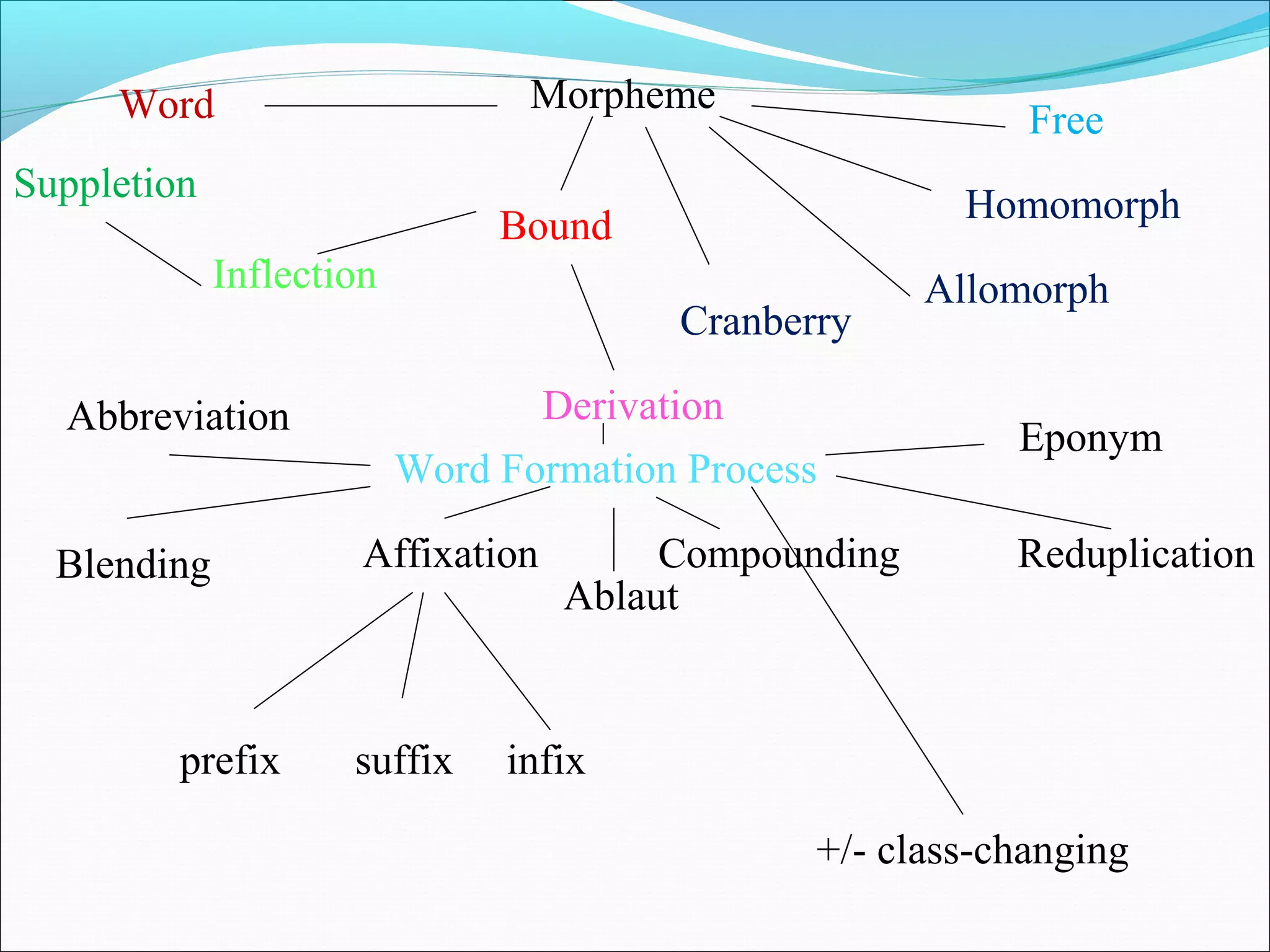
Morpheme
Inflection
Word Formation Process
Derivation
Affixation Compounding
prefix       suffix     infix
Reduplication
+/- class-changing 
Free
Bound
Blending
Cranberry
Ablaut
Eponym
Abbreviation
Word
Suppletion
Allomorph
Homomorph
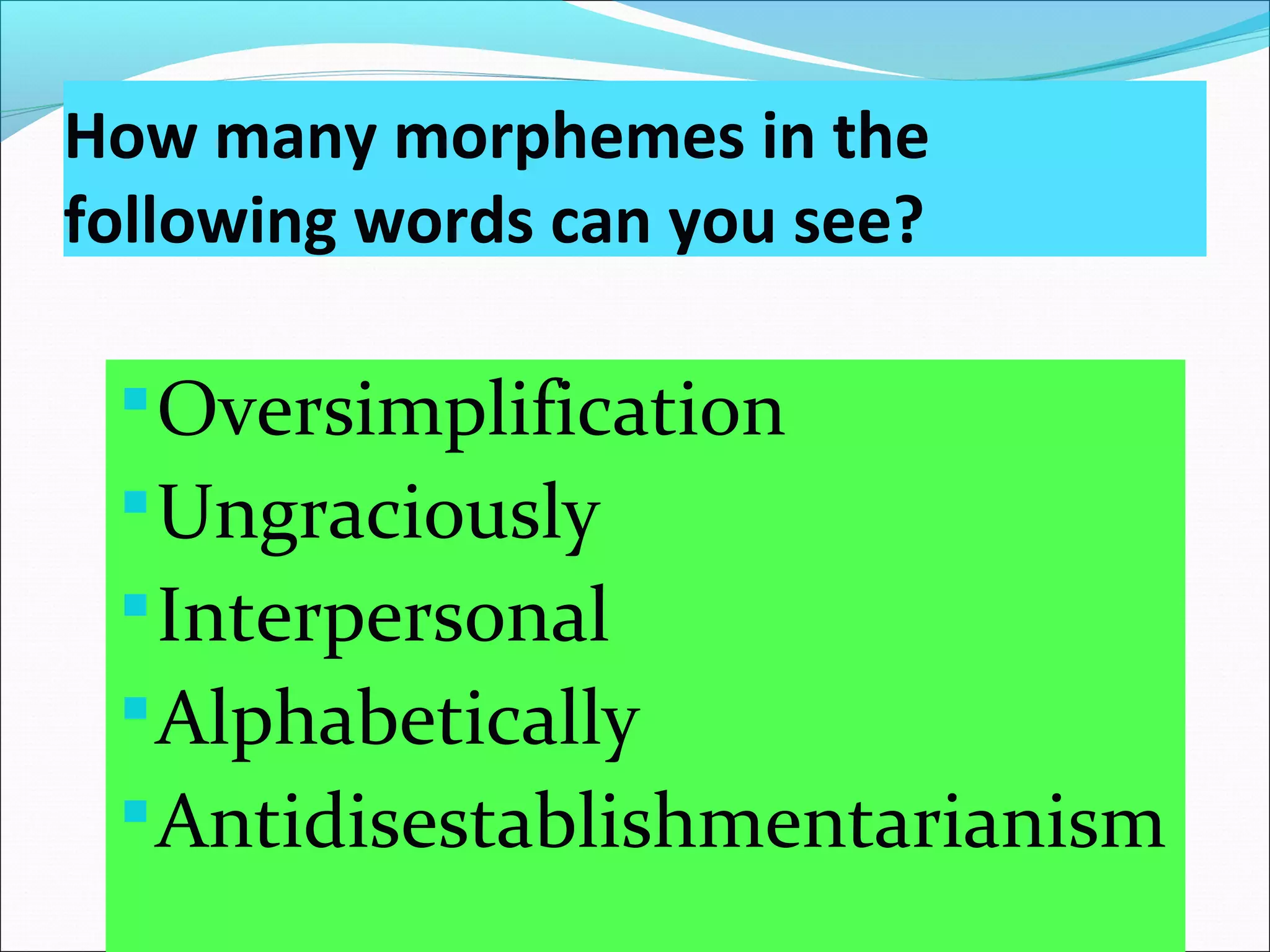
How many morphemes in the
following words can you see?
Oversimplification
Ungraciously
Interpersonal
Alphabetically
Antidisestablishmentarianism
The End!
Thank you for Listening!

Introduction to Morphology

  • 1.
  • 2.
    Outline of Presentation A.Brief History of Morphology B. Importance of Studying Morphology C. Definition of Morphology, Morpheme, and Word D. Kinds of Words according to Morpheme Structure E. Bound and Free Morphemes F. Inflection and Derivation G. Types of Word-Formation Processes
  • 3.
      ancient Indian  linguistin 6th century BC who formulated the 3,959 rules of Sanskrit morphology in the text Aṣṭādhyāyī. A. History of Morphology Panini
  • 4.
    The Greco- Roman grammatical  tradition  also  took interest  in  morphological  analysis, as  well  as  studies  in Arabic morphology.
  • 5.
    In  1786,  Sir  William Jones  claimed  that  Sanskrit,  Latin,  Persian  and  Germanic  languages  were  descended  from  a  common  ancestor. 
  • 6.
    In 1899, underthe influence of Darwinian Theory of evolution, Max Muller delivered his lectures in Oxford that the study of the evolution of words illuminated the evolution of language just as in biology morphology.
  • 7.
    His specific claimwas that the study of the 400-500 basic roots of the Indo- European ancestors of many of the languages of Europe and Asia was the key to understanding the origin of human language.
  • 8.
    - a German linguistwho coined the term “morphology” which was derived from the Greek words μορφή ("form") and λόγος ("explanation, account"). August Schleicher
  • 10.
    B. IMPORTANCE OF STUDYINGMORPHOLOGY Decoding – Readers who recognize morphemes read more quickly and accurately. Comprehension - Knowledge of morphemes helps makes meaning from text. Vocabulary – Knowledge of meaning of word parts expands reader’s vocabulary. Spelling - Morphemes are units that can be predictably spelled.
  • 11.
    C. What isMORPHOLOGY? Morphology  is  the  branch  of  linguistics that studies the structure of words. Morphology  deals  with  the  syntax  of  complex  words  and  parts  of  words,  also  called  morphemes,  as  well  as  with  the  semantics  of  their  lexical meanings. 
  • 12.
  • 13.
    Understanding how wordsare formed and what semantic properties they convey through their forms enables human beings to easily recognize individual words and their meanings in discourse.
  • 14.
  • 15.
    The smallest unitwhich has a meaning or grammatical function that words can be broken down into  are known as morphemes. So to be clear: “un” is a morpheme. “yes” is also a morpheme, but also  happens to be a word. 
  • 16.
    WORD = MORPHEME? Word- the smallest free- standing sign in a language Morpheme – the smallest sign in a language (smallest form with a specific meaning.
  • 17.
    A morpheme isnot equal to a syllable: "coats" has 1 syllable, but 2 morphemes. "syllable" has 2 syllables, but only 1 morpheme MORPHEME= SYLLABLE?
  • 18.
    HOMOMORPHS  Morphemes withthe same form but different meanings  -ER 1 (comparative) fatter and bigger  -ER 2 (human agent) worker and teacher  -ER 3 ( inanimate instrument) screwdriver
  • 19.
     is atype of bound morpheme that cannot be assigned a meaning or a grammatical function but nonetheless serves to distinguish one word from the other. Examples: mit in permit, commit, and submit ceive in receive, perceive, and conceive twi in twilight Cranberry Morpheme
  • 20.
    ALLOMORPHS Forms with thesame meaning but slightly different sound- shapes, and the difference is predictable. Example: sincere/sincerity , severe/severity, confuse/confusion
  • 21.
    Kinds of Wordsaccording to Morpheme Structure 1. Simple Word - with a single morpheme. -example: house, I, the, off, salamander
  • 22.
    Kinds of Wordsaccording to Morpheme Structure 2. Complex words - root word + at least 1 affix. -example: worker, reread, retelling
  • 23.
    Kinds of Wordsaccording to Morpheme Structure 3. Compound words - with 2 root words - example: ashtray, mailbox, lazybones, backbone
  • 24.
    D. Free vs.Bound Morphemes There are several important distinctions that must be made when it comes to morphemes: Free vs. Bound Morphemes
  • 25.
    also known as“unbound morphemes” are those which can stand by themselves or alone as words of a language. Free Morphemes
  • 26.
    FREE MORPHEMES Content words/Lexical words Function words/ Grammatical words this group includes nouns, verbs, adverbs and adjectives Examples: happy, run, man, pizza, pretty, easy this group includes conjunctions, articles, pronouns and prepositions Examples: to, but, and, that, there, first, often, soon, none, all
  • 27.
    Bound Morphemes never existas words themselves, but are always attached to some other morpheme. We have already seen the example of “un”. When we identify the number and types of morphemes that a given word consists of, we are looking at what is referred to as the structure of a word.
  • 28.
    Every word hasat least one free morpheme, which is referred to as the root, stem, or base.
  • 29.
    We can furtherdivide bound morphemes into three categories: prefix un-happy infix mother-in-law suffix happi-ness The general term for all three is Affix.
  • 30.
    Free Morpheme BoundMorpheme are words with a complete meaning, so they can stand alone as an independent word in a sentence. are lexical items incorporated into a word as a dependent part. They cannot stand alone, but must be connected to another morpheme. Example: girl, boy, mother, etc Example: -un, -s, -ed, etc.
  • 31.
    Bound morphemes operates inthe connection processes by means of : Derivation Inflection Compounding
  • 32.
    Derivational vs. InflectionalMorphemes Derivational morphemes create or derive new words by changing the meaning or by changing the word class of the word. For example: happy → unhappy Both words are adjectives, but the meaning changes.
  • 33.
    quick → quickness Theaffix changes both meaning and word class - adjective to a noun. In English: Derivational morphemes can be either prefixes or suffixes.
  • 34.
    Inflectional morphemes don’talter words the meaning or word class of a word; instead they only refine and give extra grammatical information about the word’s already existing meaning. For example: Cat → cats walk → walking
  • 35.
    In English: Inflectional morphemesare all suffixes (by chance, since in other languages this is not true). There are only 8 inflectional morphemes in English:
  • 36.
    1.-s 3rd personsg. present “He waits” 2. -ed past tense “He waited” 3.-ing progressive “He is waiting”
  • 37.
    4. -en pastparticiple “I had eaten” 5. -s plural “Both chairs are broken” 6. -’s possessive “The chair’s leg is broken”
  • 38.
    7. -er comparative “Hewas faster” 8. -estsuperlative “He was the fastest”
  • 39.
    8 Inflectional Morphemes 3for verbs: -ed, -s, -ing (worked, works, working) 3 for nouns : -s, -’s, -s’ (boys, boy’s, boys’) 2 for adjectives: -er, -est ( smarter, smartest)
  • 40.
    -is a minorinflection technique where we change the morpheme instead of adding an affix. A. Total Suppletion Example: bad –worse , good –better, go – went, is – was B. Partial Suppletion Example: was-were, teach-taught Suppletion
  • 41.
    Inflectional morphemes arerequired by syntax. (that is, they indicate syntactic or semantic relations between different words in a sentence). For example: Kim loves bananas. but They love bananas.
  • 42.
    Derivational morphemes aredifferent in that syntax does not require the presence of derivational morphemes; they do, however, indicate semantic relations within a word (that is, they change the meaning of the word). For example: kind → unkind He is kind They are unkind
  • 43.
    Inflection Derivation produces wordforms of a single lexeme produces new lexemes involves few variables of a closed system may involve many variables in an open system high commutability within the word-form low commutability within the word form low commutability within the sentence high commutability within the sentence marks agreement does not mark agreement further from the root than derivation closer to the root than inflection cannot be replaced by a single root form often can be replaced by a single root form no gaps gaps in a paradigm, or just gaps semantically regular semantically irregular Derivational versus Inflectional Morphology
  • 44.
    F. Types ofWord-Formation Processes 1. Affixation - which is forming new words by the combination of bound affixes and free morphemes. There are three types of affixation: A.Prefixation: where an affix is placed before the base of the word
  • 45.
    B. Suffixation: wherean affix is placed after the base of the word C. Infixation: where an affix is placed within a stem (mother-in-law) While English uses primarily prefixation and suffixation, many other languages use infixes.
  • 46.
    In Tagolog, alanguage of the Philippines, for example, the infix ‘um’ is used for infinitive forms of verbs (to _______) sulat ‘write’ sumulat ‘to write’ bili ‘buy’ bumili ‘to buy’ kuha ‘take’ kumuha ‘to take’
  • 47.
    2. Compounding -which is forming new words not from bound affixes but from two or more independent words: the words can be free morphemes, words derived by affixation, or even words formed by compounds themselves. e.g. girlfriend air-conditioner  blackbird looking-glass  textbook watchmaker
  • 48.
    Compound words havedifferent stress, as in the following examples: 1.      The wool sweater gave the man a red neck. 2.      The redneck in the bar got drunk and started yelling
  • 49.
    In compounds, theprimary stress is on the first word only, while individual words in phrases have independent primary stress. blackbird black bird makeup make up
  • 50.
    Morphology 3.Reduplication - whichis forming new words either by doubling an entire free morpheme (total reduplication) or part of a morpheme (partial reduplication). English doesn’t use this, but other languages make much more extensive use of reduplication. Example: criss-cross, ding dong
  • 51.
    4. Blending -where two words merge into each other, such as: brunch from breakfast and lunch smog from smoke and fog
  • 52.
    5. Ablaut -it is a change in a vowel that carries extra meaning Example: sing-sang-sung
  • 53.
    6. Abbreviations (several types) Clipping: grad, math, prof, dorm Acronym: radar, AIDS
  • 54.
    7. Eponym -Proper noun becomes a common noun. Example: sandwich, burger, sideburns, hooker, Sequoia
  • 55.
  • 56.
    How many morphemesin the following words can you see? Oversimplification Ungraciously Interpersonal Alphabetically Antidisestablishmentarianism
  • 57.
    The End! Thank youfor Listening!

Editor's Notes

  • #4 The history of morphological analysis dates back to the