Azrar Ahmed Chishti
Saima
Uzma Aslam
Asma
Husna
Nazia
Iram Shaheen
Awais Jamil Chishti
All of us will teach you according to the
concept of Microteaching.
 Morphology
 Morphemes
 Types of Morphemes with examples
 Word formation Process with examples
 1) Derivation
 2) Compounding
 3) Blending
 4) Acronyms
 5) Coinage
 Morphology is a branch of Biology that deals with the
study of plants and animals shape formation.
 In linguistics, morphology is the identification,
analysis and description of the struct
 ure of a given language's morphemes and other
linguistic units, such as root words, affixes, parts of
speech, intonations and stresses, or implied context.
 In Linguistics, Panini was the first who worked on
Sanskrit and formed 3959 rules of Sanskrit morphology.
 Now Morphology has gained the distinct position as sub
branch of Linguistics.
That means MORPHOLOGY studies how
phonemes are combined to form words.
Richards et al (1993)
“it is the study of
morphemes and their
different forms, and
the way they in word
formations” (p.237)
Nuwara & Ahmed
(2001)
“It is the study of
internal structure
of words and of
rules by which
words formed” (p.
63)
What is MORPHEME ?
Greet Booij (2005)
Defined morpheme as
the smallest part of a
word that has a
meaning and can not
be divided into
smaller unit.
TYPES OF MORPHEMES:
There are two types of Morphemes:
FREE MORPHEMES
BOUND MORPHEMES .
-According to Francis (1993), they are
divided to two types are:
FREE MORPHEMES:
-Free morphemes defined by Nuwara & Ahmed (2001) as words can stand
alone and make sense called ROOTS.
Examples: Hand – Lord – Cat
Lexical Morphemes Functional Morphemes
 Words that have meaning by
themselve
 - Nouns, (e.g.): Amna,
Hawa, father, Fauzia,
Hala, Aisha, Mother.
 - Adjectives, (e.g.):
clever, sharp.
 - Verbs, (e.g.): beat,
read.
 - Propositions, (e.g.):
in, over, under…etc.
 simply modifies the
meaning of the word,
rather than supplying the
root meaning of the word.
 Or
 that has some function.
 - Articles: a, the, an.
 - Demonstratives:
these, those, that,
this.
 - Pronouns: you, they,
we….etc.
 - Conjunctions: and,
but, yet, if…etc.
-They are not words but parts of words occur before and after
free morphemes, we call them PREFIXES and SUFFIXES.
-Bound Morphemes are the
opposite of free morphemes,
they can not stand alone and
they have to be with other
morphemes (FREE
MORPHEMES).
Examples: Ly, Un, Dis, Ness
Are those bound morphemes that we use in making new words or
making words of a different grammatical category from the stem.
or
A derivational morpheme is the prefix or suffix
used to create one word from another.
(Change in Meaning of words)
Example:
good(adj.)+-ness(derivational morpheme) =goodness(noun)
care(noun)+-ful(derivational morpheme) =careful(adj.)
A list of derivational morphemes concludes;
suffixes:-ish, -less, ly …etc.
prefixes: re-,pre-, un-, ex-, mis-, co- …etc.
Derivational morphemes can be developed by the addition of
Suffix Meaning Example
-acy state or quality privacy
-al act or process of refusal
-ance, -ence state or quality of maintenance, eminence
-dom place or state of being freedom, kingdom
-er, -or one who trainer, protector
-ism doctrine, belief communism
-ist one who chemist
-ity, -ty quality of veracity
-ment condition of argument
-sion, -tion state of being concession, transition
Suffix Meaning Example
-ate become eradicate
-en become enlighten
-ify, -fy make or become terrify
-ize, -ise become civilize
Suffix Meaning Example
-able being 'able' movable, portable
-al relating to global, manual
-en made of golden, wooden
-ful full of hopeful, wishful
-ic characteristic of domestic
-ive tending to sensitive, selective
-less lack of, without endless, powerless
-ous full of enormous, mysterious
-y state, having windy, slowly
Suffix Meaning Example
-ate become eradicate
-en become enlighten
-ify, -fy make or become terrify
-ize, -ise become civilize
Are those morphemes that are used to indicate
aspects of the grammatical function of a word.
(change in Grammar of a word)
Example:
clean+(-ed)=cleaned tenses
 Inflectional morphemes are also
called(inflections).
 1. -'s (possessive) with nouns *Jane's brother
 2. _s (plural) * pens
 3.-ing (present participle) *teaching
 4. –s (3rd person singular) with verbs *she likes
 5.-ed(past tense) *played
 6. –en(past participle) *forgotten
 7. – est (superlative) with adjectives *happiest
 8. –er (comparative) *happier
 what's the difference between inflectional
morpheme and derivational morpheme?
 Inflectional morpheme ,never change the
grammatical category of a word.
-Old (adj.) Older (adj.)
While derivational morpheme can change
the grammatical category of a word .
-teach (v.) teacher (n.)
Find morphemes
 The girl’s wildness shocked the teachers.
 Write it down on your note books.
How new words are being formed in
the language.
Word formation is of great interest
for linguists as it sheds light on other
aspects of language.
31
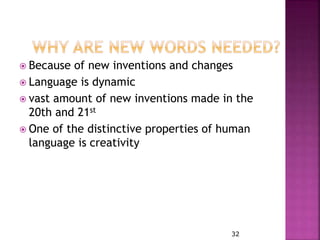
 Because of new inventions and changes
 Language is dynamic
 vast amount of new inventions made in the
20th and 21st
 One of the distinctive properties of human
language is creativity
32
etymology: studies of the history of words,
their origin, and how their form
and meaning changed over time
33
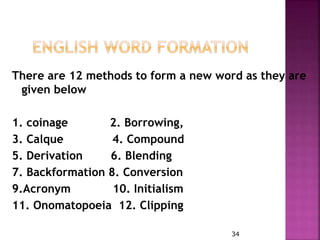
There are 12 methods to form a new word as they are
given below
1. coinage 2. Borrowing,
3. Calque 4. Compound
5. Derivation 6. Blending
7. Backformation 8. Conversion
9.Acronym 10. Initialism
11. Onomatopoeia 12. Clipping
34
 A blending is a combination of two or more words
to create a new one, usually by taking the
beginning of the other word and the end of the
other one
 Ex: brunch =breakfast+ lunch
motel = motor + hotel
smog = smoke + fog
transistor = transfer + resistor
emoticon = emotion + icon
webinar = web+ seminar
35
 Compounding is the process of putting
words together to build a new one that
''does not denote two things, but one'' and
that is ''pronounced as one unit''
 Ex: -handbag=hand + bag;
-wallpaper=wall + paper;
-fingerprint=finger + print;
-sunburn=sun + burn,
37
Compounding
 Derivation, as ''the most common word formation
process'', builds new words by adding morphemes
 word formation by affixes
 By prefixes: un-usual , mis-pronounce
mis-lead, dis-respect
 By suffixes: care-less, child-ish
faith-ful
 prefix and suffix: dis-loyal-ty
un-erring-ly
40
Acronyms
Acquired Immune Deficiency Syndrome
United States of America
Light Amplification by
Stimulated Emission of
Radiation
Radio Detection and Ranging
45
 e-cruitment-online recruitment of employees;
online submission of resumes and cover letters
 netbook–small laptop computer which weighs
less than 3 pounds and has a 7 to 10 inch screen
 notspot-an area where there is slow internet
access or no connection at all
 slumdog-very poor, underprivileged person who
lives in an overcrowded a slum
48
 What is Morphology?
 What are Morphemes?
 What are the types of Morphemes.
 How many methods can be used to form
words?
 Who will define compounding?
 Define blending?
Morphology 150301031003-conversion-gate01

Morphology 150301031003-conversion-gate01

  • 4.
    Azrar Ahmed Chishti Saima UzmaAslam Asma Husna Nazia Iram Shaheen Awais Jamil Chishti All of us will teach you according to the concept of Microteaching.
  • 5.
     Morphology  Morphemes Types of Morphemes with examples  Word formation Process with examples  1) Derivation  2) Compounding  3) Blending  4) Acronyms  5) Coinage
  • 6.
     Morphology isa branch of Biology that deals with the study of plants and animals shape formation.  In linguistics, morphology is the identification, analysis and description of the struct  ure of a given language's morphemes and other linguistic units, such as root words, affixes, parts of speech, intonations and stresses, or implied context.  In Linguistics, Panini was the first who worked on Sanskrit and formed 3959 rules of Sanskrit morphology.  Now Morphology has gained the distinct position as sub branch of Linguistics.
  • 10.
    That means MORPHOLOGYstudies how phonemes are combined to form words. Richards et al (1993) “it is the study of morphemes and their different forms, and the way they in word formations” (p.237) Nuwara & Ahmed (2001) “It is the study of internal structure of words and of rules by which words formed” (p. 63)
  • 12.
  • 13.
    Greet Booij (2005) Definedmorpheme as the smallest part of a word that has a meaning and can not be divided into smaller unit.
  • 14.
    TYPES OF MORPHEMES: Thereare two types of Morphemes: FREE MORPHEMES BOUND MORPHEMES .
  • 16.
    -According to Francis(1993), they are divided to two types are: FREE MORPHEMES: -Free morphemes defined by Nuwara & Ahmed (2001) as words can stand alone and make sense called ROOTS. Examples: Hand – Lord – Cat
  • 18.
    Lexical Morphemes FunctionalMorphemes  Words that have meaning by themselve  - Nouns, (e.g.): Amna, Hawa, father, Fauzia, Hala, Aisha, Mother.  - Adjectives, (e.g.): clever, sharp.  - Verbs, (e.g.): beat, read.  - Propositions, (e.g.): in, over, under…etc.  simply modifies the meaning of the word, rather than supplying the root meaning of the word.  Or  that has some function.  - Articles: a, the, an.  - Demonstratives: these, those, that, this.  - Pronouns: you, they, we….etc.  - Conjunctions: and, but, yet, if…etc.
  • 19.
    -They are notwords but parts of words occur before and after free morphemes, we call them PREFIXES and SUFFIXES. -Bound Morphemes are the opposite of free morphemes, they can not stand alone and they have to be with other morphemes (FREE MORPHEMES). Examples: Ly, Un, Dis, Ness
  • 20.
    Are those boundmorphemes that we use in making new words or making words of a different grammatical category from the stem. or A derivational morpheme is the prefix or suffix used to create one word from another. (Change in Meaning of words) Example: good(adj.)+-ness(derivational morpheme) =goodness(noun) care(noun)+-ful(derivational morpheme) =careful(adj.) A list of derivational morphemes concludes; suffixes:-ish, -less, ly …etc. prefixes: re-,pre-, un-, ex-, mis-, co- …etc. Derivational morphemes can be developed by the addition of
  • 21.
    Suffix Meaning Example -acystate or quality privacy -al act or process of refusal -ance, -ence state or quality of maintenance, eminence -dom place or state of being freedom, kingdom -er, -or one who trainer, protector -ism doctrine, belief communism -ist one who chemist -ity, -ty quality of veracity -ment condition of argument -sion, -tion state of being concession, transition Suffix Meaning Example -ate become eradicate -en become enlighten -ify, -fy make or become terrify -ize, -ise become civilize
  • 22.
    Suffix Meaning Example -ablebeing 'able' movable, portable -al relating to global, manual -en made of golden, wooden -ful full of hopeful, wishful -ic characteristic of domestic -ive tending to sensitive, selective -less lack of, without endless, powerless -ous full of enormous, mysterious -y state, having windy, slowly
  • 23.
    Suffix Meaning Example -atebecome eradicate -en become enlighten -ify, -fy make or become terrify -ize, -ise become civilize
  • 24.
    Are those morphemesthat are used to indicate aspects of the grammatical function of a word. (change in Grammar of a word) Example: clean+(-ed)=cleaned tenses  Inflectional morphemes are also called(inflections).
  • 25.
     1. -'s(possessive) with nouns *Jane's brother  2. _s (plural) * pens  3.-ing (present participle) *teaching  4. –s (3rd person singular) with verbs *she likes  5.-ed(past tense) *played  6. –en(past participle) *forgotten  7. – est (superlative) with adjectives *happiest  8. –er (comparative) *happier
  • 26.
     what's thedifference between inflectional morpheme and derivational morpheme?  Inflectional morpheme ,never change the grammatical category of a word. -Old (adj.) Older (adj.) While derivational morpheme can change the grammatical category of a word . -teach (v.) teacher (n.)
  • 28.
    Find morphemes  Thegirl’s wildness shocked the teachers.  Write it down on your note books.
  • 31.
    How new wordsare being formed in the language. Word formation is of great interest for linguists as it sheds light on other aspects of language. 31
  • 32.
     Because ofnew inventions and changes  Language is dynamic  vast amount of new inventions made in the 20th and 21st  One of the distinctive properties of human language is creativity 32
  • 33.
    etymology: studies ofthe history of words, their origin, and how their form and meaning changed over time 33
  • 34.
    There are 12methods to form a new word as they are given below 1. coinage 2. Borrowing, 3. Calque 4. Compound 5. Derivation 6. Blending 7. Backformation 8. Conversion 9.Acronym 10. Initialism 11. Onomatopoeia 12. Clipping 34
  • 35.
     A blendingis a combination of two or more words to create a new one, usually by taking the beginning of the other word and the end of the other one  Ex: brunch =breakfast+ lunch motel = motor + hotel smog = smoke + fog transistor = transfer + resistor emoticon = emotion + icon webinar = web+ seminar 35
  • 37.
     Compounding isthe process of putting words together to build a new one that ''does not denote two things, but one'' and that is ''pronounced as one unit''  Ex: -handbag=hand + bag; -wallpaper=wall + paper; -fingerprint=finger + print; -sunburn=sun + burn, 37
  • 38.
  • 40.
     Derivation, as''the most common word formation process'', builds new words by adding morphemes  word formation by affixes  By prefixes: un-usual , mis-pronounce mis-lead, dis-respect  By suffixes: care-less, child-ish faith-ful  prefix and suffix: dis-loyal-ty un-erring-ly 40
  • 44.
    Acronyms Acquired Immune DeficiencySyndrome United States of America Light Amplification by Stimulated Emission of Radiation Radio Detection and Ranging
  • 45.
  • 48.
     e-cruitment-online recruitmentof employees; online submission of resumes and cover letters  netbook–small laptop computer which weighs less than 3 pounds and has a 7 to 10 inch screen  notspot-an area where there is slow internet access or no connection at all  slumdog-very poor, underprivileged person who lives in an overcrowded a slum 48
  • 49.
     What isMorphology?  What are Morphemes?  What are the types of Morphemes.  How many methods can be used to form words?  Who will define compounding?  Define blending?