

ENGLISH CONSTITUENT STRUCTURE
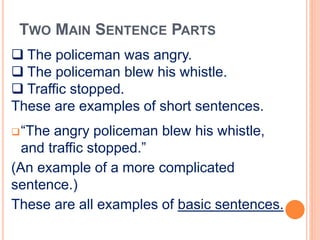
TWO MAIN SENTENCE PARTS
“The angry policeman blew his whistle,
and traffic stopped.”
(An example of a more complicated
sentence.)
These are all examples of basic sentences.
 The policeman was angry.
 The policeman blew his whistle.
 Traffic stopped.
These are examples of short sentences.
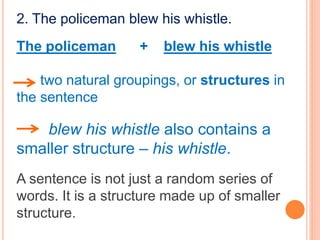
2. The policeman blew his whistle.
The policeman + blew his whistle
two natural groupings, or structures in
the sentence
blew his whistle also contains a
smaller structure – his whistle.
A sentence is not just a random series of
words. It is a structure made up of smaller
structure.
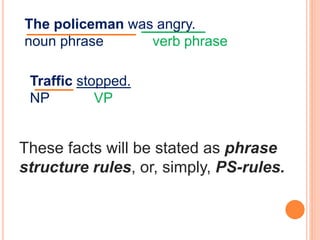
The policeman was angry.
noun phrase verb phrase
Traffic stopped.
NP VP
These facts will be stated as phrase
structure rules, or, simply, PS-rules.
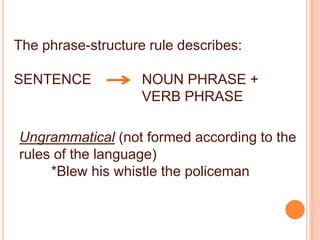
The phrase-structure rule describes:
SENTENCE NOUN PHRASE +
VERB PHRASE
Ungrammatical (not formed according to the
rules of the language)
*Blew his whistle the policeman
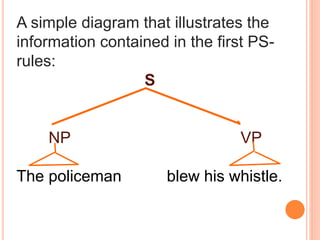
A simple diagram that illustrates the
information contained in the first PS-
rules:
S
NP VP
The policeman blew his whistle.
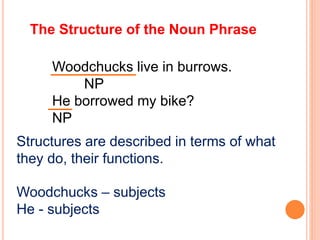
The Structure of the Noun Phrase
Structures are described in terms of what
they do, their functions.
Woodchucks – subjects
He - subjects
Woodchucks live in burrows.
NP
He borrowed my bike?
NP
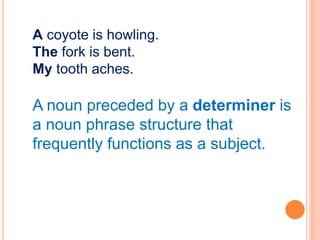
A coyote is howling.
The fork is bent.
My tooth aches.
A noun preceded by a determiner is
a noun phrase structure that
frequently functions as a subject.
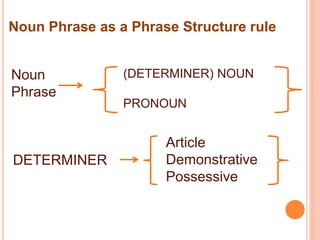
Noun Phrase as a Phrase Structure rule
Noun
Phrase
(DETERMINER) NOUN
PRONOUN
DETERMINER
Article
Demonstrative
Possessive
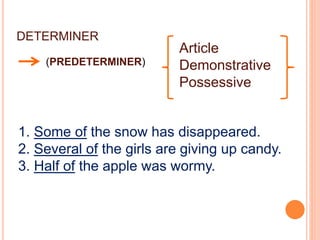
DETERMINER
(PREDETERMINER)
Article
Demonstrative
Possessive
1. Some of the snow has disappeared.
2. Several of the girls are giving up candy.
3. Half of the apple was wormy.
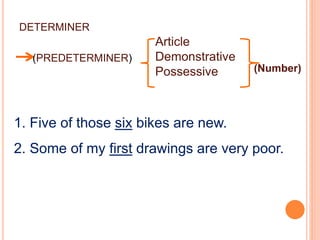
DETERMINER
(PREDETERMINER)
Article
Demonstrative
Possessive (Number)
1. Five of those six bikes are new.
2. Some of my first drawings are very poor.
THE STRUCTURE OF
THE VERB PHRASE
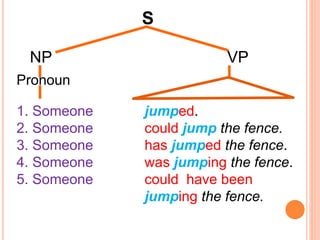
S
NP VP
Pronoun
1. Someone jumped.
2. Someone could jump the fence.
3. Someone has jumped the fence.
4. Someone was jumping the fence.
5. Someone could have been
jumping the fence.
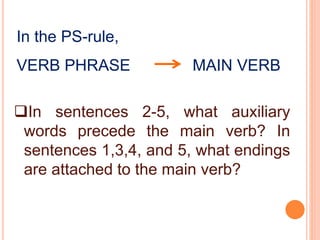
In the PS-rule,
VERB PHRASE MAIN VERB
In sentences 2-5, what auxiliary
words precede the main verb? In
sentences 1,3,4, and 5, what endings
are attached to the main verb?
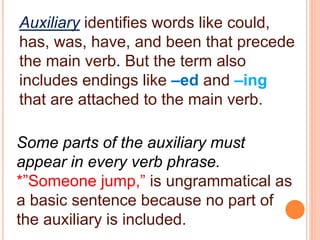
Auxiliary identifies words like could,
has, was, have, and been that precede
the main verb. But the term also
includes endings like –ed and –ing
that are attached to the main verb.
Some parts of the auxiliary must
appear in every verb phrase.
*”Someone jump,” is ungrammatical as
a basic sentence because no part of
the auxiliary is included.
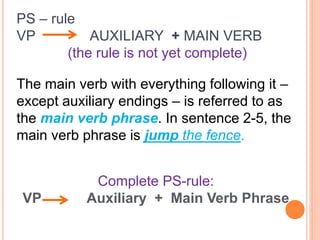
PS – rule
VP AUXILIARY + MAIN VERB
(the rule is not yet complete)
The main verb with everything following it –
except auxiliary endings – is referred to as
the main verb phrase. In sentence 2-5, the
main verb phrase is jump the fence.
Complete PS-rule:
VP Auxiliary + Main Verb Phrase
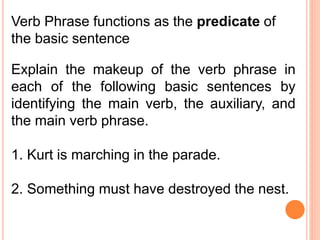
Verb Phrase functions as the predicate of
the basic sentence
Explain the makeup of the verb phrase in
each of the following basic sentences by
identifying the main verb, the auxiliary, and
the main verb phrase.
1. Kurt is marching in the parade.
2. Something must have destroyed the nest.
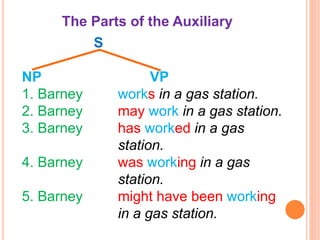
The Parts of the Auxiliary
S
NP VP
1. Barney works in a gas station.
2. Barney may work in a gas station.
3. Barney has worked in a gas
station.
4. Barney was working in a gas
station.
5. Barney might have been working
in a gas station.
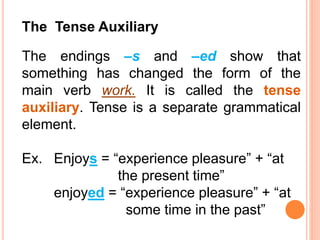
The Tense Auxiliary
The endings –s and –ed show that
something has changed the form of the
main verb work. It is called the tense
auxiliary. Tense is a separate grammatical
element.
Ex. Enjoys = “experience pleasure” + “at
the present time”
enjoyed = “experience pleasure” + “at
some time in the past”
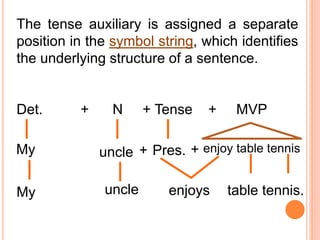
The tense auxiliary is assigned a separate
position in the symbol string, which identifies
the underlying structure of a sentence.
Det. + N + Tense + MVP
My uncle + Pres. + enjoy table tennis
My uncle enjoys table tennis.
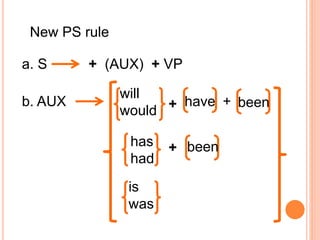
New PS rule
a. S + (AUX) + VP
b. AUX
will
would + have + been
has
had
is
was
been+
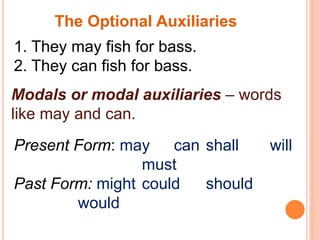
The Optional Auxiliaries
1. They may fish for bass.
2. They can fish for bass.
Modals or modal auxiliaries – words
like may and can.
Present Form: may can shall will
must
Past Form: might could should
would
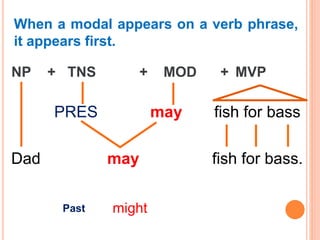
When a modal appears on a verb phrase,
it appears first.
NP + TNS + MOD + MVP
PRES may fish for bass
Dad may fish for bass.
Past might
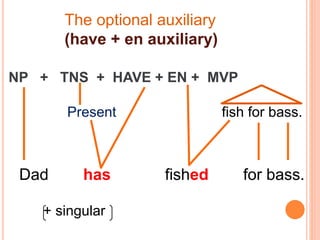
The optional auxiliary
(have + en auxiliary)
NP + TNS + HAVE + EN + MVP
Present fish for bass.
Dad has fished for bass.
+ singular
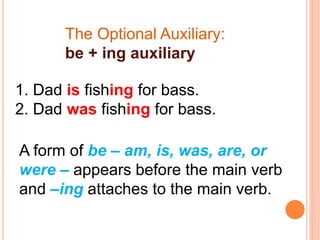
The Optional Auxiliary:
be + ing auxiliary
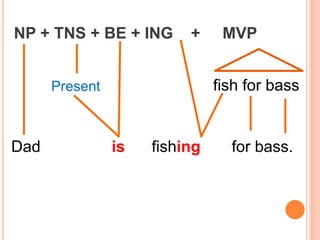
1. Dad is fishing for bass.
2. Dad was fishing for bass.
A form of be – am, is, was, are, or
were – appears before the main verb
and –ing attaches to the main verb.
NP + TNS + BE + ING + MVP
Present fish for bass
Dad is fishing for bass.
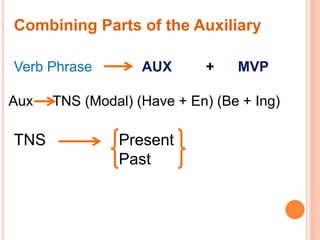
Combining Parts of the Auxiliary
Verb Phrase AUX + MVP
Aux TNS (Modal) (Have + En) (Be + Ing)
TNS Present
Past
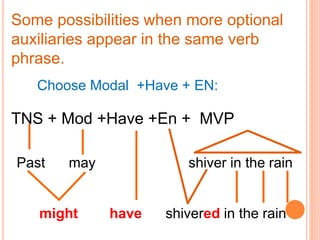
Some possibilities when more optional
auxiliaries appear in the same verb
phrase.
Choose Modal +Have + EN:
TNS + Mod +Have +En + MVP
Past may shiver in the rain
might have shivered in the rain
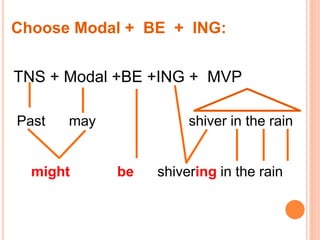
Choose Modal + BE + ING:
TNS + Modal +BE +ING + MVP
Past may shiver in the rain
might be shivering in the rain
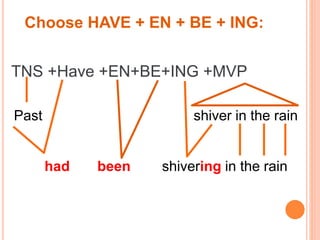
Choose HAVE + EN + BE + ING:
TNS +Have +EN+BE+ING +MVP
Past shiver in the rain
had been shivering in the rain
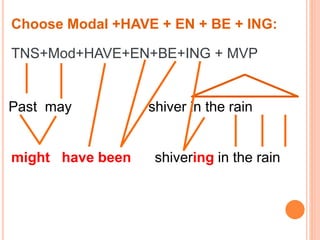
Choose Modal +HAVE + EN + BE + ING:
TNS+Mod+HAVE+EN+BE+ING + MVP
Past may shiver in the rain
might have been shivering in the rain
A REVIEW ON PHRASE
STRUCTURE RULES
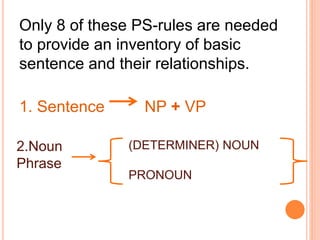
Only 8 of these PS-rules are needed
to provide an inventory of basic
sentence and their relationships.
1. Sentence NP + VP
2.Noun
Phrase
(DETERMINER) NOUN
PRONOUN
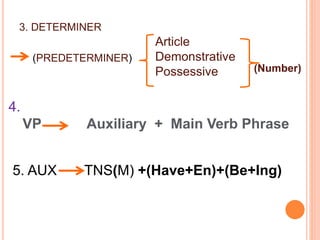
3. DETERMINER
(PREDETERMINER)
Article
Demonstrative
Possessive (Number)
4.
VP Auxiliary + Main Verb Phrase
5. AUX TNS(M) +(Have+En)+(Be+Ing)
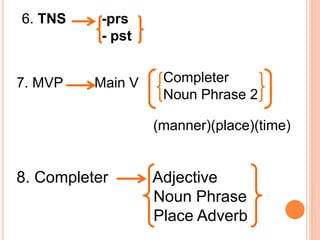
6. TNS -prs
- pst
7. MVP Main V Completer
Noun Phrase 2
(manner)(place)(time)
8. Completer Adjective
Noun Phrase
Place Adverb
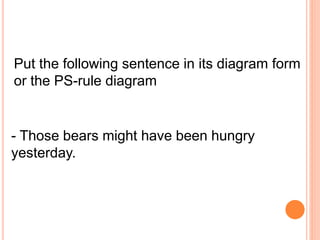
Put the following sentence in its diagram form
or the PS-rule diagram
- Those bears might have been hungry
yesterday.
REFERENCE
 Harsh, Wayne et al. Success in English:
Experiences in Language. Laidlaw Brothers,
Publishers. Doubleday & Company, Inc., 1973

Syntax

  • 1.
  • 2.
    TWO MAIN SENTENCEPARTS “The angry policeman blew his whistle, and traffic stopped.” (An example of a more complicated sentence.) These are all examples of basic sentences.  The policeman was angry.  The policeman blew his whistle.  Traffic stopped. These are examples of short sentences.
  • 3.
    2. The policemanblew his whistle. The policeman + blew his whistle two natural groupings, or structures in the sentence blew his whistle also contains a smaller structure – his whistle. A sentence is not just a random series of words. It is a structure made up of smaller structure.
  • 4.
    The policeman wasangry. noun phrase verb phrase Traffic stopped. NP VP These facts will be stated as phrase structure rules, or, simply, PS-rules.
  • 5.
    The phrase-structure ruledescribes: SENTENCE NOUN PHRASE + VERB PHRASE Ungrammatical (not formed according to the rules of the language) *Blew his whistle the policeman
  • 6.
    A simple diagramthat illustrates the information contained in the first PS- rules: S NP VP The policeman blew his whistle.
  • 7.
    The Structure ofthe Noun Phrase Structures are described in terms of what they do, their functions. Woodchucks – subjects He - subjects Woodchucks live in burrows. NP He borrowed my bike? NP
  • 8.
    A coyote ishowling. The fork is bent. My tooth aches. A noun preceded by a determiner is a noun phrase structure that frequently functions as a subject.
  • 9.
    Noun Phrase asa Phrase Structure rule Noun Phrase (DETERMINER) NOUN PRONOUN DETERMINER Article Demonstrative Possessive
  • 10.
    DETERMINER (PREDETERMINER) Article Demonstrative Possessive 1. Some ofthe snow has disappeared. 2. Several of the girls are giving up candy. 3. Half of the apple was wormy.
  • 11.
    DETERMINER (PREDETERMINER) Article Demonstrative Possessive (Number) 1. Fiveof those six bikes are new. 2. Some of my first drawings are very poor.
  • 12.
  • 13.
    S NP VP Pronoun 1. Someonejumped. 2. Someone could jump the fence. 3. Someone has jumped the fence. 4. Someone was jumping the fence. 5. Someone could have been jumping the fence.
  • 14.
    In the PS-rule, VERBPHRASE MAIN VERB In sentences 2-5, what auxiliary words precede the main verb? In sentences 1,3,4, and 5, what endings are attached to the main verb?
  • 15.
    Auxiliary identifies wordslike could, has, was, have, and been that precede the main verb. But the term also includes endings like –ed and –ing that are attached to the main verb. Some parts of the auxiliary must appear in every verb phrase. *”Someone jump,” is ungrammatical as a basic sentence because no part of the auxiliary is included.
  • 16.
    PS – rule VPAUXILIARY + MAIN VERB (the rule is not yet complete) The main verb with everything following it – except auxiliary endings – is referred to as the main verb phrase. In sentence 2-5, the main verb phrase is jump the fence. Complete PS-rule: VP Auxiliary + Main Verb Phrase
  • 17.
    Verb Phrase functionsas the predicate of the basic sentence Explain the makeup of the verb phrase in each of the following basic sentences by identifying the main verb, the auxiliary, and the main verb phrase. 1. Kurt is marching in the parade. 2. Something must have destroyed the nest.
  • 18.
    The Parts ofthe Auxiliary S NP VP 1. Barney works in a gas station. 2. Barney may work in a gas station. 3. Barney has worked in a gas station. 4. Barney was working in a gas station. 5. Barney might have been working in a gas station.
  • 19.
    The Tense Auxiliary Theendings –s and –ed show that something has changed the form of the main verb work. It is called the tense auxiliary. Tense is a separate grammatical element. Ex. Enjoys = “experience pleasure” + “at the present time” enjoyed = “experience pleasure” + “at some time in the past”
  • 20.
    The tense auxiliaryis assigned a separate position in the symbol string, which identifies the underlying structure of a sentence. Det. + N + Tense + MVP My uncle + Pres. + enjoy table tennis My uncle enjoys table tennis.
  • 21.
    New PS rule a.S + (AUX) + VP b. AUX will would + have + been has had is was been+
  • 22.
    The Optional Auxiliaries 1.They may fish for bass. 2. They can fish for bass. Modals or modal auxiliaries – words like may and can. Present Form: may can shall will must Past Form: might could should would
  • 23.
    When a modalappears on a verb phrase, it appears first. NP + TNS + MOD + MVP PRES may fish for bass Dad may fish for bass. Past might
  • 24.
    The optional auxiliary (have+ en auxiliary) NP + TNS + HAVE + EN + MVP Present fish for bass. Dad has fished for bass. + singular
  • 25.
    The Optional Auxiliary: be+ ing auxiliary 1. Dad is fishing for bass. 2. Dad was fishing for bass. A form of be – am, is, was, are, or were – appears before the main verb and –ing attaches to the main verb.
  • 26.
    NP + TNS+ BE + ING + MVP Present fish for bass Dad is fishing for bass.
  • 27.
    Combining Parts ofthe Auxiliary Verb Phrase AUX + MVP Aux TNS (Modal) (Have + En) (Be + Ing) TNS Present Past
  • 28.
    Some possibilities whenmore optional auxiliaries appear in the same verb phrase. Choose Modal +Have + EN: TNS + Mod +Have +En + MVP Past may shiver in the rain might have shivered in the rain
  • 29.
    Choose Modal +BE + ING: TNS + Modal +BE +ING + MVP Past may shiver in the rain might be shivering in the rain
  • 30.
    Choose HAVE +EN + BE + ING: TNS +Have +EN+BE+ING +MVP Past shiver in the rain had been shivering in the rain
  • 31.
    Choose Modal +HAVE+ EN + BE + ING: TNS+Mod+HAVE+EN+BE+ING + MVP Past may shiver in the rain might have been shivering in the rain
  • 32.
    A REVIEW ONPHRASE STRUCTURE RULES
  • 33.
    Only 8 ofthese PS-rules are needed to provide an inventory of basic sentence and their relationships. 1. Sentence NP + VP 2.Noun Phrase (DETERMINER) NOUN PRONOUN
  • 34.
    3. DETERMINER (PREDETERMINER) Article Demonstrative Possessive (Number) 4. VPAuxiliary + Main Verb Phrase 5. AUX TNS(M) +(Have+En)+(Be+Ing)
  • 35.
    6. TNS -prs -pst 7. MVP Main V Completer Noun Phrase 2 (manner)(place)(time) 8. Completer Adjective Noun Phrase Place Adverb
  • 36.
    Put the followingsentence in its diagram form or the PS-rule diagram - Those bears might have been hungry yesterday.
  • 37.
    REFERENCE  Harsh, Wayneet al. Success in English: Experiences in Language. Laidlaw Brothers, Publishers. Doubleday & Company, Inc., 1973