Lever Systems
By Marvin Lowe
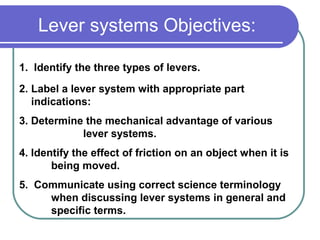
Lever systems Objectives:
1. Identify the three types of levers.
2. Label a lever system with appropriate part
indications:
3. Determine the mechanical advantage of various
lever systems.
4. Identify the effect of friction on an object when it is
being moved.
5. Communicate using correct science terminology
when discussing lever systems in general and
specific terms.
Lever Systems
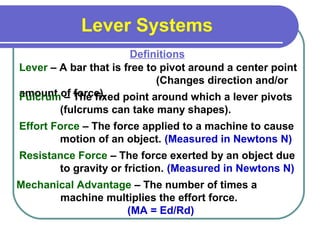
Definitions
Lever – A bar that is free to pivot around a center point
(Changes direction and/or
amount of force).Fulcrum – The fixed point around which a lever pivots
(fulcrums can take many shapes).
Effort Force – The force applied to a machine to cause
motion of an object. (Measured in Newtons N)
Resistance Force – The force exerted by an object due
to gravity or friction. (Measured in Newtons N)
Mechanical Advantage – The number of times a
machine multiplies the effort force.
(MA = Ed/Rd)
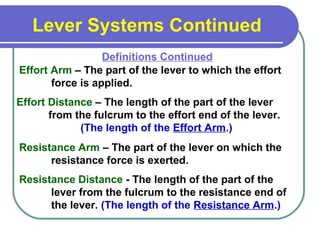
Lever Systems Continued
Effort Arm – The part of the lever to which the effort
force is applied.
Definitions Continued
Effort Distance – The length of the part of the lever
from the fulcrum to the effort end of the lever.
(The length of the Effort Arm.)
Resistance Arm – The part of the lever on which the
resistance force is exerted.
Resistance Distance - The length of the part of the
lever from the fulcrum to the resistance end of
the lever. (The length of the Resistance Arm.)
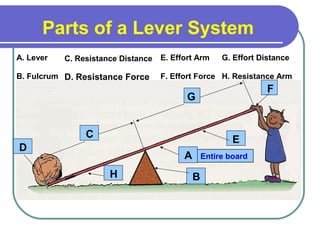
Parts of a Lever System
A. Lever E. Effort Arm
B. Fulcrum H. Resistance ArmF. Effort Force
C. Resistance Distance
D. Resistance Force
G. Effort Distance
Entire board
C
D
H
G
F
B
A
E
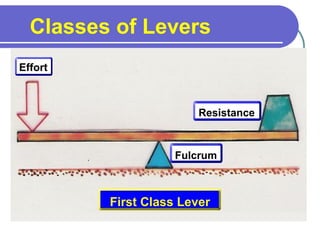
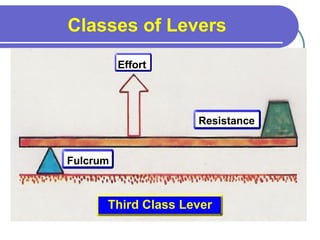
Classes of Levers
Effort
Resistance
Fulcrum
First Class Lever
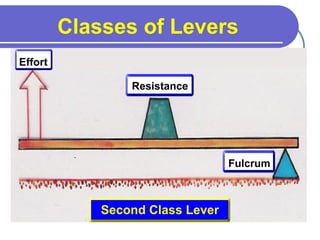
Classes of Levers
Effort
Resistance
Fulcrum
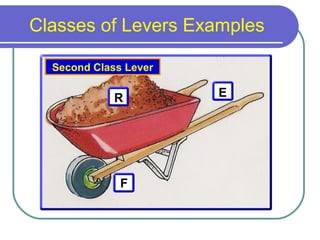
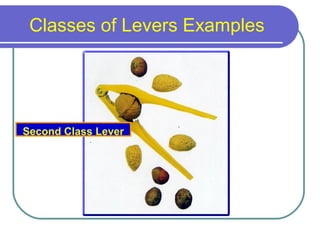
Second Class Lever
Classes of Levers
Effort
Resistance
Fulcrum
Third Class Lever
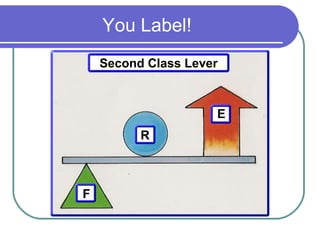
You Label!
R
F
E
Second Class Lever
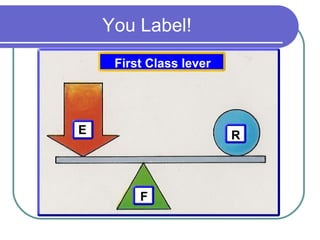
You Label!
R
F
E
First Class lever
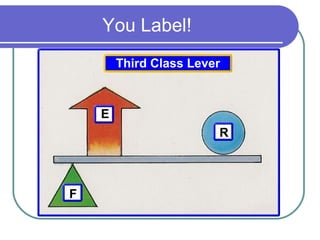
You Label!
R
E
F
Third Class Lever
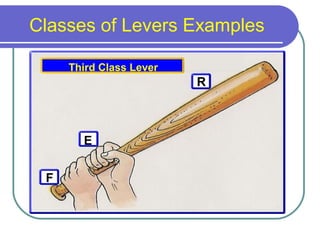
Classes of Levers Examples
F
E
R
Third Class Lever
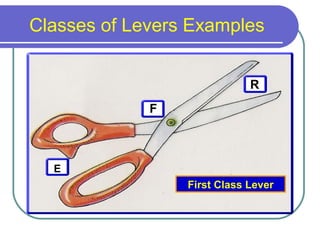
Classes of Levers Examples
E
F
R
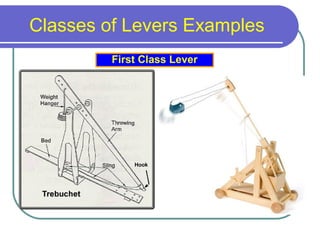
First Class Lever
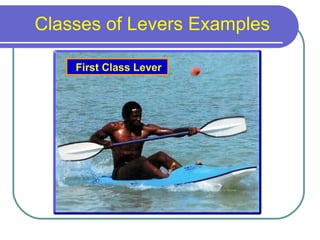
Classes of Levers Examples
First Class Lever
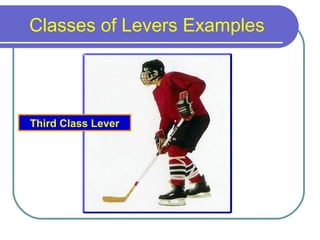
Classes of Levers Examples
Third Class Lever
Classes of Levers Examples
F
ER
Second Class Lever
Classes of Levers Examples
Second Class Lever
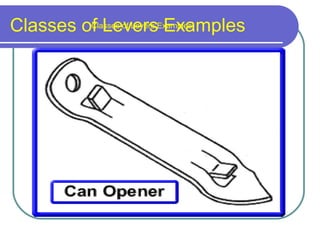
Classes of Levers ExamplesClasses of Levers Examples
Classes of Levers Examples
First Class Lever
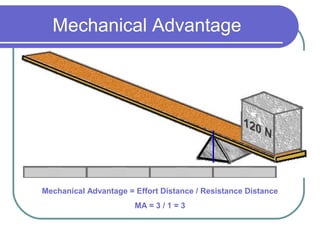
Mechanical Advantage
Mechanical Advantage = Effort Distance / Resistance Distance
MA = 3 / 1 = 3
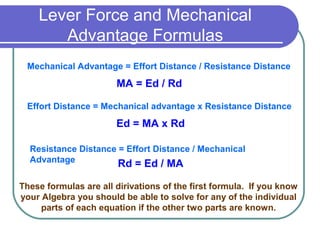
Lever Force and Mechanical
Advantage Formulas
Mechanical Advantage = Effort Distance / Resistance Distance
Effort Distance = Mechanical advantage x Resistance Distance
Resistance Distance = Effort Distance / Mechanical
Advantage
MA = Ed / Rd
Ed = MA x Rd
Rd = Ed / MA
These formulas are all dirivations of the first formula. If you know
your Algebra you should be able to solve for any of the individual
parts of each equation if the other two parts are known.
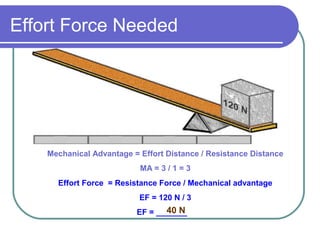
Effort Force Needed
Effort Force = Resistance Force / Mechanical advantage
EF = 120 N / 3
EF = _______
Mechanical Advantage = Effort Distance / Resistance Distance
MA = 3 / 1 = 3
40 N
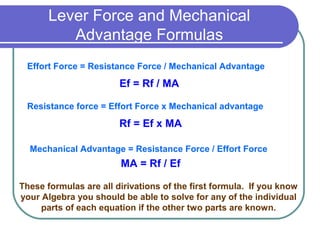
Lever Force and Mechanical
Advantage Formulas
Effort Force = Resistance Force / Mechanical Advantage
Resistance force = Effort Force x Mechanical advantage
Mechanical Advantage = Resistance Force / Effort Force
Ef = Rf / MA
Rf = Ef x MA
MA = Rf / Ef
These formulas are all dirivations of the first formula. If you know
your Algebra you should be able to solve for any of the individual
parts of each equation if the other two parts are known.
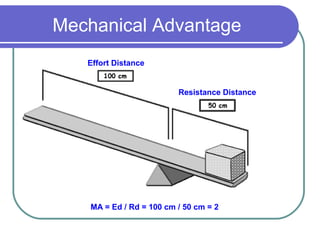
Mechanical Advantage
Effort Distance
Resistance Distance
MA = Ed / Rd = 100 cm / 50 cm = 2
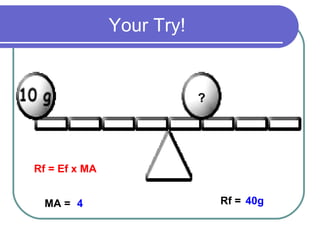
Your Try!
?
MA = 4 Rf = 40g
Rf = Ef x MA
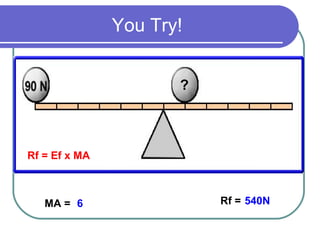
You Try!
MA = 6 Rf = 540N
?
Rf = Ef x MA
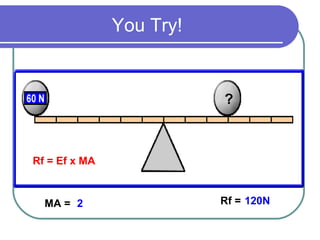
You Try!
?
MA = 2 Rf = 120N
Rf = Ef x MA
You Try!
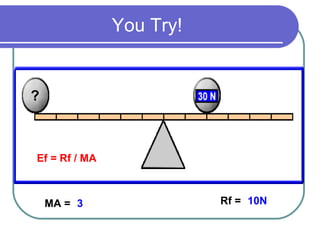
?
MA = 3 Rf = 10N
Ef = Rf / MA
You Try!
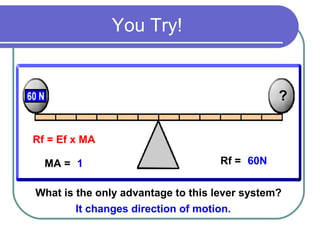
?
MA = 1 Rf = 60N
What is the only advantage to this lever system?
It changes direction of motion.
Rf = Ef x MA
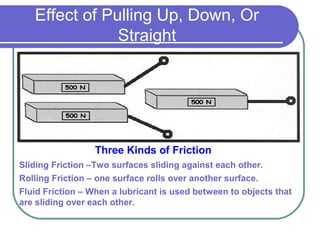
Effect of Pulling Up, Down, Or
Straight
Three Kinds of Friction
Sliding Friction –Two surfaces sliding against each other.
Rolling Friction – one surface rolls over another surface.
Fluid Friction – When a lubricant is used between to objects that
are sliding over each other.
Lever systems Objectives:
1. Identify the three types of levers.
2. Label a lever system with appropriate part
indications:
3. Determine the mechanical advantage of various
lever systems.
4. Identify the effect of friction on an object when it is
being moved.
5. Communicate using correct science terminology
when discussing lever systems in general and
specific terms.

Levers

  • 1.
  • 2.
    Lever systems Objectives: 1.Identify the three types of levers. 2. Label a lever system with appropriate part indications: 3. Determine the mechanical advantage of various lever systems. 4. Identify the effect of friction on an object when it is being moved. 5. Communicate using correct science terminology when discussing lever systems in general and specific terms.
  • 3.
    Lever Systems Definitions Lever –A bar that is free to pivot around a center point (Changes direction and/or amount of force).Fulcrum – The fixed point around which a lever pivots (fulcrums can take many shapes). Effort Force – The force applied to a machine to cause motion of an object. (Measured in Newtons N) Resistance Force – The force exerted by an object due to gravity or friction. (Measured in Newtons N) Mechanical Advantage – The number of times a machine multiplies the effort force. (MA = Ed/Rd)
  • 4.
    Lever Systems Continued EffortArm – The part of the lever to which the effort force is applied. Definitions Continued Effort Distance – The length of the part of the lever from the fulcrum to the effort end of the lever. (The length of the Effort Arm.) Resistance Arm – The part of the lever on which the resistance force is exerted. Resistance Distance - The length of the part of the lever from the fulcrum to the resistance end of the lever. (The length of the Resistance Arm.)
  • 5.
    Parts of aLever System A. Lever E. Effort Arm B. Fulcrum H. Resistance ArmF. Effort Force C. Resistance Distance D. Resistance Force G. Effort Distance Entire board C D H G F B A E
  • 6.
  • 7.
  • 8.
  • 9.
  • 10.
  • 11.
  • 12.
    Classes of LeversExamples F E R Third Class Lever
  • 13.
    Classes of LeversExamples E F R First Class Lever
  • 14.
    Classes of LeversExamples First Class Lever
  • 15.
    Classes of LeversExamples Third Class Lever
  • 16.
    Classes of LeversExamples F ER Second Class Lever
  • 17.
    Classes of LeversExamples Second Class Lever
  • 18.
    Classes of LeversExamplesClasses of Levers Examples
  • 19.
    Classes of LeversExamples First Class Lever
  • 20.
    Mechanical Advantage Mechanical Advantage= Effort Distance / Resistance Distance MA = 3 / 1 = 3
  • 21.
    Lever Force andMechanical Advantage Formulas Mechanical Advantage = Effort Distance / Resistance Distance Effort Distance = Mechanical advantage x Resistance Distance Resistance Distance = Effort Distance / Mechanical Advantage MA = Ed / Rd Ed = MA x Rd Rd = Ed / MA These formulas are all dirivations of the first formula. If you know your Algebra you should be able to solve for any of the individual parts of each equation if the other two parts are known.
  • 22.
    Effort Force Needed EffortForce = Resistance Force / Mechanical advantage EF = 120 N / 3 EF = _______ Mechanical Advantage = Effort Distance / Resistance Distance MA = 3 / 1 = 3 40 N
  • 23.
    Lever Force andMechanical Advantage Formulas Effort Force = Resistance Force / Mechanical Advantage Resistance force = Effort Force x Mechanical advantage Mechanical Advantage = Resistance Force / Effort Force Ef = Rf / MA Rf = Ef x MA MA = Rf / Ef These formulas are all dirivations of the first formula. If you know your Algebra you should be able to solve for any of the individual parts of each equation if the other two parts are known.
  • 24.
    Mechanical Advantage Effort Distance ResistanceDistance MA = Ed / Rd = 100 cm / 50 cm = 2
  • 25.
    Your Try! ? MA =4 Rf = 40g Rf = Ef x MA
  • 26.
    You Try! MA =6 Rf = 540N ? Rf = Ef x MA
  • 27.
    You Try! ? MA =2 Rf = 120N Rf = Ef x MA
  • 28.
    You Try! ? MA =3 Rf = 10N Ef = Rf / MA
  • 29.
    You Try! ? MA =1 Rf = 60N What is the only advantage to this lever system? It changes direction of motion. Rf = Ef x MA
  • 30.
    Effect of PullingUp, Down, Or Straight Three Kinds of Friction Sliding Friction –Two surfaces sliding against each other. Rolling Friction – one surface rolls over another surface. Fluid Friction – When a lubricant is used between to objects that are sliding over each other.
  • 31.
    Lever systems Objectives: 1.Identify the three types of levers. 2. Label a lever system with appropriate part indications: 3. Determine the mechanical advantage of various lever systems. 4. Identify the effect of friction on an object when it is being moved. 5. Communicate using correct science terminology when discussing lever systems in general and specific terms.