Notes: Levers CW: Levers H: Types of Levers
Levers April 17, 2009
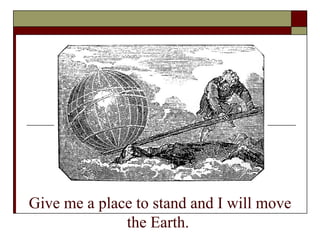
~ Archimedes Give me a place to stand and I will move the Earth.
Objectives Analyze and label the parts of a lever Provide examples of first, second and third class levers. Calculate and determine the mechanical advantage of a lever.
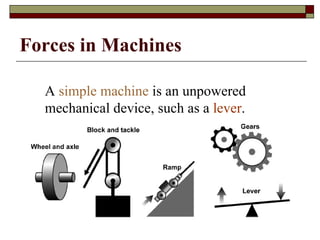
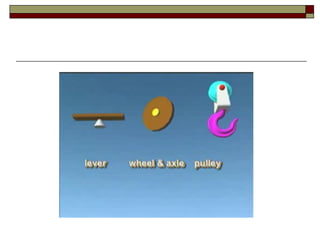
Forces in Machines   A  simple machine  is an unpowered mechanical device, such as a  lever .
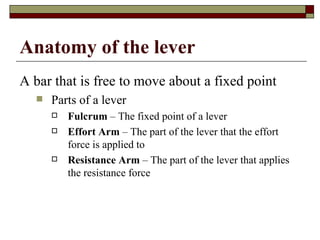
A bar that is free to move about a fixed point Parts of a lever Fulcrum  – The fixed point of a lever Effort Arm  – The part of the lever that the effort force is applied to  Resistance Arm  – The part of the lever that applies the resistance force Anatomy of the lever
Input Force  – Force exerted  ON  the lever Output Force  – Force exerted  BY  the lever Forces
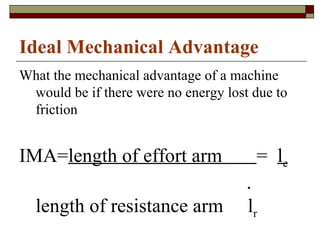
Ideal Mechanical Advantage What the mechanical advantage of a machine would be if there were no energy lost due to friction IMA= length of effort arm  =  l e   .  length of resistance arm  l r
There are 3 types of levers 1 st  Class Levers 2 nd  Class Levers 3 rd  Class Levers
1 st  Class Lever The fulcrum is located between the F e  and the F r .  First class levers can multiply force and distance. Examples: Scissors, see-saw
 
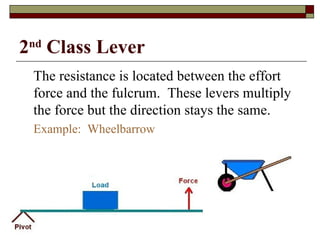
2 nd  Class Lever The resistance is located between the effort force and the fulcrum.  These levers multiply the force but the direction stays the same. Example:  Wheelbarrow
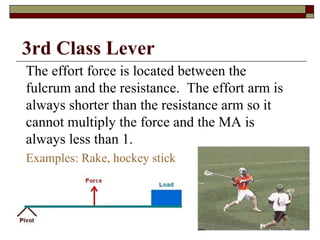
The effort force is located between the fulcrum and the resistance.  The effort arm is always shorter than the resistance arm so it cannot multiply the force and the MA is always less than 1. Examples: Rake, hockey stick 3rd Class Lever

2008lever

  • 1.
    Notes: Levers CW:Levers H: Types of Levers
  • 2.
  • 3.
    ~ Archimedes Giveme a place to stand and I will move the Earth.
  • 4.
    Objectives Analyze andlabel the parts of a lever Provide examples of first, second and third class levers. Calculate and determine the mechanical advantage of a lever.
  • 5.
    Forces in Machines A simple machine is an unpowered mechanical device, such as a lever .
  • 6.
    A bar thatis free to move about a fixed point Parts of a lever Fulcrum – The fixed point of a lever Effort Arm – The part of the lever that the effort force is applied to Resistance Arm – The part of the lever that applies the resistance force Anatomy of the lever
  • 7.
    Input Force – Force exerted ON the lever Output Force – Force exerted BY the lever Forces
  • 8.
    Ideal Mechanical AdvantageWhat the mechanical advantage of a machine would be if there were no energy lost due to friction IMA= length of effort arm = l e . length of resistance arm l r
  • 9.
    There are 3types of levers 1 st Class Levers 2 nd Class Levers 3 rd Class Levers
  • 10.
    1 st Class Lever The fulcrum is located between the F e and the F r . First class levers can multiply force and distance. Examples: Scissors, see-saw
  • 11.
  • 12.
    2 nd Class Lever The resistance is located between the effort force and the fulcrum. These levers multiply the force but the direction stays the same. Example: Wheelbarrow
  • 13.
    The effort forceis located between the fulcrum and the resistance. The effort arm is always shorter than the resistance arm so it cannot multiply the force and the MA is always less than 1. Examples: Rake, hockey stick 3rd Class Lever