The document discusses advanced concepts in API design using type classes and dependent types in Scala, focusing on computation and IO computation traits. It presents examples of how to execute multiple computations of different types simultaneously, return embedded types, and handle errors. Additionally, it explores type classes for obtaining the size of objects and introduces the complexity of dependent types in defining computation behaviors.
![What I want
traitComp[A] { ... }
Specifies the
“computation” of a
value of type ‘A’
val ii: Comp[Int] = ...
vali: Int = exec(ii)
“Execute” the
computation
specified by ‘ii’.](https://image.slidesharecdn.com/dependentypes-scalasyd-120711233039-phpapp02/85/API-design-using-type-classes-and-dependent-types-2-320.jpg)
![What would be cool
val ii: Comp[Int] = ...
valss: Comp[String] = ...
val (i: Int, s: String) = exec(ii, ss)
“Execute” multiple
computations of
different types, then
return “embedded”
types as a tuple.](https://image.slidesharecdn.com/dependentypes-scalasyd-120711233039-phpapp02/85/API-design-using-type-classes-and-dependent-types-3-320.jpg)
![More generally
valaa: Comp[A] = ...
val bb: Comp[B] = ...
valcc: Comp[C] = ...
valdd: Comp[D] = ...
val (a: A, b: B, c: C, d: D) = exec(aa, bb, cc, dd)
Ability to “execute” many
computations
simultaneously and return
all “embedded” values
together retaining types.](https://image.slidesharecdn.com/dependentypes-scalasyd-120711233039-phpapp02/85/API-design-using-type-classes-and-dependent-types-4-320.jpg)
![But wait, there’s more
traitIOComp[A] { ... }
Specifies the “IO
computation” of a
value of type ‘A’
val ii: IOComp[Int] = ...
Err[A]
vali: Err[Int] = exec(ii) ||
Either[String, A])
Either return the “Execute” the IO
computed value computation
or an error string specified by ‘ii’.](https://image.slidesharecdn.com/dependentypes-scalasyd-120711233039-phpapp02/85/API-design-using-type-classes-and-dependent-types-5-320.jpg)
![And of course
val ii: IOComp[Int] = ...
valss: IOComp[String] = ...
val (i: Err[Int],
s: Err[String]) = exec(ii, ss)
“Execute” multiple IO
computations of
different types, then
return “embedded”
types as a tuple.](https://image.slidesharecdn.com/dependentypes-scalasyd-120711233039-phpapp02/85/API-design-using-type-classes-and-dependent-types-6-320.jpg)
![Finally
valaa: Comp[A] = ...
val bb: IOComp[B] = ...
valcc: Comp[C] = ...
valdd: IOComp[D] = ...
val (a: A, b: Err[B], c: C, d: Err[D]) =
exec(aa, bb, cc, dd)
“Execute” a mixture
of normal and IO
computations.](https://image.slidesharecdn.com/dependentypes-scalasyd-120711233039-phpapp02/85/API-design-using-type-classes-and-dependent-types-7-320.jpg)
(implicit runner: Runner[R]): runner.Out](https://image.slidesharecdn.com/dependentypes-scalasyd-120711233039-phpapp02/85/API-design-using-type-classes-and-dependent-types-8-320.jpg)

(implicit runner: Runner[R]): runner.Out
Tuple Type Dependent
sweetness classes types](https://image.slidesharecdn.com/dependentypes-scalasyd-120711233039-phpapp02/85/API-design-using-type-classes-and-dependent-types-10-320.jpg)
 { prinln(x) }
echo((“good”, 47, true))
echo(“good”, 47, true) // equivalent](https://image.slidesharecdn.com/dependentypes-scalasyd-120711233039-phpapp02/85/API-design-using-type-classes-and-dependent-types-11-320.jpg)
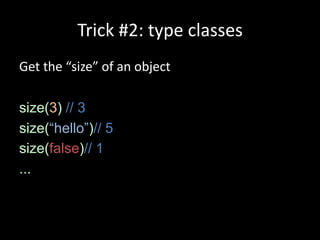
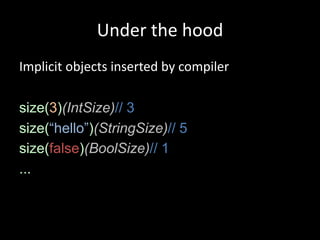
![Size type class
traitSize[T] {
defapply(in: T): Int Type class
}
object Size {
defsize[S](v: S)(implicits: Size[S]): Int = s(v)
implicit defIntSize = newSize[Int] {
defapply(in: Int): Int = in
}
implicit defBoolSize = newSize[Boolean] {
defapply(in: Boolean): Int = 1
Type class
instances
}
implicit defStringSize = newSize[String] {
defapply(in: String): Int = in.length
}
}](https://image.slidesharecdn.com/dependentypes-scalasyd-120711233039-phpapp02/85/API-design-using-type-classes-and-dependent-types-13-320.jpg)
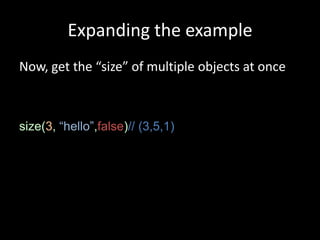
![Runner type class
traitRunner[In, Out] {
defapply(in: In): Out
}
object Runner {
defsize[I, O](v: I)(implicitr: Runner[I, O]): O = r(v)
implicit def Tup1[T1](implicit s1: Size[T1]) =
new Runner[T1, Int] {
defapply(in: T1): Int = s1(in) Referencing
} ‘Size’
implicit def Tup2[T1,T2](implicit s1: Size[T1], s2: Size[T2]) =
new Runner[(T1,T2), (Int,Int)] {
defapply(in: (T1,T2)): (Int,Int) = (s1(in._1), s2(in._2))
}
implicit def Tup3[T1,T2,T3](implicit s1: Size[T1], ...](https://image.slidesharecdn.com/dependentypes-scalasyd-120711233039-phpapp02/85/API-design-using-type-classes-and-dependent-types-16-320.jpg)
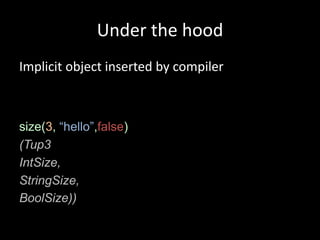
(implicitsizer: Size[S]): Int
is equivalent to
defsize[S : Size](v: S) : Int
Type class
constraint](https://image.slidesharecdn.com/dependentypes-scalasyd-120711233039-phpapp02/85/API-design-using-type-classes-and-dependent-types-18-320.jpg)
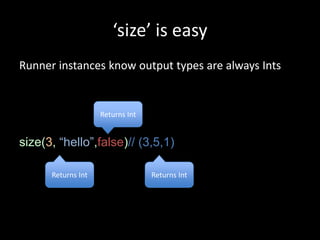
![‘exec’ is harder
Output types are always different
Returns Returns
Err[B] Err[D]
exec(aa, bb, cc, dd)
Returns A Returns C](https://image.slidesharecdn.com/dependentypes-scalasyd-120711233039-phpapp02/85/API-design-using-type-classes-and-dependent-types-20-320.jpg)
![Exec type class
traitExec[In, Out] {
defapply(in: In): Out
}
object Exec {
implicit defcompExec[A] = newExec[Comp[A], A] {
defapply(in: Comp[A]): A = execute(in)
}
implicit defioCompExec[A] = newExec[IOComp[A], Err[A]] {
defapply(in: IOComp[A]): Err[A] = ioExecute(in)
}
}](https://image.slidesharecdn.com/dependentypes-scalasyd-120711233039-phpapp02/85/API-design-using-type-classes-and-dependent-types-21-320.jpg)
![Updated Runner type class
Runner return type is dependent on Exec return type
traitRunner[In, Out] {
defapply(in: In): Out
}
object Runner {
defexec[I,O](v: I)(implicitr: Runner[I,O]): O = r(v)
implicit def Tup1[T1](implicit ex1: Exec[T1,?]) =
new Runner[T1, ?] {
defapply(in: T1): ? = ex1(in)
} Needs to be
... dependent on ex1](https://image.slidesharecdn.com/dependentypes-scalasyd-120711233039-phpapp02/85/API-design-using-type-classes-and-dependent-types-22-320.jpg)
 =
new Runner[(T1,T2),(?,?)] {
defapply(in: (T1,T2)): (?,?) = (ex1(in._1),
ex2(in._2))
}
...](https://image.slidesharecdn.com/dependentypes-scalasyd-120711233039-phpapp02/85/API-design-using-type-classes-and-dependent-types-23-320.jpg)
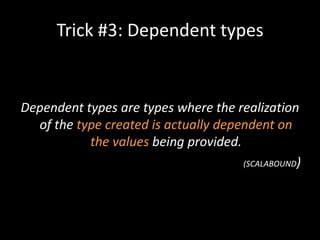
![Type parameters vs members
traitExec[In, Out] { Type
parameter
defapply(in: In): Out
}
is equivalent to
traitExec[In] {
typeOut Type
member
defapply(in: In): Out
}](https://image.slidesharecdn.com/dependentypes-scalasyd-120711233039-phpapp02/85/API-design-using-type-classes-and-dependent-types-25-320.jpg)
![Exec using type members
traitExec[In] {
typeOut
defapply(in: In): Out
}
object Exec {
implicit defcompExec[A] = newExec[Comp[A]] {
typeOut = A
defapply(in: Comp[A]): A = execute(in)
}
implicit defioCompExec[A] = newExec[IOComp[A]] {
typeOut = Err[A]
defapply(in: IOComp[A]): Err[A] = ioExecute(in)
}
}](https://image.slidesharecdn.com/dependentypes-scalasyd-120711233039-phpapp02/85/API-design-using-type-classes-and-dependent-types-26-320.jpg)
![Using dependent method types
traitRunner[In] {
typeOut
defapply(in: In): Out Return type is
dependent on
}
‘r’. Access type
as a member.
object Runner {
defexec[R](v: R)(implicitr: Runner[R]): r.Out = r(v)
implicit def Tup1[T1](implicit ex1: Exec[T1]) =
new Runner[T1] {
typeOut = ex1.Out
defapply(in: T1): ex1.Out = ex1(in)
}
Return type is dependent on
... ex1’s return type](https://image.slidesharecdn.com/dependentypes-scalasyd-120711233039-phpapp02/85/API-design-using-type-classes-and-dependent-types-27-320.jpg)
 =
new Runner[(T1,T2)] {
typeOut = (ex1.Out, ex2.Out)
defapply(in: (T1,T2)): Out = (ex1(in._1),
ex2(in._2))
}
...](https://image.slidesharecdn.com/dependentypes-scalasyd-120711233039-phpapp02/85/API-design-using-type-classes-and-dependent-types-28-320.jpg)


![PassMark OSForensics Professional 11.1 Crack [Latest]](https://cdn.slidesharecdn.com/ss_thumbnails/typeclassderivationinscala3-250819190837-f91dde58-250827083250-b12dec05-thumbnail.jpg?width=640&height=640&fit=bounds)


![5G Explained! A High Level Overview [Introduction]](https://cdn.slidesharecdn.com/ss_thumbnails/5gexplainedahighleveloverview-260119165306-cc137a3e-thumbnail.jpg?width=640&height=640&fit=bounds)


