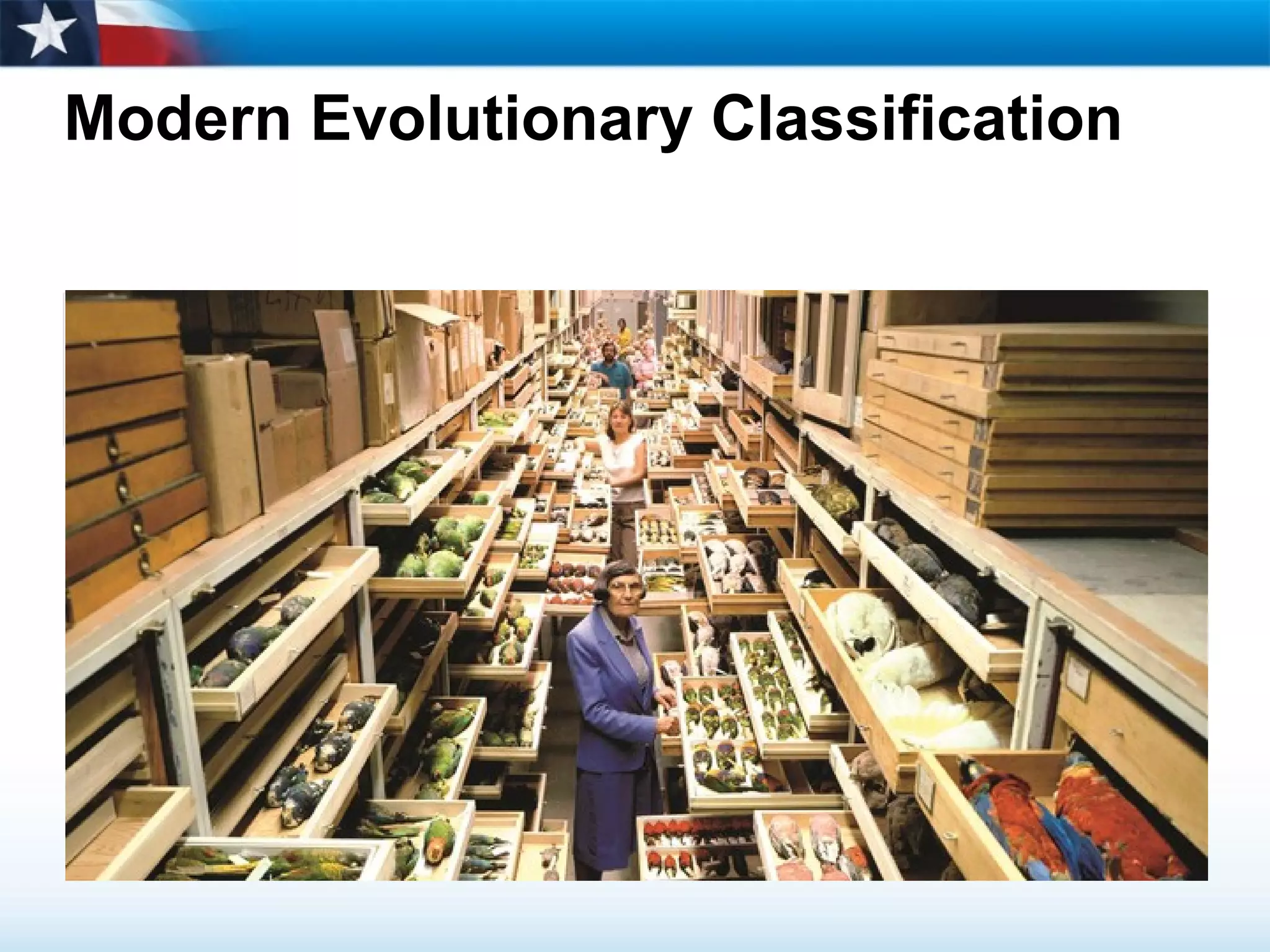
Modern Evolutionary Classification
Learning Objectives
 Explain the difference between evolutionary classification
and Linnaean classification.
 Describe how to make and interpret a cladogram.
 Explain the use of DNA sequences in classification.
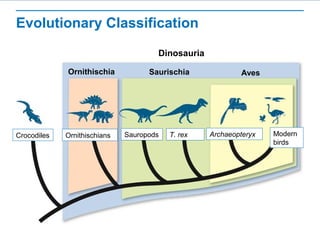
Evolutionary Classification
Dinosauria
Ornithischia Saurischia Aves
Crocodiles Ornithischians Sauropods T. rex Archaeopteryx Modern
birds
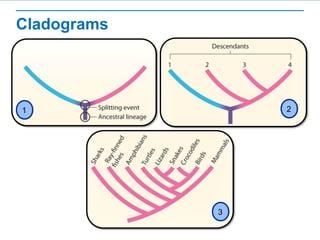
Cladograms
11 22
33
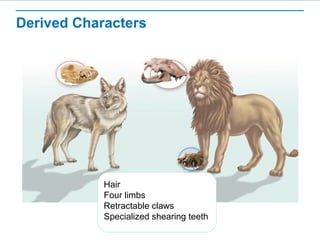
Derived Characters
Hair
Four limbs
Retractable claws
Specialized shearing teeth
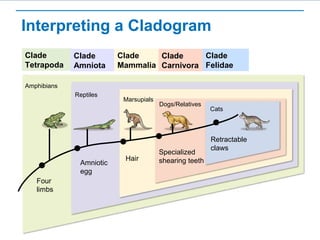
Interpreting a Cladogram
Clade
Tetrapoda
Clade
Amniota
Clade
Mammalia
Clade
Carnivora
Clade
Felidae
Amphibians
Reptiles
Marsupials
Dogs/Relatives
Cats
Four
limbs
Retractable
claws
Amniotic
egg
Hair
Specialized
shearing teeth
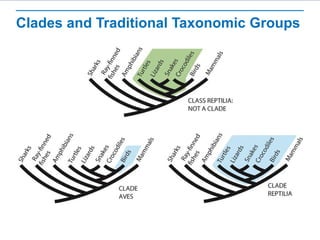
Clades and Traditional Taxonomic Groups
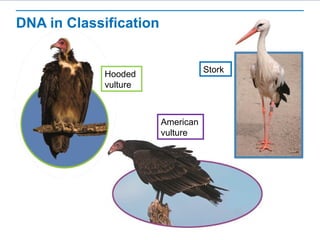
DNA in Classification
Hooded
vulture
American
vulture
Stork
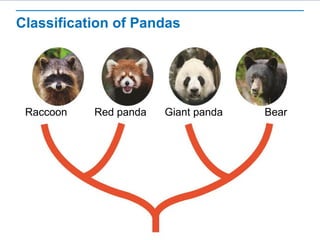
Classification of Pandas
Raccoon Red panda Giant panda Bear
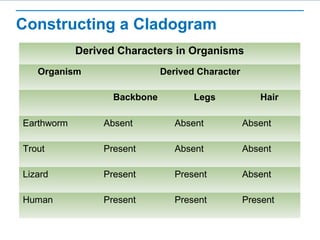
Constructing a Cladogram
Derived Characters in Organisms
Organism Derived Character
Backbone Legs Hair
Earthworm Absent Absent Absent
Trout Present Absent Absent
Lizard Present Present Absent
Human Present Present Present

Evolutionary Classification

Editor's Notes

  • #2 Read the lesson title aloud to students.
  • #3 Click to reveal each of the learning objectives. Hand out the worksheet and have students fill in the model for the word clade. Review Carl Linnaeus’s binomial classification system. Ask: What is the scientific name for the human species? Answer: Homo sapiens Ask: What do you think are the common names for Felis catus and Canis familiaris? Answer: cat, dog Ask: In each case, what does the first of the two names refer to? Answer: the genus Ask: What does the second of the two names refer to? Answer: the species Ask: Which term, genus or species, is the most inclusive group? Answer: genus Explain that Charles Darwin’s ideas about a “tree of life” suggests a new way to classify organisms—based not only on similarities and differences, but also on evolutionary relationships. Under this system, taxa are arranged according to how closely related they are. When taxa are rearranged in this way, some old Linnaean ranks fall apart. For example, the Linnaean class Reptilia isn’t valid unless birds are included— which means birds are reptiles! And not only are birds reptiles, but they’re also dinosaurs! Wondering why? To understand, we need to look at the way evolutionary classification works.
  • #4 Tell students that the concept of descent with modification led to the study of phylogeny: the evolutionary history of lineages. Advances in phylogeny, in turn, led to phylogenetic systematics. The goal of phylogenetic systematics, or evolutionary classification, is to group species into larger categories that reflect lines of evolutionary descent rather than overall similarities and differences. Phylogenetic systematics places organisms into higher taxa whose members are more closely related to one another than they are to members of any other group. The larger a taxon is, the further back in time all of its members shared a common ancestor. This is true all the way up to the largest taxa. Explain that classifying organisms according to these rules places them into groups called clades. A clade is a group of species that includes a single common ancestor and all descendants of that ancestor—living and extinct. How are clades different from Linnaean taxa? A clade must be a monophyletic group. A monophyletic group includes a single common ancestor and all of its descendants. Some groups of organisms defined before the advent of evolutionary classification are monophyletic. Some, however, are paraphyletic, meaning that the group includes a common ancestor but excludes one or more groups of descendants. These groups are invalid under evolutionary classification. Direct student attention to the image. Ask: This image shows the Reptilia clade. Explain why birds have to be included in both the Reptilia and Dinsosauria clades. Answer: Because birds are one of the descendants from the common ancestor. If birds are not included, the result would be paraphyletic.
  • #5 Tell students that modern evolutionary classification uses a method called cladistic analysis. Cladistic analysis compares carefully selected traits to determine the order in which groups of organisms branched off from their common ancestors. This information is then used to link clades together into a branching classification diagram called a cladogram. A cladogram links groups of organisms by showing how evolutionary lines, or lineages, branched off from common ancestors. To help students understand how cladograms are constructed, have them think back to the process of speciation. A speciation event, in which one ancestral species splits into two new ones, is the basis of each branch point, or node, in a cladogram. That node represents the last point at which the two new lineages shared a common ancestor. As shown in Step 1, a node splits a lineage into two separate lines of evolutionary ancestry. Each node represents the last point at which species in lineages above the node shared a common ancestor. The bottom, or “root,” of a cladogram represents the common ancestor shared by all of the organisms in the cladogram. A cladogram’s branching patterns indicate degrees of relatedness among organisms. Ask: In Step 1, the ancestral lineage splits into two new lineages. On a cladogram, what is this place, where a split like this occurs, called? Answer: a node Click to reveal Step 2. Because lineages 3 and 4 share a common ancestor more recently with each other than they do with lineage 2, you know that lineages 3 and 4 are more closely related to each other than either is to lineage 2. The same is true for lineages 2, 3, and 4. In terms of ancestry, they are more closely related to each other than any of them is to lineage 1. Ask: In Step 2, what does the node on the right side represent for lineages 3 and 4? Answer: the last point at which lineages 3 and 4 shared a common ancestor Click to reveal Step 3. Explain that the cladogram in Step 3 represents how lineages branched over time from the first branch in Step 1. This cladogram shows the evolutionary relationships among vertebrates—animals with backbones. Does it surprise you that amphibians are more closely related to mammals than they are to ray-finned fish? In terms of ancestry, it’s true.
  • #6 Tell students that, in contrast to Linnaean taxonomy, cladistic analysis focuses on certain kinds of characters, called derived characters, when assigning organisms into clades. A derived character is a trait that arose in the most recent common ancestor of a particular lineage and was passed along to its descendants. Whether or not a character is derived depends on the level at which you’re grouping organisms. Direct student attention to the image. Explain that the image shows several traits that are shared by coyotes and lions, both members of the clade Carnivora. Four limbs is a derived character for the entire clade Tetrapoda because the common ancestor of all tetrapods had four limbs, and this trait was passed to its descendants. Hair is a derived character for the clade Mammalia. But for mammals, four limbs is not a derived character—if it were, only mammals would have that trait. Nor is four limbs or hair a derived character for clade Carnivora. Specialized shearing teeth, however, is. Ask: What about retractable claws? Answer: This trait is found in lions but not in coyotes. Thus, retractable claws is a derived character for the clade Felidae—also known as cats.
  • #7 Tell students that four limbs is a derived character for clade Tetrapoda. Ask: But what about snakes? Answer: Accept all reasonable answers. Explain that snakes are definitely reptiles, which are tetrapods. But snakes certainly don’t have four limbs. The ancestors of snakes, however, did have four limbs. Somewhere in the lineage leading to modern snakes, that trait was lost. Tell students that, because distantly related groups of organisms can sometimes lose the same character, systematists are cautious about using the absence of a trait as a character in their analyses. After all, whales don’t have four limbs either, but snakes are certainly more closely related to other reptiles than they are to whales. Make sure students understand that derived characters are used in cladograms to explain the branching of lineages. Explain to students that when considering whether a given character is derived, scientists use an “outgroup” for comparison. An outgroup is an organism, or group of organisms, that evolved before the clade being analyzed. For example, reptiles are an outgroup for clade Mammalia. Likewise, amphibians are an outgroup for clade Reptilia. Help students understand why kangaroos are considered an outgroup for the clade Carnivora by asking the following questions. Ask: Does a kangaroo have hair? Answer: yes Ask: If a kangaroo has hair, can hair be a derived trait for the clade Carnivora? Answer: No. If hair were a derived trait for Carnivora, then only carnivores would have hair, which is not true. Ask: Specialized shearing teeth are used by carnivores to eat meat. Kangaroos are herbivores. Are they likely to have specialized shearing teeth, then? Answer: no Explain that because the outgroup for the clade does not have specialized shearing teeth, that trait is likely to be derived for clade Carnivora. Using dogs and their relatives as the outgroup for clade Felidae, you can follow a similar process to illustrate that retractable claws is a derived trait for that clade. Explain that a node is a point at which two groups branched off from each other. It also represents the last point at which those two groups shared a common ancestor. Ask: What is the lowest node? Answer: The lowest node represents the last common ancestor of all four-limbed animals—members of the clade Tetrapoda. Ask: What do the forks in this cladogram show? Answer: The forks in this cladogram show the order in which various groups branched off from the tetrapod lineage over the course of evolution. Explain that the positions of various characters in the cladogram reflect the order in which those characteristics arose in this lineage. In the lineage leading to cats, for example, specialized shearing teeth evolved before retractable claws. Furthermore, each derived character listed along the main trunk of the cladogram defines a clade. Ask: What is the derived character for the clade Mammalia? Answer: hair Ask: What is a derived character shared only by the clade Felidae? Answer: retractable claws Remind students that derived characters that occur “lower” on the cladogram than the branch point for a clade are not derived for that particular clade. Hair, for example, is not a derived character for the clade Carnivora.
  • #8 Remind students that a true clade must be monophyletic, which means that it contains an ancestral species and all of its descendants—it can’t leave any out. It also cannot include any species which are not descendants of that original ancestor. Cladistic analysis shows that many traditional taxonomic groups do form valid clades. For example, Linnaean class Mammalia corresponds to clade Mammalia. Members of this clade include all vertebrates with hair and several other important characteristics. In other cases, however, traditional groups do not form valid clades. Today’s reptiles are all descended from a common ancestor. But birds, which have traditionally not been considered part of the Linnaean class Reptilia, are also descended from that same ancestor. So, class Reptilia without birds is not a clade. However, several valid clades do include birds: Aves (the birds themselves), Dinosauria, and the clade named Reptilia. So, is it correct to call birds reptiles? An evolutionary biologist would say yes! Students may be wondering: Class Reptilia, clade Reptilia, who cares? Explain that the names aren’t as important as the concepts behind the classification. Evolutionary biologists look for links between groups, figuring out how each is related to others. So the next time you see a bird, thinking of it as a member of a clade or class isn’t as important as thinking about it not just as a bird, but also as a dinosaur, a reptile, a tetrapod, and a chordate. Tell students that one way to help understand clades is by using “the snip test.” Have students imagine they have a pair of scissors and can “snip” above any node on a cladogram. What would fall off is a monophyletic group, or clade. So, if students snipped above the node where amphibians branch off, a tree containing turtles, lizards, snakes, crocodiles, birds, and mammals would fall off. These groups form a monophyletic group called clade Amniotic. Have students recognize that you can snip the cladogram shown in the image to get the two groups of organisms shaded in blue, but you cannot snip anywhere to get class Reptilia, the group of organisms shaded in green. That is because class Reptilia is not a clade, it’s a paraphyletic group because it excludes birds, a descendant group of the common ancestor shared by the other organisms. Ask: Where would you snip on the cladogram to get clade Aves to fall off? Answer: right above the node that separates crocodiles from birds Ask: Do lizards and snakes form a clade? How do you know? Answer: Yes; you can snip above the node where lizards and snakes branch off from crocodiles and birds to get a tree that includes only snakes and lizards.
  • #9 Tell students that the examples of cladistic analysis discussed so far are based largely on physical characteristics like skeletons and teeth. But the goal of modern systematics is to understand the evolutionary relationships of all life on Earth—from bacteria to plants, snails, and apes. How can we devise hypotheses about the common ancestors of organisms that appear to have no physical similarities? Remind students that all organisms carry genetic information in their DNA passed on from earlier generations. A wide range of organisms share a number of genes and show important homologies that can be used to determine evolutionary relationships. For example, all eukaryotic cells have mitochondria, and all mitochondria have their own genes. Because all genes mutate over time, shared genes contain differences that can be treated as derived characters in cladistic analysis. For that reason, similarities and differences in DNA can be used to develop hypotheses about evolutionary relationships. In general, the more derived genetic characters two species share, the more recently they shared a common ancestor and the more closely they are related in evolutionary terms. Review with students what they learned about mitochondria and about mutations. Then discuss with students genes as derived characters. Ask: If a gene mutates and is passed along to offspring, how are those offspring different from other offspring within the species? Answer: The offspring with the mutated DNA will have a different genetic makeup than other offspring within the species. Point out that the mutated form of the gene may be passed to each generation thereafter. DNA analysis can be used to determine whether a species is more closely related to one ancestor than to another by comparing the different forms of genes present in each species. Explain that new techniques suggest new trees. The use of DNA characters in cladistic analysis has helped to make evolutionary trees more accurate. Consider, for example, the birds shown. The hooded vulture from Africa looks a lot like the American vulture. Both were traditionally classified in the falcon clade. But American vultures have a peculiar behavior: When they get overheated, they urinate on their legs, relying on evaporation to cool them down. Storks share this behavior, while hooded vultures and other vultures from Africa do not. Could the behavior be a clue to the real relationships between these birds? Tell students that biologists solved the puzzle by analyzing DNA from all three species. Molecular analysis showed that the DNA from American vultures is more similar to the DNA of storks than to the DNA of African vultures. DNA evidence therefore suggests that American vultures and storks share a more recent common ancestor than the American and African vultures do. Molecular analysis is a powerful tool that is now routinely used by taxonomists to supplement data from anatomy and answer questions like these.
  • #10 Tell students that scientists use DNA evidence when anatomical traits alone can’t provide clear answers. Giant pandas and red pandas, for example, have given taxonomists a lot of trouble. These two species share anatomical similarities with both bears and raccoons, and both of them have peculiar wrist bones that work like a human thumb. Click to reveal the cladogram. Ask: What happened to the red panda? Answer: It is placed in a different clade than the giant panda. Explain that this different clade also includes other organisms such as seals and weasels. DNA analysis revealed that the giant panda shares a more recent common ancestor with bears than with raccoons, whereas the red panda shares a more recent common ancestor with raccoons than with bears.
  • #11 Group students and have those groups use the information on the table to construct a cladogram. Once they have finished, have volunteers answer the following questions. Ask: What trait separates the least closely related animal from the other animals? Answer: a backbone Ask: Do you have enough information to determine where a frog should be placed on the cladogram? Explain your answer. Answer: No. A frog would be inserted somewhere between the trout and the human, because a frog has a backbone and legs but lacks hair. However, without another derived character, it’s impossible to know if the frog lineage branched off before or after the lizard lineage. Ask: Does your cladogram indicate that lizards and humans share a more recent common ancestor than either does with an earthworm? Explain your answer. Answer: Yes, lizards and humans share a more recent ancestor, because the branching point between them is further up on the cladogram than the branching point between humans, lizards, and earthworms. Also, lizards and humans share the derived characters of legs and a backbone.
  • #12 Divide students into small groups and instruct them to compare their models and add any important information they were missing. After a few minutes, create a master model on the board or chart paper, using volunteer answers to complete the table. Use this opportunity to identify and discuss any points of confusion or misconceptions that students have. Worksheet Answers: Definition: a group of species that includes a single common ancestor and all descendants of that ancestor. Facts/characteristics: Clades must include all the descendants of the common ancestor. Examples: Monophyletic clade includes a single ancestor and all of its descendants: clades Aves, Reptilia, Dinosauria. Nonexamples: Paraphyletic clades are missing organisms. Class Reptilia without birds is not a proper clade.