The Work of Gregor Mendel
Learning Objectives 
 Describe Mendel’s studies and conclusions about 
inheritance. 
 Describe what happens during segregation.
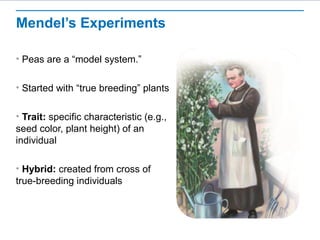
Mendel’s Experiments 
• Peas are a “model system.” 
• Started with “true breeding” plants 
• Trait: specific characteristic (e.g., 
seed color, plant height) of an 
individual 
• Hybrid: created from cross of 
true-breeding individuals
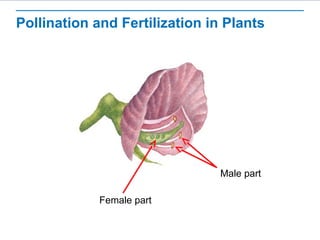
Pollination and Fertilization in Plants 
Male part 
Female part
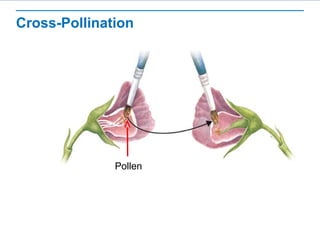
Cross-Pollination 
Pollen
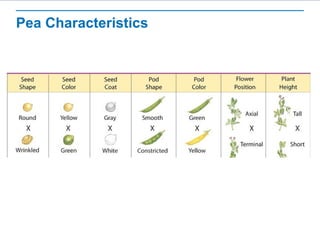
Pea Characteristics
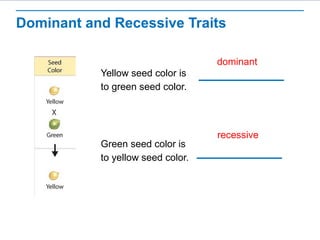
Dominant and Recessive Traits 
Yellow seed color is 
to green seed color. 
Green seed color is 
to yellow seed color. 
dominant 
recessive
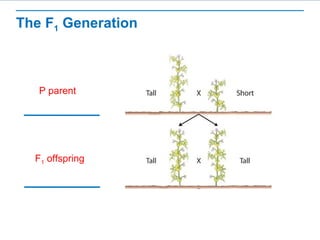
The F1 Generation 
P parent 
F1 offspring
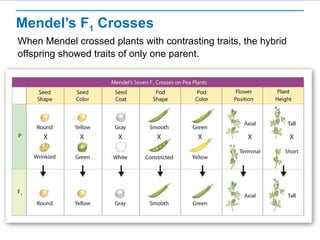
Mendel’s F1 Crosses 
When Mendel crossed plants with contrasting traits, the hybrid 
offspring showed traits of only one parent.
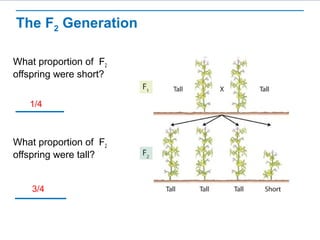
The F2 Generation 
What proportion of F2 
offspring were short? 
1/4 
What proportion of F2 
offspring were tall? 
3/4
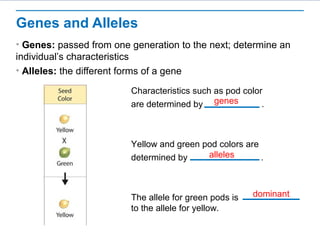
Genes and Alleles 
• Genes: passed from one generation to the next; determine an 
individual’s characteristics 
• Alleles: the different forms of a gene 
Characteristics such as pod color 
are determined by genes 
. 
Yellow and green pod colors are 
determined by alleles 
. 
The allele for green pods is 
to the allele for yellow. 
dominant
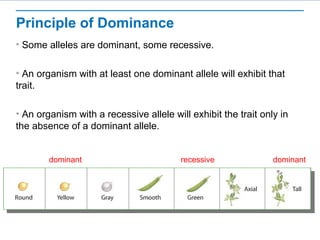
Principle of Dominance 
• Some alleles are dominant, some recessive. 
• An organism with at least one dominant allele will exhibit that 
trait. 
• An organism with a recessive allele will exhibit the trait only in 
the absence of a dominant allele. 
dominant recessive dominant
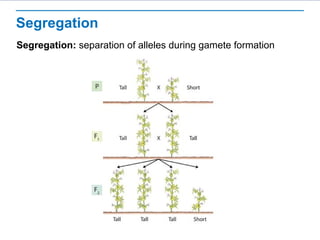
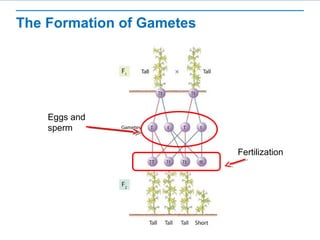
Segregation 
Segregation: separation of alleles during gamete formation
The Formation of Gametes 
Eggs and 
sperm 
Fertilization

Medel's Greatest Hits

  • 1.
    The Work ofGregor Mendel
  • 2.
    Learning Objectives Describe Mendel’s studies and conclusions about inheritance.  Describe what happens during segregation.
  • 3.
    Mendel’s Experiments •Peas are a “model system.” • Started with “true breeding” plants • Trait: specific characteristic (e.g., seed color, plant height) of an individual • Hybrid: created from cross of true-breeding individuals
  • 4.
    Pollination and Fertilizationin Plants Male part Female part
  • 5.
  • 6.
  • 7.
    Dominant and RecessiveTraits Yellow seed color is to green seed color. Green seed color is to yellow seed color. dominant recessive
  • 8.
    The F1 Generation P parent F1 offspring
  • 9.
    Mendel’s F1 Crosses When Mendel crossed plants with contrasting traits, the hybrid offspring showed traits of only one parent.
  • 10.
    The F2 Generation What proportion of F2 offspring were short? 1/4 What proportion of F2 offspring were tall? 3/4
  • 11.
    Genes and Alleles • Genes: passed from one generation to the next; determine an individual’s characteristics • Alleles: the different forms of a gene Characteristics such as pod color are determined by genes . Yellow and green pod colors are determined by alleles . The allele for green pods is to the allele for yellow. dominant
  • 12.
    Principle of Dominance • Some alleles are dominant, some recessive. • An organism with at least one dominant allele will exhibit that trait. • An organism with a recessive allele will exhibit the trait only in the absence of a dominant allele. dominant recessive dominant
  • 13.
    Segregation Segregation: separationof alleles during gamete formation
  • 14.
    The Formation ofGametes Eggs and sperm Fertilization

Editor's Notes

  • #2 Read the lesson title aloud to students.
  • #3 Click to reveal each of the learning objectives in turn. Show students a picture of a large family that includes at least two generations. Ask students to list some physical characteristics that the younger family members likely inherited from their parents or grandparents. Invite volunteers to share one or two items on their list. Then encourage students to share their ideas about the inheritance of traits. Distribute the lesson worksheet. Instruct students to create two-column charts like the example shown to summarize the main ideas from the presentation. In the left column they should write the main ideas, and in the right column they should note important details or sketch diagrams. If they need additional room, they can continue their charts on the back of the worksheet. Students should aim for at least one “main idea” entry per slide.
  • #4 Explain that back in the early 19th century, no one could describe exactly why offspring of plants and animals looked like their parents, and why traits seemed to appear and disappear and reappear again down through generations. Introduce Gregor Mendel as a monk who was born in 1822. He spent a great deal of time in the monastery garden where he was able to carry out experiments into inheritance. He chose to work with peas, which are small and easy to grow, and produce large number of offspring. Click to reveal first bullet. Ask: Why do you think inheritance studies using peas is preferable to using species like pigs or horses? Point out that the plants Mendel started with were true breeding strains. Describe how true breeding strains are created. Click to reveal second and third bullets. Explain that Mendel’s different groups of true-breeding plants would produce the same set of traits in each generation. To figure out how traits were inherited from one generation to the next, Mendel crossed individuals from his true-breeding strains to produce hybrids. Click to reveal fourth bullet.
  • #5 Ask students to describe the general process of pollination in plants. Point out that pea plants also have the ability to self-pollinate, meaning a single individual can produce offspring. Explain that, although Mendel did not have our modern understanding of genes and alleles, he did understand that male parts of a flower produce male sex cells (sperm) and that female parts of a flower produce female sex cells (eggs), and that these cells join in the process fertilization. Be sure students understand the difference between pollination and fertilization. Misconception Alert: Students may think that self-pollination is a form of asexual reproduction. Explain that, while offspring are produced from only one parent, each offspring forms from the fusion of male and female cells.
  • #6 Ask students to describe what they notice about the flowers shown here compared to the flower on the last slide. Guide them to realize that in the last slide the flower had both male and female structures. Here, the flowers have only male or female structures. Explain that Mendel removed reproductive structures from pea flowers so that only one set remained. Ask: What do you think Mendel was trying to prevent by removing one set of reproductive structures? Why? Answer: He was trying to prevent the flowers from self-pollinating. He wanted to be able to control which plants were being crossed. Explain that the diagram shows the method Mendel used to cross pea plants. Ask a volunteer to describe what the figure is showing.
  • #7 Point out that Mendel was looking at seven characteristics in pea plants. His goal was to look for patterns in the traits across generations. Misconception Alert: Emphasize to students that in Mendel’s day, the terminology we use of genes, alleles, and chromosomes was unknown.
  • #8 Explain how some traits show a pattern of dominance, “masking” another, recessive, trait. Challenge students to think like Mendel. Ask them to imagine they crossed two plants: one with green seeds and one with yellow. The offspring of the plant produced only yellow seeds. Ask them what they could infer about the green and yellow seed color traits. Have a volunteer go to the board and write in the terms that correctly complete the sentences. Ask if the rest of the class agrees, and ask students to explain how they know. Click to reveal the correct terms. Ask: How would the results of the cross change if green seed color were dominant to yellow seed color? Answer: The offspring of a green-yellow cross would have green seeds. Misconception Alert: Students may sometimes get the impression, when considering traits such as pod color, seed color, or seed shape, that the structures themselves are somehow being “crossed.” Remind students that these structures are traits of full plants, and that the results of the crosses refer to the traits shown by the offspring plant.
  • #9 Explain that a big question for Mendel was whether a recessive trait disappeared once it was masked by a dominant trait. Make sure students understand how to read this diagram representing crosses of plants. Ask: Where in the diagram are the parent plants? Answer: the plants in the top row Ask: What are the plants in the bottom row? Answer: the offspring generation Have a volunteer go to the board to label the “P” and “F1” generations. Click to reveal the correct answers. Ask: Based on the diagram for this cross, which trait is dominant: tall or short? Answer: tall Ask: If you only saw the plants in the F1 generation, could you know for sure what the parents’ heights are? Why or why not? Answer: No, tall pea plants could have one tall and one short parent or two tall parents.
  • #10 Step students through the figure, describing the results of crosses of plants with contrasting traits for a given feature. Ask: What does it mean for the trait of roundness to be to be dominant in the F1 generation? Answer: If a plant has one allele for round and one for wrinkled, the offspring will have a round seed shape. Challenge students to figure out the pattern that Mendel saw for the F1 generation. Ask: What pattern do you see in the offspring? Answer: All offspring had traits of only one parent. Click to reveal the statement summarizing Mendel’s findings.
  • #11 Remind students that Mendel wanted to see what would happen to traits that were seemingly “masked” in the F1 generation. To address this question, he created another generation, crossing F1 plants with themselves (essentially self-pollination) to produce the next generation, called F2. Walk through the diagram with students. Ask: How does the height of the plants in the F1 generation compare to the heights of the plants in the F2 generation? Answer: All the plants in F1 were tall, but not all F2 plants were tall. Ask: What is the relationship between the P generation and the F2 generation? Answer: The P generation are the grandparents to the F2 generation. Misconception Alert: Students may think when they see diagrams such as the one here that the cross involved only two parents and exactly four offspring were produced. Make sure students understand that Mendel crossed many plants in each generation, and that the “four” offspring represented here in the F2 generation just represent the relative proportion of offspring in that generation having the particular trait. Ask students to answer the questions on the screen. Click to reveal the correct responses. Ask: Suppose the F2 generation contained 100 individual plants. How many would you expect to be tall? Answer: about 75
  • #12 Emphasize that Mendel’s first conclusion from his experiments was that an individual’s characteristics are determined by factors that are passed from one parental generation to the next. Explain that today we can talk about genes that govern particular characteristics and the different alleles that control the different versions of those characteristics. But for Mendel, he could consider only the traits themselves. What he called factors, today we call “genes.” The different versions of a gene that produce the different traits (for example, yellow seeds versus green seeds) are called alleles. Ask students to consider the characteristic shown here (pod color) in terms of genes and alleles. Click to reveal three sentences and three blanks. Have volunteers fill in the blanks by responding verbally. Click to reveal the correct answers.
  • #13 Explain that Mendel’s second conclusion is called the principle of dominance. Read the first bullet point aloud. Ask for a volunteer to explain what is meant by the terms “dominant” and “recessive.” Click to reveal the second bullet and ask a student to read it aloud. Focus students’ attention on the graphic. Tell students: In Mendel’s experiments with pea plants, he found that the allele for tall plants was dominant and the allele for short plants was recessive. Click to reveal the “dominant” label over “Tall” in the figure. Ask students: If a pea plant has two alleles for “tall,” will it be tall or short? Answer: It will be tall, because “tall” is the dominant allele. Ask students: If a pea plant has one allele for “tall” and one allele for “short,” will it be tall or short? Answer: It will be tall, because “tall” is the dominant allele. The principle of dominance states that the presence of at least one dominant allele will cause the trait to be exhibited. Click to reveal the third bullet and ask a different student to read it aloud. Focus students’ attention on the graphic. Tell students: Mendel found that the allele for yellow seeds was dominant over the recessive allele for green seeds. Click to highlight the yellow and green seeds. Ask students: If a pea plant has one allele for yellow seeds and one allele for green, what color will its seeds be? Answer: Yellow, because yellow is the dominant allele. As students: What must be true of a pea plant with green seeds? Answer: It must have two of the recessive alleles for green seeds.
  • #14 Explain that even though Mendel was able to reach two conclusions from his initial experiments, he still wanted to know what happened to traits that seemed to disappear from one generation to the next. In particular, he wanted to know if recessive factors (alleles) had disappeared or were still present in offspring with a dominant trait. Walk students through the crosses shown in the diagram. Make sure they understand that the short trait reappeared because the F1 generation had both tall and short alleles. Ask: Why didn’t the allele for shortness show in the F1 generation? Answer: The short allele is recessive. It was masked by the dominant allele for tallness. Ask: Was the recessive allele for shortness lost in the F1 generation? How do you know? Answer: No, it reappeared in the F2 generation. Explain that from this result Mendel was able to infer that the factors controlling traits do not blend or become last within an individual but that they remain separate. This led him to conclude that when that individual them produces gametes (sex cells) those distinct traits segregate and can move into anther generation where they may or may not be expressed in offspring.
  • #15 Explain that during formation of gametes, or sex cells, alleles segregate from each other so that each gamete carries only a single copy of (one allele for) each gene. Have a volunteer go to the board to point out (or to respond verbally) what portion of the diagram represents eggs and sperm. Click to reveal the eggs and sperm label and circle. Ask: When do the gametes join up again to form allele pairs? Answer: at fertilization Have a volunteer point out (or indicate verbally) what portion of the diagram represents fertilization. Click to reveal the fertilization label and rectangle. Make sure students understand the results of the F2 generation by tracing the inheritance pattern. Point out how the F1 gametes segregated to produce new combinations of alleles in the F2 plants. Challenge students to imagine gamete formation in the F2 generation. Ask: For each of the 4 F2 plants shown, how many kinds of gametes could each produce? Answer: (from L to R) 1, 2, 2, 1
  • #16 Remind students that they should have been noting main ideas and important details throughout the presentation, with at least one main idea per slide. Have students work in small groups to compare charts and discuss any gaps they may have. After several minutes, bring the class back together and, as a group, identify the main ideas. Worksheet Answers The sample answers shown here are one possibility. Main Ideas: Mendel experimented with pea plants to determine inheritance. Pea plants can self-pollinate. He cross-pollinated true breeding plants to make hybrids. He looked at seven pea-plant characteristics. He found that some traits “masked” others. In the F1 generation, recessive traits seemed to disappear. When Mendel crossed plants with contrasting traits, the hybrid offspring showed traits of only one parent. What Mendel called factors, we call genes.Principle of Dominance Alleles segregate during gamete formation. Important Details: Peas are model organisms: small, easy to grow, and produce large number of offspring. Pollination: Pollen moves from male to female structures. True breeding plants all have same traits. Each characteristic had two different traits. Dominant and recessive traits. F1 is first offspring generation. Mendel’s first conclusion Alleles are different forms of a gene. Mendel’s second conclusion: An organism with at least one dominant allele will exhibit that trait. Recessive traits appeared in F2; alleles recombine at fertilization.