Introduction to Atoms 
Holt: Chapter 11 
Fusion: Unit 5
SOL PS. 3 
• The student will investigate and understand the 
modern and historical models of atomic structure. Key 
concepts include 
A) The contributions of Dalton, Thomson, Rutherford and 
Bohr in understanding the atom; and 
B) The modern model of atomic structure
Section 1: Development of Atomic Theory 
• Democritus (440 BC) 
• The word atom is from the Greek atomos, meaning “not 
able to be divided.” 
• He thought atoms were small hard particles made of a 
single material formed into different shapes. 
• Aristotle disagreed, but Democritus was right! 
• Matter is made of tiny particles we call atoms. 
• Atom- the smallest unit of an element that maintains the 
properties of that element.
Dalton 
• 1700s- scientists realized that elements could combine in specific ratios to 
form compounds. 
• John Dalton, a British chemist and teacher, wanted to know why 
• The results of his experiments were the basis for this atomic theory 
published in 1803. 
• His theory stated: 
• All substances are made of atoms. Atoms are small particles that cannot be created, 
divided or destroyed. 
• Atoms of the same element are exactly alike, and atoms of different elements are 
different. 
• Atoms join with other atoms to make new substances. 
• He wasn’t 100% correct…
Thomson 
• 1897, British scientist J.J. Thomson showed that there was a mistake 
in Dalton’s theory. 
• He discovered there are small particles INSIDE the atom! This means 
that atoms can be divided into smaller parts. 
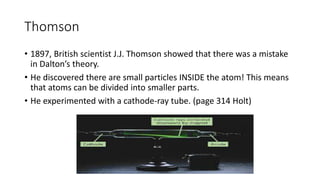
• He experimented with a cathode-ray tube. (page 314 Holt)
Thomson’s findings 
• Due to beam attraction to the positive plate, there must be negative 
electric charges. 
• Negatively charged particles are present in every kind of atom. 
• These negative particles are now called electrons. 
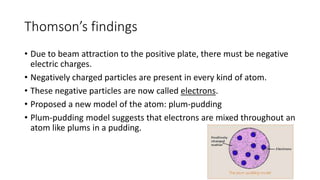
• Proposed a new model of the atom: plum-pudding 
• Plum-pudding model suggests that electrons are mixed throughout an 
atom like plums in a pudding.
Rutherford 
• 1909, Ernest Rutherford tested Thomson’s theory 
• Gold foil experiment- he aimed a beam of positively charged particles 
at a sheet of gold foil; he expected the beam to go straight through 
the foil, but some particles were deflected or bounced straight back 
• He explained that atoms are mostly empty space, with a tiny part 
made of highly dense matter. 
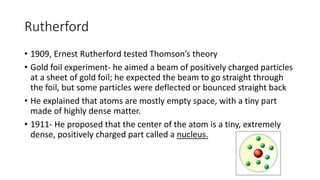
• 1911- He proposed that the center of the atom is a tiny, extremely 
dense, positively charged part called a nucleus.
Bohr 
• 1913- Niels Bohr, a Danish scientist, studied the way atoms react to 
light. 
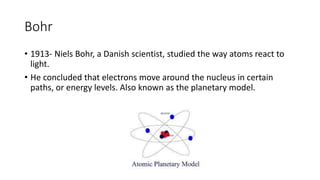
• He concluded that electrons move around the nucleus in certain 
paths, or energy levels. Also known as the planetary model.
Modern Atomic Theory 
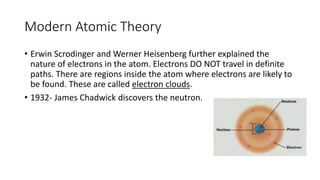
• Erwin Scrodinger and Werner Heisenberg further explained the 
nature of electrons in the atom. Electrons DO NOT travel in definite 
paths. There are regions inside the atom where electrons are likely to 
be found. These are called electron clouds. 
• 1932- James Chadwick discovers the neutron.
Section 2: The Atom 
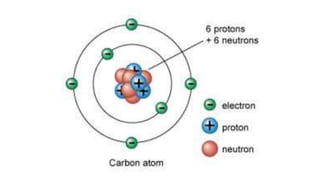
• Atoms are made of protons, neutrons and electrons 
• Protons- positively charged particles in the nucleus 
• Neutrons- no electrical charge or neutral, located in the nucleus 
• Electrons- negatively charged particles found around the nucleus in 
electron clouds 
• Protons and neutrons are more massive than electrons. The majority 
of the mass of an atom is located in the nucleus. 
• Atomic mass units are used to describe the mass of atoms or 
molecules.
• Atoms are neutral. This is due to the protons (+) and electrons (-) 
“canceling” each other. 
• If the number of protons and neutrons are not equal, the atom 
becomes a charged particle called an ion. Losing electrons creates a 
positive ion. Losing protons creates a negative ion. 
• Atoms of different elements differ.
Atomic number 
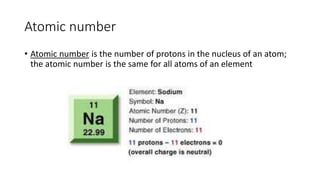
• Atomic number is the number of protons in the nucleus of an atom; 
the atomic number is the same for all atoms of an element

Atomic theory notes

  • 1.
    Introduction to Atoms Holt: Chapter 11 Fusion: Unit 5
  • 2.
    SOL PS. 3 • The student will investigate and understand the modern and historical models of atomic structure. Key concepts include A) The contributions of Dalton, Thomson, Rutherford and Bohr in understanding the atom; and B) The modern model of atomic structure
  • 3.
    Section 1: Developmentof Atomic Theory • Democritus (440 BC) • The word atom is from the Greek atomos, meaning “not able to be divided.” • He thought atoms were small hard particles made of a single material formed into different shapes. • Aristotle disagreed, but Democritus was right! • Matter is made of tiny particles we call atoms. • Atom- the smallest unit of an element that maintains the properties of that element.
  • 4.
    Dalton • 1700s-scientists realized that elements could combine in specific ratios to form compounds. • John Dalton, a British chemist and teacher, wanted to know why • The results of his experiments were the basis for this atomic theory published in 1803. • His theory stated: • All substances are made of atoms. Atoms are small particles that cannot be created, divided or destroyed. • Atoms of the same element are exactly alike, and atoms of different elements are different. • Atoms join with other atoms to make new substances. • He wasn’t 100% correct…
  • 5.
    Thomson • 1897,British scientist J.J. Thomson showed that there was a mistake in Dalton’s theory. • He discovered there are small particles INSIDE the atom! This means that atoms can be divided into smaller parts. • He experimented with a cathode-ray tube. (page 314 Holt)
  • 6.
    Thomson’s findings •Due to beam attraction to the positive plate, there must be negative electric charges. • Negatively charged particles are present in every kind of atom. • These negative particles are now called electrons. • Proposed a new model of the atom: plum-pudding • Plum-pudding model suggests that electrons are mixed throughout an atom like plums in a pudding.
  • 7.
    Rutherford • 1909,Ernest Rutherford tested Thomson’s theory • Gold foil experiment- he aimed a beam of positively charged particles at a sheet of gold foil; he expected the beam to go straight through the foil, but some particles were deflected or bounced straight back • He explained that atoms are mostly empty space, with a tiny part made of highly dense matter. • 1911- He proposed that the center of the atom is a tiny, extremely dense, positively charged part called a nucleus.
  • 8.
    Bohr • 1913-Niels Bohr, a Danish scientist, studied the way atoms react to light. • He concluded that electrons move around the nucleus in certain paths, or energy levels. Also known as the planetary model.
  • 9.
    Modern Atomic Theory • Erwin Scrodinger and Werner Heisenberg further explained the nature of electrons in the atom. Electrons DO NOT travel in definite paths. There are regions inside the atom where electrons are likely to be found. These are called electron clouds. • 1932- James Chadwick discovers the neutron.
  • 10.
    Section 2: TheAtom • Atoms are made of protons, neutrons and electrons • Protons- positively charged particles in the nucleus • Neutrons- no electrical charge or neutral, located in the nucleus • Electrons- negatively charged particles found around the nucleus in electron clouds • Protons and neutrons are more massive than electrons. The majority of the mass of an atom is located in the nucleus. • Atomic mass units are used to describe the mass of atoms or molecules.
  • 12.
    • Atoms areneutral. This is due to the protons (+) and electrons (-) “canceling” each other. • If the number of protons and neutrons are not equal, the atom becomes a charged particle called an ion. Losing electrons creates a positive ion. Losing protons creates a negative ion. • Atoms of different elements differ.
  • 13.
    Atomic number •Atomic number is the number of protons in the nucleus of an atom; the atomic number is the same for all atoms of an element