Science 8
3rd Quarter
ATOMS AND IT’S SUB-ATOMIC
PARTICLES
Studying about what matter is made of involves dealing with very small
“particles”
beyond what your eyes can see. Historically, two ancient Greek
philosophers,
Democritus and Leucippus formulated atomic theory.
These are:
Nature consisted of two things “atoms and void that
surrounds them” (Knieram, 1995 – 2013). 2. Atoms are
physically, but not geometrically, invisible. 3. For
Democritus, atoms are indestructible and completely full,
so there is no empty space. 4. There are an infinite
number of kinds of atoms, which differ in shape and size.
5. All atoms move randomly in space. However they didn’t
give an explanation for motion of atoms.(Knieram, 1995 –
ATOMS AND IT’S SUB-ATOMIC
PARTICLES
These are:
1. Nature consisted of two things “atoms and void that surrounds them”
(Knieram, 1995 – 2013).
2. Atoms are physically, but not geometrically, invisible.
3. For Democritus, atoms are indestructible and completely full, so there is
no empty space.
4. There are an infinite number of kinds of atoms, which differ in shape and
size.
5. All atoms move randomly in space. However, they didn’t give an
explanation for motion of atoms.(Knieram, 1995 – 2013)
John Dalton
was an English chemist, physicist and
meteorologist. He is best known for
introducing the atomic theory into
chemistry, and for his research into color
blindness, sometimes referred to as
Daltonism in his honor.
Dalton’s Atomic Theory
The idea of the atom was not further explored until a little over two
centuries ago when John Dalton (1766 – 1844) presented concrete
evidence that all matter is made of very small particles called atoms. An
atom is the smallest particle of an element that has all properties of the
element. Although two century old, Dalton’s atomic theory remains valid in
modern chemical thought.
Modern atomic theory is a little more involved than Dalton’s atomic theory,
but the essence of Dalton’s theory remains valid. We know that atoms can
be destroyed via nuclear reactions but not by chemical reactions.
Dalton’s Atomic Theory
1. Elements are made of extremely small particles called atoms.
2. Atoms of a given element are identical in size, mass, and other
properties; atoms of different elements differ in size, mass, and other
properties.
3. Compounds are made by a combination of two or more different kinds of
atoms.
4. A chemical reaction is a rearrangement of atoms.
5. Atoms cannot be subdivided, created, or destroyed
J.J. Thomson(1856-1940)
credited with the discovery of the electron,
the negatively charged particle in the atom.
He is known for the Thomson atomic
theory.
J.J. Thomson(1856-1940)
 Proved that atom can be divided into smaller parts.
 The next major advance in the history of the atom was the
discovery of electrons in 1897. Electrons have negative charged
and the first subatomic particles to be identified.
 In 1897, proposed the Plum Pudding Model which states that
atoms mostly consist of positively charged material with
negatively charged particles (electrons) located throughout the
positive material
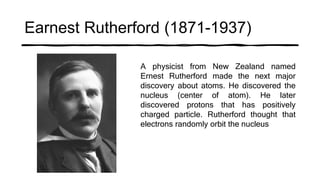
Earnest Rutherford (1871-1937)
A physicist from New Zealand named
Ernest Rutherford made the next major
discovery about atoms. He discovered the
nucleus (center of atom). He later
discovered protons that has positively
charged particle. Rutherford thought that
electrons randomly orbit the nucleus
Earnest Rutherford (1871-1937)
In 1909, he performed the Gold Foil Experiment and suggested the following
characteristics of the atom:
1. An atom consists of a small core, or nucleus, that contains most of the
mass.
2. This nucleus is made up of particles called protons, which have a positive
charge
3. The protons are surrounded by negatively charged electrons, but most of the
atom is actually, empty space o Rutherford’s model was called the “planetary
model” • Because of Rutherford’s gold experiment, the plum pudding model
was replaced by the nuclear model of the atom. He was also referred to as
“Father of Nuclear Physic
James Chadwick (1891-1974)
Chadwick discovered a third type
of subatomic particle, which he
named the neutron.
 Neutrons always reside in the
nucleus of atoms, and they are
about the same size as protons.
Neutrons do not have any
electrical charge; they are
electrically neutral.
Neils Bohr (1885-1962)
Neils Bohr used math to show electrons
were found in shells at specific distances
from the nucleus. This explained
observations from experiments.
In 1913, proposed the Bohr Model, which
suggests that:
1. Electrons travel around the nucleus of
an atom in orbits or definite paths.
2. Electrons can jump from a path in one
level to a path in another level (depending
on their energy) electrons can jump
Erwin Schrodinger (1887-1961)
In 1926, he further explained the nature of
electrons in an atom by stating that: -the
exact location of an electron cannot be
stated; therefore, it is more accurate to
view the electrons in regions called
electron clouds; electron clouds are places
where the electrons are likely to be found. )

Science-8-week-5.pptx

  • 1.
  • 2.
    ATOMS AND IT’SSUB-ATOMIC PARTICLES Studying about what matter is made of involves dealing with very small “particles” beyond what your eyes can see. Historically, two ancient Greek philosophers, Democritus and Leucippus formulated atomic theory. These are: Nature consisted of two things “atoms and void that surrounds them” (Knieram, 1995 – 2013). 2. Atoms are physically, but not geometrically, invisible. 3. For Democritus, atoms are indestructible and completely full, so there is no empty space. 4. There are an infinite number of kinds of atoms, which differ in shape and size. 5. All atoms move randomly in space. However they didn’t give an explanation for motion of atoms.(Knieram, 1995 –
  • 3.
    ATOMS AND IT’SSUB-ATOMIC PARTICLES These are: 1. Nature consisted of two things “atoms and void that surrounds them” (Knieram, 1995 – 2013). 2. Atoms are physically, but not geometrically, invisible. 3. For Democritus, atoms are indestructible and completely full, so there is no empty space. 4. There are an infinite number of kinds of atoms, which differ in shape and size. 5. All atoms move randomly in space. However, they didn’t give an explanation for motion of atoms.(Knieram, 1995 – 2013)
  • 4.
    John Dalton was anEnglish chemist, physicist and meteorologist. He is best known for introducing the atomic theory into chemistry, and for his research into color blindness, sometimes referred to as Daltonism in his honor.
  • 5.
    Dalton’s Atomic Theory Theidea of the atom was not further explored until a little over two centuries ago when John Dalton (1766 – 1844) presented concrete evidence that all matter is made of very small particles called atoms. An atom is the smallest particle of an element that has all properties of the element. Although two century old, Dalton’s atomic theory remains valid in modern chemical thought. Modern atomic theory is a little more involved than Dalton’s atomic theory, but the essence of Dalton’s theory remains valid. We know that atoms can be destroyed via nuclear reactions but not by chemical reactions.
  • 6.
    Dalton’s Atomic Theory 1.Elements are made of extremely small particles called atoms. 2. Atoms of a given element are identical in size, mass, and other properties; atoms of different elements differ in size, mass, and other properties. 3. Compounds are made by a combination of two or more different kinds of atoms. 4. A chemical reaction is a rearrangement of atoms. 5. Atoms cannot be subdivided, created, or destroyed
  • 7.
    J.J. Thomson(1856-1940) credited withthe discovery of the electron, the negatively charged particle in the atom. He is known for the Thomson atomic theory.
  • 8.
    J.J. Thomson(1856-1940)  Provedthat atom can be divided into smaller parts.  The next major advance in the history of the atom was the discovery of electrons in 1897. Electrons have negative charged and the first subatomic particles to be identified.  In 1897, proposed the Plum Pudding Model which states that atoms mostly consist of positively charged material with negatively charged particles (electrons) located throughout the positive material
  • 9.
    Earnest Rutherford (1871-1937) Aphysicist from New Zealand named Ernest Rutherford made the next major discovery about atoms. He discovered the nucleus (center of atom). He later discovered protons that has positively charged particle. Rutherford thought that electrons randomly orbit the nucleus
  • 10.
    Earnest Rutherford (1871-1937) In1909, he performed the Gold Foil Experiment and suggested the following characteristics of the atom: 1. An atom consists of a small core, or nucleus, that contains most of the mass. 2. This nucleus is made up of particles called protons, which have a positive charge 3. The protons are surrounded by negatively charged electrons, but most of the atom is actually, empty space o Rutherford’s model was called the “planetary model” • Because of Rutherford’s gold experiment, the plum pudding model was replaced by the nuclear model of the atom. He was also referred to as “Father of Nuclear Physic
  • 11.
    James Chadwick (1891-1974) Chadwickdiscovered a third type of subatomic particle, which he named the neutron.  Neutrons always reside in the nucleus of atoms, and they are about the same size as protons. Neutrons do not have any electrical charge; they are electrically neutral.
  • 12.
    Neils Bohr (1885-1962) NeilsBohr used math to show electrons were found in shells at specific distances from the nucleus. This explained observations from experiments. In 1913, proposed the Bohr Model, which suggests that: 1. Electrons travel around the nucleus of an atom in orbits or definite paths. 2. Electrons can jump from a path in one level to a path in another level (depending on their energy) electrons can jump
  • 13.
    Erwin Schrodinger (1887-1961) In1926, he further explained the nature of electrons in an atom by stating that: -the exact location of an electron cannot be stated; therefore, it is more accurate to view the electrons in regions called electron clouds; electron clouds are places where the electrons are likely to be found. )