S.S.A.S.I.T, SURAT GTU
INTRODUCTION
 The Foundation Can be classified broadly into
two types:
1. Shallow foundations
2. Deep foundations
SHALLOW FOUNDATIONS
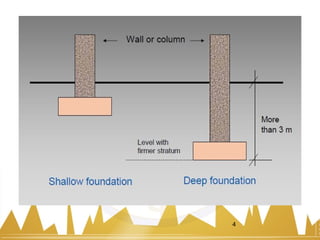
 When the depth of foundation is equal to or less than
the width of foundation, then it is termed as shallow
foundation. It is also know as open foundation.
 A shallow foundation is placed immediately below the
lowest part of the superstructure.
 A footing is a foundation unit constructed in brick
work, stone masonry or concrete below the base of the
wall or column for the purpose of distributing the
structural-load over a wide area.
3
4
TYPES OF SHALLOW
FOUNDATION
1. Spread footing
2. Combined footing
3. Strap footing
4. Mat or Raft foundation
5
1. Spread footing
 The spread footing are those which spread the
superimposed Load of wall or column over a larger
area. The spread footing support either a column or a
wall.
 The spread footing may be of the following kinds:
i. Single footing for a column
ii. Stepped footing for a column
iii.Slopped footing (Trapezoidal) for a column
iv.Wall footing without step
v. Stepped footing for wall
vi.Grillage foundation 6
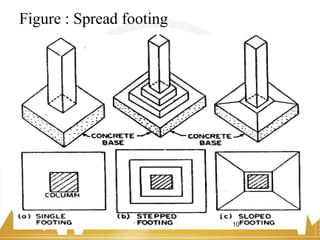
(i) Single footing for a column
 A spread footing for a single column is either known
as the isolated or pad footing.
 In this case, the footing may consist of simple
concrete block projecting out from the column face
on all sides.
 The base dimensions of the concrete base should not
be less than twice the appropriate lateral dimension of
the column in that direction.
 The thickness of concrete block should atleast be
equal to side offset from the column face.
7
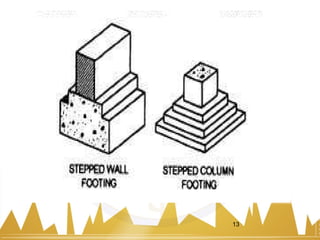
(ii) Stepped footing for a column
 If the column load is more or if the safe bearing
pressure of the soil is less, the base area will be large.
 In such a case, it is necessary to provide masonry
offsets, to achieve larger spread, before the load is
transferred to the concrete base.
 The height and width of each should be so
proportioned that the rate of spread does not exceed
the permissible value for the masonry.
8
(iii) Slopped footing for a column
 These are also known as Isolated or Individual
column footings, They have the projection in the
concrete base.
 Due to the low bending strength, the footing
constructed with brick, stone or plain concrete
required considererable depth to be safe to carry
heavy loads.
 The depth of plain concrete footing can be reduced
much, by providing reinforcement at its base to take
up tensile stresses.
 RCC column footing may be circular, rectangular or
square in plan. 9
Figure : Spread footing
10
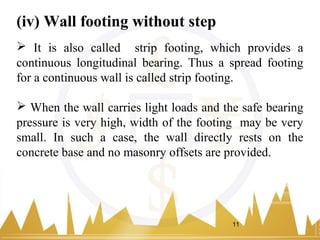
(iv) Wall footing without step
 It is also called strip footing, which provides a
continuous longitudinal bearing. Thus a spread footing
for a continuous wall is called strip footing.
 When the wall carries light loads and the safe bearing
pressure is very high, width of the footing may be very
small. In such a case, the wall directly rests on the
concrete base and no masonry offsets are provided.
11
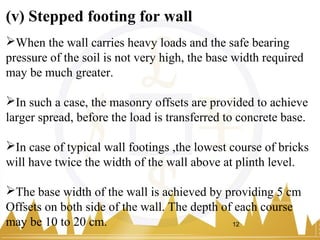
(v) Stepped footing for wall
When the wall carries heavy loads and the safe bearing
pressure of the soil is not very high, the base width required
may be much greater.
In such a case, the masonry offsets are provided to achieve
larger spread, before the load is transferred to concrete base.
In case of typical wall footings ,the lowest course of bricks
will have twice the width of the wall above at plinth level.
The base width of the wall is achieved by providing 5 cm
Offsets on both side of the wall. The depth of each course
may be 10 to 20 cm. 12
13
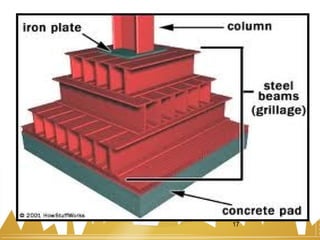
(vi) Grillage foundations
 A grillage foundation is an isolated footing generally
provided, when heavy structural loads from columns,
piers or steel stanchions are required to be transferred
to a soil having poor or low bearing capacity.
 It can be broadly divided into two categories,
depending upon the material used:
a) Steel grillage foundation
b)Timber grillage foundation
14
(a) Steel grillage foundation
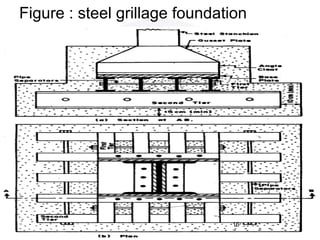
 Fig. 3.4 shows steel grillage foundation for steel
stanchion.
 Steel grillage foundation consists of steel joints or
beams (Rolled Steel Joints – RSJ) which are provided
in single or double tiers.
 A Minimum cover of 10cm. is kept on the outer sides
of the external beams as well as above the upper
flanges of the top tier.
 The depth of concrete below the lower tier should be
atleast 15cm.
15
Figure : steel grillage foundation
16
17
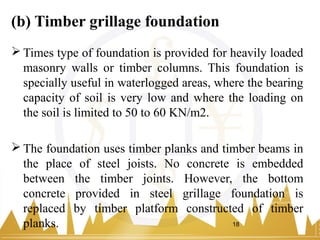
(b) Timber grillage foundation
 Times type of foundation is provided for heavily loaded
masonry walls or timber columns. This foundation is
specially useful in waterlogged areas, where the bearing
capacity of soil is very low and where the loading on
the soil is limited to 50 to 60 KN/m2.
 The foundation uses timber planks and timber beams in
the place of steel joists. No concrete is embedded
between the timber joints. However, the bottom
concrete provided in steel grillage foundation is
replaced by timber platform constructed of timber
planks. 18
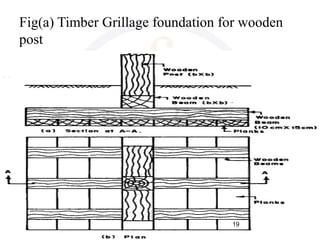
Fig(a) Timber Grillage foundation for wooden
post
19
 Fig.(a) shows a typical timber grillage foundation for
a timber column. The excavation for the base is
leveled. The bottom layer of timber planks of size 20
to 30cm. Wide 5.0 to 7.5 cm. thick is laid, side by
side; without any gap between them.
 Over the top of this layer, a timber beam of same
section as that of the wooden post is placed at right
angles.
20
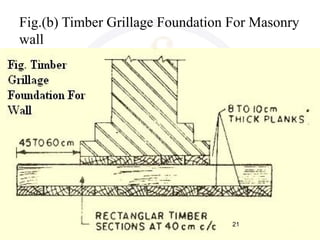
Fig.(b) Timber Grillage Foundation For Masonry
wall
21
 Fig. shows the timber grillage foundation for wall.
The foundation consists of bottom layer of planks,
over which the wooden beams are placed at right
angles to the direction of the planks.
 Then, another layer of planks again is laid at right
angles to the direction of beams. This upper layer of
planks may be 7.5 to 10 cm. Thick, extending over
the full width of the wall base, over which masonry
wall is constructed.
22
(vii) Combined Footing
• A combined footing is a single footing, which supports
two columns. It is provided under following situations:-
1. When the columns are very near to each other, so that
their footings overlap.
2. When the bearing capacity of soil is less, requiring more
area under individual footing.
3. When the end column is near a property line so that its
footing cannot spread in that direction.
23
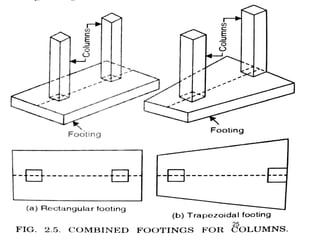
The combined footing may be of following kinds.
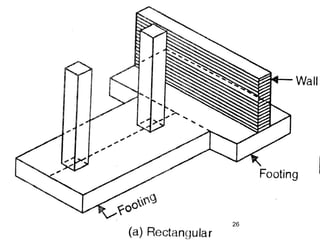
Rectangular combined footing: The combined footings will
be provide in rectangular in shape if columns carry equal
loads. The design of rectangular combined footing should
be done in such way that centre of gravity of column
coincide with centroid of footing area.
Trapezoidal combined footing: If columns carry unequal
loads the footing is of trapezoidal shape are provided.
Combined column-wall footing: It may be required to
provide a combined footing for column and wall. Such
combined footing are shown in fig.
24
25
26
(viii) Strap footing
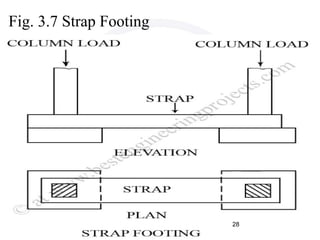
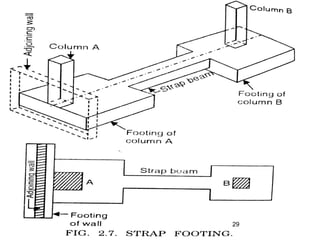
 A strap footing consists of two or more footing of
individual column by a beam, called a strap.
 The strap beam, connecting the spread footing of the
two columns, does not remain in contact with soil and
thus does not transfer any pressure to the soil.
 The function of the strap beam is to transfer the load of
heavily loaded outer column to the inner one. In doing
so, the strap beam is subjected to bending moment and
shear-force and it should be designed to withstand
these.
27
Fig. 3.7 Strap Footing
28
29
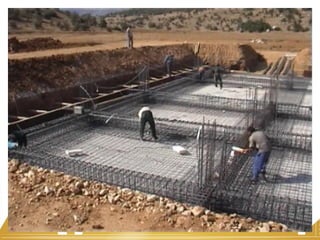
(viiii) Raft foundation
• A raft or mat is a combined footing that covers the entire
area beneath a structure and supports all the walls and
columns.
• When the allowable soil pressure is low, or the building
loads are heavy, the use of spread footings would cover
more than one half the area and it may prove more
economical to use mat or raft foundation.
• The mat or raft tends to bridge over the erratic deposits and
eliminates the differential settlements. Raft foundation is
also used to reduce settlement above highly compressible
soils.
30
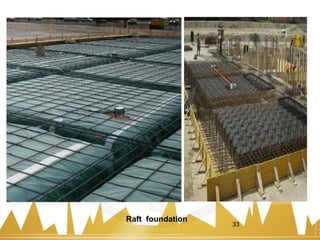
• Raft foundation may be divided in to three types based on
their design and construction.
1.Solid slab system
2.Beam slab system
3.Cellular system
All the three types are basically the same, consisting of a
large, generally unbroken area of slab covering the whole
or large part of structure.
31
32
Raft foundation
33
FOUNDATIONS IN BLACK COTTON
SOILS
 Construction of building on black cotton or expansive
soils is very much dangerous due to its volumetric
changes with the change of atmospheric conditions.
 The differential settlement of the buildings, caused by
the movement of the ground due to the alternate
swelling and shrinkage, results in formation of cracks
thus formed are sometimes 15 to 20 cm. wide and 2.5 to
4.0 m. deep.
34
Precaution for Foundation in Black Cotton
soils
- The foundation should be taken to such depths, where
the cracks cease to extend. The minimum depth of
foundation should be atleast 1.50m.
- The construction in black cotton soil should be carried
out during dry season.
- The external walls should be provided with plinth
protection at ground level, so that moisture does not
enter in foundation during monsoon.
35
• Where this soil occurs only in top layer, and where the
thickness of this layer does not exceed 1 to 1.5 m, the
entire layer of black cotton soil should be removed, and
the foundation should be laid on non-shrinkable non-
expansive soil.
• Where the soil is highly expansive, it is very essential to
have minimum contact between the soil and the footing.
This can be best achieved by transmitting the loads
through deep piles.
36
Types of foundation in Black Cotton soils
i. Strip or pad foundation
ii. Pier foundation
iii. Under-reamed pile foundation
37
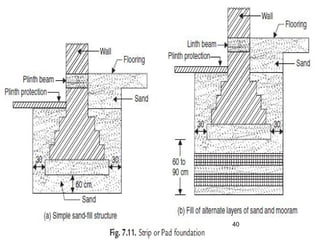
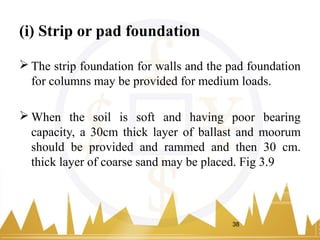
(i) Strip or pad foundation
 The strip foundation for walls and the pad foundation
for columns may be provided for medium loads.
 When the soil is soft and having poor bearing
capacity, a 30cm thick layer of ballast and moorum
should be provided and rammed and then 30 cm.
thick layer of coarse sand may be placed. Fig 3.9
38
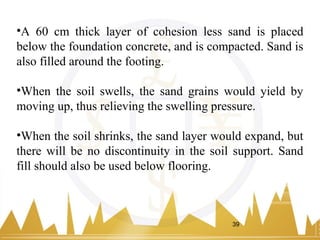
•A 60 cm thick layer of cohesion less sand is placed
below the foundation concrete, and is compacted. Sand is
also filled around the footing.
•When the soil swells, the sand grains would yield by
moving up, thus relieving the swelling pressure.
•When the soil shrinks, the sand layer would expand, but
there will be no discontinuity in the soil support. Sand
fill should also be used below flooring.
39
40
• It is suitable where the swelling pressures are relatively
high. The alternate layers of mooram (or ballast) and sand
act as a spring which can compress or expand along with the
sub-soil movements.
• It will, thus absorb all the movements, thus keeping the
footing free from these effects. If the soil is soft and has
poor bearing capacity, a 30 cm thick layer of ballast and
mooram should first be rammed into the soil.
• Over the top of it, a min. of 30 cm thick layer of coarse
grained sand may be placed. In all the three cases, the
foundation concrete may be done in rigid cement concrete,
and if possible, it may contain nominal reinforcement.
41
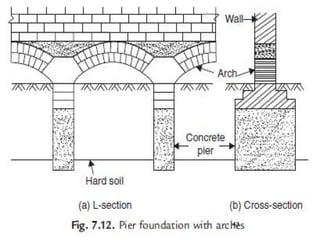
(ii) Pier foundation
 For the walls carrying heavy loads, the pier foundation
with arches may be provided. The piers are dug at
regular interval and filled with concrete, which are
connected by concrete or masonry arch and the wall
may be constructed over it.
 The arches are constructed with a gap above the ground
level, which may permit the movement of soil during
swelling and shrinkage operating.
42
43
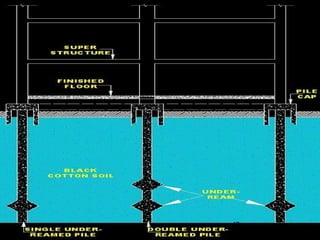
(iii) Under-reamed Pile Foundation
• Under-reamed piles are bored cast-in-situ concrete
piles having bulb shaped enlargement near base.
• These piles are commonly recommended for providing
safe and economical foundations in expansive soils
such as black cotton soil having poor bearing capacity.
• In these type of foundation the structure is anchored to
the ground at a depth where ground movement due to
changes in moisture content negligible.
44
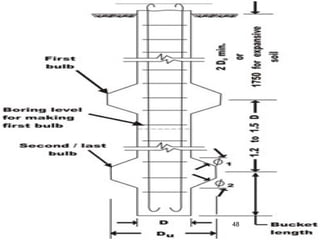
•A pile having one bulb is known as single under-reamed
pile. It is seen that the load bearing capacity of the pile
can be increased by increasing the number of bulb at the
base.
• In such a case the pile is named as multi-under-reamed
pile. The increase in the bearing capacity of the pile can
also be achieved by increasing the diameter and the length
of the pile.
45
• The method of construction of under-reamed pile is very
simple. The holes for casting piles in the ground may be
bored by using hand augers.
• After boring is carried out at the required depth, the base of
the bore hole is enlarged in the form of a bulb near its base
by use of a tool, known under-reamer.
• After the pile holes are ready for concreting, reinforcement
cage are lowered in the holes and concrete is poured.
• The piles should be cast at least 200 to 400 mm above the
cut-off level. Later on, when the concrete is hardened, the
extra length of each pile is broken and the pile top is brought
to the desired level. 46
47
48
CAUSES OF FAILURE OF FOUNDATION
• Unequal settlement of sub-soil.
• Unequal settlement of masonry.
• Horizontal movement of adjoining the structures.
• Shrinkage due to with drawl of moisture from soil
below the foundation.
• Lateral pressure on walls.
• Action of atmosphere.
• Lateral movement of soil below foundation.
49
1. Unequal settlement of sub-soil:- Unequal settlement of
the sub-soil may lead to cracks in the structural components
and rotation thereof. Unequal settlement of sub-soil may be
due to (i) non-uniform nature of sub-soil throughout the
foundation, (ii) unequal load distribution of the soil strata,
and (iii) eccentric loading. The failures of foundation due to
unequal settlement can be checked by : (i) resting the
foundation on rigid strata, such as rock or hard moorum, (ii)
proper design of the base of footing, so that it can resist
cracking, (iii) limiting the pressure in the soil, and
50
2. Unequal settlement of masonry:- As stated earlier,
foundation includes the portion of the structure which is below
ground level. This portion of masonry, situated between the
ground level and concrete footing(base) has mortar joints
which may either shrink or compress, leading to unequal
settlement of masonry. Due to this, the superstructure will also
have cracks. This could be checked by (i) using mortar of
proper strength, (ii) using thin mortar joints, (iii) restricting the
height of masonry to 1 m per day if lime mortar is used and 1.5
m per day if cement mortar is used, and (iv) properly watering
51
3. Sub-soil moisture movement:- This is one of the major
causes of failures of footings on cohesive soil, where the
sub-soil water level fluctuates. When water table drops
down, shrinkage of sub-soil takes place. Due to this, there is
lack of sub-soil support to the footings which crack,
resulting in the cracks in the building.
During upward movement of moisture, the soil (specially if
it is expansive) swells resulting in high swelling pressure. If
the foundation and superstructure is unable to resist the
swelling pressure, cracks are induced. 52
4. Lateral pressure on the walls:- The walls transmitting
the load to the foundation may be subjected to lateral
pressure or thrust from a pitched roof or an arch or wind
action. Due to this, the foundation will be subjected to a
moment (or resultant eccentric load). If the foundation has
not been designed for such a situation, it may fail by either
overturning or by generation of tensile stresses on one
side and high compressive stresses on the other side of the
footing.
53
5. Lateral Movement of sub-soil:- This is applicable to
very soft soil which are liable to move out or squeeze out
laterally under vertical loads, specially at locations where
the ground is sloping. Such a situation may also arise in
granular soils where a big pit is excavated in the near
vicinity of the foundation. Due to such movement,
excessive settlements take place, or the structure may even
collapse. If such a situation exists, sheet piles should be
driven to prevent the lateral movement or escape of the soil.
54
6. Atmospheric action:- The behavior of foundation may
be adversely affected due to atmospheric agents such as
sun, wind, and rains. If the depth of foundation is shallow,
moisture movements due to rains or drought may cause
trouble.
If the water remains stagnant near the foundation, it will
remain constantly damp, resulting in the decrease in the
strength of footing or foundation wall. Hence it is always
recommended to provide suitable plinth protection along
the external walls by (i) filling back the foundation trenches
with good soil and compacting it, (ii) providing gentle
ground slope away from the wall and (iii) providing a
narrow, sloping strip of impervious material (such as of
lime or lean cement concrete) along the exterior walls.55
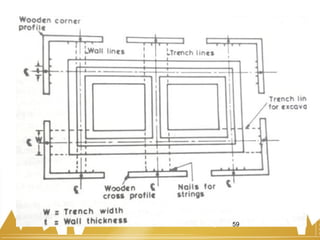
For setting out the foundations of small buildings, the centre
line of the longest outer wall of the building is first marked on
the ground by stretching a string between wooden or mild
steel pegs driven at the ends.
This line serves as reference line. For accurate work, nails
can be fixed al the centre of the pegs. Two pegs, one on either
side of the central peg, are driven at each end of the line. Each
peg is equidistant from the central peg, and the distance
between the outer pegs corresponds to the width of foundation
trench to be excavated.
Each peg may project about 25 to 50 mm above ground level
and may be driven at a distance of about 2 m from the edge of
excavation so that they are not disturbed.
SETTING OUT FOUNDATION TRENCHES
56
When string is stretched joining the corresponding pegs
(say 2-2) at the two extremities of the line, the boundary
of the trench to be excavated can be marked on the
ground with dry lime powder.
The centre lines of other walls, which are perpendicular
to the long wall, are then marked by setting out right
angles. A right angle can be set out by forming a triangle
with 3, 4 and 5 units long. These dimensions should be
measured with the help of a steel tape.
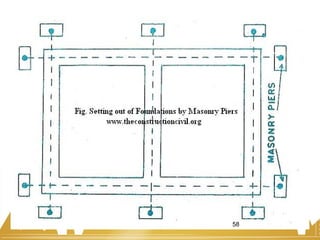
Alternatively, a theodolite or prismatic compass may be
used for setting out right angles. Similarly, outer lines of
the foundation trench of each cross-wall can be set out, as
shown in Fig. 57
58
59
60

Chapter 3 shallow foundations

  • 1.
  • 2.
    INTRODUCTION  The FoundationCan be classified broadly into two types: 1. Shallow foundations 2. Deep foundations
  • 3.
    SHALLOW FOUNDATIONS  Whenthe depth of foundation is equal to or less than the width of foundation, then it is termed as shallow foundation. It is also know as open foundation.  A shallow foundation is placed immediately below the lowest part of the superstructure.  A footing is a foundation unit constructed in brick work, stone masonry or concrete below the base of the wall or column for the purpose of distributing the structural-load over a wide area. 3
  • 4.
  • 5.
    TYPES OF SHALLOW FOUNDATION 1.Spread footing 2. Combined footing 3. Strap footing 4. Mat or Raft foundation 5
  • 6.
    1. Spread footing The spread footing are those which spread the superimposed Load of wall or column over a larger area. The spread footing support either a column or a wall.  The spread footing may be of the following kinds: i. Single footing for a column ii. Stepped footing for a column iii.Slopped footing (Trapezoidal) for a column iv.Wall footing without step v. Stepped footing for wall vi.Grillage foundation 6
  • 7.
    (i) Single footingfor a column  A spread footing for a single column is either known as the isolated or pad footing.  In this case, the footing may consist of simple concrete block projecting out from the column face on all sides.  The base dimensions of the concrete base should not be less than twice the appropriate lateral dimension of the column in that direction.  The thickness of concrete block should atleast be equal to side offset from the column face. 7
  • 8.
    (ii) Stepped footingfor a column  If the column load is more or if the safe bearing pressure of the soil is less, the base area will be large.  In such a case, it is necessary to provide masonry offsets, to achieve larger spread, before the load is transferred to the concrete base.  The height and width of each should be so proportioned that the rate of spread does not exceed the permissible value for the masonry. 8
  • 9.
    (iii) Slopped footingfor a column  These are also known as Isolated or Individual column footings, They have the projection in the concrete base.  Due to the low bending strength, the footing constructed with brick, stone or plain concrete required considererable depth to be safe to carry heavy loads.  The depth of plain concrete footing can be reduced much, by providing reinforcement at its base to take up tensile stresses.  RCC column footing may be circular, rectangular or square in plan. 9
  • 10.
    Figure : Spreadfooting 10
  • 11.
    (iv) Wall footingwithout step  It is also called strip footing, which provides a continuous longitudinal bearing. Thus a spread footing for a continuous wall is called strip footing.  When the wall carries light loads and the safe bearing pressure is very high, width of the footing may be very small. In such a case, the wall directly rests on the concrete base and no masonry offsets are provided. 11
  • 12.
    (v) Stepped footingfor wall When the wall carries heavy loads and the safe bearing pressure of the soil is not very high, the base width required may be much greater. In such a case, the masonry offsets are provided to achieve larger spread, before the load is transferred to concrete base. In case of typical wall footings ,the lowest course of bricks will have twice the width of the wall above at plinth level. The base width of the wall is achieved by providing 5 cm Offsets on both side of the wall. The depth of each course may be 10 to 20 cm. 12
  • 13.
  • 14.
    (vi) Grillage foundations A grillage foundation is an isolated footing generally provided, when heavy structural loads from columns, piers or steel stanchions are required to be transferred to a soil having poor or low bearing capacity.  It can be broadly divided into two categories, depending upon the material used: a) Steel grillage foundation b)Timber grillage foundation 14
  • 15.
    (a) Steel grillagefoundation  Fig. 3.4 shows steel grillage foundation for steel stanchion.  Steel grillage foundation consists of steel joints or beams (Rolled Steel Joints – RSJ) which are provided in single or double tiers.  A Minimum cover of 10cm. is kept on the outer sides of the external beams as well as above the upper flanges of the top tier.  The depth of concrete below the lower tier should be atleast 15cm. 15
  • 16.
    Figure : steelgrillage foundation 16
  • 17.
  • 18.
    (b) Timber grillagefoundation  Times type of foundation is provided for heavily loaded masonry walls or timber columns. This foundation is specially useful in waterlogged areas, where the bearing capacity of soil is very low and where the loading on the soil is limited to 50 to 60 KN/m2.  The foundation uses timber planks and timber beams in the place of steel joists. No concrete is embedded between the timber joints. However, the bottom concrete provided in steel grillage foundation is replaced by timber platform constructed of timber planks. 18
  • 19.
    Fig(a) Timber Grillagefoundation for wooden post 19
  • 20.
     Fig.(a) showsa typical timber grillage foundation for a timber column. The excavation for the base is leveled. The bottom layer of timber planks of size 20 to 30cm. Wide 5.0 to 7.5 cm. thick is laid, side by side; without any gap between them.  Over the top of this layer, a timber beam of same section as that of the wooden post is placed at right angles. 20
  • 21.
    Fig.(b) Timber GrillageFoundation For Masonry wall 21
  • 22.
     Fig. showsthe timber grillage foundation for wall. The foundation consists of bottom layer of planks, over which the wooden beams are placed at right angles to the direction of the planks.  Then, another layer of planks again is laid at right angles to the direction of beams. This upper layer of planks may be 7.5 to 10 cm. Thick, extending over the full width of the wall base, over which masonry wall is constructed. 22
  • 23.
    (vii) Combined Footing •A combined footing is a single footing, which supports two columns. It is provided under following situations:- 1. When the columns are very near to each other, so that their footings overlap. 2. When the bearing capacity of soil is less, requiring more area under individual footing. 3. When the end column is near a property line so that its footing cannot spread in that direction. 23
  • 24.
    The combined footingmay be of following kinds. Rectangular combined footing: The combined footings will be provide in rectangular in shape if columns carry equal loads. The design of rectangular combined footing should be done in such way that centre of gravity of column coincide with centroid of footing area. Trapezoidal combined footing: If columns carry unequal loads the footing is of trapezoidal shape are provided. Combined column-wall footing: It may be required to provide a combined footing for column and wall. Such combined footing are shown in fig. 24
  • 25.
  • 26.
  • 27.
    (viii) Strap footing A strap footing consists of two or more footing of individual column by a beam, called a strap.  The strap beam, connecting the spread footing of the two columns, does not remain in contact with soil and thus does not transfer any pressure to the soil.  The function of the strap beam is to transfer the load of heavily loaded outer column to the inner one. In doing so, the strap beam is subjected to bending moment and shear-force and it should be designed to withstand these. 27
  • 28.
    Fig. 3.7 StrapFooting 28
  • 29.
  • 30.
    (viiii) Raft foundation •A raft or mat is a combined footing that covers the entire area beneath a structure and supports all the walls and columns. • When the allowable soil pressure is low, or the building loads are heavy, the use of spread footings would cover more than one half the area and it may prove more economical to use mat or raft foundation. • The mat or raft tends to bridge over the erratic deposits and eliminates the differential settlements. Raft foundation is also used to reduce settlement above highly compressible soils. 30
  • 31.
    • Raft foundationmay be divided in to three types based on their design and construction. 1.Solid slab system 2.Beam slab system 3.Cellular system All the three types are basically the same, consisting of a large, generally unbroken area of slab covering the whole or large part of structure. 31
  • 32.
  • 33.
  • 34.
    FOUNDATIONS IN BLACKCOTTON SOILS  Construction of building on black cotton or expansive soils is very much dangerous due to its volumetric changes with the change of atmospheric conditions.  The differential settlement of the buildings, caused by the movement of the ground due to the alternate swelling and shrinkage, results in formation of cracks thus formed are sometimes 15 to 20 cm. wide and 2.5 to 4.0 m. deep. 34
  • 35.
    Precaution for Foundationin Black Cotton soils - The foundation should be taken to such depths, where the cracks cease to extend. The minimum depth of foundation should be atleast 1.50m. - The construction in black cotton soil should be carried out during dry season. - The external walls should be provided with plinth protection at ground level, so that moisture does not enter in foundation during monsoon. 35
  • 36.
    • Where thissoil occurs only in top layer, and where the thickness of this layer does not exceed 1 to 1.5 m, the entire layer of black cotton soil should be removed, and the foundation should be laid on non-shrinkable non- expansive soil. • Where the soil is highly expansive, it is very essential to have minimum contact between the soil and the footing. This can be best achieved by transmitting the loads through deep piles. 36
  • 37.
    Types of foundationin Black Cotton soils i. Strip or pad foundation ii. Pier foundation iii. Under-reamed pile foundation 37
  • 38.
    (i) Strip orpad foundation  The strip foundation for walls and the pad foundation for columns may be provided for medium loads.  When the soil is soft and having poor bearing capacity, a 30cm thick layer of ballast and moorum should be provided and rammed and then 30 cm. thick layer of coarse sand may be placed. Fig 3.9 38
  • 39.
    •A 60 cmthick layer of cohesion less sand is placed below the foundation concrete, and is compacted. Sand is also filled around the footing. •When the soil swells, the sand grains would yield by moving up, thus relieving the swelling pressure. •When the soil shrinks, the sand layer would expand, but there will be no discontinuity in the soil support. Sand fill should also be used below flooring. 39
  • 40.
  • 41.
    • It issuitable where the swelling pressures are relatively high. The alternate layers of mooram (or ballast) and sand act as a spring which can compress or expand along with the sub-soil movements. • It will, thus absorb all the movements, thus keeping the footing free from these effects. If the soil is soft and has poor bearing capacity, a 30 cm thick layer of ballast and mooram should first be rammed into the soil. • Over the top of it, a min. of 30 cm thick layer of coarse grained sand may be placed. In all the three cases, the foundation concrete may be done in rigid cement concrete, and if possible, it may contain nominal reinforcement. 41
  • 42.
    (ii) Pier foundation For the walls carrying heavy loads, the pier foundation with arches may be provided. The piers are dug at regular interval and filled with concrete, which are connected by concrete or masonry arch and the wall may be constructed over it.  The arches are constructed with a gap above the ground level, which may permit the movement of soil during swelling and shrinkage operating. 42
  • 43.
  • 44.
    (iii) Under-reamed PileFoundation • Under-reamed piles are bored cast-in-situ concrete piles having bulb shaped enlargement near base. • These piles are commonly recommended for providing safe and economical foundations in expansive soils such as black cotton soil having poor bearing capacity. • In these type of foundation the structure is anchored to the ground at a depth where ground movement due to changes in moisture content negligible. 44
  • 45.
    •A pile havingone bulb is known as single under-reamed pile. It is seen that the load bearing capacity of the pile can be increased by increasing the number of bulb at the base. • In such a case the pile is named as multi-under-reamed pile. The increase in the bearing capacity of the pile can also be achieved by increasing the diameter and the length of the pile. 45
  • 46.
    • The methodof construction of under-reamed pile is very simple. The holes for casting piles in the ground may be bored by using hand augers. • After boring is carried out at the required depth, the base of the bore hole is enlarged in the form of a bulb near its base by use of a tool, known under-reamer. • After the pile holes are ready for concreting, reinforcement cage are lowered in the holes and concrete is poured. • The piles should be cast at least 200 to 400 mm above the cut-off level. Later on, when the concrete is hardened, the extra length of each pile is broken and the pile top is brought to the desired level. 46
  • 47.
  • 48.
  • 49.
    CAUSES OF FAILUREOF FOUNDATION • Unequal settlement of sub-soil. • Unequal settlement of masonry. • Horizontal movement of adjoining the structures. • Shrinkage due to with drawl of moisture from soil below the foundation. • Lateral pressure on walls. • Action of atmosphere. • Lateral movement of soil below foundation. 49
  • 50.
    1. Unequal settlementof sub-soil:- Unequal settlement of the sub-soil may lead to cracks in the structural components and rotation thereof. Unequal settlement of sub-soil may be due to (i) non-uniform nature of sub-soil throughout the foundation, (ii) unequal load distribution of the soil strata, and (iii) eccentric loading. The failures of foundation due to unequal settlement can be checked by : (i) resting the foundation on rigid strata, such as rock or hard moorum, (ii) proper design of the base of footing, so that it can resist cracking, (iii) limiting the pressure in the soil, and 50
  • 51.
    2. Unequal settlementof masonry:- As stated earlier, foundation includes the portion of the structure which is below ground level. This portion of masonry, situated between the ground level and concrete footing(base) has mortar joints which may either shrink or compress, leading to unequal settlement of masonry. Due to this, the superstructure will also have cracks. This could be checked by (i) using mortar of proper strength, (ii) using thin mortar joints, (iii) restricting the height of masonry to 1 m per day if lime mortar is used and 1.5 m per day if cement mortar is used, and (iv) properly watering 51
  • 52.
    3. Sub-soil moisturemovement:- This is one of the major causes of failures of footings on cohesive soil, where the sub-soil water level fluctuates. When water table drops down, shrinkage of sub-soil takes place. Due to this, there is lack of sub-soil support to the footings which crack, resulting in the cracks in the building. During upward movement of moisture, the soil (specially if it is expansive) swells resulting in high swelling pressure. If the foundation and superstructure is unable to resist the swelling pressure, cracks are induced. 52
  • 53.
    4. Lateral pressureon the walls:- The walls transmitting the load to the foundation may be subjected to lateral pressure or thrust from a pitched roof or an arch or wind action. Due to this, the foundation will be subjected to a moment (or resultant eccentric load). If the foundation has not been designed for such a situation, it may fail by either overturning or by generation of tensile stresses on one side and high compressive stresses on the other side of the footing. 53
  • 54.
    5. Lateral Movementof sub-soil:- This is applicable to very soft soil which are liable to move out or squeeze out laterally under vertical loads, specially at locations where the ground is sloping. Such a situation may also arise in granular soils where a big pit is excavated in the near vicinity of the foundation. Due to such movement, excessive settlements take place, or the structure may even collapse. If such a situation exists, sheet piles should be driven to prevent the lateral movement or escape of the soil. 54
  • 55.
    6. Atmospheric action:-The behavior of foundation may be adversely affected due to atmospheric agents such as sun, wind, and rains. If the depth of foundation is shallow, moisture movements due to rains or drought may cause trouble. If the water remains stagnant near the foundation, it will remain constantly damp, resulting in the decrease in the strength of footing or foundation wall. Hence it is always recommended to provide suitable plinth protection along the external walls by (i) filling back the foundation trenches with good soil and compacting it, (ii) providing gentle ground slope away from the wall and (iii) providing a narrow, sloping strip of impervious material (such as of lime or lean cement concrete) along the exterior walls.55
  • 56.
    For setting outthe foundations of small buildings, the centre line of the longest outer wall of the building is first marked on the ground by stretching a string between wooden or mild steel pegs driven at the ends. This line serves as reference line. For accurate work, nails can be fixed al the centre of the pegs. Two pegs, one on either side of the central peg, are driven at each end of the line. Each peg is equidistant from the central peg, and the distance between the outer pegs corresponds to the width of foundation trench to be excavated. Each peg may project about 25 to 50 mm above ground level and may be driven at a distance of about 2 m from the edge of excavation so that they are not disturbed. SETTING OUT FOUNDATION TRENCHES 56
  • 57.
    When string isstretched joining the corresponding pegs (say 2-2) at the two extremities of the line, the boundary of the trench to be excavated can be marked on the ground with dry lime powder. The centre lines of other walls, which are perpendicular to the long wall, are then marked by setting out right angles. A right angle can be set out by forming a triangle with 3, 4 and 5 units long. These dimensions should be measured with the help of a steel tape. Alternatively, a theodolite or prismatic compass may be used for setting out right angles. Similarly, outer lines of the foundation trench of each cross-wall can be set out, as shown in Fig. 57
  • 58.
  • 59.
  • 60.