PREPARED BY-AJEET YADAV
FOUNDATION
• Introduction :
• A structure essentially consists of two parts, namely
the super structure which is above the plinth level and
the substructure which is below the plinth level.
• Substructure is otherwise known as the foundation
and this forms the base for any structure. Generally
about 30% of the total construction cost is spent on
the foundation.
• The soil on which the foundation rests is called the
“foundation soil”.
Objectives of a foundation :
 A foundation is provided for the following purposes:
 To distribute the total load coming on
the structure on a larger area.
To support the structures.
 To give enough stability to the structures
against various disturbing forces, such as
wind and rain.
Factors affecting design of foundation
• Soil types and ground water table conditions.
• Structural requirements and foundations.
• Site condition and environmental factor.
• Economy etc.
• Types of foundation :
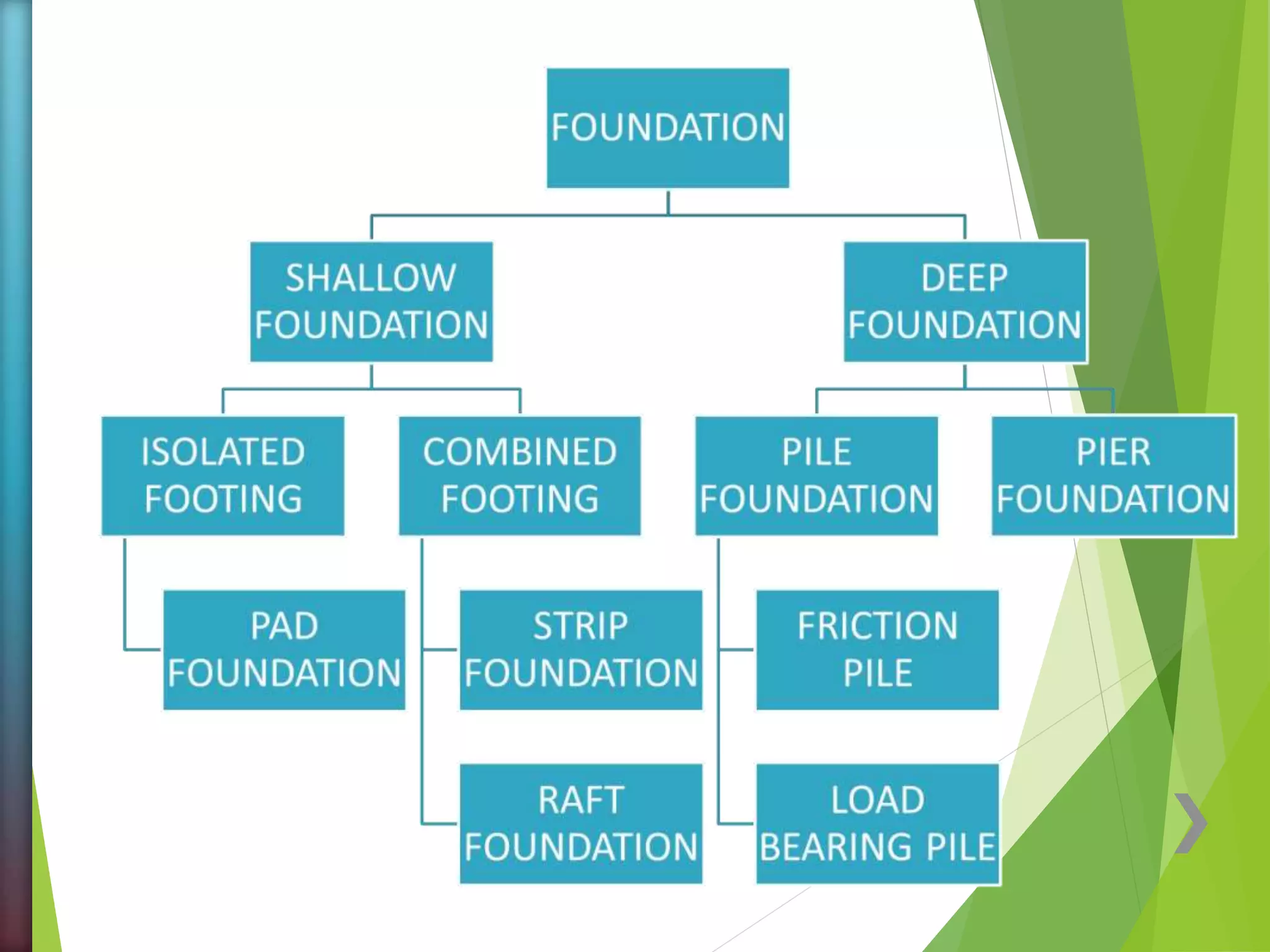
The two main types of foundation:
•
•
Shallow foundation
Deep foundation
Types of Shallow foundation :
•
•
Isolated footing (single footing, Column footing)
Combined footing
Types of Deep foundation :
•
•
Pile foundation
Pier foundation
•
•
•
•
•
•
Shallow foundation (spread
foundation):
Depth of foundation is less
than or equal to its width.
Isolated footing (single footing,
column footing):
In framed structures where
several columns are to be
constructed, isolated footings
can be adopted.
The columns involved can be
provided with masonry or
concrete footing.
If masonry footing is provided,
steps are given and the
foundation area is thus
increased so that the stresses
developed at the base is within
the limit.
• Isolated footing (single footing, column footing)…
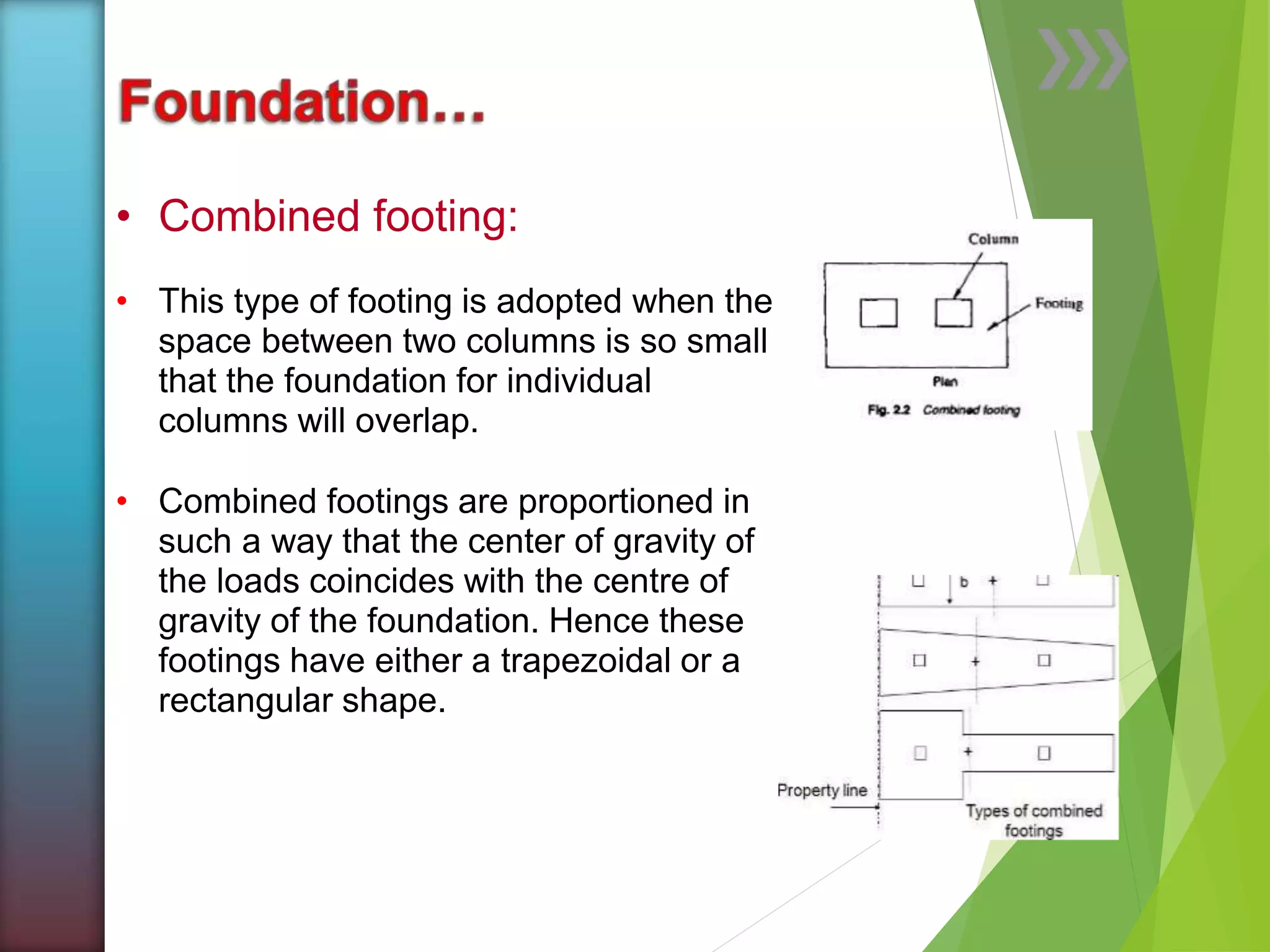
• Combined footing:
• This type of footing is adopted when the
space between two columns is so small
that the foundation for individual
columns will overlap.
• Combined footings are proportioned in
such a way that the center of gravity of
the loads coincides with the centre of
gravity of the foundation. Hence these
footings have either a trapezoidal or a
rectangular shape.
• Pile :
• A slender, structural member consisting steel or concrete or timber.
• It is installed in the ground to transfer the structural loads to soils at
some significant depth below the base of the structure.
•
•
•
Deep foundation :
Deep foundation consists of
pile and pier foundations.
This consists in carrying down
through the soil a huge
masonry cylinder which may
be supported by the sides of
soil or may be supported on
solid rock (hard stratum).
•
•
Pile foundation :
Pile is an element of
construction used as
foundation. It may be driven in
the ground vertically or with
some inclination to transfer the
load safely.
• Pile foundation…
•
•
•
•
•
Loads are supported in two
ways.
If the load is supported by the
effect of friction between the
soil and the pile skin, it is
called friction pile.
Friction piles may be made of
cast iron, cement concrete,
timber, steel, wrought iron and
composite materials.
If the load is supported by
resting the pile on a very hard
stratum, it is called load
bearing pile.
Load bearing piles are steel
sheet piles, concrete piles and
timber piles.
•
•
Piles may be cast-in-situ or
precast.
They may be cased or
uncased.
Load Bearing Pile
Friction Pile
 PPT ON FOUNDATION OF SOIL

PPT ON FOUNDATION OF SOIL

  • 1.
  • 3.
    • Introduction : •A structure essentially consists of two parts, namely the super structure which is above the plinth level and the substructure which is below the plinth level. • Substructure is otherwise known as the foundation and this forms the base for any structure. Generally about 30% of the total construction cost is spent on the foundation. • The soil on which the foundation rests is called the “foundation soil”.
  • 4.
    Objectives of afoundation :  A foundation is provided for the following purposes:  To distribute the total load coming on the structure on a larger area. To support the structures.  To give enough stability to the structures against various disturbing forces, such as wind and rain.
  • 5.
    Factors affecting designof foundation • Soil types and ground water table conditions. • Structural requirements and foundations. • Site condition and environmental factor. • Economy etc.
  • 6.
    • Types offoundation : The two main types of foundation: • • Shallow foundation Deep foundation Types of Shallow foundation : • • Isolated footing (single footing, Column footing) Combined footing Types of Deep foundation : • • Pile foundation Pier foundation
  • 8.
    • • • • • • Shallow foundation (spread foundation): Depthof foundation is less than or equal to its width. Isolated footing (single footing, column footing): In framed structures where several columns are to be constructed, isolated footings can be adopted. The columns involved can be provided with masonry or concrete footing. If masonry footing is provided, steps are given and the foundation area is thus increased so that the stresses developed at the base is within the limit.
  • 9.
    • Isolated footing(single footing, column footing)…
  • 10.
    • Isolated footing(single footing, column footing)…
  • 11.
    • Combined footing: •This type of footing is adopted when the space between two columns is so small that the foundation for individual columns will overlap. • Combined footings are proportioned in such a way that the center of gravity of the loads coincides with the centre of gravity of the foundation. Hence these footings have either a trapezoidal or a rectangular shape.
  • 12.
    • Pile : •A slender, structural member consisting steel or concrete or timber. • It is installed in the ground to transfer the structural loads to soils at some significant depth below the base of the structure.
  • 13.
    • • • Deep foundation : Deepfoundation consists of pile and pier foundations. This consists in carrying down through the soil a huge masonry cylinder which may be supported by the sides of soil or may be supported on solid rock (hard stratum). • • Pile foundation : Pile is an element of construction used as foundation. It may be driven in the ground vertically or with some inclination to transfer the load safely.
  • 14.
    • Pile foundation… • • • • • Loadsare supported in two ways. If the load is supported by the effect of friction between the soil and the pile skin, it is called friction pile. Friction piles may be made of cast iron, cement concrete, timber, steel, wrought iron and composite materials. If the load is supported by resting the pile on a very hard stratum, it is called load bearing pile. Load bearing piles are steel sheet piles, concrete piles and timber piles. • • Piles may be cast-in-situ or precast. They may be cased or uncased.
  • 15.