![© 2013 Cisco and/or its affiliates. All rights reserved. Cisco Public 5
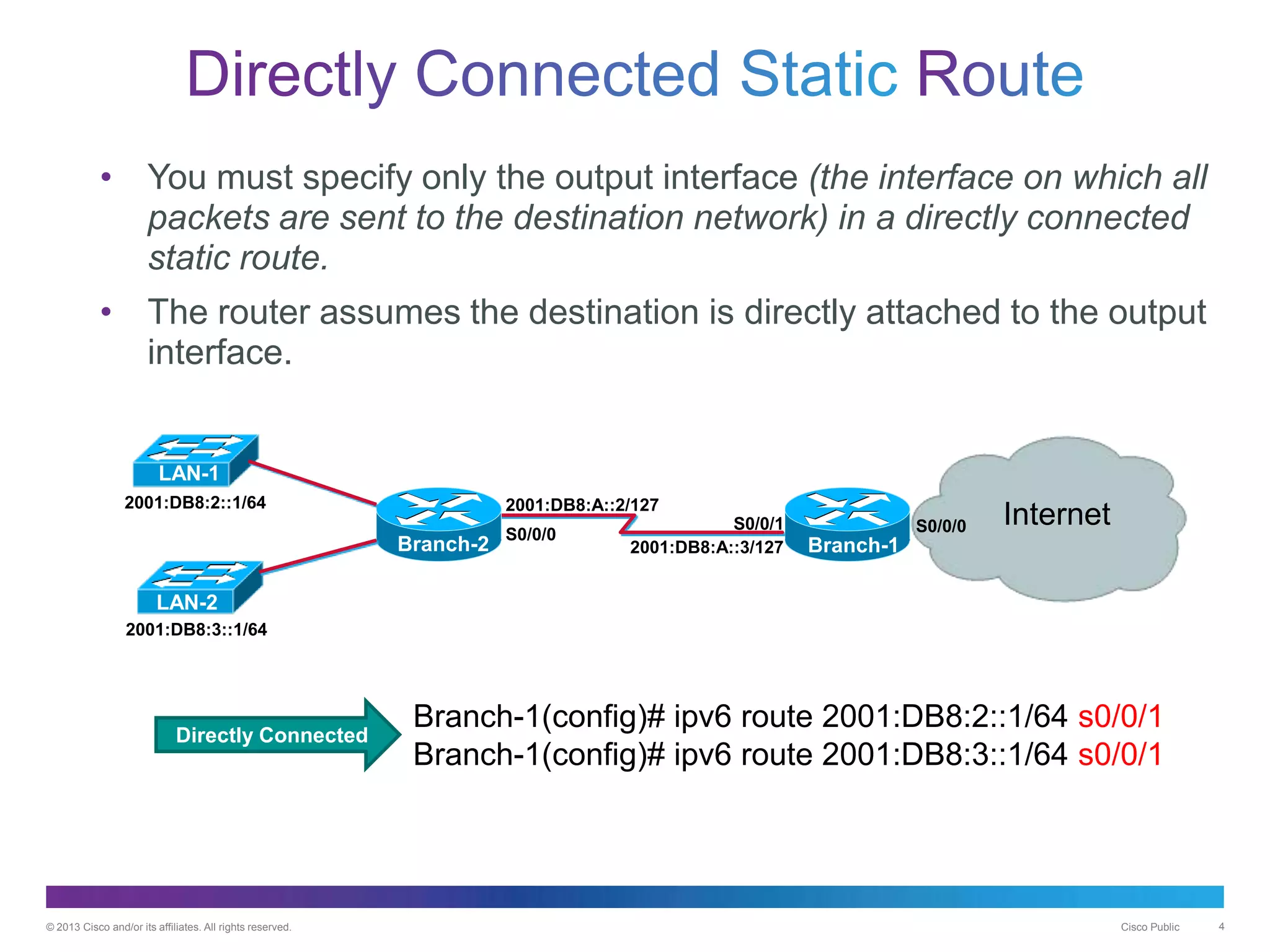
Branch-2
2001:DB8:A::2/127
2001:DB8:A::3/127
2001:DB8:2::1/64
2001:DB8:3::1/64
Branch-1(config)# ipv6 route 2001:DB8:2::1/64 s0/0/1
Branch-1(config)# ipv6 route 2001:DB8:3::1/64 s0/0/1
S0/0/0
S0/0/1 InternetS0/0/0
Branch-1
Directly Connected
LAN-1
LAN-2
Branch-1#show ipv6 route
(Output Omitted)
S 2001:DB8:2::/62 [1/0]
via ::, Serial0/0/1
S 2001:DB8:3::/62 [1/0]
via ::, Serial0/0/1
C 2001:DB8:A::2/127 [0/0]
via ::, Serial0/0/1
L 2001:DB8:A::3/128 [0/0]
via ::, Serial0/0/1
C 2001:DB8:B::/127 [0/0]
via ::, Serial0/0/0
L 2001:DB8:B::/128 [0/0]
via ::, Serial0/0/0
L FF00::/8 [0/0]
via ::, Null0
Branch-2#
“L” in the routing table is a new
identifier which indicates the
specific address assigned to an
interface, as opposed to “C”
which only displays
the subnet.](https://image.slidesharecdn.com/ipv6staticroutes-130928015652-phpapp02/75/IPv6-Static-Routes-5-2048.jpg)
![© 2013 Cisco and/or its affiliates. All rights reserved. Cisco Public 7
Branch-1(config)# ipv6 route 2001:DB8:2::1/64 2001:DB8:A::2
Branch-1(config)# ipv6 route 2001:DB8:3::1/64 2001:DB8:A::2
Next Hop/Recursive
Branch-1#show ipv6 route
(Output Omitted)
S 2001:DB8:2::/64 [1/0]
via 2001:DB8:A::2
S 2001:DB8:3::/64 [1/0]
via 2001:DB8:A::2
C 2001:DB8:A::2/127 [0/0]
via ::, Serial0/0/1
L 2001:DB8:A::3/128 [0/0]
via ::, Serial0/0/1
C 2001:DB8:B::/127 [0/0]
via ::, Serial0/0/0
L 2001:DB8:B::/128 [0/0]
via ::, Serial0/0/0
L FF00::/8 [0/0]
via ::, Null0
Branch-2#
Branch-2
2001:DB8:A::2/127
2001:DB8:A::3/127
2001:DB8:2::1/64
2001:DB8:3::1/64
S0/0/0
S0/0/1 InternetS0/0/0
Branch-1
LAN-1
LAN-2](https://image.slidesharecdn.com/ipv6staticroutes-130928015652-phpapp02/75/IPv6-Static-Routes-7-2048.jpg)
![© 2013 Cisco and/or its affiliates. All rights reserved. Cisco Public 9
Fully Specified
Branch-1#show ipv6 route
(Output Omitted)
S 2001:DB8:2::1/64 [1/0]
via 2001:DB8:A::2, Gigabit0/0
S 2001:DB8:3::1/64 [1/0]
via 2001:DB8:A::2, Gigabit0/0
C 2001:DB8:A::2/127 [0/0]
via ::, Serial0/0/1
L 2001:DB8:A::3/128 [0/0]
via ::, Serial0/0/1
C 2001:DB8:B::/127 [0/0]
via ::, Serial0/0/0
L 2001:DB8:B::/128 [0/0]
via ::, Serial0/0/0
L FF00::/8 [0/0]
via ::, Null0
Branch-2#
Branch-2
2001:DB8:A::2/64 2001:DB8:A::1/64
2001:DB8:2::1/64
2001:DB8:3::1/64
G0/0 G0/0
Branch-1
LAN-1
LAN-2
G0/0
G0/0 Branch-4
Branch-3
2001:DB8:A::4/64
2001:DB8:A::3/64
DSW-1
G0/1
G0/0](https://image.slidesharecdn.com/ipv6staticroutes-130928015652-phpapp02/75/IPv6-Static-Routes-9-2048.jpg)
![© 2013 Cisco and/or its affiliates. All rights reserved. Cisco Public 11
Branch-2
2001:DB8:A::2/127
2001:DB8:A::3/127
2001:DB8:2::1/64
2001:DB8:3::1/64
S0/0/0
S0/0/1 InternetS0/0/0
Branch-1
LAN-1
LAN-2
Branch-1(config)#ipv6 route ::/0 s0/0/0
Branch-1#sh ipv6 route
(Output Omitted)
S ::/0 [1/0]
via ::, Serial0/0/0
S 2001:DB8:2::1/64 [1/0]
via 2001:DB8:A::2, Serial0/0/1
S 2001:DB8:3::1/64 [1/0]
via 2001:DB8:A::2, Serial0/0/1
C 2001:DB8:A::2/127 [0/0]
via ::, Serial0/0/1
L 2001:DB8:A::3/128 [0/0]
via ::, Serial0/0/1
C 2001:DB8:B::/127 [0/0]
via ::, Serial0/0/0
L 2001:DB8:B::/128 [0/0]
via ::, Serial0/0/0
L FF00::/8 [0/0]
via ::, Null0
Branch-1#
Default Route](https://image.slidesharecdn.com/ipv6staticroutes-130928015652-phpapp02/75/IPv6-Static-Routes-11-2048.jpg)
![© 2013 Cisco and/or its affiliates. All rights reserved. Cisco Public 13
Branch-1(config)#ipv6 route 2001:DB8:2::/46 s0/0/0
Branch-1#show ipv6 route
(output omitted)
S ::/0 [1/0]
via ::, Serial0/0/0
S 2001:DB8::/46 [1/0]
via ::, Serial0/0/1
2001:DB8:0000000000000010
2001:DB8:0000000000000011
Summarize based on common bits:
• 16-bits in the 1st and 2nd hextets for a total of 32-bits
• 14-bits in the 3rd hextet
• Total of 46-bits in common between the two addresses
Common Bits
Branch-1# ping 2001:db8:2::1
Type escape sequence to abort.
Sending 5, 100-byte ICMP Echos to 2001:db8:2::, timeout is 2 seconds:
!!!!!
Success rate is 100 percent (5/5), round-trip min/avg/max = 1/10/41 ms
Branch-1# ping 2001:db8:3::1
Type escape sequence to abort.
Sending 5, 100-byte ICMP Echos to 2001:db8:3::, timeout is 2 seconds:
!!!!!
Success rate is 100 percent (5/5), round-trip min/avg/max = 2/9/18 ms
Branch-1#
Branch-2
2001:DB8:A::2/127
2001:DB8:A::3/127
2001:DB8:2::/64
S0/0/0
S0/0/1 InternetS0/0/0
Branch-1
LAN-1
LAN-2
2001:DB8:3::/64](https://image.slidesharecdn.com/ipv6staticroutes-130928015652-phpapp02/75/IPv6-Static-Routes-13-2048.jpg)
![© 2013 Cisco and/or its affiliates. All rights reserved. Cisco Public 15
InternetBranch-1
Branch-2
Branch-1(config)# ipv6 route 2001:DB8:4::1/127 s0/0/1 91
Branch-1(config)# ipv6 route 2001:DB8:5::1/127 s0/0/1 91
Branch-1(config)# ipv6 route 2001:DB8:6::1/127 s0/0/1 91
Branch-1(config)# ipv6 route 2001:DB8:C::1/127 s0/0/1 91
Branch-1(config)# ipv6 route 2001:DB8:A::1/127 s0/0/1 91
Branch-1#sh ipv6 route
(output omitted)
D 2001:DB8:4::/128 [90/3321856]
via FE80::2E0:8FFF:FE31:4201, Serial0/0/0
D 2001:DB8:5::/128 [90/3321856]
via FE80::2E0:8FFF:FE31:4201, Serial0/0/0
D 2001:DB8:6::/128 [90/3321856]
via FE80::2E0:8FFF:FE31:4201, Serial0/0/0
D 2001:DB8:B::/127 [90/3193856]
via FE80::2E0:8FFF:FE31:4201, Serial0/0/0
D 2001:DB8:C::/127 [90/2681856]
via FE80::2E0:8FFF:FE31:4201, Serial0/0/0
Branch-1#
Branch-1#show ipv6 route
(output omitted)
S 2001:DB8:4::/128 [91/0]
via ::, Serial0/0/1
S 2001:DB8:5::/128 [91/0]
via ::, Serial0/0/1
S 2001:DB8:6::/128 [91/0]
via ::, Serial0/0/1
S 2001:DB8:A::/128 [91/0]
via ::, Serial0/0/1
S 2001:DB8:C::/128 [91/0]
Branch-1#](https://image.slidesharecdn.com/ipv6staticroutes-130928015652-phpapp02/75/IPv6-Static-Routes-15-2048.jpg)


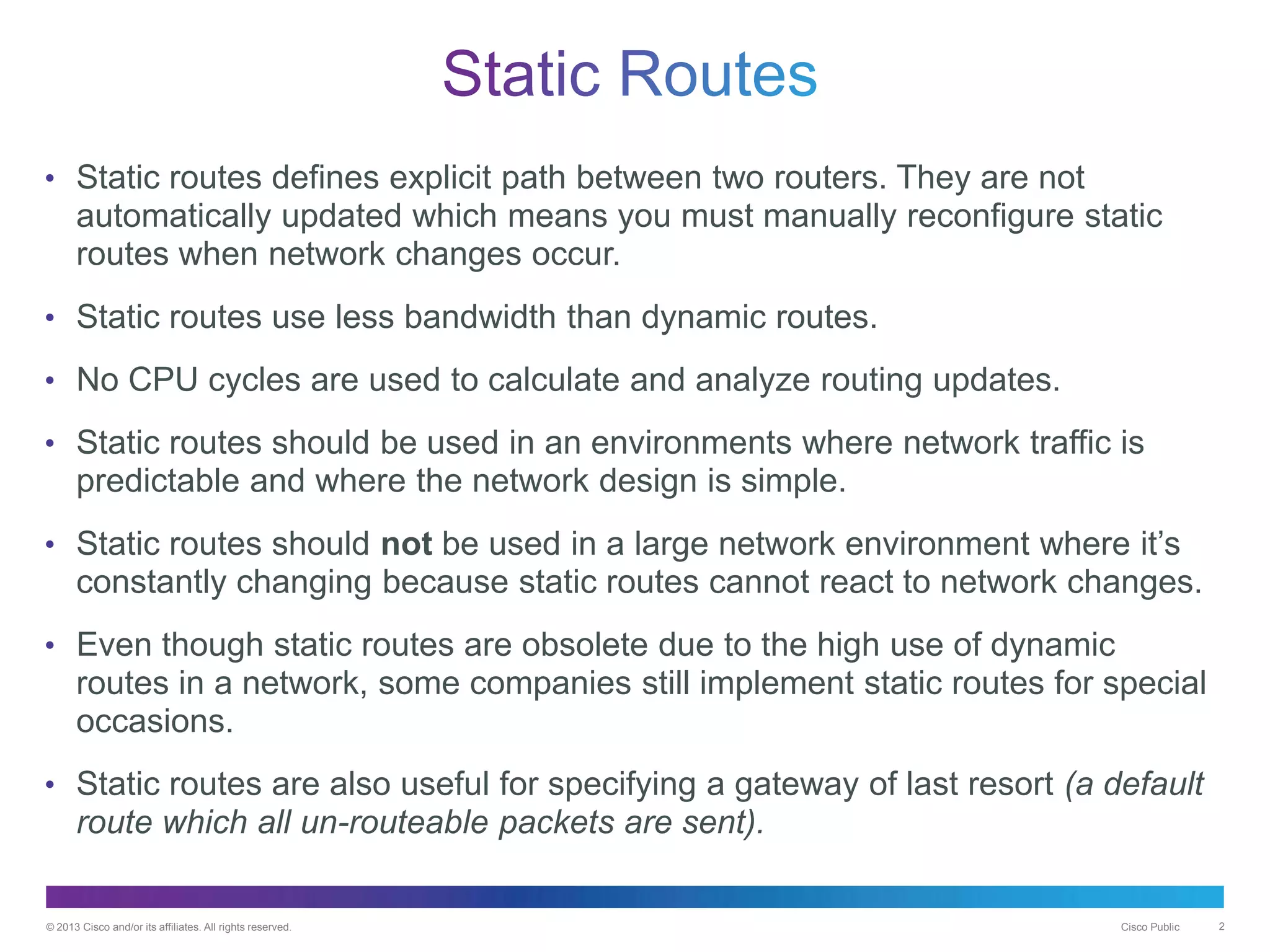
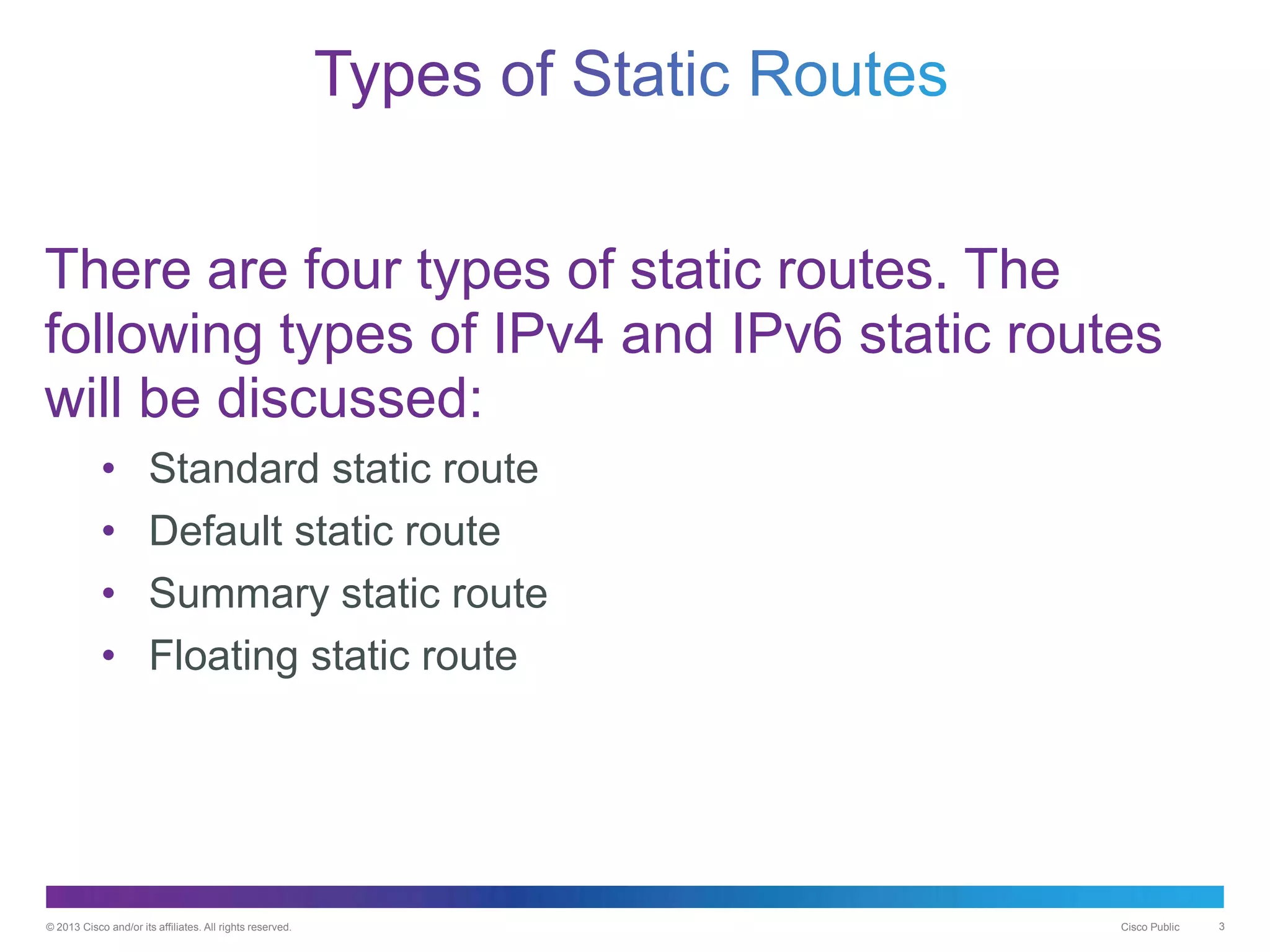
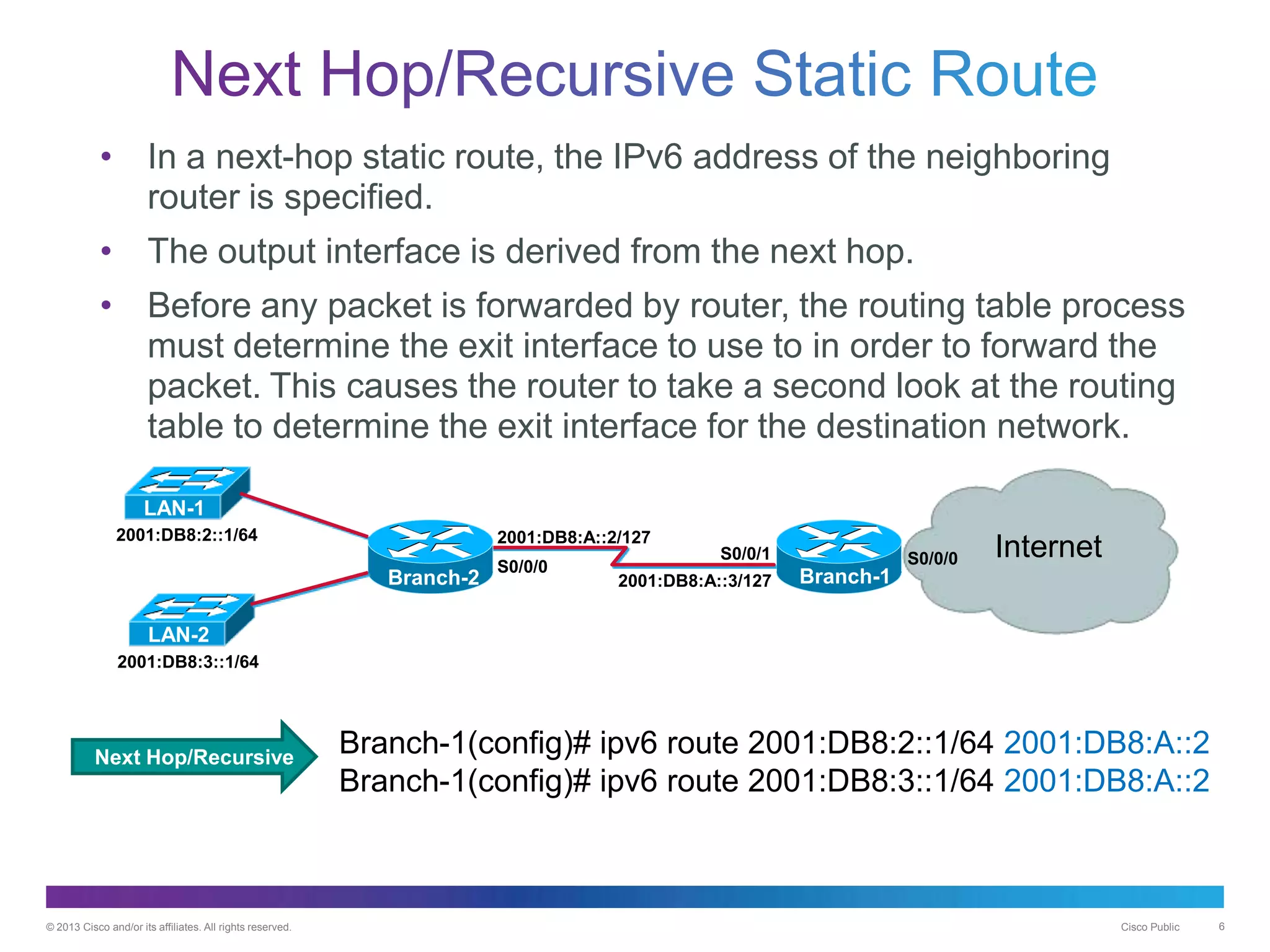
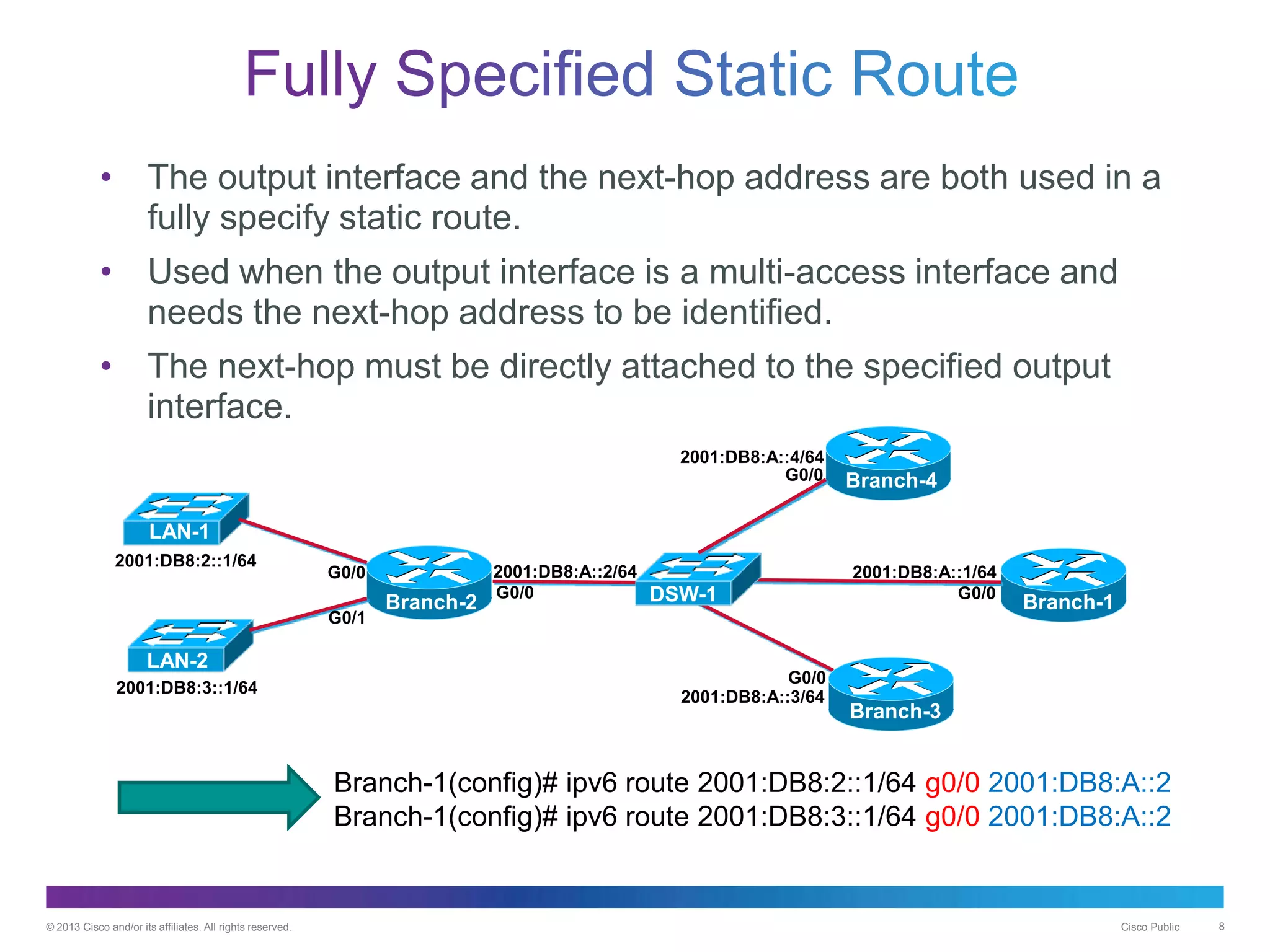
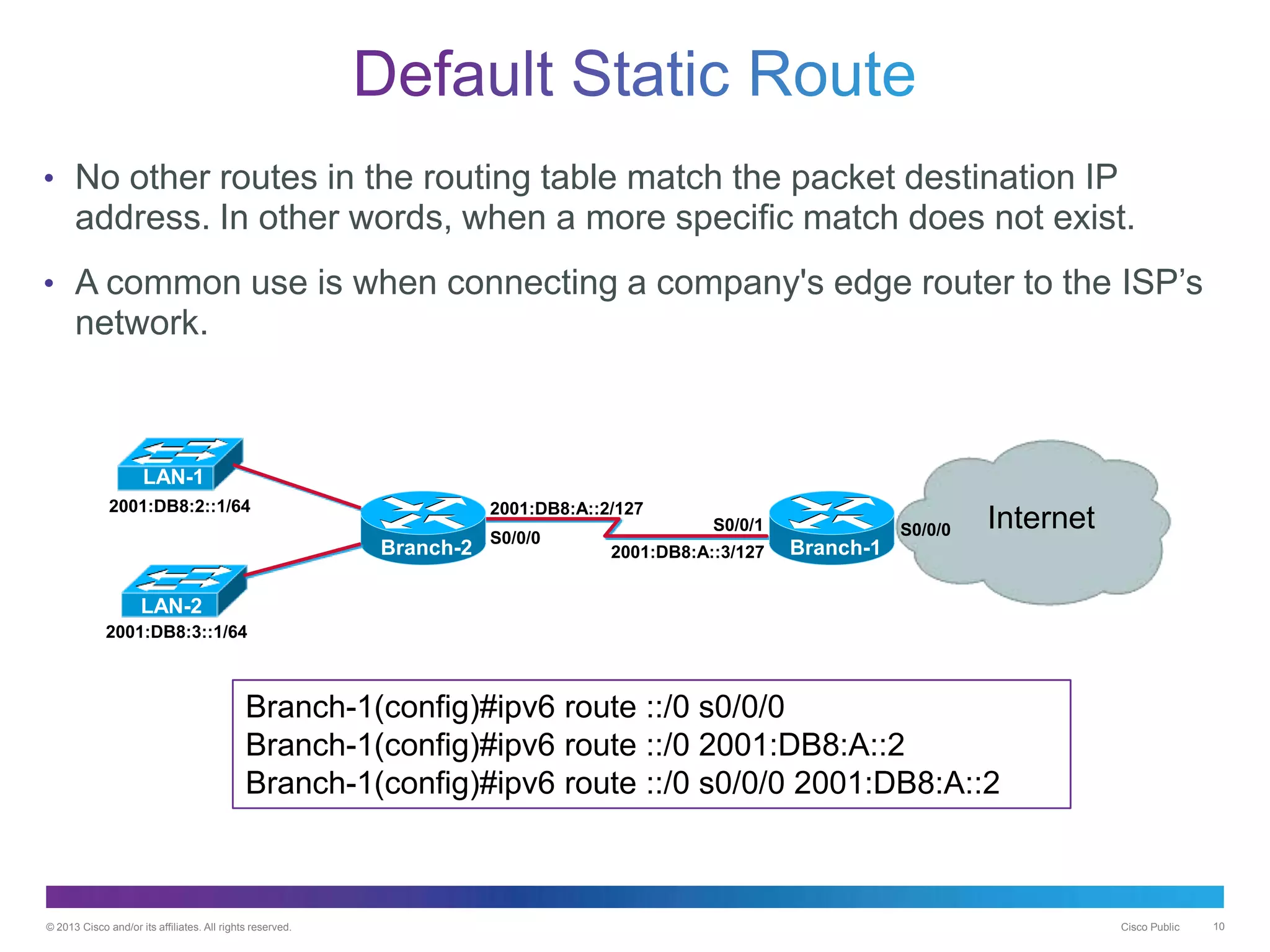
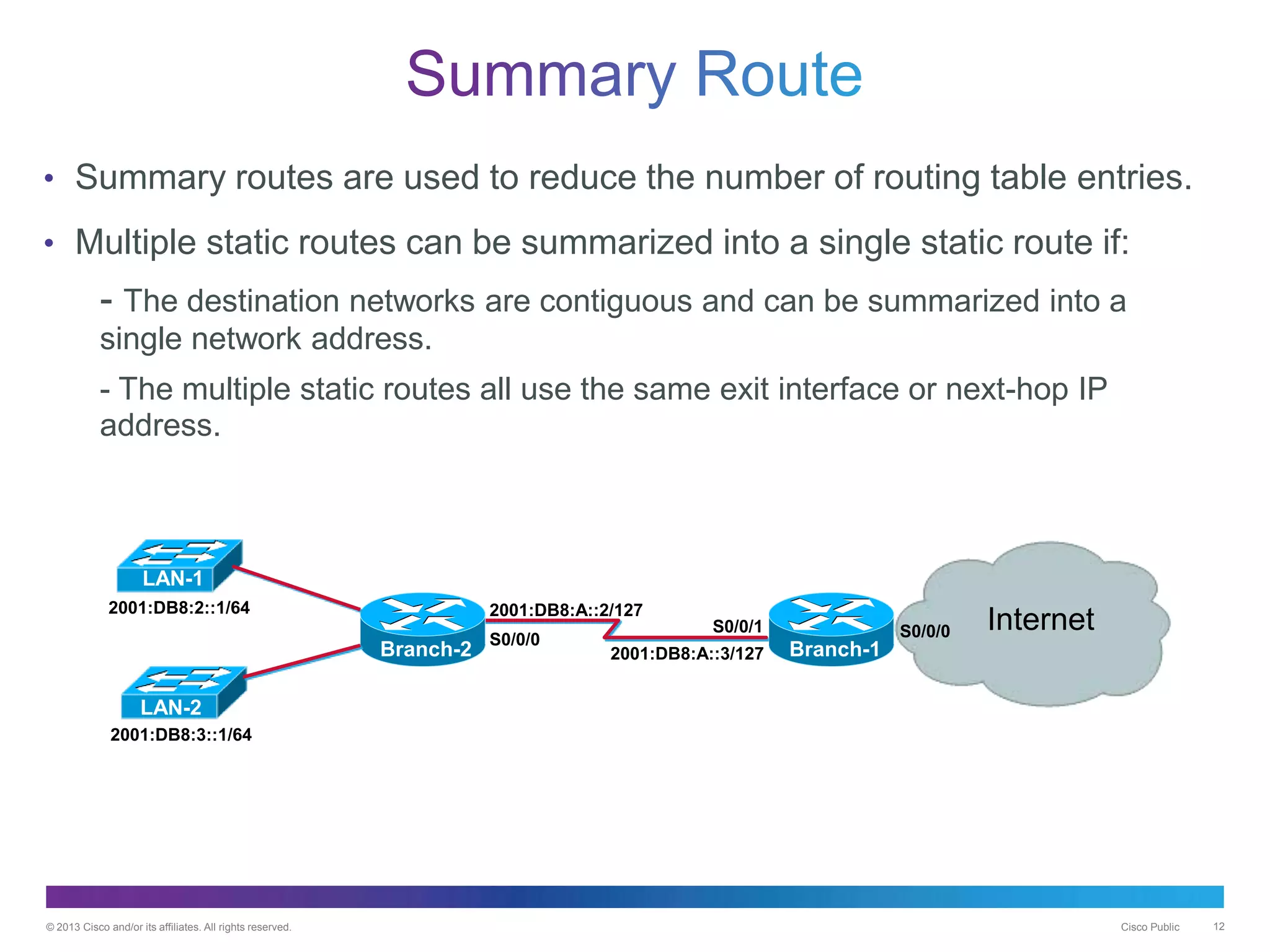
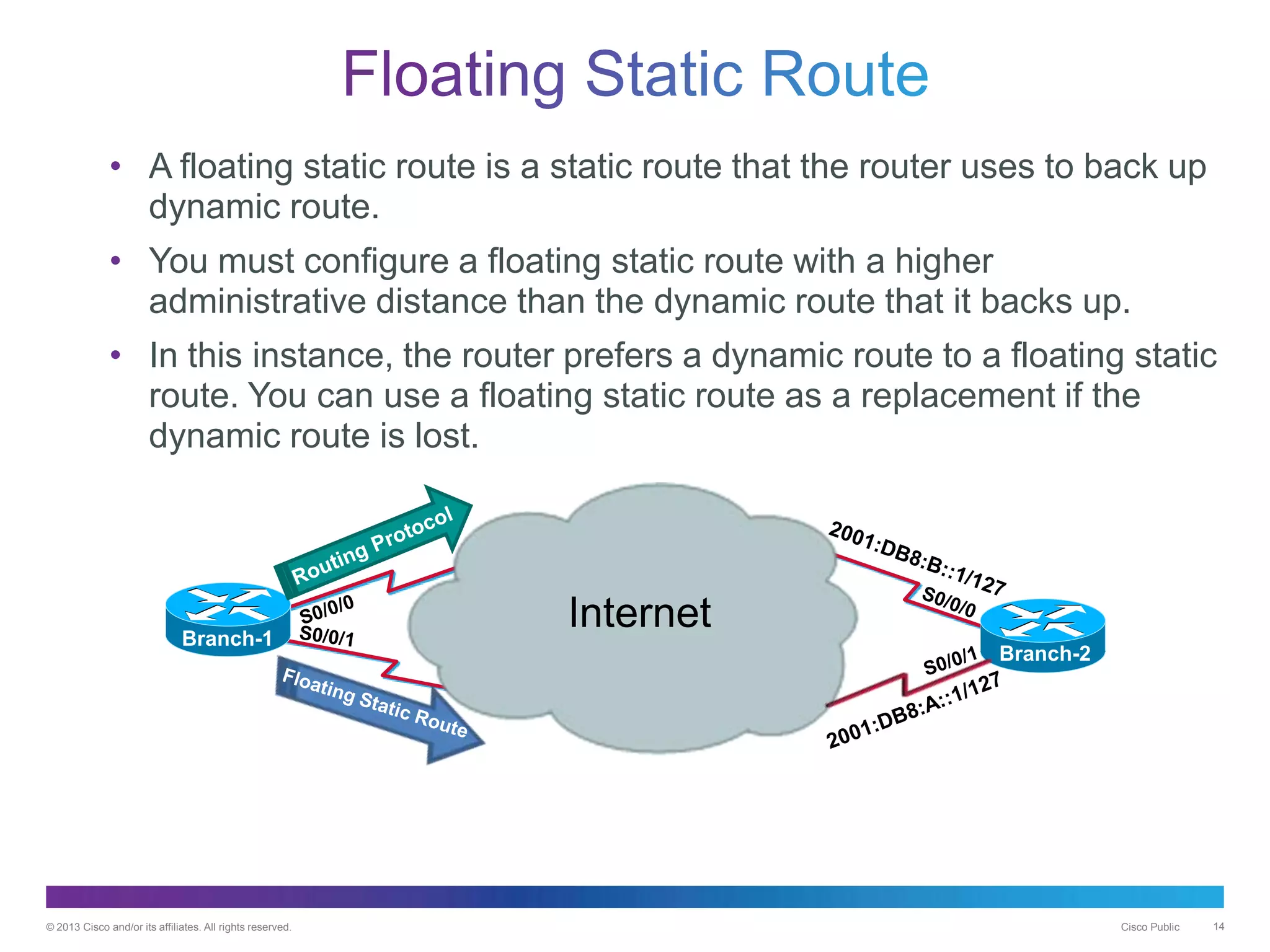
- Static routes define explicit paths between routers but must be manually reconfigured when network changes occur, unlike dynamic routes. They use less bandwidth than dynamic routes and do not use CPU cycles for route calculations. - There are four types of static routes: directly connected, next hop, fully specified, and default. Directly connected only requires the output interface, while next hop specifies the next hop router. Fully specified defines both the output interface and next hop router. The default route is used when no other routes match. - Static routes can be summarized into a single route when destinations are contiguous and use the same exit point. Floating static routes back up dynamic routes but have a higher administrative distance so are lower priority.


