PENTOSE PHOSPHATE PATHWAY
NILOUFER M.A and Dr. KAYEEN VADAKKAN
DEPARTMENT OF BIOTECHNOLOGY
ST.MARY’S COLLEGE, THRISSUR
PENTOSE PHOSPHATE PATHWAY, NILOUFER M.A, ST.MAR’YS COLLEGE - THRISSUR
INTRODUCTION
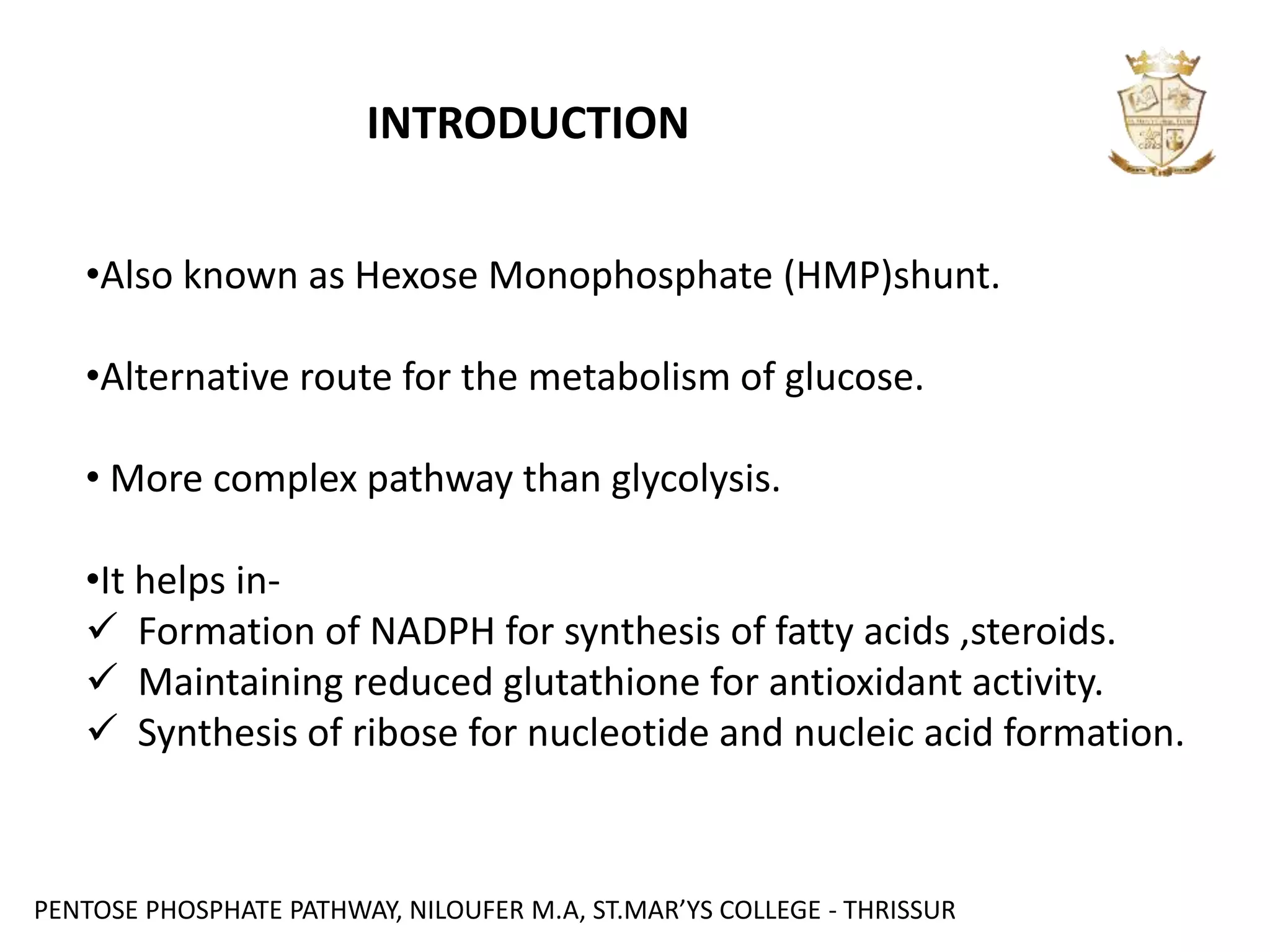
•Also known as Hexose Monophosphate (HMP)shunt.
•Alternative route for the metabolism of glucose.
• More complex pathway than glycolysis.
•It helps in-
 Formation of NADPH for synthesis of fatty acids ,steroids.
 Maintaining reduced glutathione for antioxidant activity.
 Synthesis of ribose for nucleotide and nucleic acid formation.
PENTOSE PHOSPHATE PATHWAY, NILOUFER M.A, ST.MAR’YS COLLEGE - THRISSUR
PENTOSE PHOSPHATE PATHWAY
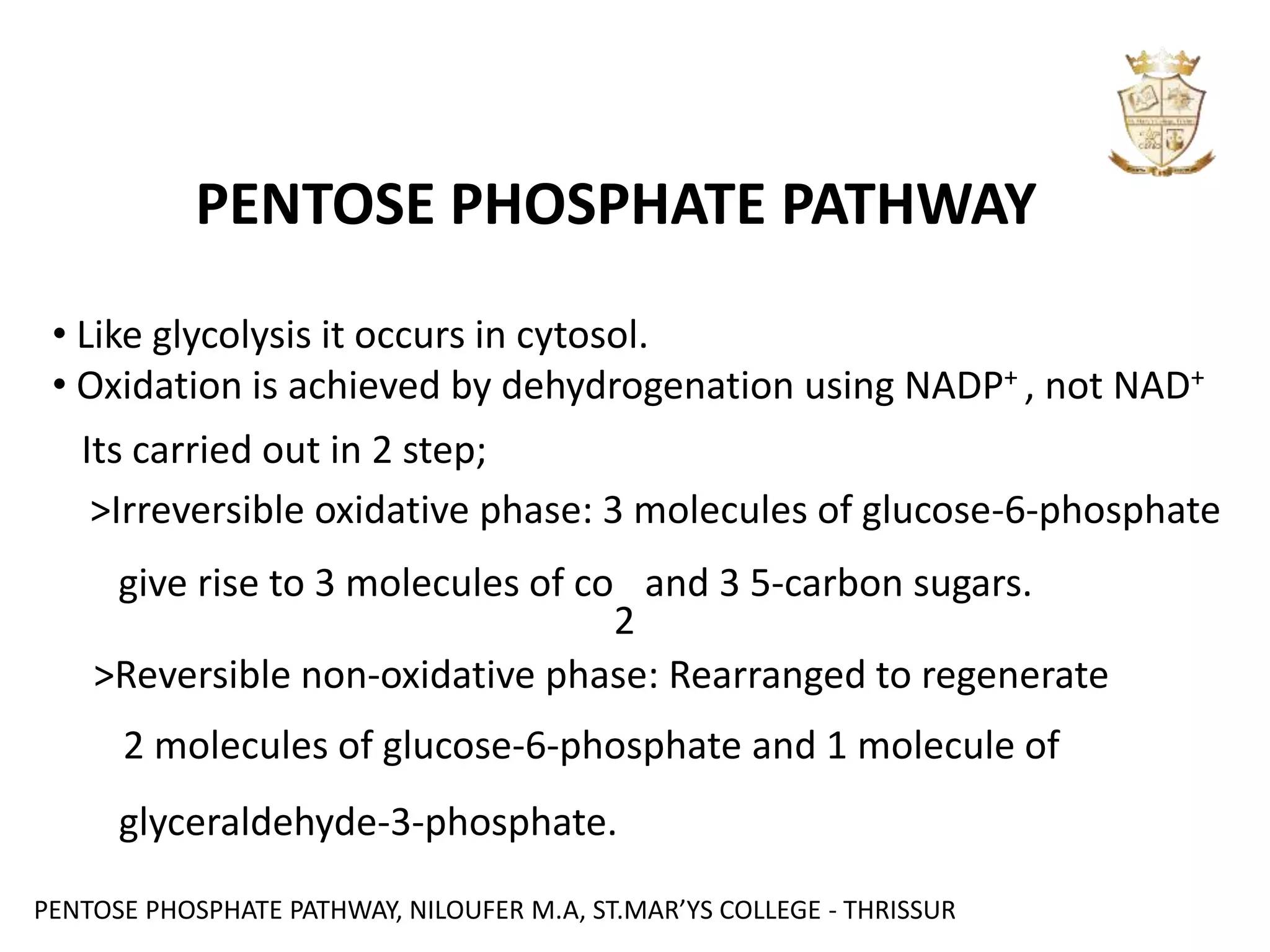
• Like glycolysis it occurs in cytosol.
• Oxidation is achieved by dehydrogenation using NADP+ , not NAD+
Its carried out in 2 step;
>Irreversible oxidative phase: 3 molecules of glucose-6-phosphate
give rise to 3 molecules of co
2
and 3 5-carbon sugars.
>Reversible non-oxidative phase: Rearranged to regenerate
2 molecules of glucose-6-phosphate and 1 molecule of
glyceraldehyde-3-phosphate.
PENTOSE PHOSPHATE PATHWAY, NILOUFER M.A, ST.MAR’YS COLLEGE - THRISSUR
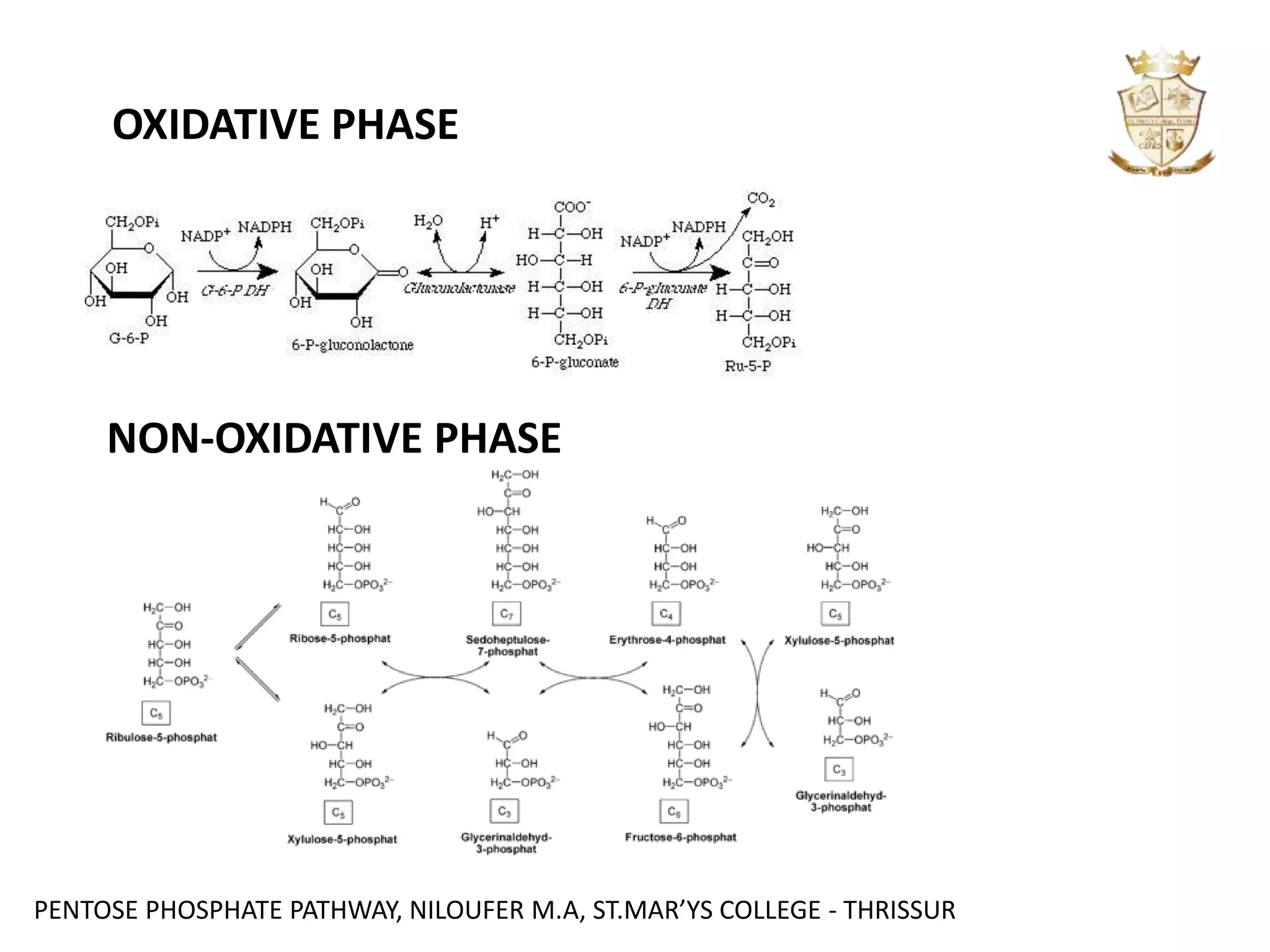
OXIDATIVE PHASE
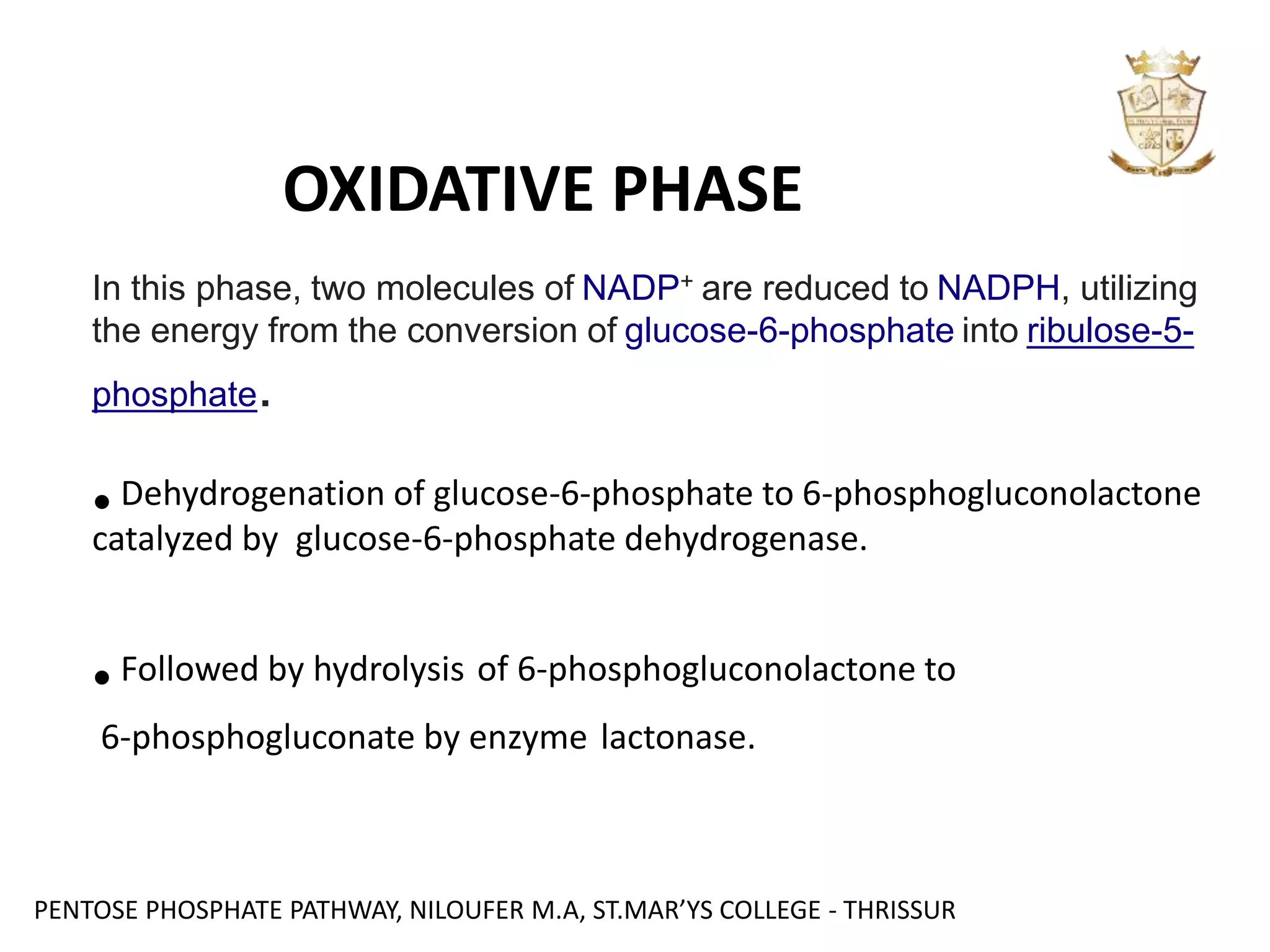
In this phase, two molecules of NADP+ are reduced to NADPH, utilizing
the energy from the conversion of glucose-6-phosphate into ribulose-5-
phosphate.
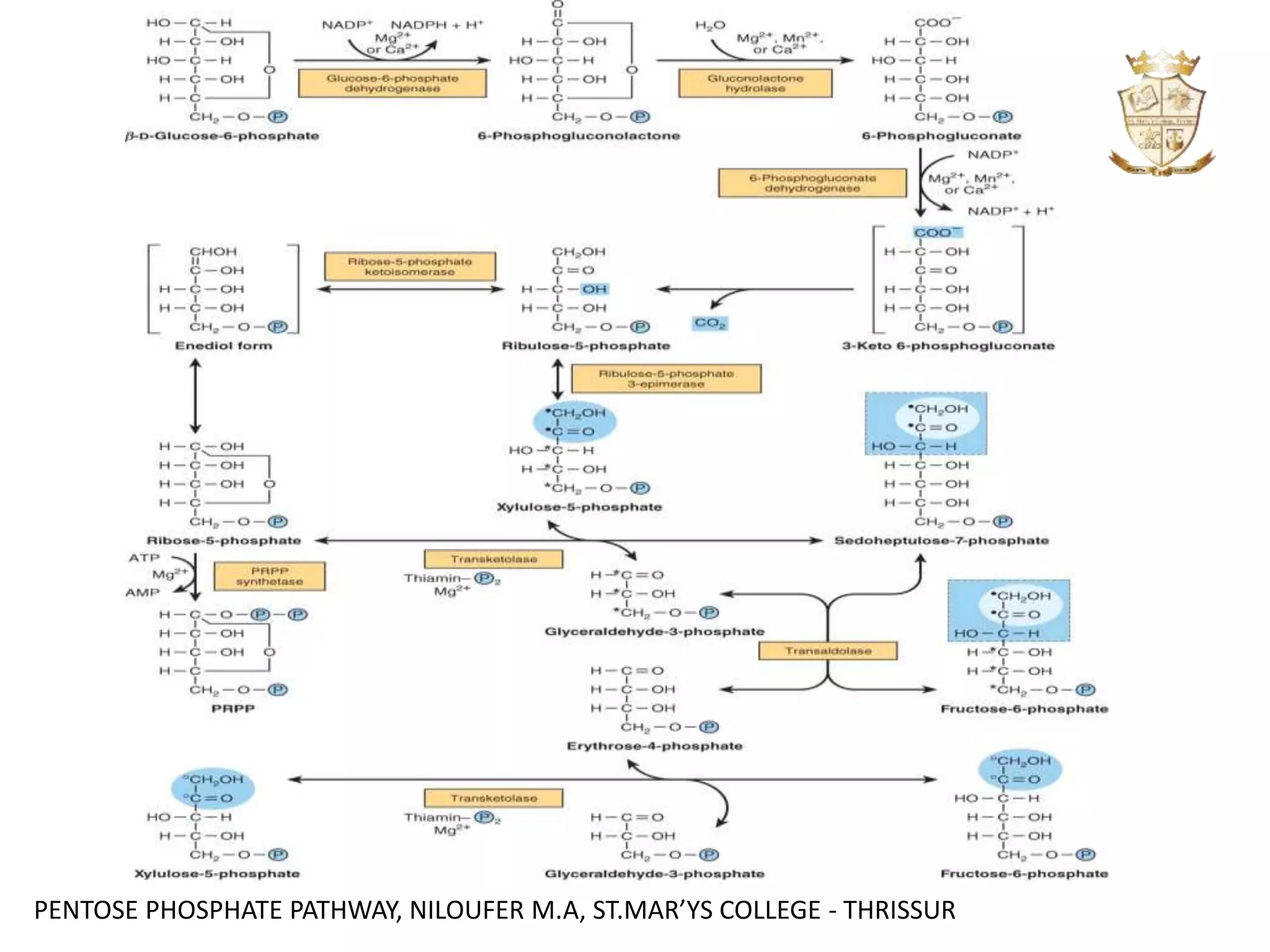
• Dehydrogenation of glucose-6-phosphate to 6-phosphogluconolactone
catalyzed by glucose-6-phosphate dehydrogenase.
• Followed by hydrolysis of 6-phosphogluconolactone to
6-phosphogluconate by enzyme lactonase.
PENTOSE PHOSPHATE PATHWAY, NILOUFER M.A, ST.MAR’YS COLLEGE - THRISSUR
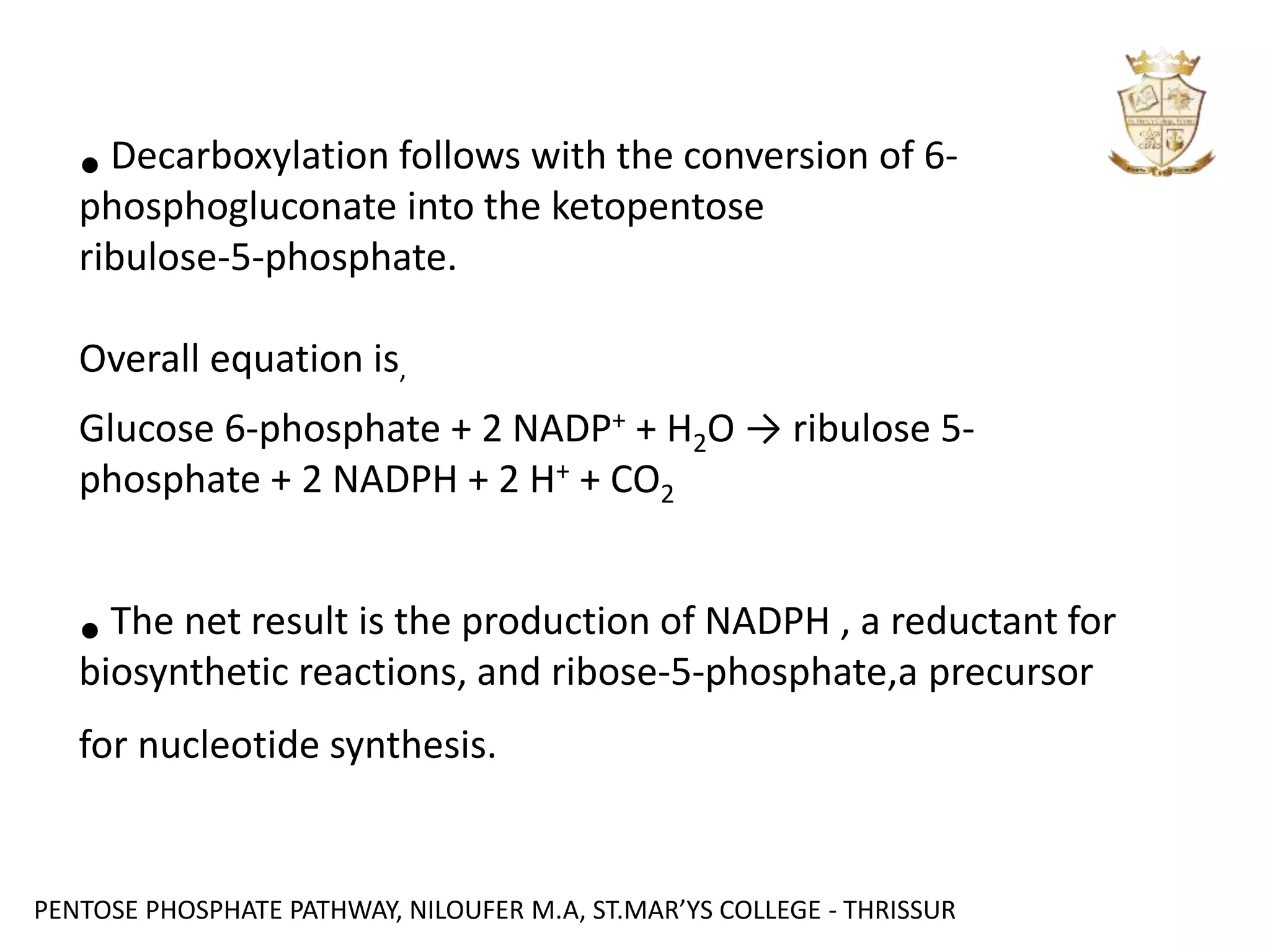
•Decarboxylation follows with the conversion of 6-
phosphogluconate into the ketopentose
ribulose-5-phosphate.
Overall equation is,
Glucose 6-phosphate + 2 NADP+ + H2O → ribulose 5-
phosphate + 2 NADPH + 2 H+ + CO2
•The net result is the production of NADPH , a reductant for
biosynthetic reactions, and ribose-5-phosphate,a precursor
for nucleotide synthesis.
PENTOSE PHOSPHATE PATHWAY, NILOUFER M.A, ST.MAR’YS COLLEGE - THRISSUR
NON-OXIDATIVE PHASE
•Ribulose-5-phosphate is the substrate for two enzymes;
 Ribose-5-phosphate ketoisomerase:ribulose-5-phosphate to
the corresponding ribose-5-phosphate ,used for nucleotide and
nucleic acid synthesis.
 Ribulose-5-phosphate 3-epimerase:alters the configuration about
carbon giving xylulose-5-phosphate.
•Xylulose-5-phosphate (5c) and ribose-5-phosphate(5c) reacts to give
glyceraldehydes-3-phosphate (3c) and sedoheptulose-7-phosphate(7c)
by the enzyme Transketolase.
•Glyceraldehyde-3-phosphate (3c) and sedoheptulose-7-phosphate(7c)
is acted by Transaldolase to give fructose-6-phosphate and erythrose-
4-phosphate.
PENTOSE PHOSPHATE PATHWAY, NILOUFER M.A, ST.MAR’YS COLLEGE - THRISSUR
•Erythrose-4-phosphate and xylulose-5-phosphate reacts in the
presence of enzyme transketolase to give fructose-6-phosphate and
glyceraldehyde-3-phosphate.
Mg2+ and thiamin diphosphate (vitaminB1) as coenzyme
• Subsequently fructose-6-phosphate is isomerised to
glucose-6-phosphate by enzyme phosphohexose isomerase.
Net reaction:
3 ribulose-5-phosphate → 1 ribose-5-phosphate + 2 xylulose-5-
phosphate → 2 fructose-6-phosphate + glyceraldehyde-3-
phosphate
•A genetic defect in transketolase that lowers its affinity for TPP
exacerbates the Wernicke-Korsakoff syndrome.
PENTOSE PHOSPHATE PATHWAY, NILOUFER M.A, ST.MAR’YS COLLEGE - THRISSUR
OXIDATIVE PHASE
NON-OXIDATIVE PHASE
PENTOSE PHOSPHATE PATHWAY, NILOUFER M.A, ST.MAR’YS COLLEGE - THRISSUR
•Entry of glucose-6-phosphate either into glycolysis or into the pentose
phosphate pathway is largely determined by the relative concentration of
NADP+ and NADPH.
Regulation
• Glucose-6-phosphate dehydrogenase is the rate-controlling enzyme of
this pathway.
• It is allosterically stimulated by NADP+ and strongly inhibited by NADPH.
• The ratio of NADPH:NADP+ is normally about 100:1 in liver cytosol. This
makes the cytosol a highly-reducing environment.
• An NADPH-utilizing pathway forms NADP+, which stimulates Glucose-6-
phosphate dehydrogenase to produce more NADPH.
• This step is also inhibited by acetyl CoA
PENTOSE PHOSPHATE PATHWAY, NILOUFER M.A, ST.MAR’YS COLLEGE - THRISSUR
Reactants Products Enzyme Description
Glucose 6-phosphate+
NADP+
→ 6-phosphoglucono-δ-
lactone + NADPH
glucose 6-phosphate
dehydrogenase
Dehydrogenation. The
hydroxyl on carbon 1 of
glucose 6-phosphate turns
into a carbonyl, generating
a lactone, and, in the
process, NADPH is
generated.
6-phosphoglucono-δ-
lactone + H2O
→ 6-phosphogluconate +
H+
6-
phosphogluconolactonase
Hydrolysis
6-phosphogluconate +
NADP+
→ ribulose 5-
phosphate + NADPH + CO2
6-phosphogluconate
dehydrogenase
Oxidative decarboxylation.
NADP+ is the electron
acceptor, generating
another molecule
of NADPH, a CO2,
and ribulose 5-phosphate.
:
The entire set of reactions of oxidative phase can be summarized as
follows:
PENTOSE PHOSPHATE PATHWAY, NILOUFER M.A, ST.MAR’YS COLLEGE - THRISSUR
The entire set of reactions of non-oxidative phase can be summarized
as follows:
Reactants Products Enzymes
Ribulose-5-phosphate → ribose 5-phosphate Ribose-5-phosphate isomerase
Ribulose-5-phosphate → xylulose-5-phosphate
Ribulose-5-Phosphate 3-
Epimerase
Xylulose-5-
phosphatate + ribose 5-
phosphate
→ glyceraldehyde-3-
phosphate + sedoheptulose-7-
phosphate
Transketolase
Sedoheptulose-7-
phosphate + glyceraldehyde-3-
phosphate
→ erythrose-4-
phosphate + fructose 6-
phosphate
Transaldolase
Xylulose-5-
phosphate+ erythrose-4-
phosphate
→ glyceraldehyde-3-
phosphate+ fructose 6-
phosphate
Transketolase
PENTOSE PHOSPHATE PATHWAY, NILOUFER M.A, ST.MAR’YS COLLEGE - THRISSUR
IMPORTANCE OF NADPH
• Bio-synthesis of fatty acid.
• Certain aminoacid involving the enzyme glutamate dehydrogenase.
• Antioxidant reaction-Glutathione mediated reaction of H2O2.
• Detoxification of drugs-cytochrome P450.
• Phagocytosis.
• Integrity of RBC membrane.
PENTOSE PHOSPHATE PATHWAY, NILOUFER M.A, ST.MAR’YS COLLEGE - THRISSUR
OUTCOME
The primary results of the pathway are:
• The generation of reducing equivalents, in the form of
NADPH, used in reductive biosynthesis reactions within
cells (e.g. fatty acid synthesis).
• Production of ribose 5-phosphate(R5P), used in the
synthesis of nucleotides and nucleic acids.
• Production of erythrose 4-phosphate (E4P) used in the
synthesis of aromatic amino acids.
PENTOSE PHOSPHATE PATHWAY, NILOUFER M.A, ST.MAR’YS COLLEGE - THRISSUR

Pentose phosphate pathway

  • 1.
    PENTOSE PHOSPHATE PATHWAY NILOUFERM.A and Dr. KAYEEN VADAKKAN DEPARTMENT OF BIOTECHNOLOGY ST.MARY’S COLLEGE, THRISSUR
  • 2.
    PENTOSE PHOSPHATE PATHWAY,NILOUFER M.A, ST.MAR’YS COLLEGE - THRISSUR INTRODUCTION •Also known as Hexose Monophosphate (HMP)shunt. •Alternative route for the metabolism of glucose. • More complex pathway than glycolysis. •It helps in-  Formation of NADPH for synthesis of fatty acids ,steroids.  Maintaining reduced glutathione for antioxidant activity.  Synthesis of ribose for nucleotide and nucleic acid formation.
  • 3.
    PENTOSE PHOSPHATE PATHWAY,NILOUFER M.A, ST.MAR’YS COLLEGE - THRISSUR PENTOSE PHOSPHATE PATHWAY • Like glycolysis it occurs in cytosol. • Oxidation is achieved by dehydrogenation using NADP+ , not NAD+ Its carried out in 2 step; >Irreversible oxidative phase: 3 molecules of glucose-6-phosphate give rise to 3 molecules of co 2 and 3 5-carbon sugars. >Reversible non-oxidative phase: Rearranged to regenerate 2 molecules of glucose-6-phosphate and 1 molecule of glyceraldehyde-3-phosphate.
  • 4.
    PENTOSE PHOSPHATE PATHWAY,NILOUFER M.A, ST.MAR’YS COLLEGE - THRISSUR OXIDATIVE PHASE In this phase, two molecules of NADP+ are reduced to NADPH, utilizing the energy from the conversion of glucose-6-phosphate into ribulose-5- phosphate. • Dehydrogenation of glucose-6-phosphate to 6-phosphogluconolactone catalyzed by glucose-6-phosphate dehydrogenase. • Followed by hydrolysis of 6-phosphogluconolactone to 6-phosphogluconate by enzyme lactonase.
  • 5.
    PENTOSE PHOSPHATE PATHWAY,NILOUFER M.A, ST.MAR’YS COLLEGE - THRISSUR •Decarboxylation follows with the conversion of 6- phosphogluconate into the ketopentose ribulose-5-phosphate. Overall equation is, Glucose 6-phosphate + 2 NADP+ + H2O → ribulose 5- phosphate + 2 NADPH + 2 H+ + CO2 •The net result is the production of NADPH , a reductant for biosynthetic reactions, and ribose-5-phosphate,a precursor for nucleotide synthesis.
  • 6.
    PENTOSE PHOSPHATE PATHWAY,NILOUFER M.A, ST.MAR’YS COLLEGE - THRISSUR NON-OXIDATIVE PHASE •Ribulose-5-phosphate is the substrate for two enzymes;  Ribose-5-phosphate ketoisomerase:ribulose-5-phosphate to the corresponding ribose-5-phosphate ,used for nucleotide and nucleic acid synthesis.  Ribulose-5-phosphate 3-epimerase:alters the configuration about carbon giving xylulose-5-phosphate. •Xylulose-5-phosphate (5c) and ribose-5-phosphate(5c) reacts to give glyceraldehydes-3-phosphate (3c) and sedoheptulose-7-phosphate(7c) by the enzyme Transketolase. •Glyceraldehyde-3-phosphate (3c) and sedoheptulose-7-phosphate(7c) is acted by Transaldolase to give fructose-6-phosphate and erythrose- 4-phosphate.
  • 7.
    PENTOSE PHOSPHATE PATHWAY,NILOUFER M.A, ST.MAR’YS COLLEGE - THRISSUR •Erythrose-4-phosphate and xylulose-5-phosphate reacts in the presence of enzyme transketolase to give fructose-6-phosphate and glyceraldehyde-3-phosphate. Mg2+ and thiamin diphosphate (vitaminB1) as coenzyme • Subsequently fructose-6-phosphate is isomerised to glucose-6-phosphate by enzyme phosphohexose isomerase. Net reaction: 3 ribulose-5-phosphate → 1 ribose-5-phosphate + 2 xylulose-5- phosphate → 2 fructose-6-phosphate + glyceraldehyde-3- phosphate •A genetic defect in transketolase that lowers its affinity for TPP exacerbates the Wernicke-Korsakoff syndrome.
  • 8.
    PENTOSE PHOSPHATE PATHWAY,NILOUFER M.A, ST.MAR’YS COLLEGE - THRISSUR OXIDATIVE PHASE NON-OXIDATIVE PHASE
  • 9.
    PENTOSE PHOSPHATE PATHWAY,NILOUFER M.A, ST.MAR’YS COLLEGE - THRISSUR •Entry of glucose-6-phosphate either into glycolysis or into the pentose phosphate pathway is largely determined by the relative concentration of NADP+ and NADPH. Regulation • Glucose-6-phosphate dehydrogenase is the rate-controlling enzyme of this pathway. • It is allosterically stimulated by NADP+ and strongly inhibited by NADPH. • The ratio of NADPH:NADP+ is normally about 100:1 in liver cytosol. This makes the cytosol a highly-reducing environment. • An NADPH-utilizing pathway forms NADP+, which stimulates Glucose-6- phosphate dehydrogenase to produce more NADPH. • This step is also inhibited by acetyl CoA
  • 10.
    PENTOSE PHOSPHATE PATHWAY,NILOUFER M.A, ST.MAR’YS COLLEGE - THRISSUR Reactants Products Enzyme Description Glucose 6-phosphate+ NADP+ → 6-phosphoglucono-δ- lactone + NADPH glucose 6-phosphate dehydrogenase Dehydrogenation. The hydroxyl on carbon 1 of glucose 6-phosphate turns into a carbonyl, generating a lactone, and, in the process, NADPH is generated. 6-phosphoglucono-δ- lactone + H2O → 6-phosphogluconate + H+ 6- phosphogluconolactonase Hydrolysis 6-phosphogluconate + NADP+ → ribulose 5- phosphate + NADPH + CO2 6-phosphogluconate dehydrogenase Oxidative decarboxylation. NADP+ is the electron acceptor, generating another molecule of NADPH, a CO2, and ribulose 5-phosphate. : The entire set of reactions of oxidative phase can be summarized as follows:
  • 11.
    PENTOSE PHOSPHATE PATHWAY,NILOUFER M.A, ST.MAR’YS COLLEGE - THRISSUR The entire set of reactions of non-oxidative phase can be summarized as follows: Reactants Products Enzymes Ribulose-5-phosphate → ribose 5-phosphate Ribose-5-phosphate isomerase Ribulose-5-phosphate → xylulose-5-phosphate Ribulose-5-Phosphate 3- Epimerase Xylulose-5- phosphatate + ribose 5- phosphate → glyceraldehyde-3- phosphate + sedoheptulose-7- phosphate Transketolase Sedoheptulose-7- phosphate + glyceraldehyde-3- phosphate → erythrose-4- phosphate + fructose 6- phosphate Transaldolase Xylulose-5- phosphate+ erythrose-4- phosphate → glyceraldehyde-3- phosphate+ fructose 6- phosphate Transketolase
  • 12.
    PENTOSE PHOSPHATE PATHWAY,NILOUFER M.A, ST.MAR’YS COLLEGE - THRISSUR
  • 13.
    PENTOSE PHOSPHATE PATHWAY,NILOUFER M.A, ST.MAR’YS COLLEGE - THRISSUR IMPORTANCE OF NADPH • Bio-synthesis of fatty acid. • Certain aminoacid involving the enzyme glutamate dehydrogenase. • Antioxidant reaction-Glutathione mediated reaction of H2O2. • Detoxification of drugs-cytochrome P450. • Phagocytosis. • Integrity of RBC membrane.
  • 14.
    PENTOSE PHOSPHATE PATHWAY,NILOUFER M.A, ST.MAR’YS COLLEGE - THRISSUR OUTCOME The primary results of the pathway are: • The generation of reducing equivalents, in the form of NADPH, used in reductive biosynthesis reactions within cells (e.g. fatty acid synthesis). • Production of ribose 5-phosphate(R5P), used in the synthesis of nucleotides and nucleic acids. • Production of erythrose 4-phosphate (E4P) used in the synthesis of aromatic amino acids.
  • 15.
    PENTOSE PHOSPHATE PATHWAY,NILOUFER M.A, ST.MAR’YS COLLEGE - THRISSUR