Presented by:-
Introduction
Fatty acids have 4 major physiological roles:
fatty acids are building blocks of phospholipids
and glycolipids
many proteins are modified by the covalent
attachment of fatty acids, which targets them to
membrane locations.
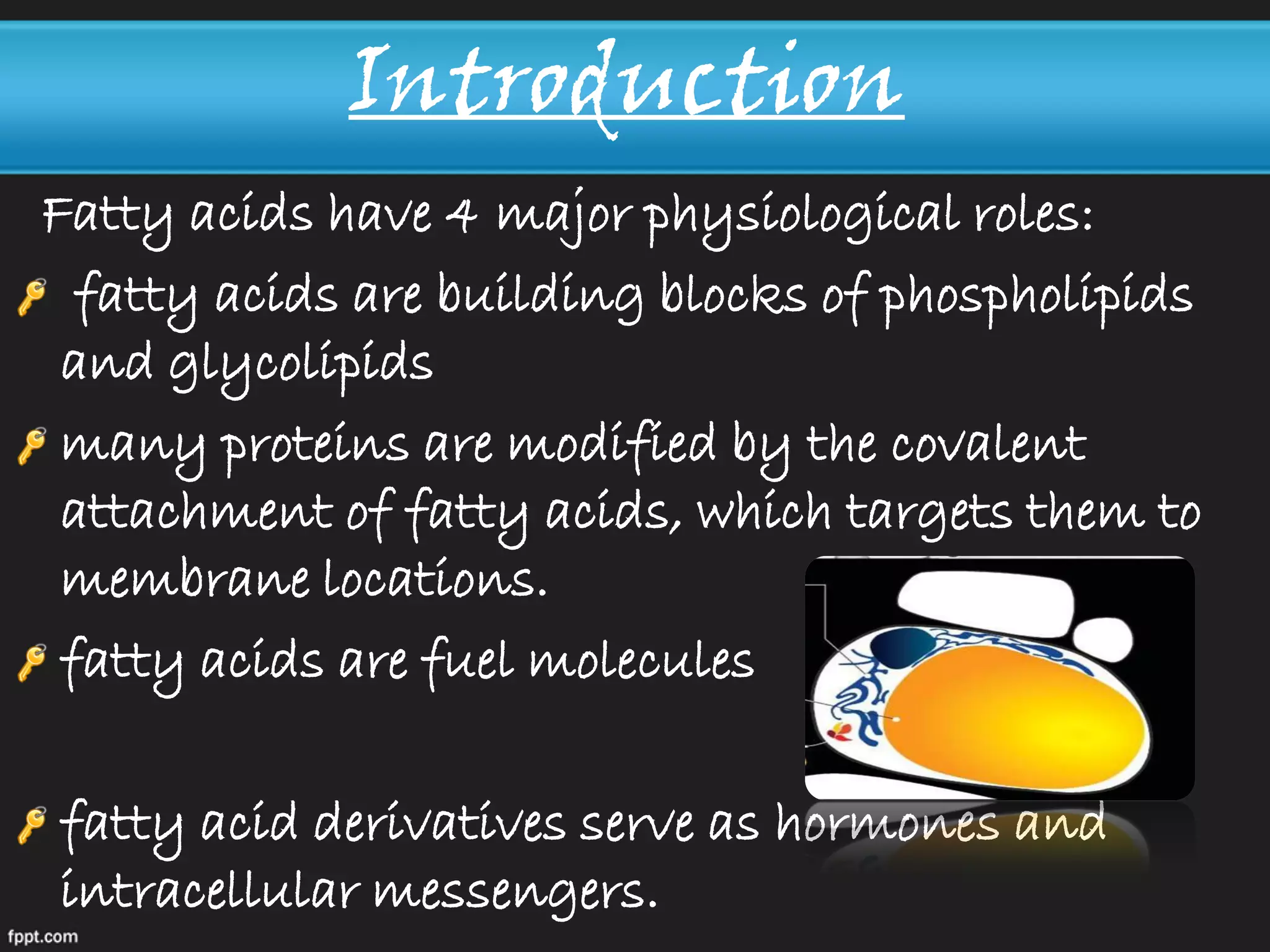
fatty acids are fuel molecules
fatty acid derivatives serve as hormones and
intracellular messengers.
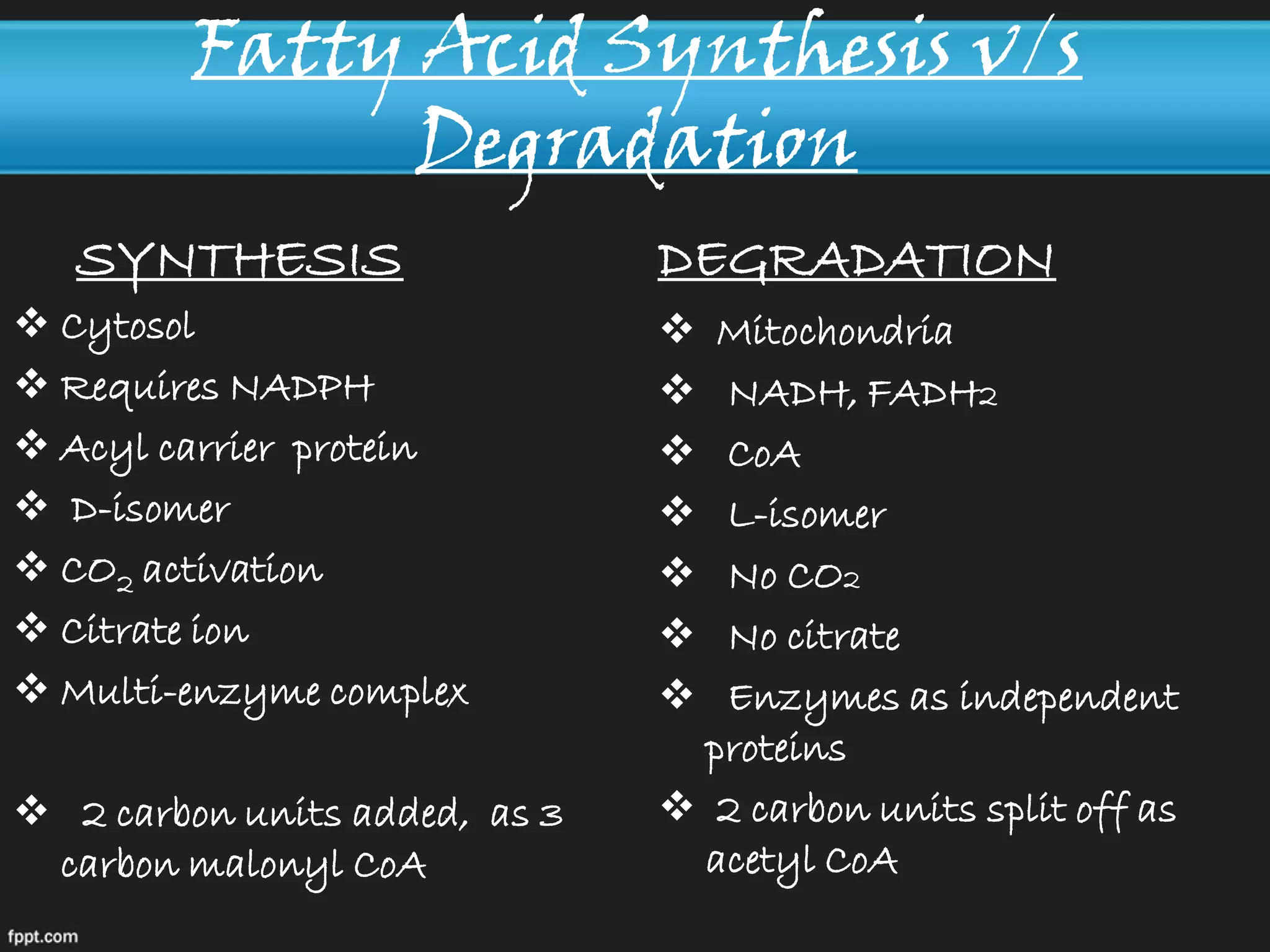
Fatty Acid Synthesis v/s
Degradation
SYNTHESIS
 Cytosol
 Requires NADPH
 Acyl carrier protein
 D-isomer
 CO2 activation
 Citrate ion
 Multi-enzyme complex
 2 carbon units added, as 3
carbon malonyl CoA
DEGRADATION
 Mitochondria
 NADH, FADH2
 CoA
 L-isomer
 No CO2
 No citrate
 Enzymes as independent
proteins
 2 carbon units split off as
acetyl CoA
Biosynthesis
Fatty Acid biosynthesis is a stepwise assembly of
acetyl-CoA units (in the form of malonyl-CoA
units) ending with Palmitate (C-16).
It includes 3 steps :
Transfer of Acetyl CoA to
Cytosol
MITOCHONDRIA CYTOSOL
Citrate Citrate
Pyruvate Pyruvate
Oxaloacetate
Malate
AcetylCoA
NAD+
NADH
NADPH
Oxaloacetate
AcetylCoA
1)Activation Of Acetyl-CoA
Reaction is catalyzed by acetyl-CoA carboxylase. It is
a multienzyme protein. The enzyme contains a
variable number of identical subunits, each
containing biotin, biotin carboxylase, biotin carboxyl
carrier protein, and transcarboxylase, as well as a
regulatory allosteric site.
CH3CO~SCoA OOC*-CH2CO~SCoA
_
Enz-Biotin-*COO
_
Enz-Biotin
ATP+H*CO3
_
ADP+Pi
2)Elongation Cycle
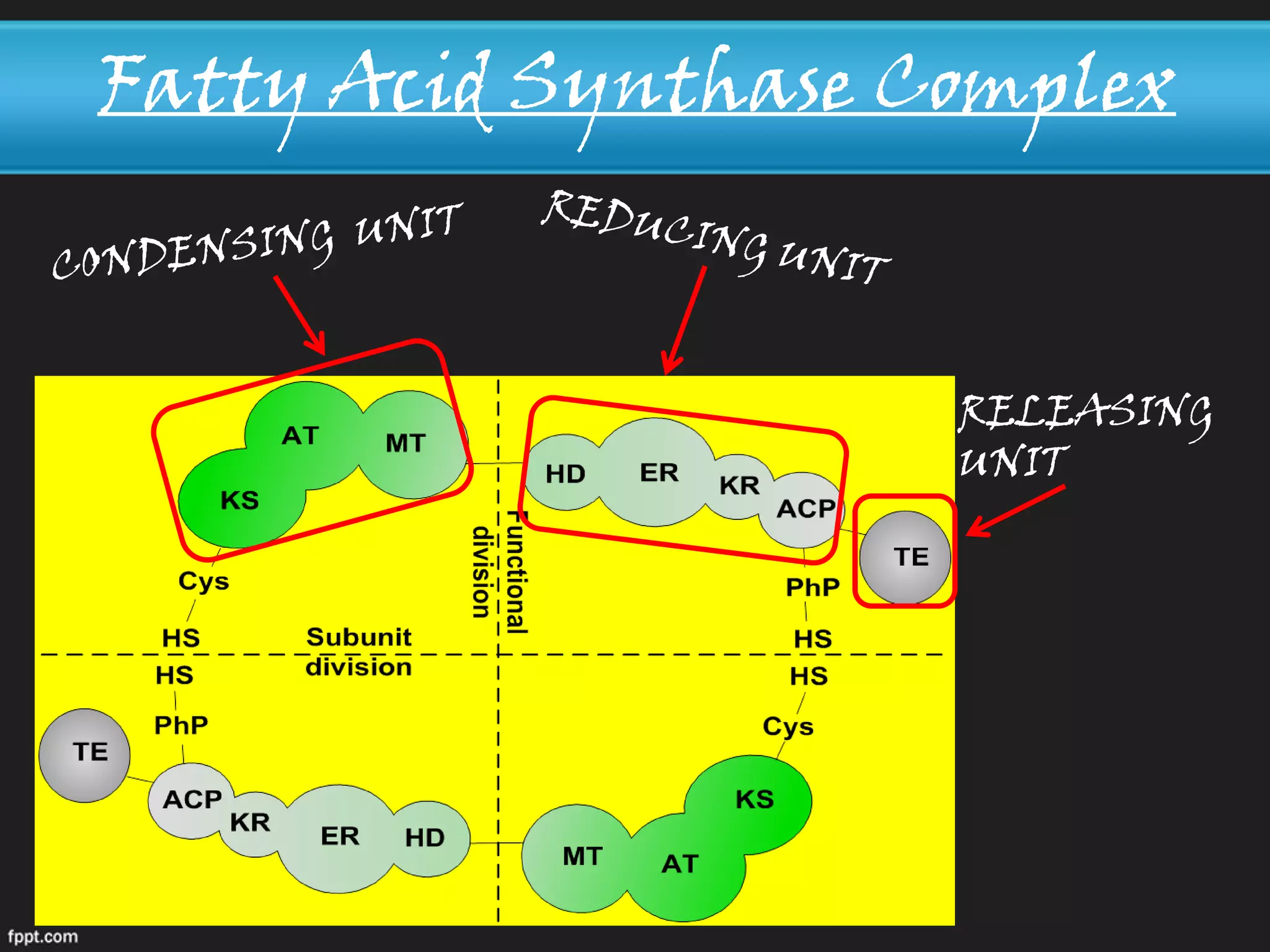
The enzyme system that catalyzes the synthesis of
saturated long-chain fatty acids from acetyl CoA,
malonyl CoA, and NADPH is called the fatty acid
synthase.
Acyl Carrier Protein contains the vitamin pantothenic
acid in the form of 4'-phosphopantetheine. ACP takes over
the role of CoA.
HS-CH2-CH2-N-C-CH2-CH2-N-C-C-C-CH2-O-P-O-CH2-Ser-
O O O
O
H
H
H
HO CH3
H
ACP
ACP, a single polypeptide chain of 77 residues, can be regarded as
a giant prosthetic group.
CYSTEAMINE
PHOSPHOPANTETHEINE
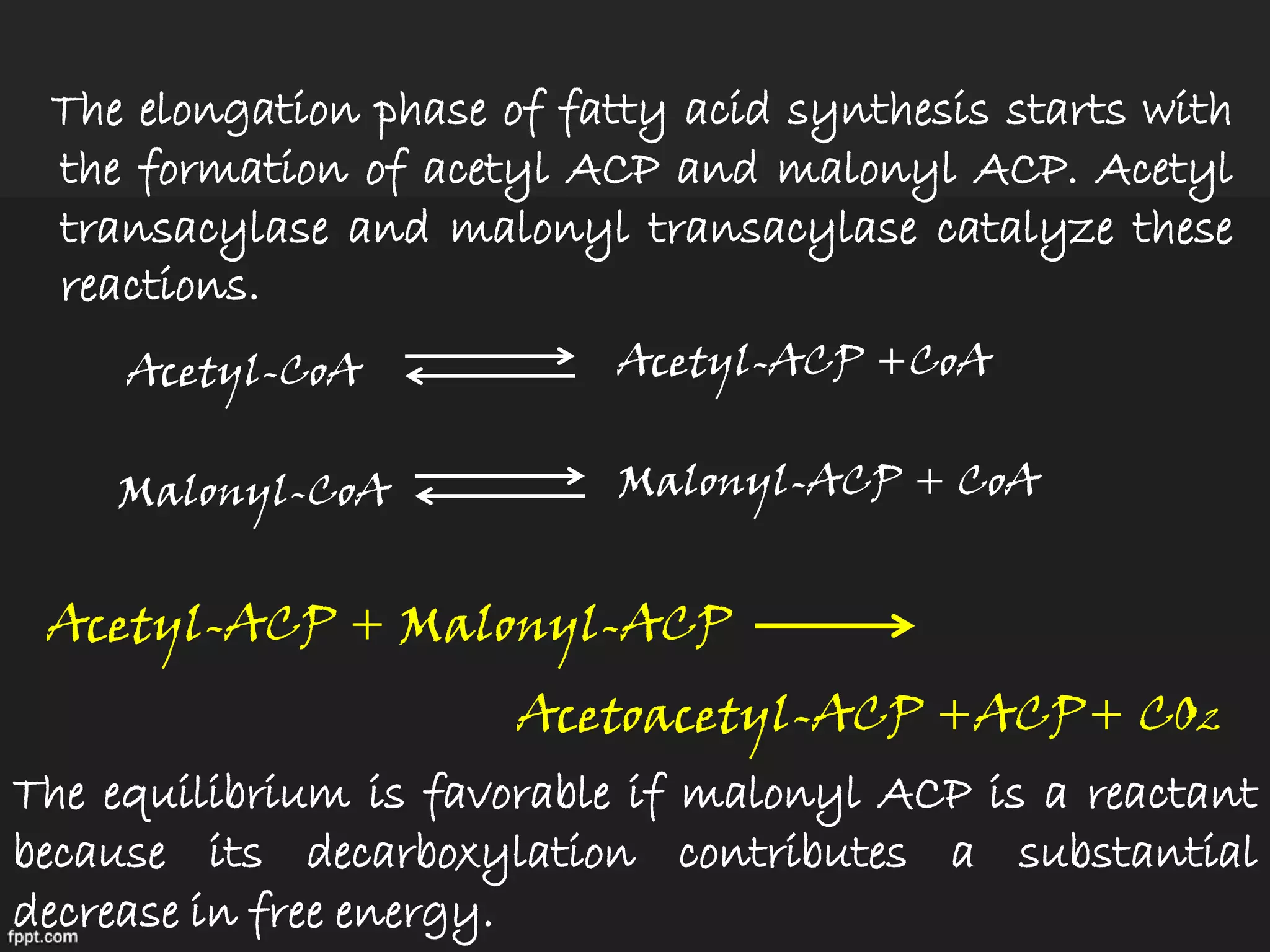
The elongation phase of fatty acid synthesis starts with
the formation of acetyl ACP and malonyl ACP. Acetyl
transacylase and malonyl transacylase catalyze these
reactions.
Acetyl-CoA Acetyl-ACP +CoA
Malonyl-CoA Malonyl-ACP + CoA
Acetyl-ACP + Malonyl-ACP
Acetoacetyl-ACP +ACP+ CO2
The equilibrium is favorable if malonyl ACP is a reactant
because its decarboxylation contributes a substantial
decrease in free energy.
Fatty Acid Synthase Complex
RELEASING
UNIT
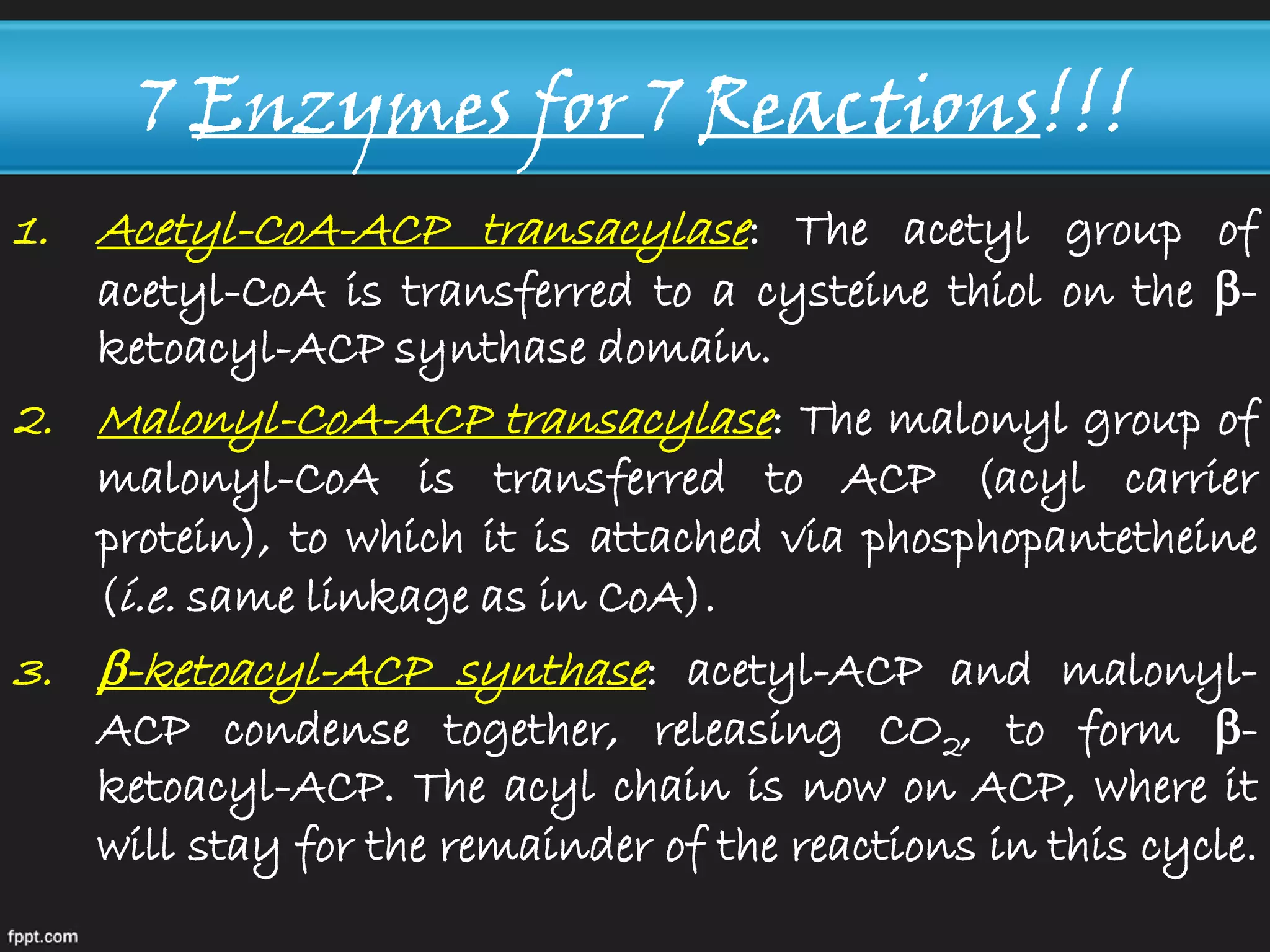
7 Enzymes for 7 Reactions!!!
1. Acetyl-CoA-ACP transacylase: The acetyl group of
acetyl-CoA is transferred to a cysteine thiol on the -
ketoacyl-ACP synthase domain.
2. Malonyl-CoA-ACP transacylase: The malonyl group of
malonyl-CoA is transferred to ACP (acyl carrier
protein), to which it is attached via phosphopantetheine
(i.e. same linkage as in CoA).
3. -ketoacyl-ACP synthase: acetyl-ACP and malonyl-
ACP condense together, releasing CO2, to form -
ketoacyl-ACP. The acyl chain is now on ACP, where it
will stay for the remainder of the reactions in this cycle.
4. -ketoacyl-ACP reductase: Using NADPH, the ketone is
reduced to a hydroxyl group. (Note that the carbon
bearing the hydroxyl is chiral – this compound is in the
D-configuration.)
5. -hydroxyacyl-ACP dehydratase: Water is eliminated,
making a trans-2-enoyl-ACP.
6. enoyl-ACP reductase: Using NADPH, the double bond is
saturated.
7 iterations of this cycle will give
a Palmitoyl- ACP.
‘CH3 C-
O
CH2C~S-
O
ACP
NADPH
CH3 CH2CH2C~S-
O
ACP
CH3 C- CH2C~S-
O
ACP
HO
H
CH3 C = C- C~S-
O
ACP
H
H
-H2O
NADPH
-Carbon ELONGATION
D isomer
REDUCTION
DEHYDRATION
REDUCTION
-Ketoacyl-ACP reductase
 -Hydroxyacyl-ACP dehydrase
Enoyl-ACP reductase
Termination via 7th Enzyme
7. thioesterase: Palmitate is released by hydrolysis of
palmitoyl-ACP via thioesterase. This enzyme is rather
specific for C16.
Reactions
7 AcetylCoA +7CO2+ 7ATP 7MalonylCoA+7ADP+7Pi
+14H
ActylCoA + 7MalonylCoA
+ 14NADPH+ 14H
Palmitate + 7CO2 + 14
NADP +8HSCoA+ 6 H2O
8 AcetylCoA + 7ATP +
14NADPH + 7H
Palmitate + 14NADP
+ 8HSCoA +6H2O
+7ADP + 7Pi
+
+
+
+
+
Post Synthesis Modification
Elongation beyond the 16-C length of the palmitate product of
Fatty Acid Synthase is mainly catalyzed by enzymes
associated with the endoplasmic reticulum (ER).
ER enzymes lengthen fatty acids produced by Fatty Acyl
Synthase as well as dietary polyunsaturated fatty acids.
Fatty acids esterified to coenzyme A serve as substrates.
Malonyl-CoA is the donor of 2-carbon units in a reaction
sequence similar to that of Fatty Acid Synthase except that
individual steps are catalyzed by separate proteins.
1) ELONGATION
2) UNSATURATION
Desaturase introduce double bonds at specific positions in
a fatty acid chain.
Mammalian cells are unable to produce double bonds at
certain locations, e.g., ∆12 . Thus some polyunsaturated
fatty acids are dietary essentials, e.g., linoleic acid.
In the conversion of stearoyl CoA into oleoyl CoA, a cis-
∆ double bond is inserted by an oxidase that employs
molecular oxygen and NADH (or NADPH).
StearoylCoA + NADH +
H + O2
OleoylCoA + NAD
+ 2H2O
+
+
9
Membrane Bound Enzymes
Present in E.R
Formation of a double bond in a fatty acid
involves the following endoplasmic reticulum
membrane proteins in mammalian cells.
NADH-
CYTOCHROME
-B5
REDUCTASE
DESATURASECYTOCHROME
- B5
First, electrons are transferred from NADH to the FAD
moiety of NADH-cytochrome b 5 reductase .
Electron Transport Chain In The
Desaturation Of Fatty Acids
E- FAD
E-
FADH2
Fe
Fe
Fe
Fe
OleoylCoA +
2H2O
Stearoyl CoA
+ O2
H +
NADH
NAD
+
+
2+
3+ 2+
3+
NADH
CYTOCHROME
b5 REDUCTASE
CYTODHROME
b5
DESATURASE
The nonheme iron atom of the desaturase is subsequently converted
into the Fe state, which enables it to interact with O2 and the
saturated fatty acyl CoA substrate. Two electrons come from NADH
and two from the single bond of the fatty acyl substrate.
+3
Palmitate
Stearate
Oleate
Linoleate
-Linolenate
-Linolenate
Eicosatrienoate
Arachidonate
18:3(9,12,15)
18:2(9,12)
18:3(6,9,12)
16:0
18:0
Elongase
18:1(9)
Palmitoleate
16:1(9)
Desaturase
Desaturase
Desaturase
Desaturase
Desaturase
Desaturase
Elongase
20:3(8,11,14)
20:4(5,8,11,14)
Other lipids
REFERENCES
 Biochemistry by Stryer, Berg, Tymozcko
5th_Edition
Biochemistry_Lehninger
Harper’s Illustrated Biochemistry (26th ed)
Biochemistry of fatty acids- Medical
biochemistry
Fatty Acid Synthesis- Renesselear
Biosynthesis of fatty acids

Biosynthesis of fatty acids

  • 1.
  • 2.
    Introduction Fatty acids have4 major physiological roles: fatty acids are building blocks of phospholipids and glycolipids many proteins are modified by the covalent attachment of fatty acids, which targets them to membrane locations. fatty acids are fuel molecules fatty acid derivatives serve as hormones and intracellular messengers.
  • 3.
    Fatty Acid Synthesisv/s Degradation SYNTHESIS  Cytosol  Requires NADPH  Acyl carrier protein  D-isomer  CO2 activation  Citrate ion  Multi-enzyme complex  2 carbon units added, as 3 carbon malonyl CoA DEGRADATION  Mitochondria  NADH, FADH2  CoA  L-isomer  No CO2  No citrate  Enzymes as independent proteins  2 carbon units split off as acetyl CoA
  • 4.
    Biosynthesis Fatty Acid biosynthesisis a stepwise assembly of acetyl-CoA units (in the form of malonyl-CoA units) ending with Palmitate (C-16). It includes 3 steps :
  • 5.
    Transfer of AcetylCoA to Cytosol MITOCHONDRIA CYTOSOL Citrate Citrate Pyruvate Pyruvate Oxaloacetate Malate AcetylCoA NAD+ NADH NADPH Oxaloacetate AcetylCoA
  • 6.
    1)Activation Of Acetyl-CoA Reactionis catalyzed by acetyl-CoA carboxylase. It is a multienzyme protein. The enzyme contains a variable number of identical subunits, each containing biotin, biotin carboxylase, biotin carboxyl carrier protein, and transcarboxylase, as well as a regulatory allosteric site. CH3CO~SCoA OOC*-CH2CO~SCoA _ Enz-Biotin-*COO _ Enz-Biotin ATP+H*CO3 _ ADP+Pi
  • 7.
    2)Elongation Cycle The enzymesystem that catalyzes the synthesis of saturated long-chain fatty acids from acetyl CoA, malonyl CoA, and NADPH is called the fatty acid synthase. Acyl Carrier Protein contains the vitamin pantothenic acid in the form of 4'-phosphopantetheine. ACP takes over the role of CoA. HS-CH2-CH2-N-C-CH2-CH2-N-C-C-C-CH2-O-P-O-CH2-Ser- O O O O H H H HO CH3 H ACP ACP, a single polypeptide chain of 77 residues, can be regarded as a giant prosthetic group. CYSTEAMINE PHOSPHOPANTETHEINE
  • 8.
    The elongation phaseof fatty acid synthesis starts with the formation of acetyl ACP and malonyl ACP. Acetyl transacylase and malonyl transacylase catalyze these reactions. Acetyl-CoA Acetyl-ACP +CoA Malonyl-CoA Malonyl-ACP + CoA Acetyl-ACP + Malonyl-ACP Acetoacetyl-ACP +ACP+ CO2 The equilibrium is favorable if malonyl ACP is a reactant because its decarboxylation contributes a substantial decrease in free energy.
  • 9.
    Fatty Acid SynthaseComplex RELEASING UNIT
  • 10.
    7 Enzymes for7 Reactions!!! 1. Acetyl-CoA-ACP transacylase: The acetyl group of acetyl-CoA is transferred to a cysteine thiol on the - ketoacyl-ACP synthase domain. 2. Malonyl-CoA-ACP transacylase: The malonyl group of malonyl-CoA is transferred to ACP (acyl carrier protein), to which it is attached via phosphopantetheine (i.e. same linkage as in CoA). 3. -ketoacyl-ACP synthase: acetyl-ACP and malonyl- ACP condense together, releasing CO2, to form - ketoacyl-ACP. The acyl chain is now on ACP, where it will stay for the remainder of the reactions in this cycle.
  • 11.
    4. -ketoacyl-ACP reductase:Using NADPH, the ketone is reduced to a hydroxyl group. (Note that the carbon bearing the hydroxyl is chiral – this compound is in the D-configuration.) 5. -hydroxyacyl-ACP dehydratase: Water is eliminated, making a trans-2-enoyl-ACP. 6. enoyl-ACP reductase: Using NADPH, the double bond is saturated. 7 iterations of this cycle will give a Palmitoyl- ACP.
  • 12.
    ‘CH3 C- O CH2C~S- O ACP NADPH CH3 CH2CH2C~S- O ACP CH3C- CH2C~S- O ACP HO H CH3 C = C- C~S- O ACP H H -H2O NADPH -Carbon ELONGATION D isomer REDUCTION DEHYDRATION REDUCTION -Ketoacyl-ACP reductase  -Hydroxyacyl-ACP dehydrase Enoyl-ACP reductase
  • 13.
    Termination via 7thEnzyme 7. thioesterase: Palmitate is released by hydrolysis of palmitoyl-ACP via thioesterase. This enzyme is rather specific for C16. Reactions 7 AcetylCoA +7CO2+ 7ATP 7MalonylCoA+7ADP+7Pi +14H ActylCoA + 7MalonylCoA + 14NADPH+ 14H Palmitate + 7CO2 + 14 NADP +8HSCoA+ 6 H2O 8 AcetylCoA + 7ATP + 14NADPH + 7H Palmitate + 14NADP + 8HSCoA +6H2O +7ADP + 7Pi + + + + +
  • 15.
    Post Synthesis Modification Elongationbeyond the 16-C length of the palmitate product of Fatty Acid Synthase is mainly catalyzed by enzymes associated with the endoplasmic reticulum (ER). ER enzymes lengthen fatty acids produced by Fatty Acyl Synthase as well as dietary polyunsaturated fatty acids. Fatty acids esterified to coenzyme A serve as substrates. Malonyl-CoA is the donor of 2-carbon units in a reaction sequence similar to that of Fatty Acid Synthase except that individual steps are catalyzed by separate proteins. 1) ELONGATION
  • 16.
    2) UNSATURATION Desaturase introducedouble bonds at specific positions in a fatty acid chain. Mammalian cells are unable to produce double bonds at certain locations, e.g., ∆12 . Thus some polyunsaturated fatty acids are dietary essentials, e.g., linoleic acid. In the conversion of stearoyl CoA into oleoyl CoA, a cis- ∆ double bond is inserted by an oxidase that employs molecular oxygen and NADH (or NADPH). StearoylCoA + NADH + H + O2 OleoylCoA + NAD + 2H2O + + 9
  • 17.
    Membrane Bound Enzymes Presentin E.R Formation of a double bond in a fatty acid involves the following endoplasmic reticulum membrane proteins in mammalian cells. NADH- CYTOCHROME -B5 REDUCTASE DESATURASECYTOCHROME - B5 First, electrons are transferred from NADH to the FAD moiety of NADH-cytochrome b 5 reductase .
  • 18.
    Electron Transport ChainIn The Desaturation Of Fatty Acids E- FAD E- FADH2 Fe Fe Fe Fe OleoylCoA + 2H2O Stearoyl CoA + O2 H + NADH NAD + + 2+ 3+ 2+ 3+ NADH CYTOCHROME b5 REDUCTASE CYTODHROME b5 DESATURASE The nonheme iron atom of the desaturase is subsequently converted into the Fe state, which enables it to interact with O2 and the saturated fatty acyl CoA substrate. Two electrons come from NADH and two from the single bond of the fatty acyl substrate. +3
  • 19.
  • 20.
    REFERENCES  Biochemistry byStryer, Berg, Tymozcko 5th_Edition Biochemistry_Lehninger Harper’s Illustrated Biochemistry (26th ed) Biochemistry of fatty acids- Medical biochemistry Fatty Acid Synthesis- Renesselear