METABOLISM
PREPARED BY ;
BULBUL SHRESTHA
PUSHPA MAHATO
YOGITA GURUNG
HEXOSE MONOPHOSPHATE PATHWAY
 Hexose monophosphate pathway or HMP Shunt is also called as pentose phosphate
pathway(PPP) or phosphogluconate pathway.
This is an alternative pathway to Glycolysis and TCA cycle for the oxidation of
glucose.
 However , HMP pathway is more anabolic in nature , since it is concered with the
biosynthesis of NADPH and Pentoses .
BIOLOGICAL SIGNIFICANCE;
A) Importance of NADPH
 It is used in the biosynthesis of fatty acids and steroids
 It is used in the synthesis of certain amino acids
 It keeps the glutathione of RBC in reduced state to preserve the integrity of RBC
membrane
 The process phagocytosis requires NADPH
 It is required for the detoxification of drugs
B) Importance of pentoses
 The pentose and its derivatives are used for the synthesis of nucleic acids ( DNA ,RNA )
and many mucleotides such as (ATP ,NAD+ ,FAD , CoA)
HMP Pathway – a unique multifunctional pathway
 The pathway starts with Glucose-6 phosphate .
No ATP is directly utilized or produced in HMP Pathway .
 It is a unique multifunctional pathway , since there are several interconvertible substances
produced which may proceed in different directions in metabolic reactions
LOCATION;
 It takes place in the cytoplasm of both prokaryotes and eukaryotes
 The tissues suchas liver , adipose tissue , adrenal gland ,erythocytes, testes,and lactating
mammary gland are highly active in HMP shunt.
How does it happens?
The breakdown of the simple sugar, glucose, in glycolysis provides the first 6-carbon
molecule required for the pentose phosphate pathway. During the first step of glycolysis,
glucose is transformed by the addition of a phosphate group, generating glucose-6-phosphate,
another 6-carbon molecule. The pentose phosphate pathway can use any available molecules
of glucose-6-phosphate, whether they are produced by glycolysis or other methods.
Now, we are ready to enter the first of two phases of the pentose
phosphate pathway:
1) The oxidative phase
2) The non-oxidative phase
1.The oxidative phase
First four reactions are irreversible and oxidative in which glucose molecule is
oxidized twice generating two molecules of NADPH and glucose is converted into Ribose-5
phosphate.
REACTION 1ST : CONVERSION OF GLUCOSE TO GLUCOSE -6 PHOSPHATE
 This reaction is catalyzed by the enzyme
hexokinase and a molecule of ATP is utilized .
This is a primary step of glycolysis.
REACTION 2nd : CONVERSION OF GLUCOSE 6-PHOSPHATE TO 6-PHOSPHOGLUCONOLACTONATE
 This reaction is catalyzed by an enzyme
glucose6 -phosphate dehydrogenase (G6PD)
 In this reaction a molecule of NADPH
is produced
REACTION 3rd : CONVERSION OF 6-PHOSPHOGLUCONOLACTONE TO
6-PHOSPHOGLUCONATE
 This reaction is hydrolysis reaction
catalyzed by hydrolase enzyme i.e 6-phospho gluconolactonase
REACTION 4th :CONVERSION OF 6-PHOSPHOGLUCONATE
TO RIBOSE- 6 -PHOSPHATE
 This reaction is catalyzed by the enzyme 6-phosphogluconate dehydrogenase to produce
3-keto 6 phosphogluconate which undergoes decarboxylation to produce ribulose
phosphate
 In this reaction a molecule of NADPH is generated.
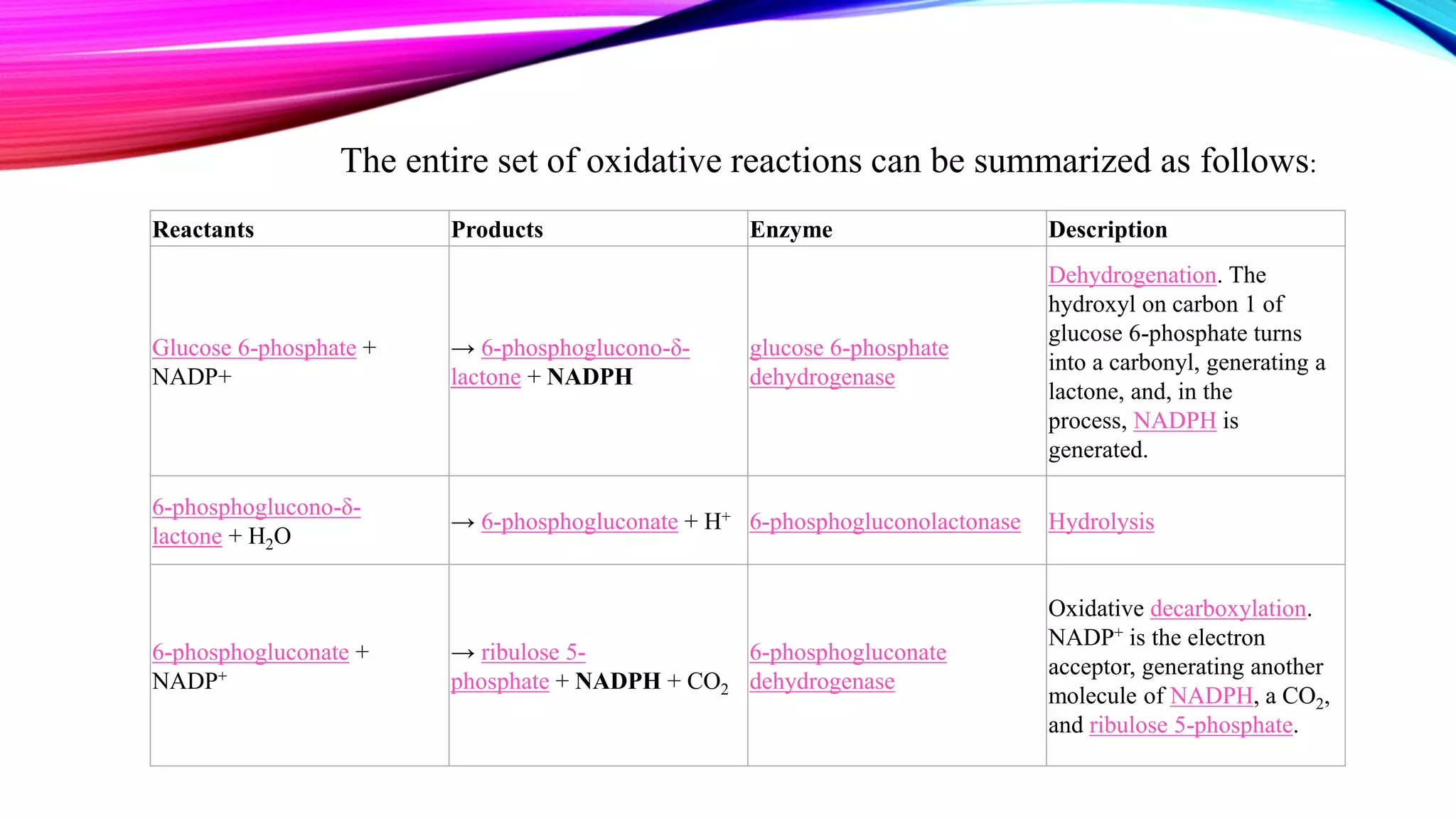
Reactants Products Enzyme Description
Glucose 6-phosphate +
NADP+
→ 6-phosphoglucono-δ-
lactone + NADPH
glucose 6-phosphate
dehydrogenase
Dehydrogenation. The
hydroxyl on carbon 1 of
glucose 6-phosphate turns
into a carbonyl, generating a
lactone, and, in the
process, NADPH is
generated.
6-phosphoglucono-δ-
lactone + H2O
→ 6-phosphogluconate + H+ 6-phosphogluconolactonase Hydrolysis
6-phosphogluconate +
NADP+
→ ribulose 5-
phosphate + NADPH + CO2
6-phosphogluconate
dehydrogenase
Oxidative decarboxylation.
NADP+ is the electron
acceptor, generating another
molecule of NADPH, a CO2,
and ribulose 5-phosphate.
The entire set of oxidative reactions can be summarized as follows:
THE NON OXIDATIVE PHASE
 Non-Oxidative reactions is followed by a series reversible sugar phosphate inter-conversion reaction.
 REACTION 5th ;
Ribulose-5-phosphate is epimerized to produce xylulose 5-phosphate in the presence of enzyme
phosphor pentose epimerase. Similarly ribulose-5-phosphate is also keto-isomerized into ribose 5-
phosphate.
 REACTION 6th ;
Xylulose-5-phosphate transfer two carbon moiety to ribose 5-phospahate in the presence of enzyme
transketolase to form sedoheptulose-7-phosphate and glyceraldehyde 3—phosphate.
 REACTION 7th ;
Sedoheptulose -7-phosphate transfer three carbon moiety to glyceraldehyde -3-phosphate to
form fructose 6-phopsphate and erythrose 4-phosphate in the presence of enzyme transaldolase.
 REACTION 8th;
Transketolase enzyme catalyse the transfer of two carbon moiety from Xylulose-5-phosphate to
erythrose-4- phosphate to form fructose-6-phosphate and glyceraldehyde-3-phosphate.
 REACTION 9th ;
Fructose-6-phosphate and glyceraldehyde-3-phosphate is later enter into glycolysis and kreb’s cycle.
 The rate and direction of reversible reaction depends upon the needs of cell.
 If cell needs only NADPH then fructose-phosphate and glyceraldehyde-3-phosphate are converted
back to glucose by reverse glycolysis, otherwise converted to pyruvate and enter TCA cycle
generating ATPs.
Reactants Products Enzymes
ribulose 5-phosphate → ribose 5-phosphate Ribose-5-phosphate isomerase
ribulose 5-phosphate → xylulose 5-phosphate Ribulose 5-Phosphate 3-Epimerase
xylulose 5-phosphate + ribose 5-
phosphate
→ glyceraldehyde 3-
phosphate + sedoheptulose 7-
phosphate
transketolase
sedoheptulose 7-
phosphate + glyceraldehyde 3-
phosphate
→ erythrose 4-phosphate + fructose
transaldolase
xylulose 5-phosphate + erythrose
→ glyceraldehyde 3-
phosphate + fructose 6-phosphate
transketolase
The entire set of non oxidative reactions can be summarized as follows:
RESULTS OF PENTOSE PHOSPHATE PATHWAY
• Oxidative portion : Irreversible
Generates two NADPH , which can then be used in fatty acid synthesis and cholestrol
synthesis and for maintaining reduced glutathione inside RBCs
• Nonoxidative portion : Reversible
Generates intermediate molecules ( Ribose-5 -phosphate ; Glyceraldehyde-3-phosphate;
fructose-6-phosphate) for nucleotide synthesis and glycolysis
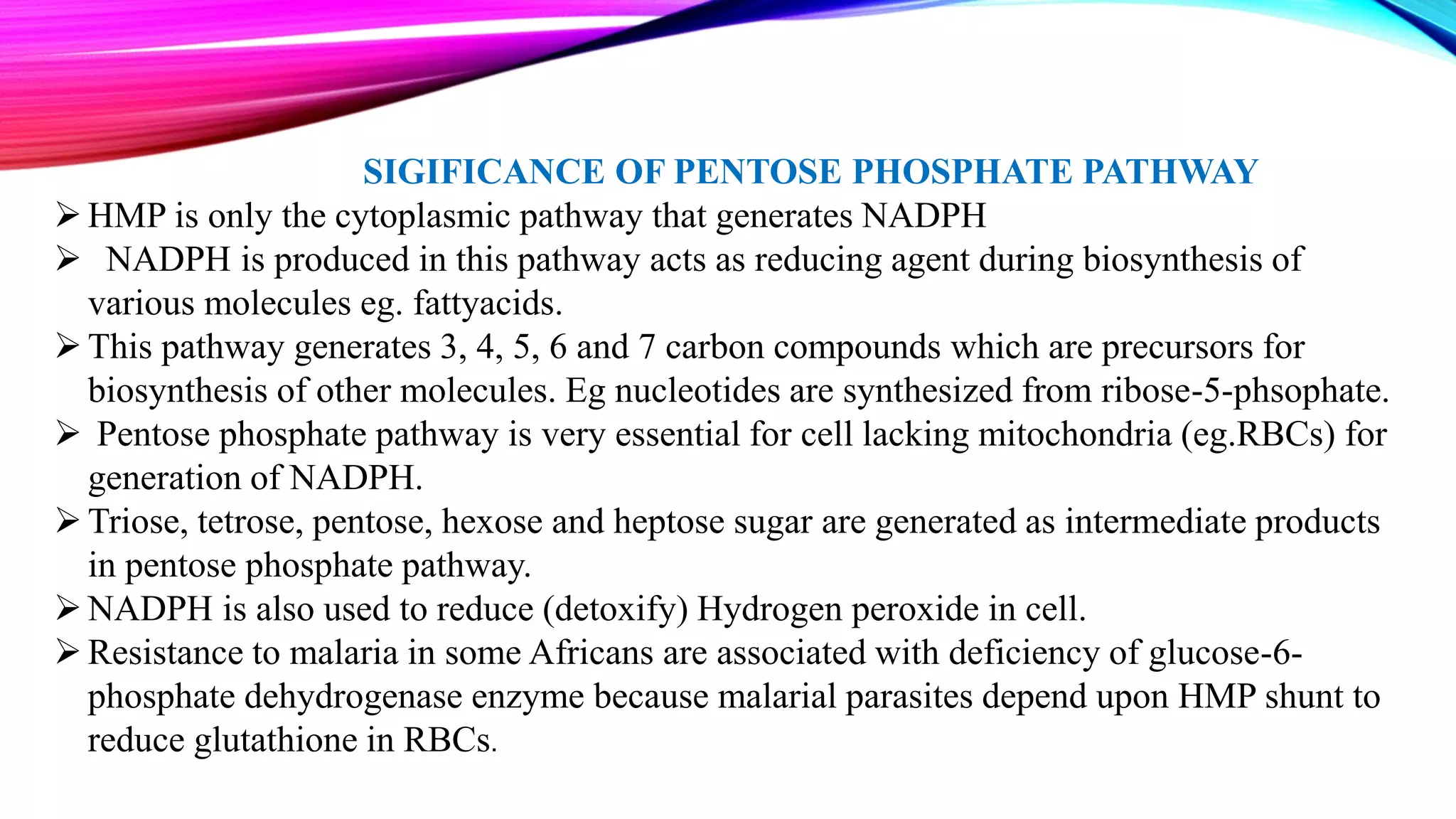
SIGIFICANCE OF PENTOSE PHOSPHATE PATHWAY
HMP is only the cytoplasmic pathway that generates NADPH
 NADPH is produced in this pathway acts as reducing agent during biosynthesis of
various molecules eg. fattyacids.
This pathway generates 3, 4, 5, 6 and 7 carbon compounds which are precursors for
biosynthesis of other molecules. Eg nucleotides are synthesized from ribose-5-phsophate.
 Pentose phosphate pathway is very essential for cell lacking mitochondria (eg.RBCs) for
generation of NADPH.
Triose, tetrose, pentose, hexose and heptose sugar are generated as intermediate products
in pentose phosphate pathway.
NADPH is also used to reduce (detoxify) Hydrogen peroxide in cell.
Resistance to malaria in some Africans are associated with deficiency of glucose-6-
phosphate dehydrogenase enzyme because malarial parasites depend upon HMP shunt to
reduce glutathione in RBCs.
REFERENCES
BIOCHEMISTRY 3rd Edition Dr. U . Satayanarayan & Dr . U. Chakrapani
Slideshare; Pentose phosphate pathway by Mr. Anup Muni Bajracharya
HMP PATHWAY

HMP PATHWAY

  • 1.
    METABOLISM PREPARED BY ; BULBULSHRESTHA PUSHPA MAHATO YOGITA GURUNG
  • 3.
    HEXOSE MONOPHOSPHATE PATHWAY Hexose monophosphate pathway or HMP Shunt is also called as pentose phosphate pathway(PPP) or phosphogluconate pathway. This is an alternative pathway to Glycolysis and TCA cycle for the oxidation of glucose.  However , HMP pathway is more anabolic in nature , since it is concered with the biosynthesis of NADPH and Pentoses . BIOLOGICAL SIGNIFICANCE; A) Importance of NADPH  It is used in the biosynthesis of fatty acids and steroids  It is used in the synthesis of certain amino acids  It keeps the glutathione of RBC in reduced state to preserve the integrity of RBC membrane  The process phagocytosis requires NADPH  It is required for the detoxification of drugs
  • 4.
    B) Importance ofpentoses  The pentose and its derivatives are used for the synthesis of nucleic acids ( DNA ,RNA ) and many mucleotides such as (ATP ,NAD+ ,FAD , CoA) HMP Pathway – a unique multifunctional pathway  The pathway starts with Glucose-6 phosphate . No ATP is directly utilized or produced in HMP Pathway .  It is a unique multifunctional pathway , since there are several interconvertible substances produced which may proceed in different directions in metabolic reactions LOCATION;  It takes place in the cytoplasm of both prokaryotes and eukaryotes  The tissues suchas liver , adipose tissue , adrenal gland ,erythocytes, testes,and lactating mammary gland are highly active in HMP shunt.
  • 5.
    How does ithappens? The breakdown of the simple sugar, glucose, in glycolysis provides the first 6-carbon molecule required for the pentose phosphate pathway. During the first step of glycolysis, glucose is transformed by the addition of a phosphate group, generating glucose-6-phosphate, another 6-carbon molecule. The pentose phosphate pathway can use any available molecules of glucose-6-phosphate, whether they are produced by glycolysis or other methods. Now, we are ready to enter the first of two phases of the pentose phosphate pathway: 1) The oxidative phase 2) The non-oxidative phase
  • 7.
    1.The oxidative phase Firstfour reactions are irreversible and oxidative in which glucose molecule is oxidized twice generating two molecules of NADPH and glucose is converted into Ribose-5 phosphate.
  • 8.
    REACTION 1ST :CONVERSION OF GLUCOSE TO GLUCOSE -6 PHOSPHATE  This reaction is catalyzed by the enzyme hexokinase and a molecule of ATP is utilized . This is a primary step of glycolysis. REACTION 2nd : CONVERSION OF GLUCOSE 6-PHOSPHATE TO 6-PHOSPHOGLUCONOLACTONATE  This reaction is catalyzed by an enzyme glucose6 -phosphate dehydrogenase (G6PD)  In this reaction a molecule of NADPH is produced
  • 9.
    REACTION 3rd :CONVERSION OF 6-PHOSPHOGLUCONOLACTONE TO 6-PHOSPHOGLUCONATE  This reaction is hydrolysis reaction catalyzed by hydrolase enzyme i.e 6-phospho gluconolactonase REACTION 4th :CONVERSION OF 6-PHOSPHOGLUCONATE TO RIBOSE- 6 -PHOSPHATE  This reaction is catalyzed by the enzyme 6-phosphogluconate dehydrogenase to produce 3-keto 6 phosphogluconate which undergoes decarboxylation to produce ribulose phosphate  In this reaction a molecule of NADPH is generated.
  • 10.
    Reactants Products EnzymeDescription Glucose 6-phosphate + NADP+ → 6-phosphoglucono-δ- lactone + NADPH glucose 6-phosphate dehydrogenase Dehydrogenation. The hydroxyl on carbon 1 of glucose 6-phosphate turns into a carbonyl, generating a lactone, and, in the process, NADPH is generated. 6-phosphoglucono-δ- lactone + H2O → 6-phosphogluconate + H+ 6-phosphogluconolactonase Hydrolysis 6-phosphogluconate + NADP+ → ribulose 5- phosphate + NADPH + CO2 6-phosphogluconate dehydrogenase Oxidative decarboxylation. NADP+ is the electron acceptor, generating another molecule of NADPH, a CO2, and ribulose 5-phosphate. The entire set of oxidative reactions can be summarized as follows:
  • 13.
    THE NON OXIDATIVEPHASE  Non-Oxidative reactions is followed by a series reversible sugar phosphate inter-conversion reaction.  REACTION 5th ; Ribulose-5-phosphate is epimerized to produce xylulose 5-phosphate in the presence of enzyme phosphor pentose epimerase. Similarly ribulose-5-phosphate is also keto-isomerized into ribose 5- phosphate.  REACTION 6th ; Xylulose-5-phosphate transfer two carbon moiety to ribose 5-phospahate in the presence of enzyme transketolase to form sedoheptulose-7-phosphate and glyceraldehyde 3—phosphate.  REACTION 7th ; Sedoheptulose -7-phosphate transfer three carbon moiety to glyceraldehyde -3-phosphate to form fructose 6-phopsphate and erythrose 4-phosphate in the presence of enzyme transaldolase.
  • 14.
     REACTION 8th; Transketolaseenzyme catalyse the transfer of two carbon moiety from Xylulose-5-phosphate to erythrose-4- phosphate to form fructose-6-phosphate and glyceraldehyde-3-phosphate.  REACTION 9th ; Fructose-6-phosphate and glyceraldehyde-3-phosphate is later enter into glycolysis and kreb’s cycle.  The rate and direction of reversible reaction depends upon the needs of cell.  If cell needs only NADPH then fructose-phosphate and glyceraldehyde-3-phosphate are converted back to glucose by reverse glycolysis, otherwise converted to pyruvate and enter TCA cycle generating ATPs.
  • 15.
    Reactants Products Enzymes ribulose5-phosphate → ribose 5-phosphate Ribose-5-phosphate isomerase ribulose 5-phosphate → xylulose 5-phosphate Ribulose 5-Phosphate 3-Epimerase xylulose 5-phosphate + ribose 5- phosphate → glyceraldehyde 3- phosphate + sedoheptulose 7- phosphate transketolase sedoheptulose 7- phosphate + glyceraldehyde 3- phosphate → erythrose 4-phosphate + fructose transaldolase xylulose 5-phosphate + erythrose → glyceraldehyde 3- phosphate + fructose 6-phosphate transketolase The entire set of non oxidative reactions can be summarized as follows:
  • 17.
    RESULTS OF PENTOSEPHOSPHATE PATHWAY • Oxidative portion : Irreversible Generates two NADPH , which can then be used in fatty acid synthesis and cholestrol synthesis and for maintaining reduced glutathione inside RBCs • Nonoxidative portion : Reversible Generates intermediate molecules ( Ribose-5 -phosphate ; Glyceraldehyde-3-phosphate; fructose-6-phosphate) for nucleotide synthesis and glycolysis
  • 18.
    SIGIFICANCE OF PENTOSEPHOSPHATE PATHWAY HMP is only the cytoplasmic pathway that generates NADPH  NADPH is produced in this pathway acts as reducing agent during biosynthesis of various molecules eg. fattyacids. This pathway generates 3, 4, 5, 6 and 7 carbon compounds which are precursors for biosynthesis of other molecules. Eg nucleotides are synthesized from ribose-5-phsophate.  Pentose phosphate pathway is very essential for cell lacking mitochondria (eg.RBCs) for generation of NADPH. Triose, tetrose, pentose, hexose and heptose sugar are generated as intermediate products in pentose phosphate pathway. NADPH is also used to reduce (detoxify) Hydrogen peroxide in cell. Resistance to malaria in some Africans are associated with deficiency of glucose-6- phosphate dehydrogenase enzyme because malarial parasites depend upon HMP shunt to reduce glutathione in RBCs.
  • 19.
    REFERENCES BIOCHEMISTRY 3rd EditionDr. U . Satayanarayan & Dr . U. Chakrapani Slideshare; Pentose phosphate pathway by Mr. Anup Muni Bajracharya