Lecture 3
Survey Research & Design in Psychology
James Neill, 2017
Creative Commons Attribution 4.0
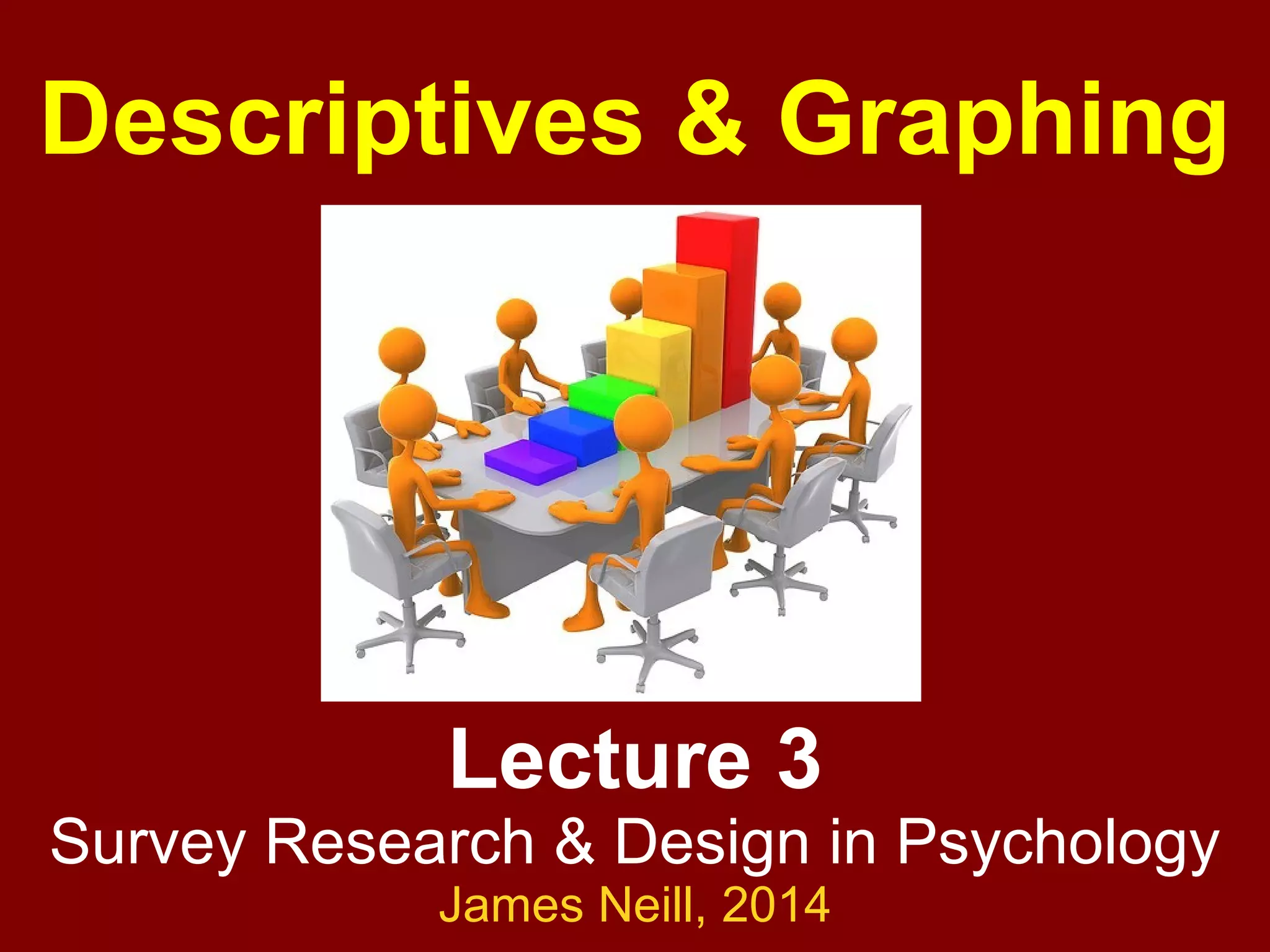
Descriptives & Graphing
Image source: http://commons.wikimedia.org/wiki/File:3D_Bar_Graph_Meeting.jpg
2
Overview:
Descriptives & Graphing
1. Getting to know a data set
2. LOM & types of statistics
3. Descriptive statistics
4. Normal distribution
5. Non-normal distributions
6. Effect of skew on central tendency
7. Principles of graphing
8. Univariate graphical techniques
3
Getting to know
a data-set
(how to approach data)
4
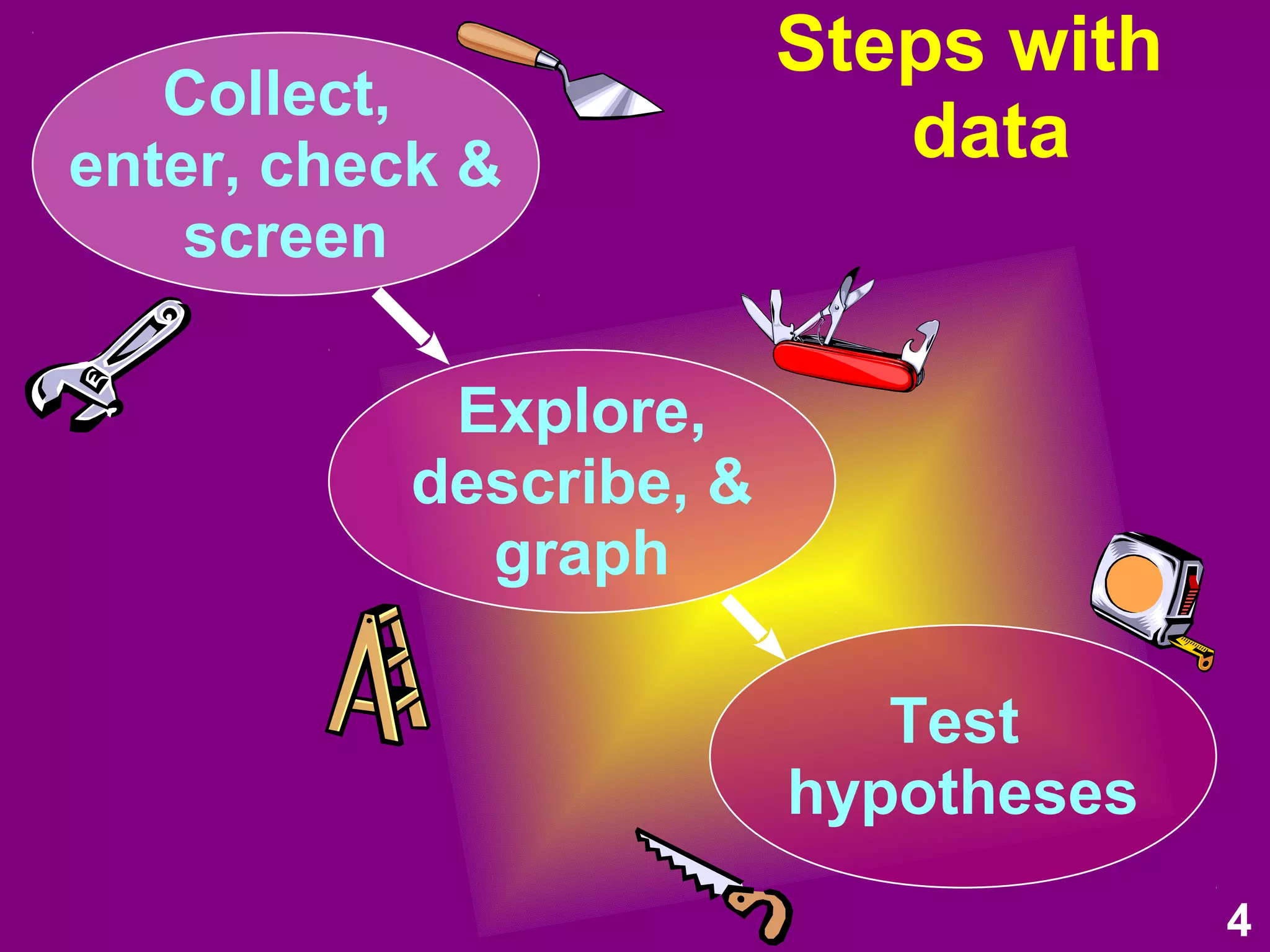
Play with the data –
get to know it.Image source: http://www.flickr.com/photos/analytik/1356366068/
5
Don't be afraid - you
can't break data!Image source: http://www.flickr.com/photos/rnddave/5094020069
6
Check & screen the data –
keep signal, reduce noise
Image source: https://commons.wikimedia.org/wiki/File:Nasir-al_molk_-1.jpg
7
Data checking: One
person reads the survey responses
aloud to another person who checks
the electronic data file.
For large studies, check a
proportion of the surveys
and declare the error-rate
in the research report.
Image source: http://maxpixel.freegreatpicture.com/Business-Team-Two-People-Meeting-Computers-Office-1209640
8
Data screening: Carefully
'screening' a data file helps to
remove errors and maximise validity.
For example, screen for:
Out of range values
Mis-entered data
Missing cases
Duplicate cases
Missing data
Image source: https://commons.wikimedia.org/wiki/File:Archaeology_dirt_screening.jpg
9
Explore the data
Image source: https://commons.wikimedia.org/wiki/File:Kazimierz_Nowak_in_jungle_2.jpgI
10
Get intimate
with the data
Image source: http://www.flickr.com/photos/elmoalves/2932572231/
11
Describe the data's
main features
find a
meaningful,
accurate
way to
depict the
‘true story’ of
the data
Image source: http://www.flickr.com/photos/lloydm/2429991235/
12
Test hypotheses
to answer research questions
Image source: https://pixabay.com/en/light-bulb-current-light-glow-1042480/
13
Level of
measurement &
types of statistics
Image source: http://www.flickr.com/photos/peanutlen/2228077524/
14
Golden rule of data analysis
A variable's level of
measurement determines the
type of statistics that can be
used, including types of:
• descriptive statistics
• graphs
• inferential statistics
15
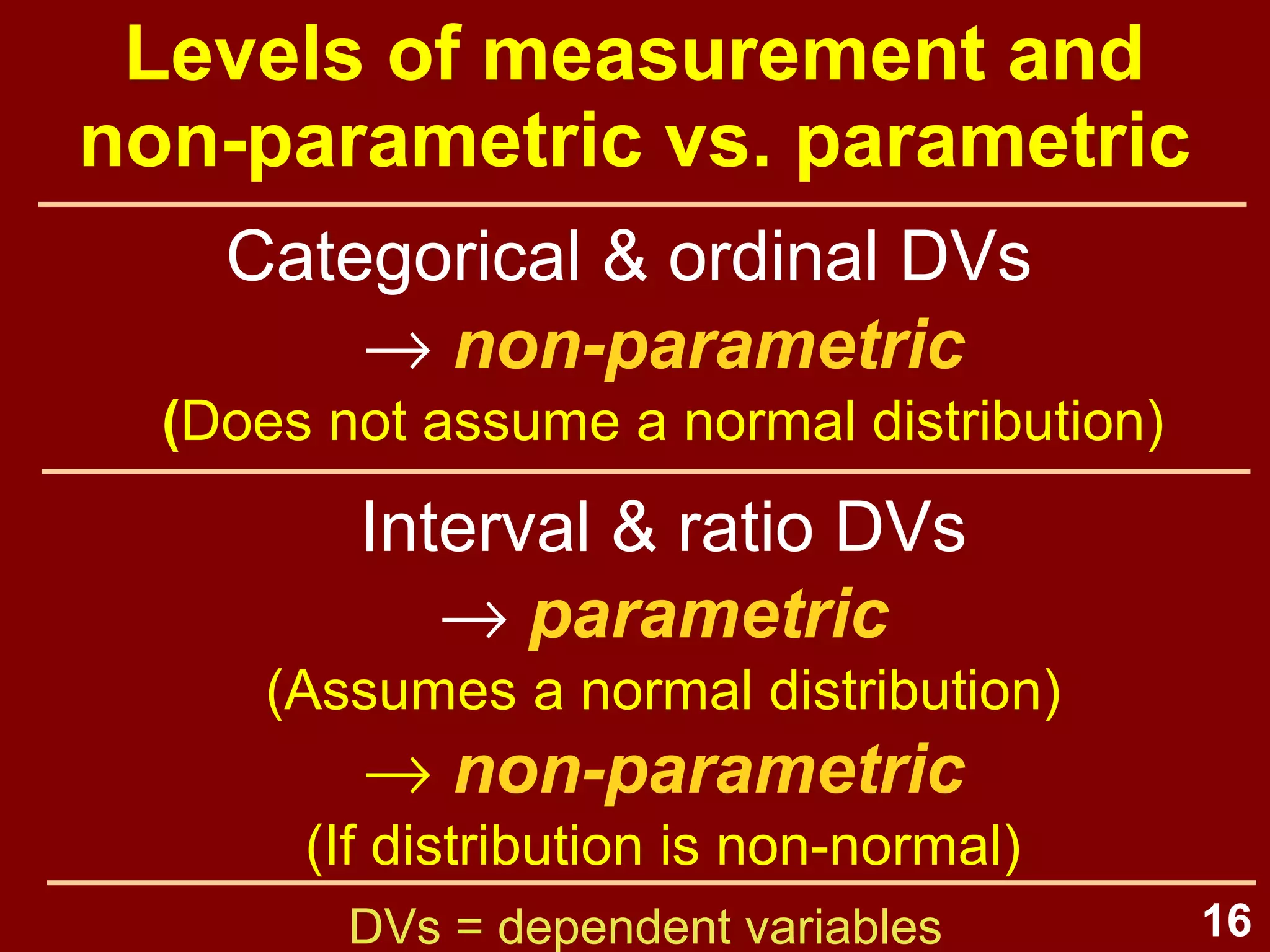
Levels of measurement and
non-parametric vs. parametric
Categorical & ordinal data DV
→ non-parametric
(Does not assume a normal distribution)
Interval & ratio data DV
→ parametric
(Assumes a normal distribution)
→ non-parametric
(If distribution is non-normal)
DVs = dependent variables
16
Parametric statistics
• Statistics which estimate
parameters of a population, based
on the normal distribution
–Univariate:
mean, standard deviation, skewness,
kurtosis, t-tests, ANOVAs
–Bivariate:
correlation, linear regression
–Multivariate:
multiple linear regression
17
• More powerful
(more sensitive)
• More assumptions
(population is normally distributed)
• Vulnerable to violations of
assumptions
(less robust)
Parametric statistics
18
Non-parametric statistics
• Statistics which do not assume
sampling from a population which
is normally distributed
–There are non-parametric alternatives for
many parametric statistics
–e.g., sign test, chi-squared, Mann-
Whitney U test, Wilcoxon matched-pairs
signed-ranks test.
19
Non-parametric statistics
• Less powerful
(less sensitive)
• Fewer assumptions
(do not assume a normal distribution)
• Less vulnerable to assumption
violation
(more robust)
20
Univariate
descriptive
statistics
21
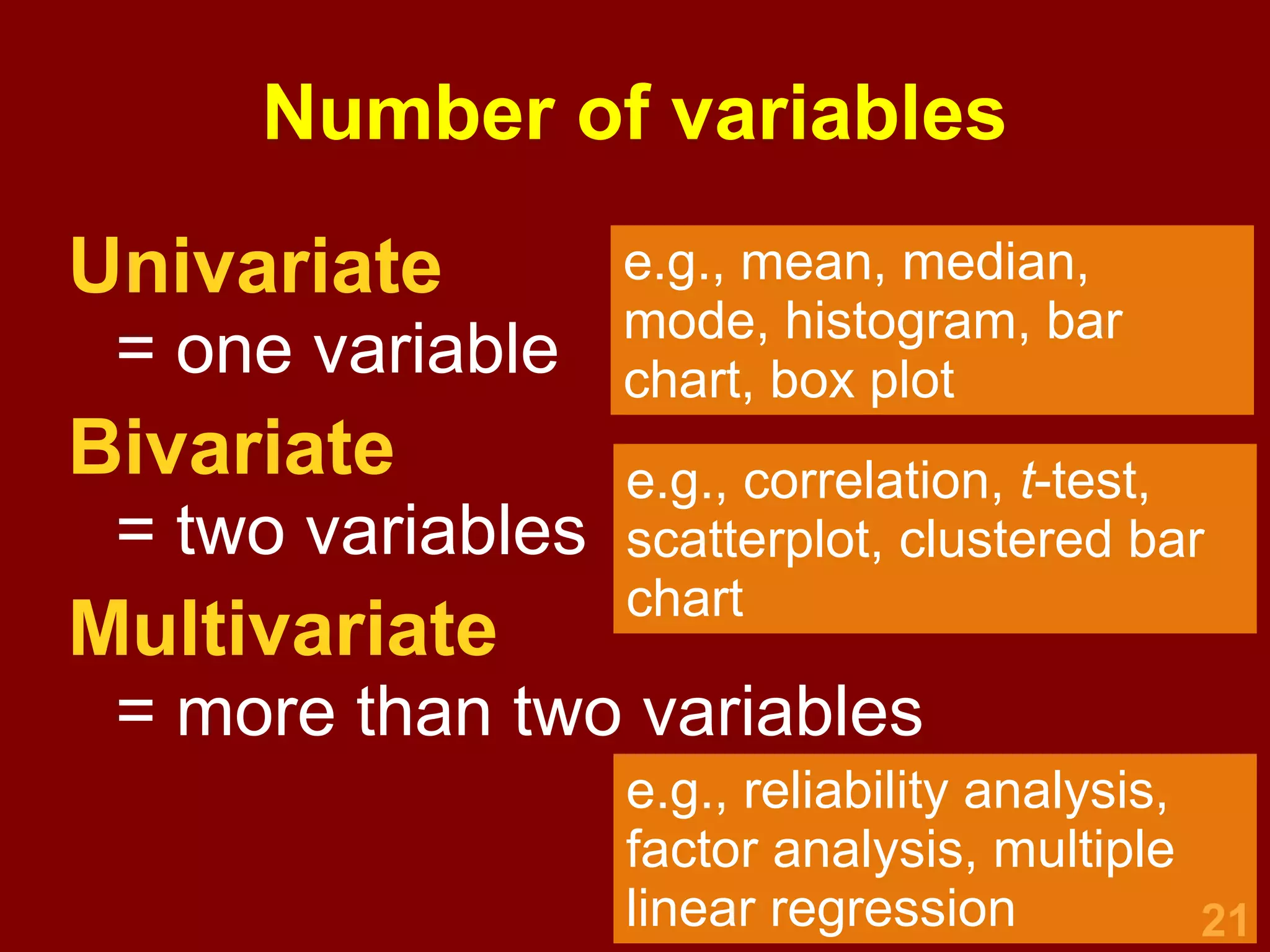
Number of variables
Univariate
= one variable
Bivariate
= two variables
Multivariate
= more than two variables
mean, median, mode,
histogram, bar chart
correlation, t-test,
scatterplot, clustered bar
chart
reliability analysis, factor
analysis, multiple linear
regression
22
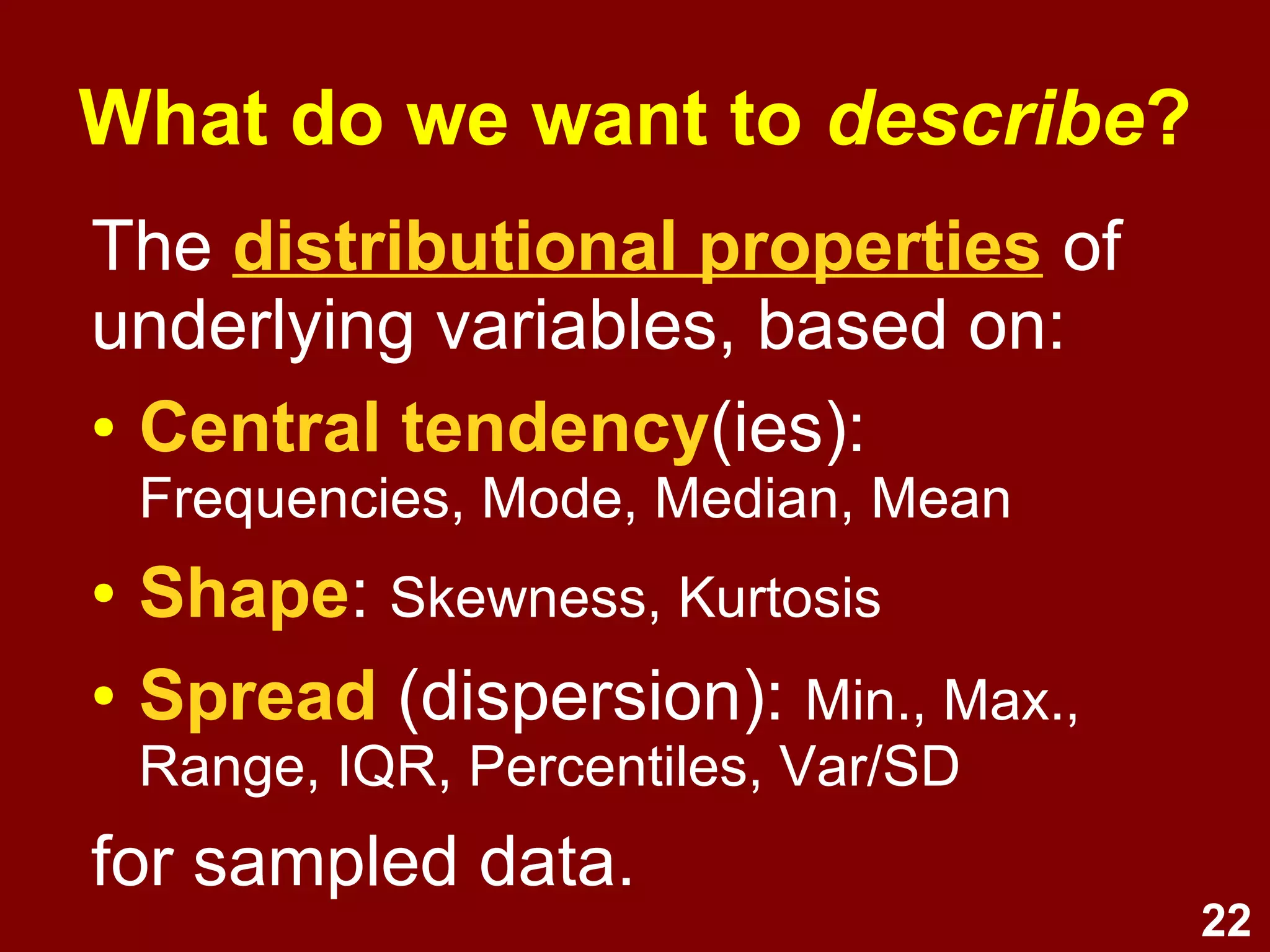
What do we want to describe?
The distributional properties of
variables, based on:
● Central tendency(ies): e.g.,
frequencies, mode, median, mean
● Shape: e.g., skewness, kurtosis
● Spread (dispersion): min., max.,
range, IQR, percentiles, variance,
standard deviation
23
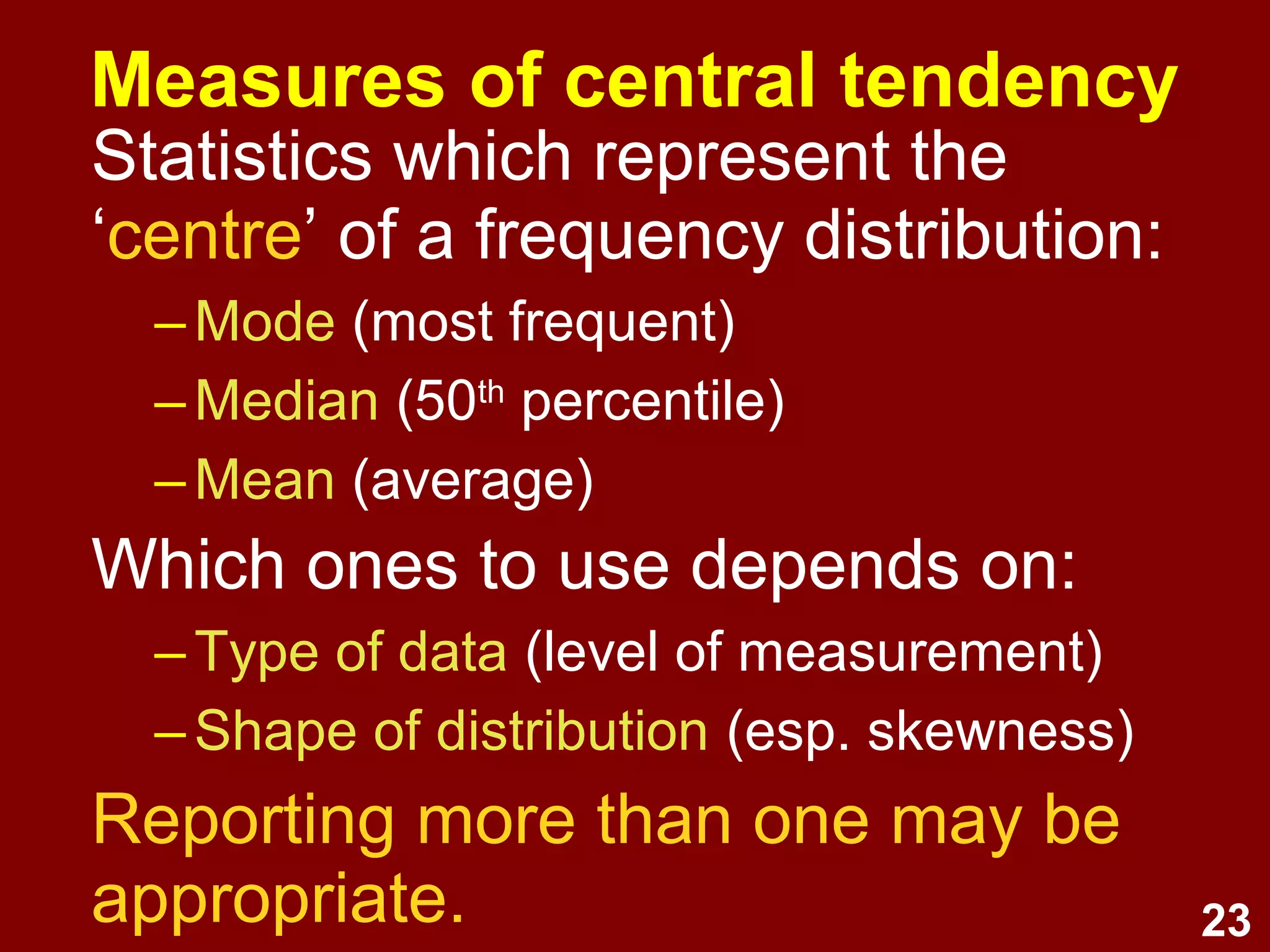
Measures of central tendency
Statistics which represent the
‘centre’ of a frequency distribution:
–Mode (most frequent)
–Median (50th
percentile)
–Mean (average)
Which ones to use depends on:
–Type of data (level of measurement)
–Shape of distribution (esp. skewness)
Reporting more than one may be
appropriate.
24
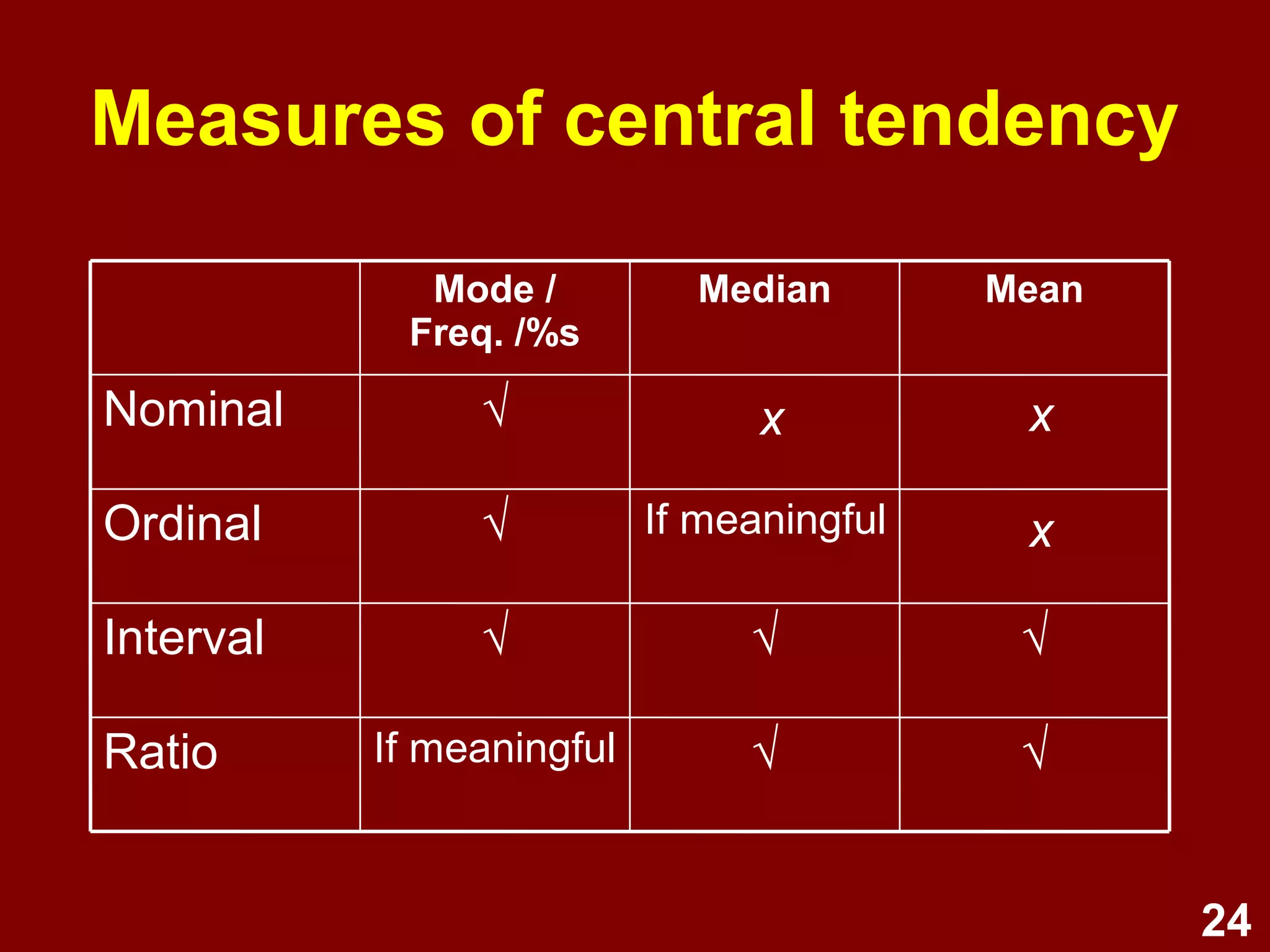
Measures of central tendency
√√If meaningfulRatio
√√√Interval
√Ordinal
√Nominal
MeanMedianMode /
Freq. /%s
If meaningful
x x
x
25
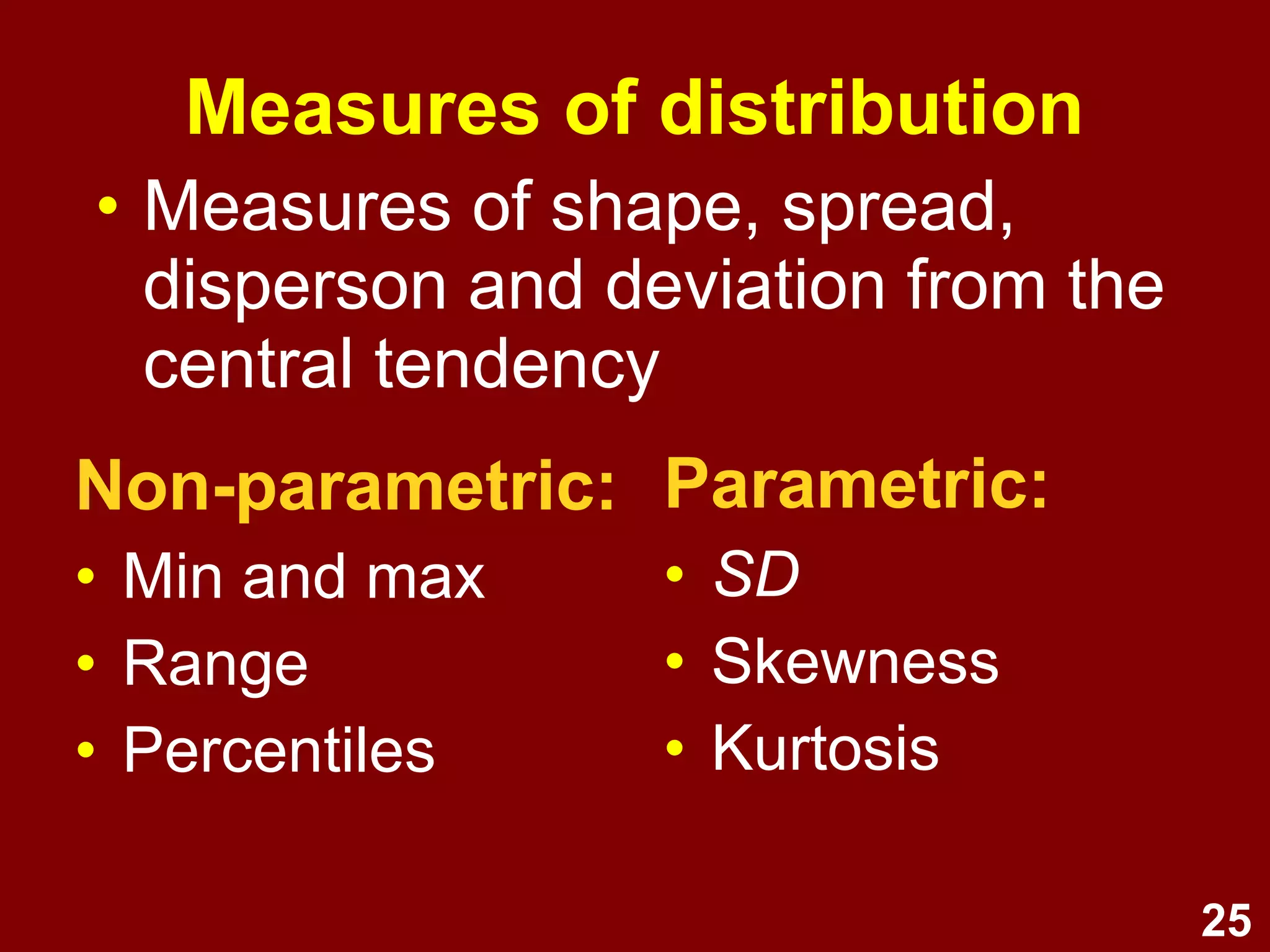
Measures of distribution
• Measures of shape, spread,
dispersion, and deviation from the
central tendency
Non-parametric:
• Min. and max.
• Range
• Percentiles
Parametric:
• SD
• Skewness
• Kurtosis
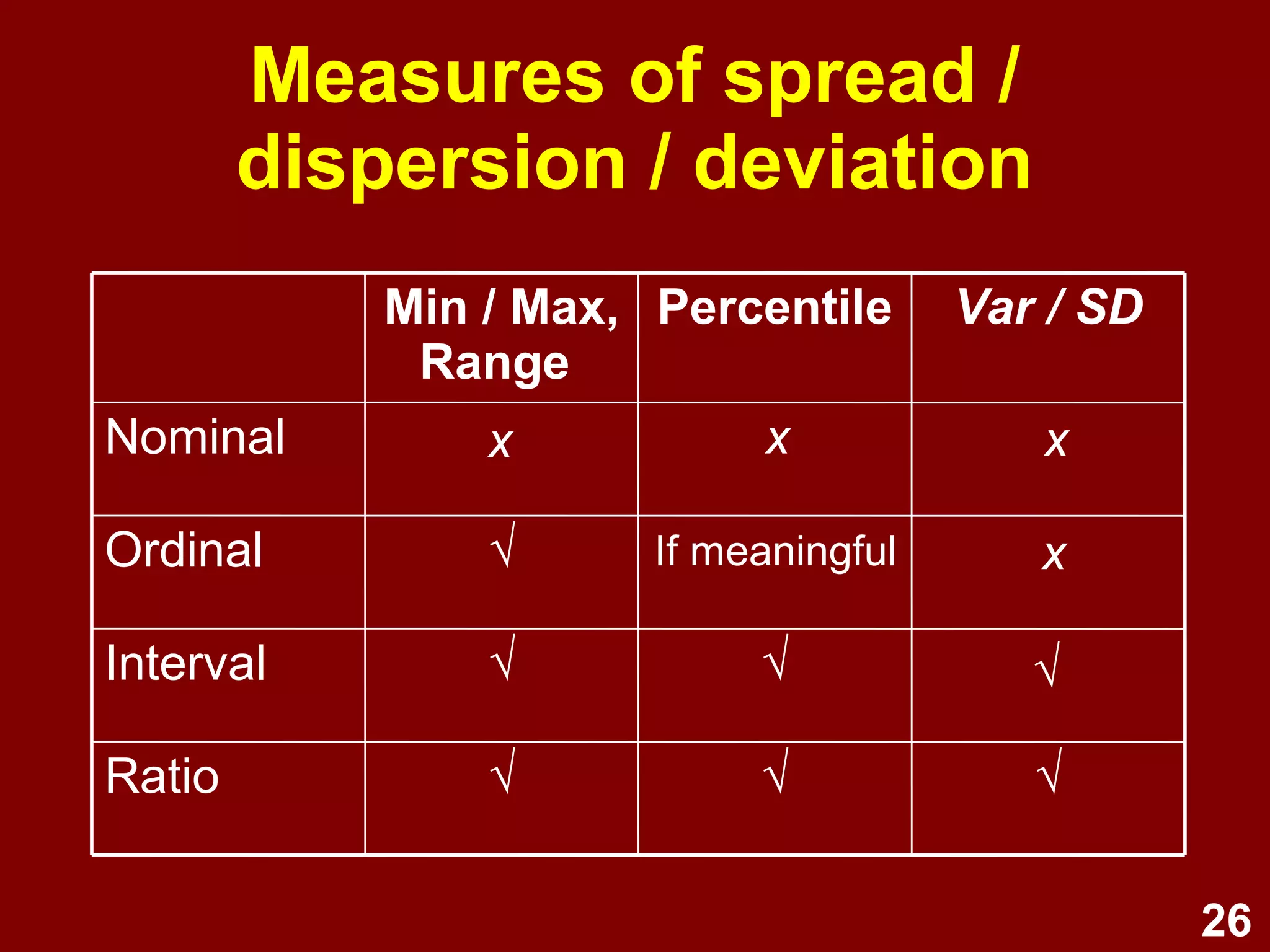
26
√√√Ratio
√√Interval
√Ordinal
Nominal
Var / SDPercentileMin / Max,
Range
Measures of spread /
dispersion / deviation
If meaningful
√
x x x
x
27
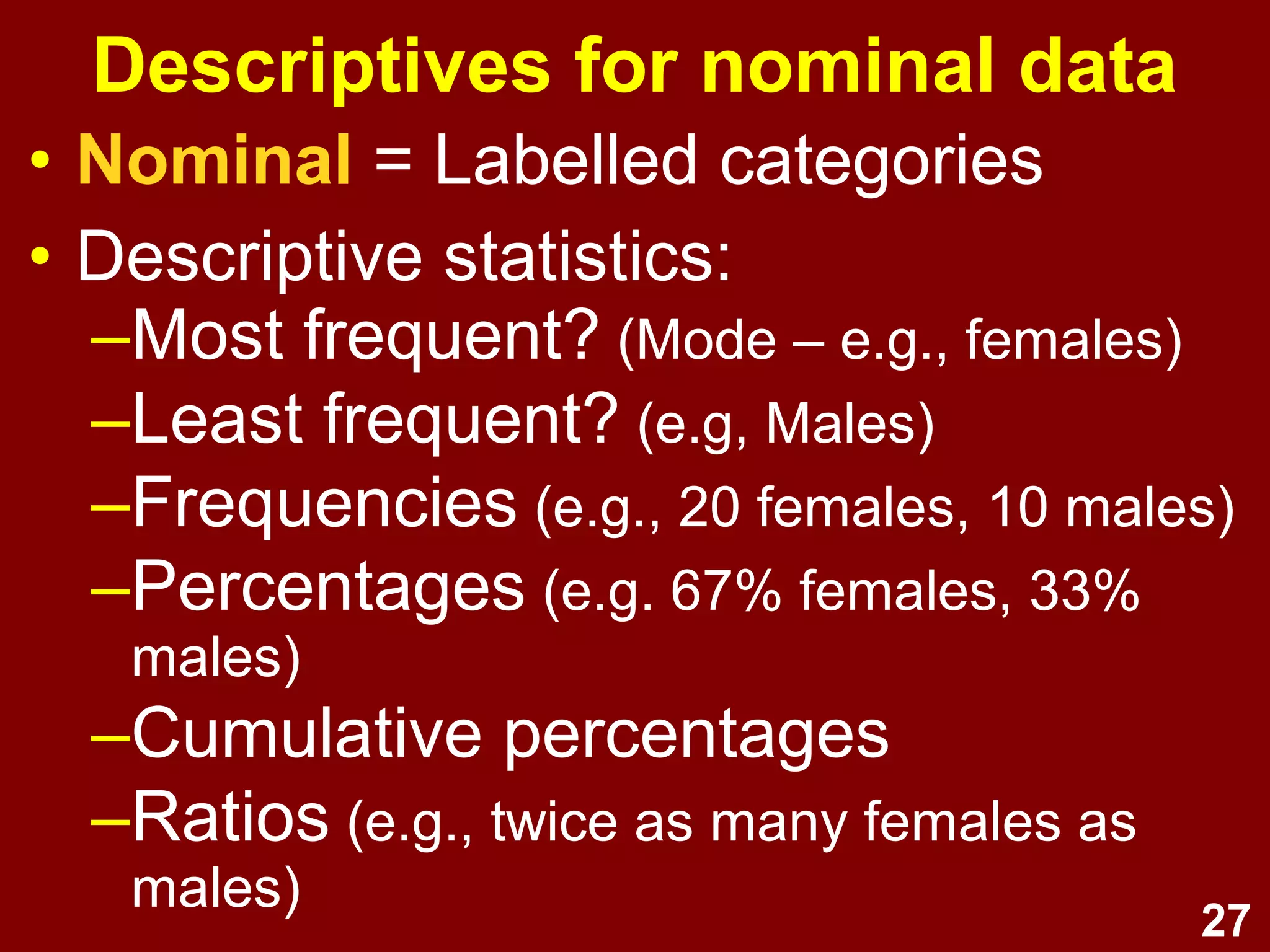
Descriptives for nominal data
• Nominal LOM = Labelled categories
• Descriptive statistics:
–Most frequent? (Mode – e.g., females)
–Least frequent? (e.g., Males)
–Frequencies (e.g., 20 females, 10 males)
–Percentages (e.g. 67% females, 33% males)
–Cumulative percentages
–Ratios (e.g., twice as many females as males)
28
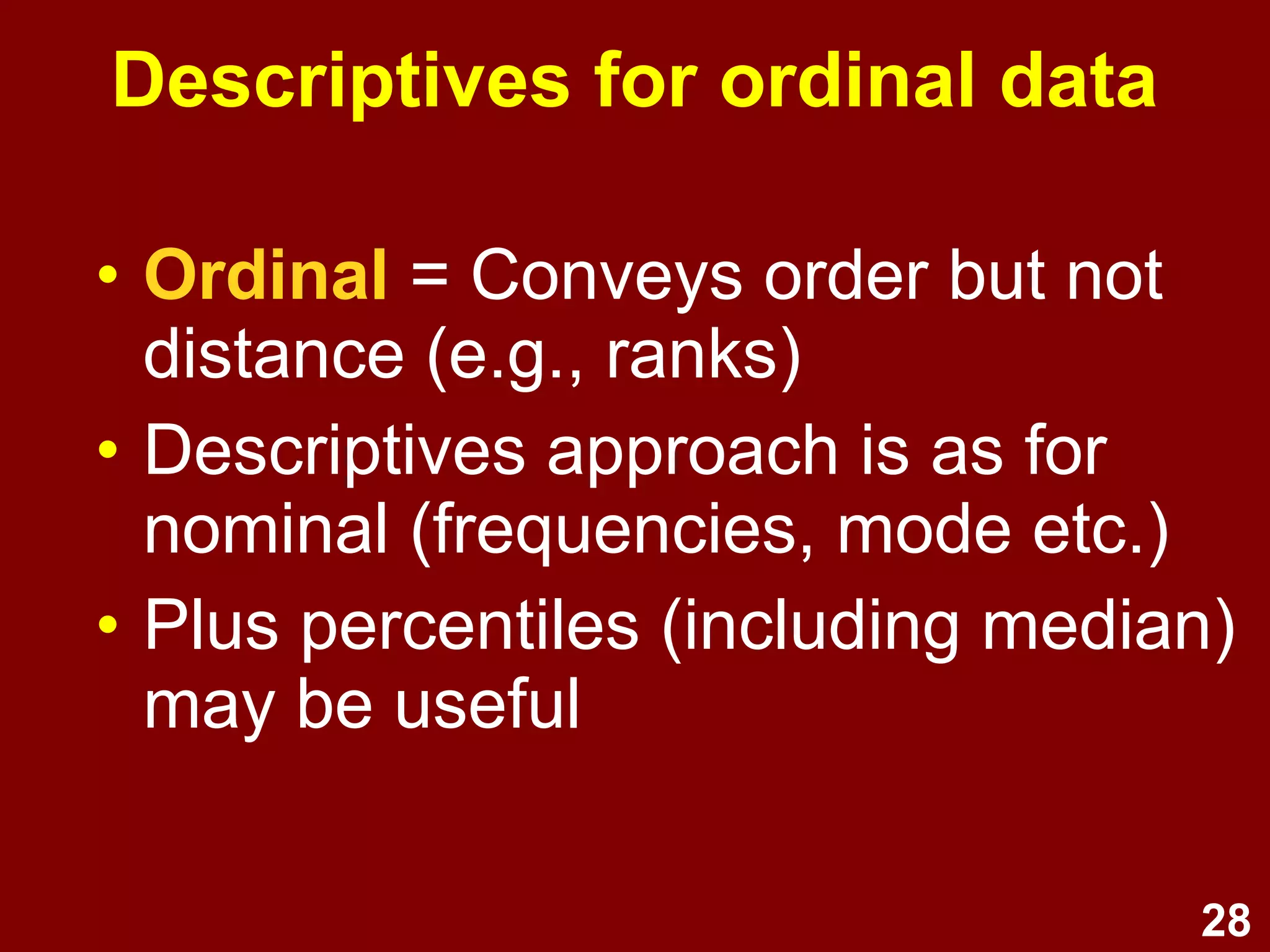
Descriptives for ordinal data
• Ordinal LOM = Conveys order but
not distance (e.g., ranks)
• Descriptives approach is as for
nominal (frequencies, mode etc.)
• Plus percentiles (including median)
may be useful
29
Descriptives for interval data
• Interval LOM = order and
distance, but no true 0 (0 is
arbitrary).
• Central tendency (mode, median,
mean)
• Shape/Spread (min., max., range,
SD, skewness, kurtosis)
Interval data is discrete, but is often treated as
ratio/continuous (especially for > 5 intervals)
30
Descriptives for ratio data
• Ratio = Numbers convey order
and distance, meaningful 0 point
• As for interval, use median,
mean, SD, skewness etc.
• Can also use ratios (e.g., Category A is
twice as large as Category B)
31
Mode (Mo)
• Most common score - highest point in a
frequency distribution – a real score – the most
common response
• Suitable for all levels of data, but
may not be appropriate for ratio (continuous)
• Not affected by outliers
• Check frequencies and bar graph
to see whether it is an accurate
and useful statistic
32
Frequencies (f) and
percentages (%)
• # of responses in each category
• % of responses in each category
• Frequency table
• Visualise using a bar or pie chart
33
Median (Mdn)
• Mid-point of distribution
(Quartile 2, 50th
percentile)
• Not badly affected by outliers
• May not represent the central
tendency in skewed data
• If the Median is useful, then
consider what other percentiles
may also be worth reporting
34
Summary: Descriptive statistics
• Level of measurement and
normality determines whether
data can be treated as parametric
• Describe the central tendency
–Frequencies, Percentages
–Mode, Median, Mean
• Describe the variability:
–Min., Max., Range, Quartiles
–Standard Deviation, Variance
35
Properties of the
normal distribution
Image source: http://www.flickr.com/photos/trevorblake/3200899889/
36
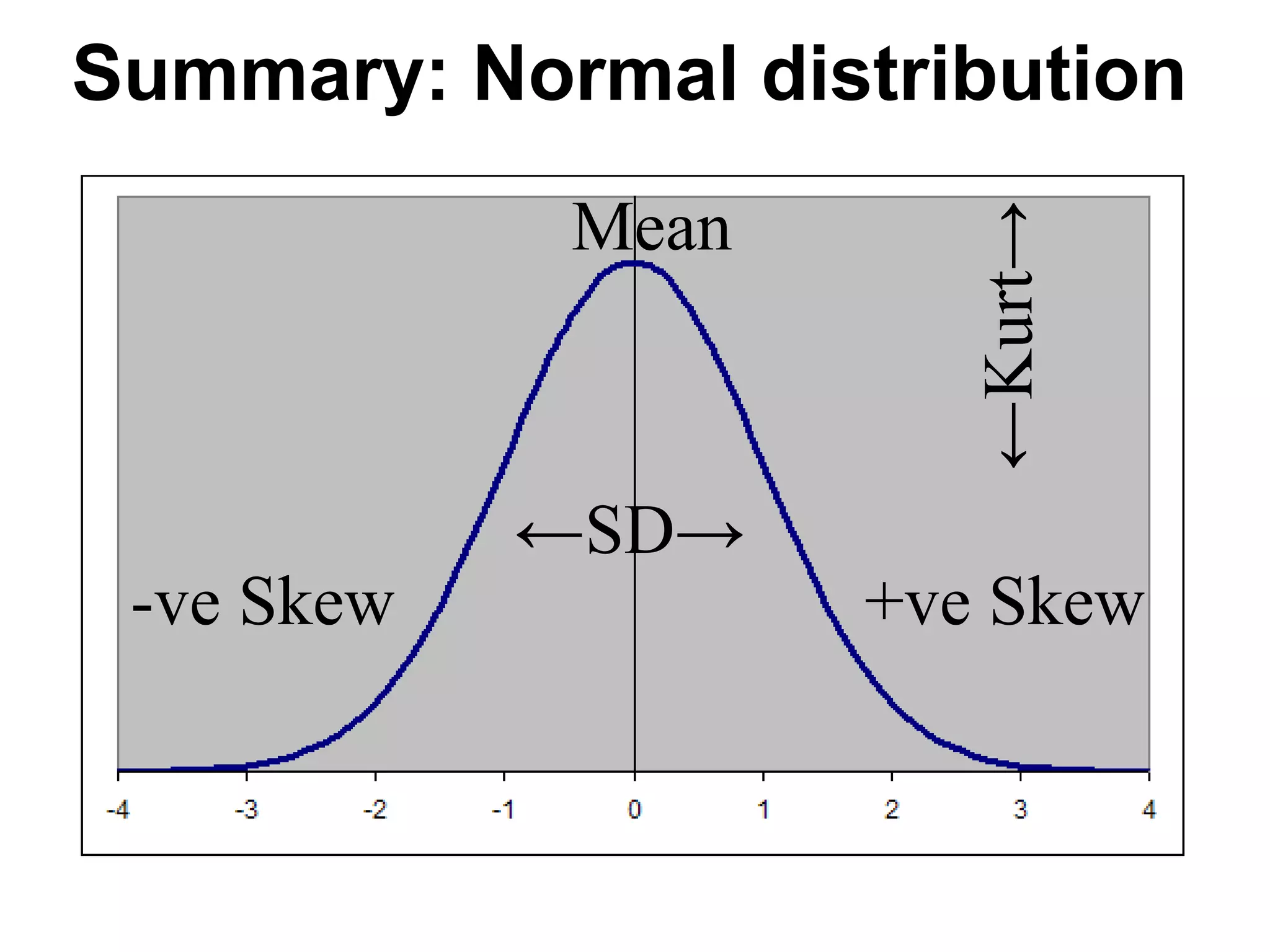
Four moments of a
normal distribution
Row 1 Row 2 Row 3 Row 4
0
2
4
6
8
10
12
Column 1
Column 2
Column 3
Mean
←SD→
-ve Skew +ve Skew
←Kurtosis→
37
Four moments of a
normal distribution
Four mathematical qualities
(parameters) can describe a
continuous distribution which at least
roughly follows a bell curve shape:
• 1st
= mean (central tendency)
• 2nd
= SD (dispersion)
• 3rd
= skewness (lean / tail)
• 4th
= kurtosis (peakedness / flattness)
38
Mean
(1st moment )
• Average score
Mean = Σ X / N
• For normally distributed ratio or
interval (if treating it as continuous) data.
• Influenced by extreme scores
(outliers)
39
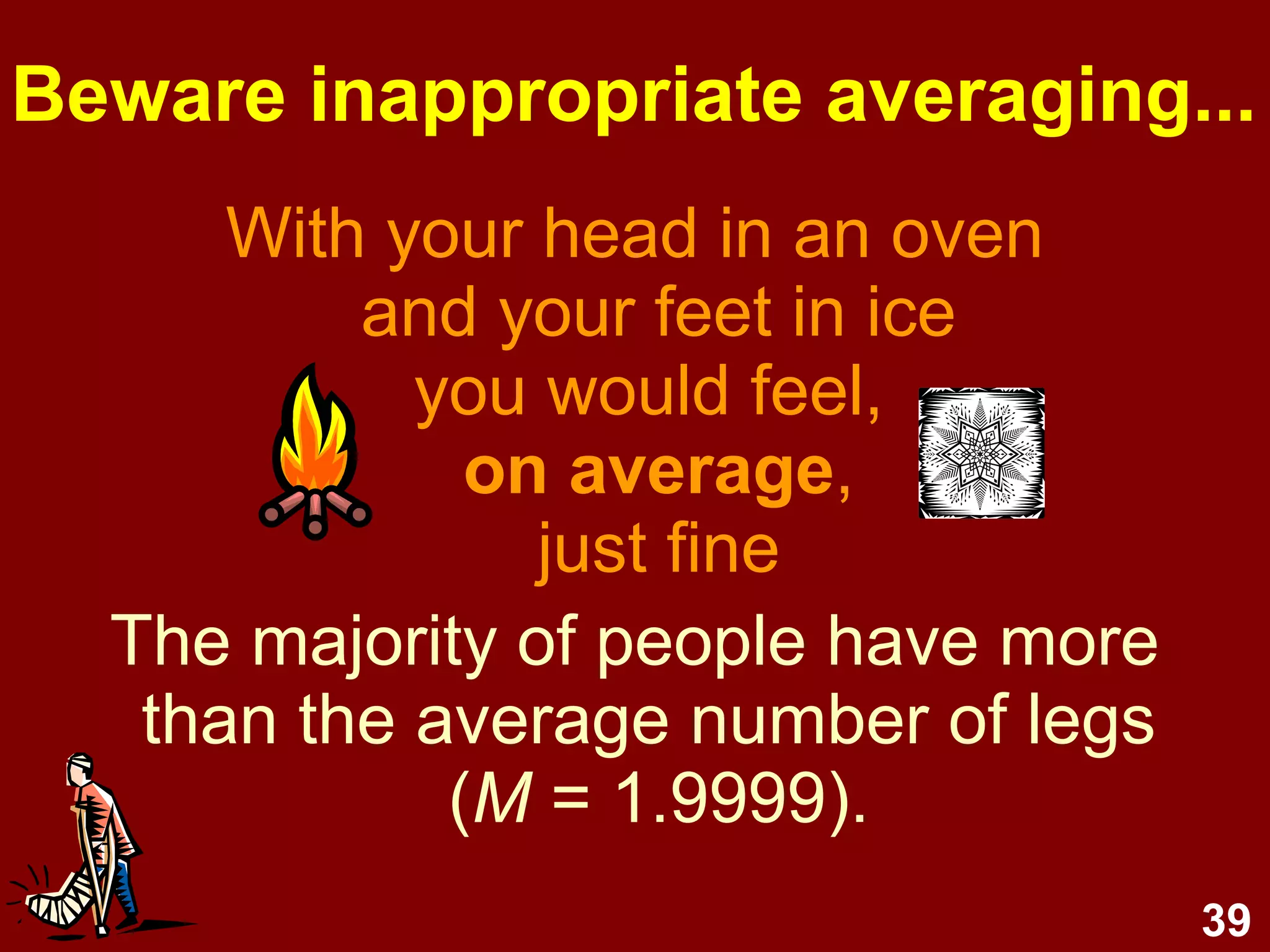
Beware inappropriate averaging...
With your head in an oven
and your feet in ice
you would feel,
on average,
just fine
The majority of people have more
than the average number of legs
(M = 1.9999).
40
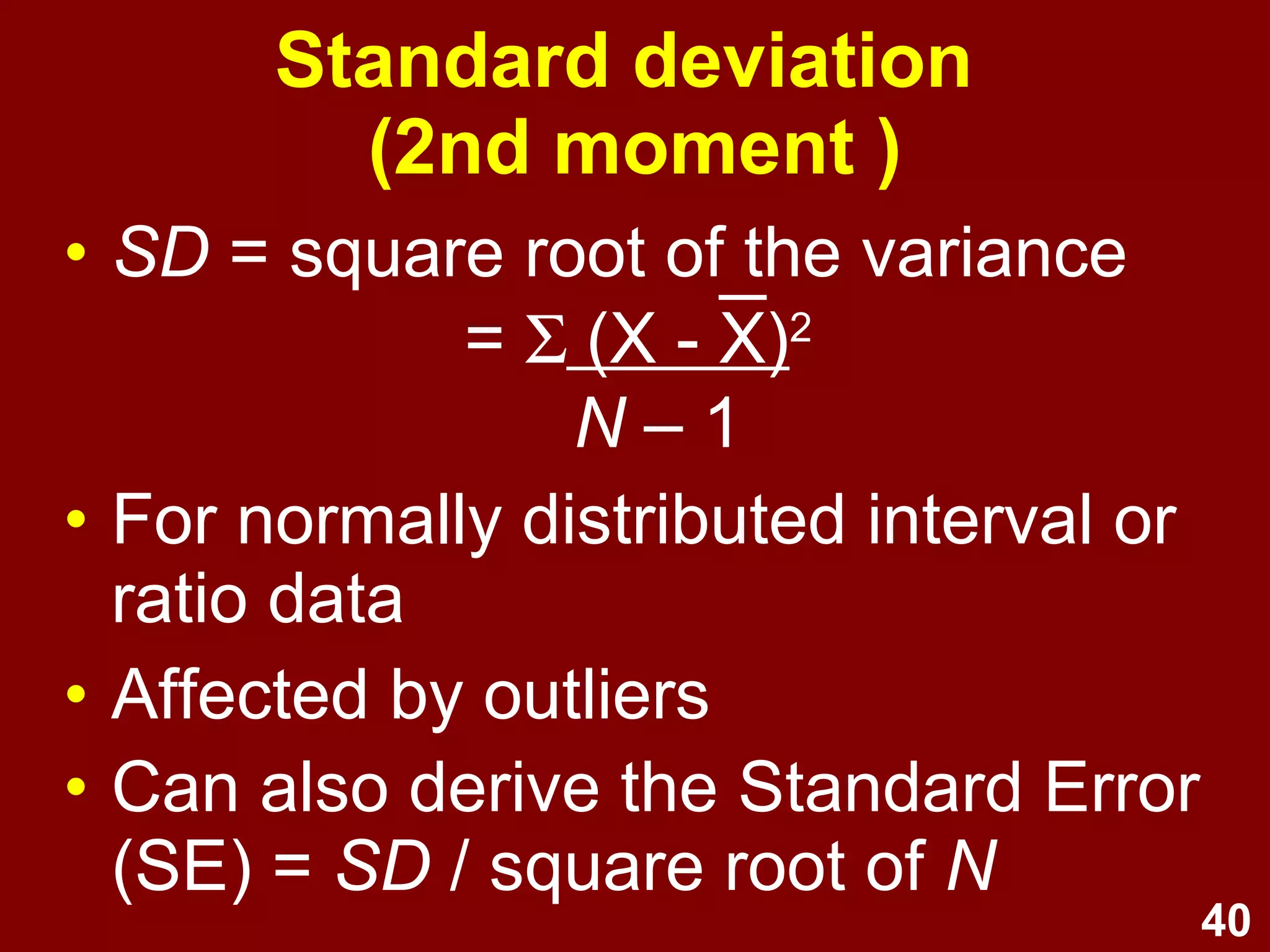
Standard deviation
(2nd moment)
• SD = square root of the variance
= Σ (X - X)2
N – 1
• For normally distributed interval or
ratio data
• Affected by outliers
• Can also derive the Standard Error
(SE) = SD / square root of N
41
Skewness
(3rd moment )
• Lean of distribution
– +ve = tail to right
– -ve = tail to left
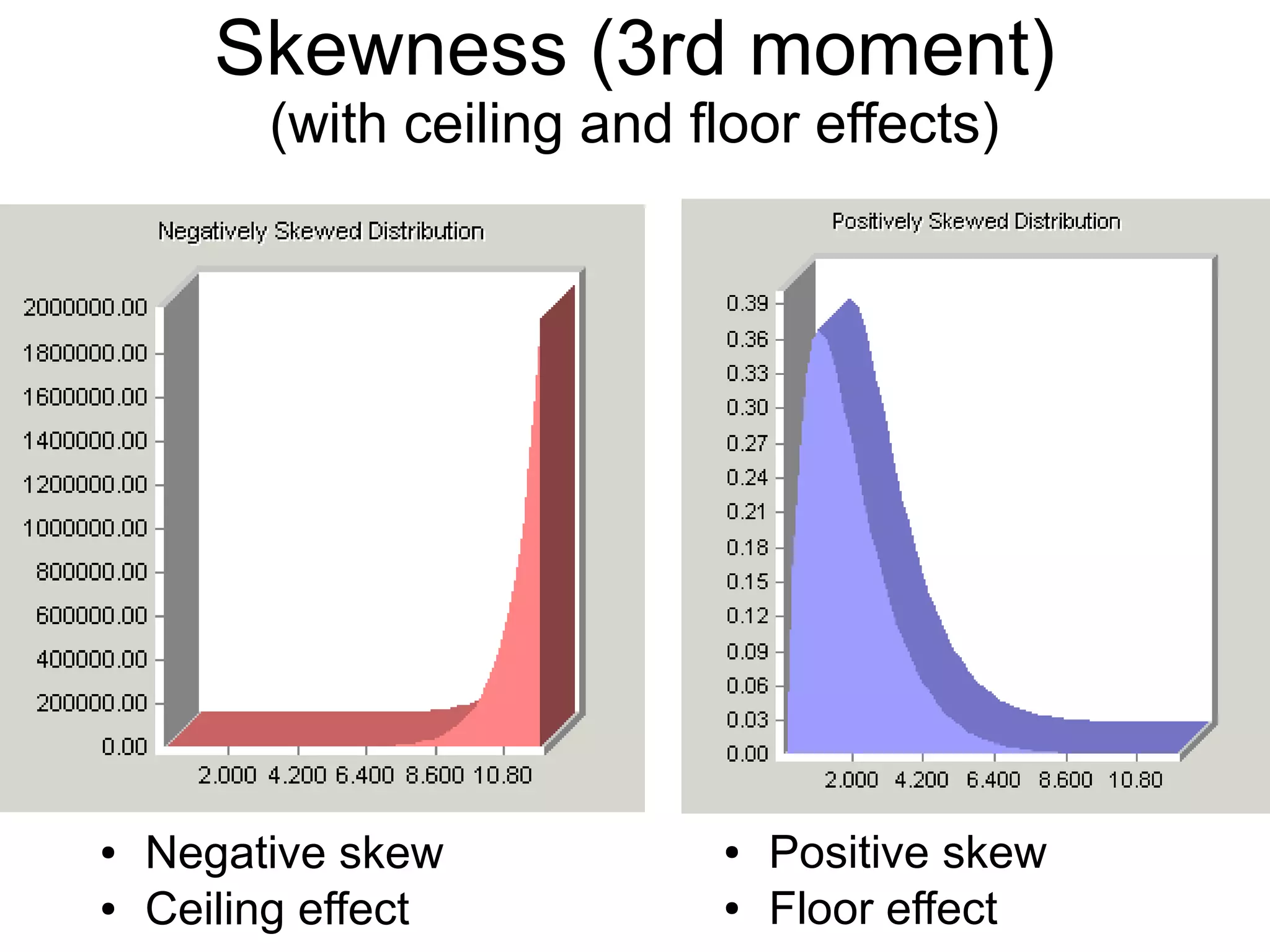
• Can be caused by an outlier, or
ceiling or floor effects
• Can be accurate (e.g., cars owned per person
would have a skewed distribution)
42
Skewness (3rd moment)
(with ceiling and floor effects)
● Negative skew
● Ceiling effect
● Positive skew
● Floor effect
Image source http://www.visualstatistics.net/Visual%20Statistics%20Multimedia/normalization.htm
43
Kurtosis
(4th moment )
• Flatness or peakedness of
distribution
+ve = peaked
-ve = flattened
• By altering the X &/or Y axis, any
distribution can be made to look
more peaked or flat – add a normal
curve to help judge kurtosis visually.
44
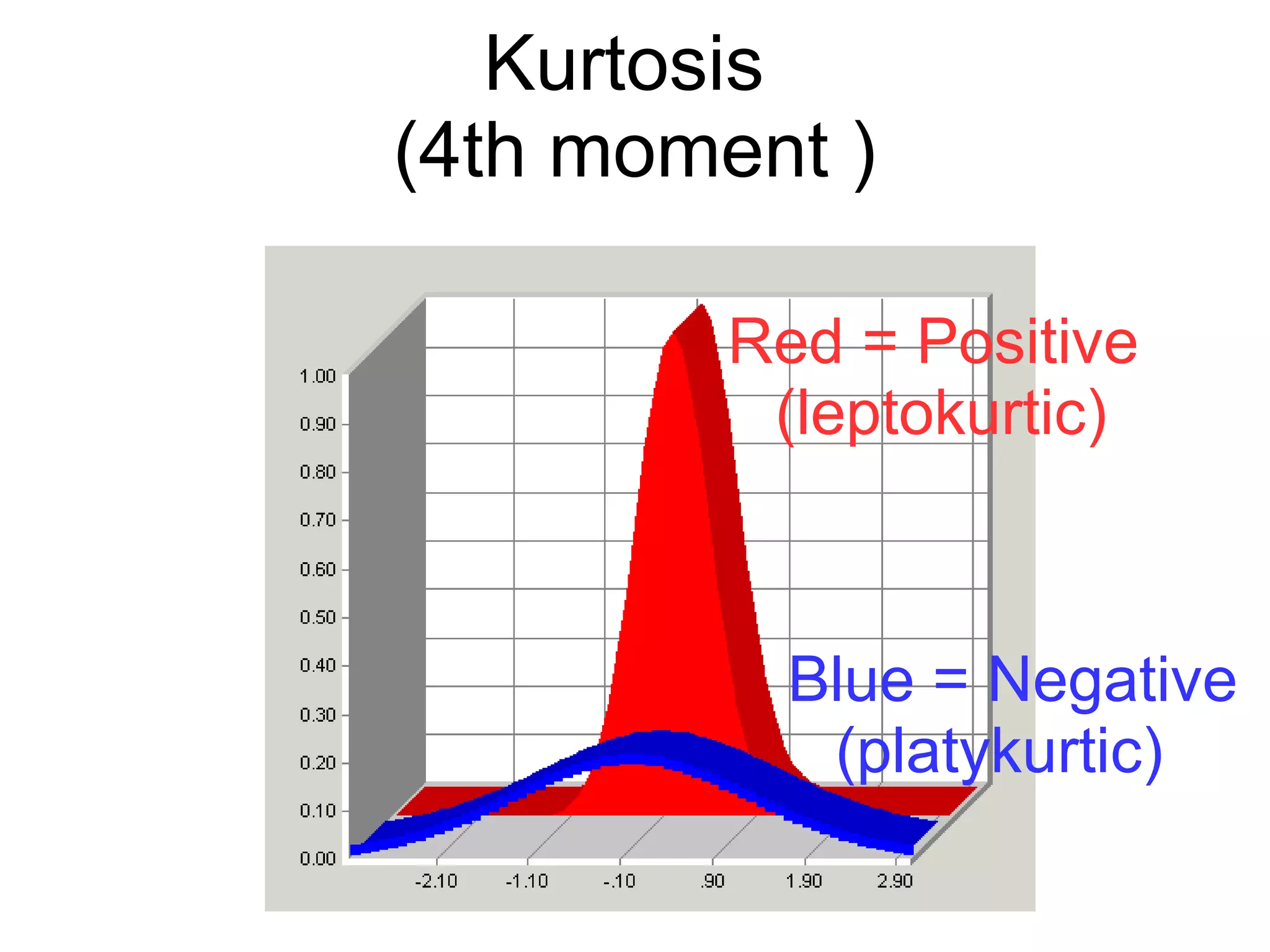
Kurtosis
(4th moment )
Image source: https://classconnection.s3.amazonaws.com/65/flashcards/2185065/jpg/kurtosis-142C1127AF2178FB244.jpg
45
Judging severity of
skewness & kurtosis
• View histogram with normal curve
• Deal with outliers
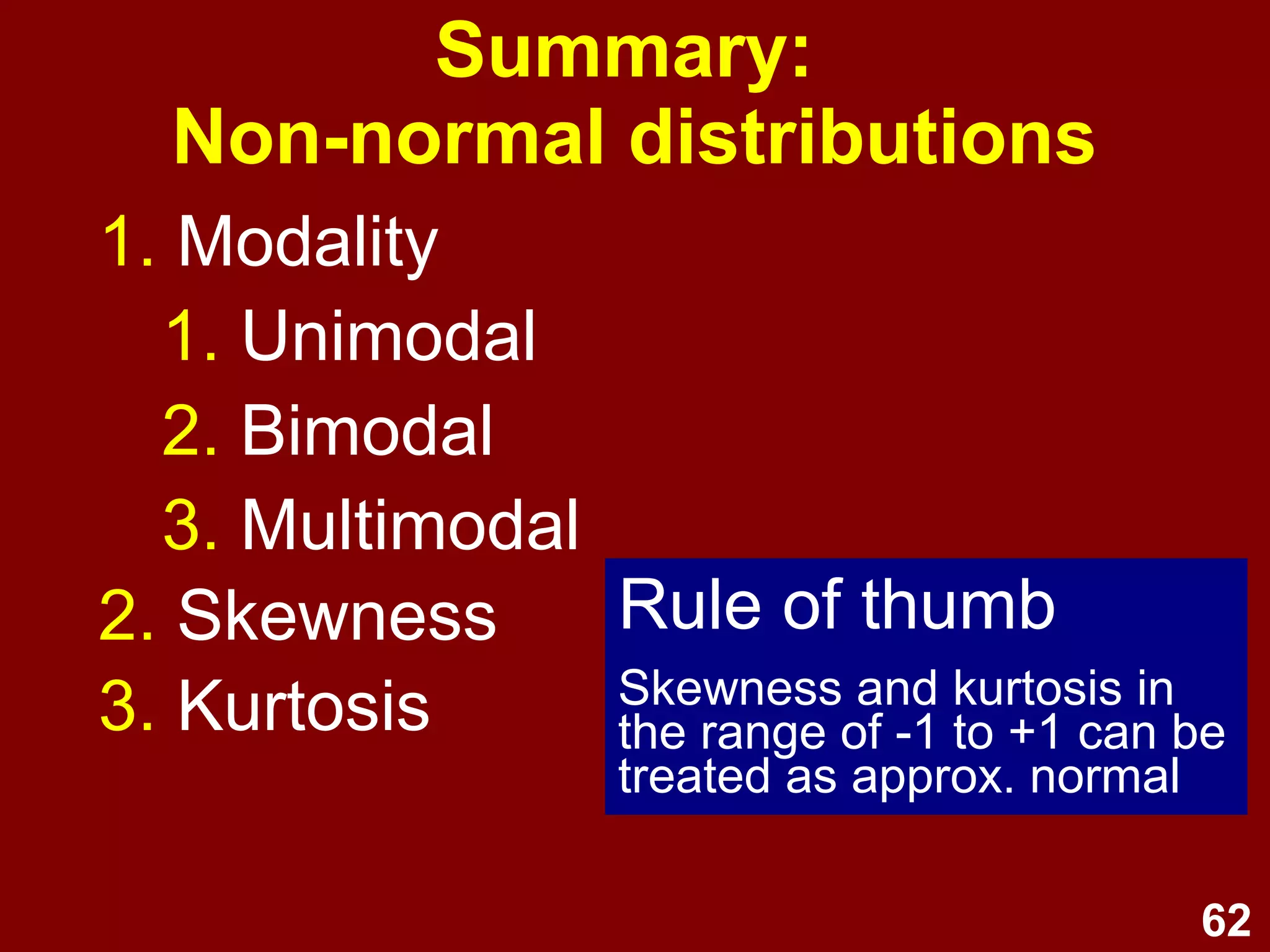
• Rule of thumb:
Skewness and kurtosis > -1 or < 1 is
generally considered to sufficiently normal
for meeting the assumptions of parametric
inferential statistics
• Significance tests of skewness:
Tend to be overly sensitive
(therefore avoid using)
46
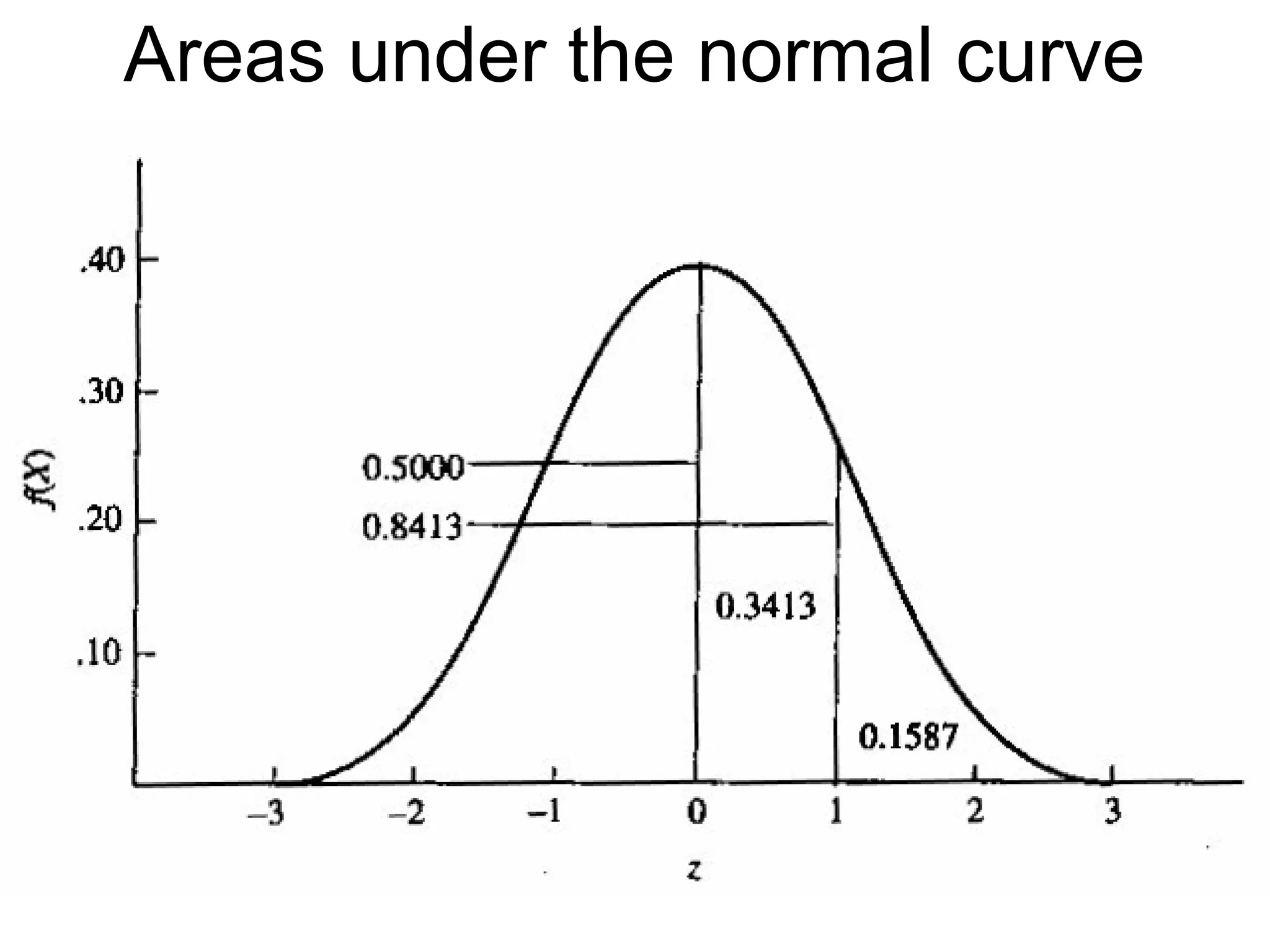
Areas under the normal curve
If distribution is normal
(bell-shaped - or close):
~68% of scores within +/- 1 SD of M
~95% of scores within +/- 2 SD of M
~99.7% of scores within +/- 3 SD of M
47
Areas under the normal curve
Image source: https://commons.wikimedia.org/wiki/File:Empirical_Rule.PNG
48
Non-normal
distributions
49
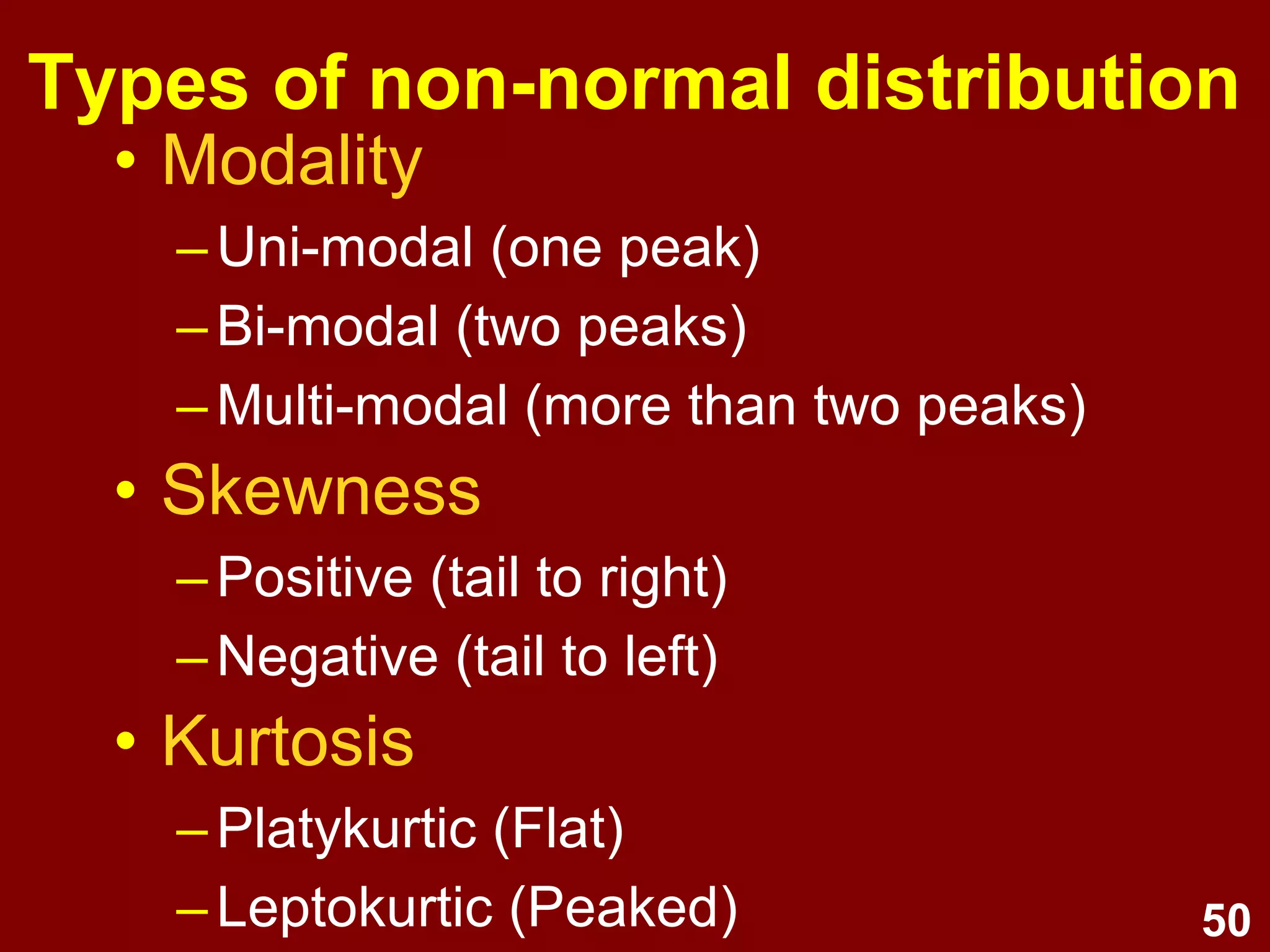
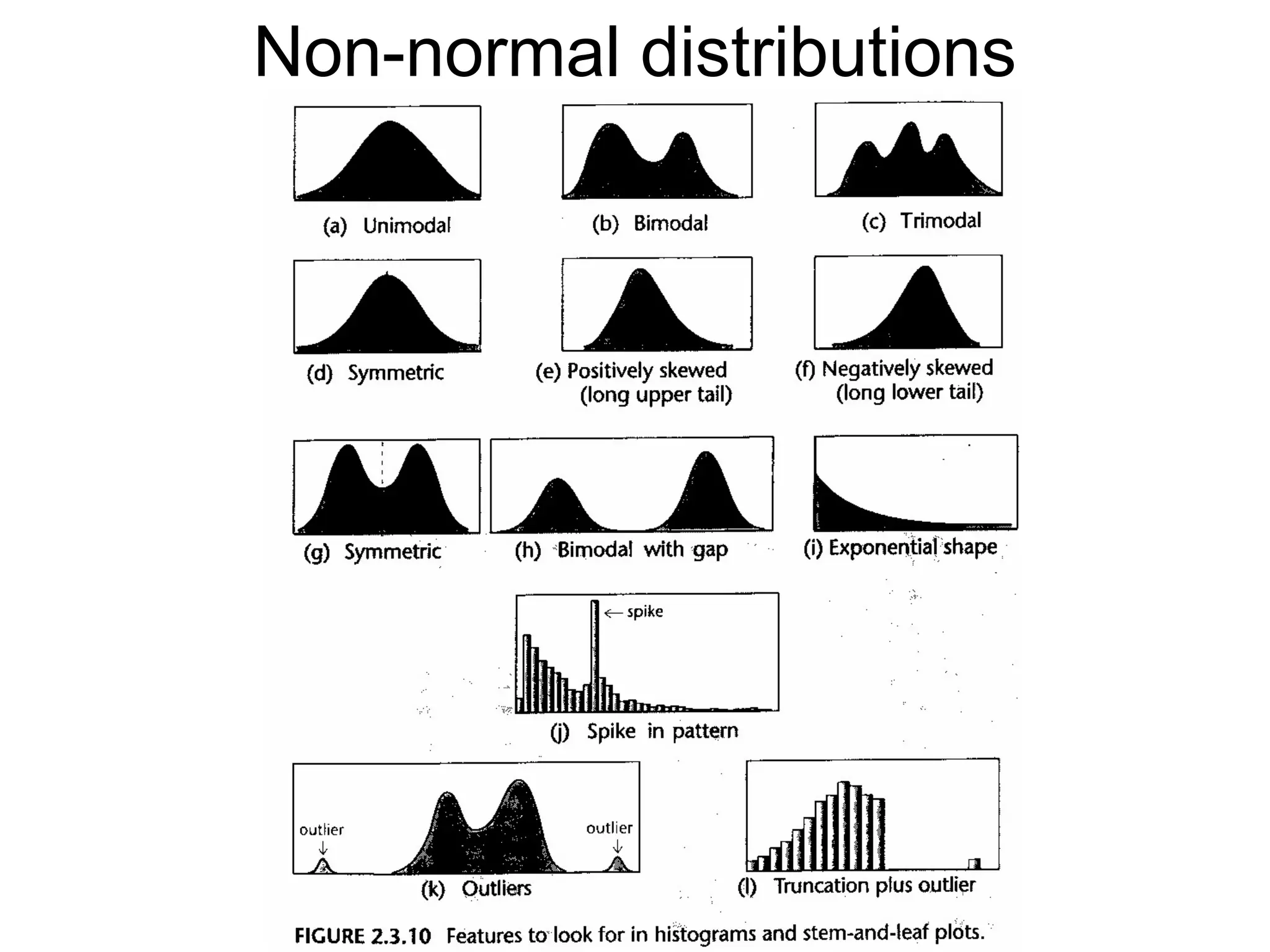
Types of non-normal distribution
• Modality
–Uni-modal (one peak)
–Bi-modal (two peaks)
–Multi-modal (more than two peaks)
• Skewness
–Positive (tail to right)
–Negative (tail to left)
• Kurtosis
–Platykurtic (Flat)
–Leptokurtic (Peaked)
50
Non-normal distributions
51
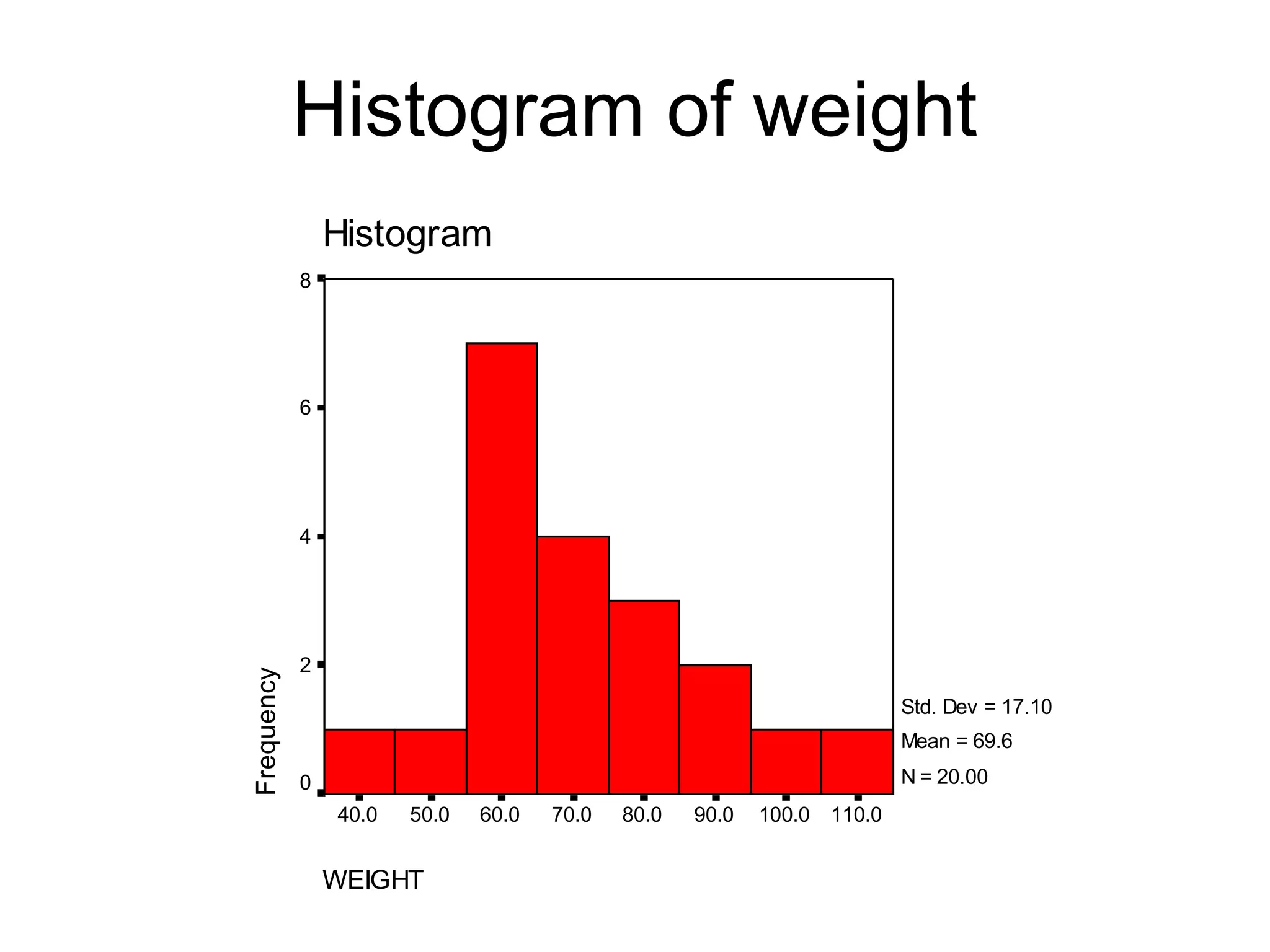
Histogram of people's weight
WEIGHT
110.0100.090.080.070.060.050.040.0
Histogram
Frequency 8
6
4
2
0
Std. Dev = 17.10
Mean = 69.6
N = 20.00
52
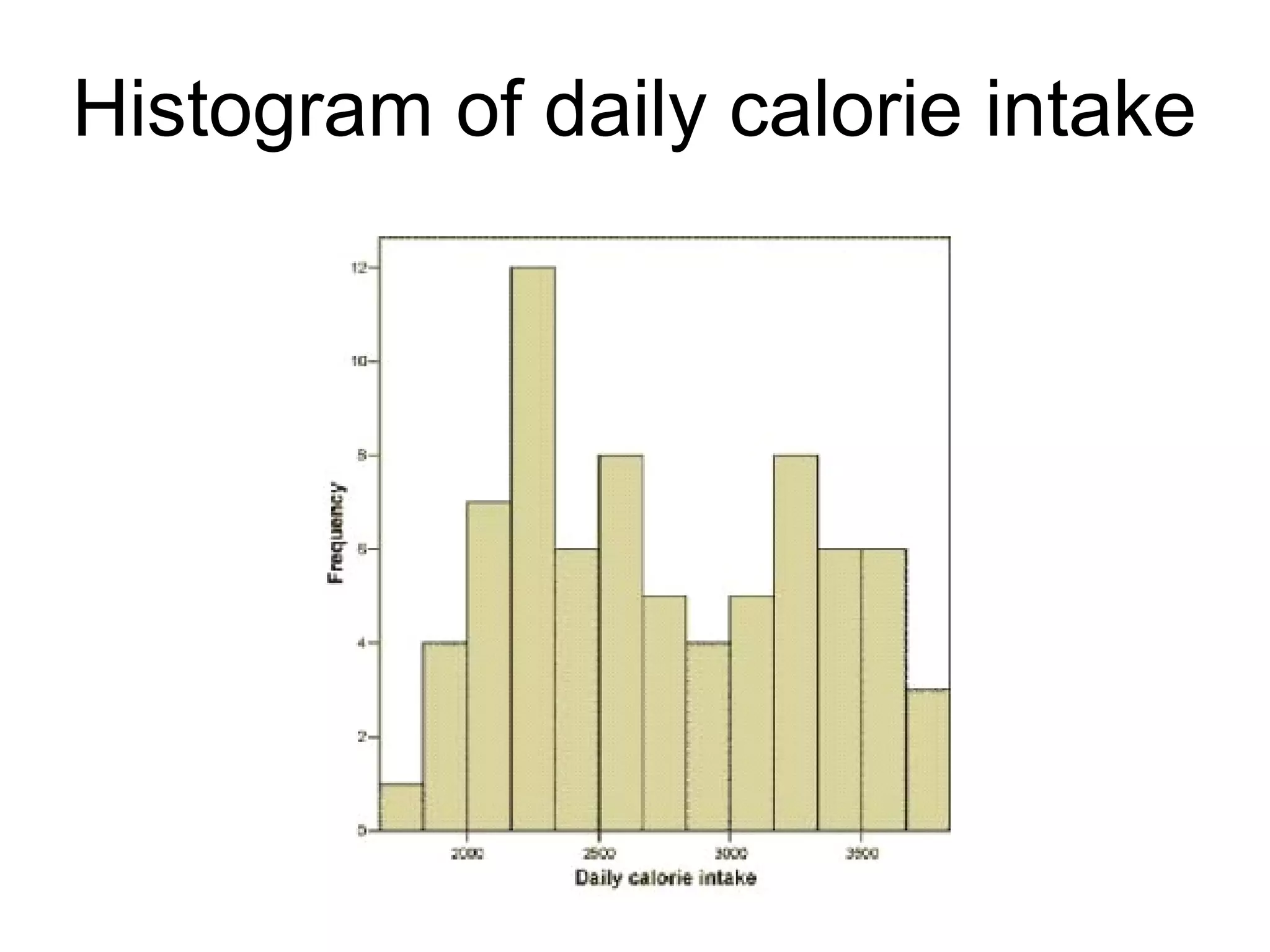
Histogram of daily calorie intake
N = 75
53
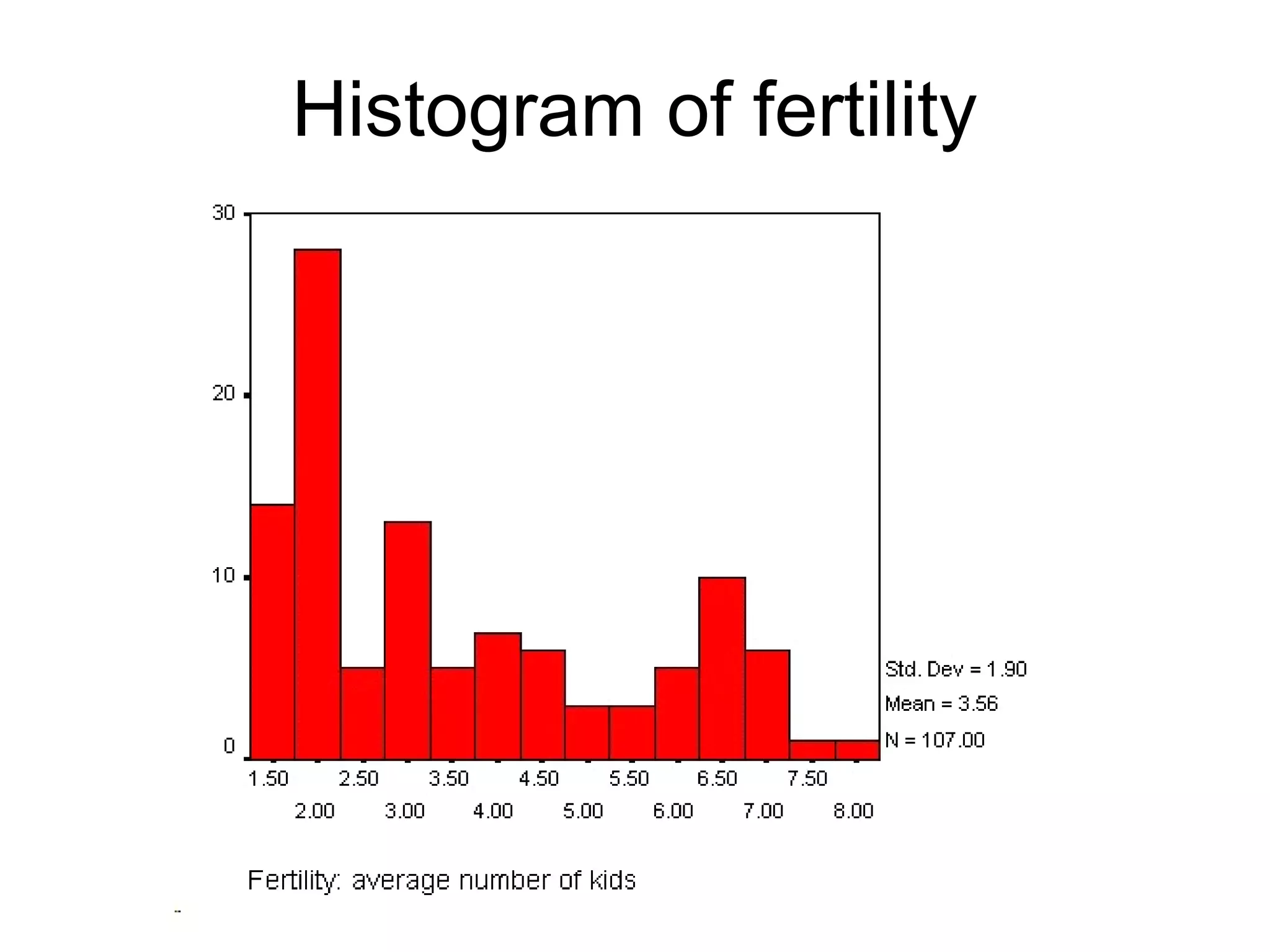
Histogram of fertility
54
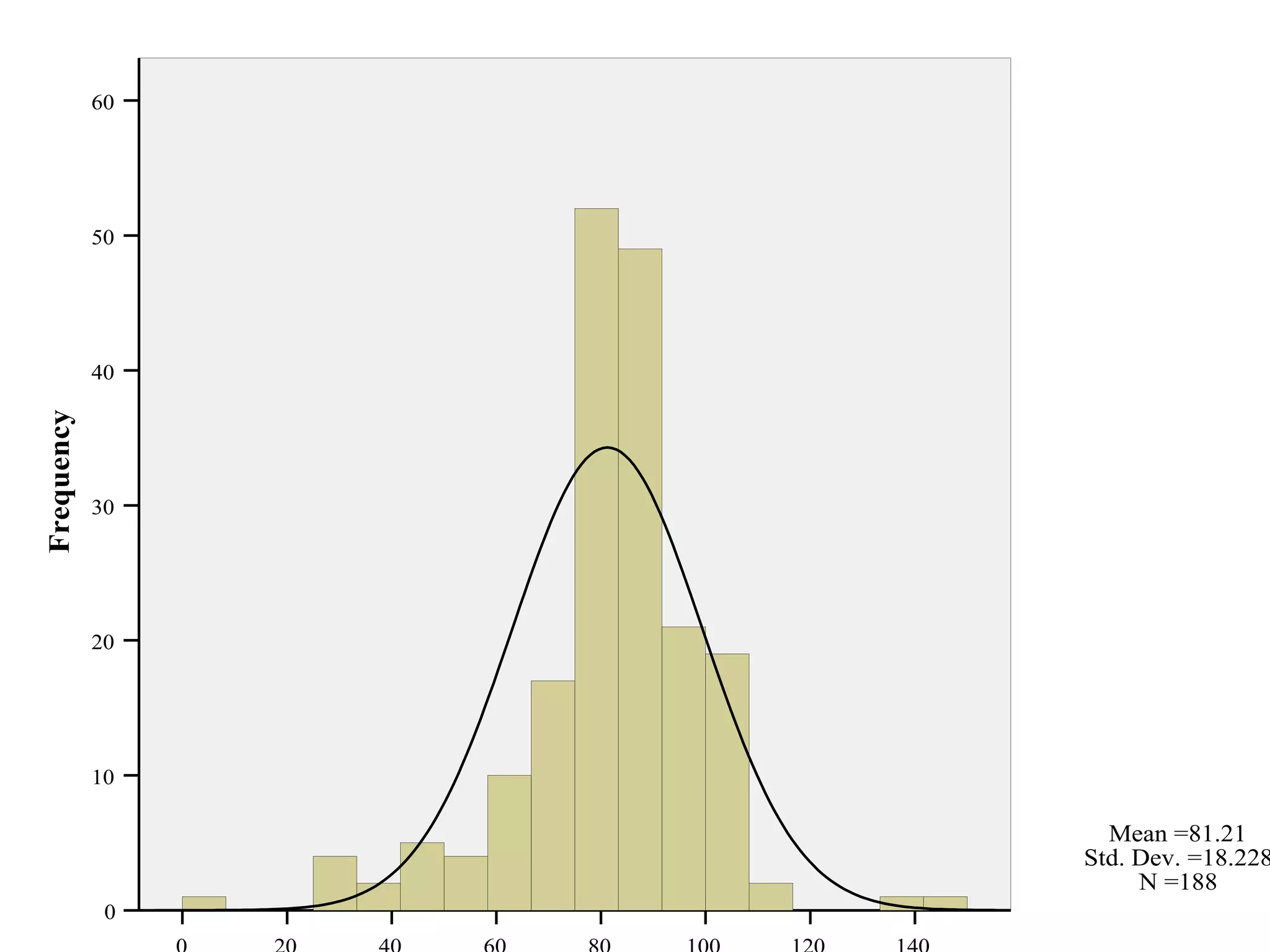
Example ‘normal’ distribution
1
140120100806040200
Die
60
50
40
30
20
10
0
Frequency
Mean =81.21
Std. Dev. =18.228
N =188
At what age do you think you will die?
55
Example ‘normal’ distribution
2
Very masculineFairly masculineAndrogynousFairly feminineVery feminine
Femininity-Masculinity
60
40
20
0
Count
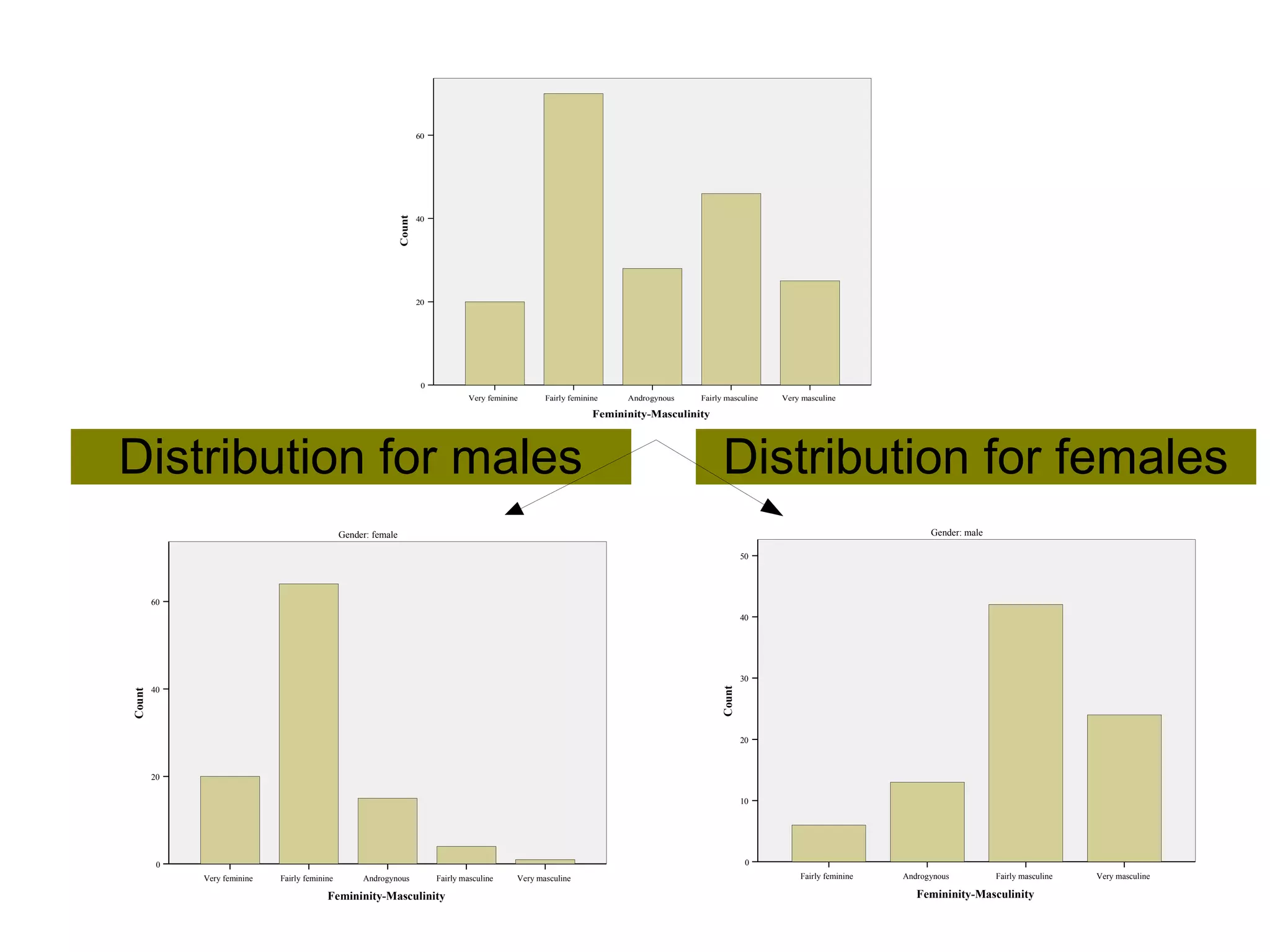
This bimodal graph
actually consists of two
different, underlying
normal distributions.
56
Very masculineFairly masculineAndrogynousFairly feminineVery feminine
Femininity-Masculinity
60
40
20
0
Count
Very masculineFairly masculineAndrogynousFairly feminine
Femininity-Masculinity
50
40
30
20
10
0
Count
Gender: male
Distribution for females Distribution for males
Very masculineFairly masculineAndrogynousFairly feminineVery feminine
Femininity-Masculinity
60
40
20
0
Count
Gender: female
57
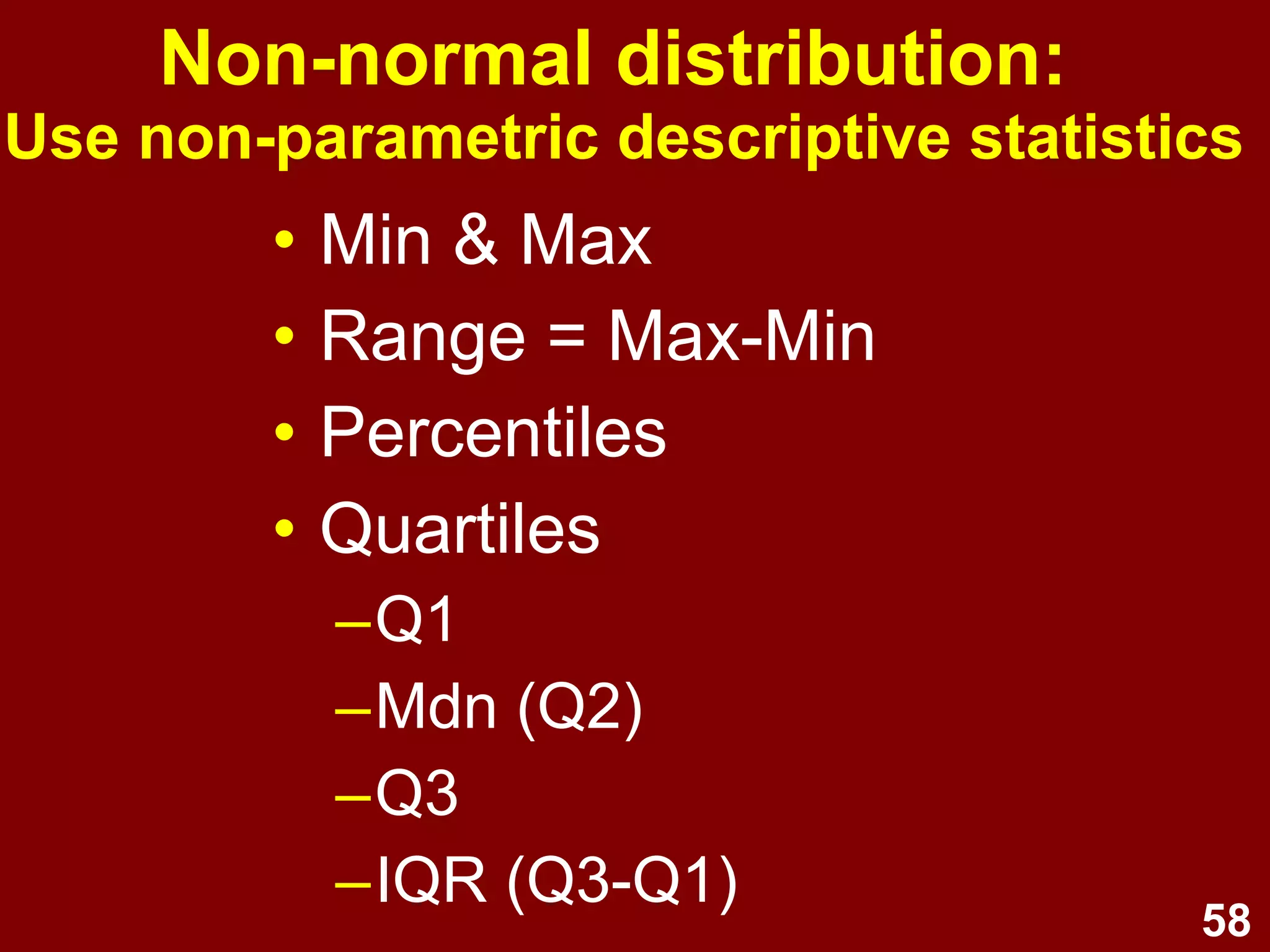
Non-normal distribution:
Use non-parametric descriptive statistics
• Min. & Max.
• Range = Max. - Min.
• Percentiles
• Quartiles
–Q1
–Mdn (Q2)
–Q3
–IQR (Q3-Q1)
58
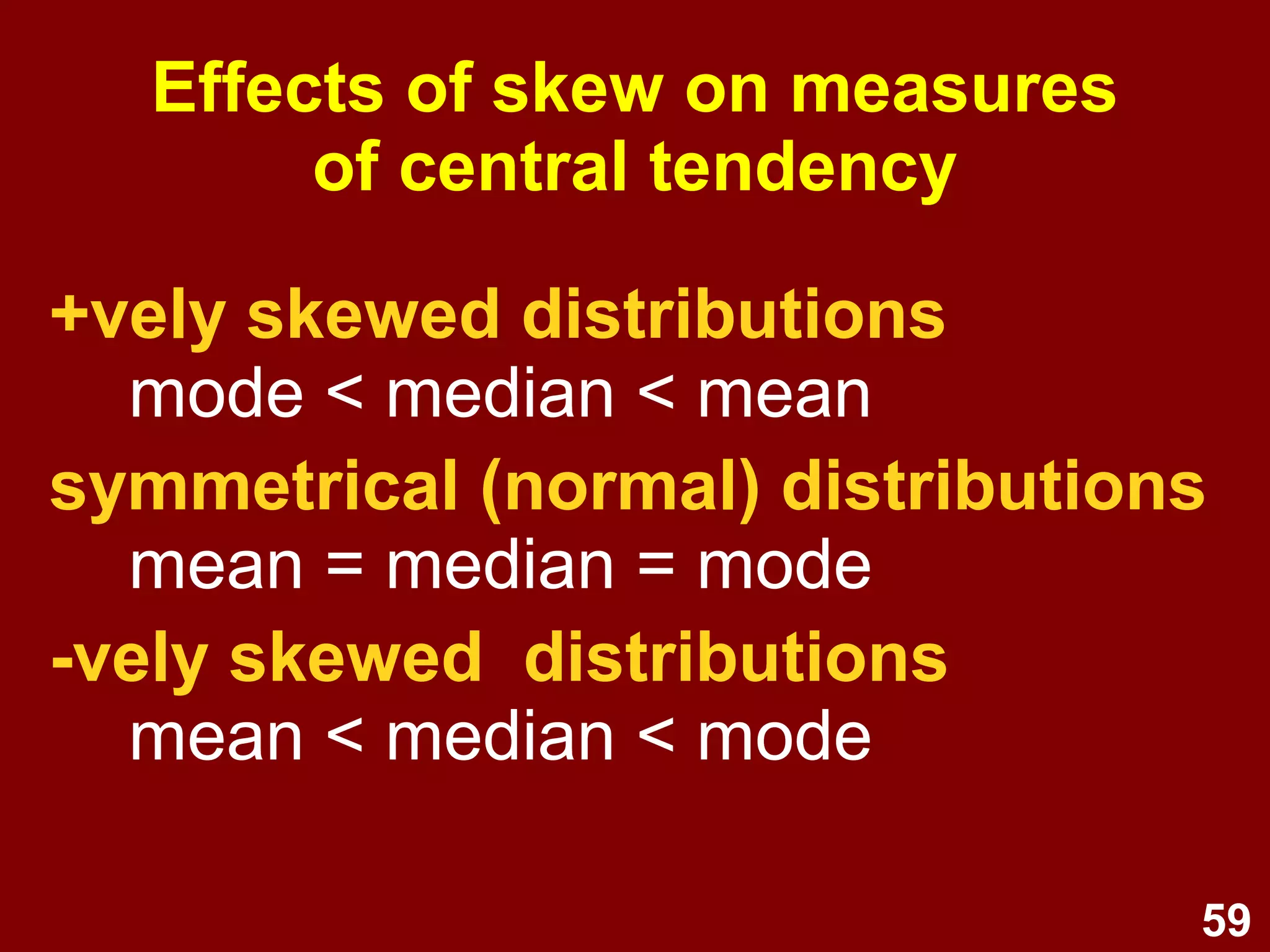
Effects of skew on measures
of central tendency
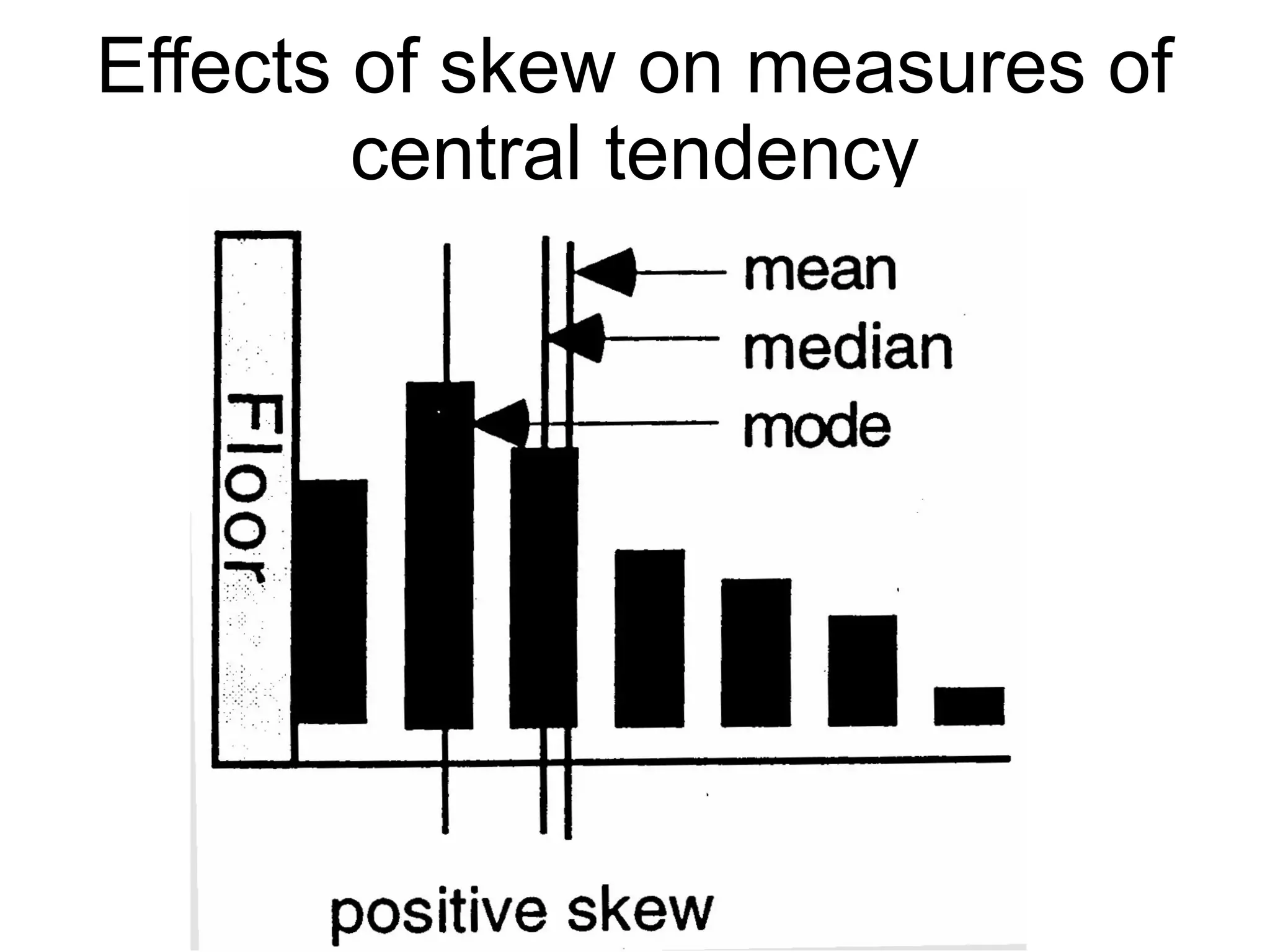
+vely skewed distributions
mode < median < mean
symmetrical (normal) distributions
mean = median = mode
-vely skewed distributions
mean < median < mode
59
Effects of skew on measures of
central tendency
60
Transformations
• Converts data using various
formulae to achieve normality
and allow more powerful tests
• Loses original metric
• Complicates interpretation
61
1. If a survey question produces a
‘floor effect’, where will the mean,
median and mode lie in relation to
one another?
Review questions
62
2. Would the mean # of cars owned in
Australia to exceed the median?
Review questions
63
3. Would the mean score on an easy
test exceed the median
performance?
Review questions
64
Graphical
techniques
Image source: http://www.flickr.com/photos/pagedooley/2121472112/
65
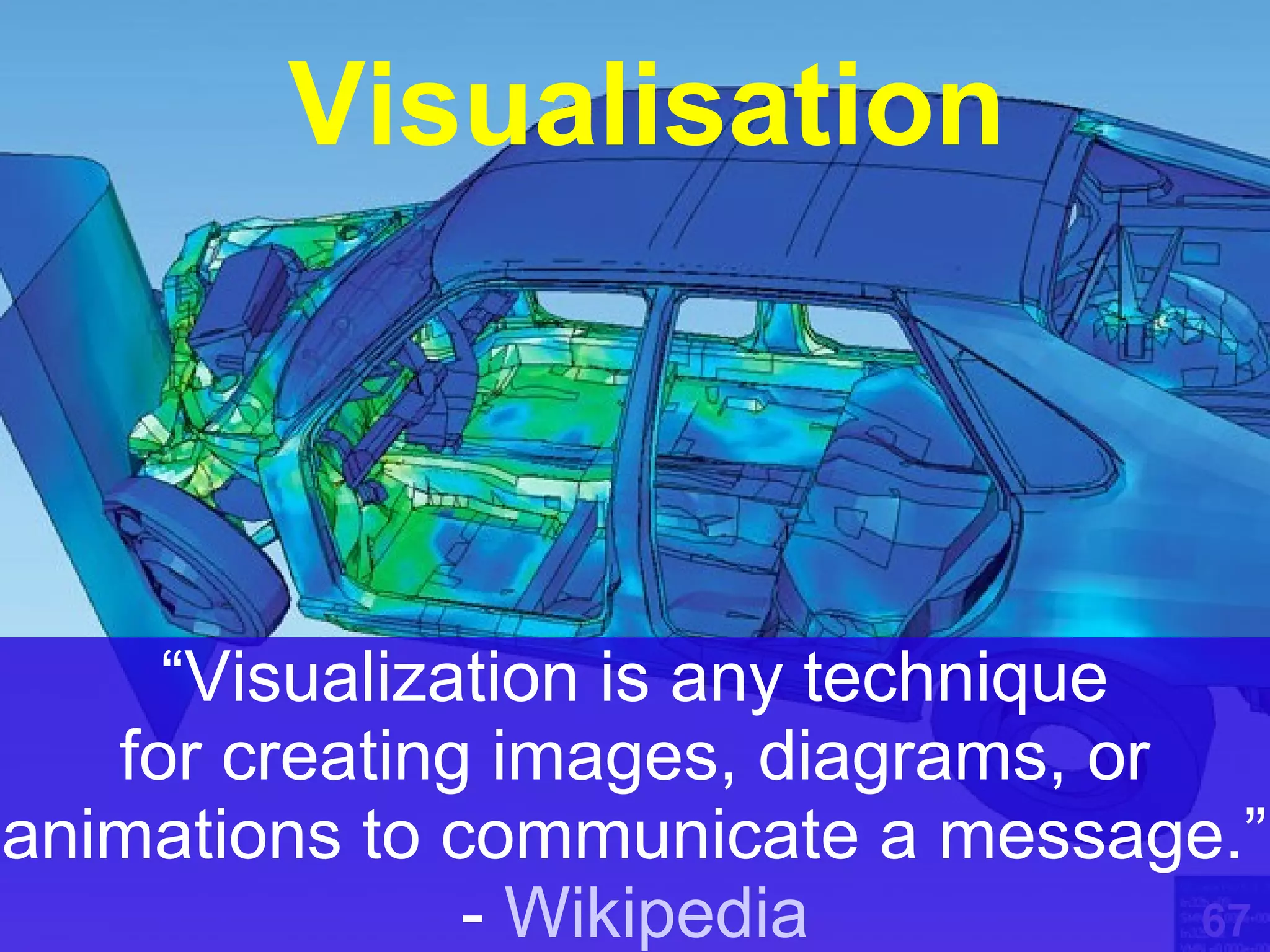
Visualisation
“Visualization is any technique
for creating images, diagrams, or
animations to communicate a message.”
- Wikipedia
Image source: http://en.wikipedia.org/wiki/File:FAE_visualization.jpg
66
Science is
beautiful
(Nature Video)
(Youtube – 5:30 mins)
Image source:http://commons.wikimedia.org/wiki/File:Parodyfilm.png
67
Is Pivot a turning
point for web
exploration?
(Gary Flake)
(TED talk - 6 min.)
Image source:http://commons.wikimedia.org/wiki/File:Parodyfilm.png
68
Principles of graphing
• Clear purpose
• Maximise clarity
• Minimise clutter
• Allow visual comparison
69
Graphs
(Edward Tufte)
• Visualise data
• Reveal data
– Describe
– Explore
– Tabulate
– Decorate
• Communicate complex ideas
with clarity, precision, and
efficiency
70
Graphing steps
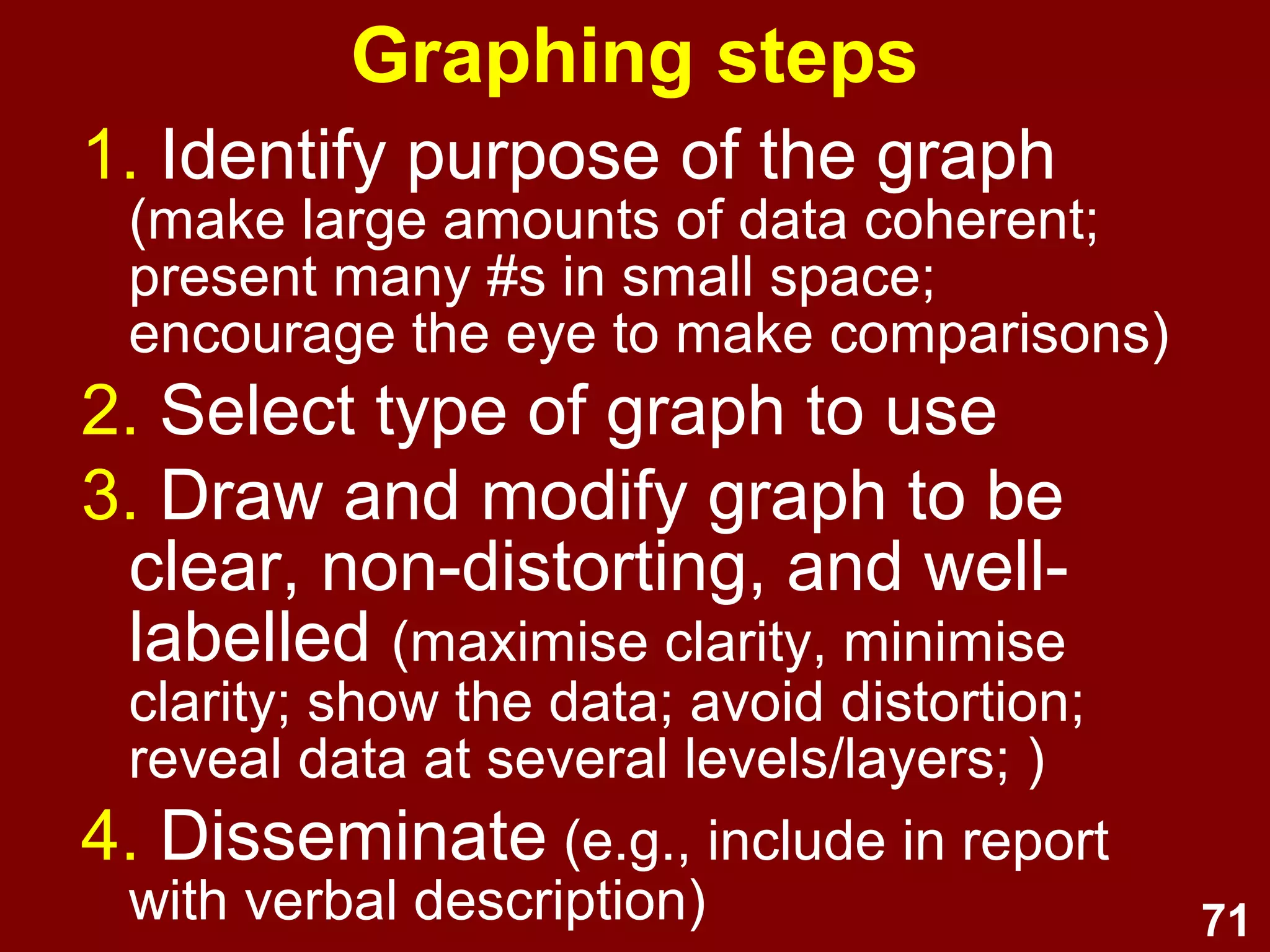
1. Identify purpose of the graph
(make large amounts of data coherent;
present many #s in small space;
encourage the eye to make comparisons)
2. Select type of graph to use
3. Draw and modify graph to be
clear, non-distorting, and well-
labelled (maximise clarity, minimise
clarity; show the data; avoid distortion;
reveal data at several levels/layers)
71
Software for
data visualisation (graphing)
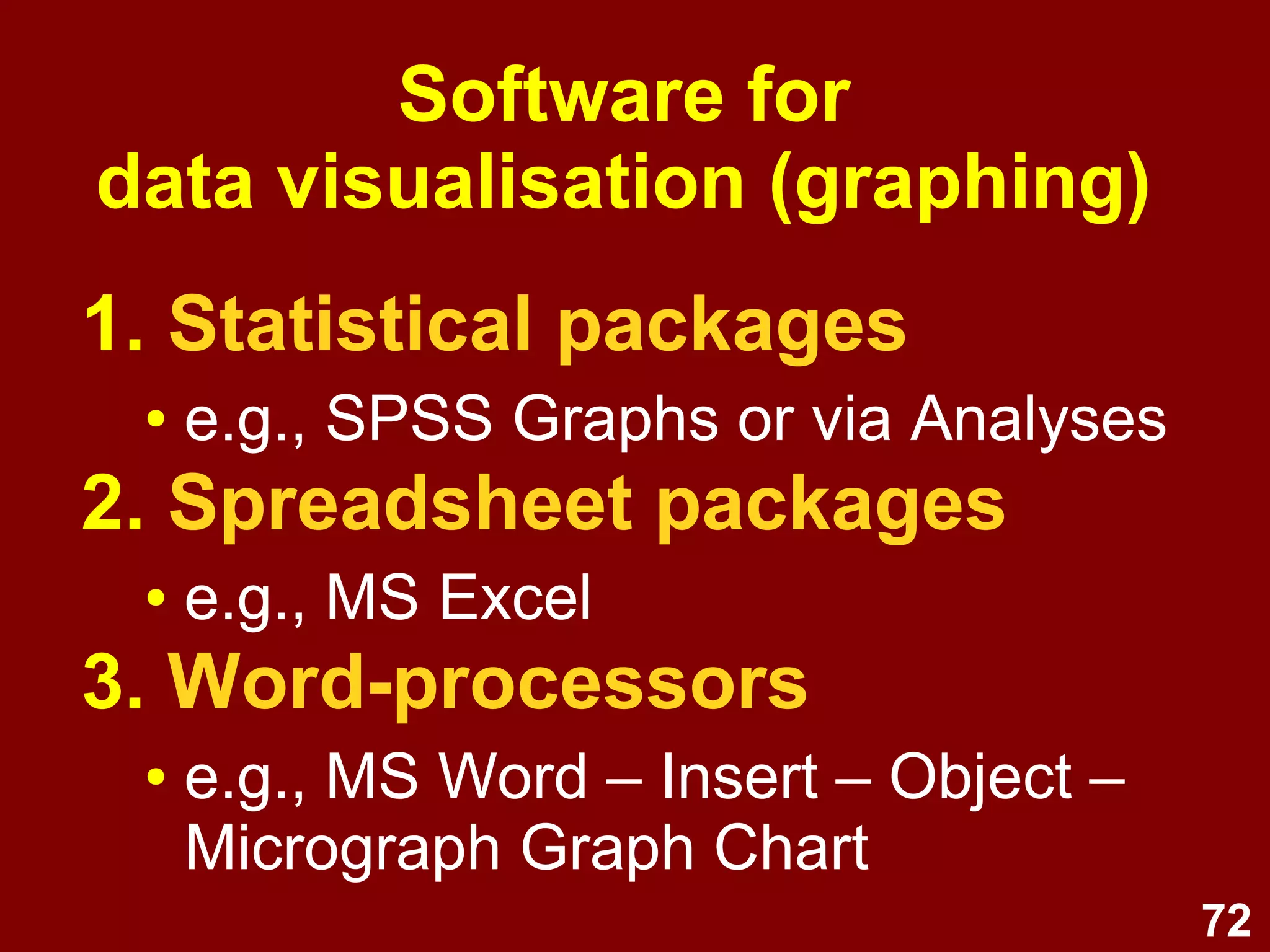
1. Statistical packages
● e.g., SPSS Graphs or via Analyses
2. Spreadsheet packages
● e.g., MS Excel
3. Word-processors
● e.g., MS Word – Insert – Object –
Micrograph Graph Chart
72
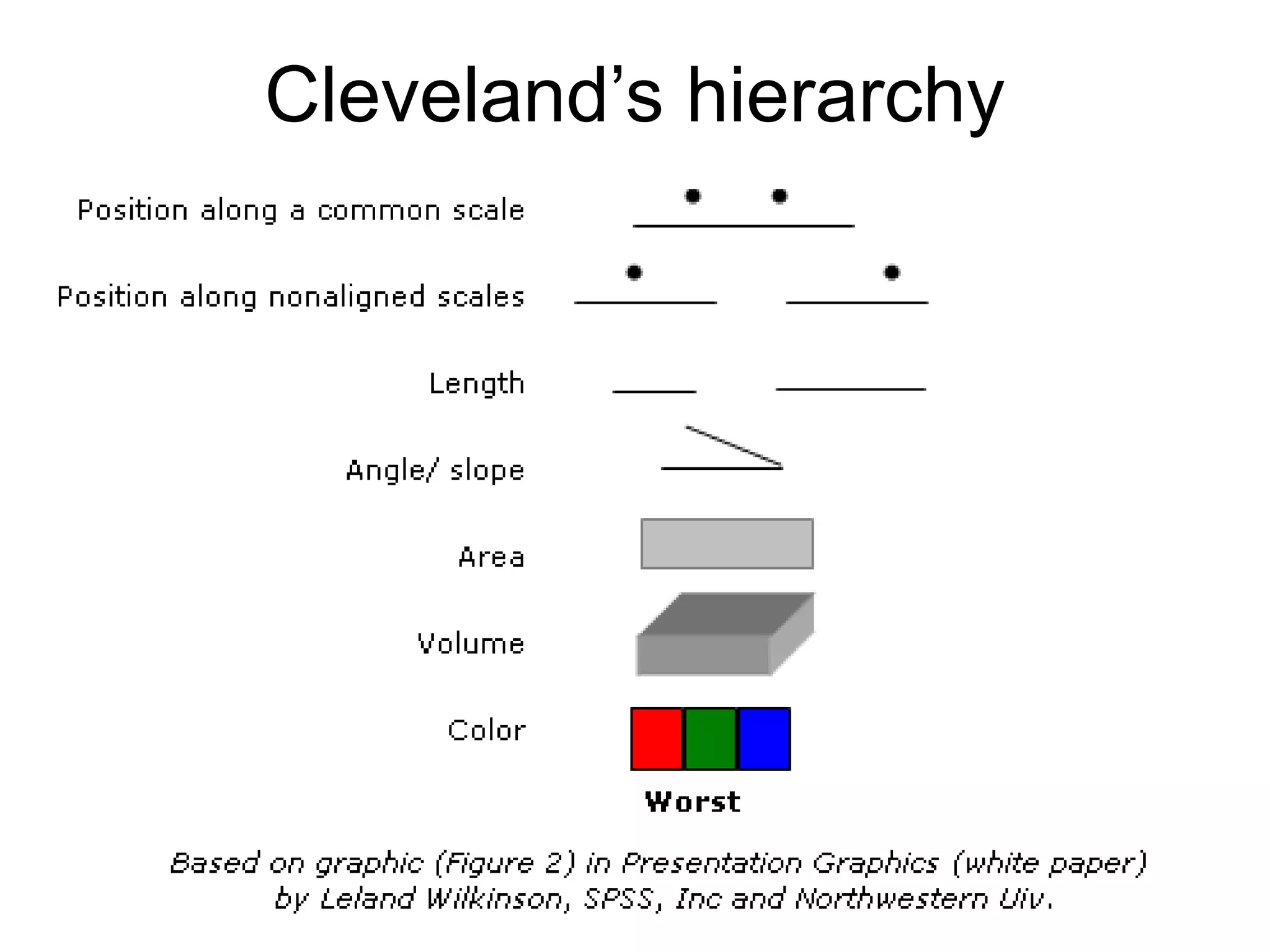
Cleveland’s hierarchyImage source:http://www.processtrends.com/TOC_data_visualization.htm
73
Cleveland’s hierarchyImage source:https://priceonomics.com/how-william-cleveland-turned-data-visualization/
74
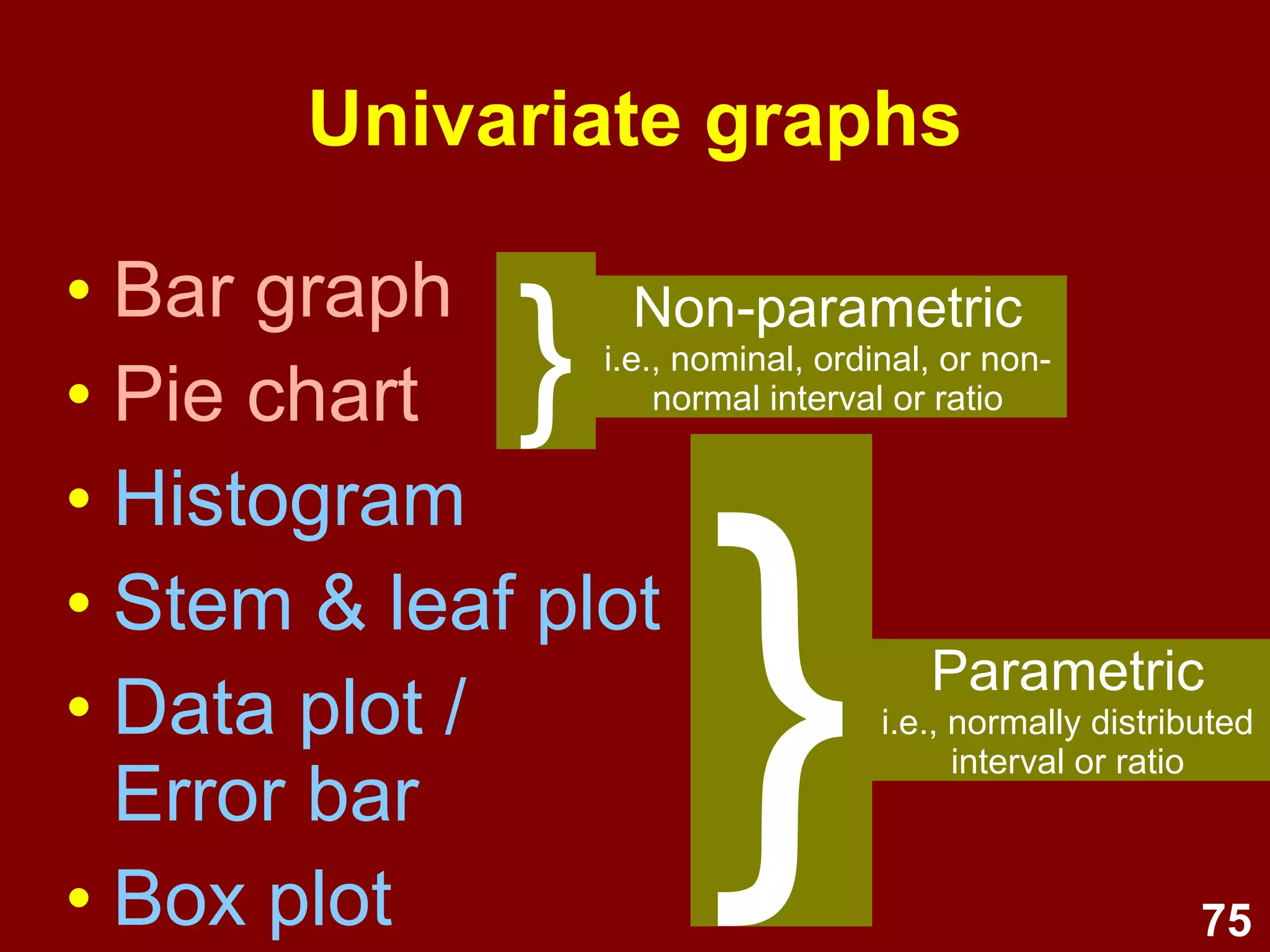
Univariate graphs
• Bar graph
• Pie chart
• Histogram
• Stem & leaf plot
• Data plot /
Error bar
• Box plot
Non-parametric
i.e., nominal or ordinal
}
} Parametric
i.e., normally distributed
interval or ratio
75
Bar chart (Bar graph)
AREA
Biology
Anthropology
Information Technolo
Psychology
Sociology
Count
13
12
12
11
11
10
10
9
9
AREA
Biology
Anthropology
Information Technolo
Psychology
Sociology
Count
12
11
10
9
8
7
6
5
4
3
2
1
0
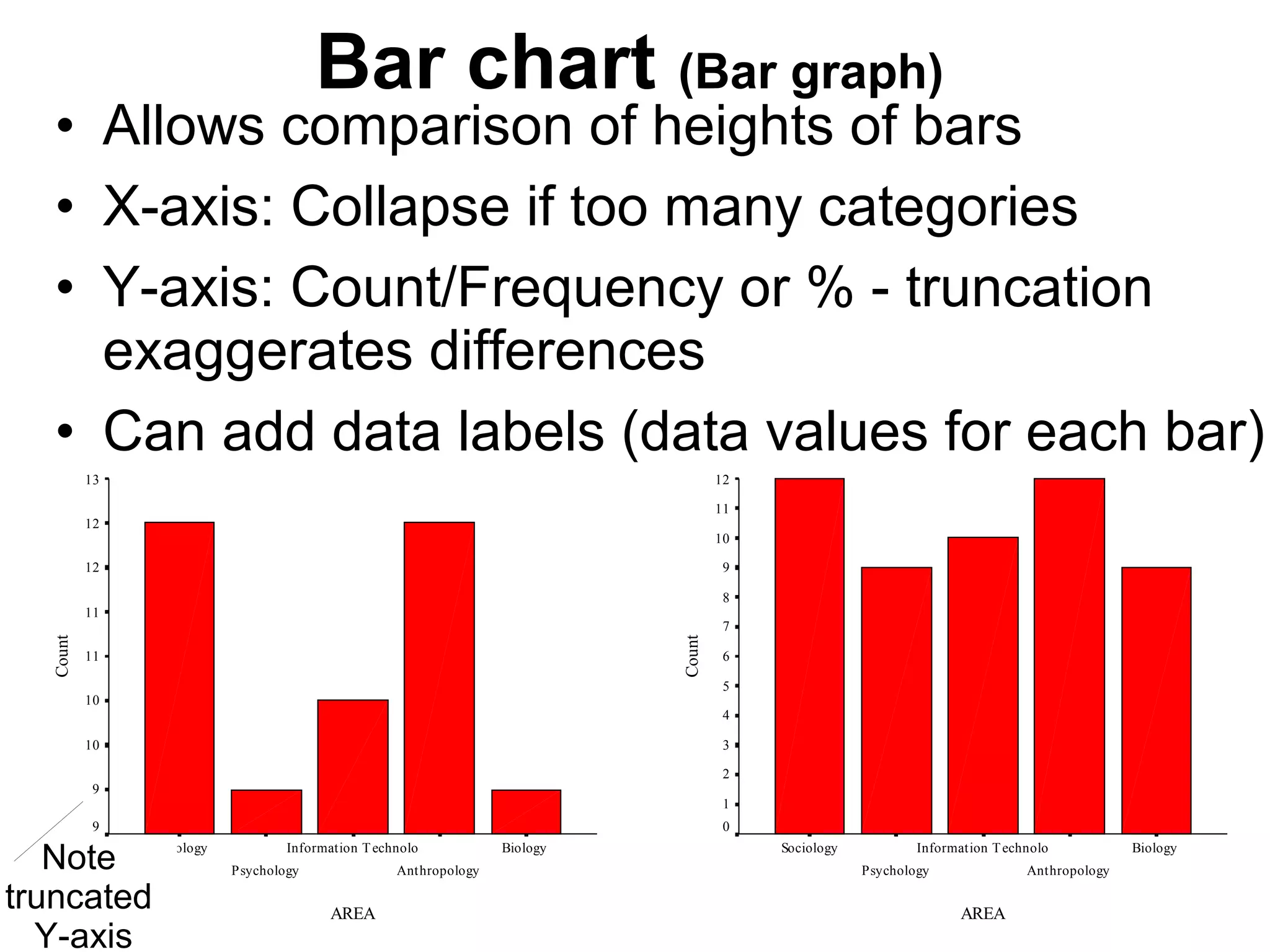
• Allows comparison of heights of bars
• X-axis: Collapse if too many categories
• Y-axis: Count/Frequency or % - truncation
exaggerates differences
• Can add data labels (data values for each bar)
Note
truncated
Y-axis
76
Biology
Anthropology
Information Technolo
Psychology
Sociology
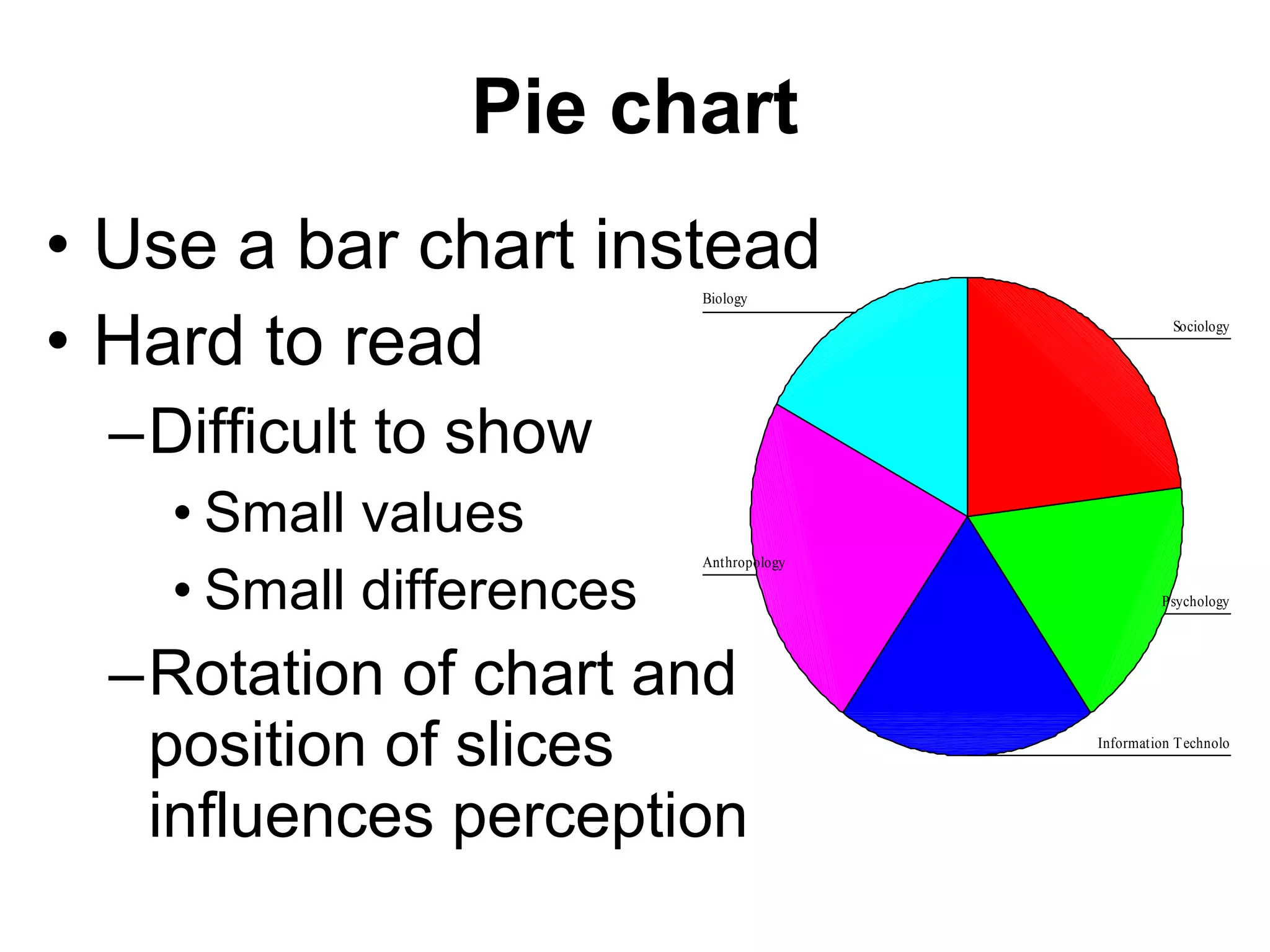
• Use a bar chart instead
• Hard to read
–Difficult to show
• Small values
• Small differences
–Rotation of chart and
position of slices
influences perception
Pie chart
77
Pie chart → Use bar chart instead
Image source: https://priceonomics.com/how-william-cleveland-turned-data-visualization/
78
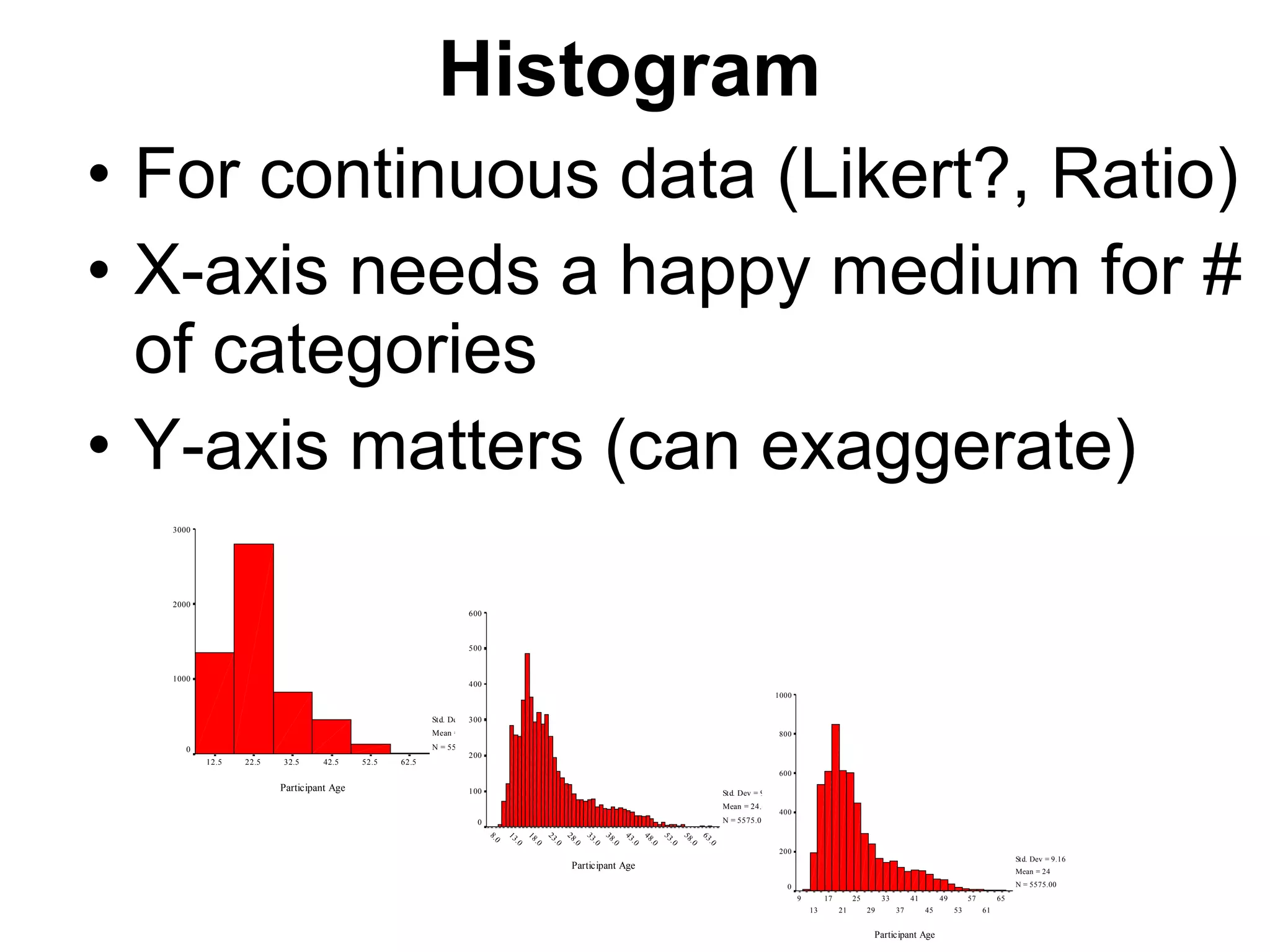
Histogram
Participant Age
62.552.542.532.522.512.5
3000
2000
1000
0
Std. Dev = 9.16
Mean = 24.0
N = 5575.00
Participant Age
63.0
58.0
53.0
48.0
43.0
38.0
33.0
28.0
23.0
18.0
13.0
8.0
600
500
400
300
200
100
0
Std. Dev = 9.16
Mean = 24.0
N = 5575.00
Participant Age
65
61
57
53
49
45
41
37
33
29
25
21
17
13
9
1000
800
600
400
200
0
Std. Dev = 9.16
Mean = 24
N = 5575.00
• For continuous data (Likert?, Ratio)
• X-axis needs a happy medium for #
of categories
• Y-axis matters (can exaggerate)
79
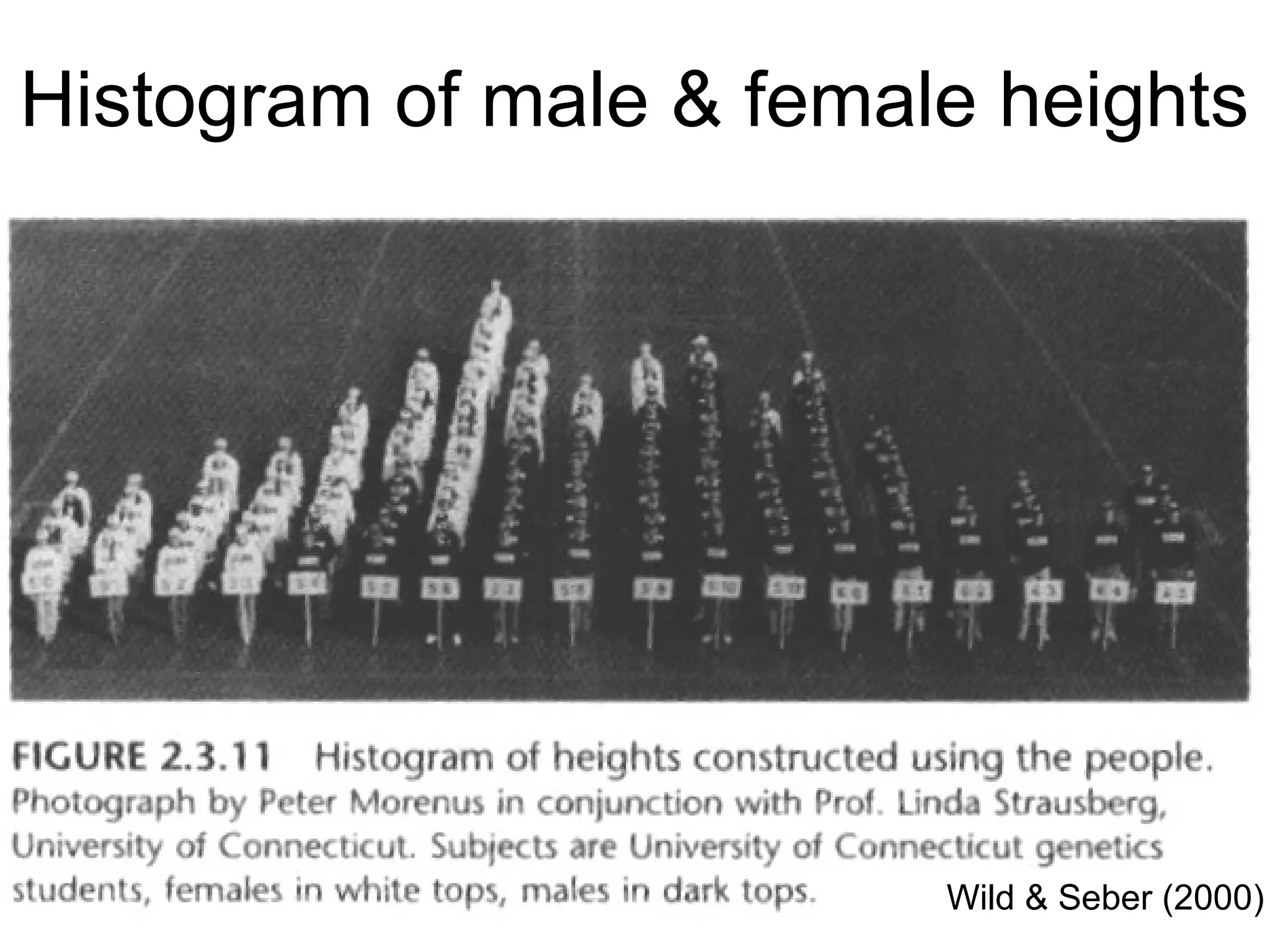
Histogram of male & female heights
Wild & Seber (2000)
Image source: Wild, C. J., & Seber, G. A. F. (2000). Chance encounters: A first course in data analysis and inference. New York: Wiley.
80
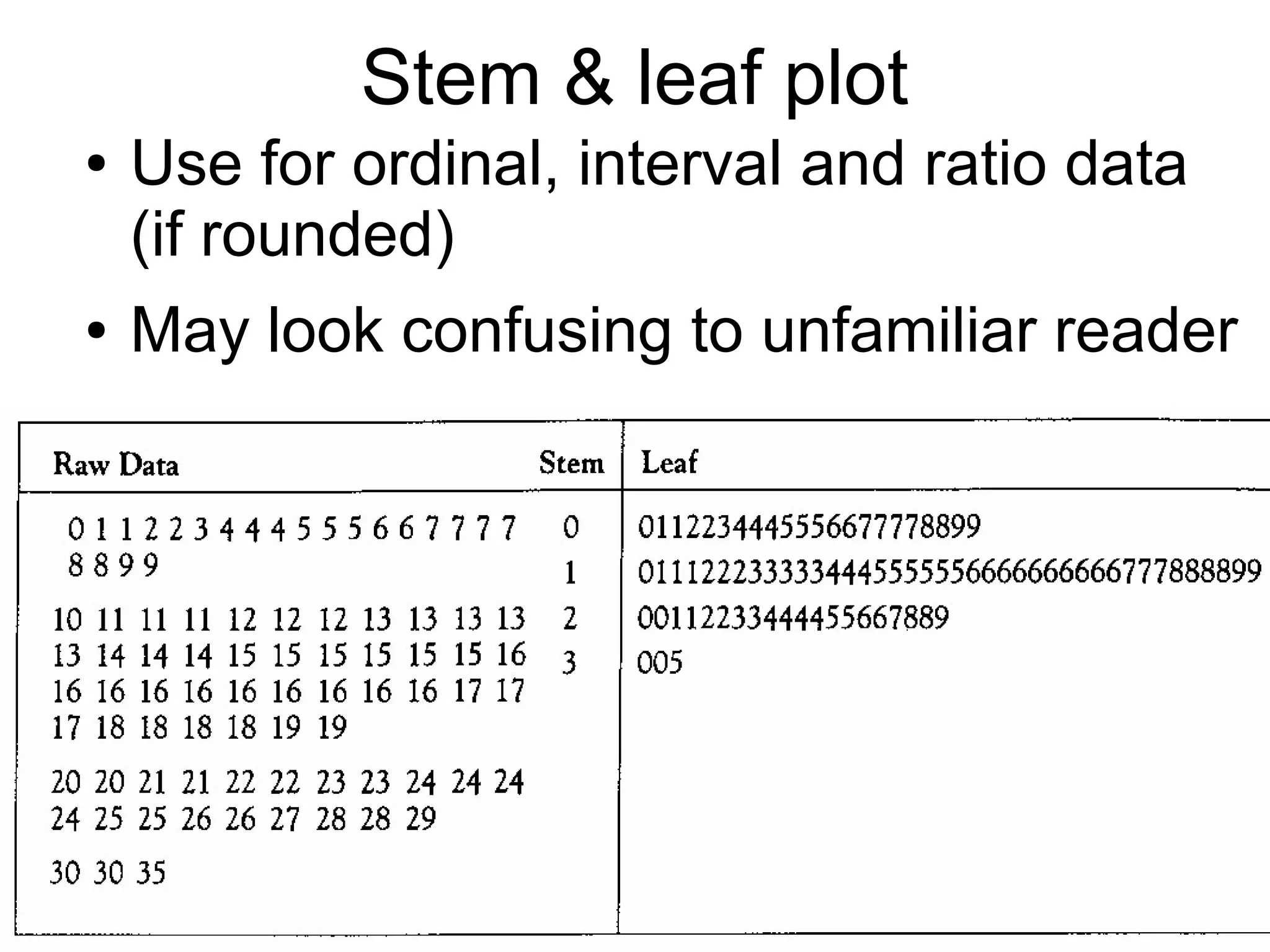
Stem & leaf plot
● Use for ordinal, interval and ratio data
(if rounded)
● May look confusing to unfamiliar reader
81
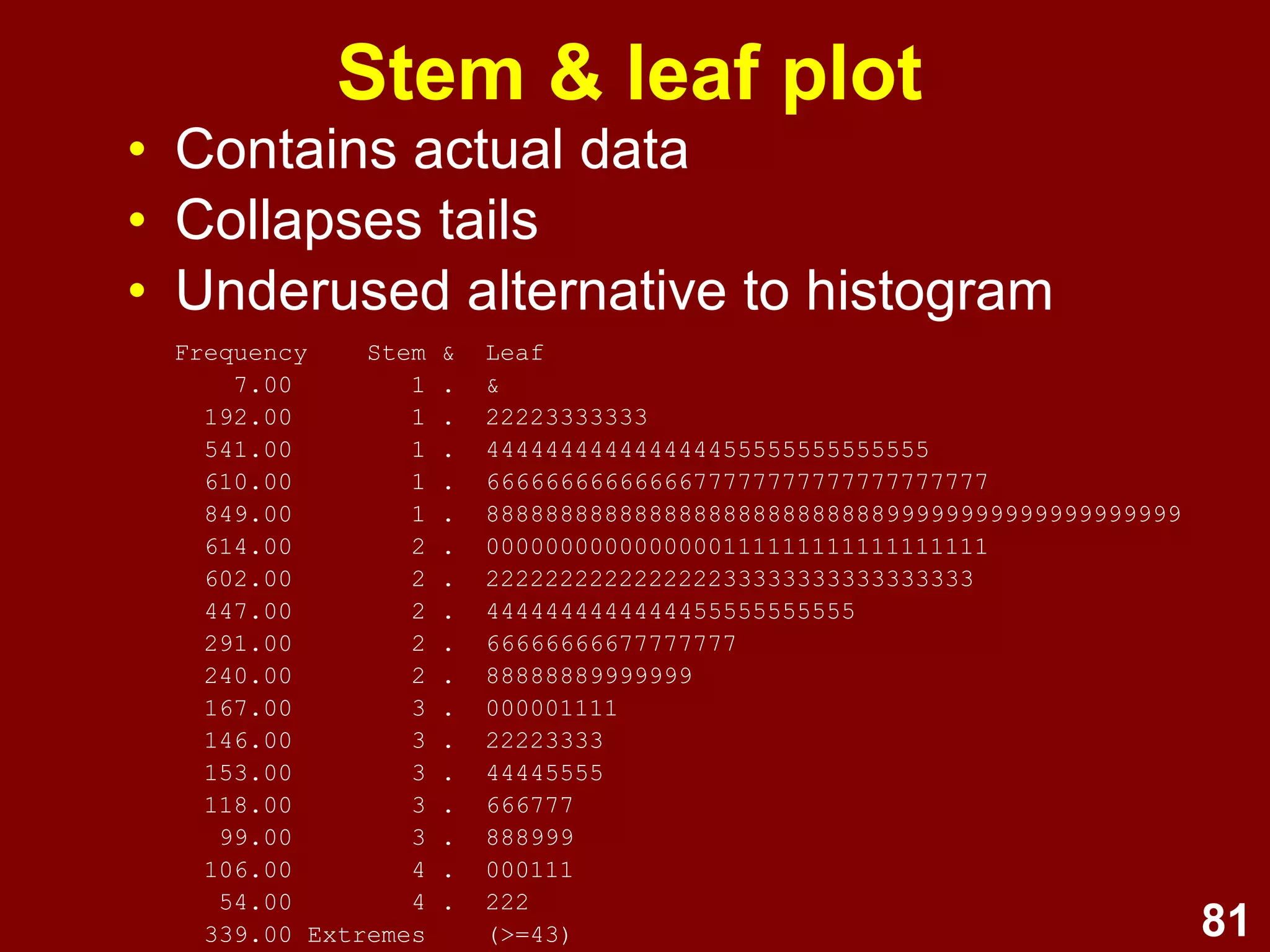
• Contains actual data
• Collapses tails
• Underused alternative to histogram
Stem & leaf plot
Frequency Stem & Leaf
7.00 1 . &
192.00 1 . 22223333333
541.00 1 . 444444444444444455555555555555
610.00 1 . 6666666666666677777777777777777777
849.00 1 . 88888888888888888888888888899999999999999999999
614.00 2 . 0000000000000000111111111111111111
602.00 2 . 222222222222222233333333333333333
447.00 2 . 4444444444444455555555555
291.00 2 . 66666666677777777
240.00 2 . 88888889999999
167.00 3 . 000001111
146.00 3 . 22223333
153.00 3 . 44445555
118.00 3 . 666777
99.00 3 . 888999
106.00 4 . 000111
54.00 4 . 222
339.00 Extremes (>=43)
82
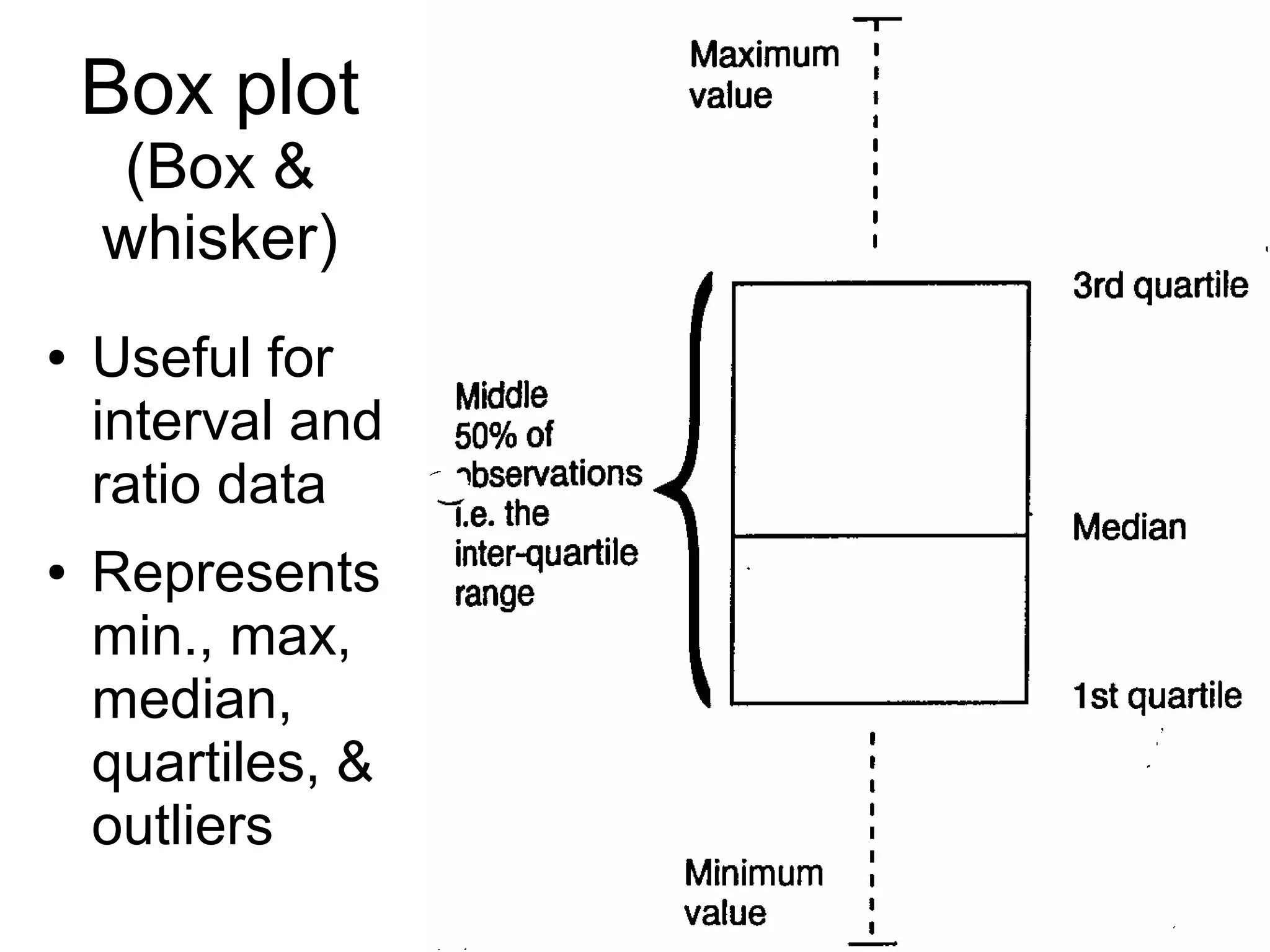
Box plot
(Box &
whisker)
● Useful for
interval and
ratio data
● Represents
min., max,
median,
quartiles, &
outliers
83
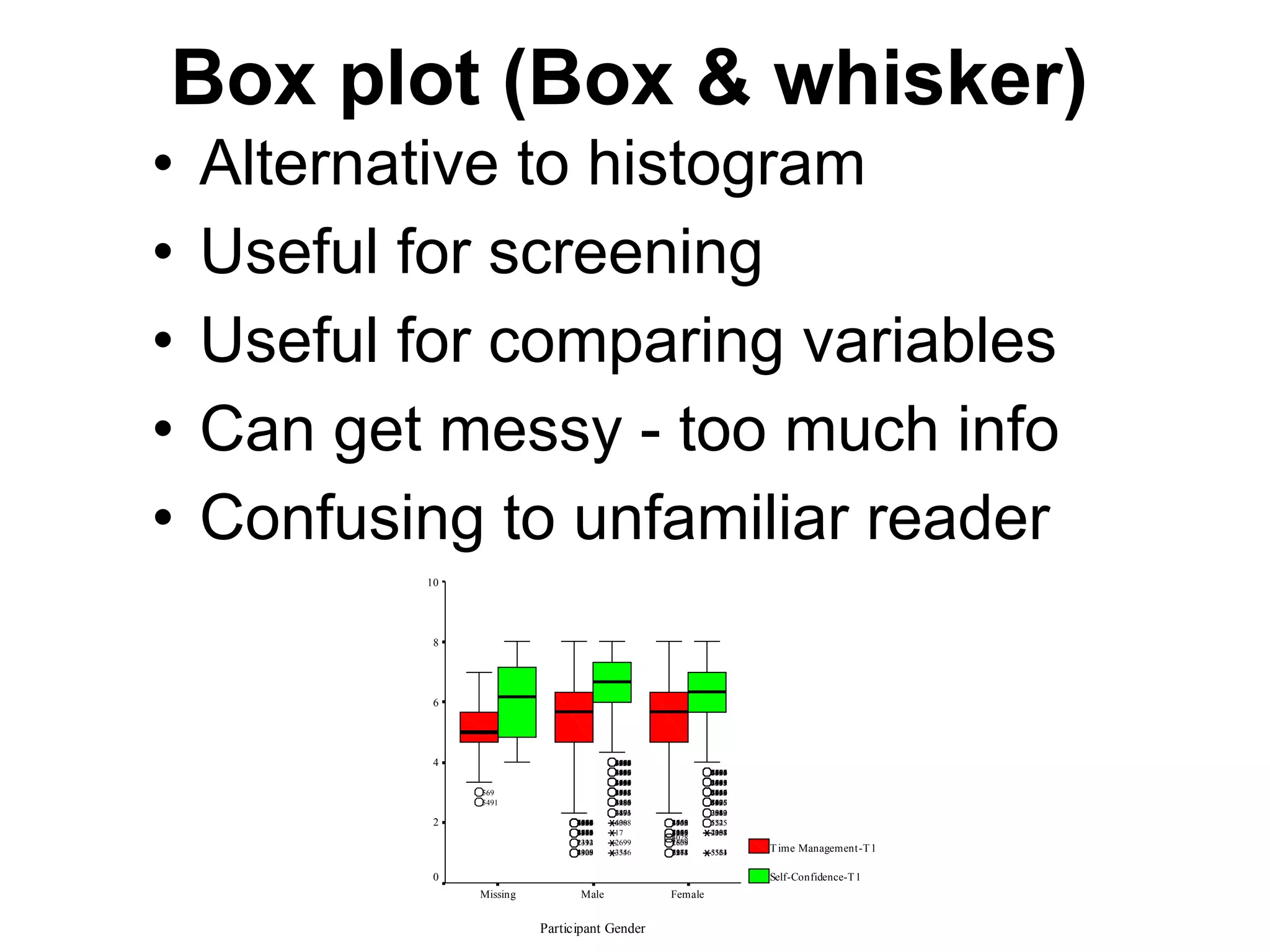
• Alternative to histogram
• Useful for screening
• Useful for comparing variables
• Can get messy - too much info
• Confusing to unfamiliar reader
Box plot (Box & whisker)
Participant Gender
FemaleMaleMissing
10
8
6
4
2
0
Time Management-T1
Self-Confidence-T1
44954162578259628414042044353275182341862330517623006559128211495
3201419358828475475400198324512898200336473
52157129504268724318255928345427211669040523444
4423423635403519067273946893137
3562338330403962312229
12255255545
2385410773323584004
552433515563
28294482267253154120226228451504231939983902646355221793020527435314997364541416412902548168628144167196326144171955174443826882822262617931747148
218736735510399522434250553623594998649620510638344230032962562527
35644317149302843626902101233519693009296541539905538229314216883634
27433593251521081985531655582138303424526783352317
2480296024926454284316542285186
419324766472662291
6084308
17
2699
3556334
1503275241623466255243493045
304032431371222596415943511907247380
4028
18082659
197862231372721142861
226520672270403852527688296021515564300430321938532836535506271835192336608405435012183292849986302224518624385114882241
27806412743294423212570661146542792576430229232476
231214932334
4308292014254307
569
5491
84
Data plot & error bar
Data plot Error bar
85
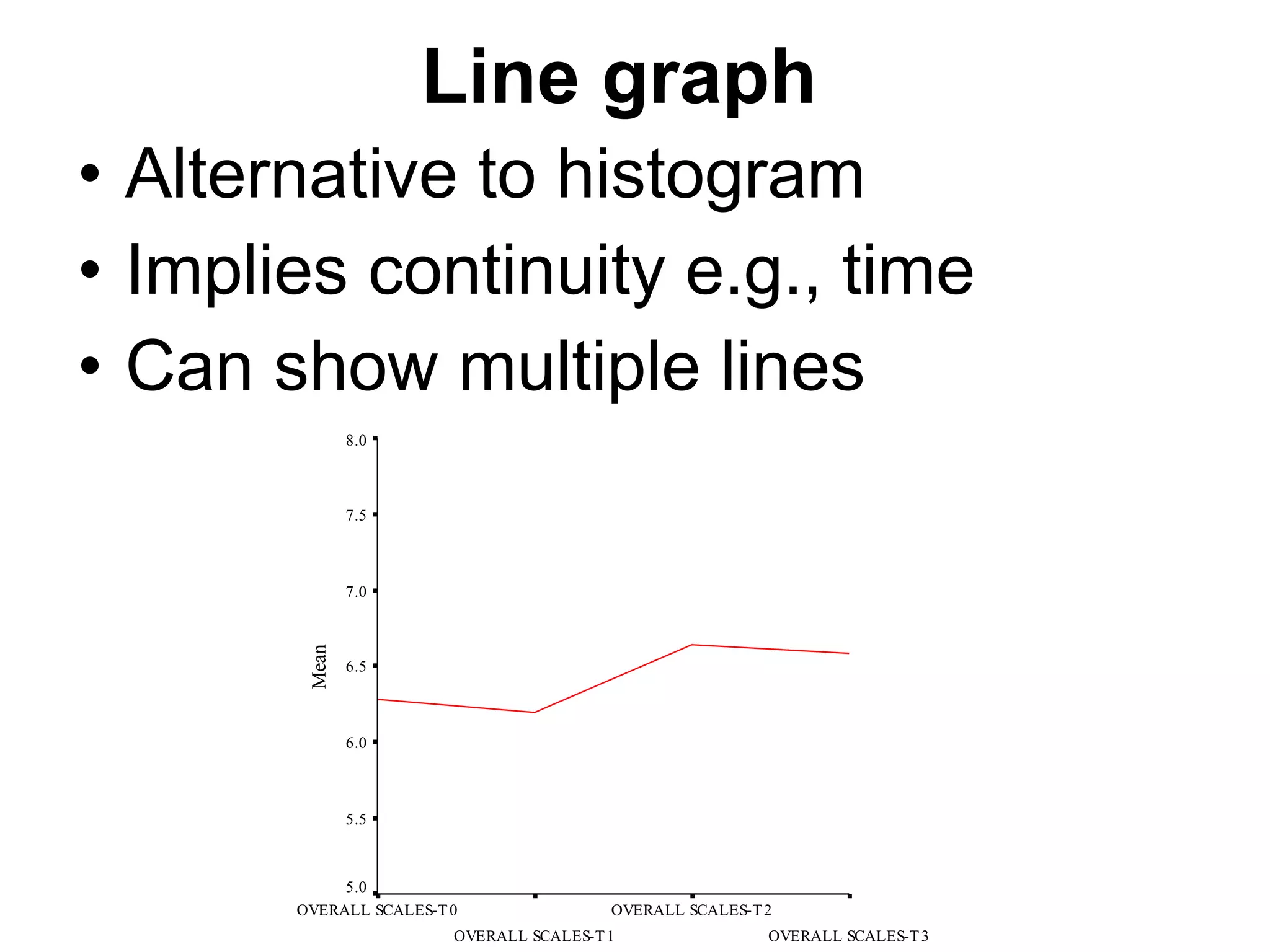
• Alternative to histogram
• Implies continuity e.g., time
• Can show multiple lines
Line graph
OVERALL SCALES-T3
OVERALL SCALES-T2
OVERALL SCALES-T1
OVERALL SCALES-T0
Mean
8.0
7.5
7.0
6.5
6.0
5.5
5.0
86
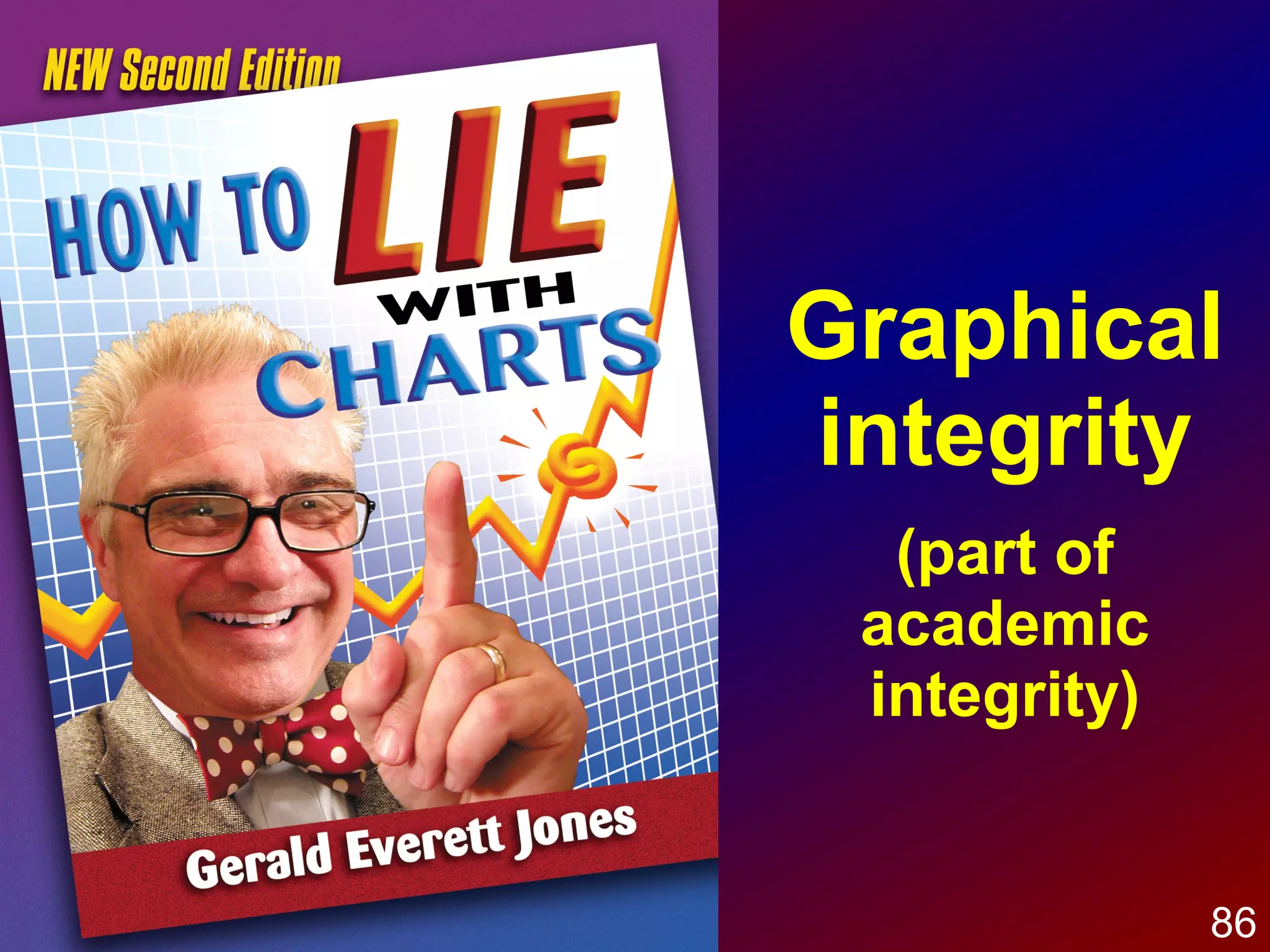
Graphical
integrity
(part of
academic
integrity)
87
"Like good writing, good graphical
displays of data communicate ideas
with clarity, precision, and efficiency.
Like poor writing, bad graphical
displays distort or obscure the data,
make it harder to understand or
compare, or otherwise thwart the
communicative effect which the
graph should convey."
Michael Friendly –
Gallery of Data Visualisation
88
Tufte’s graphical integrity
• Some lapses intentional, some not
• Lie Factor = size of effect in graph
size of effect in data
• Misleading uses of area
• Misleading uses of perspective
• Leaving out important context
• Lack of taste and aesthetics
89
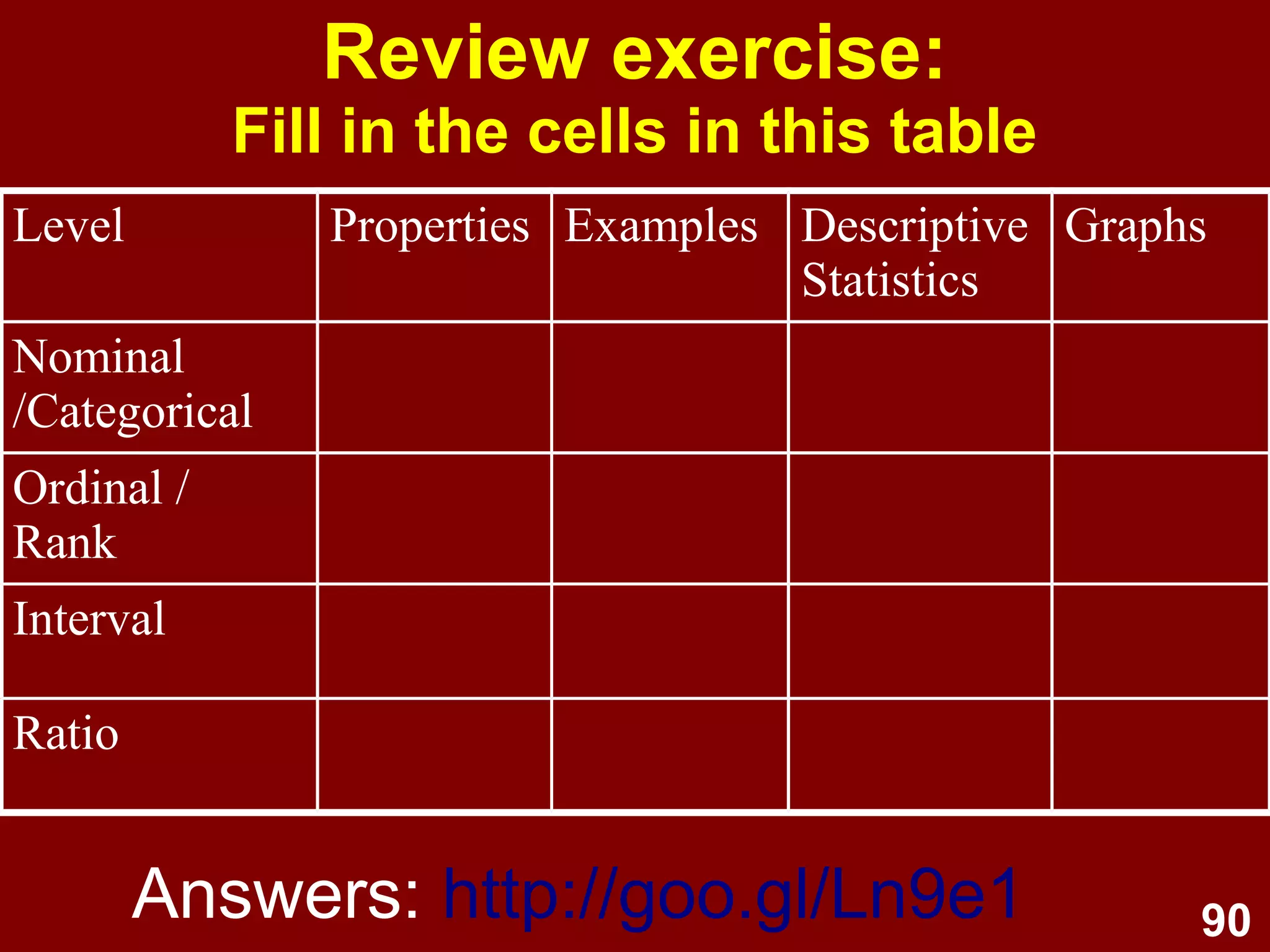
Review exercise:
Fill in the cells in this table
Level Properties Examples Descriptive
Statistics
Graphs
Nominal
/Categorical
Ordinal /
Rank
Interval
Ratio
Answers: http://goo.gl/Ln9e1
90
References
1. Chambers, J., Cleveland, B., Kleiner, B., & Tukey, P. (1983).
Graphical methods for data analysis. Boston, MA: Duxbury
Press.
2. Cleveland, W. S. (1985). The elements of graphing data.
Monterey, CA: Wadsworth.
3. Jones, G. E. (2006). How to lie with charts. Santa Monica, CA:
LaPuerta.
4. Tufte, E. R. (1983). The visual display of quantitative information.
Cheshire, CT: Graphics Press.
5. Tufte. E. R. (2001). Visualizing quantitative data. Cheshire, CT:
Graphics Press.
6. Tukey J. (1977). Exploratory data analysis. Addison-Wesley.
7. Wild, C. J., & Seber, G. A. F. (2000). Chance encounters: A first
course in data analysis and inference. New York: Wiley.
91
Open Office Impress
● This presentation was made using
Open Office Impress.
● Free and open source software.
● http://www.openoffice.org/product/impress.html

Descriptives & Graphing

  • 1.
    Lecture 3 Survey Research& Design in Psychology James Neill, 2017 Creative Commons Attribution 4.0 Descriptives & Graphing Image source: http://commons.wikimedia.org/wiki/File:3D_Bar_Graph_Meeting.jpg
  • 2.
    2 Overview: Descriptives & Graphing 1.Getting to know a data set 2. LOM & types of statistics 3. Descriptive statistics 4. Normal distribution 5. Non-normal distributions 6. Effect of skew on central tendency 7. Principles of graphing 8. Univariate graphical techniques
  • 3.
    3 Getting to know adata-set (how to approach data)
  • 4.
    4 Play with thedata – get to know it.Image source: http://www.flickr.com/photos/analytik/1356366068/
  • 5.
    5 Don't be afraid- you can't break data!Image source: http://www.flickr.com/photos/rnddave/5094020069
  • 6.
    6 Check & screenthe data – keep signal, reduce noise Image source: https://commons.wikimedia.org/wiki/File:Nasir-al_molk_-1.jpg
  • 7.
    7 Data checking: One personreads the survey responses aloud to another person who checks the electronic data file. For large studies, check a proportion of the surveys and declare the error-rate in the research report. Image source: http://maxpixel.freegreatpicture.com/Business-Team-Two-People-Meeting-Computers-Office-1209640
  • 8.
    8 Data screening: Carefully 'screening'a data file helps to remove errors and maximise validity. For example, screen for: Out of range values Mis-entered data Missing cases Duplicate cases Missing data Image source: https://commons.wikimedia.org/wiki/File:Archaeology_dirt_screening.jpg
  • 9.
    9 Explore the data Imagesource: https://commons.wikimedia.org/wiki/File:Kazimierz_Nowak_in_jungle_2.jpgI
  • 10.
    10 Get intimate with thedata Image source: http://www.flickr.com/photos/elmoalves/2932572231/
  • 11.
    11 Describe the data's mainfeatures find a meaningful, accurate way to depict the ‘true story’ of the data Image source: http://www.flickr.com/photos/lloydm/2429991235/
  • 12.
    12 Test hypotheses to answerresearch questions Image source: https://pixabay.com/en/light-bulb-current-light-glow-1042480/
  • 13.
    13 Level of measurement & typesof statistics Image source: http://www.flickr.com/photos/peanutlen/2228077524/
  • 14.
    14 Golden rule ofdata analysis A variable's level of measurement determines the type of statistics that can be used, including types of: • descriptive statistics • graphs • inferential statistics
  • 15.
    15 Levels of measurementand non-parametric vs. parametric Categorical & ordinal data DV → non-parametric (Does not assume a normal distribution) Interval & ratio data DV → parametric (Assumes a normal distribution) → non-parametric (If distribution is non-normal) DVs = dependent variables
  • 16.
    16 Parametric statistics • Statisticswhich estimate parameters of a population, based on the normal distribution –Univariate: mean, standard deviation, skewness, kurtosis, t-tests, ANOVAs –Bivariate: correlation, linear regression –Multivariate: multiple linear regression
  • 17.
    17 • More powerful (moresensitive) • More assumptions (population is normally distributed) • Vulnerable to violations of assumptions (less robust) Parametric statistics
  • 18.
    18 Non-parametric statistics • Statisticswhich do not assume sampling from a population which is normally distributed –There are non-parametric alternatives for many parametric statistics –e.g., sign test, chi-squared, Mann- Whitney U test, Wilcoxon matched-pairs signed-ranks test.
  • 19.
    19 Non-parametric statistics • Lesspowerful (less sensitive) • Fewer assumptions (do not assume a normal distribution) • Less vulnerable to assumption violation (more robust)
  • 20.
  • 21.
    21 Number of variables Univariate =one variable Bivariate = two variables Multivariate = more than two variables mean, median, mode, histogram, bar chart correlation, t-test, scatterplot, clustered bar chart reliability analysis, factor analysis, multiple linear regression
  • 22.
    22 What do wewant to describe? The distributional properties of variables, based on: ● Central tendency(ies): e.g., frequencies, mode, median, mean ● Shape: e.g., skewness, kurtosis ● Spread (dispersion): min., max., range, IQR, percentiles, variance, standard deviation
  • 23.
    23 Measures of centraltendency Statistics which represent the ‘centre’ of a frequency distribution: –Mode (most frequent) –Median (50th percentile) –Mean (average) Which ones to use depends on: –Type of data (level of measurement) –Shape of distribution (esp. skewness) Reporting more than one may be appropriate.
  • 24.
    24 Measures of centraltendency √√If meaningfulRatio √√√Interval √Ordinal √Nominal MeanMedianMode / Freq. /%s If meaningful x x x
  • 25.
    25 Measures of distribution •Measures of shape, spread, dispersion, and deviation from the central tendency Non-parametric: • Min. and max. • Range • Percentiles Parametric: • SD • Skewness • Kurtosis
  • 26.
    26 √√√Ratio √√Interval √Ordinal Nominal Var / SDPercentileMin/ Max, Range Measures of spread / dispersion / deviation If meaningful √ x x x x
  • 27.
    27 Descriptives for nominaldata • Nominal LOM = Labelled categories • Descriptive statistics: –Most frequent? (Mode – e.g., females) –Least frequent? (e.g., Males) –Frequencies (e.g., 20 females, 10 males) –Percentages (e.g. 67% females, 33% males) –Cumulative percentages –Ratios (e.g., twice as many females as males)
  • 28.
    28 Descriptives for ordinaldata • Ordinal LOM = Conveys order but not distance (e.g., ranks) • Descriptives approach is as for nominal (frequencies, mode etc.) • Plus percentiles (including median) may be useful
  • 29.
    29 Descriptives for intervaldata • Interval LOM = order and distance, but no true 0 (0 is arbitrary). • Central tendency (mode, median, mean) • Shape/Spread (min., max., range, SD, skewness, kurtosis) Interval data is discrete, but is often treated as ratio/continuous (especially for > 5 intervals)
  • 30.
    30 Descriptives for ratiodata • Ratio = Numbers convey order and distance, meaningful 0 point • As for interval, use median, mean, SD, skewness etc. • Can also use ratios (e.g., Category A is twice as large as Category B)
  • 31.
    31 Mode (Mo) • Mostcommon score - highest point in a frequency distribution – a real score – the most common response • Suitable for all levels of data, but may not be appropriate for ratio (continuous) • Not affected by outliers • Check frequencies and bar graph to see whether it is an accurate and useful statistic
  • 32.
    32 Frequencies (f) and percentages(%) • # of responses in each category • % of responses in each category • Frequency table • Visualise using a bar or pie chart
  • 33.
    33 Median (Mdn) • Mid-pointof distribution (Quartile 2, 50th percentile) • Not badly affected by outliers • May not represent the central tendency in skewed data • If the Median is useful, then consider what other percentiles may also be worth reporting
  • 34.
    34 Summary: Descriptive statistics •Level of measurement and normality determines whether data can be treated as parametric • Describe the central tendency –Frequencies, Percentages –Mode, Median, Mean • Describe the variability: –Min., Max., Range, Quartiles –Standard Deviation, Variance
  • 35.
    35 Properties of the normaldistribution Image source: http://www.flickr.com/photos/trevorblake/3200899889/
  • 36.
    36 Four moments ofa normal distribution Row 1 Row 2 Row 3 Row 4 0 2 4 6 8 10 12 Column 1 Column 2 Column 3 Mean ←SD→ -ve Skew +ve Skew ←Kurtosis→
  • 37.
    37 Four moments ofa normal distribution Four mathematical qualities (parameters) can describe a continuous distribution which at least roughly follows a bell curve shape: • 1st = mean (central tendency) • 2nd = SD (dispersion) • 3rd = skewness (lean / tail) • 4th = kurtosis (peakedness / flattness)
  • 38.
    38 Mean (1st moment ) •Average score Mean = Σ X / N • For normally distributed ratio or interval (if treating it as continuous) data. • Influenced by extreme scores (outliers)
  • 39.
    39 Beware inappropriate averaging... Withyour head in an oven and your feet in ice you would feel, on average, just fine The majority of people have more than the average number of legs (M = 1.9999).
  • 40.
    40 Standard deviation (2nd moment) •SD = square root of the variance = Σ (X - X)2 N – 1 • For normally distributed interval or ratio data • Affected by outliers • Can also derive the Standard Error (SE) = SD / square root of N
  • 41.
    41 Skewness (3rd moment ) •Lean of distribution – +ve = tail to right – -ve = tail to left • Can be caused by an outlier, or ceiling or floor effects • Can be accurate (e.g., cars owned per person would have a skewed distribution)
  • 42.
    42 Skewness (3rd moment) (withceiling and floor effects) ● Negative skew ● Ceiling effect ● Positive skew ● Floor effect Image source http://www.visualstatistics.net/Visual%20Statistics%20Multimedia/normalization.htm
  • 43.
    43 Kurtosis (4th moment ) •Flatness or peakedness of distribution +ve = peaked -ve = flattened • By altering the X &/or Y axis, any distribution can be made to look more peaked or flat – add a normal curve to help judge kurtosis visually.
  • 44.
    44 Kurtosis (4th moment ) Imagesource: https://classconnection.s3.amazonaws.com/65/flashcards/2185065/jpg/kurtosis-142C1127AF2178FB244.jpg
  • 45.
    45 Judging severity of skewness& kurtosis • View histogram with normal curve • Deal with outliers • Rule of thumb: Skewness and kurtosis > -1 or < 1 is generally considered to sufficiently normal for meeting the assumptions of parametric inferential statistics • Significance tests of skewness: Tend to be overly sensitive (therefore avoid using)
  • 46.
    46 Areas under thenormal curve If distribution is normal (bell-shaped - or close): ~68% of scores within +/- 1 SD of M ~95% of scores within +/- 2 SD of M ~99.7% of scores within +/- 3 SD of M
  • 47.
    47 Areas under thenormal curve Image source: https://commons.wikimedia.org/wiki/File:Empirical_Rule.PNG
  • 48.
  • 49.
    49 Types of non-normaldistribution • Modality –Uni-modal (one peak) –Bi-modal (two peaks) –Multi-modal (more than two peaks) • Skewness –Positive (tail to right) –Negative (tail to left) • Kurtosis –Platykurtic (Flat) –Leptokurtic (Peaked)
  • 50.
  • 51.
    51 Histogram of people'sweight WEIGHT 110.0100.090.080.070.060.050.040.0 Histogram Frequency 8 6 4 2 0 Std. Dev = 17.10 Mean = 69.6 N = 20.00
  • 52.
    52 Histogram of dailycalorie intake N = 75
  • 53.
  • 54.
    54 Example ‘normal’ distribution 1 140120100806040200 Die 60 50 40 30 20 10 0 Frequency Mean=81.21 Std. Dev. =18.228 N =188 At what age do you think you will die?
  • 55.
    55 Example ‘normal’ distribution 2 VerymasculineFairly masculineAndrogynousFairly feminineVery feminine Femininity-Masculinity 60 40 20 0 Count This bimodal graph actually consists of two different, underlying normal distributions.
  • 56.
    56 Very masculineFairly masculineAndrogynousFairlyfeminineVery feminine Femininity-Masculinity 60 40 20 0 Count Very masculineFairly masculineAndrogynousFairly feminine Femininity-Masculinity 50 40 30 20 10 0 Count Gender: male Distribution for females Distribution for males Very masculineFairly masculineAndrogynousFairly feminineVery feminine Femininity-Masculinity 60 40 20 0 Count Gender: female
  • 57.
    57 Non-normal distribution: Use non-parametricdescriptive statistics • Min. & Max. • Range = Max. - Min. • Percentiles • Quartiles –Q1 –Mdn (Q2) –Q3 –IQR (Q3-Q1)
  • 58.
    58 Effects of skewon measures of central tendency +vely skewed distributions mode < median < mean symmetrical (normal) distributions mean = median = mode -vely skewed distributions mean < median < mode
  • 59.
    59 Effects of skewon measures of central tendency
  • 60.
    60 Transformations • Converts datausing various formulae to achieve normality and allow more powerful tests • Loses original metric • Complicates interpretation
  • 61.
    61 1. If asurvey question produces a ‘floor effect’, where will the mean, median and mode lie in relation to one another? Review questions
  • 62.
    62 2. Would themean # of cars owned in Australia to exceed the median? Review questions
  • 63.
    63 3. Would themean score on an easy test exceed the median performance? Review questions
  • 64.
  • 65.
    65 Visualisation “Visualization is anytechnique for creating images, diagrams, or animations to communicate a message.” - Wikipedia Image source: http://en.wikipedia.org/wiki/File:FAE_visualization.jpg
  • 66.
    66 Science is beautiful (Nature Video) (Youtube– 5:30 mins) Image source:http://commons.wikimedia.org/wiki/File:Parodyfilm.png
  • 67.
    67 Is Pivot aturning point for web exploration? (Gary Flake) (TED talk - 6 min.) Image source:http://commons.wikimedia.org/wiki/File:Parodyfilm.png
  • 68.
    68 Principles of graphing •Clear purpose • Maximise clarity • Minimise clutter • Allow visual comparison
  • 69.
    69 Graphs (Edward Tufte) • Visualisedata • Reveal data – Describe – Explore – Tabulate – Decorate • Communicate complex ideas with clarity, precision, and efficiency
  • 70.
    70 Graphing steps 1. Identifypurpose of the graph (make large amounts of data coherent; present many #s in small space; encourage the eye to make comparisons) 2. Select type of graph to use 3. Draw and modify graph to be clear, non-distorting, and well- labelled (maximise clarity, minimise clarity; show the data; avoid distortion; reveal data at several levels/layers)
  • 71.
    71 Software for data visualisation(graphing) 1. Statistical packages ● e.g., SPSS Graphs or via Analyses 2. Spreadsheet packages ● e.g., MS Excel 3. Word-processors ● e.g., MS Word – Insert – Object – Micrograph Graph Chart
  • 72.
  • 73.
  • 74.
    74 Univariate graphs • Bargraph • Pie chart • Histogram • Stem & leaf plot • Data plot / Error bar • Box plot Non-parametric i.e., nominal or ordinal } } Parametric i.e., normally distributed interval or ratio
  • 75.
    75 Bar chart (Bargraph) AREA Biology Anthropology Information Technolo Psychology Sociology Count 13 12 12 11 11 10 10 9 9 AREA Biology Anthropology Information Technolo Psychology Sociology Count 12 11 10 9 8 7 6 5 4 3 2 1 0 • Allows comparison of heights of bars • X-axis: Collapse if too many categories • Y-axis: Count/Frequency or % - truncation exaggerates differences • Can add data labels (data values for each bar) Note truncated Y-axis
  • 76.
    76 Biology Anthropology Information Technolo Psychology Sociology • Usea bar chart instead • Hard to read –Difficult to show • Small values • Small differences –Rotation of chart and position of slices influences perception Pie chart
  • 77.
    77 Pie chart →Use bar chart instead Image source: https://priceonomics.com/how-william-cleveland-turned-data-visualization/
  • 78.
    78 Histogram Participant Age 62.552.542.532.522.512.5 3000 2000 1000 0 Std. Dev= 9.16 Mean = 24.0 N = 5575.00 Participant Age 63.0 58.0 53.0 48.0 43.0 38.0 33.0 28.0 23.0 18.0 13.0 8.0 600 500 400 300 200 100 0 Std. Dev = 9.16 Mean = 24.0 N = 5575.00 Participant Age 65 61 57 53 49 45 41 37 33 29 25 21 17 13 9 1000 800 600 400 200 0 Std. Dev = 9.16 Mean = 24 N = 5575.00 • For continuous data (Likert?, Ratio) • X-axis needs a happy medium for # of categories • Y-axis matters (can exaggerate)
  • 79.
    79 Histogram of male& female heights Wild & Seber (2000) Image source: Wild, C. J., & Seber, G. A. F. (2000). Chance encounters: A first course in data analysis and inference. New York: Wiley.
  • 80.
    80 Stem & leafplot ● Use for ordinal, interval and ratio data (if rounded) ● May look confusing to unfamiliar reader
  • 81.
    81 • Contains actualdata • Collapses tails • Underused alternative to histogram Stem & leaf plot Frequency Stem & Leaf 7.00 1 . & 192.00 1 . 22223333333 541.00 1 . 444444444444444455555555555555 610.00 1 . 6666666666666677777777777777777777 849.00 1 . 88888888888888888888888888899999999999999999999 614.00 2 . 0000000000000000111111111111111111 602.00 2 . 222222222222222233333333333333333 447.00 2 . 4444444444444455555555555 291.00 2 . 66666666677777777 240.00 2 . 88888889999999 167.00 3 . 000001111 146.00 3 . 22223333 153.00 3 . 44445555 118.00 3 . 666777 99.00 3 . 888999 106.00 4 . 000111 54.00 4 . 222 339.00 Extremes (>=43)
  • 82.
    82 Box plot (Box & whisker) ●Useful for interval and ratio data ● Represents min., max, median, quartiles, & outliers
  • 83.
    83 • Alternative tohistogram • Useful for screening • Useful for comparing variables • Can get messy - too much info • Confusing to unfamiliar reader Box plot (Box & whisker) Participant Gender FemaleMaleMissing 10 8 6 4 2 0 Time Management-T1 Self-Confidence-T1 44954162578259628414042044353275182341862330517623006559128211495 3201419358828475475400198324512898200336473 52157129504268724318255928345427211669040523444 4423423635403519067273946893137 3562338330403962312229 12255255545 2385410773323584004 552433515563 28294482267253154120226228451504231939983902646355221793020527435314997364541416412902548168628144167196326144171955174443826882822262617931747148 218736735510399522434250553623594998649620510638344230032962562527 35644317149302843626902101233519693009296541539905538229314216883634 27433593251521081985531655582138303424526783352317 2480296024926454284316542285186 419324766472662291 6084308 17 2699 3556334 1503275241623466255243493045 304032431371222596415943511907247380 4028 18082659 197862231372721142861 226520672270403852527688296021515564300430321938532836535506271835192336608405435012183292849986302224518624385114882241 27806412743294423212570661146542792576430229232476 231214932334 4308292014254307 569 5491
  • 84.
    84 Data plot &error bar Data plot Error bar
  • 85.
    85 • Alternative tohistogram • Implies continuity e.g., time • Can show multiple lines Line graph OVERALL SCALES-T3 OVERALL SCALES-T2 OVERALL SCALES-T1 OVERALL SCALES-T0 Mean 8.0 7.5 7.0 6.5 6.0 5.5 5.0
  • 86.
  • 87.
    87 "Like good writing,good graphical displays of data communicate ideas with clarity, precision, and efficiency. Like poor writing, bad graphical displays distort or obscure the data, make it harder to understand or compare, or otherwise thwart the communicative effect which the graph should convey." Michael Friendly – Gallery of Data Visualisation
  • 88.
    88 Tufte’s graphical integrity •Some lapses intentional, some not • Lie Factor = size of effect in graph size of effect in data • Misleading uses of area • Misleading uses of perspective • Leaving out important context • Lack of taste and aesthetics
  • 89.
    89 Review exercise: Fill inthe cells in this table Level Properties Examples Descriptive Statistics Graphs Nominal /Categorical Ordinal / Rank Interval Ratio Answers: http://goo.gl/Ln9e1
  • 90.
    90 References 1. Chambers, J.,Cleveland, B., Kleiner, B., & Tukey, P. (1983). Graphical methods for data analysis. Boston, MA: Duxbury Press. 2. Cleveland, W. S. (1985). The elements of graphing data. Monterey, CA: Wadsworth. 3. Jones, G. E. (2006). How to lie with charts. Santa Monica, CA: LaPuerta. 4. Tufte, E. R. (1983). The visual display of quantitative information. Cheshire, CT: Graphics Press. 5. Tufte. E. R. (2001). Visualizing quantitative data. Cheshire, CT: Graphics Press. 6. Tukey J. (1977). Exploratory data analysis. Addison-Wesley. 7. Wild, C. J., & Seber, G. A. F. (2000). Chance encounters: A first course in data analysis and inference. New York: Wiley.
  • 91.
    91 Open Office Impress ●This presentation was made using Open Office Impress. ● Free and open source software. ● http://www.openoffice.org/product/impress.html

Editor's Notes

  • #2 7126/6667 Survey Research &amp; Design in Psychology Semester 1, 2017, University of Canberra, ACT, Australia James T. Neill http://www.slideshare.net/jtneill/descriptives-graphing http://en.wikiversity.org/wiki/Survey_research_and_design_in_psychology/Lectures/Descriptives_%26_graphing Image source: http://commons.wikimedia.org/wiki/File:3D_Bar_Graph_Meeting.jpg Image author: lumaxart, http://www.flickr.com/photos/lumaxart/2136954043/ Image license: Creative Commons Attribution Share Alike 2.0 unported, http://creativecommons.org/licenses/by-sa/2.0/deed.en Description: Overviews descriptive statistics and graphical approaches to analysis of univariate data.
  • #5 Image source: http://www.flickr.com/photos/analytik/1356366068/ By analytic http://www.flickr.com/photos/analytik/ License: CC-by-SA 2.0 http://creativecommons.org/licenses/by-sa/2.0/deed.en
  • #6 Image source: http://www.flickr.com/photos/rnddave/5094020069 By David (rnddave), http://www.flickr.com/photos/rnddave/ License: CC-by-SA 2.0 http://creativecommons.org/licenses/by-sa/2.0/deed.en
  • #7 Image source: https://commons.wikimedia.org/wiki/File:Nasir-al_molk_-1.jpg Image author: Ayyoubsabawiki, https://commons.wikimedia.org/w/index.php?title=User:Ayyoubsabawiki License: CC-SA 4.0, Creative Commons Attribution-Share Alike 4.0 International, https://creativecommons.org/licenses/by-sa/4.0/deed.en
  • #8 Image source: http://maxpixel.freegreatpicture.com/Business-Team-Two-People-Meeting-Computers-Office-1209640 Image author: freegreatpicture.com, http://maxpixel.freegreatpicture.com License: CC0 Public Domain, https://creativecommons.org/publicdomain/zero/1.0/
  • #9 Image source: https://commons.wikimedia.org/wiki/File:Archaeology_dirt_screening.jpg Image author: U.S. Air Force photo/Airman 1st Class Devante Williams License: CC0 Public Domain, https://creativecommons.org/publicdomain/zero/1.0/
  • #10 Image source: https://commons.wikimedia.org/wiki/File:Kazimierz_Nowak_in_jungle_2.jpg Image author: http://www.poznajswiat.com.pl/art/1039 License: Public domain, https://commons.wikimedia.org/wiki/Commons:Licensing#Material_in_the_public_domain
  • #11 Image source: http://www.flickr.com/photos/elmoalves/2932572231/ By analytic Elmo Alves http://www.flickr.com/photos/elmoalves/ License: CC-A 2.0 http://creativecommons.org/licenses/by/2.0/deed.en
  • #12 Image source: http://www.flickr.com/photos/lloydm/2429991235/ By analytic fakelvis http://www.flickr.com/photos/lloydm/ License: CC-by-SA 2.0 http://creativecommons.org/licenses/by-sa/2.0/deed.en
  • #13 Image source: https://pixabay.com/en/light-bulb-current-light-glow-1042480/ Image author: ComFreak, https://pixabay.com/en/users/Comfreak-51581/ License: Public domain
  • #14 Image source: http://www.flickr.com/photos/peanutlen/2228077524/ by Smile My Day Image author: Terence Chang, http://www.flickr.com/photos/peanutlen/ Image license: CC-by-A 2.0
  • #16 &amp;lt;number&amp;gt;
  • #17 &amp;lt;number&amp;gt;
  • #18 &amp;lt;number&amp;gt;
  • #19 &amp;lt;number&amp;gt;
  • #20 &amp;lt;number&amp;gt;
  • #22 This lecture focuses on univariate descritive statistics and graphs
  • #23 By using univariate statistics and possibly also graphs, we want to give a meaningful snapshop summary which captures the main features of each variable’s distribution.
  • #25 Nominal Mode e.g., what’s the favourite colour? Ordinal Median e.g., See also http://www.quickmba.com/stats/centralten/ OVERHEAD p.84 Bryman &amp; Duncan (1997)
  • #28 Nominal data consists of labels - e.g., 1=no, 2=yes Note that if you want to test whether one frequency is significantly higher than another, then use binomial test or a contingency test (chi-square). Also note that nominal variables can be used as IV’s in tests of mean differences, but not in parametric tests of association such as correlations. To use in parametric tests of association, nominal data can be dummy coded (i.e., converted into a series of dichotomous variables).
  • #29 Note: Can use ordinal data as IV’s in tests of mean differences, but not in parametric tests of association.
  • #32 e.g., for a distribution with 32%, 33%, and 34%, the mode would be misleading to report; instead it would be appropriate to report the similar % for each of the three categories.
  • #33 Note: Can use ordinal data as IV’s in tests of mean differences, but not in parametric tests of association. Crosstabs (contingency table) is the bivariate equivalent of frequencies
  • #36 Image source: Bell Curve http://www.flickr.com/photos/trevorblake/3200899889/ By Trevor Blake http://www.flickr.com/photos/trevorblake/ License: CC-by-SA 2.0 http://creativecommons.org/licenses/by-sa/2.0/deed.en
  • #37 Image source: Unknown Karl Pearson in his 1893 letter to Nature suggested that the moments about the mean could be used to measure the deviations of empirical distributions from the normal distribution Moments around the mean: http://www.visualstatistics.net/Visual%20Statistics%20Multimedia/normalization.htm
  • #40 Image sources: Clipart
  • #41 Standard deviation is related to the scale of measurement, e.g. If SD = 1 one for cms, it would be 10 for ms and 1000 for km So, don’t assume SD = 50 is big or SD = .1 is small – it all depends on what scale is used. Be aware that the lower the N, the lower the SD –&amp;gt; large samples reduce the SD N-1 is the formula when generalising from a sample to a population; otherwise use N if its the SD for the sample.
  • #43 Image source http://www.visualstatistics.net/Visual%20Statistics%20Multimedia/normalization.htm
  • #45 Image source: https://classconnection.s3.amazonaws.com/65/flashcards/2185065/jpg/kurtosis-142C1127AF2178FB244.jpg The kurtosis reflects the extent to which the density of the empirical distribution differs from the probability densities of the normal curve. Mesokurtic = 0 http://www.visualstatistics.net/Visual%20Statistics%20Multimedia/normalization.htm
  • #46 The significance tests for skewness / kurtosis are not often used, at least in part because they are subject to sample size, so with a small size sample they are less likely to be significant than with a large sample size.
  • #48 Image source: https://commons.wikimedia.org/wiki/File:Empirical_Rule.PNG Image author: Dan Kernler, https://commons.wikimedia.org/w/index.php?title=User:Mathprofdk Image license: Creative Commons Attribution-Share Alike 4.0 International license, https://creativecommons.org/licenses/by-sa/4.0/deed.en
  • #51 Image source: Unknown. The significance tests for skewness / kurtosis are subject to sample size, so with a small size sample they are less likely to be significant than with a large sample size.
  • #52 Image source: James Neill, 2007, Creative Commons Attribution 2.5 Australia. Roughly normal, with positive skew
  • #53 Image source: James Neill, 2007, Creative Commons Attribution 2.5 Australia. Bimodal
  • #54 Image source: James Neill, 2007, Creative Commons Attribution 2.5 Australia. Bimodal, with positive skew
  • #55 Image source: James Neill, 2007, Creative Commons Attribution 2.5 Australia. At what age do you think you will die? There is an outlier near zero which is minimising the positive skew; the data is also leptokurtic.
  • #56 Image source: James Neill, 2007, Creative Commons Attribution 2.5 Australia. This distribution is bi-modal. It should not be treated as normal. In fact, if one looks more closely, it would sense to break down the distribution by gender. From the Quick Fun Survey data in Tutorial 1.
  • #57 Image source: James Neill, 2007, Creative Commons Attribution 2.5 Australia. This is the distribution for males; it has a ceiling effect, with ‘very feminine’ not being selected at all (and not shown on the graph – it should be). It is negatively skewed and leptokurtic. Note though that because ‘Very feminine’ has no cases and is not shown, the population data would probably be even more skewed than this sample indicates. It is probably leptokurtic.
  • #58 Add slide showing boxplot from p.84 Bryman &amp; Duncan (1997)
  • #59 The more skewed a distribution is, the more important it is to use the median tends as a measure of central tendency
  • #60 Image source: Unknown
  • #65 Image source: http://www.flickr.com/photos/pagedooley/2121472112/ By Kevin Dooley http://www.flickr.com/photos/pagedooley/ License: CC-by-A 2.0 http://creativecommons.org/licenses/by/2.0/deed.en
  • #66 Image source: http://en.wikipedia.org/wiki/File:FAE_visualization.jpg License: Public domain
  • #67 http://www.youtube.com/watch?v=dvM4JPGsmVw Image source:http://commons.wikimedia.org/wiki/File:Parodyfilm.png Image author: FRacco, http://commons.wikimedia.org/wiki/User:FRacco Image license: Creative Commons Attribution 3.0 unported, http://creativecommons.org/licenses/by-sa/3.0/deed.en
  • #68 Image source:http://commons.wikimedia.org/wiki/File:Parodyfilm.png Image author: FRacco, http://commons.wikimedia.org/wiki/User:FRacco Image license: Creative Commons Attribution 3.0 unported, http://creativecommons.org/licenses/by-sa/3.0/deed.en
  • #73 Image source:http://www.processtrends.com/TOC_data_visualization.htm Cleveland, William S., Elements of Graphing Data, 1985 License: Unknown Cleveland (1984) conducted experiments to measure people&amp;apos;s accuracy in interpreting graphs, with findings as follows (Robbins): Position along a common scale Position along non aligned scales Length Angle-slope Area Volume Color hue - saturation - density
  • #74 Image source:https://priceonomics.com/how-william-cleveland-turned-data-visualization/ Cleveland, William S., Elements of Graphing Data, 1985 License: Unknown Cleveland (1984) conducted experiments to measure people&amp;apos;s accuracy in interpreting graphs, with findings as follows (Robbins): Position along a common scale Position along non aligned scales Length Angle-slope Area Volume Color hue - saturation - density
  • #75 Non-normal parametric data can be recoded and treated as nominal or ordinal data.
  • #77 Image source: Unknown
  • #78 Image source: https://priceonomics.com/how-william-cleveland-turned-data-visualization/
  • #79 Image source: Author
  • #80 Image source: Wild, C. J., &amp; Seber, G. A. F. (2000). Chance encounters: A first course in data analysis and inference. New York: Wiley. DV = height (ratio) IV = Gender (categorical)
  • #81 Image source: Unknown. A bit of a plug and plea for stem &amp; leaf plots – they are underused. They are powerful because they are: Efficient – e.g., they contain all the data succinctly – others could use the data in a stem &amp; leaf plot to do further analysis Visual and mathematical: As well as containing all the data, the stem &amp; leaf plot presents a powerful, recognizable visual of the data, akin to a bar graph. Turning a stem &amp; leaf plot 90 degrees counter-clockiwse is recommend – this makes the visual display more conventional and is easy to recognise, and the numbers are are less obvious, hence emphasizing the visual histogram shape.
  • #82 Image source: Unknown
  • #83 Image source: Unknown
  • #84 Image source: Author
  • #85 Image source: Unknown. This is a univariate precursor to a scatterplot (a plot of a ratio by ratio variable). It works if there is a small amount of data; otherwise use a histogram to indicate the frequency within equal interval ranges. From: http://www.physics.csbsju.edu/stats/display.distribution.html Image source: Unknown. Karl Pearson in his 1893 letter to Nature suggested that the moments about the mean could be used to measure the deviations of empirical distributions from the normal distribution Moments around the mean: http://www.visualstatistics.net/Visual%20Statistics%20Multimedia/normalization.htm Image source: James Neill, 2007, Creative Commons Attribution 2.5 Australia. Histogram: At what age do you think you will die? There is an outlier near zero which is minimising the positive skew; the data is also quite strongly leptokurtic.
  • #86 Image source: Author
  • #87 Image source: Unknown.
  • #88 Tufte, Edward R., The Visual Display of Quantitative Information, 1983
  • #89 Tufte, Edward R., The Visual Display of Quantitative Information, 1983