PRESENTED BY ,
TEENA THANKACHEN
PHYSICAL SCIENCE
MTTC, PATHANAPURAM
CONCEPT OF CORRELATION
• It means the relationship between different
subjects of the curriculum.
• It can be Direct / Reciprocal.
• Development of the mind can be achieved
when the person has got the ability to solve
problems.
• To solve that practical difficulty combined
knowledge of physics and other branches of
knowledge is necessary.
• The interrelationship of science must be
taught in schools in relation to another
subjects.
• The child must know the importance between
the different branches of knowledge.
CORRELATION IS OF THREE KINDS:
• Correlation within the subject
• Correlation with other subjects
• Correlation with life and environment
Correlation of science with other
subjects can be of two types :
• Incidental Correlation
• Systematic Correlation
INCIDENTAL CORRELATION
• Natural correlation.
• It means a broad treatment of the subject that
brings about points of similarities between
science and other related subjects.
• Success of incidental correlation depends on
‘wide knowledge and versatility of the science
teacher’ .
EXAMPLES OF INCIDENTAL
CORRELATION
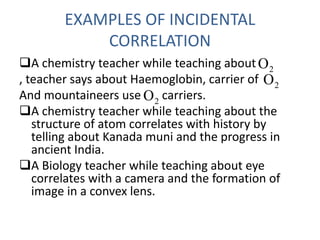
A chemistry teacher while teaching about
, teacher says about Haemoglobin, carrier of
And mountaineers use carriers.
A chemistry teacher while teaching about the
structure of atom correlates with history by
telling about Kanada muni and the progress in
ancient India.
A Biology teacher while teaching about eye
correlates with a camera and the formation of
image in a convex lens.
2O
2O
2O
SYSTEMATIC CORRELATION
• It is achieved by a careful organization of
curriculum in different subjects .
• It can be effective only when the teachers of
different subjects co-operate and co-ordinate
their work.
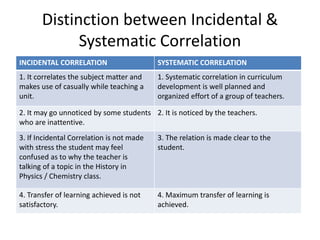
Distinction between Incidental &
Systematic Correlation
INCIDENTAL CORRELATION SYSTEMATIC CORRELATION
1. It correlates the subject matter and
makes use of casually while teaching a
unit.
1. Systematic correlation in curriculum
development is well planned and
organized effort of a group of teachers.
2. It may go unnoticed by some students
who are inattentive.
2. It is noticed by the teachers.
3. If Incidental Correlation is not made
with stress the student may feel
confused as to why the teacher is
talking of a topic in the History in
Physics / Chemistry class.
3. The relation is made clear to the
student.
4. Transfer of learning achieved is not
satisfactory.
4. Maximum transfer of learning is
achieved.
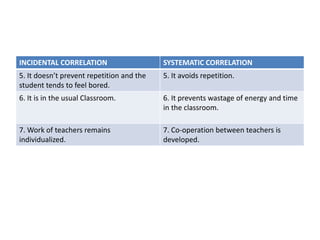
INCIDENTAL CORRELATION SYSTEMATIC CORRELATION
5. It doesn’t prevent repetition and the
student tends to feel bored.
5. It avoids repetition.
6. It is in the usual Classroom. 6. It prevents wastage of energy and time
in the classroom.
7. Work of teachers remains
individualized.
7. Co-operation between teachers is
developed.
CORRELATION OF SCIENCE WITHIN
THE SUBJECT
• All the branches of science are interdependent
upon each other & a no: of facts and
principles which are common to various
science subjects.
• As a result , new subjects like Physical
chemistry,Bio-Physics,Bio-Chemistry,Soil
Chemistry , Electrochemisry , Geo- Physics
have been introduced.
• Subject like ‘atom’, ‘heat of a chemical reaction’,
‘Electrolysis’, are of equal importance to a Physicist and
Chemist.
• Physics provides instruments for the study of almost all
other science subjects , thus correlating many
principles of physics with other science subjects.
• Chemistry find its applications in various subjects like
physics(theory of electrochemical
reaction),biology(chemical manuring , air and
water);hygiene and physiology(air , water , chemistry
of foods , chemistry of blood and purification of water)
PHYSICS
 LIGHT: light and health, light and germs , light
and vitamins , artificial sunlight , in sun-bathing.
Eye as camera , use of spectacles. Natural and
artificial lighting, physics and physiology of
room.
 HEAT: temperature of body, heat as energy,
heating of rooms, humidity, ventilation , sweat,
evaporation, treatment of heat burns.
 SOUND: ear how it works , effect of noise on
health.
PHYSICS
 ELECTRICITY : use of electricity in homes,
heating and lighting for health , electricity as
a curative agent, X-ray, electric shock and its
treatment.
 MECHANICS : bones and muscles from
mechanical systems, work and energy of
human body.
CHEMISTRY
• The chemistry of foods, digestive system,
vitamins , chemistry of blood, soap , hard and
soft water detergents.
BIOLOGY
• Development , structure and chief functions of
the body breathing and correlation of blood.
Correlation in physical science

Correlation in physical science

  • 1.
    PRESENTED BY , TEENATHANKACHEN PHYSICAL SCIENCE MTTC, PATHANAPURAM
  • 3.
    CONCEPT OF CORRELATION •It means the relationship between different subjects of the curriculum. • It can be Direct / Reciprocal. • Development of the mind can be achieved when the person has got the ability to solve problems. • To solve that practical difficulty combined knowledge of physics and other branches of knowledge is necessary.
  • 4.
    • The interrelationshipof science must be taught in schools in relation to another subjects. • The child must know the importance between the different branches of knowledge.
  • 5.
    CORRELATION IS OFTHREE KINDS: • Correlation within the subject • Correlation with other subjects • Correlation with life and environment
  • 6.
    Correlation of sciencewith other subjects can be of two types : • Incidental Correlation • Systematic Correlation
  • 7.
    INCIDENTAL CORRELATION • Naturalcorrelation. • It means a broad treatment of the subject that brings about points of similarities between science and other related subjects. • Success of incidental correlation depends on ‘wide knowledge and versatility of the science teacher’ .
  • 8.
    EXAMPLES OF INCIDENTAL CORRELATION Achemistry teacher while teaching about , teacher says about Haemoglobin, carrier of And mountaineers use carriers. A chemistry teacher while teaching about the structure of atom correlates with history by telling about Kanada muni and the progress in ancient India. A Biology teacher while teaching about eye correlates with a camera and the formation of image in a convex lens. 2O 2O 2O
  • 9.
    SYSTEMATIC CORRELATION • Itis achieved by a careful organization of curriculum in different subjects . • It can be effective only when the teachers of different subjects co-operate and co-ordinate their work.
  • 10.
    Distinction between Incidental& Systematic Correlation INCIDENTAL CORRELATION SYSTEMATIC CORRELATION 1. It correlates the subject matter and makes use of casually while teaching a unit. 1. Systematic correlation in curriculum development is well planned and organized effort of a group of teachers. 2. It may go unnoticed by some students who are inattentive. 2. It is noticed by the teachers. 3. If Incidental Correlation is not made with stress the student may feel confused as to why the teacher is talking of a topic in the History in Physics / Chemistry class. 3. The relation is made clear to the student. 4. Transfer of learning achieved is not satisfactory. 4. Maximum transfer of learning is achieved.
  • 11.
    INCIDENTAL CORRELATION SYSTEMATICCORRELATION 5. It doesn’t prevent repetition and the student tends to feel bored. 5. It avoids repetition. 6. It is in the usual Classroom. 6. It prevents wastage of energy and time in the classroom. 7. Work of teachers remains individualized. 7. Co-operation between teachers is developed.
  • 12.
    CORRELATION OF SCIENCEWITHIN THE SUBJECT • All the branches of science are interdependent upon each other & a no: of facts and principles which are common to various science subjects. • As a result , new subjects like Physical chemistry,Bio-Physics,Bio-Chemistry,Soil Chemistry , Electrochemisry , Geo- Physics have been introduced.
  • 13.
    • Subject like‘atom’, ‘heat of a chemical reaction’, ‘Electrolysis’, are of equal importance to a Physicist and Chemist. • Physics provides instruments for the study of almost all other science subjects , thus correlating many principles of physics with other science subjects. • Chemistry find its applications in various subjects like physics(theory of electrochemical reaction),biology(chemical manuring , air and water);hygiene and physiology(air , water , chemistry of foods , chemistry of blood and purification of water)
  • 14.
    PHYSICS  LIGHT: lightand health, light and germs , light and vitamins , artificial sunlight , in sun-bathing. Eye as camera , use of spectacles. Natural and artificial lighting, physics and physiology of room.  HEAT: temperature of body, heat as energy, heating of rooms, humidity, ventilation , sweat, evaporation, treatment of heat burns.  SOUND: ear how it works , effect of noise on health.
  • 15.
    PHYSICS  ELECTRICITY :use of electricity in homes, heating and lighting for health , electricity as a curative agent, X-ray, electric shock and its treatment.  MECHANICS : bones and muscles from mechanical systems, work and energy of human body.
  • 16.
    CHEMISTRY • The chemistryof foods, digestive system, vitamins , chemistry of blood, soap , hard and soft water detergents.
  • 17.
    BIOLOGY • Development ,structure and chief functions of the body breathing and correlation of blood.