Cell Structure and Function Chapter 4 
Table of Contents 
Section 1 The History of Cell Biology 
Section 2 Introduction to Cells 
Section 3 Cell Organelles and Features 
Section 4 Unique Features of Plant Cells
Section 1 The History of Cell Biology 
Chapter 4 
Objectives 
• Name the scientists who first observed living and 
nonliving cells. 
• Summarize the research that led to the development 
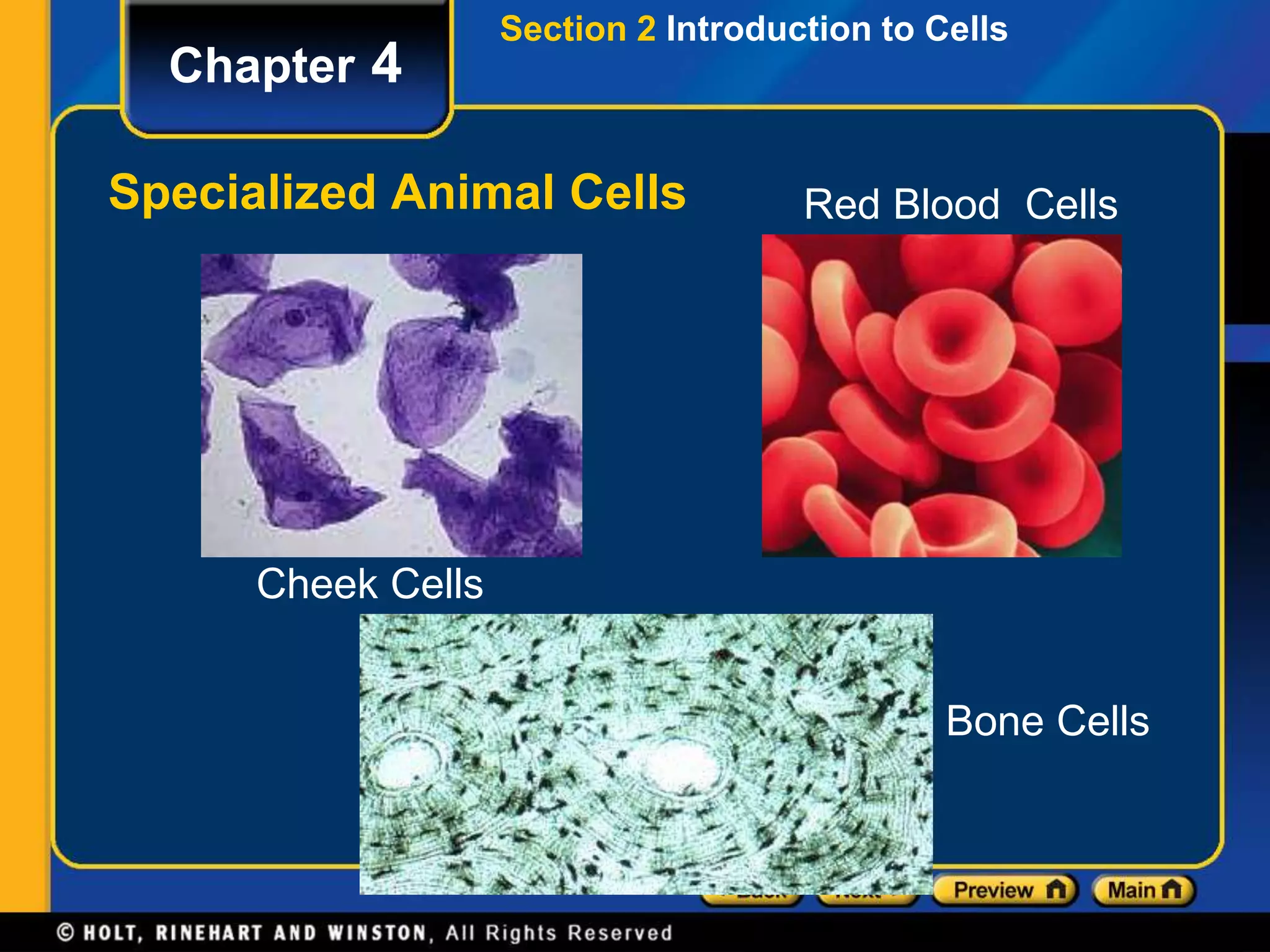
of the cell theory. 
• State the three principles of the cell theory. 
• Explain why the cell is considered to be the basic 
unit of life.
Section 1 The History of Cell Biology 
Chapter 4 
The Discovery of Cells 
• All living things are made up of one or more cells. 
• A cell is the smallest unit that can carry on all of the 
processes of life.
Section 1 The History of Cell Biology 
Chapter 4 
The Discovery of Cells, continued 
• Hooke 
– In 1665, Robert Hooke discovered cells in slices of 
cork. 
• Leeuwenhoek 
– In 1673, Anton van Leeuwenhoek was the first to 
observe living cells in microorganisms; 
Leeuwenhoek called these organism animalcules 
~ we now call them protists.
Section 1 The History of Cell Biology 
Chapter 4 
The Cell Theory 
• The cell theory states that all living organisms are 
made of one or more cells, cells are the basic units of 
structure and function, and cells come only from pre-existing 
cells. 
• In 1838, the German botanist Matthias Schleiden 
concluded that all plants were composed of cells 
• In 1839, Theodor Schwann concluded the same thing 
for animals 
• In 1855, Rudolf Virchow noted that all cells come 
from other cells
Chapter 4 
Click below to watch the Visual Concept. 
Visual Concept 
Cell Theory 
Section 1 The History of Cell Biology
Section 1 The History of Cell Biology 
Chapter 4 
The Cell Theory, continued 
• Cellular Basis of Life 
– All living things are made of organized parts, 
obtain energy from their surroundings, perform 
chemical reactions, change with time, respond to 
their environment, and reproduce.
Section 2 Introduction to Cells 
Chapter 4 
Objectives 
• Explain the relationship between cell shape and cell 
function. 
• Identify the factor that limits cell size. 
• Describe the three basic parts of a cell. 
• Compare prokaryotic cells and eukaryotic cells. 
• Analyze the relationship among cells, tissues, 
organs, organ systems, and organisms.
Section 2 Introduction to Cells 
Chapter 4 
Cell Diversity 
• Cell Shape 
– A cell’s shape reflects its function.
Section 2 Introduction to Cells 
Chapter 4 
Cell Diversity, Continued 
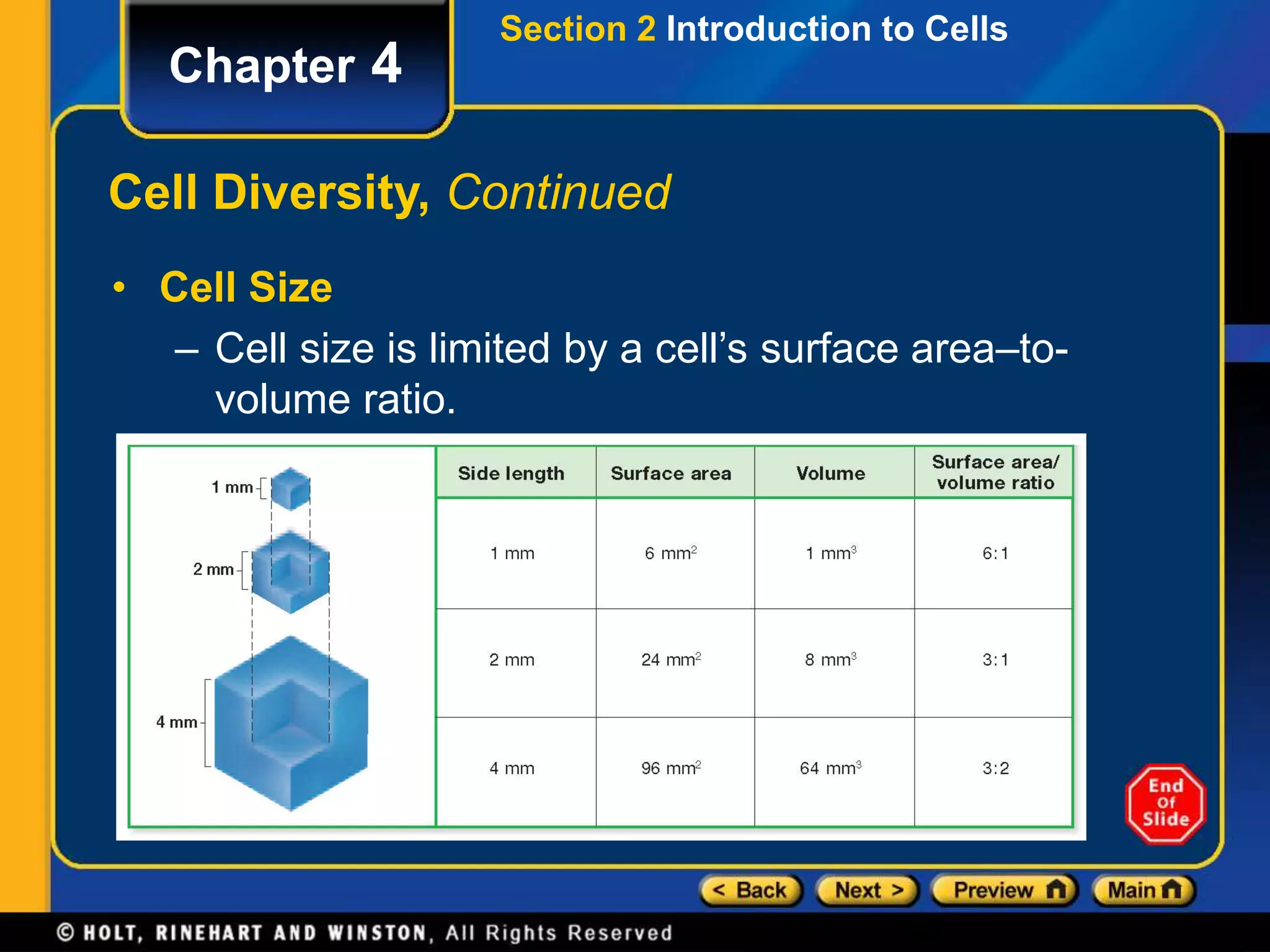
• Cell Size 
– Cell size is limited by a cell’s surface area–to-volume 
ratio.
Chapter 4 
Section 2 Introduction to Cells 
Cell size differs amongst species
Section 2 Introduction to Cells 
Chapter 4 
Cell Size 
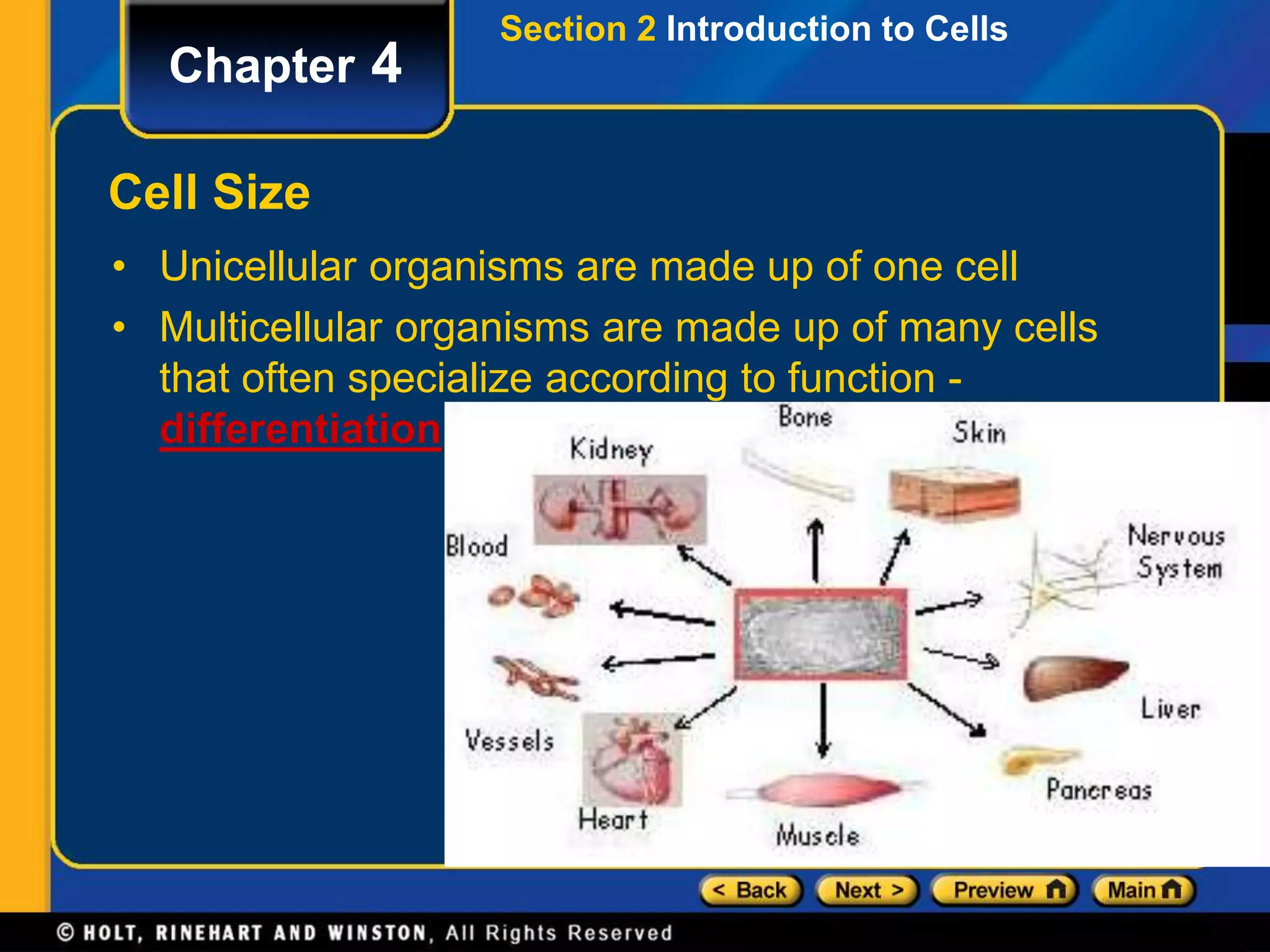
• Unicellular organisms are made up of one cell 
• Multicellular organisms are made up of many cells 
that often specialize according to function - 
differentiation
Section 2 Introduction to Cells 
Chapter 4 
Specialized Animal Cells 
Bone Cells 
Cheek Cells 
Red Blood Cells
Chapter 4 
Section 2 Introduction to Cells 
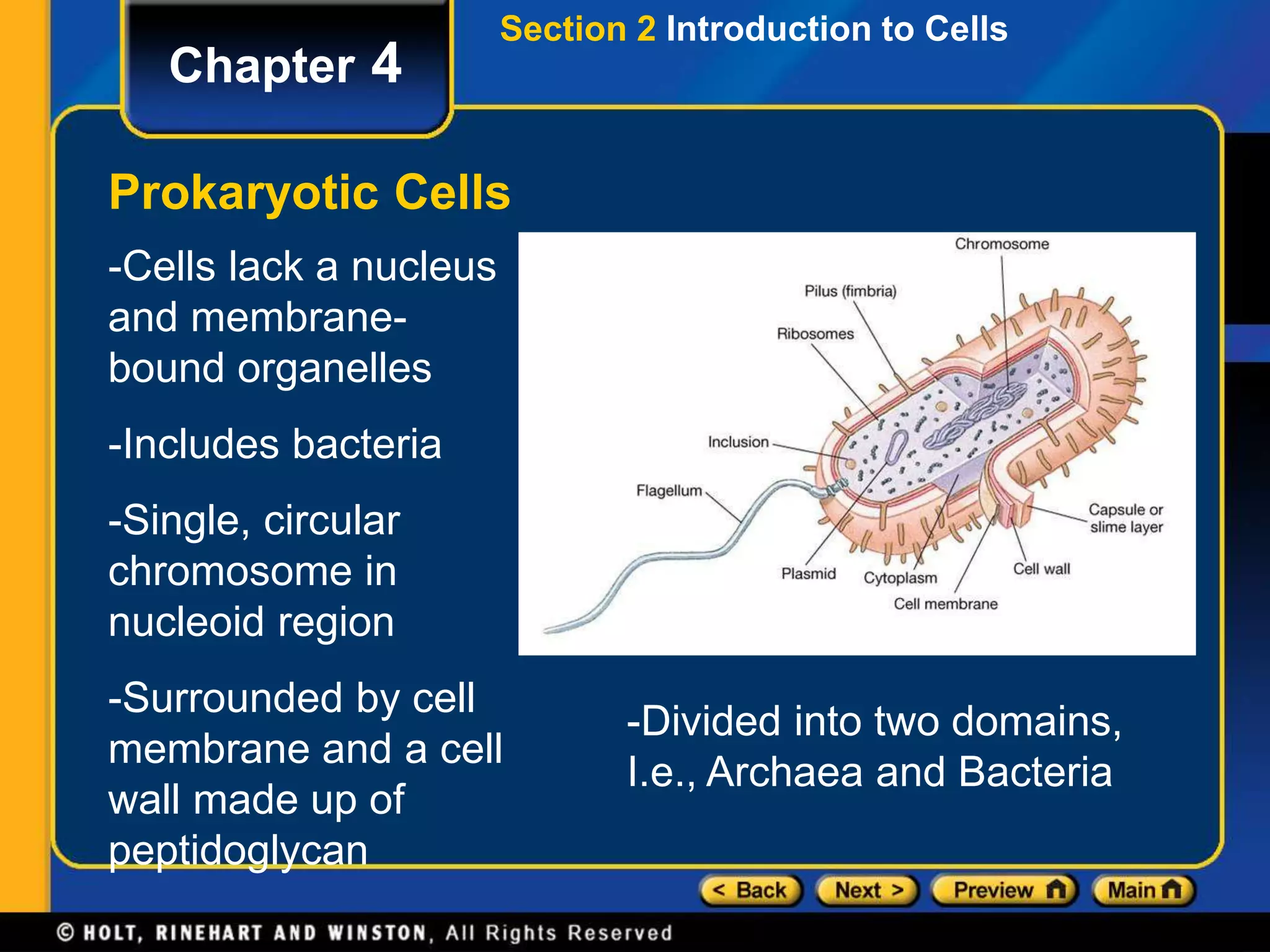
Prokaryotic Cells 
-Cells lack a nucleus 
and membrane-bound 
organelles 
-Includes bacteria 
-Single, circular 
chromosome in 
nucleoid region 
-Surrounded by cell 
membrane and a cell 
wall made up of 
peptidoglycan 
-Divided into two domains, 
I.e., Archaea and Bacteria
Eukaryotic Cells 
Section 2 Introduction to Cells 
Chapter 4 
-Cells have a nucleus and membrane-bound organelles 
-Incudes protists, fungi, plants, and animals
Chapter 4 
Section 2 Introduction to Cells 
Comparing Prokaryotes and Eukaryotes 
Click below to watch the Visual Concept. 
Visual Concept
Section 2 Introduction to Cells 
Chapter 4 
Basic Parts of a Eukaryotic Cell 
• The three basic parts of a cell are the plasma 
membrane, the cytoplasm, and the nucleus.
Chapter 4 
Section 2 Introduction to Cells 
Internal Organization of a Cell 
Click below to watch the Visual Concept. 
Visual Concept
Section 2 Introduction to Cells 
Chapter 4 
Basic Parts of a Cell, continued 
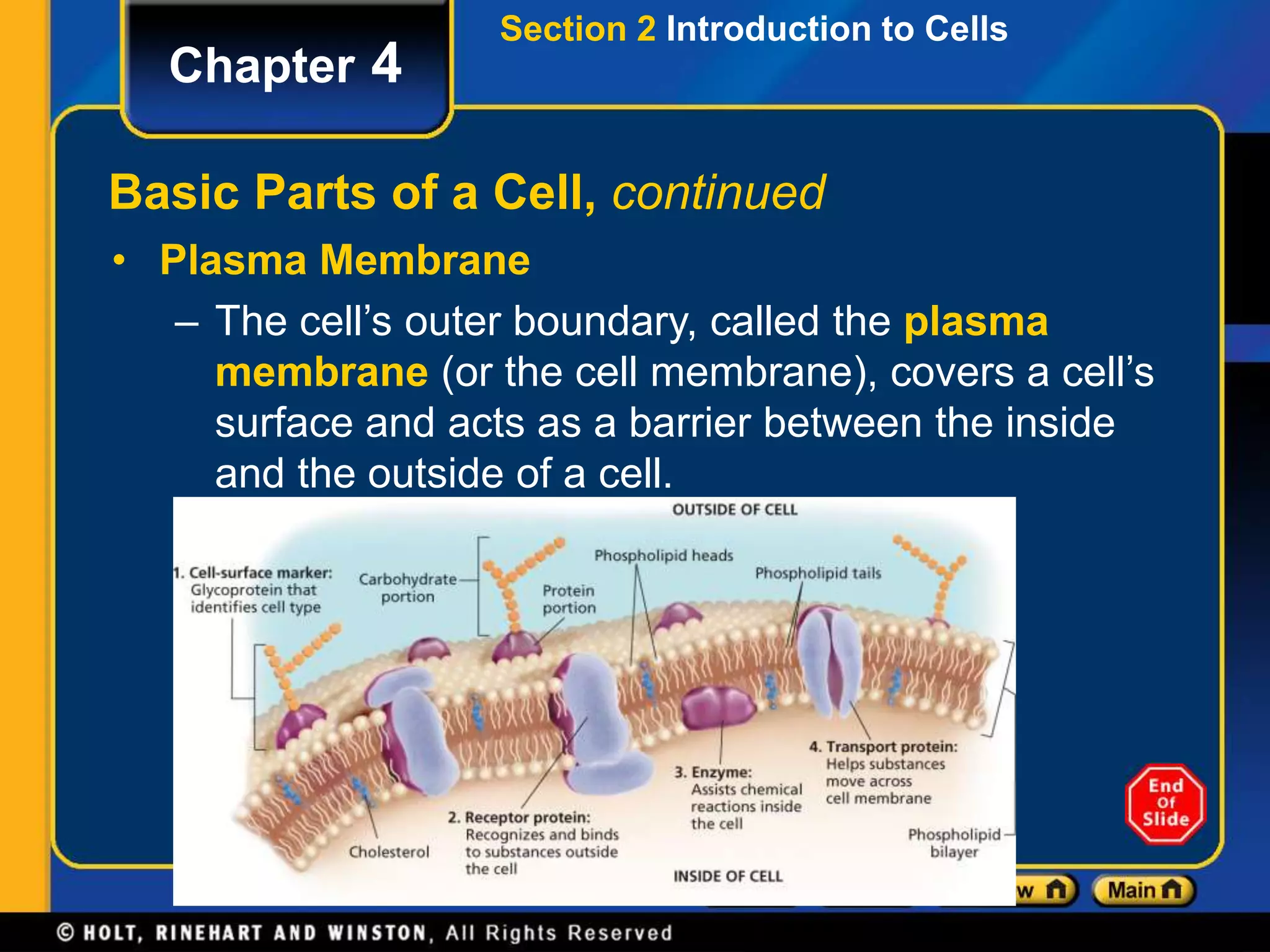
• Plasma Membrane 
– The cell’s outer boundary, called the plasma 
membrane (or the cell membrane), covers a cell’s 
surface and acts as a barrier between the inside 
and the outside of a cell.
Section 2 Introduction to Cells 
Chapter 4 
Basic Parts of a Cell, continued 
• Cytoplasm 
– The region of the cell that is within the plasma 
membrane and that includes the fluid, the 
cytoskeleton, and all of the organelles except the 
nucleus is called the cytoplasm. 
– The part of the cytoplasm that includes molecules 
and small particles, such as ribosomes, but not 
membrane bound organelles is the cytosol 
– About 20% of the cytosol is made up of protein
Section 2 Introduction to Cells 
Chapter 4 
Basic Parts of a Cell, continued 
• Nucleus 
– The nucleus is a membrane-bound organelle that 
contains a cell’s DNA.
Section 2 Introduction to Cells 
Chapter 4 
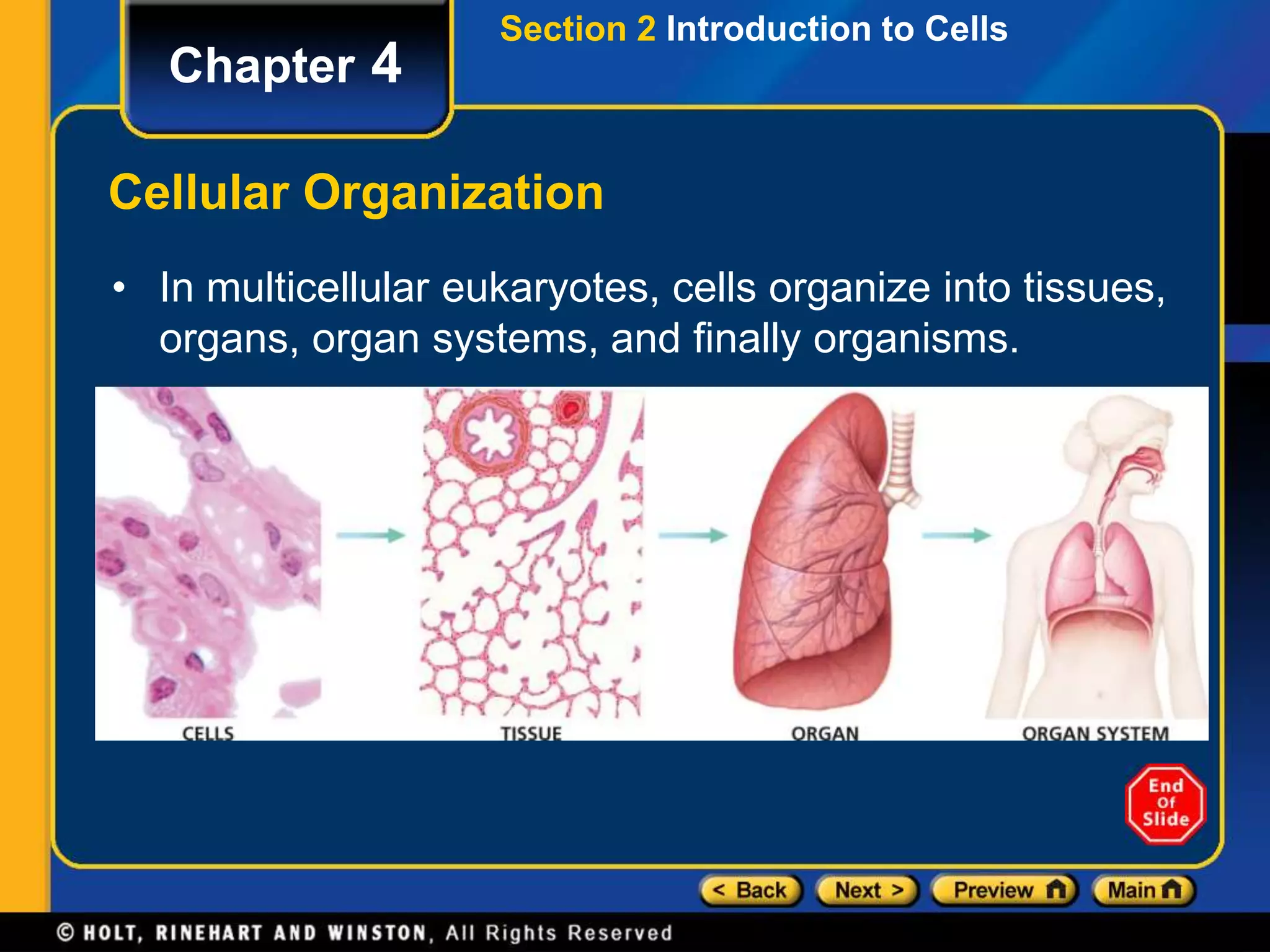
Cellular Organization 
• In multicellular eukaryotes, cells organize into tissues, 
organs, organ systems, and finally organisms.
Chapter 4 
Objectives 
Section 3 Cell Organelles 
and Features 
• Describe the structure and function of a cell’s plasma 
membrane. 
• Summarize the role of the nucleus. 
• List the major organelles found in the cytosol, and describe their 
roles. 
• Identify the characteristics of mitochondria. 
• Describe the structure and function of the cytoskeleton.
Chapter 4 
Section 3 Cell Organelles 
and Features 
Plasma Membrane 
• Selectively permeable, separates internal 
metabolic reactions from the external 
environment, and allows cell to excrete waste 
• Membrane Lipids 
– Cell membranes consist of a phospholipid 
bilayer. 
– Phospholipids have a polar, hydrophilic (“water-loving”) 
phosphate head and two nonpolar, 
hydrophobic (“water-fearing”) fatty acid tails 
– Cholesterol gives membrane firmness and 
prevents freezing in low temperatures
Chapter 4 
Structure of 
Lipid Bilayer 
Section 3 Cell Organelles 
and Features
Chapter 4 
Section 3 Cell Organelles 
and Features 
Plasma Membrane, continued 
• Membrane Proteins 
– Cell membranes often contain proteins embedded 
within the phospholipid bilayer. 
– Proteins help move large molecules or aid in cell 
recognition (peripheral and integral)
Chapter 4 
Section 3 Cell Organelles 
and Features 
Plasma Membrane, continued 
• Fluid Mosaic Model 
– The fluid mosaic model states that the 
phospholipid bilayer behaves like a fluid more than 
it behaves like a solid. 
– As a result of such lateral movement, the pattern, 
or “mosaic,” of lipids and proteins in the 
cellmembrane constantly changes
Chapter 4 
Section 3 Cell Organelles 
and Features 
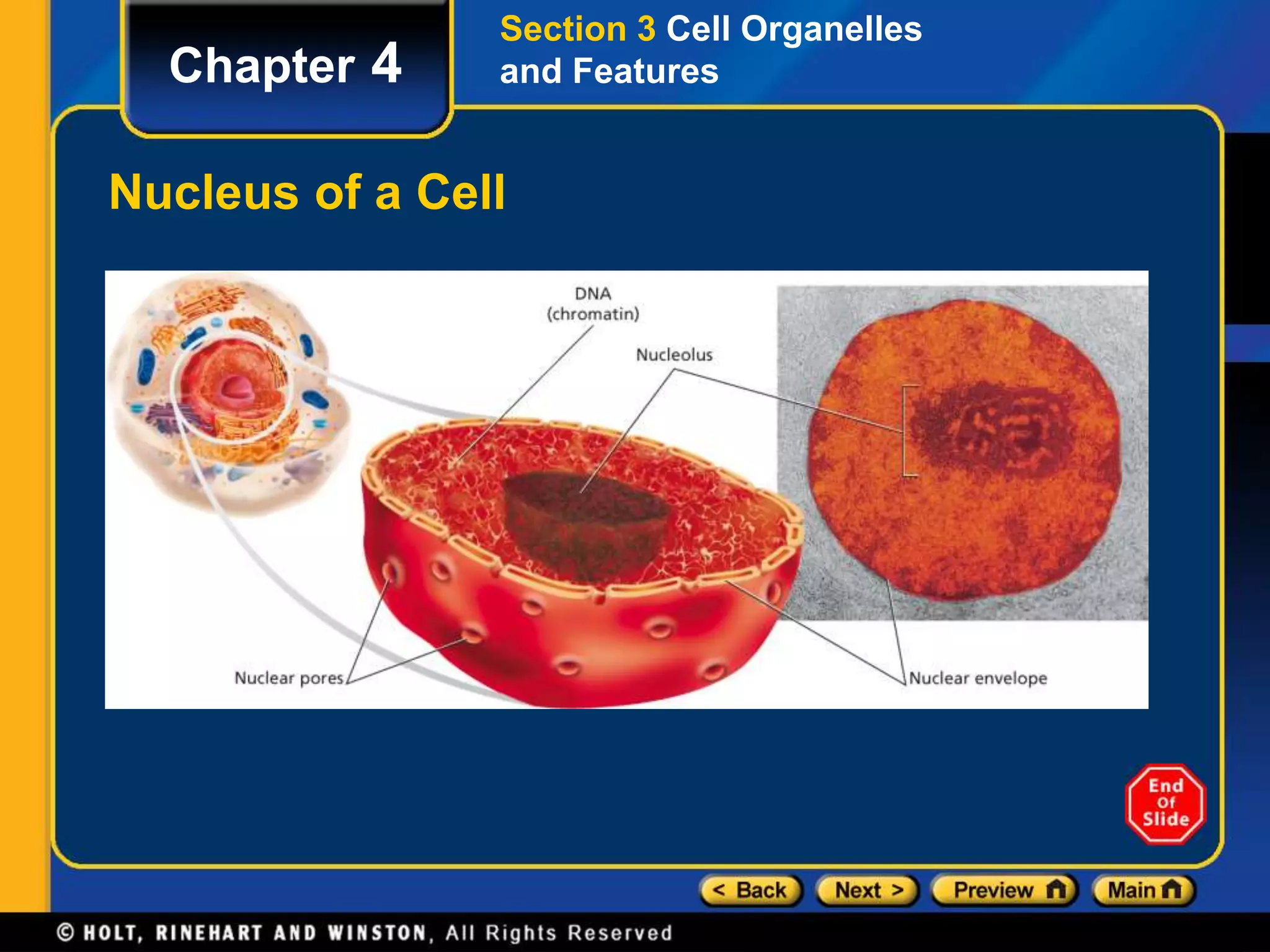
Nucleus 
• The nucleus directs the cell’s activities and stores DNA. 
• When a cell is not dividing, the DNA is in the form of a 
threadlike material called chromatin 
• When a cell is about to divide, the chromatin condenses to 
form chromosomes 
• Nuclear Envelope 
– The nucleus is surrounded by a double membrane 
called the nuclear envelope. 
• Nucleolus 
– The nucleolus is the place where DNA is concentrated 
when it is in the process of making ribosomal RNA.
Chapter 4 
Section 3 Cell Organelles 
and Features 
Nucleus of a Cell
Chapter 4 
Section 3 Cell Organelles 
and Features 
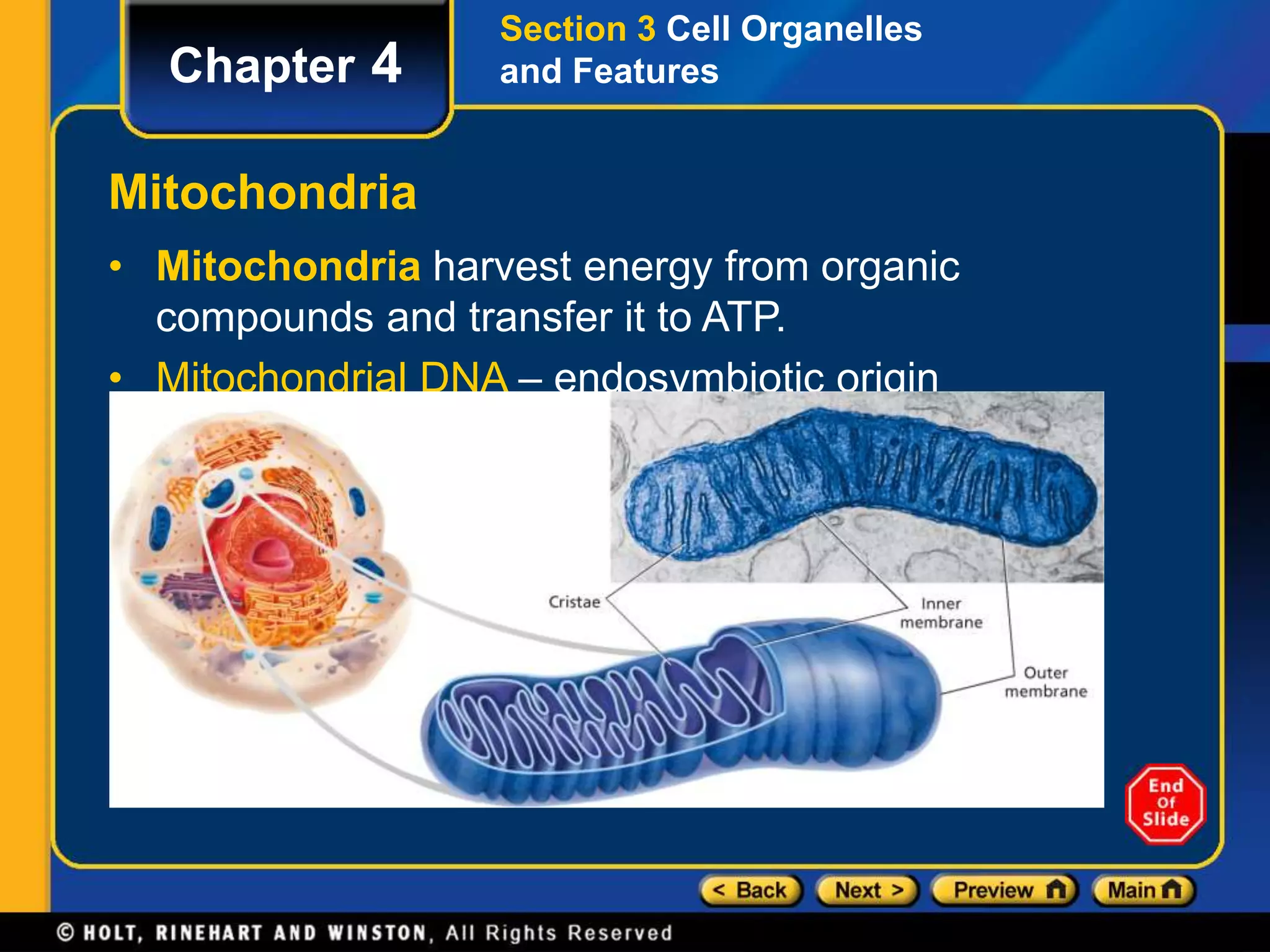
Mitochondria 
• Mitochondria harvest energy from organic 
compounds and transfer it to ATP. 
• Mitochondrial DNA – endosymbiotic origin
Chapter 4 
Ribosomes 
Section 3 Cell Organelles 
and Features 
• Ribosomes are either free or attached to the rough 
ER and play a role in protein synthesis. 
• Made of protein an RNA molecules 
• Ribosome assembly begins in the nucleolus and is 
completed in the cytoplasm
Chapter 4 
Click below to watch the Visual Concept. 
Visual Concept 
Ribosomes 
Section 3 Cell Organelles 
and Features
Chapter 4 
Section 3 Cell Organelles 
and Features 
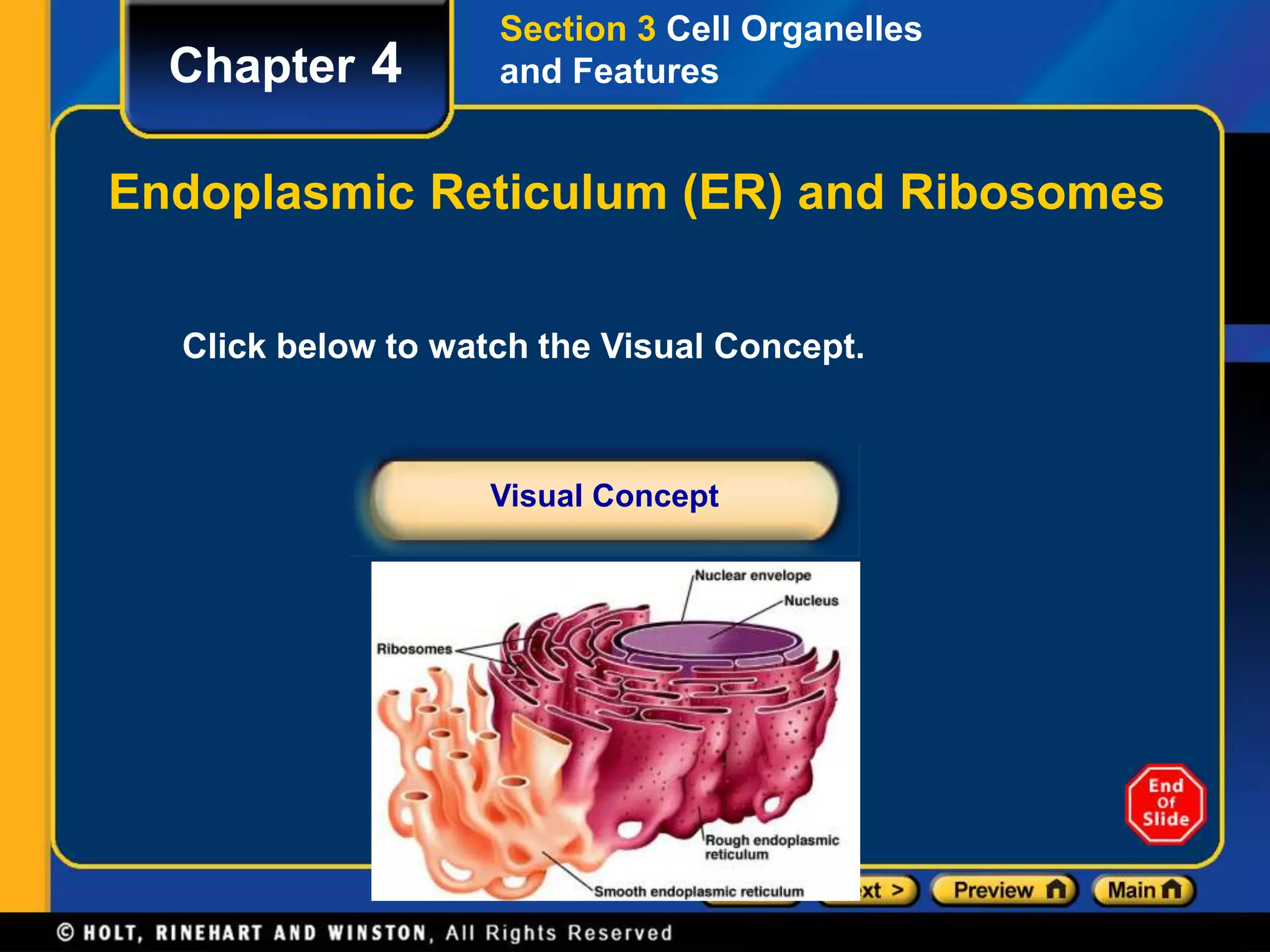
Endoplasmic Reticulum – intracellular highway 
• The rough ER prepares proteins for export or 
insertion into the cell membrane. 
– Most abundant in cells that produce large amounts of 
protein for export, such as digestive glands and 
antibody-producing cells 
• The smooth ER builds lipids, like cholesterol, and 
participates in detoxification of toxins. 
– In ovaries and testes, smooth ER produces estrogen 
and testosterone, respectively 
– In skeletal and heart muscle cells, smooth ER releases 
calcium, which stimulates contraction 
– Abundant in liver and kidneys for detoxification
Chapter 4 
Section 3 Cell Organelles 
and Features 
Endoplasmic Reticulum (ER) and Ribosomes 
Click below to watch the Visual Concept. 
Visual Concept
Chapter 4 
Golgi Apparatus 
Section 3 Cell Organelles 
and Features 
• The Golgi apparatus processes and packages 
proteins; proteins get address labels that direct them 
to other parts of the cell
Chapter 4 
Vesicles 
Section 3 Cell Organelles 
and Features 
• Vesicles, including lysosomes (digestive enzymes) 
and peroxisomes (detoxification enzymes – liver and 
kidneys), are classified by their contents. 
• Lysosomes digest worn-out organelles in a process 
called autophagy; digestion of damaged or extra cells 
by the enzymes of their own lysosomes is called 
autolysis 
•Protein Synthesis 
–The rough ER, Golgi apparatus, and vesicles 
work together to transport proteins to their 
destinations inside and outside the cell.
Chapter 4 
Section 3 Cell Organelles 
and Features 
Processing of Proteins
Chapter 4 
Cytoskeleton 
Section 3 Cell Organelles 
and Features 
• The cytoskeleton is made of protein fibers that help 
cells move and maintain their shape. 
• The cytoskeleton includes microtubules, 
microfilaments, and intermediate filaments.
Chapter 4 
Click below to watch the Visual Concept. 
Visual Concept 
Cytoskeleton 
Section 3 Cell Organelles 
and Features
Chapter 4 
Section 3 Cell Organelles 
and Features 
Cytoskeleton, continued 
• Cilia and Flagella 
– Cilia and flagella are hairlike structures that 
extend from the surface of the cell, where they 
assist in movement.
Chapter 4 
Section 3 Cell Organelles 
and Features 
Structure of Cilia and Flagella 
Click below to watch the Visual Concept. 
Visual Concept
Chapter 4 
Section 3 Cell Organelles 
and Features 
Cytoskeleton, continued 
• Centrioles 
– Centrioles consist of two short cylinders of 
microtubules at right angles to each other and are 
involved in cell division.
Chapter 4 
Objectives 
Section 4 Unique Features 
of Plant Cells 
• List three structures that are present in plant cells but not in 
animal cells. 
• Compare the plasma membrane,the primary cell wall, and the 
secondary cell wall. 
• Explain the role of the central vacuole. 
• Describe the roles of plastids in the life of a plant. 
• Identify features that distinguish prokaryotes, eukaryotes, 
plant cells, and animal cells.
Chapter 4 
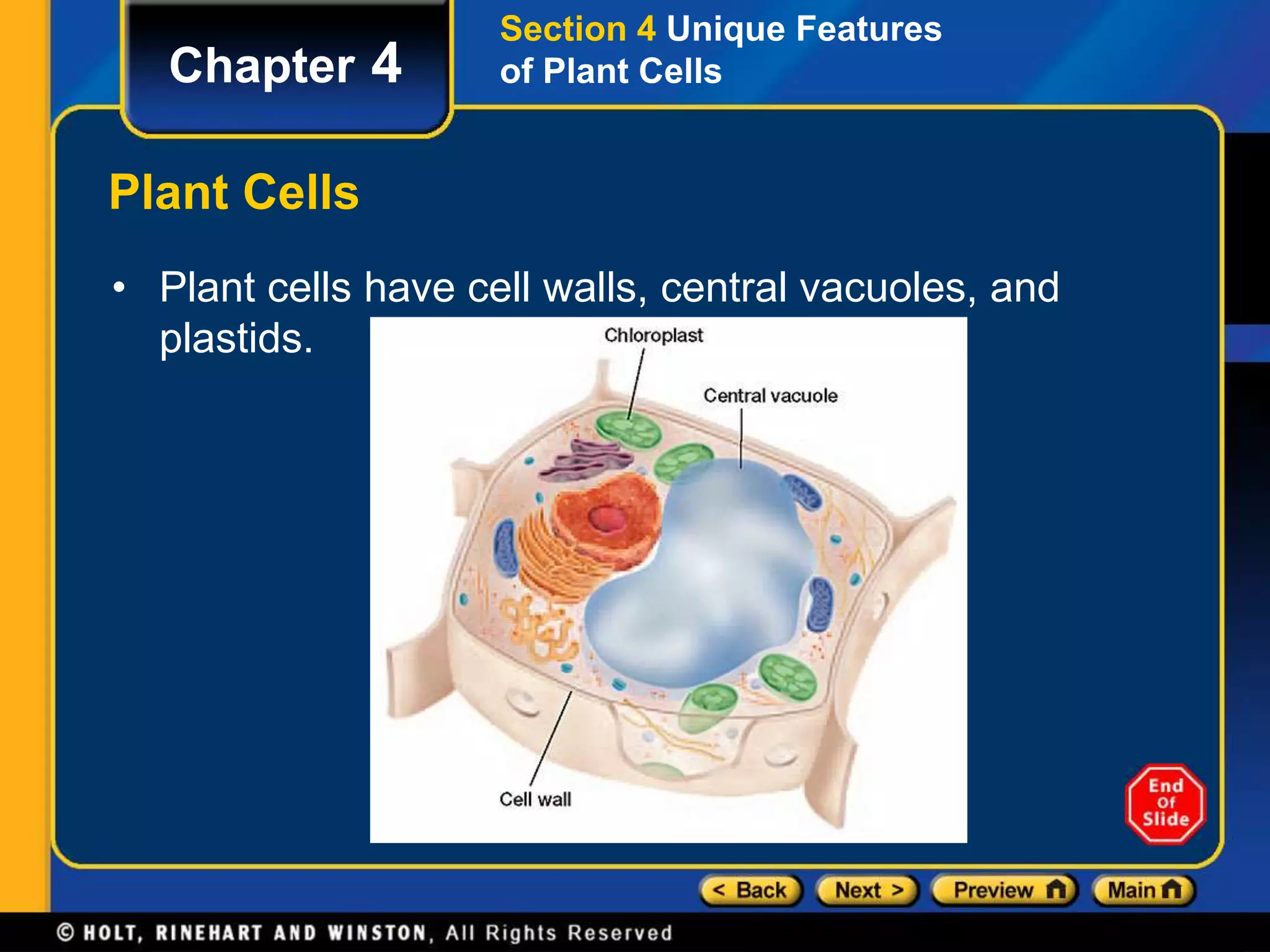
Plant Cells 
• Plant cells have cell walls, central vacuoles, and 
plastids. 
Section 4 Unique Features 
of Plant Cells
Chapter 4 
Cell Wall 
Section 4 Unique Features 
of Plant Cells 
• In plant cells, a rigid cell wall covers the cell 
membrane and provides support and protection.
Chapter 4 
Section 4 Unique Features 
of Plant Cells 
Parts of a Cell Wall 
Click below to watch the Visual Concept. 
Visual Concept
Chapter 4 
Central Vacuole 
Section 4 Unique Features 
of Plant Cells 
• Large central vacuoles store water, enzymes, and 
waste products and provide support for plant tissue.
Chapter 4 
Plastids 
Section 4 Unique Features 
of Plant Cells 
• Plastids store starch and pigments. 
– Chloroplasts – use light energy to make 
carbohydrates from carbon dioxide and water; 
thylakoids contain green pigment chlorophyll that 
absorbs light energy 
– Chromoplasts – contain colorful pigments 
– Amyloplasts – store starch
Chapter 4 
Section 4 Unique Features 
of Plant Cells 
Comparing Cells 
• Prokaryotes, animal cells, and plant cells can be 
distinguished from each other by their unique 
features.
Chapter 4 
Section 4 Unique Features 
of Plant Cells 
Comparing Plant and Animal Cells

Cell Biology ppt

  • 1.
    Cell Structure andFunction Chapter 4 Table of Contents Section 1 The History of Cell Biology Section 2 Introduction to Cells Section 3 Cell Organelles and Features Section 4 Unique Features of Plant Cells
  • 2.
    Section 1 TheHistory of Cell Biology Chapter 4 Objectives • Name the scientists who first observed living and nonliving cells. • Summarize the research that led to the development of the cell theory. • State the three principles of the cell theory. • Explain why the cell is considered to be the basic unit of life.
  • 3.
    Section 1 TheHistory of Cell Biology Chapter 4 The Discovery of Cells • All living things are made up of one or more cells. • A cell is the smallest unit that can carry on all of the processes of life.
  • 4.
    Section 1 TheHistory of Cell Biology Chapter 4 The Discovery of Cells, continued • Hooke – In 1665, Robert Hooke discovered cells in slices of cork. • Leeuwenhoek – In 1673, Anton van Leeuwenhoek was the first to observe living cells in microorganisms; Leeuwenhoek called these organism animalcules ~ we now call them protists.
  • 5.
    Section 1 TheHistory of Cell Biology Chapter 4 The Cell Theory • The cell theory states that all living organisms are made of one or more cells, cells are the basic units of structure and function, and cells come only from pre-existing cells. • In 1838, the German botanist Matthias Schleiden concluded that all plants were composed of cells • In 1839, Theodor Schwann concluded the same thing for animals • In 1855, Rudolf Virchow noted that all cells come from other cells
  • 6.
    Chapter 4 Clickbelow to watch the Visual Concept. Visual Concept Cell Theory Section 1 The History of Cell Biology
  • 7.
    Section 1 TheHistory of Cell Biology Chapter 4 The Cell Theory, continued • Cellular Basis of Life – All living things are made of organized parts, obtain energy from their surroundings, perform chemical reactions, change with time, respond to their environment, and reproduce.
  • 8.
    Section 2 Introductionto Cells Chapter 4 Objectives • Explain the relationship between cell shape and cell function. • Identify the factor that limits cell size. • Describe the three basic parts of a cell. • Compare prokaryotic cells and eukaryotic cells. • Analyze the relationship among cells, tissues, organs, organ systems, and organisms.
  • 9.
    Section 2 Introductionto Cells Chapter 4 Cell Diversity • Cell Shape – A cell’s shape reflects its function.
  • 10.
    Section 2 Introductionto Cells Chapter 4 Cell Diversity, Continued • Cell Size – Cell size is limited by a cell’s surface area–to-volume ratio.
  • 11.
    Chapter 4 Section2 Introduction to Cells Cell size differs amongst species
  • 12.
    Section 2 Introductionto Cells Chapter 4 Cell Size • Unicellular organisms are made up of one cell • Multicellular organisms are made up of many cells that often specialize according to function - differentiation
  • 13.
    Section 2 Introductionto Cells Chapter 4 Specialized Animal Cells Bone Cells Cheek Cells Red Blood Cells
  • 14.
    Chapter 4 Section2 Introduction to Cells Prokaryotic Cells -Cells lack a nucleus and membrane-bound organelles -Includes bacteria -Single, circular chromosome in nucleoid region -Surrounded by cell membrane and a cell wall made up of peptidoglycan -Divided into two domains, I.e., Archaea and Bacteria
  • 15.
    Eukaryotic Cells Section2 Introduction to Cells Chapter 4 -Cells have a nucleus and membrane-bound organelles -Incudes protists, fungi, plants, and animals
  • 16.
    Chapter 4 Section2 Introduction to Cells Comparing Prokaryotes and Eukaryotes Click below to watch the Visual Concept. Visual Concept
  • 17.
    Section 2 Introductionto Cells Chapter 4 Basic Parts of a Eukaryotic Cell • The three basic parts of a cell are the plasma membrane, the cytoplasm, and the nucleus.
  • 18.
    Chapter 4 Section2 Introduction to Cells Internal Organization of a Cell Click below to watch the Visual Concept. Visual Concept
  • 19.
    Section 2 Introductionto Cells Chapter 4 Basic Parts of a Cell, continued • Plasma Membrane – The cell’s outer boundary, called the plasma membrane (or the cell membrane), covers a cell’s surface and acts as a barrier between the inside and the outside of a cell.
  • 20.
    Section 2 Introductionto Cells Chapter 4 Basic Parts of a Cell, continued • Cytoplasm – The region of the cell that is within the plasma membrane and that includes the fluid, the cytoskeleton, and all of the organelles except the nucleus is called the cytoplasm. – The part of the cytoplasm that includes molecules and small particles, such as ribosomes, but not membrane bound organelles is the cytosol – About 20% of the cytosol is made up of protein
  • 21.
    Section 2 Introductionto Cells Chapter 4 Basic Parts of a Cell, continued • Nucleus – The nucleus is a membrane-bound organelle that contains a cell’s DNA.
  • 22.
    Section 2 Introductionto Cells Chapter 4 Cellular Organization • In multicellular eukaryotes, cells organize into tissues, organs, organ systems, and finally organisms.
  • 23.
    Chapter 4 Objectives Section 3 Cell Organelles and Features • Describe the structure and function of a cell’s plasma membrane. • Summarize the role of the nucleus. • List the major organelles found in the cytosol, and describe their roles. • Identify the characteristics of mitochondria. • Describe the structure and function of the cytoskeleton.
  • 24.
    Chapter 4 Section3 Cell Organelles and Features Plasma Membrane • Selectively permeable, separates internal metabolic reactions from the external environment, and allows cell to excrete waste • Membrane Lipids – Cell membranes consist of a phospholipid bilayer. – Phospholipids have a polar, hydrophilic (“water-loving”) phosphate head and two nonpolar, hydrophobic (“water-fearing”) fatty acid tails – Cholesterol gives membrane firmness and prevents freezing in low temperatures
  • 25.
    Chapter 4 Structureof Lipid Bilayer Section 3 Cell Organelles and Features
  • 26.
    Chapter 4 Section3 Cell Organelles and Features Plasma Membrane, continued • Membrane Proteins – Cell membranes often contain proteins embedded within the phospholipid bilayer. – Proteins help move large molecules or aid in cell recognition (peripheral and integral)
  • 27.
    Chapter 4 Section3 Cell Organelles and Features Plasma Membrane, continued • Fluid Mosaic Model – The fluid mosaic model states that the phospholipid bilayer behaves like a fluid more than it behaves like a solid. – As a result of such lateral movement, the pattern, or “mosaic,” of lipids and proteins in the cellmembrane constantly changes
  • 28.
    Chapter 4 Section3 Cell Organelles and Features Nucleus • The nucleus directs the cell’s activities and stores DNA. • When a cell is not dividing, the DNA is in the form of a threadlike material called chromatin • When a cell is about to divide, the chromatin condenses to form chromosomes • Nuclear Envelope – The nucleus is surrounded by a double membrane called the nuclear envelope. • Nucleolus – The nucleolus is the place where DNA is concentrated when it is in the process of making ribosomal RNA.
  • 29.
    Chapter 4 Section3 Cell Organelles and Features Nucleus of a Cell
  • 30.
    Chapter 4 Section3 Cell Organelles and Features Mitochondria • Mitochondria harvest energy from organic compounds and transfer it to ATP. • Mitochondrial DNA – endosymbiotic origin
  • 31.
    Chapter 4 Ribosomes Section 3 Cell Organelles and Features • Ribosomes are either free or attached to the rough ER and play a role in protein synthesis. • Made of protein an RNA molecules • Ribosome assembly begins in the nucleolus and is completed in the cytoplasm
  • 32.
    Chapter 4 Clickbelow to watch the Visual Concept. Visual Concept Ribosomes Section 3 Cell Organelles and Features
  • 33.
    Chapter 4 Section3 Cell Organelles and Features Endoplasmic Reticulum – intracellular highway • The rough ER prepares proteins for export or insertion into the cell membrane. – Most abundant in cells that produce large amounts of protein for export, such as digestive glands and antibody-producing cells • The smooth ER builds lipids, like cholesterol, and participates in detoxification of toxins. – In ovaries and testes, smooth ER produces estrogen and testosterone, respectively – In skeletal and heart muscle cells, smooth ER releases calcium, which stimulates contraction – Abundant in liver and kidneys for detoxification
  • 34.
    Chapter 4 Section3 Cell Organelles and Features Endoplasmic Reticulum (ER) and Ribosomes Click below to watch the Visual Concept. Visual Concept
  • 35.
    Chapter 4 GolgiApparatus Section 3 Cell Organelles and Features • The Golgi apparatus processes and packages proteins; proteins get address labels that direct them to other parts of the cell
  • 36.
    Chapter 4 Vesicles Section 3 Cell Organelles and Features • Vesicles, including lysosomes (digestive enzymes) and peroxisomes (detoxification enzymes – liver and kidneys), are classified by their contents. • Lysosomes digest worn-out organelles in a process called autophagy; digestion of damaged or extra cells by the enzymes of their own lysosomes is called autolysis •Protein Synthesis –The rough ER, Golgi apparatus, and vesicles work together to transport proteins to their destinations inside and outside the cell.
  • 37.
    Chapter 4 Section3 Cell Organelles and Features Processing of Proteins
  • 38.
    Chapter 4 Cytoskeleton Section 3 Cell Organelles and Features • The cytoskeleton is made of protein fibers that help cells move and maintain their shape. • The cytoskeleton includes microtubules, microfilaments, and intermediate filaments.
  • 39.
    Chapter 4 Clickbelow to watch the Visual Concept. Visual Concept Cytoskeleton Section 3 Cell Organelles and Features
  • 40.
    Chapter 4 Section3 Cell Organelles and Features Cytoskeleton, continued • Cilia and Flagella – Cilia and flagella are hairlike structures that extend from the surface of the cell, where they assist in movement.
  • 41.
    Chapter 4 Section3 Cell Organelles and Features Structure of Cilia and Flagella Click below to watch the Visual Concept. Visual Concept
  • 42.
    Chapter 4 Section3 Cell Organelles and Features Cytoskeleton, continued • Centrioles – Centrioles consist of two short cylinders of microtubules at right angles to each other and are involved in cell division.
  • 43.
    Chapter 4 Objectives Section 4 Unique Features of Plant Cells • List three structures that are present in plant cells but not in animal cells. • Compare the plasma membrane,the primary cell wall, and the secondary cell wall. • Explain the role of the central vacuole. • Describe the roles of plastids in the life of a plant. • Identify features that distinguish prokaryotes, eukaryotes, plant cells, and animal cells.
  • 44.
    Chapter 4 PlantCells • Plant cells have cell walls, central vacuoles, and plastids. Section 4 Unique Features of Plant Cells
  • 45.
    Chapter 4 CellWall Section 4 Unique Features of Plant Cells • In plant cells, a rigid cell wall covers the cell membrane and provides support and protection.
  • 46.
    Chapter 4 Section4 Unique Features of Plant Cells Parts of a Cell Wall Click below to watch the Visual Concept. Visual Concept
  • 47.
    Chapter 4 CentralVacuole Section 4 Unique Features of Plant Cells • Large central vacuoles store water, enzymes, and waste products and provide support for plant tissue.
  • 48.
    Chapter 4 Plastids Section 4 Unique Features of Plant Cells • Plastids store starch and pigments. – Chloroplasts – use light energy to make carbohydrates from carbon dioxide and water; thylakoids contain green pigment chlorophyll that absorbs light energy – Chromoplasts – contain colorful pigments – Amyloplasts – store starch
  • 49.
    Chapter 4 Section4 Unique Features of Plant Cells Comparing Cells • Prokaryotes, animal cells, and plant cells can be distinguished from each other by their unique features.
  • 50.
    Chapter 4 Section4 Unique Features of Plant Cells Comparing Plant and Animal Cells