ENDOMEMBRANE SYSTEM
By-Lovnish Thakur
IBT-2ST SEM (ASU2014010100099)
COURSE-LIFE SCIENCE(BSBT201)
School of Bioscience
WHAT IS ENDOMEMBRANE SYSTEM
 The endomembrane system is composed of the different membranes
that are suspended in the cytoplasm within a eukaryotic cell. These
membranes divide the cell into functional and structural
compartments, or organelles.
 It consist of-:
• Endoplasmic Reticulum,
• Golgi Apparatus,
• Lysosomes,
• Vacuoles, Vesicles.
ENDOPLASMIC RETICULUM
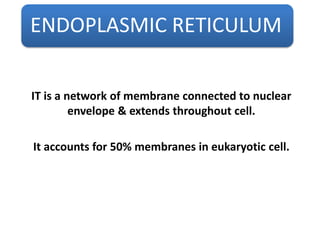
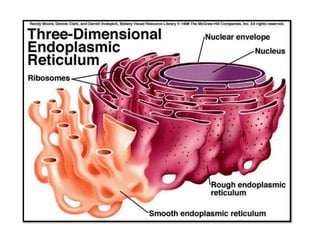
IT is a network of membrane connected to nuclear
envelope & extends throughout cell.
It accounts for 50% membranes in eukaryotic cell.
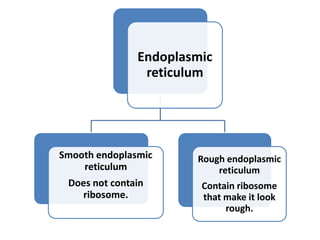
Endoplasmic
reticulum
Smooth endoplasmic
reticulum
Does not contain
ribosome.
Rough endoplasmic
reticulum
Contain ribosome
that make it look
rough.
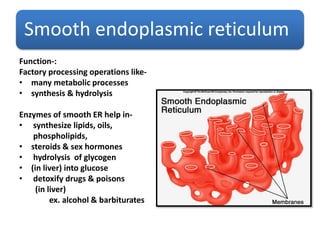
Smooth endoplasmic reticulum
Function-:
Factory processing operations like-
• many metabolic processes
• synthesis & hydrolysis
Enzymes of smooth ER help in-
• synthesize lipids, oils,
phospholipids,
• steroids & sex hormones
• hydrolysis of glycogen
• (in liver) into glucose
• detoxify drugs & poisons
(in liver)
ex. alcohol & barbiturates
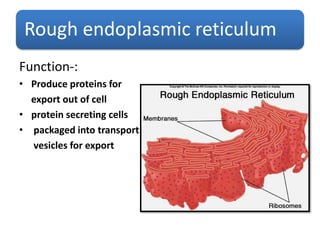
Rough endoplasmic reticulum
Function-:
• Produce proteins for
export out of cell
• protein secreting cells
• packaged into transport
vesicles for export
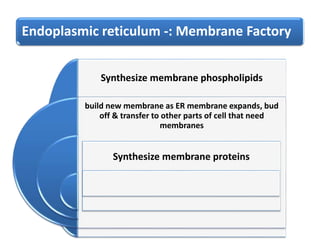
Endoplasmic reticulum -: Membrane Factory
Synthesize membrane phospholipids
build new membrane as ER membrane expands, bud
off & transfer to other parts of cell that need
membranes
Synthesize membrane proteins
Golgi Apparatus
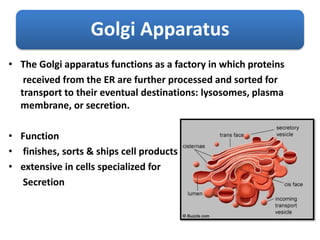
• The Golgi apparatus functions as a factory in which proteins
received from the ER are further processed and sorted for
transport to their eventual destinations: lysosomes, plasma
membrane, or secretion.
• Function
• finishes, sorts & ships cell products
• extensive in cells specialized for
Secretion
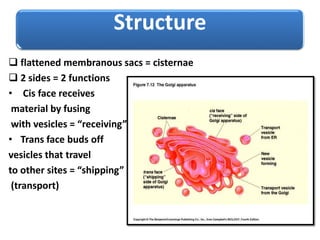
Structure
 flattened membranous sacs = cisternae
 2 sides = 2 functions
• Cis face receives
material by fusing
with vesicles = “receiving”
• Trans face buds off
vesicles that travel
to other sites = “shipping”
(transport)
Golgi processing
 During path from cis to trans, products from ER are
modified into final form tags, sorts, & packages materials
into transport vesicles
 Golgi = “UPS headquarters”
 Transport vesicles = “UPS trucks” delivering packages that
have been tagged with their own barcodes
Lysosomes
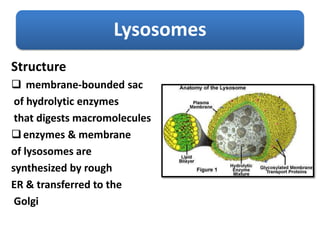
Structure
 membrane-bounded sac
of hydrolytic enzymes
that digests macromolecules
enzymes & membrane
of lysosomes are
synthesized by rough
ER & transferred to the
Golgi
Function
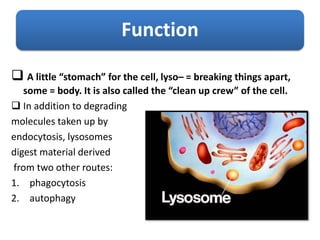
 A little “stomach” for the cell, lyso– = breaking things apart,
some = body. It is also called the “clean up crew” of the cell.
 In addition to degrading
molecules taken up by
endocytosis, lysosomes
digest material derived
from two other routes:
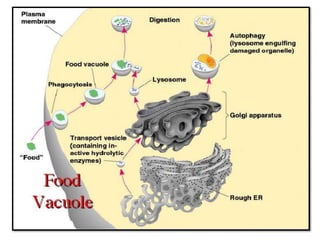
1. phagocytosis
2. autophagy
What if a lysomome digestive
enzyme doesn’t function?
Lysosomal storage diseases
 don’t digest a biomolecule instead biomolecule collects in
lysosomes
 lysosomes fill up with undigested material, lysosomes grow
larger & larger eventually disrupt cell & organ function
 “Lysosomal storage diseases”are usually fatal.
For e.g-:
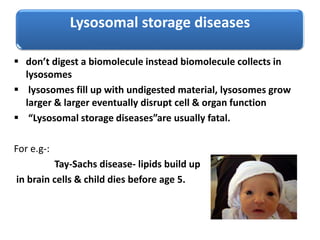
Tay-Sachs disease- lipids build up
in brain cells & child dies before age 5.
Sometimes its supposed to work
that way…
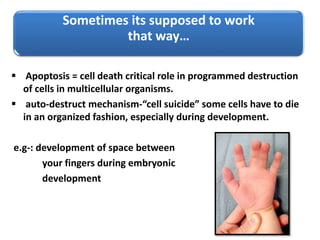
 Apoptosis = cell death critical role in programmed destruction
of cells in multicellular organisms.
 auto-destruct mechanism-“cell suicide” some cells have to die
in an organized fashion, especially during development.
e.g-: development of space between
your fingers during embryonic
development
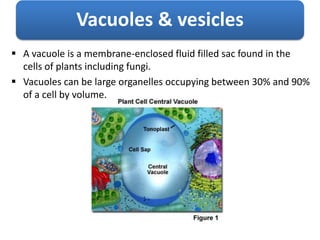
Vacuoles & vesicles
 A vacuole is a membrane-enclosed fluid filled sac found in the
cells of plants including fungi.
 Vacuoles can be large organelles occupying between 30% and 90%
of a cell by volume.
Vacuoles appear to have three main functions
• contribute to the rigidity of the plant using water to
develop hydrostatic pressure
• store nutrient and non-nutrient chemicals
• break down complex molecules.
Type-
 Food vacuoles- phagocytosis, fuse with lysosomes
 Contractile vacuoles- in freshwater protists, pump
excess H2O out of cell
 Central vacuoles- in many mature plant cells
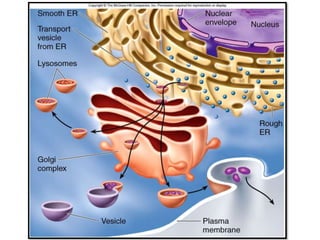
Putting it all together…
REFERENCES
www.ncbi.nlm.nih.gov › NCBI › Literature › Bookshelf
bscb.org/learning-resources/softcell-e-learning/vacuole-plants
www.ncbi.nlm.nih.gov › NCBI › Literature › Bookshelf
www.rtsd.org/cms/lib/.../The%20Cell%20Endomembrane%20Syste
m.pdf
https://fc.deltasd.bc.ca/~jonzon/S030AAF27.11/endomembrane%2
0system.pdf
THANK YOU

Endomembrane system

  • 1.
    ENDOMEMBRANE SYSTEM By-Lovnish Thakur IBT-2STSEM (ASU2014010100099) COURSE-LIFE SCIENCE(BSBT201) School of Bioscience
  • 2.
    WHAT IS ENDOMEMBRANESYSTEM  The endomembrane system is composed of the different membranes that are suspended in the cytoplasm within a eukaryotic cell. These membranes divide the cell into functional and structural compartments, or organelles.  It consist of-: • Endoplasmic Reticulum, • Golgi Apparatus, • Lysosomes, • Vacuoles, Vesicles.
  • 3.
    ENDOPLASMIC RETICULUM IT isa network of membrane connected to nuclear envelope & extends throughout cell. It accounts for 50% membranes in eukaryotic cell.
  • 5.
    Endoplasmic reticulum Smooth endoplasmic reticulum Does notcontain ribosome. Rough endoplasmic reticulum Contain ribosome that make it look rough.
  • 6.
    Smooth endoplasmic reticulum Function-: Factoryprocessing operations like- • many metabolic processes • synthesis & hydrolysis Enzymes of smooth ER help in- • synthesize lipids, oils, phospholipids, • steroids & sex hormones • hydrolysis of glycogen • (in liver) into glucose • detoxify drugs & poisons (in liver) ex. alcohol & barbiturates
  • 7.
    Rough endoplasmic reticulum Function-: •Produce proteins for export out of cell • protein secreting cells • packaged into transport vesicles for export
  • 8.
    Endoplasmic reticulum -:Membrane Factory Synthesize membrane phospholipids build new membrane as ER membrane expands, bud off & transfer to other parts of cell that need membranes Synthesize membrane proteins
  • 9.
    Golgi Apparatus • TheGolgi apparatus functions as a factory in which proteins received from the ER are further processed and sorted for transport to their eventual destinations: lysosomes, plasma membrane, or secretion. • Function • finishes, sorts & ships cell products • extensive in cells specialized for Secretion
  • 10.
    Structure  flattened membranoussacs = cisternae  2 sides = 2 functions • Cis face receives material by fusing with vesicles = “receiving” • Trans face buds off vesicles that travel to other sites = “shipping” (transport)
  • 11.
    Golgi processing  Duringpath from cis to trans, products from ER are modified into final form tags, sorts, & packages materials into transport vesicles  Golgi = “UPS headquarters”  Transport vesicles = “UPS trucks” delivering packages that have been tagged with their own barcodes
  • 12.
    Lysosomes Structure  membrane-bounded sac ofhydrolytic enzymes that digests macromolecules enzymes & membrane of lysosomes are synthesized by rough ER & transferred to the Golgi
  • 13.
    Function  A little“stomach” for the cell, lyso– = breaking things apart, some = body. It is also called the “clean up crew” of the cell.  In addition to degrading molecules taken up by endocytosis, lysosomes digest material derived from two other routes: 1. phagocytosis 2. autophagy
  • 15.
    What if alysomome digestive enzyme doesn’t function?
  • 16.
    Lysosomal storage diseases don’t digest a biomolecule instead biomolecule collects in lysosomes  lysosomes fill up with undigested material, lysosomes grow larger & larger eventually disrupt cell & organ function  “Lysosomal storage diseases”are usually fatal. For e.g-: Tay-Sachs disease- lipids build up in brain cells & child dies before age 5.
  • 17.
    Sometimes its supposedto work that way…  Apoptosis = cell death critical role in programmed destruction of cells in multicellular organisms.  auto-destruct mechanism-“cell suicide” some cells have to die in an organized fashion, especially during development. e.g-: development of space between your fingers during embryonic development
  • 18.
    Vacuoles & vesicles A vacuole is a membrane-enclosed fluid filled sac found in the cells of plants including fungi.  Vacuoles can be large organelles occupying between 30% and 90% of a cell by volume.
  • 19.
    Vacuoles appear tohave three main functions • contribute to the rigidity of the plant using water to develop hydrostatic pressure • store nutrient and non-nutrient chemicals • break down complex molecules. Type-  Food vacuoles- phagocytosis, fuse with lysosomes  Contractile vacuoles- in freshwater protists, pump excess H2O out of cell  Central vacuoles- in many mature plant cells
  • 20.
    Putting it alltogether…
  • 23.
    REFERENCES www.ncbi.nlm.nih.gov › NCBI› Literature › Bookshelf bscb.org/learning-resources/softcell-e-learning/vacuole-plants www.ncbi.nlm.nih.gov › NCBI › Literature › Bookshelf www.ncbi.nlm.nih.gov › NCBI › Literature › Bookshelf www.rtsd.org/cms/lib/.../The%20Cell%20Endomembrane%20Syste m.pdf https://fc.deltasd.bc.ca/~jonzon/S030AAF27.11/endomembrane%2 0system.pdf
  • 24.