Cell Features
The Cell TheoryIn 1838, the German botanist MattiasSchleiden concluded that cells make up not only the stems of plants but every part of a plant.
A year later, German zoologist Theodore Schwann determined that cells animals are also made of cells
In 1858, Rudolph Virchow, a German physician, determined that cells came from other cellsCell TheoryThe observations of Schleiden, Schwann, and Virchow form the cell theory  which has three parts
All living things are made of one or more cells
Cells are the basic units of structure and function in organisms
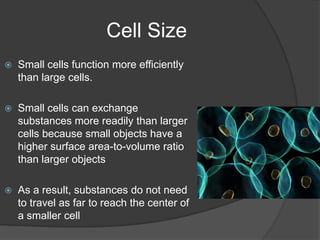
All cells arise from existing cellsCell SizeSmall cells function more efficiently than large cells.Small cells can exchange substances more readily than larger cells because small objects have a higher surface area-to-volume ratio than larger objectsAs a result, substances do not need to travel as far to reach the center of a smaller cell
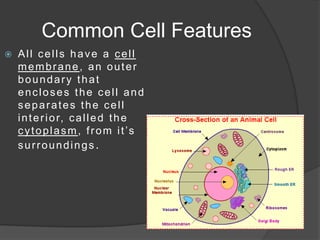
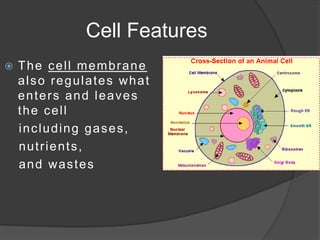
Common Cell FeaturesAll cells have a cell membrane, an outer boundary that encloses the cell and separates the cell interior, called the cytoplasm, from it’s surroundings.Cell FeaturesThe cell membrane also regulates what enters and leaves the cell   including gases,   nutrients,   and wastes
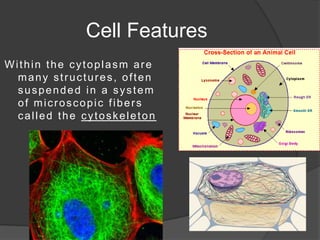
Cell FeaturesWithin the cytoplasm are many structures, often suspended in a system of microscopic fibers called the cytoskeleton
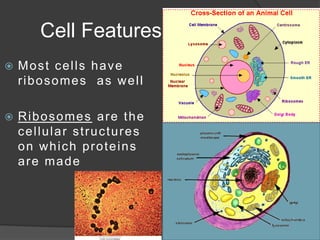
    Cell FeaturesMost cells have ribosomes  as well
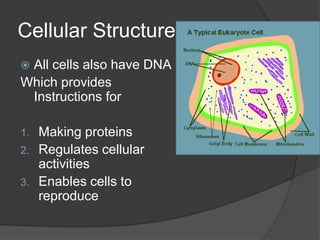
Ribosomes are the cellular structures on which proteins are madeCellular StructureAll cells also have DNAWhich provides    Instructions for Making proteinsRegulates cellular activitiesEnables cells to reproduce
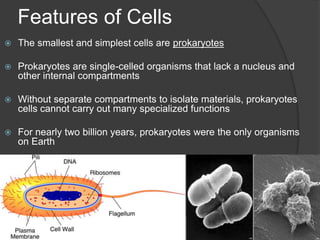
Features of CellsThe smallest and simplest cells are prokaryotes
Prokaryotes are single-celled organisms that lack a nucleus and other internal compartments
Without separate compartments to isolate materials, prokaryotes cells cannot carry out many specialized functions
For nearly two billion years, prokaryotes were the only organisms on EarthCharacteristics of ProkaryotesProkaryotes can exist in a broad range of environmental conditions
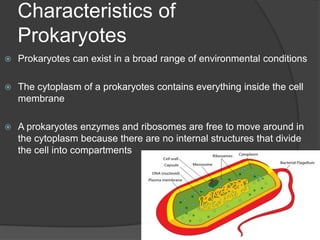
The cytoplasm of a prokaryotes contains everything inside the cell membrane
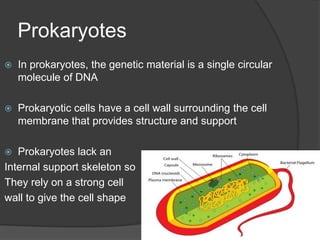
A prokaryotes enzymes and ribosomes are free to move around in the cytoplasm because there are no internal structures that divide the cell into compartmentsProkaryotesIn prokaryotes, the genetic material is a single circular molecule of DNAProkaryotic cells have a cell wall surrounding the cell membrane that provides structure and supportProkaryotes lack an Internal support skeleton so They rely on a strong cellwall to give the cell shape
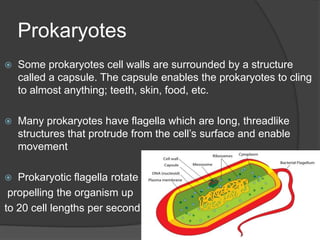
ProkaryotesSome prokaryotes cell walls are surrounded by a structure called a capsule. The capsule enables the prokaryotes to cling to almost anything; teeth, skin, food, etc.Many prokaryotes have flagella which are long, threadlike structures that protrude from the cell’s surface and enable movementProkaryotic flagella rotate propelling the organism up to 20 cell lengths per second
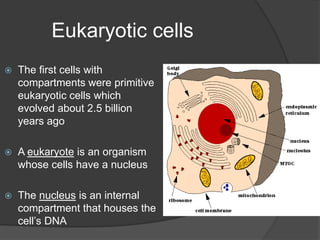
      Eukaryotic cellsThe first cells with compartments were primitive eukaryotic cells which evolved about 2.5 billion years agoA eukaryote is an organism whose cells have a nucleusThe nucleus is an internal compartment that houses the cell’s DNA
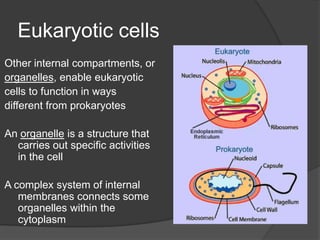
Eukaryotic cellsOther internal compartments, ororganelles, enable eukaryoticcells to function in waysdifferent from prokaryotesAn organelle is a structure that carries out specific activities in the cellA complex system of internal membranes connects some organelles within the cytoplasm
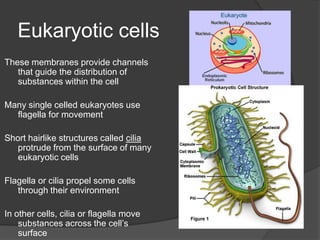
Eukaryotic cellsThese membranes provide channels that guide the distribution of substances within the cellMany single celled eukaryotes use flagella for movementShort hairlike structures called cilia protrude from the surface of many eukaryotic cellsFlagella or cilia propel some cells through their environmentIn other cells, cilia or flagella move substances across the cell’s surface
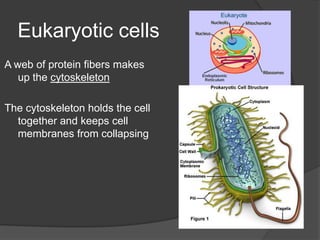
Eukaryotic cellsA web of protein fibers makes up the cytoskeletonThe cytoskeleton holds the cell together and keeps cell membranes from collapsing
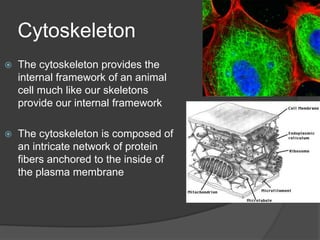
CytoskeletonThe cytoskeleton provides the internal framework of an animal cell much like our skeletons provide our internal frameworkThe cytoskeleton is composed of an intricate network of protein fibers anchored to the inside of the plasma membrane
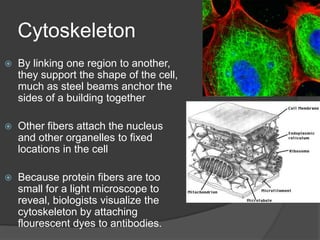
CytoskeletonBy linking one region to another, they support the shape of the cell, much as steel beams anchor the sides of a building together
Other fibers attach the nucleus and other organelles to fixed locations in the cell
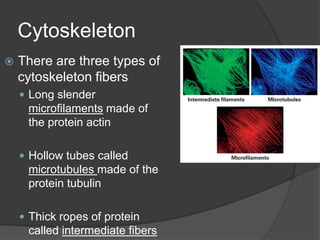
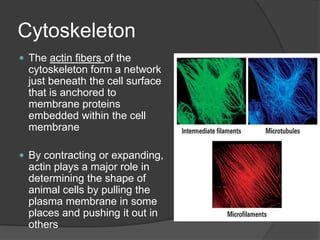
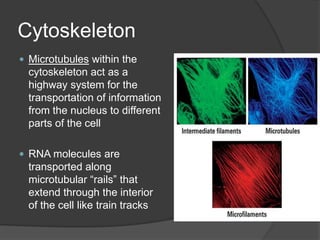
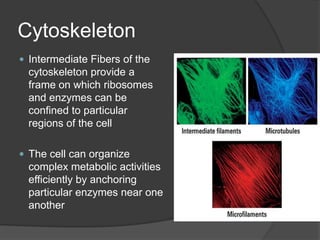
Because protein fibers are too small for a light microscope to reveal, biologists visualize the cytoskeleton by attaching flourescent dyes to antibodies. CytoskeletonThere are three types of cytoskeleton fibersLong slender microfilaments made of the protein actinHollow tubes called microtubules made of the protein tubulinThick ropes of protein called intermediate fibers
CytoskeletonThe actin fibers of the cytoskeleton form a network just beneath the cell surface that is anchored to membrane proteins embedded within the cell membrane
By contracting or expanding, actin plays a major role in determining the shape of animal cells by pulling the plasma membrane in some places and pushing it out in othersCytoskeletonMicrotubules within the cytoskeleton act as a highway system for the transportation of information from the nucleus to different parts of the cellRNA molecules are transported along microtubular “rails” that extend through the interior of the cell like train tracks
CytoskeletonIntermediate Fibers of the cytoskeleton provide a frame on which ribosomes and enzymes can be confined to particular regions of the cellThe cell can organize complex metabolic activities efficiently by anchoring particular enzymes near one another
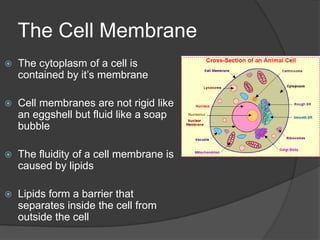
The Cell MembraneThe cytoplasm of a cell is contained by it’s membrane

Cell features

  • 1.
  • 2.
    The Cell TheoryIn1838, the German botanist MattiasSchleiden concluded that cells make up not only the stems of plants but every part of a plant.
  • 3.
    A year later,German zoologist Theodore Schwann determined that cells animals are also made of cells
  • 4.
    In 1858, RudolphVirchow, a German physician, determined that cells came from other cellsCell TheoryThe observations of Schleiden, Schwann, and Virchow form the cell theory which has three parts
  • 5.
    All living thingsare made of one or more cells
  • 6.
    Cells are thebasic units of structure and function in organisms
  • 7.
    All cells arisefrom existing cellsCell SizeSmall cells function more efficiently than large cells.Small cells can exchange substances more readily than larger cells because small objects have a higher surface area-to-volume ratio than larger objectsAs a result, substances do not need to travel as far to reach the center of a smaller cell
  • 8.
    Common Cell FeaturesAllcells have a cell membrane, an outer boundary that encloses the cell and separates the cell interior, called the cytoplasm, from it’s surroundings.Cell FeaturesThe cell membrane also regulates what enters and leaves the cell including gases, nutrients, and wastes
  • 9.
    Cell FeaturesWithin thecytoplasm are many structures, often suspended in a system of microscopic fibers called the cytoskeleton
  • 10.
    Cell FeaturesMost cells have ribosomes as well
  • 11.
    Ribosomes are thecellular structures on which proteins are madeCellular StructureAll cells also have DNAWhich provides Instructions for Making proteinsRegulates cellular activitiesEnables cells to reproduce
  • 12.
    Features of CellsThesmallest and simplest cells are prokaryotes
  • 13.
    Prokaryotes are single-celledorganisms that lack a nucleus and other internal compartments
  • 14.
    Without separate compartmentsto isolate materials, prokaryotes cells cannot carry out many specialized functions
  • 15.
    For nearly twobillion years, prokaryotes were the only organisms on EarthCharacteristics of ProkaryotesProkaryotes can exist in a broad range of environmental conditions
  • 16.
    The cytoplasm ofa prokaryotes contains everything inside the cell membrane
  • 17.
    A prokaryotes enzymesand ribosomes are free to move around in the cytoplasm because there are no internal structures that divide the cell into compartmentsProkaryotesIn prokaryotes, the genetic material is a single circular molecule of DNAProkaryotic cells have a cell wall surrounding the cell membrane that provides structure and supportProkaryotes lack an Internal support skeleton so They rely on a strong cellwall to give the cell shape
  • 18.
    ProkaryotesSome prokaryotes cellwalls are surrounded by a structure called a capsule. The capsule enables the prokaryotes to cling to almost anything; teeth, skin, food, etc.Many prokaryotes have flagella which are long, threadlike structures that protrude from the cell’s surface and enable movementProkaryotic flagella rotate propelling the organism up to 20 cell lengths per second
  • 19.
    Eukaryotic cellsThe first cells with compartments were primitive eukaryotic cells which evolved about 2.5 billion years agoA eukaryote is an organism whose cells have a nucleusThe nucleus is an internal compartment that houses the cell’s DNA
  • 20.
    Eukaryotic cellsOther internalcompartments, ororganelles, enable eukaryoticcells to function in waysdifferent from prokaryotesAn organelle is a structure that carries out specific activities in the cellA complex system of internal membranes connects some organelles within the cytoplasm
  • 21.
    Eukaryotic cellsThese membranesprovide channels that guide the distribution of substances within the cellMany single celled eukaryotes use flagella for movementShort hairlike structures called cilia protrude from the surface of many eukaryotic cellsFlagella or cilia propel some cells through their environmentIn other cells, cilia or flagella move substances across the cell’s surface
  • 22.
    Eukaryotic cellsA webof protein fibers makes up the cytoskeletonThe cytoskeleton holds the cell together and keeps cell membranes from collapsing
  • 23.
    CytoskeletonThe cytoskeleton providesthe internal framework of an animal cell much like our skeletons provide our internal frameworkThe cytoskeleton is composed of an intricate network of protein fibers anchored to the inside of the plasma membrane
  • 24.
    CytoskeletonBy linking oneregion to another, they support the shape of the cell, much as steel beams anchor the sides of a building together
  • 25.
    Other fibers attachthe nucleus and other organelles to fixed locations in the cell
  • 26.
    Because protein fibersare too small for a light microscope to reveal, biologists visualize the cytoskeleton by attaching flourescent dyes to antibodies. CytoskeletonThere are three types of cytoskeleton fibersLong slender microfilaments made of the protein actinHollow tubes called microtubules made of the protein tubulinThick ropes of protein called intermediate fibers
  • 27.
    CytoskeletonThe actin fibersof the cytoskeleton form a network just beneath the cell surface that is anchored to membrane proteins embedded within the cell membrane
  • 28.
    By contracting orexpanding, actin plays a major role in determining the shape of animal cells by pulling the plasma membrane in some places and pushing it out in othersCytoskeletonMicrotubules within the cytoskeleton act as a highway system for the transportation of information from the nucleus to different parts of the cellRNA molecules are transported along microtubular “rails” that extend through the interior of the cell like train tracks
  • 29.
    CytoskeletonIntermediate Fibers ofthe cytoskeleton provide a frame on which ribosomes and enzymes can be confined to particular regions of the cellThe cell can organize complex metabolic activities efficiently by anchoring particular enzymes near one another
  • 30.
    The Cell MembraneThecytoplasm of a cell is contained by it’s membrane