Shaukat Khanum Memorial Cancer Hospital and Research Centre
Jibran Mohsin
RENAL TRAUMA
Fellow Surgical Oncology
SKMCH & RC, Lahore
Click to edit Master title style
Shaukat Khanum Memorial Cancer Hospital and Research Centre
Outline
 Introduction
 Epidemiology
 Mode of injury
 Classification system
 Diagnostic evaluation
 Disease management
 Follow up
 Complications
 Iatrogenic renal trauma
 Summary (Algorithms)
Click to edit Master title style
Shaukat Khanum Memorial Cancer Hospital and Research Centre
Trauma
Trauma is defined as a physical injury or a wound to
living tissue caused by an extrinsic agent.
Click to edit Master title style
Shaukat Khanum Memorial Cancer Hospital and Research Centre
Initial evaluation and treatment
 The first priority is stabilization of the patient and
treatment of associated life-threatening injuries.
 ATLS Protocol
 Securing the airway with C-spine immobilisation
 Breathing
 controlling external bleeding and resuscitation of shock.
Click to edit Master title style
Shaukat Khanum Memorial Cancer Hospital and Research Centre
Renal Trauma (Epidemiology)
 Kidney is the most commonly injured organ in the
genito-urinary system.
 Seen in up to 5% of all trauma cases, and in 10%
of all abdominal trauma cases.
 Associated with young age and male gender with
incidence of about 4.9 per 100,000.
Click to edit Master title style
Shaukat Khanum Memorial Cancer Hospital and Research Centre
Renal Trauma (Mode of injury)
 Blunt injuries
 motor vehicle collision,
 falls,
 vehicle-associated pedestrian accidents
 Assault
 Sports injury
Click to edit Master title style
Shaukat Khanum Memorial Cancer Hospital and Research Centre
Renal Trauma (Mode of injury)
 Blunt injuries
 Sudden deceleration or a crush injury
 Parenchymal injury (Contusion or laceration) vs
 Renal hilum (Renal vascular injuries)
 <5% of blunt abdominal trauma,
 isolated renal artery injury (0.05-0.08%)
 Renal artery occlusion is associated with rapid
deceleration injuries.
Click to edit Master title style
Shaukat Khanum Memorial Cancer Hospital and Research Centre
Renal Trauma (Mode of injury)
 Penetrating injuries
 Gunshot and stab wounds
 Tend to be more severe and less predictable than blunt
trauma.
 In urban settings, the percentage of penetrating injuries
can be as high as 20% or higher
Click to edit Master title style
Shaukat Khanum Memorial Cancer Hospital and Research Centre
Renal Trauma (Mode of injury)
 Penetrating injuries
 Bullets have the potential for
 greater parenchymal destruction
 Disruption of vascular pedicles, or collecting system.
 multiple-organ injuries.
Click to edit Master title style
Shaukat Khanum Memorial Cancer Hospital and Research Centre
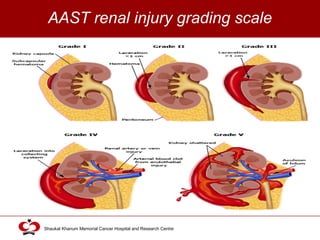
AAST renal injury grading scale
 This validated system has clinical relevance
 Helps to predict the need for intervention.
 Predicts morbidity after blunt or penetrating injury
and mortality after blunt injury.
Click to edit Master title style
Shaukat Khanum Memorial Cancer Hospital and Research Centre
AAST renal injury grading scale
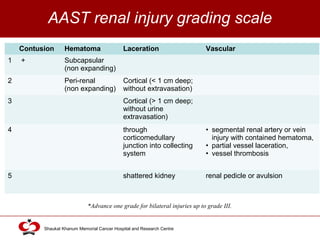
Contusion Hematoma Laceration Vascular
1 + Subcapsular
(non expanding)
2 Peri-renal
(non expanding)
Cortical (< 1 cm deep;
without extravasation)
3 Cortical (> 1 cm deep;
without urine
extravasation)
4 through
corticomedullary
junction into collecting
system
• segmental renal artery or vein
injury with contained hematoma,
• partial vessel laceration,
• vessel thrombosis
5 shattered kidney renal pedicle or avulsion
*Advance one grade for bilateral injuries up to grade III.
Click to edit Master title style
Shaukat Khanum Memorial Cancer Hospital and Research Centre
AAST renal injury grading scale
Click to edit Master title style
Shaukat Khanum Memorial Cancer Hospital and Research Centre
EAU proposals for changes to the
AAST classification
 Substratification of the intermediate grade injury
into
 grade 4a (low-risk cases likely to be managed non-
operatively) and
 grade 4b (high risk-cases likely to benefit from
angiographic embolisation, repair or nephrectomy),
 Based on the presence of radiographic risk
factors,including peri-renal haematoma, intravascular
contrast extravasation and laceration complexity
Click to edit Master title style
Shaukat Khanum Memorial Cancer Hospital and Research Centre
EAU proposals for changes to the
AAST classification
 Grade 4 injuries comprise
 all collecting system injuries, including ureteropelvic
junction (UPJ) injury of any severity and
 segmental arterial and venous injuries,
 Grade 5 injuries should include
 only hilar injuries, including thrombotic events.
Click to edit Master title style
Shaukat Khanum Memorial Cancer Hospital and Research Centre
Diagnostic evaluation
Patient history and physical examination
Laboratory evaluation
Imaging
Click to edit Master title style
Shaukat Khanum Memorial Cancer Hospital and Research Centre
EAU Recommendations for patient history and physical examination
Assess hemodynamic stability upon admission.
Obtain a history from conscious patients, witnesses and rescue team personnel with
regard to the time and setting of the incident. (rapid deceleration, direct flank blow)
Record past renal surgery, and known pre-existing renal abnormalities (UPJ
obstruction, large cysts, lithiasis  hydronephrosis  complicate minor injury)
__________________________________________________________________
Perform a thorough physical examination to rule out penetrating injury.
Flank pain, flank abrasions and bruising ecchymoses, fractured ribs, abdominal
tenderness, distension or mass, could indicate possible renal involvement.
Click to edit Master title style
Shaukat Khanum Memorial Cancer Hospital and Research Centre
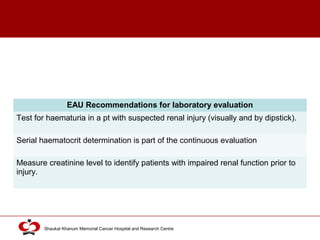
EAU Recommendations for laboratory evaluation
Test for haematuria in a pt with suspected renal injury (visually and by dipstick).
Serial haematocrit determination is part of the continuous evaluation
Measure creatinine level to identify patients with impaired renal function prior to
injury.
Click to edit Master title style
Shaukat Khanum Memorial Cancer Hospital and Research Centre
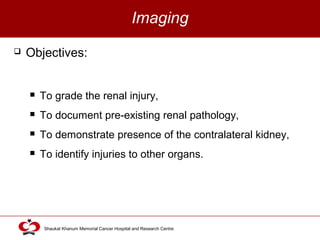
Imaging
 Objectives:
 To grade the renal injury,
 To document pre-existing renal pathology,
 To demonstrate presence of the contralateral kidney,
 To identify injuries to other organs.
Click to edit Master title style
Shaukat Khanum Memorial Cancer Hospital and Research Centre
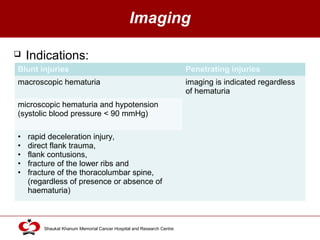
Imaging
 Indications:
Blunt injuries Penetrating injuries
macroscopic hematuria imaging is indicated regardless
of hematuria
microscopic hematuria and hypotension
(systolic blood pressure < 90 mmHg)
• rapid deceleration injury,
• direct flank trauma,
• flank contusions,
• fracture of the lower ribs and
• fracture of the thoracolumbar spine,
(regardless of presence or absence of
haematuria)
Click to edit Master title style
Shaukat Khanum Memorial Cancer Hospital and Research Centre
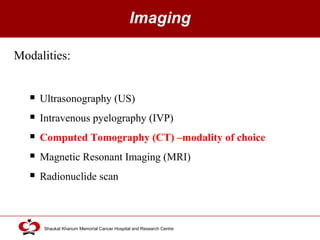
Imaging
Modalities:
 Ultrasonography (US)
 Intravenous pyelography (IVP)
 Computed Tomography (CT) –modality of choice
 Magnetic Resonant Imaging (MRI)
 Radionuclide scan
Click to edit Master title style
Shaukat Khanum Memorial Cancer Hospital and Research Centre
Ultrasonography (US)
 FAST (hemoperitoneum).
 Insensitive to solid abdominal organ injury
 American College of Radiologists (ACR) Renal Trauma
guidelines considers US usually not appropriate in renal
trauma.
 Possible no-radiation alternative to CT in the follow-up of
renal trauma
Click to edit Master title style
Shaukat Khanum Memorial Cancer Hospital and Research Centre
Intravenous pyelography (IVP)
 superseded by cross-sectional imaging
 should only be performed when CT is not
available.
 can be used to confirm function of the injured
kidney and presence of the contralateral kidney
Click to edit Master title style
Shaukat Khanum Memorial Cancer Hospital and Research Centre
Intraoperative pyelography
 One-shot, intraoperative IVP remains a useful
technique to confirm the presence of a functioning
contralateral kidney in patients too unstable to
undergo preoperative imaging.
 A bolus IV injection of radiographic contrast (2
ml/kg) followed by a single plain film taken after 10
minutes.
Click to edit Master title style
Shaukat Khanum Memorial Cancer Hospital and Research Centre
Computed tomography (CT)
 imaging modality of choice in hemodynamically
stable patients following blunt or penetrating
trauma.
 Merits:
 widely available,
 can quickly and accurately identify and grade renal
injury,
 establish the presence of the contralateral kidney and
demonstrate concurrent injuries to other organs.
Click to edit Master title style
Shaukat Khanum Memorial Cancer Hospital and Research Centre
Computed tomography (CT)
 WBCT in the initial management of polytrauma
patients significantly increases the probability of
survival.
 Although the AAST system of grading renal
injuries is primarily based on surgical findings,
there is a good correlation with CT appearances
Click to edit Master title style
Shaukat Khanum Memorial Cancer Hospital and Research Centre
Computed tomography (CT)
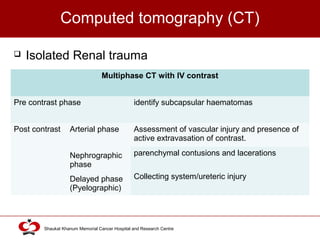
 Isolated Renal trauma
Multiphase CT with IV contrast
Pre contrast phase identify subcapsular haematomas
Post contrast Arterial phase Assessment of vascular injury and presence of
active extravasation of contrast.
parenchymal contusions and lacerationsNephrographic
phase
Collecting system/ureteric injuryDelayed phase
(Pyelographic)
Click to edit Master title style
Shaukat Khanum Memorial Cancer Hospital and Research Centre
Magnetic resonance imaging (MRI)
 Diagnostic accuracy of MRI in renal trauma is
similar to that of CT.
 BUT routine evaluation of trauma patients by MRI
impractical due to logistical challenges of moving a
trauma patient to the MRI suite.
Click to edit Master title style
Shaukat Khanum Memorial Cancer Hospital and Research Centre
Radionuclide scans
Radionuclide scans do not play a role in the
immediate evaluation of renal trauma patients.
Click to edit Master title style
Shaukat Khanum Memorial Cancer Hospital and Research Centre
Disease management
Non-operative management
 Conservative
 Interventional radiology
Operative management
Click to edit Master title style
Shaukat Khanum Memorial Cancer Hospital and Research Centre
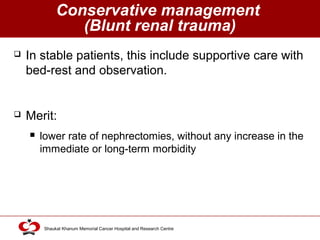
Conservative management
(Blunt renal trauma)
 In stable patients, this include supportive care with
bed-rest and observation.
 Merit:
 lower rate of nephrectomies, without any increase in the
immediate or long-term morbidity
Click to edit Master title style
Shaukat Khanum Memorial Cancer Hospital and Research Centre
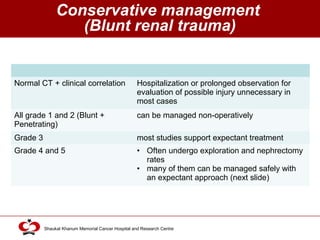
Conservative management
(Blunt renal trauma)
Normal CT + clinical correlation Hospitalization or prolonged observation for
evaluation of possible injury unnecessary in
most cases
All grade 1 and 2 (Blunt +
Penetrating)
can be managed non-operatively
Grade 3 most studies support expectant treatment
Grade 4 and 5 • Often undergo exploration and nephrectomy
rates
• many of them can be managed safely with
an expectant approach (next slide)
Click to edit Master title style
Shaukat Khanum Memorial Cancer Hospital and Research Centre
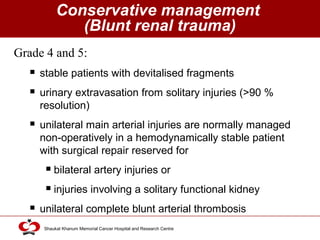
Conservative management
(Blunt renal trauma)
Grade 4 and 5:
 stable patients with devitalised fragments
 urinary extravasation from solitary injuries (>90 %
resolution)
 unilateral main arterial injuries are normally managed
non-operatively in a hemodynamically stable patient
with surgical repair reserved for
 bilateral artery injuries or
 injuries involving a solitary functional kidney
 unilateral complete blunt arterial thrombosis
Click to edit Master title style
Shaukat Khanum Memorial Cancer Hospital and Research Centre
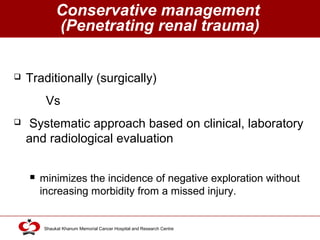
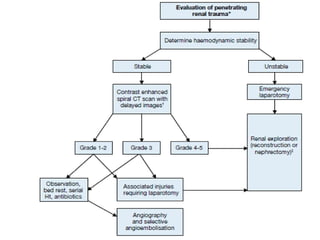
Conservative management
(Penetrating renal trauma)
 Traditionally (surgically)
Vs
 Systematic approach based on clinical, laboratory
and radiological evaluation
 minimizes the incidence of negative exploration without
increasing morbidity from a missed injury.
Click to edit Master title style
Shaukat Khanum Memorial Cancer Hospital and Research Centre
Conservative management
(Penetrating renal trauma)
 Stab wounds
 Site of penetration: posterior to the anterior axillary line,
88% of such injuries can be managed non-operatively.
vs
 major renal injuries (grade 3 or higher) are more
unpredictable and are associated with a higher rate of
delayed complications if treated expectantly
Click to edit Master title style
Shaukat Khanum Memorial Cancer Hospital and Research Centre
Conservative management
(Penetrating renal trauma)
 Gunshot injuries
 Indication for exploration
 involve the hilum or
 accompanied by signs of ongoing bleeding, ureteral
injuries, or renal pelvis lacerations
Click to edit Master title style
Shaukat Khanum Memorial Cancer Hospital and Research Centre
Conservative management
(Penetrating renal trauma)
 Gunshot injuries
 Minor low-velocity gunshot and stab wounds may be
managed conservatively with an acceptably good
outcome.
Vs
 High-velocity gunshot injuries can be more extensive
and nephrectomy may be required.
 Outcome
 50 % stab wounds vs 40 % gunshot wounds.
Click to edit Master title style
Shaukat Khanum Memorial Cancer Hospital and Research Centre
Interventional radiology
(Angioembolisation)
 Indication:
 Hemodynamically stable blunt renal trauma
 CT findings
 active extravasation of contrast (± a large hematoma
i.e. > 25 mm depth)
 arteriovenous fistula
 pseudo aneurysm
Click to edit Master title style
Shaukat Khanum Memorial Cancer Hospital and Research Centre
Interventional radiology
(Angioembolisation)
Outcome:
 most beneficial in the setting of high grade renal trauma
(AAST > 3)
 successful in up to
 94.9% of grade 3,
 89% of grade 4 and
 52% of grade 5 injuries
Click to edit Master title style
Shaukat Khanum Memorial Cancer Hospital and Research Centre
Interventional radiology
(Angioembolisation)
 In severe polytrauma or high operative risk, the
main artery may be embolised, either as a
definitive treatment or to be followed by interval
nephrectomy.
 Available evidence regarding angioembolisation in
penetrating renal trauma is sparse.
Click to edit Master title style
Shaukat Khanum Memorial Cancer Hospital and Research Centre
Surgical management
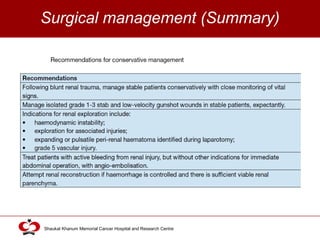
Indications for renal exploration
 Continuing hemodynamic instability and unresponsive to
aggressive resuscitation due to renal hemorrhage
(irrespective of the mode of injury)
 expanding or pulsatile peri-renal hematoma identified at
exploratory laparotomy performed for associated
injuries.
Click to edit Master title style
Shaukat Khanum Memorial Cancer Hospital and Research Centre
Surgical management
Indications for renal exploration
 Inconclusive imaging and a pre-existing abnormality or
an incidentally diagnosed tumour may require surgery
even after minor renal injury
 Grade 5 vascular injuries (absolute indication for
exploration)
Click to edit Master title style
Shaukat Khanum Memorial Cancer Hospital and Research Centre
Surgical management
Operative findings and reconstruction
 The overall exploration rate for blunt trauma is less than
10%
 Goal:
 Control of hemorrhage and
 renal salvage.
Click to edit Master title style
Shaukat Khanum Memorial Cancer Hospital and Research Centre
Surgical management
 Stable haematomas (Zone 2)
 should not be opened.
 Central (Zone 1) or expanding haematomas
indicate injuries of the renal pedicle, aorta, or vena
cava and are potentially life-threatening
Click to edit Master title style
Shaukat Khanum Memorial Cancer Hospital and Research Centre
Surgical management
 unilateral arterial intimal disruption,
 repair can be delayed, especially in the presence of a
normal contralateral kidney.
Vs
 prolonged warm ischaemia usually results in irreparable
damage and renal loss.
Click to edit Master title style
Shaukat Khanum Memorial Cancer Hospital and Research Centre
Surgical management
 Entering the retroperitoneum and leaving the
confined haematoma undisturbed within the
perinephric fascia is recommended unless it is
violated and cortical bleeding is noted;
 packing the fossa tightly with laparotomy pads
temporarily can salvage the kidney
Click to edit Master title style
Shaukat Khanum Memorial Cancer Hospital and Research Centre
Surgical management
Renal reconstruction:
 Renorrhaphy (most common reconstructive technique)
 Partial nephrectomy (in case of non-viable tissue)
Click to edit Master title style
Shaukat Khanum Memorial Cancer Hospital and Research Centre
Surgical management
 Renal reconstruction:
 Watertight closure of the opened collecting system
(desirable), vs closing the parenchyma over the injured
collecting system.
 If the capsule is not preserved, an omental pedicle flap
or perirenal fat bolster may be used for coverage
 use of hemostatic agents and sealants
Click to edit Master title style
Shaukat Khanum Memorial Cancer Hospital and Research Centre
Surgical management
 In all cases, drainage of the ipsilateral
retroperitoneum is recommended
Click to edit Master title style
Shaukat Khanum Memorial Cancer Hospital and Research Centre
Surgical management
 Grade 5 Vascular repair
 seldom, if ever, effective.
 Indication: solitary kidney or bilateral injuries
 Nephrectomy for main artery injury has outcomes
similar to those of vascular repair and does not worsen
post-treatment renal function in the short-term.
Click to edit Master title style
Shaukat Khanum Memorial Cancer Hospital and Research Centre
Surgical management (Summary)
Click to edit Master title style
Shaukat Khanum Memorial Cancer Hospital and Research Centre
Follow up
 Repeat imaging two-four days after trauma
minimises the risk of missed complications,
especially in grade 3-5 blunt injuries.
Do CT scan if fever, unexplained decreased
haematocrit or significant flank pain.
Click to edit Master title style
Shaukat Khanum Memorial Cancer Hospital and Research Centre
Follow up
 Repeat imaging can be safely omitted for patients
with grade 1-4 injuries as long as they remain
clinically well.
 Nuclear scans are useful for documenting and
tracking functional recovery following renal
reconstruction
Click to edit Master title style
Shaukat Khanum Memorial Cancer Hospital and Research Centre
Follow up
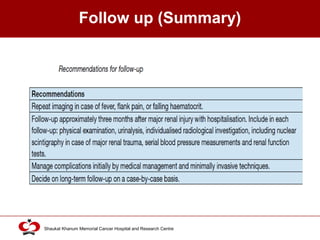
 Follow-up should involve
 physical examination,
 urinalysis,
 individualised radiological investigation,
 serial blood pressure measurement and
 serum determination of renal function
Click to edit Master title style
Shaukat Khanum Memorial Cancer Hospital and Research Centre
Follow up
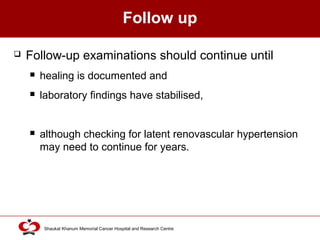
 Follow-up examinations should continue until
 healing is documented and
 laboratory findings have stabilised,
 although checking for latent renovascular hypertension
may need to continue for years.
Click to edit Master title style
Shaukat Khanum Memorial Cancer Hospital and Research Centre
Follow up (Summary)
Click to edit Master title style
Shaukat Khanum Memorial Cancer Hospital and Research Centre
Complications
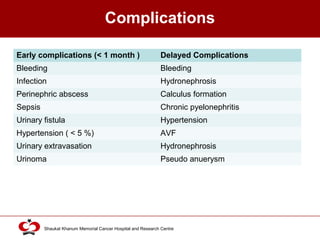
Early complications (< 1 month ) Delayed Complications
Bleeding Bleeding
Infection Hydronephrosis
Perinephric abscess Calculus formation
Sepsis Chronic pyelonephritis
Urinary fistula Hypertension
Hypertension ( < 5 %) AVF
Urinary extravasation Hydronephrosis
Urinoma Pseudo anuerysm
Click to edit Master title style
Shaukat Khanum Memorial Cancer Hospital and Research Centre
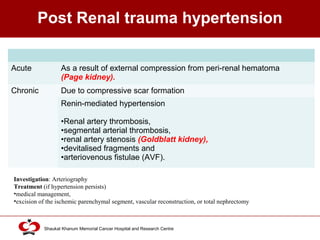
Post Renal trauma hypertension
Acute As a result of external compression from peri-renal hematoma
(Page kidney).
Chronic Due to compressive scar formation
Renin-mediated hypertension
•Renal artery thrombosis,
•segmental arterial thrombosis,
•renal artery stenosis (Goldblatt kidney),
•devitalised fragments and
•arteriovenous fistulae (AVF).
Investigation: Arteriography
Treatment (if hypertension persists)
•medical management,
•excision of the ischemic parenchymal segment, vascular reconstruction, or total nephrectomy
Click to edit Master title style
Shaukat Khanum Memorial Cancer Hospital and Research Centre
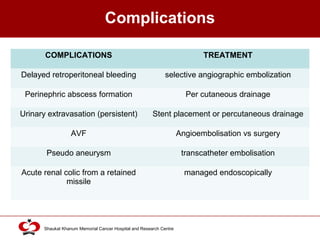
Complications
COMPLICATIONS TREATMENT
Delayed retroperitoneal bleeding selective angiographic embolization
Perinephric abscess formation Per cutaneous drainage
Urinary extravasation (persistent) Stent placement or percutaneous drainage
AVF Angioembolisation vs surgery
Pseudo aneurysm transcatheter embolisation
Acute renal colic from a retained
missile
managed endoscopically
Click to edit Master title style
Shaukat Khanum Memorial Cancer Hospital and Research Centre
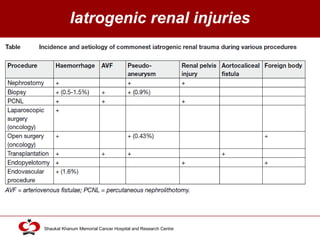
Iatrogenic renal injuries
Click to edit Master title style
Shaukat Khanum Memorial Cancer Hospital and Research Centre
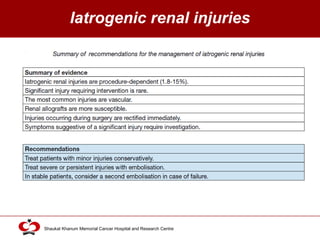
Iatrogenic renal injuries
Click to edit Master title style
Shaukat Khanum Memorial Cancer Hospital and Research Centre
Click to edit Master title style
Shaukat Khanum Memorial Cancer Hospital and Research Centre
Click to edit Master title style
Shaukat Khanum Memorial Cancer Hospital and Research Centre
THANK YOU

Renal trauma

  • 1.
    Shaukat Khanum MemorialCancer Hospital and Research Centre Jibran Mohsin RENAL TRAUMA Fellow Surgical Oncology SKMCH & RC, Lahore
  • 2.
    Click to editMaster title style Shaukat Khanum Memorial Cancer Hospital and Research Centre Outline  Introduction  Epidemiology  Mode of injury  Classification system  Diagnostic evaluation  Disease management  Follow up  Complications  Iatrogenic renal trauma  Summary (Algorithms)
  • 3.
    Click to editMaster title style Shaukat Khanum Memorial Cancer Hospital and Research Centre Trauma Trauma is defined as a physical injury or a wound to living tissue caused by an extrinsic agent.
  • 4.
    Click to editMaster title style Shaukat Khanum Memorial Cancer Hospital and Research Centre Initial evaluation and treatment  The first priority is stabilization of the patient and treatment of associated life-threatening injuries.  ATLS Protocol  Securing the airway with C-spine immobilisation  Breathing  controlling external bleeding and resuscitation of shock.
  • 5.
    Click to editMaster title style Shaukat Khanum Memorial Cancer Hospital and Research Centre Renal Trauma (Epidemiology)  Kidney is the most commonly injured organ in the genito-urinary system.  Seen in up to 5% of all trauma cases, and in 10% of all abdominal trauma cases.  Associated with young age and male gender with incidence of about 4.9 per 100,000.
  • 6.
    Click to editMaster title style Shaukat Khanum Memorial Cancer Hospital and Research Centre Renal Trauma (Mode of injury)  Blunt injuries  motor vehicle collision,  falls,  vehicle-associated pedestrian accidents  Assault  Sports injury
  • 7.
    Click to editMaster title style Shaukat Khanum Memorial Cancer Hospital and Research Centre Renal Trauma (Mode of injury)  Blunt injuries  Sudden deceleration or a crush injury  Parenchymal injury (Contusion or laceration) vs  Renal hilum (Renal vascular injuries)  <5% of blunt abdominal trauma,  isolated renal artery injury (0.05-0.08%)  Renal artery occlusion is associated with rapid deceleration injuries.
  • 8.
    Click to editMaster title style Shaukat Khanum Memorial Cancer Hospital and Research Centre Renal Trauma (Mode of injury)  Penetrating injuries  Gunshot and stab wounds  Tend to be more severe and less predictable than blunt trauma.  In urban settings, the percentage of penetrating injuries can be as high as 20% or higher
  • 9.
    Click to editMaster title style Shaukat Khanum Memorial Cancer Hospital and Research Centre Renal Trauma (Mode of injury)  Penetrating injuries  Bullets have the potential for  greater parenchymal destruction  Disruption of vascular pedicles, or collecting system.  multiple-organ injuries.
  • 10.
    Click to editMaster title style Shaukat Khanum Memorial Cancer Hospital and Research Centre AAST renal injury grading scale  This validated system has clinical relevance  Helps to predict the need for intervention.  Predicts morbidity after blunt or penetrating injury and mortality after blunt injury.
  • 11.
    Click to editMaster title style Shaukat Khanum Memorial Cancer Hospital and Research Centre AAST renal injury grading scale Contusion Hematoma Laceration Vascular 1 + Subcapsular (non expanding) 2 Peri-renal (non expanding) Cortical (< 1 cm deep; without extravasation) 3 Cortical (> 1 cm deep; without urine extravasation) 4 through corticomedullary junction into collecting system • segmental renal artery or vein injury with contained hematoma, • partial vessel laceration, • vessel thrombosis 5 shattered kidney renal pedicle or avulsion *Advance one grade for bilateral injuries up to grade III.
  • 12.
    Click to editMaster title style Shaukat Khanum Memorial Cancer Hospital and Research Centre AAST renal injury grading scale
  • 13.
    Click to editMaster title style Shaukat Khanum Memorial Cancer Hospital and Research Centre EAU proposals for changes to the AAST classification  Substratification of the intermediate grade injury into  grade 4a (low-risk cases likely to be managed non- operatively) and  grade 4b (high risk-cases likely to benefit from angiographic embolisation, repair or nephrectomy),  Based on the presence of radiographic risk factors,including peri-renal haematoma, intravascular contrast extravasation and laceration complexity
  • 14.
    Click to editMaster title style Shaukat Khanum Memorial Cancer Hospital and Research Centre EAU proposals for changes to the AAST classification  Grade 4 injuries comprise  all collecting system injuries, including ureteropelvic junction (UPJ) injury of any severity and  segmental arterial and venous injuries,  Grade 5 injuries should include  only hilar injuries, including thrombotic events.
  • 15.
    Click to editMaster title style Shaukat Khanum Memorial Cancer Hospital and Research Centre Diagnostic evaluation Patient history and physical examination Laboratory evaluation Imaging
  • 16.
    Click to editMaster title style Shaukat Khanum Memorial Cancer Hospital and Research Centre EAU Recommendations for patient history and physical examination Assess hemodynamic stability upon admission. Obtain a history from conscious patients, witnesses and rescue team personnel with regard to the time and setting of the incident. (rapid deceleration, direct flank blow) Record past renal surgery, and known pre-existing renal abnormalities (UPJ obstruction, large cysts, lithiasis  hydronephrosis  complicate minor injury) __________________________________________________________________ Perform a thorough physical examination to rule out penetrating injury. Flank pain, flank abrasions and bruising ecchymoses, fractured ribs, abdominal tenderness, distension or mass, could indicate possible renal involvement.
  • 17.
    Click to editMaster title style Shaukat Khanum Memorial Cancer Hospital and Research Centre EAU Recommendations for laboratory evaluation Test for haematuria in a pt with suspected renal injury (visually and by dipstick). Serial haematocrit determination is part of the continuous evaluation Measure creatinine level to identify patients with impaired renal function prior to injury.
  • 18.
    Click to editMaster title style Shaukat Khanum Memorial Cancer Hospital and Research Centre Imaging  Objectives:  To grade the renal injury,  To document pre-existing renal pathology,  To demonstrate presence of the contralateral kidney,  To identify injuries to other organs.
  • 19.
    Click to editMaster title style Shaukat Khanum Memorial Cancer Hospital and Research Centre Imaging  Indications: Blunt injuries Penetrating injuries macroscopic hematuria imaging is indicated regardless of hematuria microscopic hematuria and hypotension (systolic blood pressure < 90 mmHg) • rapid deceleration injury, • direct flank trauma, • flank contusions, • fracture of the lower ribs and • fracture of the thoracolumbar spine, (regardless of presence or absence of haematuria)
  • 20.
    Click to editMaster title style Shaukat Khanum Memorial Cancer Hospital and Research Centre Imaging Modalities:  Ultrasonography (US)  Intravenous pyelography (IVP)  Computed Tomography (CT) –modality of choice  Magnetic Resonant Imaging (MRI)  Radionuclide scan
  • 21.
    Click to editMaster title style Shaukat Khanum Memorial Cancer Hospital and Research Centre Ultrasonography (US)  FAST (hemoperitoneum).  Insensitive to solid abdominal organ injury  American College of Radiologists (ACR) Renal Trauma guidelines considers US usually not appropriate in renal trauma.  Possible no-radiation alternative to CT in the follow-up of renal trauma
  • 22.
    Click to editMaster title style Shaukat Khanum Memorial Cancer Hospital and Research Centre Intravenous pyelography (IVP)  superseded by cross-sectional imaging  should only be performed when CT is not available.  can be used to confirm function of the injured kidney and presence of the contralateral kidney
  • 23.
    Click to editMaster title style Shaukat Khanum Memorial Cancer Hospital and Research Centre Intraoperative pyelography  One-shot, intraoperative IVP remains a useful technique to confirm the presence of a functioning contralateral kidney in patients too unstable to undergo preoperative imaging.  A bolus IV injection of radiographic contrast (2 ml/kg) followed by a single plain film taken after 10 minutes.
  • 24.
    Click to editMaster title style Shaukat Khanum Memorial Cancer Hospital and Research Centre Computed tomography (CT)  imaging modality of choice in hemodynamically stable patients following blunt or penetrating trauma.  Merits:  widely available,  can quickly and accurately identify and grade renal injury,  establish the presence of the contralateral kidney and demonstrate concurrent injuries to other organs.
  • 25.
    Click to editMaster title style Shaukat Khanum Memorial Cancer Hospital and Research Centre Computed tomography (CT)  WBCT in the initial management of polytrauma patients significantly increases the probability of survival.  Although the AAST system of grading renal injuries is primarily based on surgical findings, there is a good correlation with CT appearances
  • 26.
    Click to editMaster title style Shaukat Khanum Memorial Cancer Hospital and Research Centre Computed tomography (CT)  Isolated Renal trauma Multiphase CT with IV contrast Pre contrast phase identify subcapsular haematomas Post contrast Arterial phase Assessment of vascular injury and presence of active extravasation of contrast. parenchymal contusions and lacerationsNephrographic phase Collecting system/ureteric injuryDelayed phase (Pyelographic)
  • 27.
    Click to editMaster title style Shaukat Khanum Memorial Cancer Hospital and Research Centre Magnetic resonance imaging (MRI)  Diagnostic accuracy of MRI in renal trauma is similar to that of CT.  BUT routine evaluation of trauma patients by MRI impractical due to logistical challenges of moving a trauma patient to the MRI suite.
  • 28.
    Click to editMaster title style Shaukat Khanum Memorial Cancer Hospital and Research Centre Radionuclide scans Radionuclide scans do not play a role in the immediate evaluation of renal trauma patients.
  • 29.
    Click to editMaster title style Shaukat Khanum Memorial Cancer Hospital and Research Centre Disease management Non-operative management  Conservative  Interventional radiology Operative management
  • 30.
    Click to editMaster title style Shaukat Khanum Memorial Cancer Hospital and Research Centre Conservative management (Blunt renal trauma)  In stable patients, this include supportive care with bed-rest and observation.  Merit:  lower rate of nephrectomies, without any increase in the immediate or long-term morbidity
  • 31.
    Click to editMaster title style Shaukat Khanum Memorial Cancer Hospital and Research Centre Conservative management (Blunt renal trauma) Normal CT + clinical correlation Hospitalization or prolonged observation for evaluation of possible injury unnecessary in most cases All grade 1 and 2 (Blunt + Penetrating) can be managed non-operatively Grade 3 most studies support expectant treatment Grade 4 and 5 • Often undergo exploration and nephrectomy rates • many of them can be managed safely with an expectant approach (next slide)
  • 32.
    Click to editMaster title style Shaukat Khanum Memorial Cancer Hospital and Research Centre Conservative management (Blunt renal trauma) Grade 4 and 5:  stable patients with devitalised fragments  urinary extravasation from solitary injuries (>90 % resolution)  unilateral main arterial injuries are normally managed non-operatively in a hemodynamically stable patient with surgical repair reserved for  bilateral artery injuries or  injuries involving a solitary functional kidney  unilateral complete blunt arterial thrombosis
  • 33.
    Click to editMaster title style Shaukat Khanum Memorial Cancer Hospital and Research Centre Conservative management (Penetrating renal trauma)  Traditionally (surgically) Vs  Systematic approach based on clinical, laboratory and radiological evaluation  minimizes the incidence of negative exploration without increasing morbidity from a missed injury.
  • 34.
    Click to editMaster title style Shaukat Khanum Memorial Cancer Hospital and Research Centre Conservative management (Penetrating renal trauma)  Stab wounds  Site of penetration: posterior to the anterior axillary line, 88% of such injuries can be managed non-operatively. vs  major renal injuries (grade 3 or higher) are more unpredictable and are associated with a higher rate of delayed complications if treated expectantly
  • 35.
    Click to editMaster title style Shaukat Khanum Memorial Cancer Hospital and Research Centre Conservative management (Penetrating renal trauma)  Gunshot injuries  Indication for exploration  involve the hilum or  accompanied by signs of ongoing bleeding, ureteral injuries, or renal pelvis lacerations
  • 36.
    Click to editMaster title style Shaukat Khanum Memorial Cancer Hospital and Research Centre Conservative management (Penetrating renal trauma)  Gunshot injuries  Minor low-velocity gunshot and stab wounds may be managed conservatively with an acceptably good outcome. Vs  High-velocity gunshot injuries can be more extensive and nephrectomy may be required.  Outcome  50 % stab wounds vs 40 % gunshot wounds.
  • 37.
    Click to editMaster title style Shaukat Khanum Memorial Cancer Hospital and Research Centre Interventional radiology (Angioembolisation)  Indication:  Hemodynamically stable blunt renal trauma  CT findings  active extravasation of contrast (± a large hematoma i.e. > 25 mm depth)  arteriovenous fistula  pseudo aneurysm
  • 38.
    Click to editMaster title style Shaukat Khanum Memorial Cancer Hospital and Research Centre Interventional radiology (Angioembolisation) Outcome:  most beneficial in the setting of high grade renal trauma (AAST > 3)  successful in up to  94.9% of grade 3,  89% of grade 4 and  52% of grade 5 injuries
  • 39.
    Click to editMaster title style Shaukat Khanum Memorial Cancer Hospital and Research Centre Interventional radiology (Angioembolisation)  In severe polytrauma or high operative risk, the main artery may be embolised, either as a definitive treatment or to be followed by interval nephrectomy.  Available evidence regarding angioembolisation in penetrating renal trauma is sparse.
  • 40.
    Click to editMaster title style Shaukat Khanum Memorial Cancer Hospital and Research Centre Surgical management Indications for renal exploration  Continuing hemodynamic instability and unresponsive to aggressive resuscitation due to renal hemorrhage (irrespective of the mode of injury)  expanding or pulsatile peri-renal hematoma identified at exploratory laparotomy performed for associated injuries.
  • 41.
    Click to editMaster title style Shaukat Khanum Memorial Cancer Hospital and Research Centre Surgical management Indications for renal exploration  Inconclusive imaging and a pre-existing abnormality or an incidentally diagnosed tumour may require surgery even after minor renal injury  Grade 5 vascular injuries (absolute indication for exploration)
  • 42.
    Click to editMaster title style Shaukat Khanum Memorial Cancer Hospital and Research Centre Surgical management Operative findings and reconstruction  The overall exploration rate for blunt trauma is less than 10%  Goal:  Control of hemorrhage and  renal salvage.
  • 43.
    Click to editMaster title style Shaukat Khanum Memorial Cancer Hospital and Research Centre Surgical management  Stable haematomas (Zone 2)  should not be opened.  Central (Zone 1) or expanding haematomas indicate injuries of the renal pedicle, aorta, or vena cava and are potentially life-threatening
  • 44.
    Click to editMaster title style Shaukat Khanum Memorial Cancer Hospital and Research Centre Surgical management  unilateral arterial intimal disruption,  repair can be delayed, especially in the presence of a normal contralateral kidney. Vs  prolonged warm ischaemia usually results in irreparable damage and renal loss.
  • 45.
    Click to editMaster title style Shaukat Khanum Memorial Cancer Hospital and Research Centre Surgical management  Entering the retroperitoneum and leaving the confined haematoma undisturbed within the perinephric fascia is recommended unless it is violated and cortical bleeding is noted;  packing the fossa tightly with laparotomy pads temporarily can salvage the kidney
  • 46.
    Click to editMaster title style Shaukat Khanum Memorial Cancer Hospital and Research Centre Surgical management Renal reconstruction:  Renorrhaphy (most common reconstructive technique)  Partial nephrectomy (in case of non-viable tissue)
  • 47.
    Click to editMaster title style Shaukat Khanum Memorial Cancer Hospital and Research Centre Surgical management  Renal reconstruction:  Watertight closure of the opened collecting system (desirable), vs closing the parenchyma over the injured collecting system.  If the capsule is not preserved, an omental pedicle flap or perirenal fat bolster may be used for coverage  use of hemostatic agents and sealants
  • 48.
    Click to editMaster title style Shaukat Khanum Memorial Cancer Hospital and Research Centre Surgical management  In all cases, drainage of the ipsilateral retroperitoneum is recommended
  • 49.
    Click to editMaster title style Shaukat Khanum Memorial Cancer Hospital and Research Centre Surgical management  Grade 5 Vascular repair  seldom, if ever, effective.  Indication: solitary kidney or bilateral injuries  Nephrectomy for main artery injury has outcomes similar to those of vascular repair and does not worsen post-treatment renal function in the short-term.
  • 50.
    Click to editMaster title style Shaukat Khanum Memorial Cancer Hospital and Research Centre Surgical management (Summary)
  • 51.
    Click to editMaster title style Shaukat Khanum Memorial Cancer Hospital and Research Centre Follow up  Repeat imaging two-four days after trauma minimises the risk of missed complications, especially in grade 3-5 blunt injuries. Do CT scan if fever, unexplained decreased haematocrit or significant flank pain.
  • 52.
    Click to editMaster title style Shaukat Khanum Memorial Cancer Hospital and Research Centre Follow up  Repeat imaging can be safely omitted for patients with grade 1-4 injuries as long as they remain clinically well.  Nuclear scans are useful for documenting and tracking functional recovery following renal reconstruction
  • 53.
    Click to editMaster title style Shaukat Khanum Memorial Cancer Hospital and Research Centre Follow up  Follow-up should involve  physical examination,  urinalysis,  individualised radiological investigation,  serial blood pressure measurement and  serum determination of renal function
  • 54.
    Click to editMaster title style Shaukat Khanum Memorial Cancer Hospital and Research Centre Follow up  Follow-up examinations should continue until  healing is documented and  laboratory findings have stabilised,  although checking for latent renovascular hypertension may need to continue for years.
  • 55.
    Click to editMaster title style Shaukat Khanum Memorial Cancer Hospital and Research Centre Follow up (Summary)
  • 56.
    Click to editMaster title style Shaukat Khanum Memorial Cancer Hospital and Research Centre Complications Early complications (< 1 month ) Delayed Complications Bleeding Bleeding Infection Hydronephrosis Perinephric abscess Calculus formation Sepsis Chronic pyelonephritis Urinary fistula Hypertension Hypertension ( < 5 %) AVF Urinary extravasation Hydronephrosis Urinoma Pseudo anuerysm
  • 57.
    Click to editMaster title style Shaukat Khanum Memorial Cancer Hospital and Research Centre Post Renal trauma hypertension Acute As a result of external compression from peri-renal hematoma (Page kidney). Chronic Due to compressive scar formation Renin-mediated hypertension •Renal artery thrombosis, •segmental arterial thrombosis, •renal artery stenosis (Goldblatt kidney), •devitalised fragments and •arteriovenous fistulae (AVF). Investigation: Arteriography Treatment (if hypertension persists) •medical management, •excision of the ischemic parenchymal segment, vascular reconstruction, or total nephrectomy
  • 58.
    Click to editMaster title style Shaukat Khanum Memorial Cancer Hospital and Research Centre Complications COMPLICATIONS TREATMENT Delayed retroperitoneal bleeding selective angiographic embolization Perinephric abscess formation Per cutaneous drainage Urinary extravasation (persistent) Stent placement or percutaneous drainage AVF Angioembolisation vs surgery Pseudo aneurysm transcatheter embolisation Acute renal colic from a retained missile managed endoscopically
  • 59.
    Click to editMaster title style Shaukat Khanum Memorial Cancer Hospital and Research Centre Iatrogenic renal injuries
  • 60.
    Click to editMaster title style Shaukat Khanum Memorial Cancer Hospital and Research Centre Iatrogenic renal injuries
  • 61.
    Click to editMaster title style Shaukat Khanum Memorial Cancer Hospital and Research Centre
  • 62.
    Click to editMaster title style Shaukat Khanum Memorial Cancer Hospital and Research Centre
  • 63.
    Click to editMaster title style Shaukat Khanum Memorial Cancer Hospital and Research Centre THANK YOU