

Bladder Trauma
Dr Abdul Qayyum Khan PGR
LEARNING OBJECTIVES
• Introduction
• Anatomy of bladder
• Mechanism of injury
• Types of trauma
• Evaluation
• Management
• Complication
• Follow up
INTRODUCTION
•Bladder injuries may result from
blunt,Penetrating and Iatrogenic trauma.
•Full bladder is more susceptible to injury
than empty bladder.
•Management varies from conservative to
surgical aiming to directly repair the injury.
Anatomy
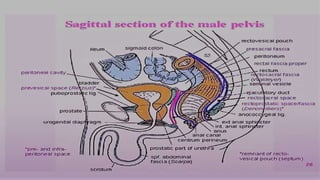
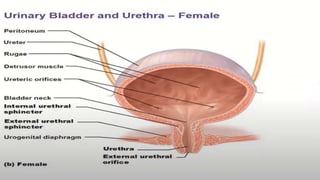
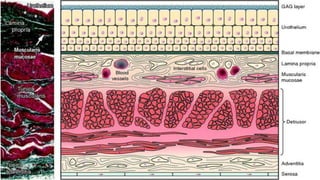
• In adults,bladder is located in the anterior pelvis and
envelop by the connective tissue and extra peritoneal
fat.
• It is separated from pubic symphysis by anterior
prevesical space called space of retzius.
• The dome is covered by peritonium.
• The neck of bladder is held in position by
puboprostatic and pubovesical ligament.
Trauma
• Trauma is defined as physical injury or a wound to living tissue cause
by an extrinsic agent.
• 6th leading cause of death worldwide.
• 5 million deaths worldwide and diasability to millions more.
• Mangement of trauma based on ATLS guidlines.
Mechanism of injury
The bony pelvis protects the urinary bladder very
well. When the pelvis is fractured by blunt
trauma, fragments from the fracture site may
perforate the bladder. These perforations usually
result in extraperitoneal rupture. If the urine is
infected, extraperitoneal bladder perforations
may result in deep pelvic abscess and severe
pelvic inflammation.
When the bladder is filled to near capacity, a direct blow to
the lower abdomen may result in bladder disruption. This
type of disruption is ordinarily intraperitoneal. Since the
reflection of the pelvic peritoneum covers the dome of the
bladder, a linear laceration will allow urine to flow into the
abdominal cavity. If the diagnosis is not established
immediately and if the urine is sterile, no symptoms may
be noted for several days. If the urine is infected,
immediate peritonitis and acute abdomen will develop.
Risk factors
• Pre existing Neuropathic Diasease
• Prior urological procedure
• Malignancy
Clinical Presentation
• Associated with other non urological life threatening injuries.
• Patients may present with
1. Haematuria ..... Most common
2. Suprapubic pain or abdominal distension due to urinary ascites.
3. Inability to void or reduced urine output
4. Uremia and raised creatinine due to intraperitoneal absorption.
5. Entry or exit wound at lower abdomen, perineum or buttocks
in penetrating injuries.
Diagnosis
• History
• Examination
• Investigation
Diagnosis
Clinical indicators of Bladder trauma
1. Suprapubic pain or tenderness.
2. Abdominal distention or ileus.
3. Inability to void or low urine output.
4. Haematuria associated with pelvic fracture.
5. Enlarged scrotum with ecchymosis.
6. Free intraperitoneal fluid on USG or CT scan.
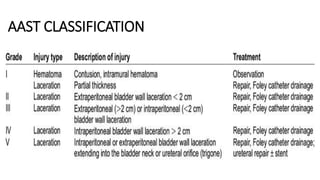
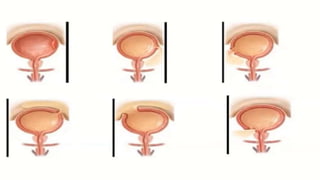
AAST CLASSIFICATION
Investigation
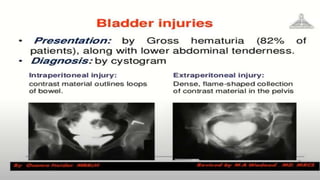
• Cystogram
• CT Cystogram
• Cystoscopy
• Ultrasound
Investigation
Cystography:
•Preferred modality for non iatrogenic and suspected IBT in post op
setting.
• Both plain and CT urography have comparable sensitivity ( 90-95%)
and specificity (100%).
• Absolute indication : gross haematuria associated with pelvic
fracture (29% of patients have bladder trauma)
Investigation
• Relative indications after blunt trauma are
gross haematuria without pelvic fracture and
microhaematuria with pelvic fracture.
• Penetrating injuries of the buttock, pelvis
or lower abdomen with any degree of
haematuria warrant cystography.
Investigations
• Retrograde cystography is nearly 100% accurate if performed
precisely.
• In cooperative and conscious patient bladder should be filled upto
sense of discomfort and otherwise upto 350 ml.
Investigations
• Plain film technique :
• Three images must be obtained
i. Control.
ii. Full bladder AP film.
iii. Drainage film. ( Posterior extravasation of
•contrast can be missed without this film)
CT Urogram :
• Superior in identification of bony fragments in
the bladder and bladder neck injuries as well as
concomitant abdomen injuries.
• Bladder must be filled in retrograde manner
with contrast material diluted upto 2-4% to avoid
scatter artifact.
•Cystoscopy :
• Preferred method for detection of
intraoperative injuries.
• Localize the lesion in relation to the position of
trigone and ureteral orifices.
• Lack of bladder distension suggest a large
perforation.
Ultrasonography:
• Alone is insufficient.
• Can be used to visualise intraperitoneal
fluid or extraperitoneal collection of fluid.
Conservative Managment:
• Clinical observation.
• Continuous bladder drainage.
• Antibiotic prophylaxis.
Conservative Managment
• Standard treatment of uncomplicated extraperitoneal and
intraperitoneal injury i-e in the absence of peritonitis and ileus.
• If lesion is larger intraperitoneal drain may be placed.
• In these situations ,when conditions are ideal, urethral catheter
management alone suffices.
• Large bore 22 Fr catheter should be used to promote
adequate drainage.
• Cystography is necessary to verify complete healing before
catheter removal 14 days after injury.
• In case of extravasation continue with bladder drainage until
radiograhic confirmation of healing.
• Antibiotics should be continued for 7 days to avoid infection.
Surgical Managment
INDICATIONS FOR IMMEDIATE REPAIR OF BLADDER INJURY
• Intraperitoneal injury from external trauma
• Penetrating or iatrogenic nonurologic injury
• Inadequate bladder drainage or clots in urine
• Bladder neck injury
• Rectal or vaginal injury
• Open pelvic fracture
• Pelvic fracture requiring open reduction and intemal! ixation ;
• Selected stable patients undergoing laparotomy tor reasons
• Bone fragments projecting into the bladder
Surgical Managment
• PENETRATING OR INTRAPERITONEAL INJURIES should
be managed by immediate operative repair.
• These injuries are often larger than suggested on
cystography and are unlikely to heal spotaneously.
• Prolonged leak of urine may cause chemical
peritonitis or abscess.
WHEN OPERATING WITHOUT PRIOR IMAGING :
•The ureteric orifices should be inspected for
clear efflux of urine.
• Ureteral integrity may be confirmed by
retrograde passage of ureteric catheter or IV
administration of methylene blue or indigo
carmine.
INJURIES INVOLVING URETERIC ORIFICES OR
INTRAMURAL URETERS:
•Warrants primary closure with stented
reimplantation of the ureter and a perivesical
drain.
• In repaired bladder cystogram can be obtained
after 7-10 days.
• Technique of bladder repair :
• Removal of devitalized tissue.
• Removal of intravesical clots.
• Repair of bladder in two layers:
• Running 3-0 vicryl suture for mucosa.
• Running 2-0 vicryl sutures for muscularis.
Unrecognized bladder injuries may manifest as
• Azotemia
•Acidosis
• Fever and sepsis
• Low urine output
• Peritonitis
• Ileus
• Urinary ascites
Complications
Follow up
• Conservatively treated bladder injuries are followed
up by cystograhy to rule out extravasation and ensure
bladder healing.
• 1st cystography is planned ten days after surgery.
• If ongoing leak, cystoscopy done to rule out bony
fragments in the bladder and then cystography 7 days
later
Bladder Trauma.pptx

Bladder Trauma.pptx

  • 1.
    Bladder Trauma Dr AbdulQayyum Khan PGR
  • 2.
    LEARNING OBJECTIVES • Introduction •Anatomy of bladder • Mechanism of injury • Types of trauma • Evaluation • Management • Complication • Follow up
  • 3.
    INTRODUCTION •Bladder injuries mayresult from blunt,Penetrating and Iatrogenic trauma. •Full bladder is more susceptible to injury than empty bladder. •Management varies from conservative to surgical aiming to directly repair the injury.
  • 4.
    Anatomy • In adults,bladderis located in the anterior pelvis and envelop by the connective tissue and extra peritoneal fat. • It is separated from pubic symphysis by anterior prevesical space called space of retzius. • The dome is covered by peritonium. • The neck of bladder is held in position by puboprostatic and pubovesical ligament.
  • 8.
    Trauma • Trauma isdefined as physical injury or a wound to living tissue cause by an extrinsic agent. • 6th leading cause of death worldwide. • 5 million deaths worldwide and diasability to millions more. • Mangement of trauma based on ATLS guidlines.
  • 9.
    Mechanism of injury Thebony pelvis protects the urinary bladder very well. When the pelvis is fractured by blunt trauma, fragments from the fracture site may perforate the bladder. These perforations usually result in extraperitoneal rupture. If the urine is infected, extraperitoneal bladder perforations may result in deep pelvic abscess and severe pelvic inflammation.
  • 10.
    When the bladderis filled to near capacity, a direct blow to the lower abdomen may result in bladder disruption. This type of disruption is ordinarily intraperitoneal. Since the reflection of the pelvic peritoneum covers the dome of the bladder, a linear laceration will allow urine to flow into the abdominal cavity. If the diagnosis is not established immediately and if the urine is sterile, no symptoms may be noted for several days. If the urine is infected, immediate peritonitis and acute abdomen will develop.
  • 11.
    Risk factors • Preexisting Neuropathic Diasease • Prior urological procedure • Malignancy
  • 12.
    Clinical Presentation • Associatedwith other non urological life threatening injuries. • Patients may present with 1. Haematuria ..... Most common 2. Suprapubic pain or abdominal distension due to urinary ascites. 3. Inability to void or reduced urine output 4. Uremia and raised creatinine due to intraperitoneal absorption. 5. Entry or exit wound at lower abdomen, perineum or buttocks in penetrating injuries.
  • 13.
  • 14.
    Diagnosis Clinical indicators ofBladder trauma 1. Suprapubic pain or tenderness. 2. Abdominal distention or ileus. 3. Inability to void or low urine output. 4. Haematuria associated with pelvic fracture. 5. Enlarged scrotum with ecchymosis. 6. Free intraperitoneal fluid on USG or CT scan.
  • 15.
  • 17.
    Investigation • Cystogram • CTCystogram • Cystoscopy • Ultrasound
  • 18.
    Investigation Cystography: •Preferred modality fornon iatrogenic and suspected IBT in post op setting. • Both plain and CT urography have comparable sensitivity ( 90-95%) and specificity (100%). • Absolute indication : gross haematuria associated with pelvic fracture (29% of patients have bladder trauma)
  • 19.
    Investigation • Relative indicationsafter blunt trauma are gross haematuria without pelvic fracture and microhaematuria with pelvic fracture. • Penetrating injuries of the buttock, pelvis or lower abdomen with any degree of haematuria warrant cystography.
  • 20.
    Investigations • Retrograde cystographyis nearly 100% accurate if performed precisely. • In cooperative and conscious patient bladder should be filled upto sense of discomfort and otherwise upto 350 ml.
  • 21.
    Investigations • Plain filmtechnique : • Three images must be obtained i. Control. ii. Full bladder AP film. iii. Drainage film. ( Posterior extravasation of •contrast can be missed without this film)
  • 23.
    CT Urogram : •Superior in identification of bony fragments in the bladder and bladder neck injuries as well as concomitant abdomen injuries. • Bladder must be filled in retrograde manner with contrast material diluted upto 2-4% to avoid scatter artifact.
  • 24.
    •Cystoscopy : • Preferredmethod for detection of intraoperative injuries. • Localize the lesion in relation to the position of trigone and ureteral orifices. • Lack of bladder distension suggest a large perforation.
  • 25.
    Ultrasonography: • Alone isinsufficient. • Can be used to visualise intraperitoneal fluid or extraperitoneal collection of fluid.
  • 26.
    Conservative Managment: • Clinicalobservation. • Continuous bladder drainage. • Antibiotic prophylaxis.
  • 27.
    Conservative Managment • Standardtreatment of uncomplicated extraperitoneal and intraperitoneal injury i-e in the absence of peritonitis and ileus. • If lesion is larger intraperitoneal drain may be placed. • In these situations ,when conditions are ideal, urethral catheter management alone suffices.
  • 28.
    • Large bore22 Fr catheter should be used to promote adequate drainage. • Cystography is necessary to verify complete healing before catheter removal 14 days after injury. • In case of extravasation continue with bladder drainage until radiograhic confirmation of healing. • Antibiotics should be continued for 7 days to avoid infection.
  • 29.
    Surgical Managment INDICATIONS FORIMMEDIATE REPAIR OF BLADDER INJURY • Intraperitoneal injury from external trauma • Penetrating or iatrogenic nonurologic injury • Inadequate bladder drainage or clots in urine • Bladder neck injury • Rectal or vaginal injury • Open pelvic fracture • Pelvic fracture requiring open reduction and intemal! ixation ; • Selected stable patients undergoing laparotomy tor reasons • Bone fragments projecting into the bladder
  • 30.
    Surgical Managment • PENETRATINGOR INTRAPERITONEAL INJURIES should be managed by immediate operative repair. • These injuries are often larger than suggested on cystography and are unlikely to heal spotaneously. • Prolonged leak of urine may cause chemical peritonitis or abscess.
  • 31.
    WHEN OPERATING WITHOUTPRIOR IMAGING : •The ureteric orifices should be inspected for clear efflux of urine. • Ureteral integrity may be confirmed by retrograde passage of ureteric catheter or IV administration of methylene blue or indigo carmine.
  • 32.
    INJURIES INVOLVING URETERICORIFICES OR INTRAMURAL URETERS: •Warrants primary closure with stented reimplantation of the ureter and a perivesical drain. • In repaired bladder cystogram can be obtained after 7-10 days.
  • 33.
    • Technique ofbladder repair : • Removal of devitalized tissue. • Removal of intravesical clots. • Repair of bladder in two layers: • Running 3-0 vicryl suture for mucosa. • Running 2-0 vicryl sutures for muscularis.
  • 34.
    Unrecognized bladder injuriesmay manifest as • Azotemia •Acidosis • Fever and sepsis • Low urine output • Peritonitis • Ileus • Urinary ascites Complications
  • 35.
    Follow up • Conservativelytreated bladder injuries are followed up by cystograhy to rule out extravasation and ensure bladder healing. • 1st cystography is planned ten days after surgery. • If ongoing leak, cystoscopy done to rule out bony fragments in the bladder and then cystography 7 days later