






















Tips on using my ppt.
1. You can freely download, edit, modify and put your
name etc.
2. Don’t be concerned about number of slides. Half the
slides are blanks except for the title.
3. First show the blank slides (eg. Aetiology ) > Ask
students what they already know about ethology of
today's topic. > Then show next slide which enumerates
aetiologies.
4. At the end rerun the show – show blank> ask questions >
show next slide.
5. This will be an ACTIVE LEARNING SESSION x
three revisions.
6. Good for self study also.
7. See notes for bibliography.
Format
Format
1. Introduction & History
2. Relevant Anatomy, Physiology
3. Aetiology
4. Pathophysiology
5. Pathology
6. Classification
7. Clinical Features
8. Investigations
9. Management
10.Prevention
Introduction & History.
• Bladder injuries can result from blunt,
penetrating, or iatrogenic trauma.
• The probability of bladder injury varies
according to the degree of bladder
distention; a full bladder is more susceptible
to injury than is an empty one.
• Management varies from conservative
approaches that center on maximizing
bladder drainage to major surgical
procedures aimed at directly repairing the
injury.
Relevant Anatomy
Relevant Anatomy
• In adults, the bladder is located in the
anterior pelvis and is enveloped by
extraperitoneal fat and connective tissue.
• It is separated from the pubic symphysis by
an anterior prevesical space known as the
space of Retzius.
• The dome of the bladder is covered by
peritoneum
• bladder neck is fixed to neighboring
structures by reflections of the pelvic fascia
as well as by true ligaments of the pelvis.
Relevant Anatomy
• The body of the bladder receives support from the
urogenital diaphragm inferiorly and the obturator
internus muscles laterally.
• The superior fascia of the urogenital diaphragm is
continuous and includes the pelvic, obturator, and
endopelvic fasciae.
• The inferior fascia of the urogenital diaphragm
fuses with Colle's fascia and continues as Scarpa's
fascia anteriorly.
• The dartos muscle and fascia in the scrotum as
well as the fascia lata of the thigh are further
continuations of this layer.
Aetiology
Aetiology
• Idiopathic
• Congenital/ Genetic
• Nutritional Deficiency/excess
• Traumatic
• Infections /Infestation
• Autoimmune
• Neoplastic (Benign/Malignant)
• Degenerative
• Iatrogenic
• Psychosomatic
Aetiology
• Blunt- RTA, Blows, Kicks
• Penetrating- gunshot and stabbing
• Iatrogenic
• Idiopathic Bladder Trauma
Aetiology
• Traumatic extraperitoneal rupture is
usually (89%-100%) associated with pelvic
fracture.
• Intraperitoneal bladder rupture generally
occurs as the result of a direct blow to a
distended urinary bladder.
• Deceleration injuries can also cause such
phenomena.
• it is more common in children due to the
relative intraabdominal bladder position that
persists until approximately 20 years of age.
Aetiology:Iatrogenic
Obstetric Trauma-
• During prolonged labor or a difficult
forceps delivery, persistent pressure from
the fetal head against the mother's pubis can
lead to bladder necrosis.
• cesarean delivery.
• Vaginal or abdominal hysterectomy
Aetiology:Iatrogenic
Urologic Trauma:
• bladder biopsy,
• cystolitholapaxy,
• transurethral resection of the
prostate(TURP),
• or transurethral resection of bladder tumor
(TURBT)
Aetiology:Iatrogenic
Orthopedic Trauma:
• internal fixation of pelvic fractures.
• thermal injuries to the bladder may occur
during the setting of cement substances
used to seat arthroplasty prosthetics.
Aetiology: Idiopathic
Idiopathic Bladder Trauma-
• combination of bladder overdistention and
minor external trauma,
Pathophysiology
Pathophysiology
• If the perforation is above the peritoneal
reflection, on the dome of the bladder, the
extravasation is intraperitoneal
• If the injury is below the peritoneal
reflection, and not on the dome of the
bladder, the extravasation is extraperitoneal
Pathophysiology
• With an anterosuperior perforation, urinary
extravasation may be intraperitoneal,
extraperitoneal (space of Retzius), or both.
• If the tear is posterosuperior, fluid can spread
intraperitoneally and retroperitoneally, as well.
• With bladder rupture, the superior fascia of the
urogenital diaphragm, when intact, prohibits
extravasated urine from escaping the pelvis, while
the inferior fascia of the urogenital diaphragm,
when intact, prevents urinary extravasate from
flowing into the perineum.
Pathology
Pathology
• Bladder contusion is an incomplete or
partial-thickness tear of the bladder.
• Bladder contusion is relatively benign. It is
self-limiting and requires no specific
therapy,
• results from blunt trama or extreme physical
activity
Classification
Classification
• Intraperitoneal Ruptures
• Extraperitoneal Ruptures
• Combination of Intraperitoneal and
Extraperitoneal.
Clinical Features
Clinical Features
• Demography
• Symptoms
• Hiistory
• Signs
• Prognosis
• Complications
Demography
Demography
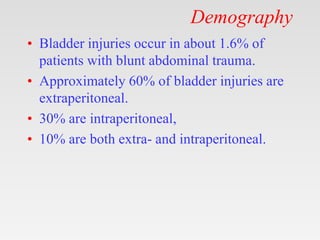
• Bladder injuries occur in about 1.6% of
patients with blunt abdominal trauma.
• Approximately 60% of bladder injuries are
extraperitoneal.
• 30% are intraperitoneal,
• 10% are both extra- and intraperitoneal.
Demography
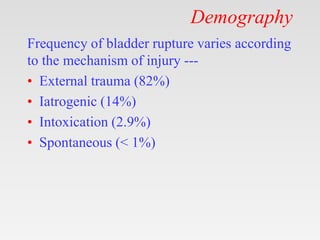
Frequency of bladder rupture varies according
to the mechanism of injury ---
• External trauma (82%)
• Iatrogenic (14%)
• Intoxication (2.9%)
• Spontaneous (< 1%)
Demography
• Approximately 60%-85% of bladder
injuries result from blunt trauma
• 15%-40% are from penetrating injury.
• Approximately 10%-25% of patients with
pelvic fracture also have urethral trauma.
• 10%-29% of patients with posterior urethral
disruption have an associated bladder
rupture.
History
• RTA
• Fall
• kick or blow
• gunshots or sharp stab wounds to the
suprapubic area.
• Surgery
Symptoms
•
Symptoms
• Since urine will generally continue to drain
into the abdomen through the open bladder
wall defect, intraperitoneal ruptures may
go undiagnosed for variable lengths of time.
Metabolic and electrolyte abnormalities
(eg, hyperkalemia, hypernatremia, uremia,
acidosis) may occur as urine is reabsorbed
through the peritoneal cavity.
• Additionally, such patients may appear
anuric.
•
Symptoms
• However, it is often not the suspected
bladder injury alone that drives the
consideration for operative intervention. As
a result, the diagnosis of such injuries is
commonly made during exploratory
laparotomy.
Signs
Signs
• An abdominal examination distention,
guarding, or rebound tenderness.
• Absent bowel sounds
• A rectal examination should be performed
to exclude rectal injury, and in males, to
evaluate prostate location.
• If the prostate is "high riding" or elevated,
proximal urethral disruption should be
suspected
Signs
• bilateral palpation of the bony pelvis may
reveal abnormal laxity or mobility,
• If blood is present at the urethral meatus,
suspect a urethral injury. Perform retrograde
urethrography to assess the integrity of the
urethra. It is crucial that urethral integrity be
confirmed before attempting to blindly pass
a urethral catheter.
Prognosis
Prognosis
• Although historically, bladder trauma was
uniformly fatal, timely diagnosis and
appropriate management now provide
excellent outcomes.
• In general, the bladder heals well and most
patients recover normal bladder function.
• Early clinical suspicion, coupled with
appropriate and reliable radiologic studies,
facilitate prompt intervention and successful
management.
Complications
Complications
• urinary incontinence
• VVF
• Persistent or recurrent urinary extravasation
• Wound dehiscence
• Hemorrhage
• Pelvic abscess
• Intraabdominal infection
• Urinary tract infection
• Low bladder capacity
• Urinary urgency
Investigations
• Laboratory Studies
– Routine
– Special
• Imaging Studies
• Tissue diagnosis
– Cytology
• FNAC
– Histology
Investigations
Investigations
• Laboratory Studies
– In the subacute setting, the serum creatinine
level can aid in the diagnosis of bladder
rupture. In the absence of acute kidney injury
and urinary tract obstruction, elevated serum
creatinine can be indicative of a urinary tract
leak with systemic reabsorption of the excreted
creatinine.
Diagnostic Studies
Diagnostic Studies
Imaging Studies
• X-Ray – Cystograpy.
• USG
• CT-- CT cystography
• Angiography
• MRI
• Endoscopy
• Nuclear scan
Diagnostic Studies Cystograpy.
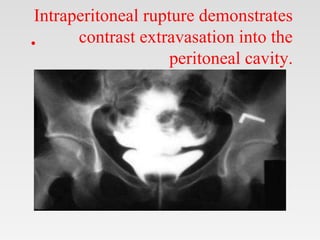
• The classic cystographic finding is contrast
extravasation around the base of the
bladder, confined to the perivesical space.
• With a more complex injury, contrast
material can extend to the thigh, penis,
perineum, or into the anterior abdominal
wall.
• Extravasation will reach the scrotum when
the superior fascia of the urogenital
diaphragm, or the urogenital diaphragm
itself, becomes disrupted.
Intraperitoneal rupture demonstrates
contrast extravasation into the
peritoneal cavity.
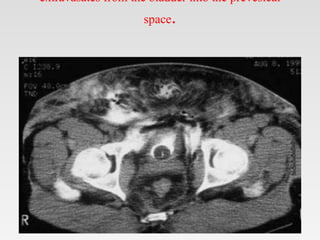
•
extravasates from the bladder into the prevesical
space.
Differential Diagnosis
• Combination of Intraperitoneal and
Extraperitoneal Ruptures-
Diagnostic imaging with cystogram will
reveal contrast outlining the abdominal
viscera and perivesical space.
Management
Management
• Most extraperitoneal bladder leaks can be
effectively managed with maximal bladder
drainage per urethral or suprapubic catheter.
• 10 to 14 days
• However, if surgery is pursued for other
indications, extraperitoneal bladder injuries may
be repaired surgically in the same setting if the
patient is stable.
• Essentially every intraperitoneal bladder rupture
requires surgical management.
• All gunshot wounds to the abdominopelvic region
should be surgically explored,
Operative Therapy
Operative Therapy
• Closure of bladder defects is usually performed in
a two-layer fashion.
• a running suture is placed to obtain a water-tight
closure.
• Only absorbable suture should be used on the
bladder, as permanent sutures serve as a nidus for
later stone formation and infection.
• Similar to nonoperative management of bladder
leaks, an indwelling catheter is left for at least 10
to 14 days to facilitate healing of the defect. A
cystogram is done prior to catheter removal.
Guidelines
• Guidelines for the treatment of bladder
trauma have been released by the following
organizations:
• American Urological Association (AUA)
• European Association of Urology (EAU)
Guidelines
• Retrograde cystography (plain film or CT)
should be performed in stable patients with
gross hematuria and pelvic fracture
• Uncomplicated extraperitoneal bladder
injuries should be treated by catheter
drainage
• Complicated extraperitoneal bladder injury
should be treated by surgical repair
• Intraperitoneal bladder rupture in the setting
of blunt or penetrating external trauma must
be treated by surgical repair
Get this ppt in mobile
1. Download Microsoft
PowerPoint from play
store.
2. Open Google assistant
3. Open Google lens.
4. Scan qr code from
next slide.
Get my ppt collection
• https://www.slideshare.net/drpradeeppande/
edit_my_uploads
• https://www.dropbox.com/sh/x600md3cvj8
5woy/AACVMHuQtvHvl_K8ehc3ltkEa?dl
=0
• https://www.facebook.com/doctorpradeeppa
nde/?ref=pages_you_manage

Urinary bladder trauma.pptx

  • 1.
    Tips on usingmy ppt. 1. You can freely download, edit, modify and put your name etc. 2. Don’t be concerned about number of slides. Half the slides are blanks except for the title. 3. First show the blank slides (eg. Aetiology ) > Ask students what they already know about ethology of today's topic. > Then show next slide which enumerates aetiologies. 4. At the end rerun the show – show blank> ask questions > show next slide. 5. This will be an ACTIVE LEARNING SESSION x three revisions. 6. Good for self study also. 7. See notes for bibliography.
  • 2.
  • 3.
    Format 1. Introduction &History 2. Relevant Anatomy, Physiology 3. Aetiology 4. Pathophysiology 5. Pathology 6. Classification 7. Clinical Features 8. Investigations 9. Management 10.Prevention
  • 4.
  • 5.
    Introduction & History. •Bladder injuries can result from blunt, penetrating, or iatrogenic trauma. • The probability of bladder injury varies according to the degree of bladder distention; a full bladder is more susceptible to injury than is an empty one. • Management varies from conservative approaches that center on maximizing bladder drainage to major surgical procedures aimed at directly repairing the injury.
  • 6.
  • 7.
    Relevant Anatomy • Inadults, the bladder is located in the anterior pelvis and is enveloped by extraperitoneal fat and connective tissue. • It is separated from the pubic symphysis by an anterior prevesical space known as the space of Retzius. • The dome of the bladder is covered by peritoneum • bladder neck is fixed to neighboring structures by reflections of the pelvic fascia as well as by true ligaments of the pelvis.
  • 8.
    Relevant Anatomy • Thebody of the bladder receives support from the urogenital diaphragm inferiorly and the obturator internus muscles laterally. • The superior fascia of the urogenital diaphragm is continuous and includes the pelvic, obturator, and endopelvic fasciae. • The inferior fascia of the urogenital diaphragm fuses with Colle's fascia and continues as Scarpa's fascia anteriorly. • The dartos muscle and fascia in the scrotum as well as the fascia lata of the thigh are further continuations of this layer.
  • 9.
  • 10.
    Aetiology • Idiopathic • Congenital/Genetic • Nutritional Deficiency/excess • Traumatic • Infections /Infestation • Autoimmune • Neoplastic (Benign/Malignant) • Degenerative • Iatrogenic • Psychosomatic
  • 11.
    Aetiology • Blunt- RTA,Blows, Kicks • Penetrating- gunshot and stabbing • Iatrogenic • Idiopathic Bladder Trauma
  • 12.
    Aetiology • Traumatic extraperitonealrupture is usually (89%-100%) associated with pelvic fracture. • Intraperitoneal bladder rupture generally occurs as the result of a direct blow to a distended urinary bladder. • Deceleration injuries can also cause such phenomena. • it is more common in children due to the relative intraabdominal bladder position that persists until approximately 20 years of age.
  • 13.
    Aetiology:Iatrogenic Obstetric Trauma- • Duringprolonged labor or a difficult forceps delivery, persistent pressure from the fetal head against the mother's pubis can lead to bladder necrosis. • cesarean delivery. • Vaginal or abdominal hysterectomy
  • 14.
    Aetiology:Iatrogenic Urologic Trauma: • bladderbiopsy, • cystolitholapaxy, • transurethral resection of the prostate(TURP), • or transurethral resection of bladder tumor (TURBT)
  • 15.
    Aetiology:Iatrogenic Orthopedic Trauma: • internalfixation of pelvic fractures. • thermal injuries to the bladder may occur during the setting of cement substances used to seat arthroplasty prosthetics.
  • 16.
    Aetiology: Idiopathic Idiopathic BladderTrauma- • combination of bladder overdistention and minor external trauma,
  • 17.
  • 18.
    Pathophysiology • If theperforation is above the peritoneal reflection, on the dome of the bladder, the extravasation is intraperitoneal • If the injury is below the peritoneal reflection, and not on the dome of the bladder, the extravasation is extraperitoneal
  • 19.
    Pathophysiology • With ananterosuperior perforation, urinary extravasation may be intraperitoneal, extraperitoneal (space of Retzius), or both. • If the tear is posterosuperior, fluid can spread intraperitoneally and retroperitoneally, as well. • With bladder rupture, the superior fascia of the urogenital diaphragm, when intact, prohibits extravasated urine from escaping the pelvis, while the inferior fascia of the urogenital diaphragm, when intact, prevents urinary extravasate from flowing into the perineum.
  • 20.
  • 21.
    Pathology • Bladder contusionis an incomplete or partial-thickness tear of the bladder. • Bladder contusion is relatively benign. It is self-limiting and requires no specific therapy, • results from blunt trama or extreme physical activity
  • 22.
  • 23.
    Classification • Intraperitoneal Ruptures •Extraperitoneal Ruptures • Combination of Intraperitoneal and Extraperitoneal.
  • 24.
  • 25.
    Clinical Features • Demography •Symptoms • Hiistory • Signs • Prognosis • Complications
  • 26.
  • 27.
    Demography • Bladder injuriesoccur in about 1.6% of patients with blunt abdominal trauma. • Approximately 60% of bladder injuries are extraperitoneal. • 30% are intraperitoneal, • 10% are both extra- and intraperitoneal.
  • 28.
    Demography Frequency of bladderrupture varies according to the mechanism of injury --- • External trauma (82%) • Iatrogenic (14%) • Intoxication (2.9%) • Spontaneous (< 1%)
  • 29.
    Demography • Approximately 60%-85%of bladder injuries result from blunt trauma • 15%-40% are from penetrating injury. • Approximately 10%-25% of patients with pelvic fracture also have urethral trauma. • 10%-29% of patients with posterior urethral disruption have an associated bladder rupture.
  • 30.
    History • RTA • Fall •kick or blow • gunshots or sharp stab wounds to the suprapubic area. • Surgery
  • 31.
  • 32.
    Symptoms • Since urinewill generally continue to drain into the abdomen through the open bladder wall defect, intraperitoneal ruptures may go undiagnosed for variable lengths of time. Metabolic and electrolyte abnormalities (eg, hyperkalemia, hypernatremia, uremia, acidosis) may occur as urine is reabsorbed through the peritoneal cavity. • Additionally, such patients may appear anuric. •
  • 33.
    Symptoms • However, itis often not the suspected bladder injury alone that drives the consideration for operative intervention. As a result, the diagnosis of such injuries is commonly made during exploratory laparotomy.
  • 34.
  • 35.
    Signs • An abdominalexamination distention, guarding, or rebound tenderness. • Absent bowel sounds • A rectal examination should be performed to exclude rectal injury, and in males, to evaluate prostate location. • If the prostate is "high riding" or elevated, proximal urethral disruption should be suspected
  • 36.
    Signs • bilateral palpationof the bony pelvis may reveal abnormal laxity or mobility, • If blood is present at the urethral meatus, suspect a urethral injury. Perform retrograde urethrography to assess the integrity of the urethra. It is crucial that urethral integrity be confirmed before attempting to blindly pass a urethral catheter.
  • 37.
  • 38.
    Prognosis • Although historically,bladder trauma was uniformly fatal, timely diagnosis and appropriate management now provide excellent outcomes. • In general, the bladder heals well and most patients recover normal bladder function. • Early clinical suspicion, coupled with appropriate and reliable radiologic studies, facilitate prompt intervention and successful management.
  • 39.
  • 40.
    Complications • urinary incontinence •VVF • Persistent or recurrent urinary extravasation • Wound dehiscence • Hemorrhage • Pelvic abscess • Intraabdominal infection • Urinary tract infection • Low bladder capacity • Urinary urgency
  • 41.
    Investigations • Laboratory Studies –Routine – Special • Imaging Studies • Tissue diagnosis – Cytology • FNAC – Histology
  • 42.
  • 43.
    Investigations • Laboratory Studies –In the subacute setting, the serum creatinine level can aid in the diagnosis of bladder rupture. In the absence of acute kidney injury and urinary tract obstruction, elevated serum creatinine can be indicative of a urinary tract leak with systemic reabsorption of the excreted creatinine.
  • 44.
  • 45.
    Diagnostic Studies Imaging Studies •X-Ray – Cystograpy. • USG • CT-- CT cystography • Angiography • MRI • Endoscopy • Nuclear scan
  • 46.
    Diagnostic Studies Cystograpy. •The classic cystographic finding is contrast extravasation around the base of the bladder, confined to the perivesical space. • With a more complex injury, contrast material can extend to the thigh, penis, perineum, or into the anterior abdominal wall. • Extravasation will reach the scrotum when the superior fascia of the urogenital diaphragm, or the urogenital diaphragm itself, becomes disrupted.
  • 47.
    Intraperitoneal rupture demonstrates contrastextravasation into the peritoneal cavity. •
  • 48.
    extravasates from thebladder into the prevesical space.
  • 49.
    Differential Diagnosis • Combinationof Intraperitoneal and Extraperitoneal Ruptures- Diagnostic imaging with cystogram will reveal contrast outlining the abdominal viscera and perivesical space.
  • 50.
  • 51.
    Management • Most extraperitonealbladder leaks can be effectively managed with maximal bladder drainage per urethral or suprapubic catheter. • 10 to 14 days • However, if surgery is pursued for other indications, extraperitoneal bladder injuries may be repaired surgically in the same setting if the patient is stable. • Essentially every intraperitoneal bladder rupture requires surgical management. • All gunshot wounds to the abdominopelvic region should be surgically explored,
  • 52.
  • 53.
    Operative Therapy • Closureof bladder defects is usually performed in a two-layer fashion. • a running suture is placed to obtain a water-tight closure. • Only absorbable suture should be used on the bladder, as permanent sutures serve as a nidus for later stone formation and infection. • Similar to nonoperative management of bladder leaks, an indwelling catheter is left for at least 10 to 14 days to facilitate healing of the defect. A cystogram is done prior to catheter removal.
  • 54.
    Guidelines • Guidelines forthe treatment of bladder trauma have been released by the following organizations: • American Urological Association (AUA) • European Association of Urology (EAU)
  • 55.
    Guidelines • Retrograde cystography(plain film or CT) should be performed in stable patients with gross hematuria and pelvic fracture • Uncomplicated extraperitoneal bladder injuries should be treated by catheter drainage • Complicated extraperitoneal bladder injury should be treated by surgical repair • Intraperitoneal bladder rupture in the setting of blunt or penetrating external trauma must be treated by surgical repair
  • 56.
    Get this pptin mobile 1. Download Microsoft PowerPoint from play store. 2. Open Google assistant 3. Open Google lens. 4. Scan qr code from next slide.
  • 59.
    Get my pptcollection • https://www.slideshare.net/drpradeeppande/ edit_my_uploads • https://www.dropbox.com/sh/x600md3cvj8 5woy/AACVMHuQtvHvl_K8ehc3ltkEa?dl =0 • https://www.facebook.com/doctorpradeeppa nde/?ref=pages_you_manage

Editor's Notes

  • #59 drpradeeppande@gmail.com 7697305442