Research Writing
Parts of a Research (Experimental design)
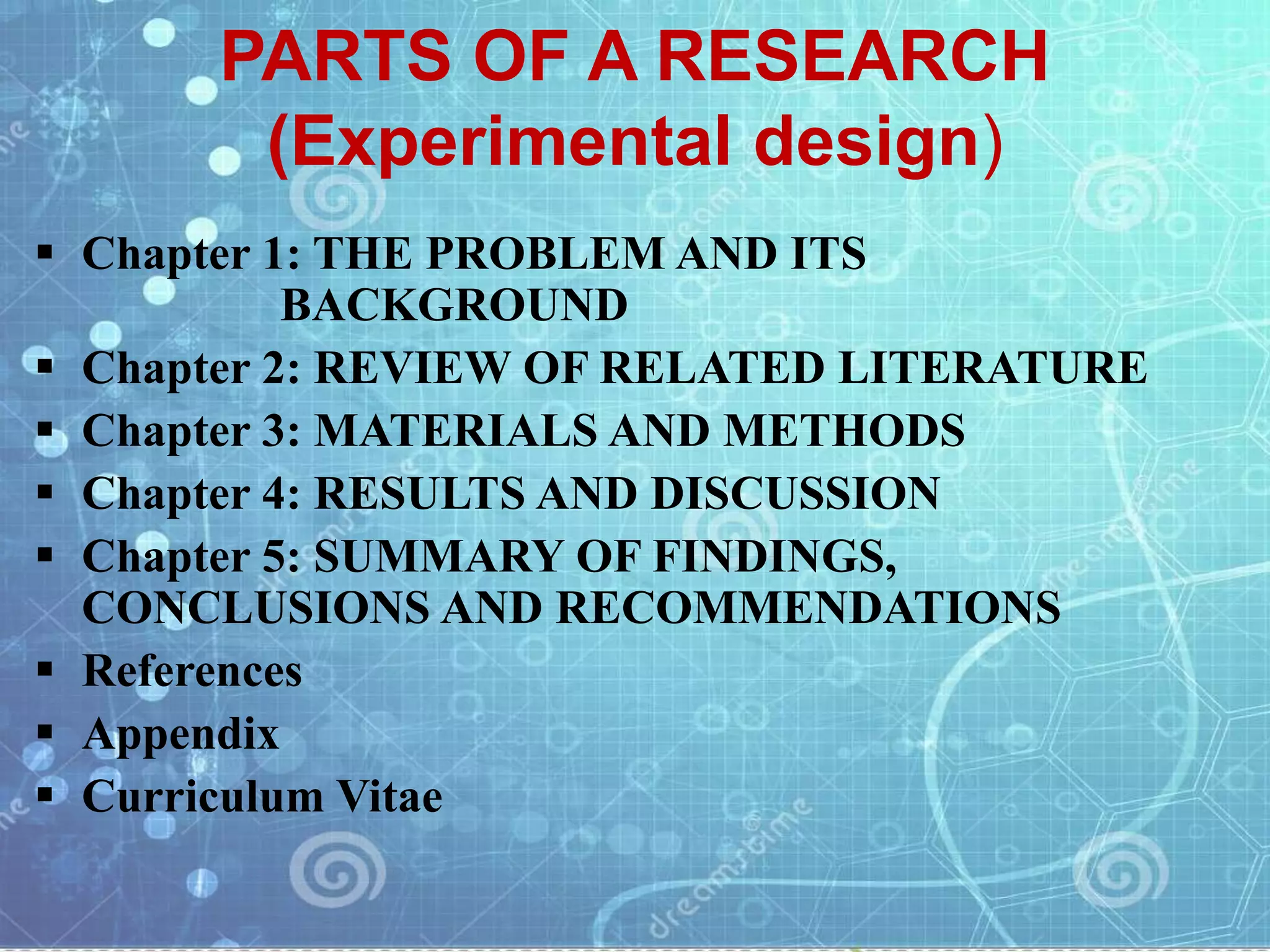
PARTS OF A RESEARCH
(Experimental design)
 Chapter 1: THE PROBLEM AND ITS
BACKGROUND
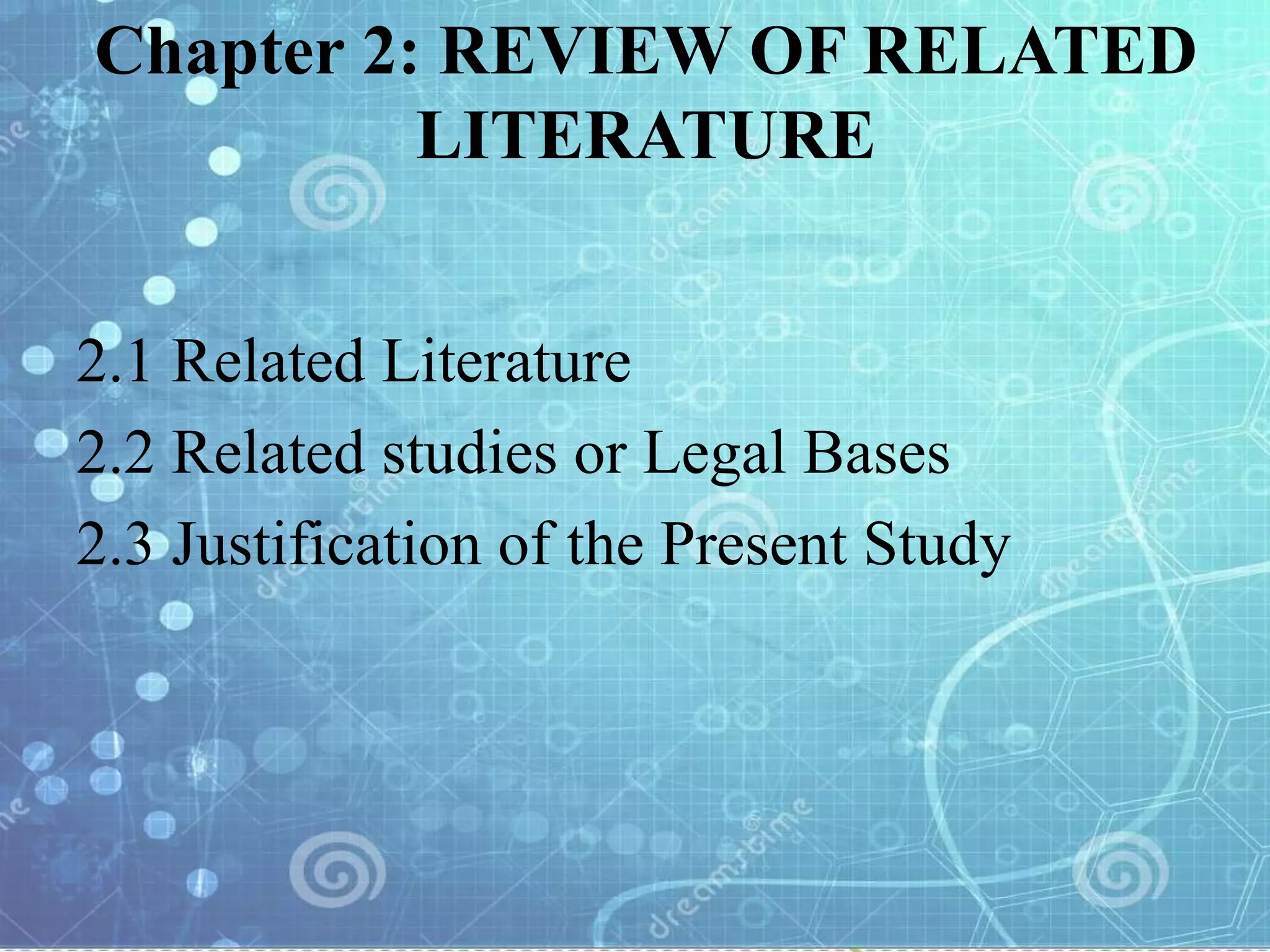
 Chapter 2: REVIEW OF RELATED LITERATURE
 Chapter 3: MATERIALS AND METHODS
 Chapter 4: RESULTS AND DISCUSSION
 Chapter 5: SUMMARY OF FINDINGS,
CONCLUSIONS AND RECOMMENDATIONS
 References
 Appendix
 Curriculum Vitae
Chapter 1: THE PROBLEM AND
ITS BACKGROUND
1.1 Background of the Study
1.2 Statement of the Problem
1.3 Hypotheses
1.4 Conceptual Framework
1.5 Significance of the Study
1.6 Scope and Delimitation
1.7 Definition of Terms
Chapter 2: REVIEW OF RELATED
LITERATURE
2.1 Related Literature
2.2 Related studies or Legal Bases
2.3 Justification of the Present Study
Chapter 3: MATERIALS AND
METHODS
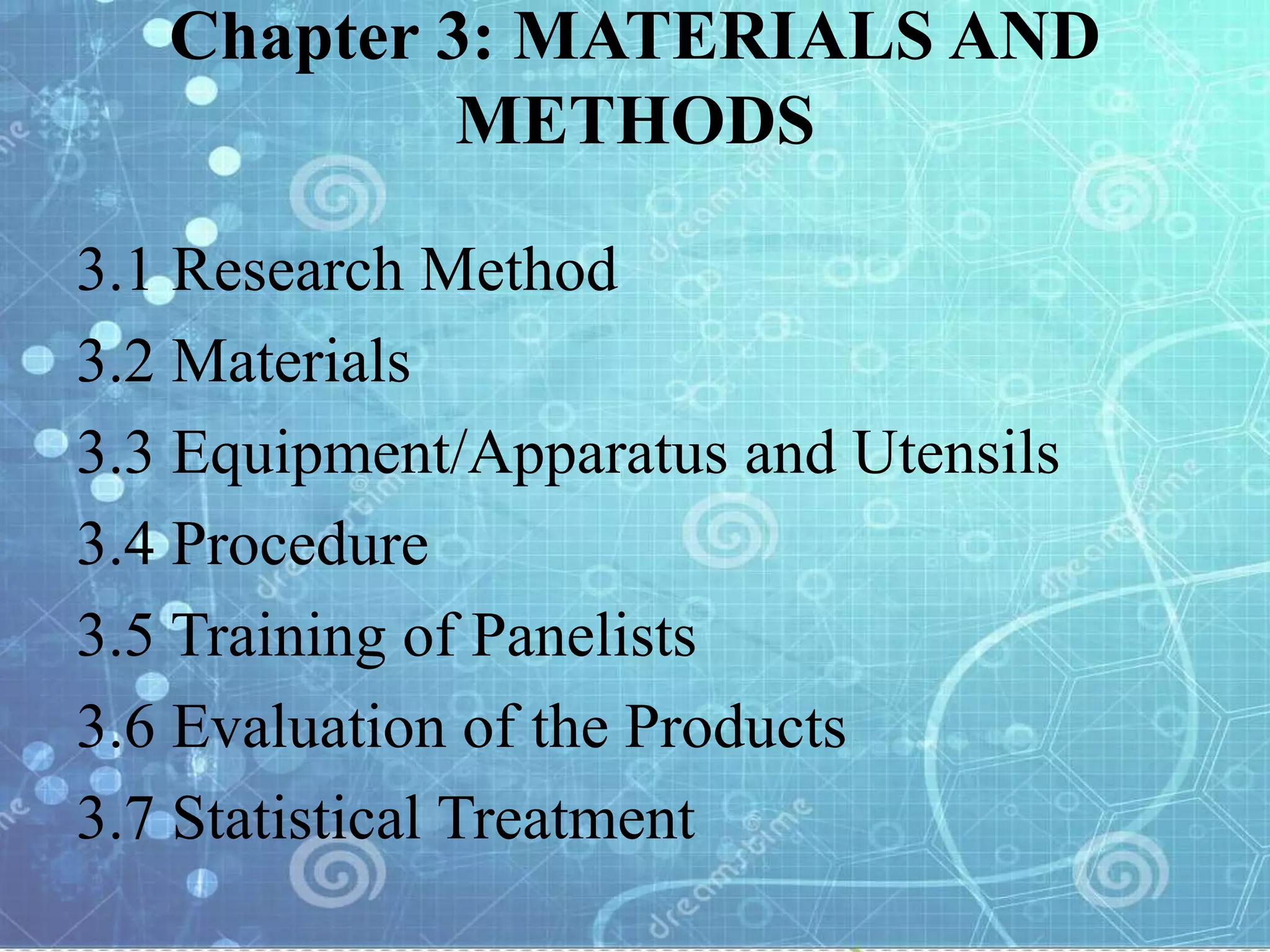
3.1 Research Method
3.2 Materials
3.3 Equipment/Apparatus and Utensils
3.4 Procedure
3.5 Training of Panelists
3.6 Evaluation of the Products
3.7 Statistical Treatment
Chapter 4: RESULTS AND
DISCUSSION
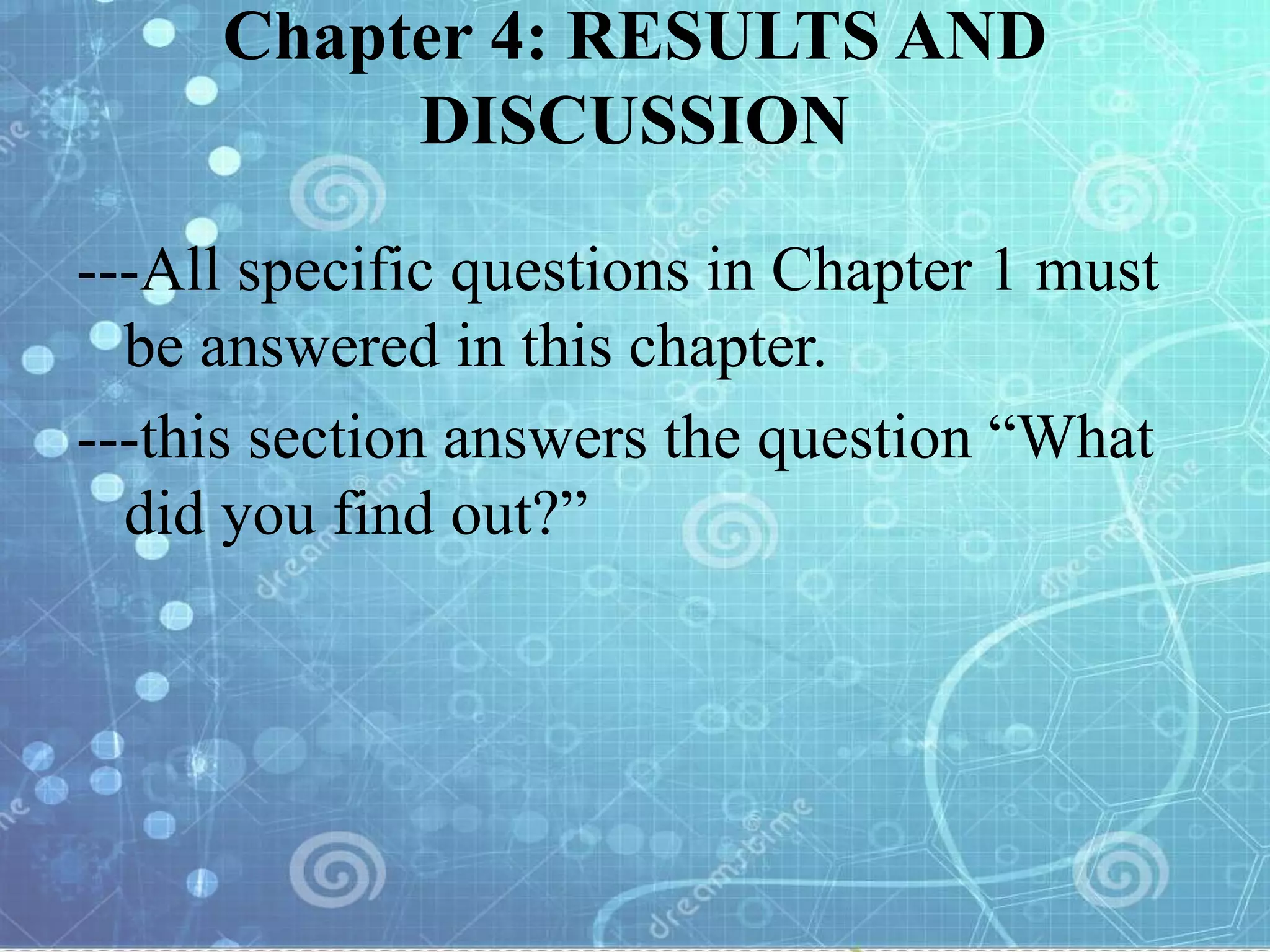
---All specific questions in Chapter 1 must
be answered in this chapter.
---this section answers the question “What
did you find out?”
Chapter 4: RESULTS AND
DISCUSSION
PRESENTATION OF DATA
1. Whenever possible, tabulate the data.
2. Report only relevant data
3. Summarize the results and analysis through tables,
graphs and/or diagrams
4.Avoid too many small tables of closely related data
which can be put together in one table for a more
comprehensive picture of the results
5. Avoid table with data that can be presented in a few
sentences in the text.
Chapter 4: RESULTS AND
DISCUSSION
Analysis of Data
1. Discuss each table, graph or diagram presented.
2. In discussing a table, do not simply repeat the data so
that the table will not be rendered useless.
3. Also include the following in the discussion:
a. all possible explanations and applications of the
findings.
b. literature that is pertinent to each findings.
c. Any defect in the methodology that may have
affected the research outcome.
d. other insights that may add meaning to the findings.
Chapter 4: RESULTS AND
DISCUSSION
Analysis of Data
4. Report all findings, including those that negate the
research hypotheses.
5. In reporting results of statistical tests, include the
degrees of freedom and level of significance
6. The report of findings should include statements as to
whether the hypotheses are rejected or not based on the
results of statistical tests.
7.In case the findings indicate a need to revise the original
conceptual framework, discuss this also in the report
8. It is not necessary to summarize the findings in the
chapter on results. It should be done in Chapter 5
Chapter 5: SUMMARY OF
FINDINGS,CONCLUSIONS AND
RECOMMENDATIONS
“What is the meaning of what you found out in your
study?”
SUMMARY
1. The findings are listed consecutively and
numbered for easy reference in the discussion of
the conclusions and recommendations which are
both based on specific findings.
2. The summary of the first three chapters is
written in the past tense, while summary of
findings is written in the present tense.
3. The summary does not contain any new
information.
Chapter 5: SUMMARY OF
FINDINGS,CONCLUSIONS AND
RECOMMENDATIONS
Conclusion
1.Based on specific findings.
2. Answer all the research questions
3. Any generalization which is not supported by
sufficient data is not acceptable
4. Written in the present tense
Chapter 5: SUMMARY OF
FINDINGS,CONCLUSIONS AND
RECOMMENDATIONS
Recommendation
1. Based on specific findings.
2. Two implications of research findings are:
a. implications for action and policies that
may be formulated.
B. implications for further research
References
Appendix
It consists only of the research
instruments.
Curriculum Vitae
I. Personal Data II. Educational Qualifications
Name Elementary Year Completed
Birthdate Secondary Year Completed
Birthplace III. Honors/Awards Received
Civil Status Honors
Parents Local/Regional
National
International
IV Scholarship/Grant Received
FORM AND STYLE IN
RESEARCH WRITING
• Title Page
• Approval Sheet
• Acknowledgment
• Table of Contents
• Tables
• Figures
• Abstract
TIMELINE
FEBRUARY 9-10 CHAPTER 3
FEBRUARY 16 CHAPTER 4 & 5
FEBRUARY 24 REVISED 3 CHAPTERS
with Forms
MARCH 2 OR 3 CHAPTER 1-5(Clear Folder)
MARCH 9(tentative) ORAL DEFENSE
FORMAT
PAPER: A4
FONT: Times New Roman
SIZE: 12
Line Spacing: 1.0

Research writing (Experimental Design)

  • 1.
    Research Writing Parts ofa Research (Experimental design)
  • 2.
    PARTS OF ARESEARCH (Experimental design)  Chapter 1: THE PROBLEM AND ITS BACKGROUND  Chapter 2: REVIEW OF RELATED LITERATURE  Chapter 3: MATERIALS AND METHODS  Chapter 4: RESULTS AND DISCUSSION  Chapter 5: SUMMARY OF FINDINGS, CONCLUSIONS AND RECOMMENDATIONS  References  Appendix  Curriculum Vitae
  • 3.
    Chapter 1: THEPROBLEM AND ITS BACKGROUND 1.1 Background of the Study 1.2 Statement of the Problem 1.3 Hypotheses 1.4 Conceptual Framework 1.5 Significance of the Study 1.6 Scope and Delimitation 1.7 Definition of Terms
  • 4.
    Chapter 2: REVIEWOF RELATED LITERATURE 2.1 Related Literature 2.2 Related studies or Legal Bases 2.3 Justification of the Present Study
  • 5.
    Chapter 3: MATERIALSAND METHODS 3.1 Research Method 3.2 Materials 3.3 Equipment/Apparatus and Utensils 3.4 Procedure 3.5 Training of Panelists 3.6 Evaluation of the Products 3.7 Statistical Treatment
  • 12.
    Chapter 4: RESULTSAND DISCUSSION ---All specific questions in Chapter 1 must be answered in this chapter. ---this section answers the question “What did you find out?”
  • 13.
    Chapter 4: RESULTSAND DISCUSSION PRESENTATION OF DATA 1. Whenever possible, tabulate the data. 2. Report only relevant data 3. Summarize the results and analysis through tables, graphs and/or diagrams 4.Avoid too many small tables of closely related data which can be put together in one table for a more comprehensive picture of the results 5. Avoid table with data that can be presented in a few sentences in the text.
  • 14.
    Chapter 4: RESULTSAND DISCUSSION Analysis of Data 1. Discuss each table, graph or diagram presented. 2. In discussing a table, do not simply repeat the data so that the table will not be rendered useless. 3. Also include the following in the discussion: a. all possible explanations and applications of the findings. b. literature that is pertinent to each findings. c. Any defect in the methodology that may have affected the research outcome. d. other insights that may add meaning to the findings.
  • 15.
    Chapter 4: RESULTSAND DISCUSSION Analysis of Data 4. Report all findings, including those that negate the research hypotheses. 5. In reporting results of statistical tests, include the degrees of freedom and level of significance 6. The report of findings should include statements as to whether the hypotheses are rejected or not based on the results of statistical tests. 7.In case the findings indicate a need to revise the original conceptual framework, discuss this also in the report 8. It is not necessary to summarize the findings in the chapter on results. It should be done in Chapter 5
  • 16.
    Chapter 5: SUMMARYOF FINDINGS,CONCLUSIONS AND RECOMMENDATIONS “What is the meaning of what you found out in your study?” SUMMARY 1. The findings are listed consecutively and numbered for easy reference in the discussion of the conclusions and recommendations which are both based on specific findings. 2. The summary of the first three chapters is written in the past tense, while summary of findings is written in the present tense. 3. The summary does not contain any new information.
  • 17.
    Chapter 5: SUMMARYOF FINDINGS,CONCLUSIONS AND RECOMMENDATIONS Conclusion 1.Based on specific findings. 2. Answer all the research questions 3. Any generalization which is not supported by sufficient data is not acceptable 4. Written in the present tense
  • 18.
    Chapter 5: SUMMARYOF FINDINGS,CONCLUSIONS AND RECOMMENDATIONS Recommendation 1. Based on specific findings. 2. Two implications of research findings are: a. implications for action and policies that may be formulated. B. implications for further research
  • 19.
  • 20.
    Appendix It consists onlyof the research instruments.
  • 21.
    Curriculum Vitae I. PersonalData II. Educational Qualifications Name Elementary Year Completed Birthdate Secondary Year Completed Birthplace III. Honors/Awards Received Civil Status Honors Parents Local/Regional National International IV Scholarship/Grant Received
  • 22.
    FORM AND STYLEIN RESEARCH WRITING • Title Page • Approval Sheet • Acknowledgment • Table of Contents • Tables • Figures • Abstract
  • 23.
    TIMELINE FEBRUARY 9-10 CHAPTER3 FEBRUARY 16 CHAPTER 4 & 5 FEBRUARY 24 REVISED 3 CHAPTERS with Forms MARCH 2 OR 3 CHAPTER 1-5(Clear Folder) MARCH 9(tentative) ORAL DEFENSE
  • 24.
    FORMAT PAPER: A4 FONT: TimesNew Roman SIZE: 12 Line Spacing: 1.0