Topic :- Superposition Theorem
Superposition Theorem
• The superposition theorem extends the use of Ohm’s Law to
circuits with multiple sources.
• Definition :- The current through, or voltage across, an
element in a linear bilateral network equal to the
algebraic sum of the currents or voltages produced
independently by each source.
• The Superposition theorem is very helpful in determining the
voltage across an element or current through a branch when
the circuit contains multiple number of voltage or current
sources.
Superposition Theorem
 In order to apply the superposition theorem to a network, certain
conditions must be met :
1. All the components must be linear, for e.g.- the current is
proportional to the applied voltage (for resistors), flux linkage is
proportional to current (in inductors), etc.
2. All the components must be bilateral, meaning that the current is the
same amount for opposite polarities of the source voltage.
3. Passive components may be used. These are components such as
resistors, capacitors, and inductors, that do not amplify or rectify.
4. Active components may not be used. Active components include
transistors, semiconductor diodes, and electron tubes. Such
components are never bilateral and seldom linear.
Procedure for applying Superposition Theorem
 Circuits Containing Only Independent Sources
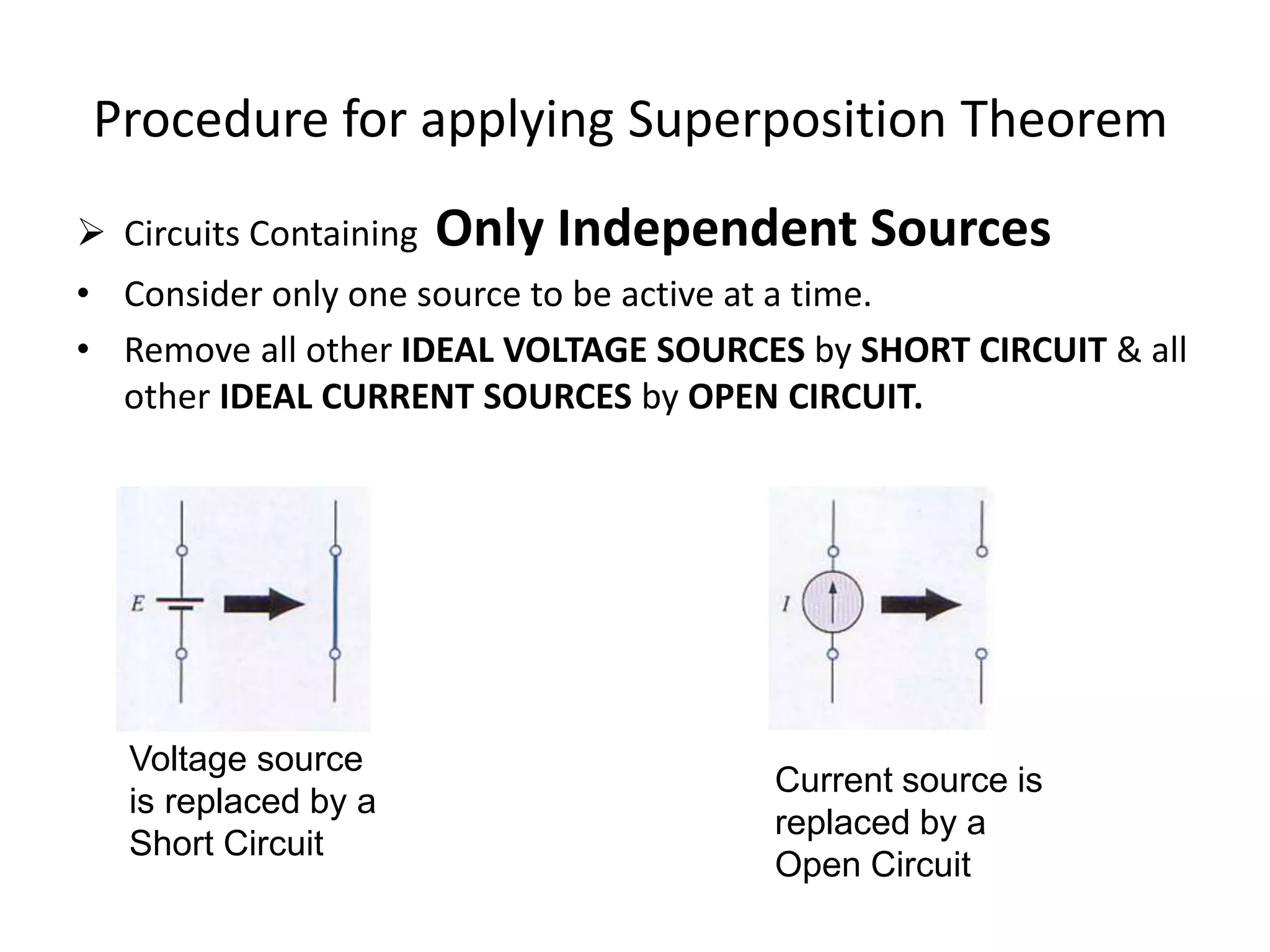
• Consider only one source to be active at a time.
• Remove all other IDEAL VOLTAGE SOURCES by SHORT CIRCUIT & all
other IDEAL CURRENT SOURCES by OPEN CIRCUIT.
Voltage source
is replaced by a
Short Circuit
Current source is
replaced by a
Open Circuit
Procedure for applying Superposition Theorem
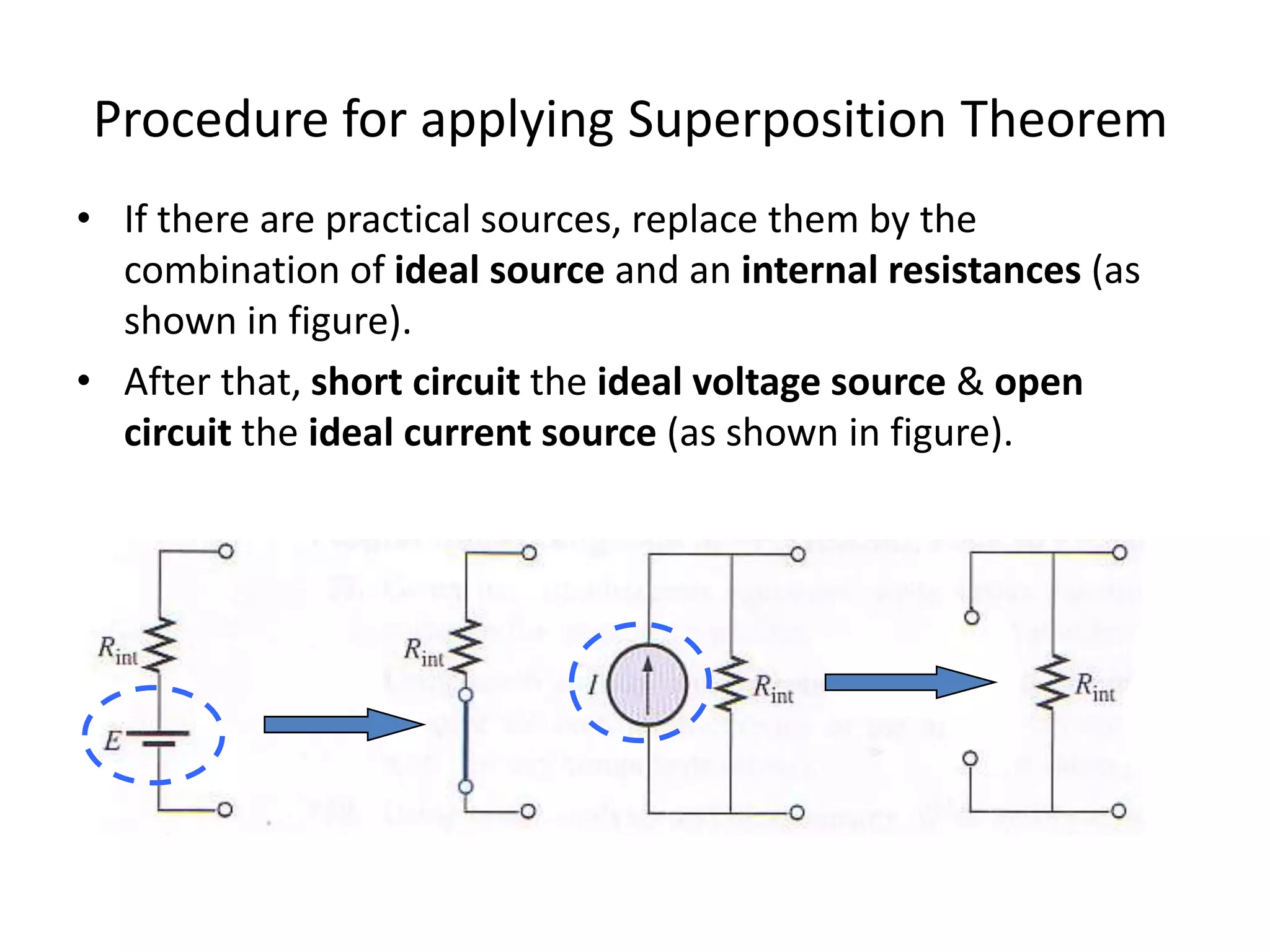
• If there are practical sources, replace them by the
combination of ideal source and an internal resistances (as
shown in figure).
• After that, short circuit the ideal voltage source & open
circuit the ideal current source (as shown in figure).
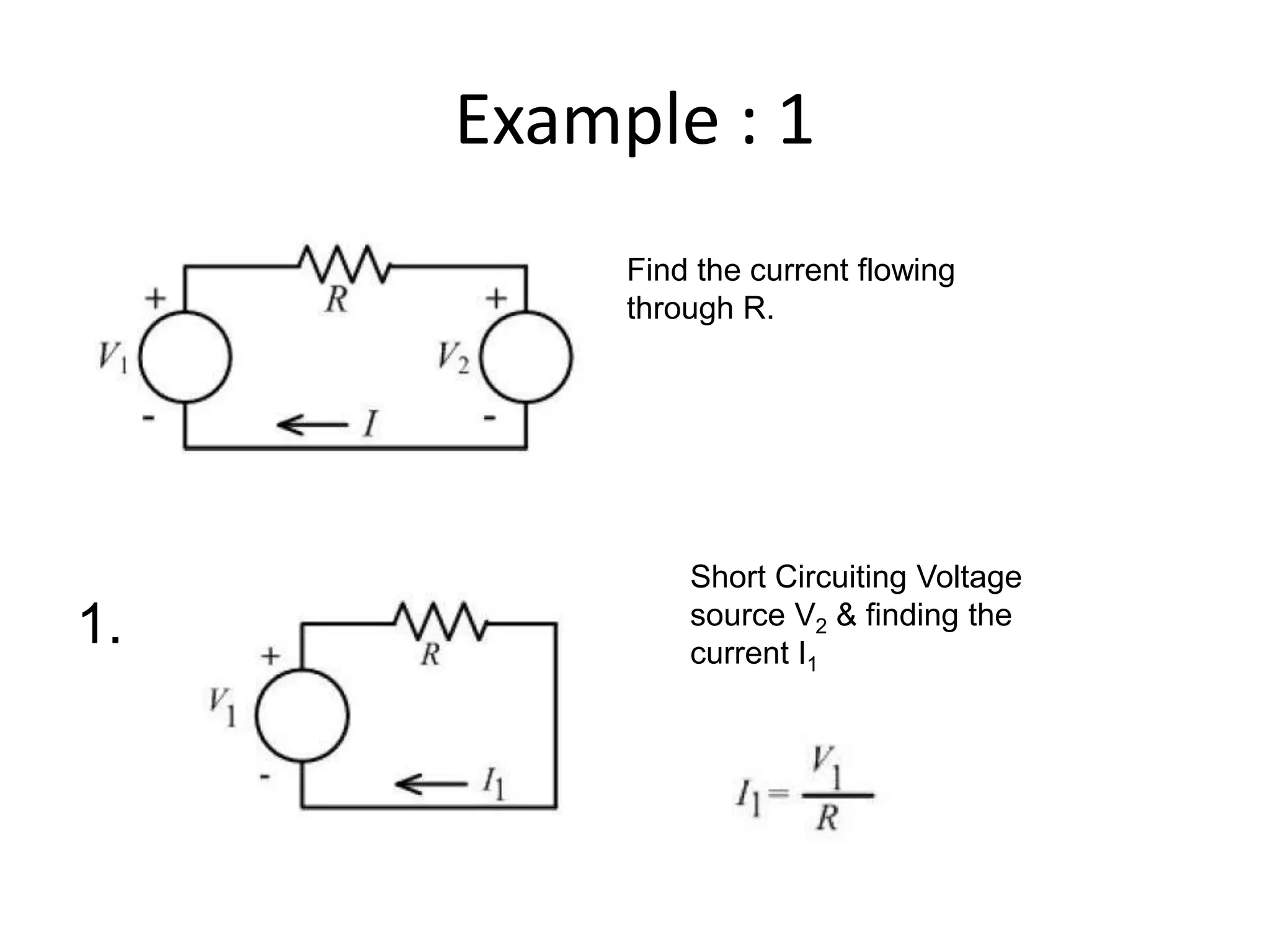
Example : 1
Find the current flowing
through R.
1.
Short Circuiting Voltage
source V2 & finding the
current I1
Example : 1
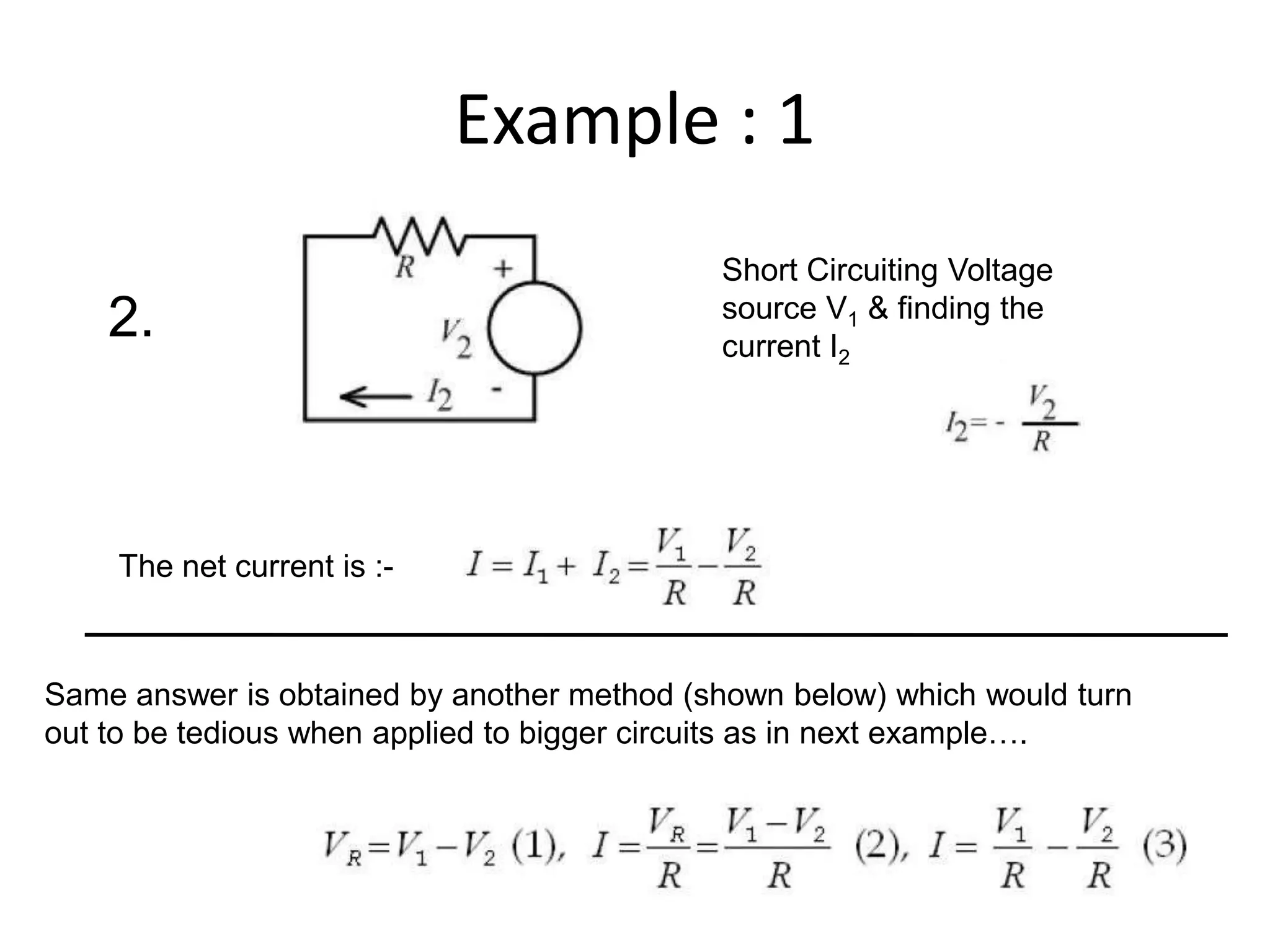
2.
Short Circuiting Voltage
source V1 & finding the
current I2
The net current is :-
Same answer is obtained by another method (shown below) which would turn
out to be tedious when applied to bigger circuits as in next example….
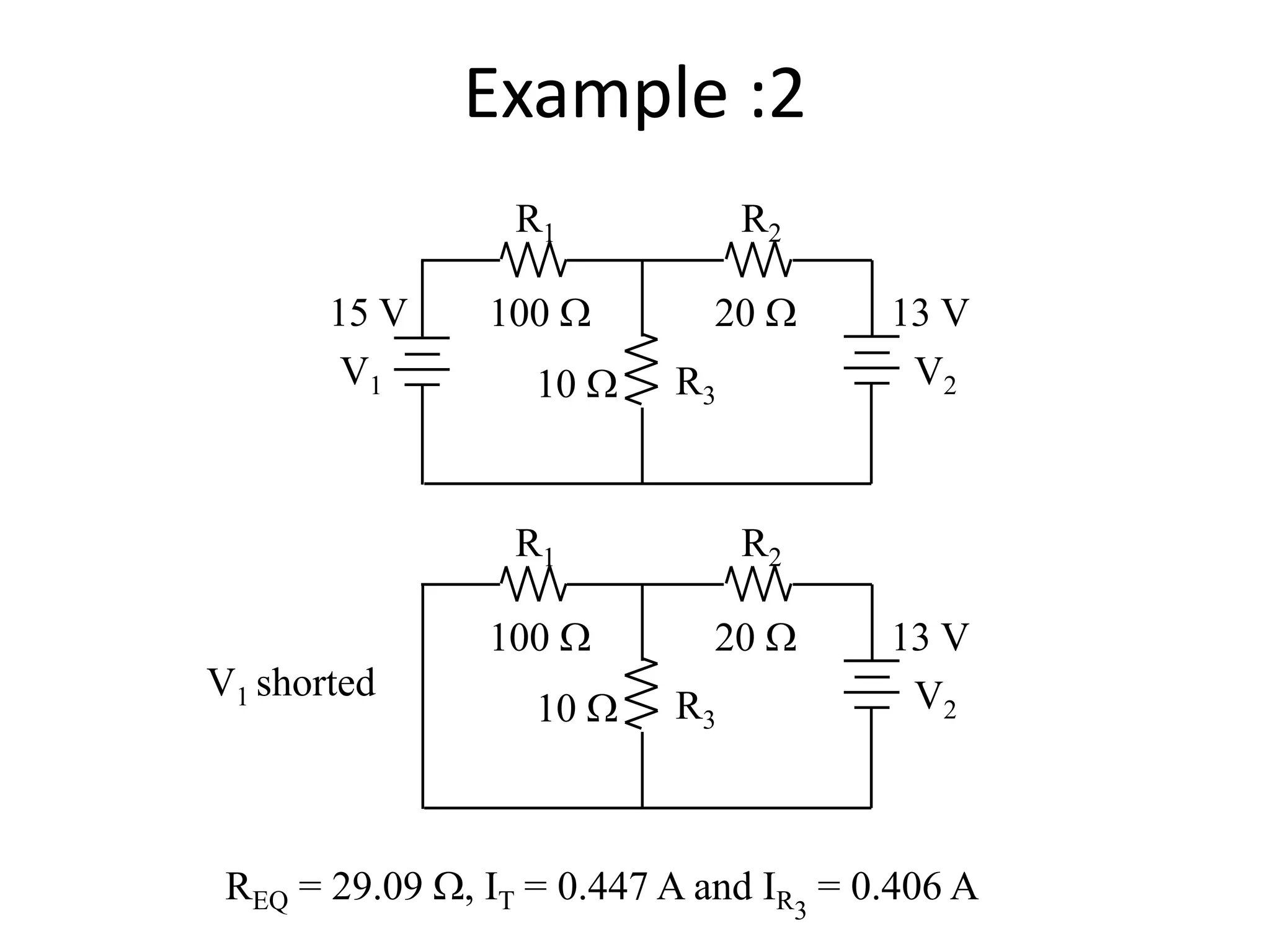
Example :2
R1
R2
R3
V1 V2
100 W 20 W
10 W
15 V 13 V
R1 R2
R3
V1
100 W 20 W
10 W
15 V
V2 shorted
REQ = 106.7 W, IT = 0.141 A and IR3
= 0.094 A
R1 R2
R3
V1 V2
100 W 20 W
10 W
15 V 13 V
REQ = 29.09 W, IT = 0.447 A and IR3
= 0.406 A
R1 R2
R3
V2
100 W 20 W
10 W
13 V
V1 shorted
Example :2
R1 R2
V1 V2
100 W 20 W15 V 13 V
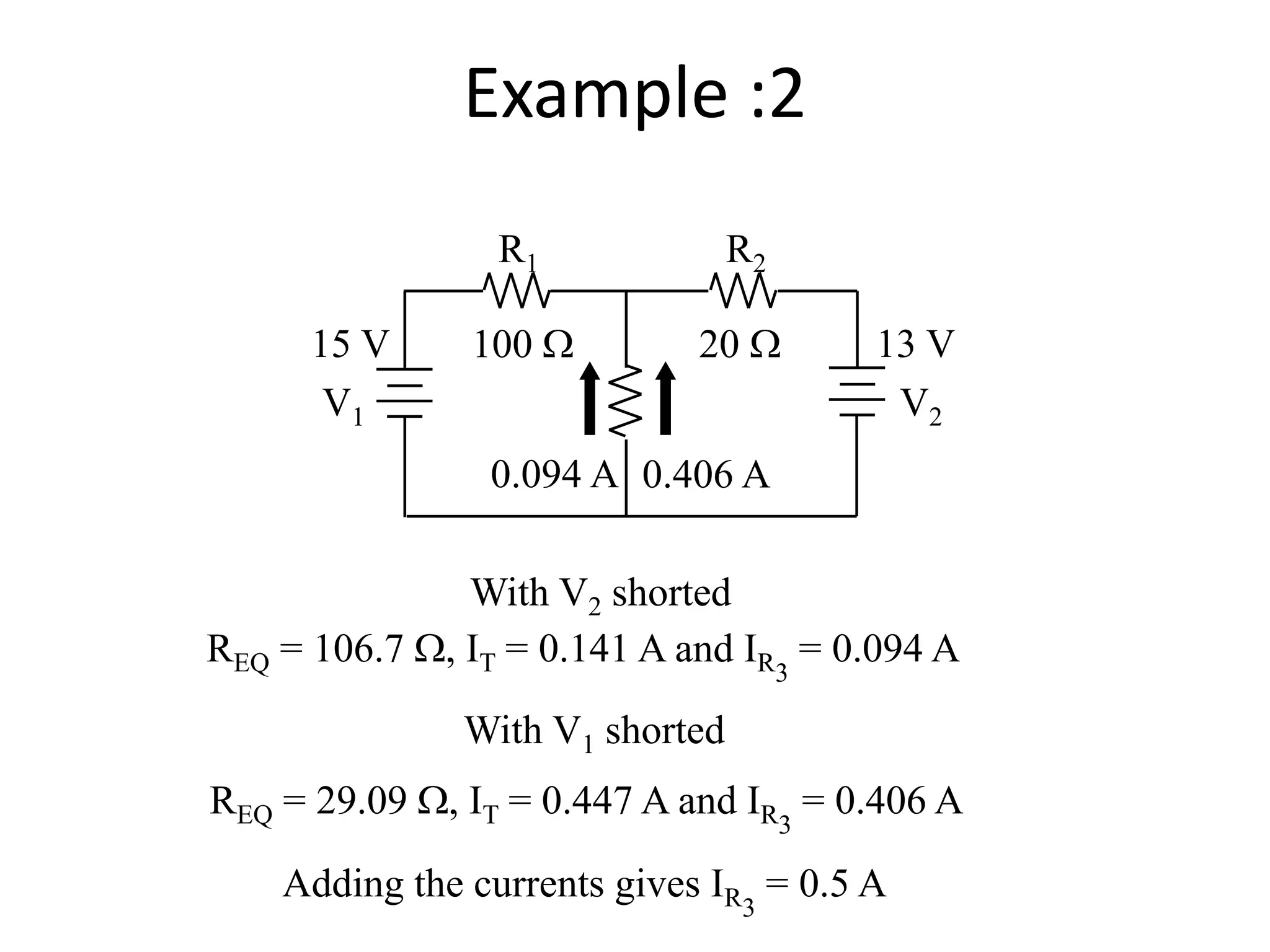
Adding the currents gives IR3
= 0.5 A
REQ = 106.7 W, IT = 0.141 A and IR3
= 0.094 A
REQ = 29.09 W, IT = 0.447 A and IR3
= 0.406 A
With V2 shorted
With V1 shorted
0.094 A 0.406 A
Example :2
R1 R2
R3
V1 V2
100 W 20 W
10 W
15 V 13 V
With 0.5 A flowing in R3, the voltage across R3 must
be 5 V (Ohm’s Law). The voltage across R1 must
therefore be 10 volts (KVL) and the voltage across R2
must be 8 volts (KVL). Solving for the currents in R1
and R2 will verify that the solution agrees with KCL.
0.5 A
IR1
= 0.1 A and IR2
= 0.4 A
IR3
= 0.1 A + 0.4 A = 0.5 A
Example :2
Procedure for applying Superposition Theorem
 Circuits Containing Independent as well as
Dependent Sources
• Consider only one source to be active at a time.
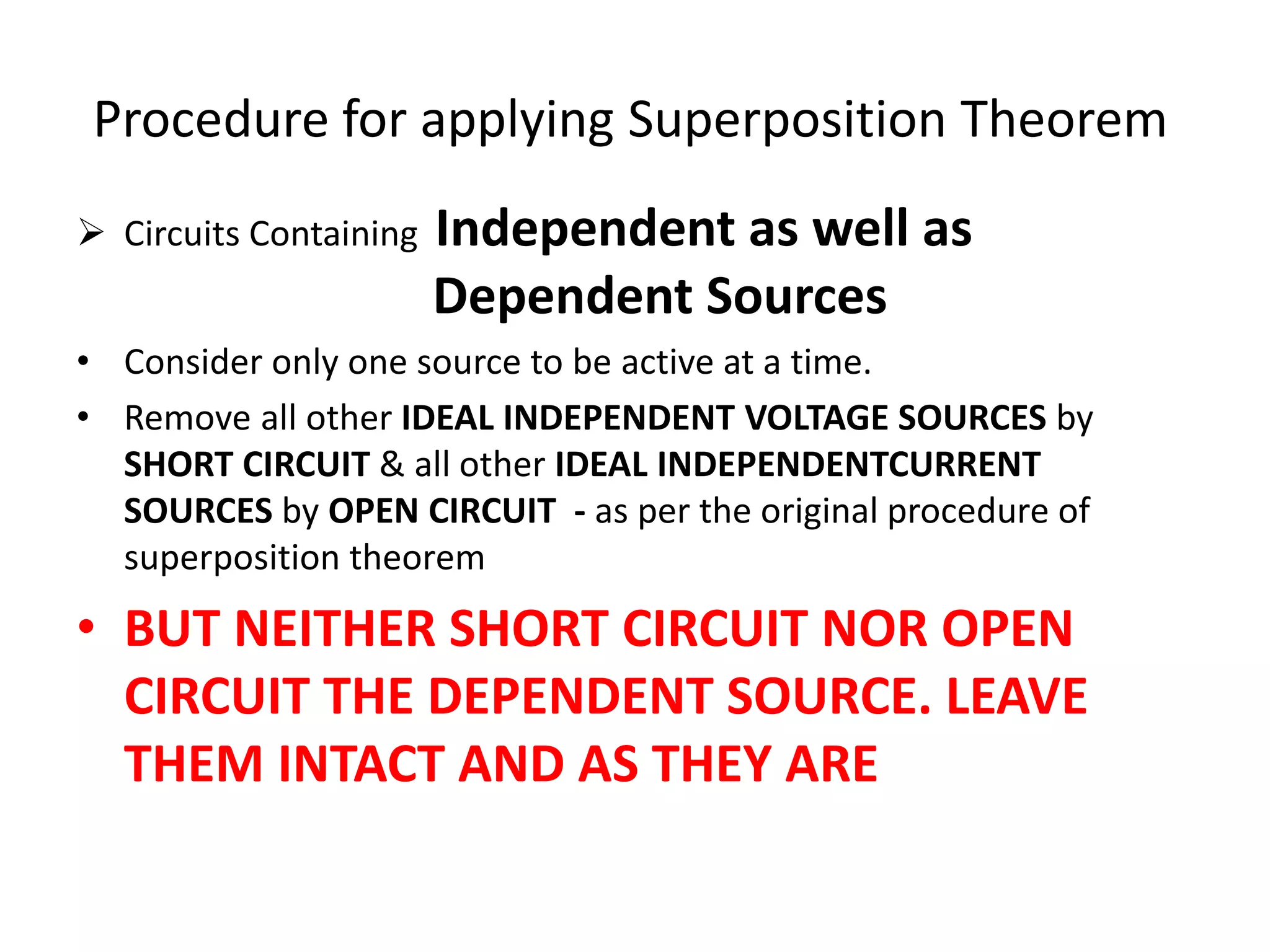
• Remove all other IDEAL INDEPENDENT VOLTAGE SOURCES by
SHORT CIRCUIT & all other IDEAL INDEPENDENTCURRENT
SOURCES by OPEN CIRCUIT - as per the original procedure of
superposition theorem
• BUT NEITHER SHORT CIRCUIT NOR OPEN
CIRCUIT THE DEPENDENT SOURCE. LEAVE
THEM INTACT AND AS THEY ARE
Procedure for applying Superposition Theorem
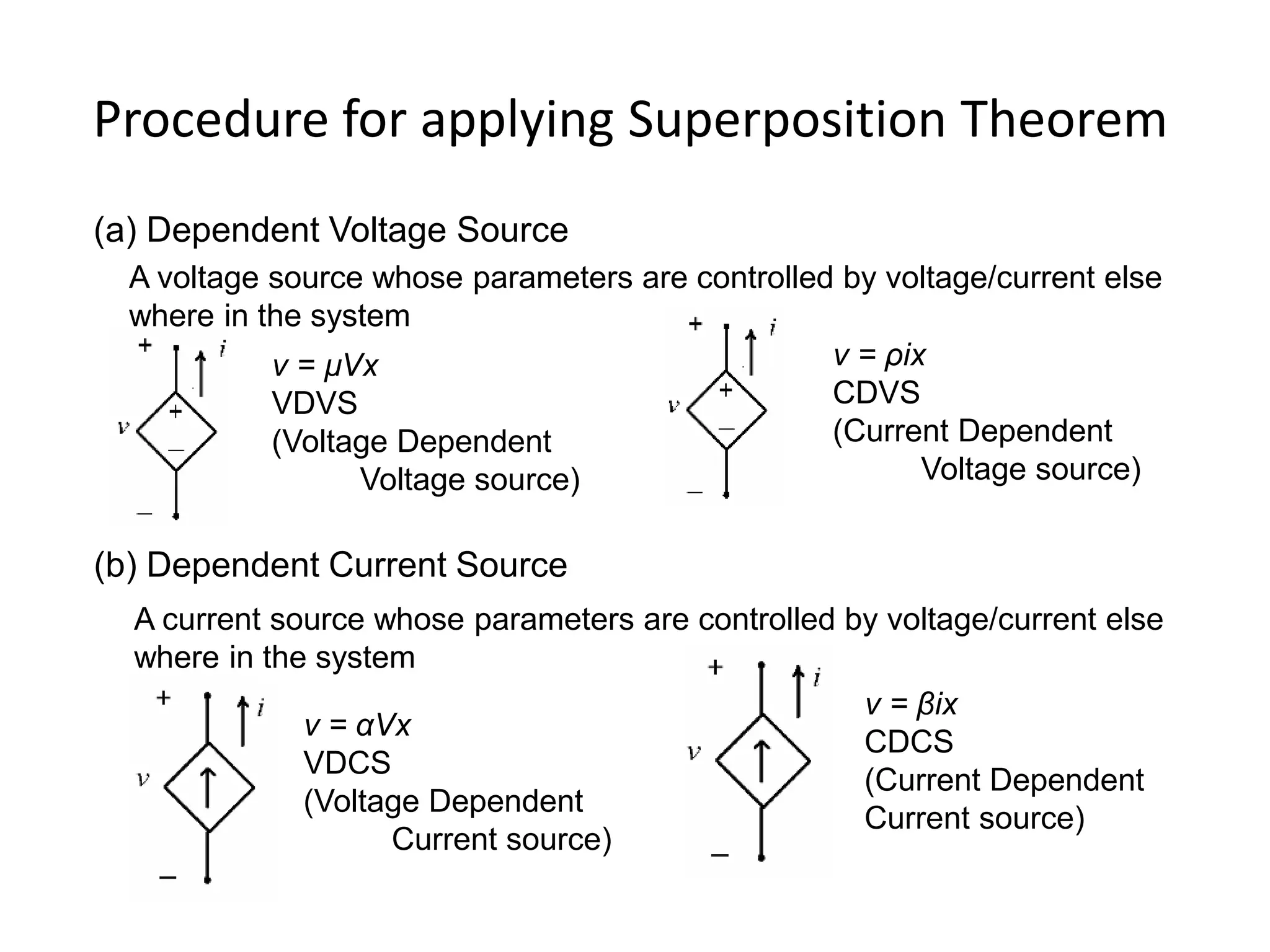
(b) Dependent Current Source
A current source whose parameters are controlled by voltage/current else
where in the system
v = αVx
VDCS
(Voltage Dependent
Current source)
v = βix
CDCS
(Current Dependent
Current source)
(a) Dependent Voltage Source
v = µVx
VDVS
(Voltage Dependent
Voltage source)
v = ρix
CDVS
(Current Dependent
Voltage source)
A voltage source whose parameters are controlled by voltage/current else
where in the system
14
Example : 3
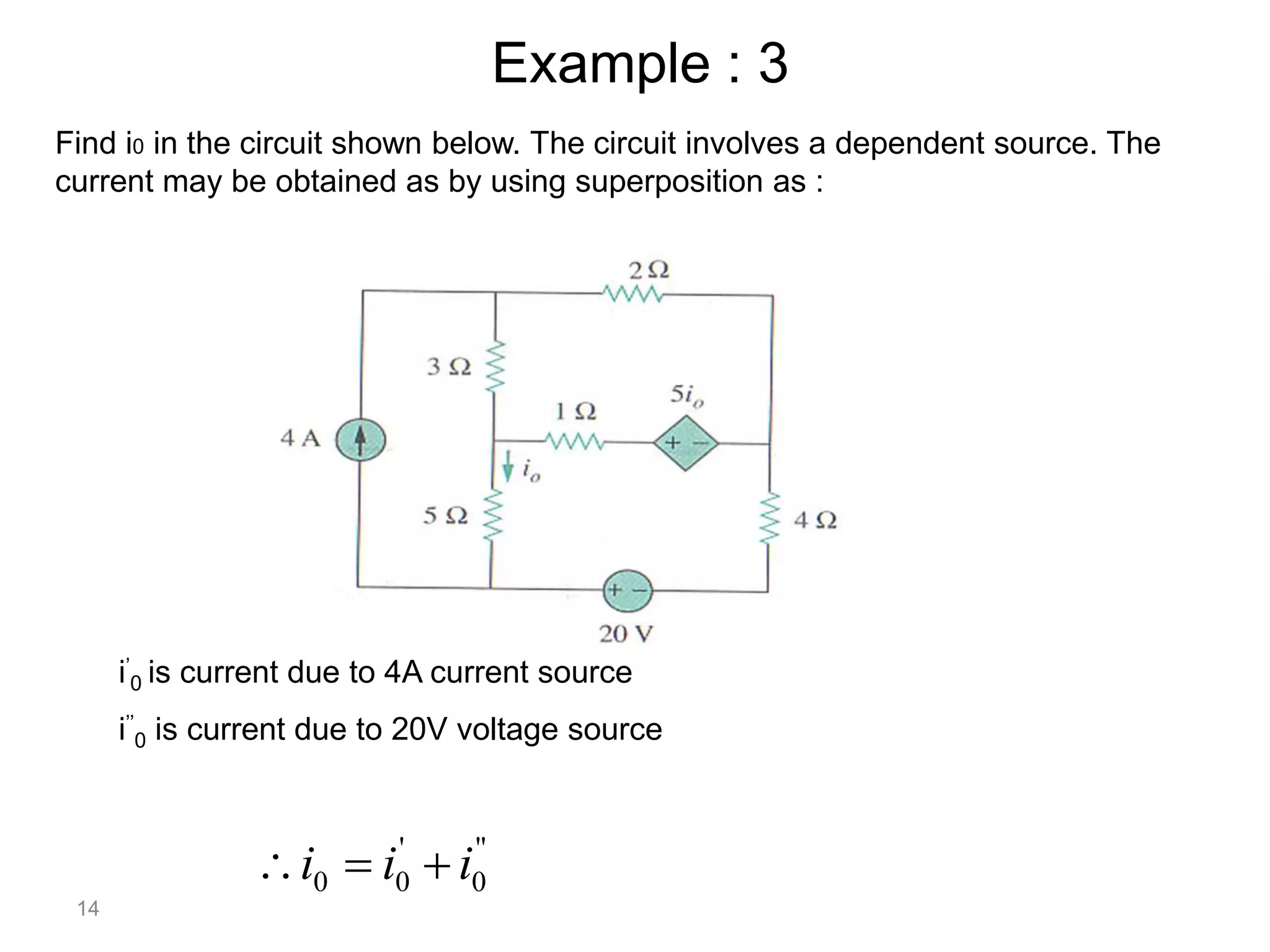
Find i0 in the circuit shown below. The circuit involves a dependent source. The
current may be obtained as by using superposition as :
''
0
'
00 iii 
i’
0 is current due to 4A current source
i’’
0 is current due to 20V voltage source
15
To obtain i’
0we short circuit the 20V
sources
i1
i2
i3A.4i1 
0)(152)(3 320
'
212  iiiiii
For loop 2
For loop 1
For loop 3
045)(1)(5 3
'
02313  iiiiii
310 iii' 
For solving i1, i2, i3 A
17
52
i 0
'

16
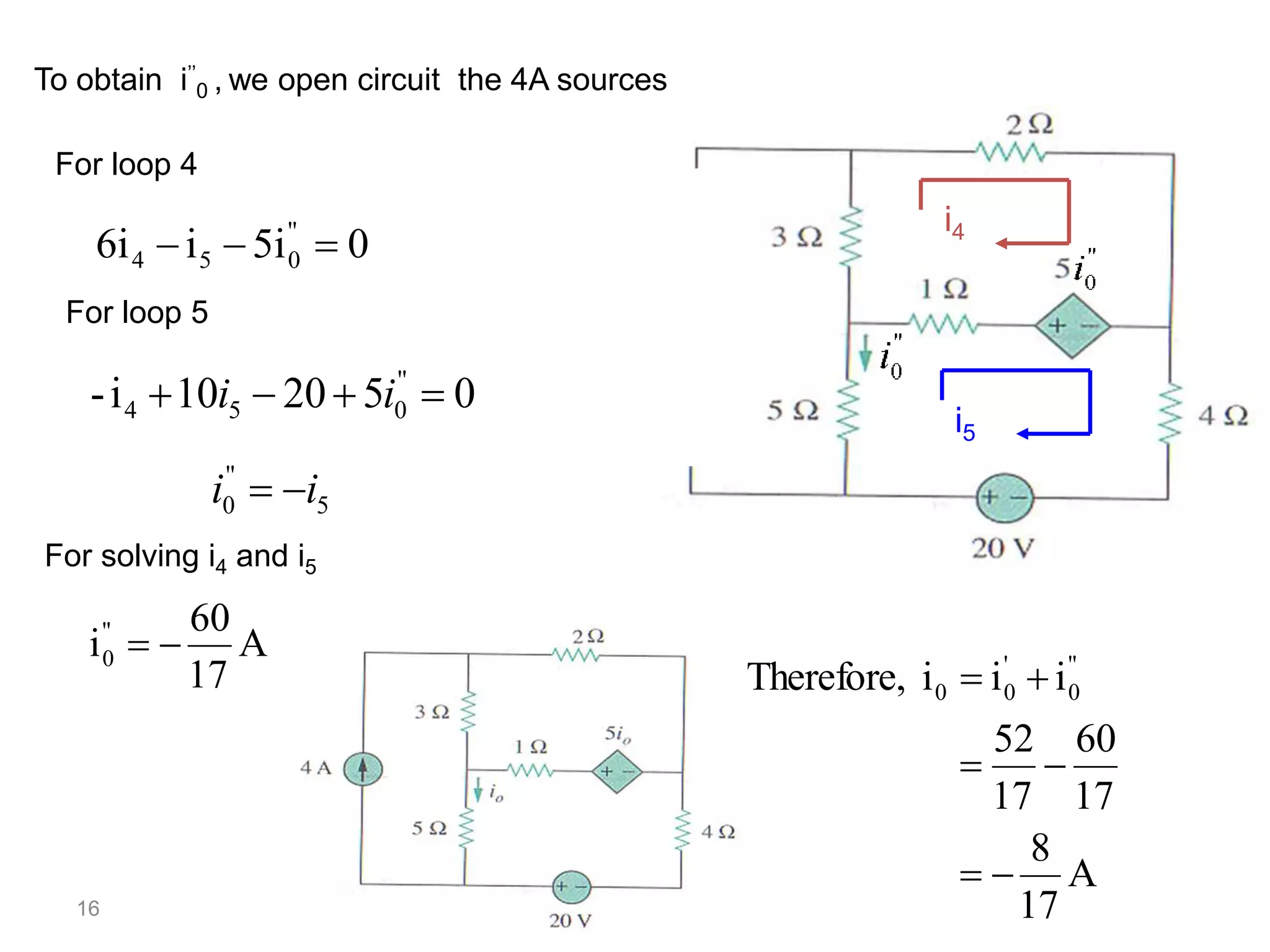
To obtain i’’
0 , we open circuit the 4A sources
i4
i5
05ii6i ''
054 
For loop 4
052010i- ''
054  ii
For loop 5
A
17
60
i ''
0 
For solving i4 and i5
A
17
8
17
60
17
52
iiiTherefore, ''
0
'
00



5
''
0 ii 
17
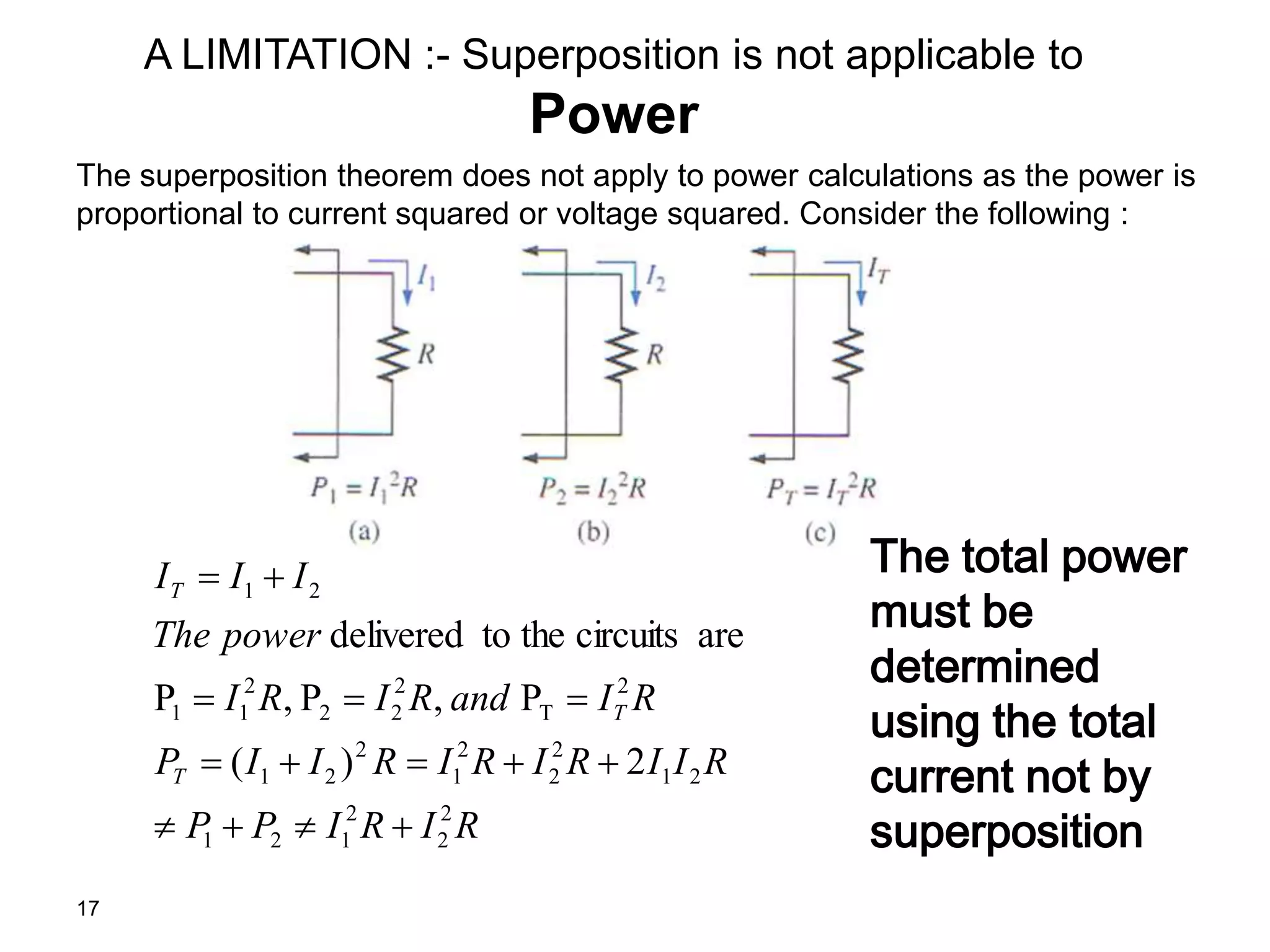
A LIMITATION :- Superposition is not applicable to
Power
The superposition theorem does not apply to power calculations as the power is
proportional to current squared or voltage squared. Consider the following :
RIRIPP
RIIRIRIRIIP
RIandRIRI
powerThe
III
T
T
T
2
2
2
121
21
2
2
2
1
2
21
2
T
2
22
2
11
21
2)(
P,P,P
arecircuitsthetodelivered



 The total power
must be
determined
using the total
current not by
superposition
THANK YOU

Superposition theorem

  • 1.
  • 2.
    Superposition Theorem • Thesuperposition theorem extends the use of Ohm’s Law to circuits with multiple sources. • Definition :- The current through, or voltage across, an element in a linear bilateral network equal to the algebraic sum of the currents or voltages produced independently by each source. • The Superposition theorem is very helpful in determining the voltage across an element or current through a branch when the circuit contains multiple number of voltage or current sources.
  • 3.
    Superposition Theorem  Inorder to apply the superposition theorem to a network, certain conditions must be met : 1. All the components must be linear, for e.g.- the current is proportional to the applied voltage (for resistors), flux linkage is proportional to current (in inductors), etc. 2. All the components must be bilateral, meaning that the current is the same amount for opposite polarities of the source voltage. 3. Passive components may be used. These are components such as resistors, capacitors, and inductors, that do not amplify or rectify. 4. Active components may not be used. Active components include transistors, semiconductor diodes, and electron tubes. Such components are never bilateral and seldom linear.
  • 4.
    Procedure for applyingSuperposition Theorem  Circuits Containing Only Independent Sources • Consider only one source to be active at a time. • Remove all other IDEAL VOLTAGE SOURCES by SHORT CIRCUIT & all other IDEAL CURRENT SOURCES by OPEN CIRCUIT. Voltage source is replaced by a Short Circuit Current source is replaced by a Open Circuit
  • 5.
    Procedure for applyingSuperposition Theorem • If there are practical sources, replace them by the combination of ideal source and an internal resistances (as shown in figure). • After that, short circuit the ideal voltage source & open circuit the ideal current source (as shown in figure).
  • 6.
    Example : 1 Findthe current flowing through R. 1. Short Circuiting Voltage source V2 & finding the current I1
  • 7.
    Example : 1 2. ShortCircuiting Voltage source V1 & finding the current I2 The net current is :- Same answer is obtained by another method (shown below) which would turn out to be tedious when applied to bigger circuits as in next example….
  • 8.
    Example :2 R1 R2 R3 V1 V2 100W 20 W 10 W 15 V 13 V R1 R2 R3 V1 100 W 20 W 10 W 15 V V2 shorted REQ = 106.7 W, IT = 0.141 A and IR3 = 0.094 A
  • 9.
    R1 R2 R3 V1 V2 100W 20 W 10 W 15 V 13 V REQ = 29.09 W, IT = 0.447 A and IR3 = 0.406 A R1 R2 R3 V2 100 W 20 W 10 W 13 V V1 shorted Example :2
  • 10.
    R1 R2 V1 V2 100W 20 W15 V 13 V Adding the currents gives IR3 = 0.5 A REQ = 106.7 W, IT = 0.141 A and IR3 = 0.094 A REQ = 29.09 W, IT = 0.447 A and IR3 = 0.406 A With V2 shorted With V1 shorted 0.094 A 0.406 A Example :2
  • 11.
    R1 R2 R3 V1 V2 100W 20 W 10 W 15 V 13 V With 0.5 A flowing in R3, the voltage across R3 must be 5 V (Ohm’s Law). The voltage across R1 must therefore be 10 volts (KVL) and the voltage across R2 must be 8 volts (KVL). Solving for the currents in R1 and R2 will verify that the solution agrees with KCL. 0.5 A IR1 = 0.1 A and IR2 = 0.4 A IR3 = 0.1 A + 0.4 A = 0.5 A Example :2
  • 12.
    Procedure for applyingSuperposition Theorem  Circuits Containing Independent as well as Dependent Sources • Consider only one source to be active at a time. • Remove all other IDEAL INDEPENDENT VOLTAGE SOURCES by SHORT CIRCUIT & all other IDEAL INDEPENDENTCURRENT SOURCES by OPEN CIRCUIT - as per the original procedure of superposition theorem • BUT NEITHER SHORT CIRCUIT NOR OPEN CIRCUIT THE DEPENDENT SOURCE. LEAVE THEM INTACT AND AS THEY ARE
  • 13.
    Procedure for applyingSuperposition Theorem (b) Dependent Current Source A current source whose parameters are controlled by voltage/current else where in the system v = αVx VDCS (Voltage Dependent Current source) v = βix CDCS (Current Dependent Current source) (a) Dependent Voltage Source v = µVx VDVS (Voltage Dependent Voltage source) v = ρix CDVS (Current Dependent Voltage source) A voltage source whose parameters are controlled by voltage/current else where in the system
  • 14.
    14 Example : 3 Findi0 in the circuit shown below. The circuit involves a dependent source. The current may be obtained as by using superposition as : '' 0 ' 00 iii  i’ 0 is current due to 4A current source i’’ 0 is current due to 20V voltage source
  • 15.
    15 To obtain i’ 0weshort circuit the 20V sources i1 i2 i3A.4i1  0)(152)(3 320 ' 212  iiiiii For loop 2 For loop 1 For loop 3 045)(1)(5 3 ' 02313  iiiiii 310 iii'  For solving i1, i2, i3 A 17 52 i 0 ' 
  • 16.
    16 To obtain i’’ 0, we open circuit the 4A sources i4 i5 05ii6i '' 054  For loop 4 052010i- '' 054  ii For loop 5 A 17 60 i '' 0  For solving i4 and i5 A 17 8 17 60 17 52 iiiTherefore, '' 0 ' 00    5 '' 0 ii 
  • 17.
    17 A LIMITATION :-Superposition is not applicable to Power The superposition theorem does not apply to power calculations as the power is proportional to current squared or voltage squared. Consider the following : RIRIPP RIIRIRIRIIP RIandRIRI powerThe III T T T 2 2 2 121 21 2 2 2 1 2 21 2 T 2 22 2 11 21 2)( P,P,P arecircuitsthetodelivered     The total power must be determined using the total current not by superposition
  • 18.