WELCOME
Introduction to Wavelet
Transform with
Applications to DSP
Hicham BERKOUK
Tarek Islam SADMI
E08/Computer Engineering
IGEE – Boumerdes.
OUTLINE
 Overview
 Historical Development
 Limitations of Fourier Transform
 Principle of Wavelet Transform
 Examples of Applications
 Conclusion
 References
 Overview
 Historical Development
 Limitations of Fourier Transform
 Principle of Wavelet Transform
 Examples of Applications
 Conclusion
 References
Overview:
What does Wavelet mean?
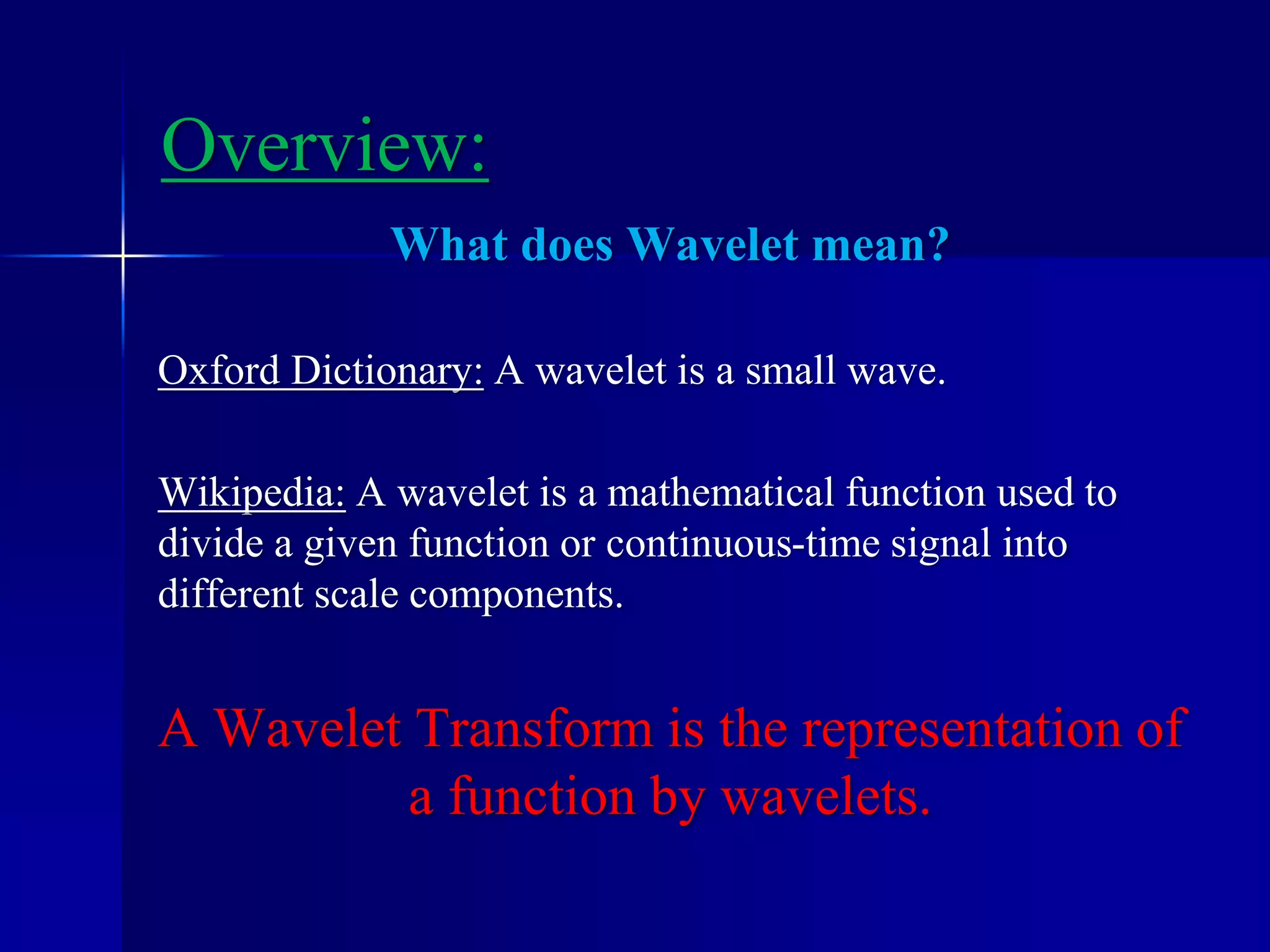
Oxford Dictionary: A wavelet is a small wave.
Wikipedia: A wavelet is a mathematical function used to
divide a given function or continuous-time signal into
different scale components.
A Wavelet Transform is the representation of
a function by wavelets.
Advantages of using Wavelets:
 Provide a way for analysing waveforms in both frequency and
duration.
 Representation of functions that have discontinuities and sharp
peaks.
 Accurately deconstructing and reconstructing finite, non-periodic
and/or non-stationary signals.
 Allow signals to be stored more efficiently than by Fourier
transform.
 Overview
 Historical Development
 Limitations of Fourier Transform
 Principle of Wavelet Transform
 Examples of Applications
 Conclusion
 References
Historical Development:
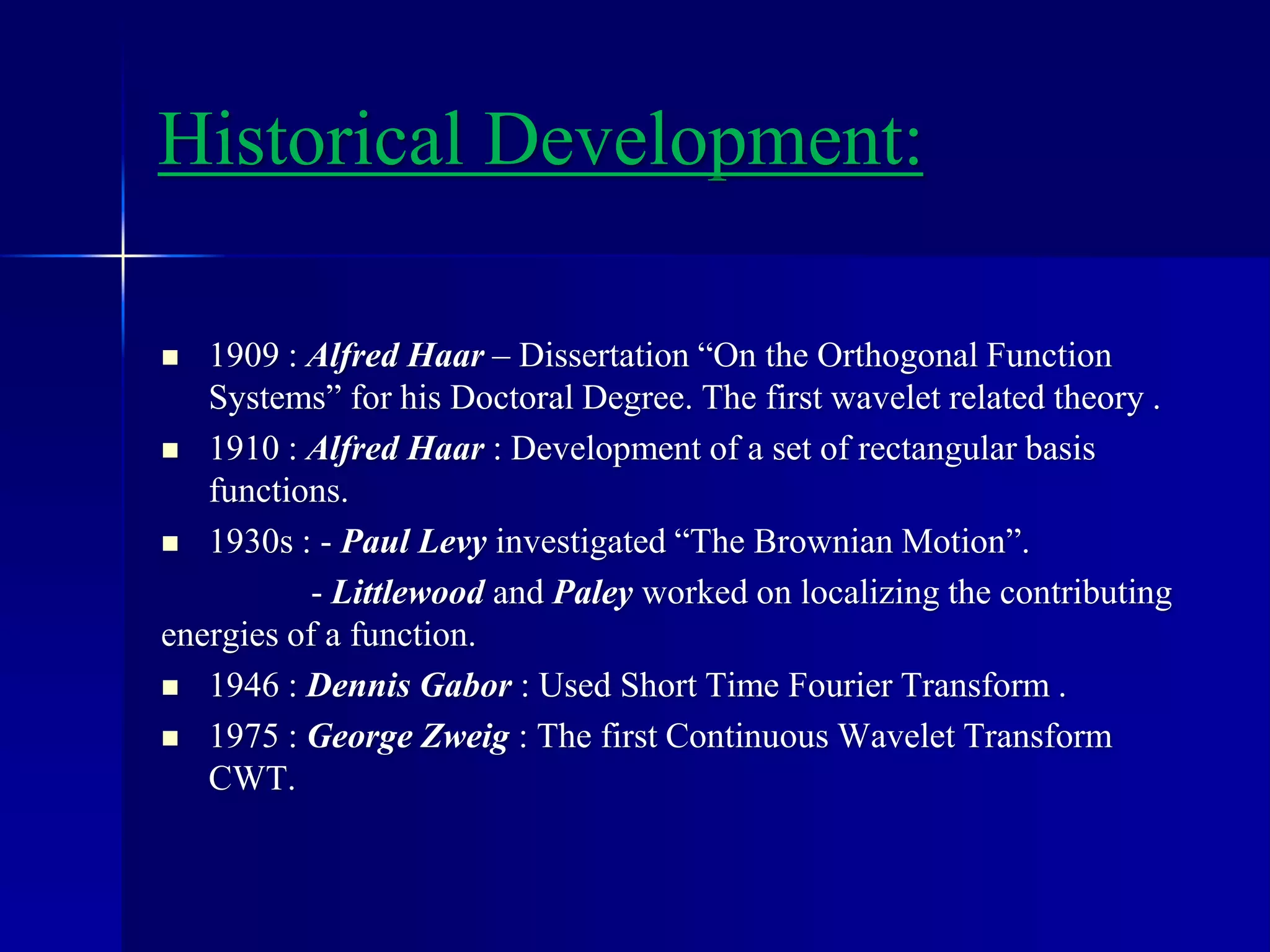
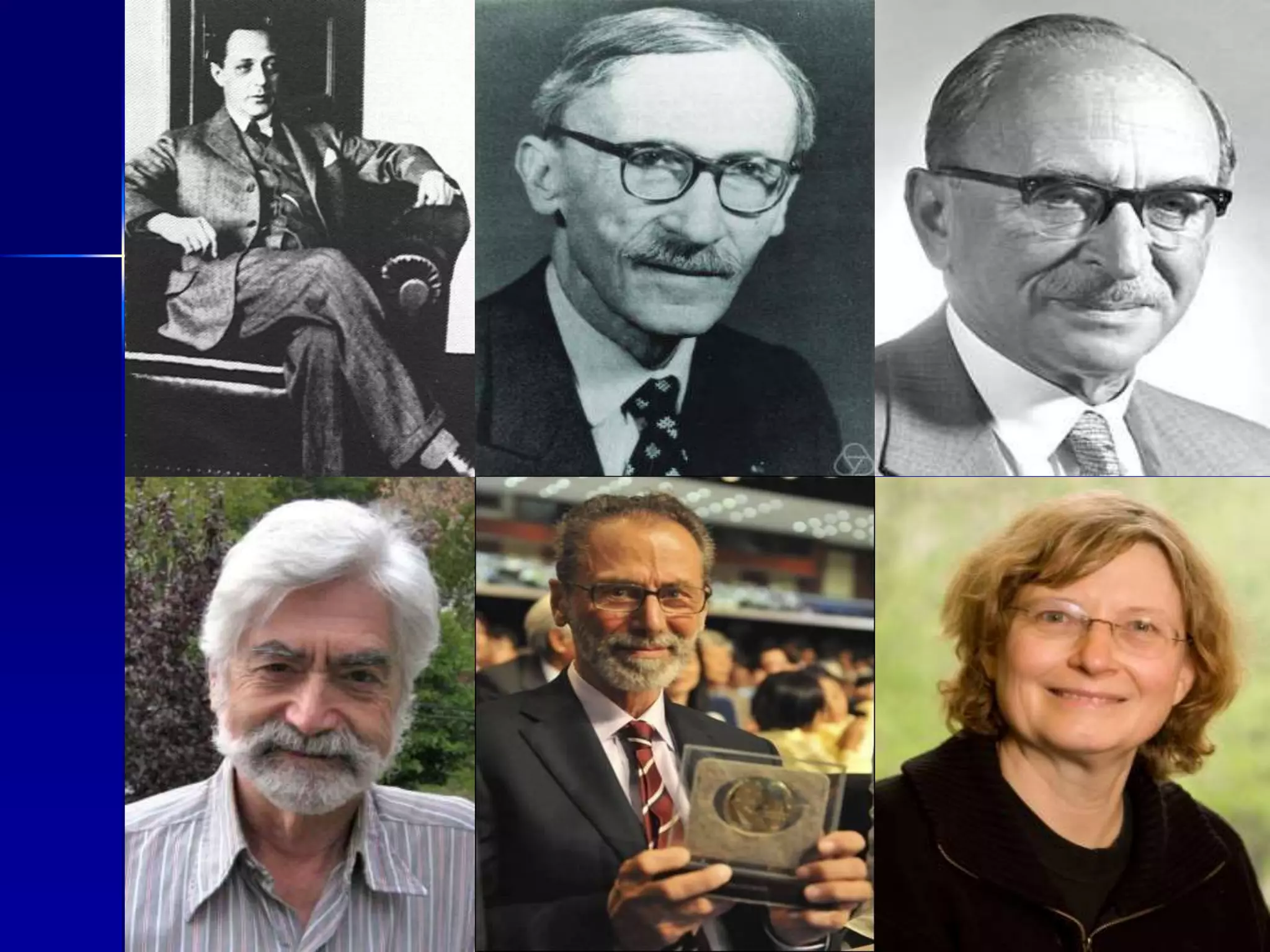
 1909 : Alfred Haar – Dissertation “On the Orthogonal Function
Systems” for his Doctoral Degree. The first wavelet related theory .
 1910 : Alfred Haar : Development of a set of rectangular basis
functions.
 1930s : - Paul Levy investigated “The Brownian Motion”.
- Littlewood and Paley worked on localizing the contributing
energies of a function.
 1946 : Dennis Gabor : Used Short Time Fourier Transform .
 1975 : George Zweig : The first Continuous Wavelet Transform
CWT.
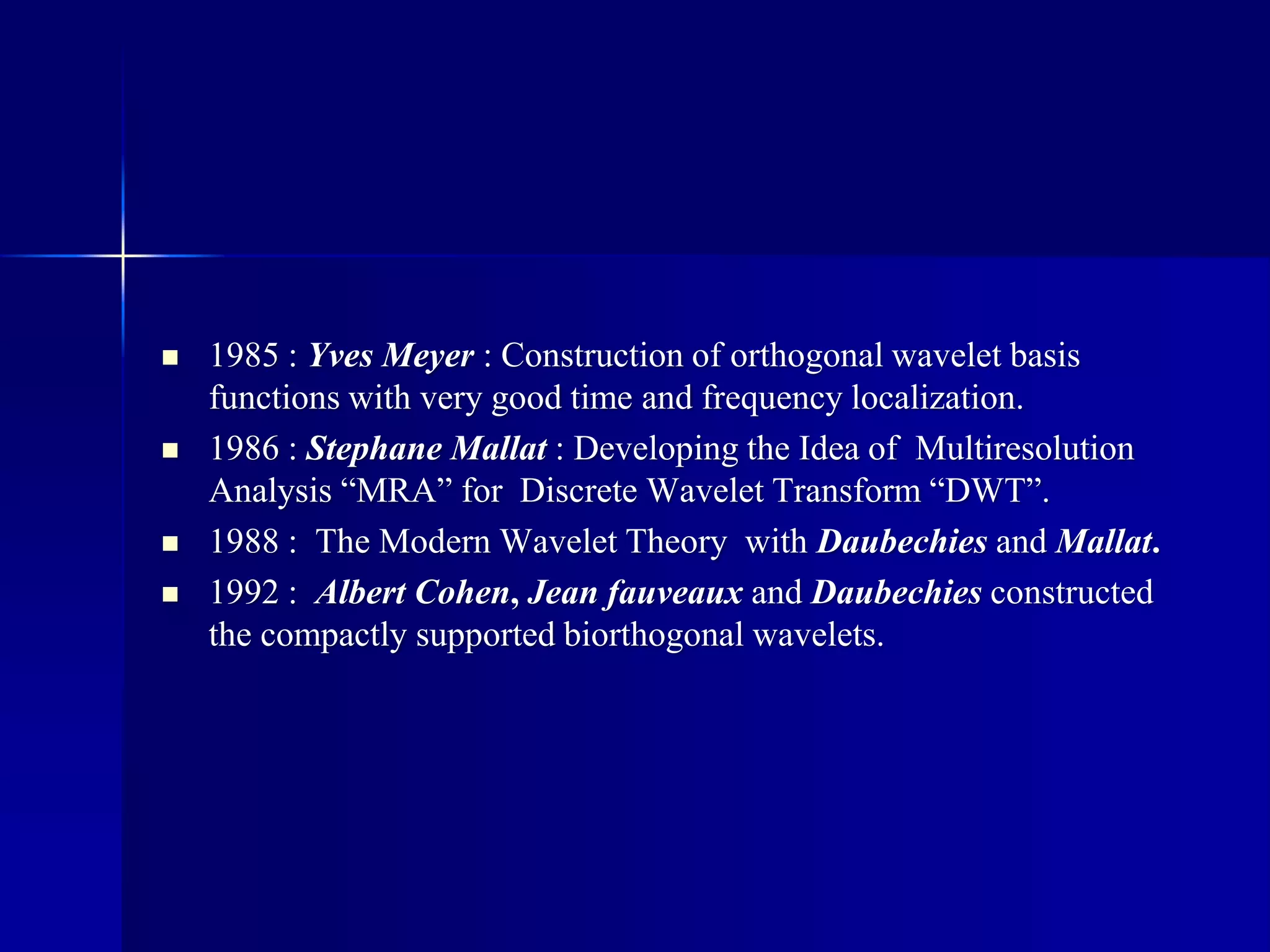
 1985 : Yves Meyer : Construction of orthogonal wavelet basis
functions with very good time and frequency localization.
 1986 : Stephane Mallat : Developing the Idea of Multiresolution
Analysis “MRA” for Discrete Wavelet Transform “DWT”.
 1988 : The Modern Wavelet Theory with Daubechies and Mallat.
 1992 : Albert Cohen, Jean fauveaux and Daubechies constructed
the compactly supported biorthogonal wavelets.
 Overview
 Historical Development
 Limitations of Fourier Transform
 Principle of Wavelet Transform
 Examples of Applications
 Conclusion
 References
Limitations of Fourier Transform:
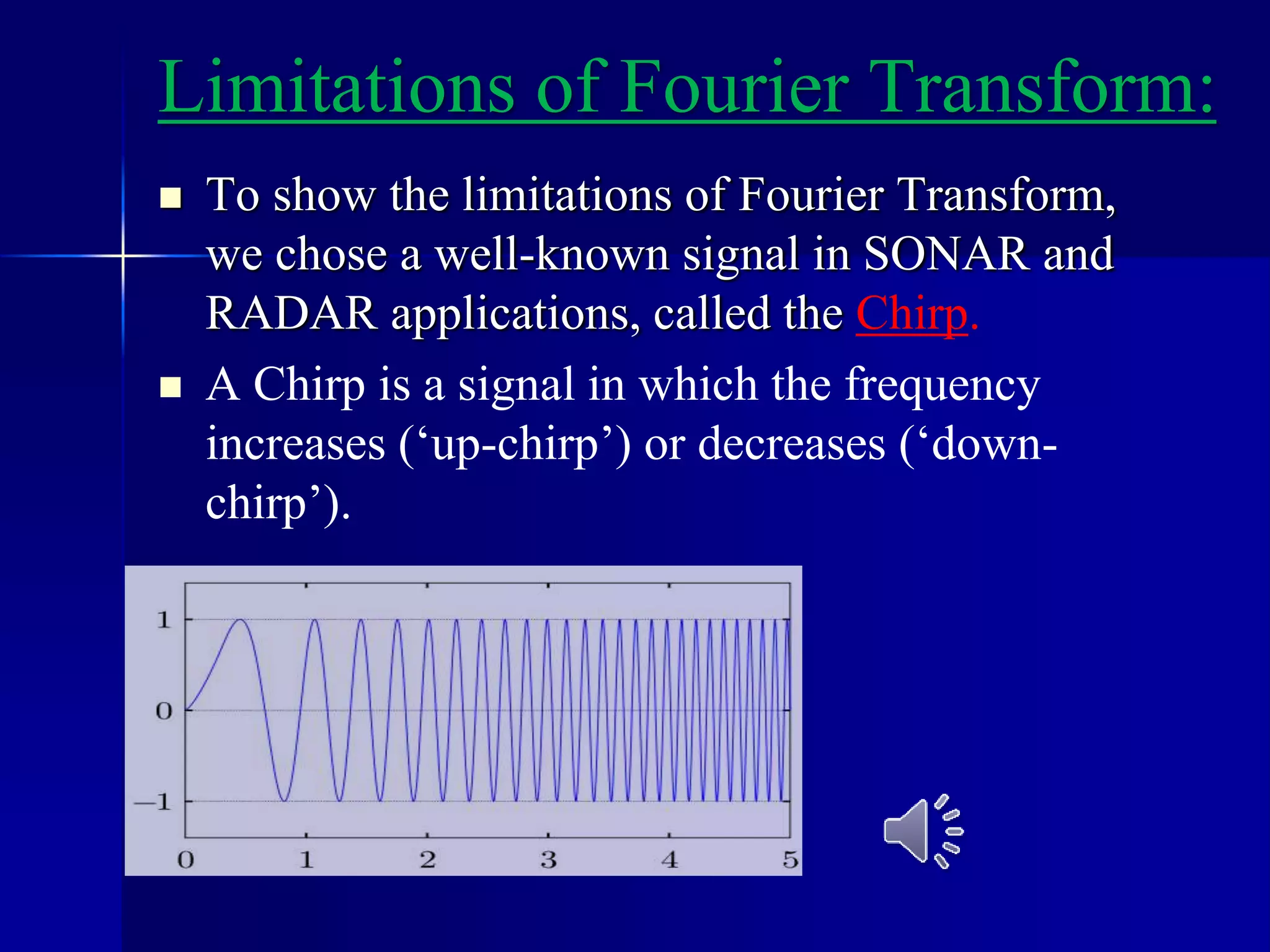
 To show the limitations of Fourier Transform,
we chose a well-known signal in SONAR and
RADAR applications, called the Chirp.
 A Chirp is a signal in which the frequency
increases (‘up-chirp’) or decreases (‘down-
chirp’).
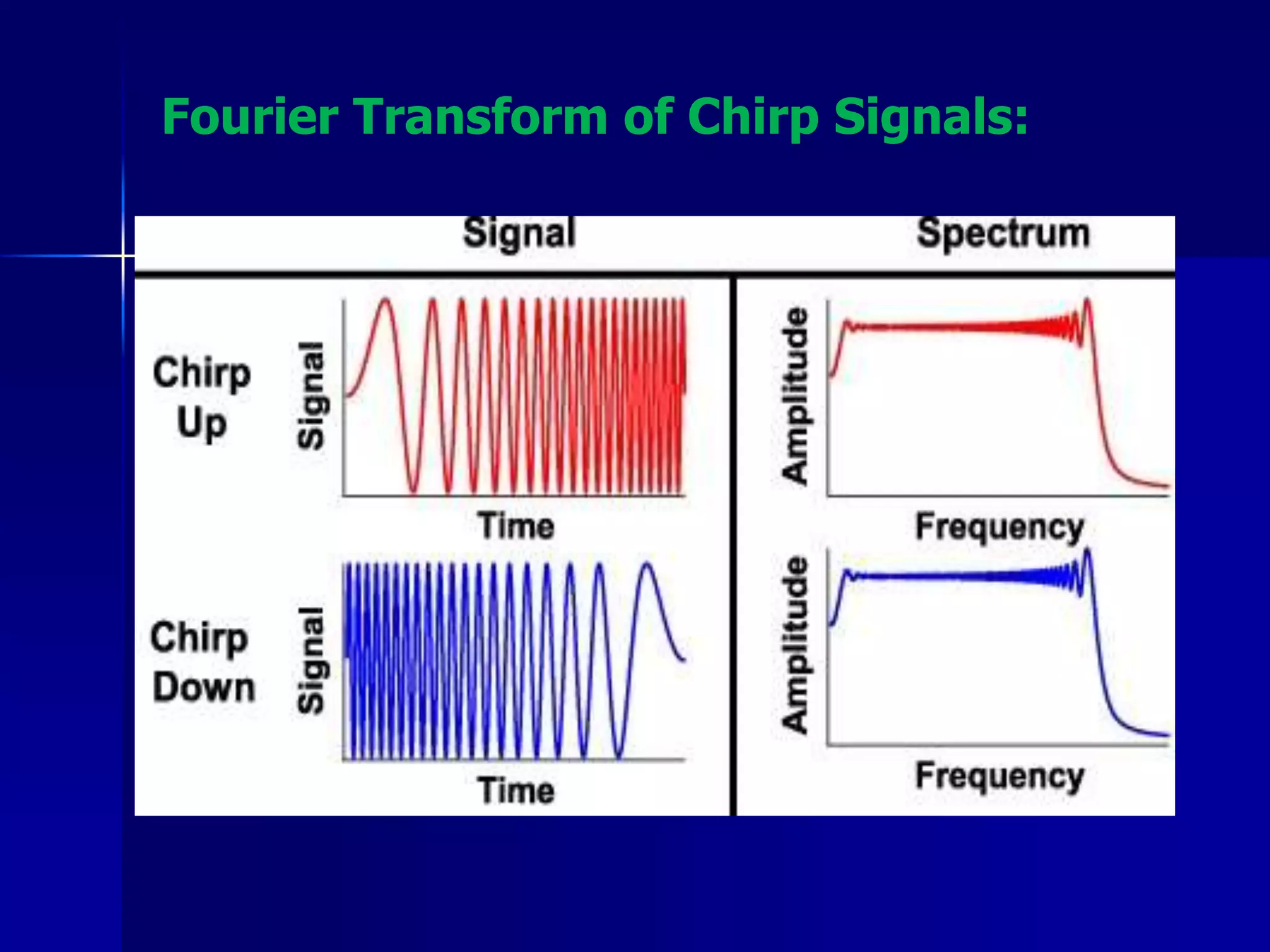
Fourier Transform of Chirp Signals:
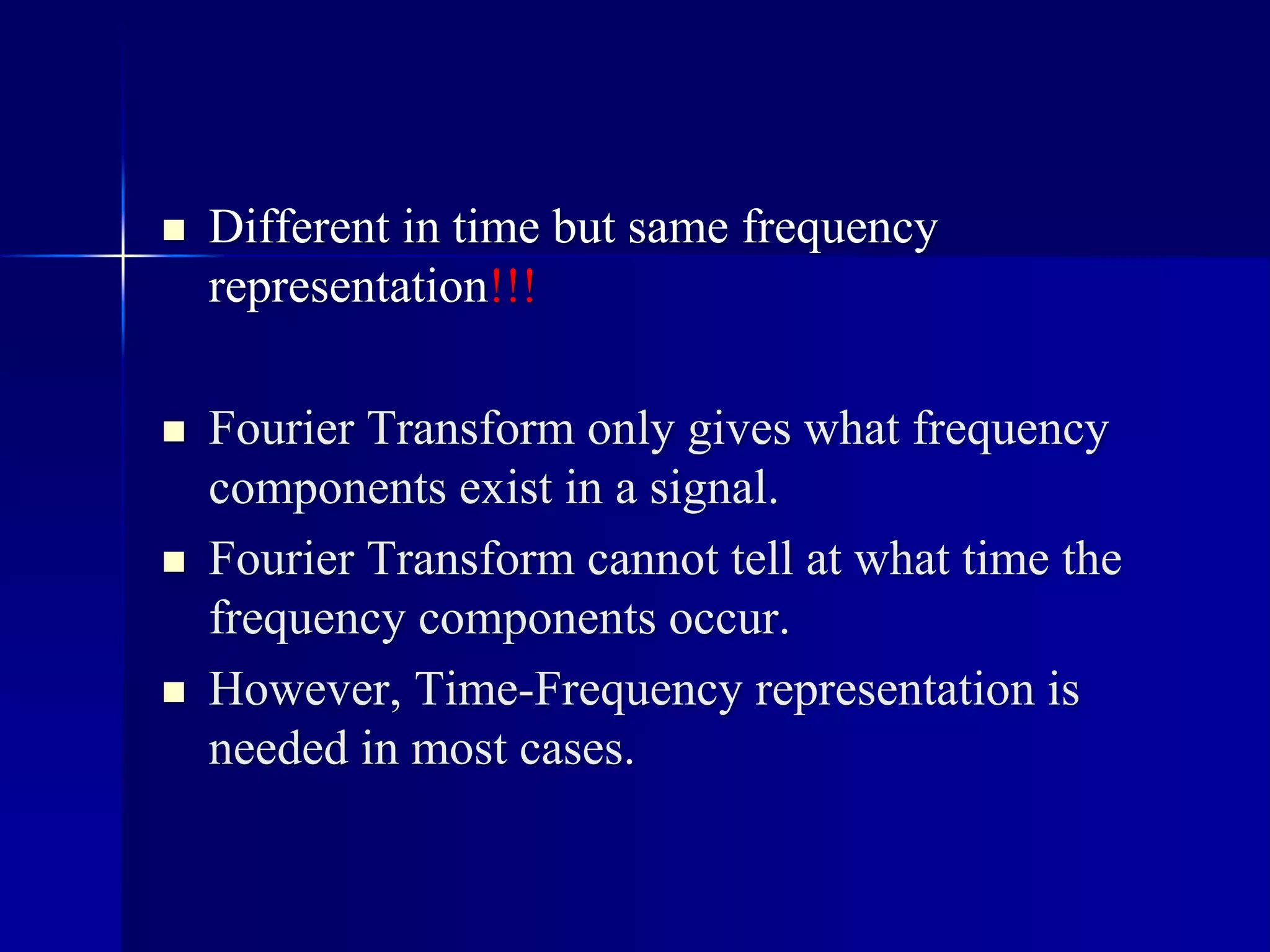
 Different in time but same frequency
representation!!!
 Fourier Transform only gives what frequency
components exist in a signal.
 Fourier Transform cannot tell at what time the
frequency components occur.
 However, Time-Frequency representation is
needed in most cases.
SOLUTION
?
WAVELET TRANSFORM
 Overview
 Historical Development
 Limitations of Fourier Transform
 Principle of Wavelet Transform
 Examples of Applications
 Conclusion
 References
Principle of Wavelet Transform:
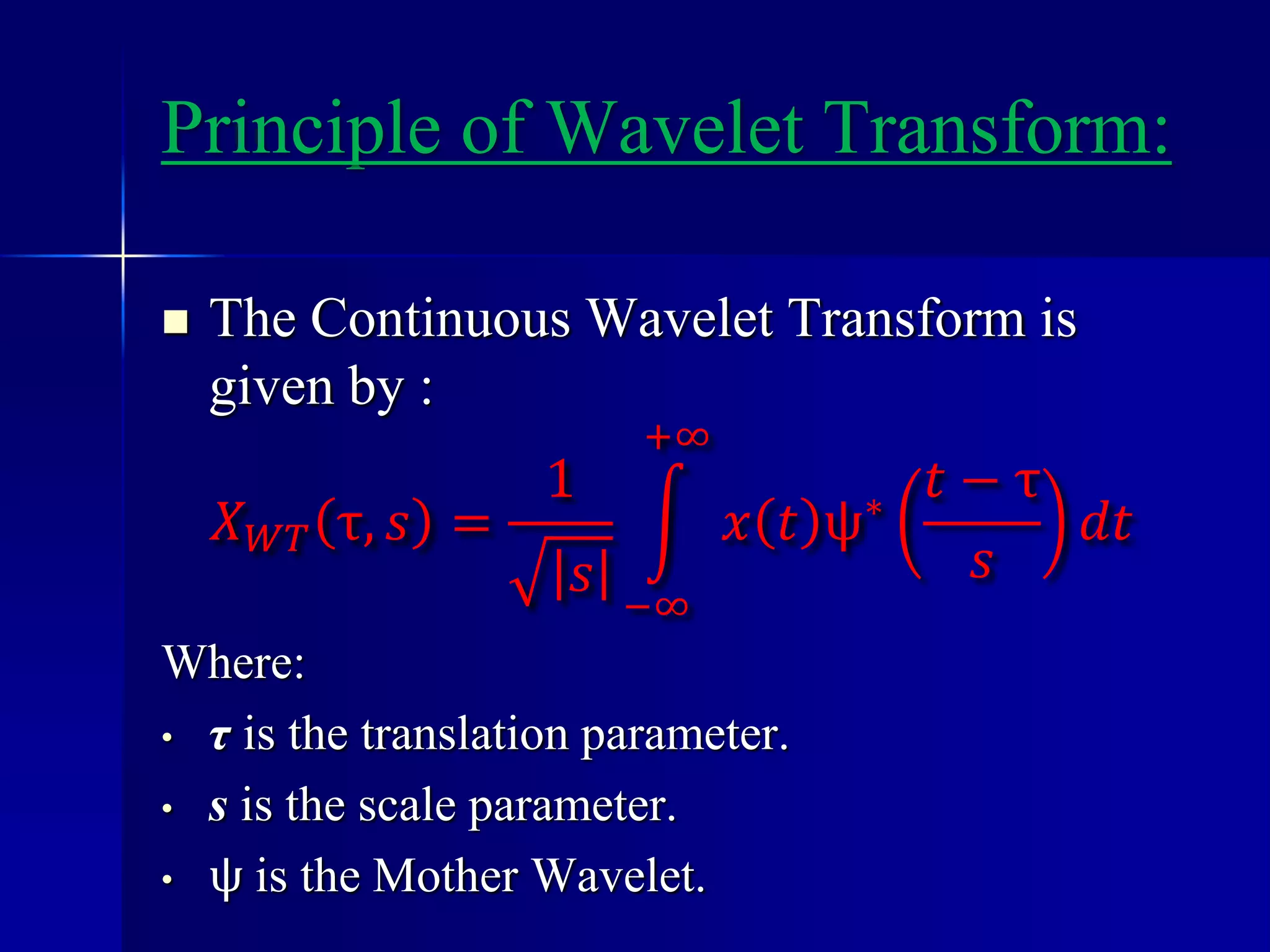
 The Continuous Wavelet Transform is
given by :
𝑋 𝑊𝑇 τ, 𝑠 =
1
𝑠 −∞
+∞
𝑥 𝑡 ѱ∗
𝑡 − τ
𝑠
𝑑𝑡
Where:
• τ is the translation parameter.
• s is the scale parameter.
• ψ is the Mother Wavelet.
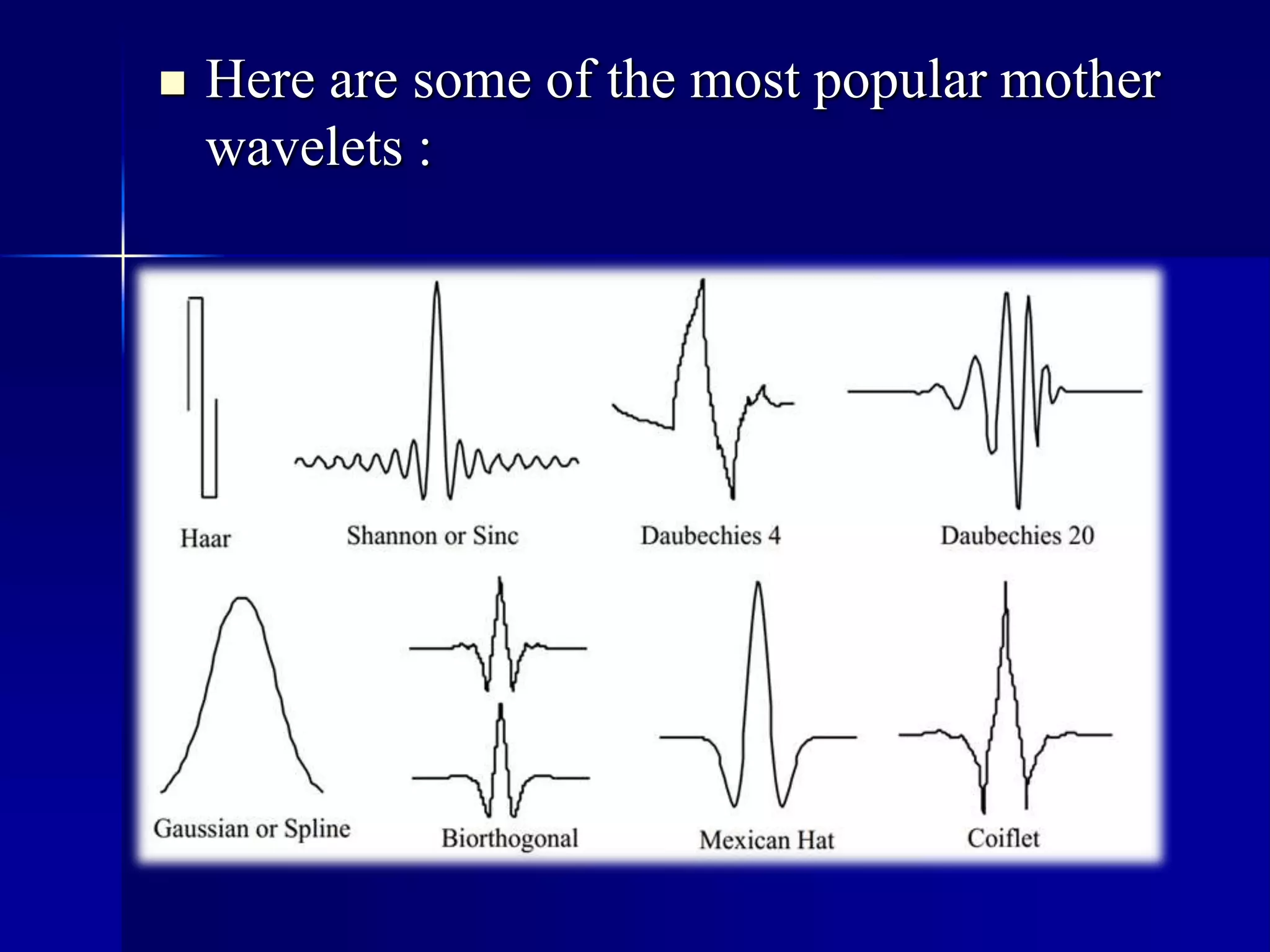
 Here are some of the most popular mother
wavelets :
Each Mother Wavelet has its own equation :
 Haar’s basis equation :
 Daubechies’ basis equation:
 Morlet’s (Mexican Hat) basis equation:
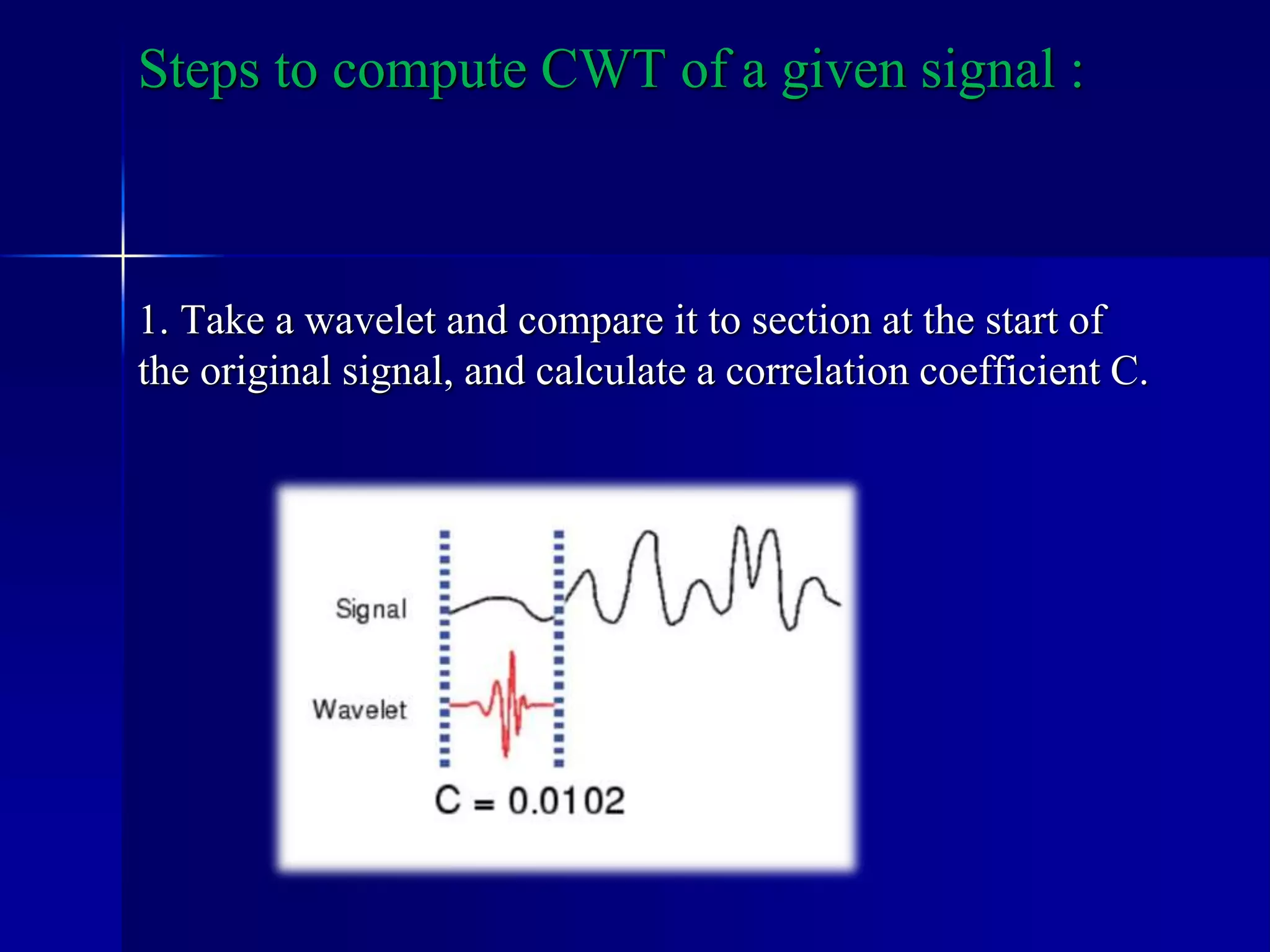
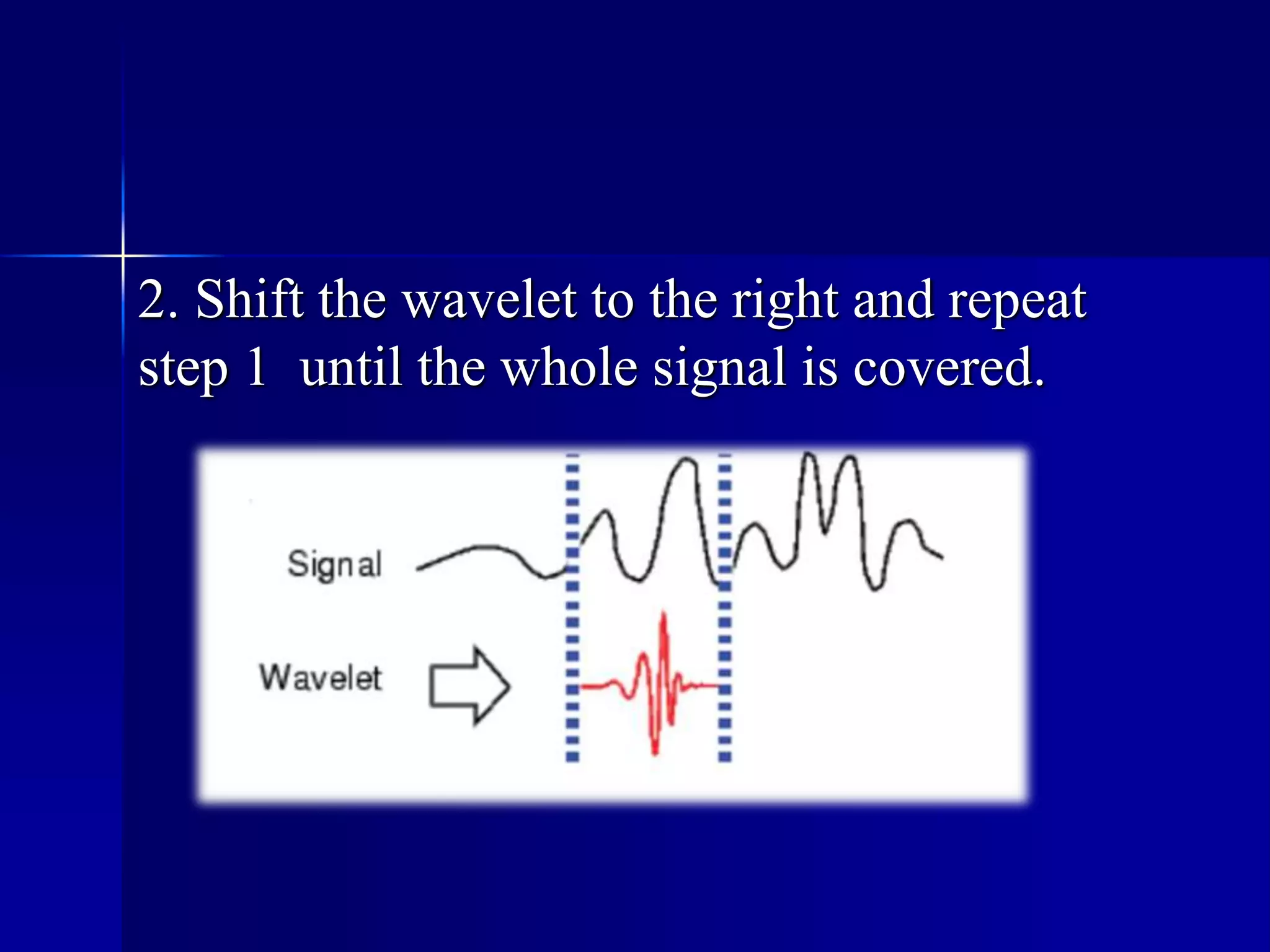
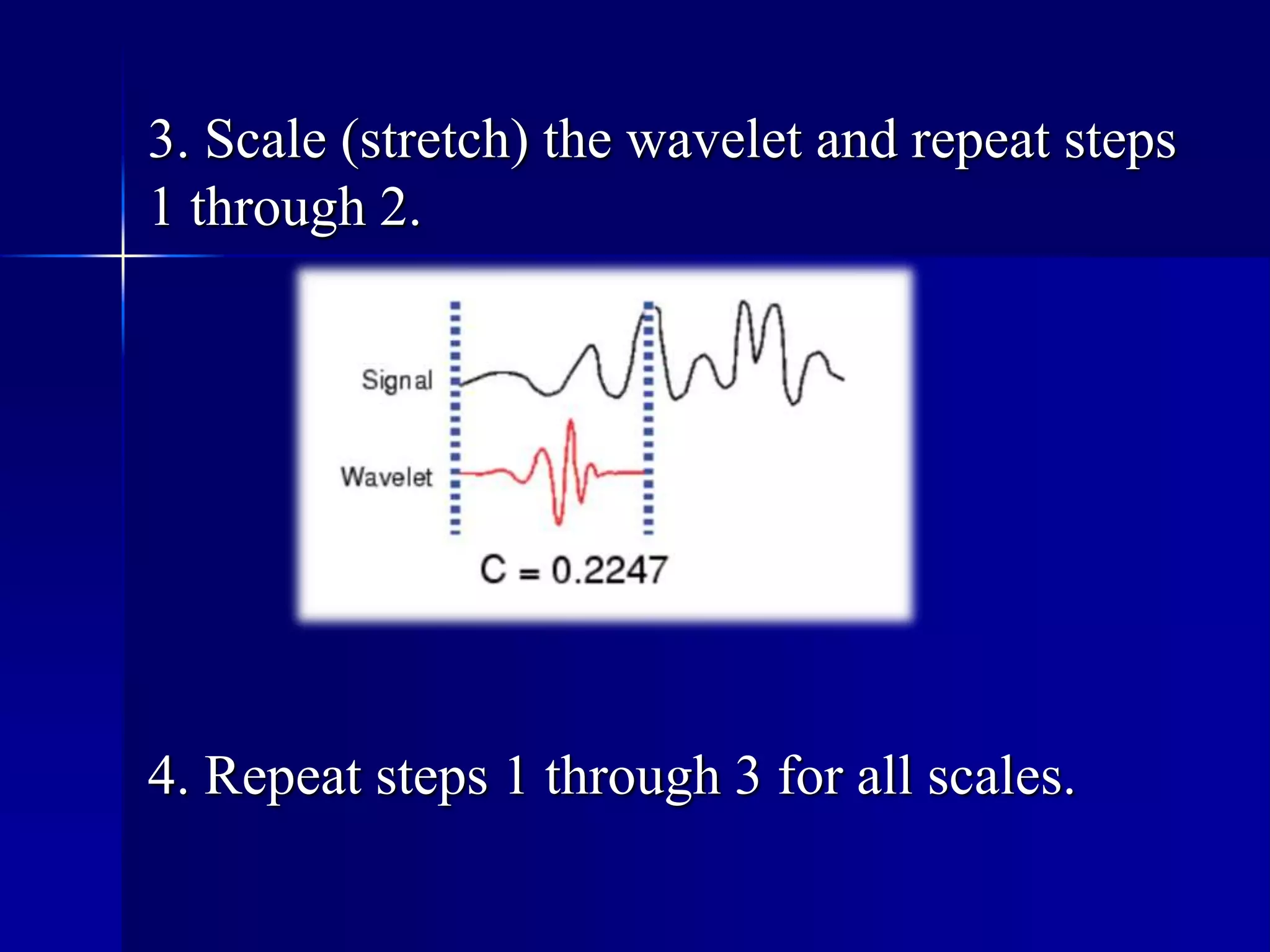
Steps to compute CWT of a given signal :
1. Take a wavelet and compare it to section at the start of
the original signal, and calculate a correlation coefficient C.
2. Shift the wavelet to the right and repeat
step 1 until the whole signal is covered.
3. Scale (stretch) the wavelet and repeat steps
1 through 2.
4. Repeat steps 1 through 3 for all scales.
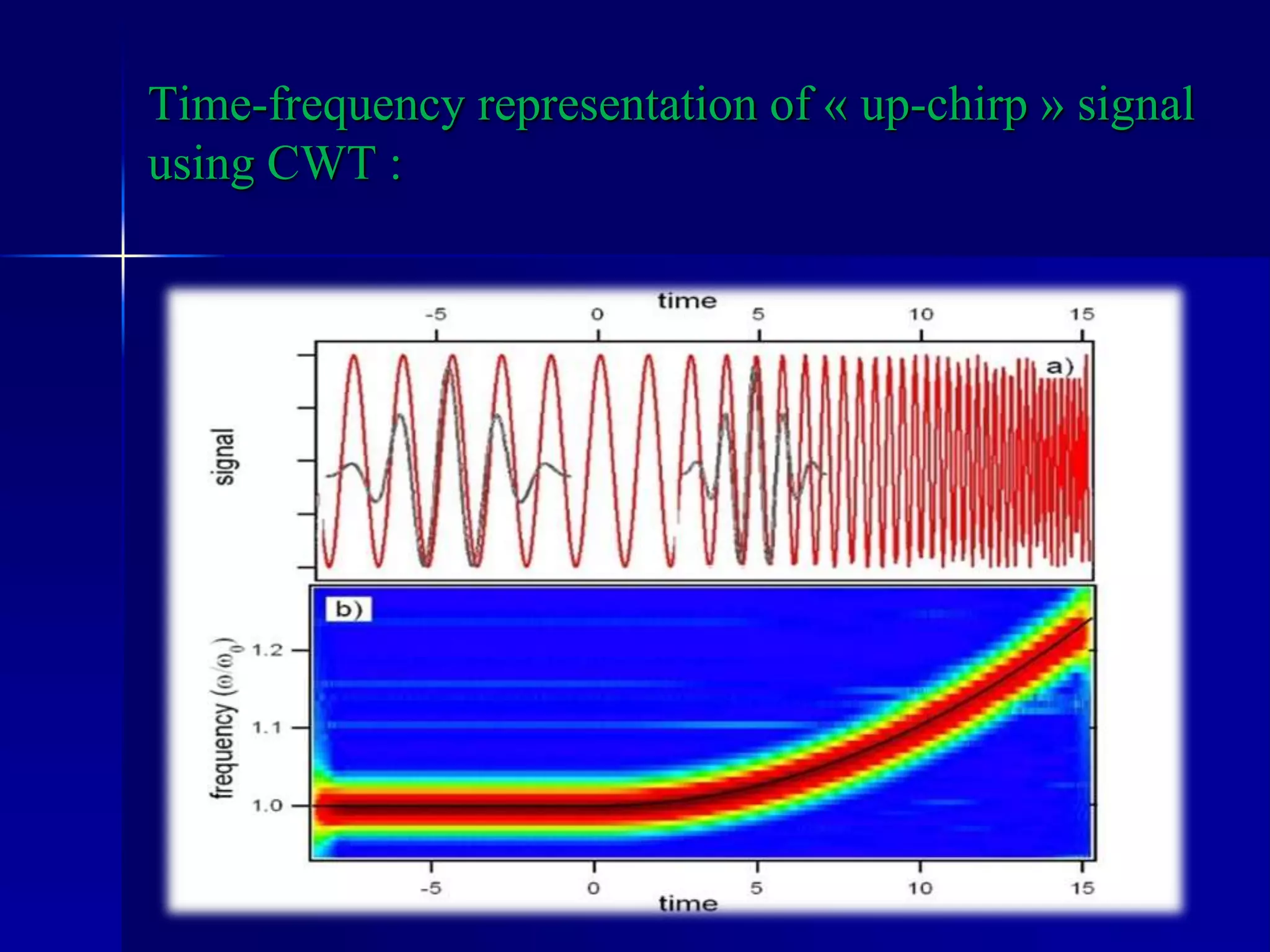
Time-frequency representation of « up-chirp » signal
using CWT :
 The Discrete Wavelet Transform (DWT) is
given by:
𝑔 𝑡 =
𝑚∊ℤ 𝑛∊ℤ
𝑥, ѱ 𝑚,𝑛 . ѱ 𝑚,𝑛[𝑡]
Where : ѱ 𝑚,𝑛 𝑡 = 𝑠0
−𝑚/2
ѱ(𝑠0
−𝑚
𝑡 − 𝑛τ0).
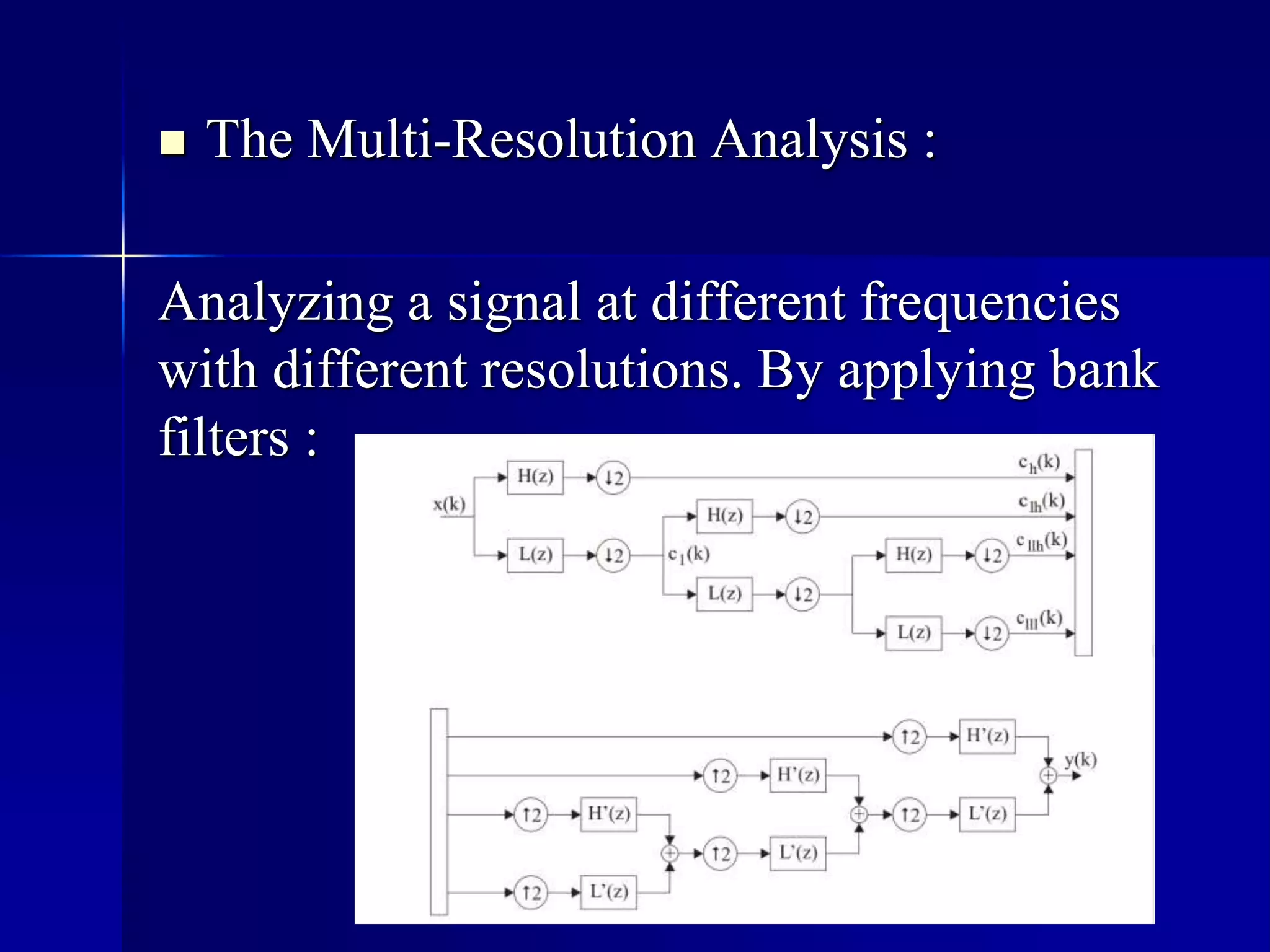
 The Multi-Resolution Analysis :
Analyzing a signal at different frequencies
with different resolutions. By applying bank
filters :
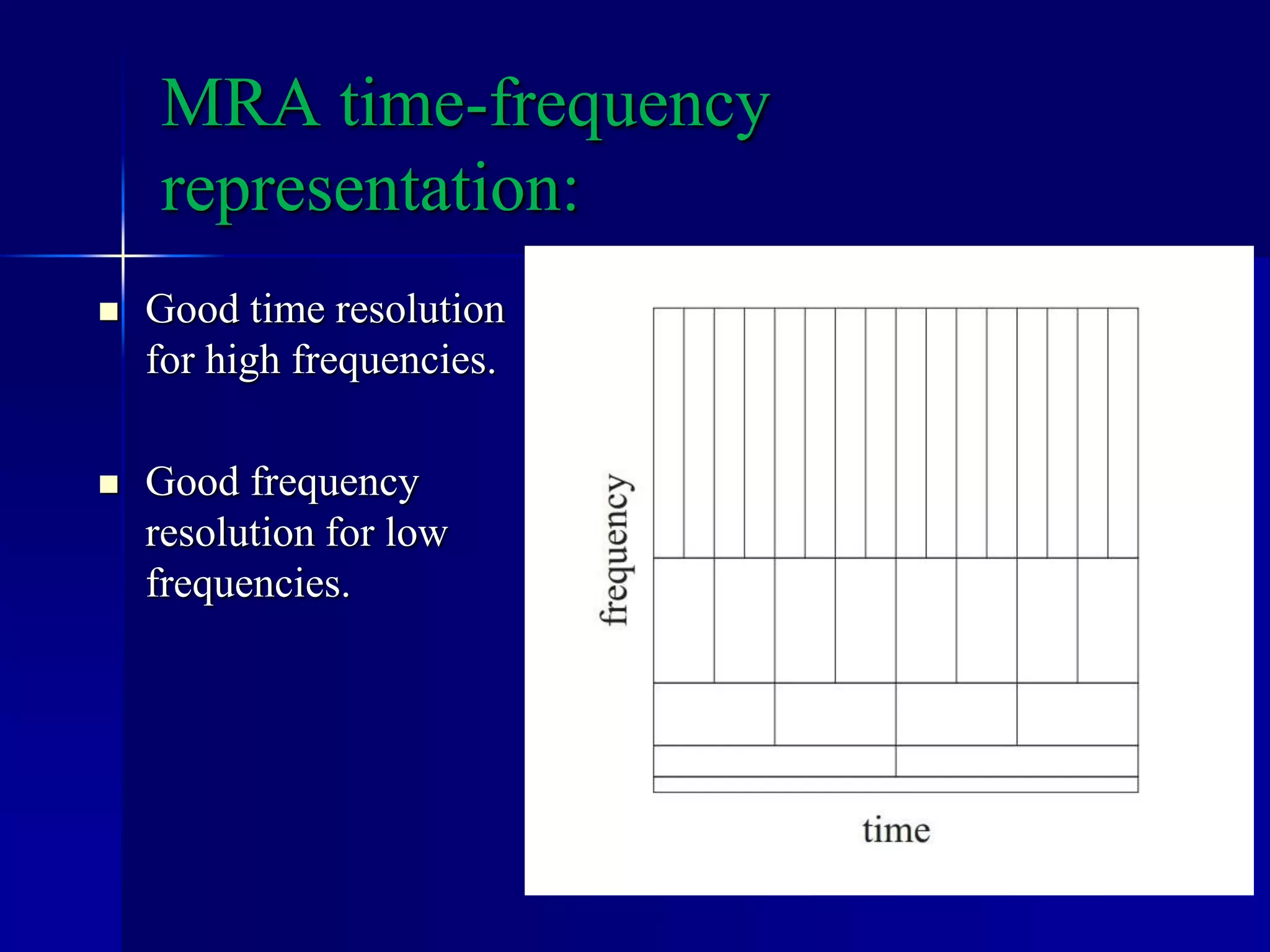
MRA time-frequency
representation:
 Good time resolution
for high frequencies.
 Good frequency
resolution for low
frequencies.
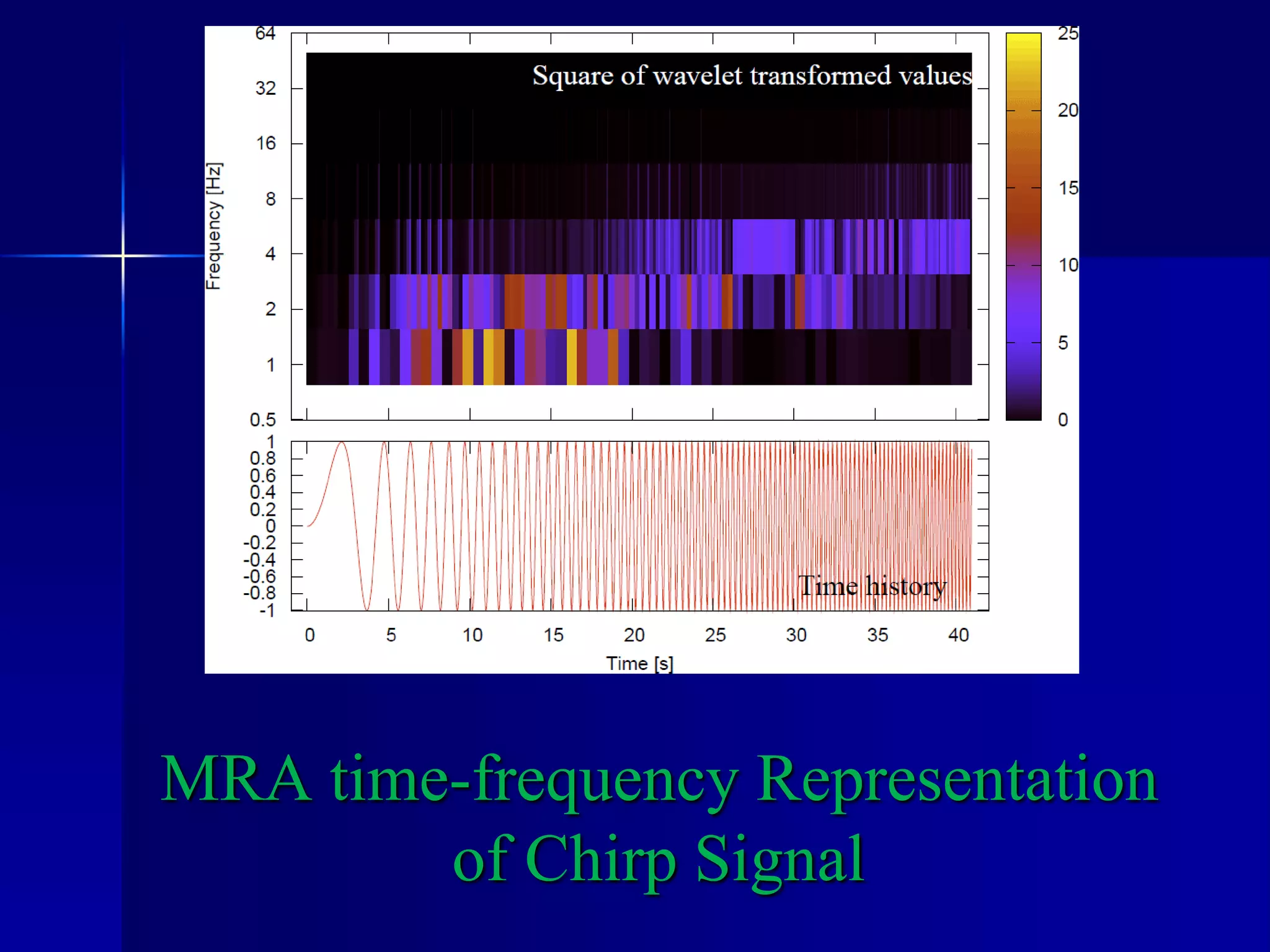
MRA time-frequency Representation
of Chirp Signal
 Overview
 Historical Development
 Limitations of Fourier Transform
 Principle of Wavelet Transform
 Examples of Applications
 Conclusion
 References
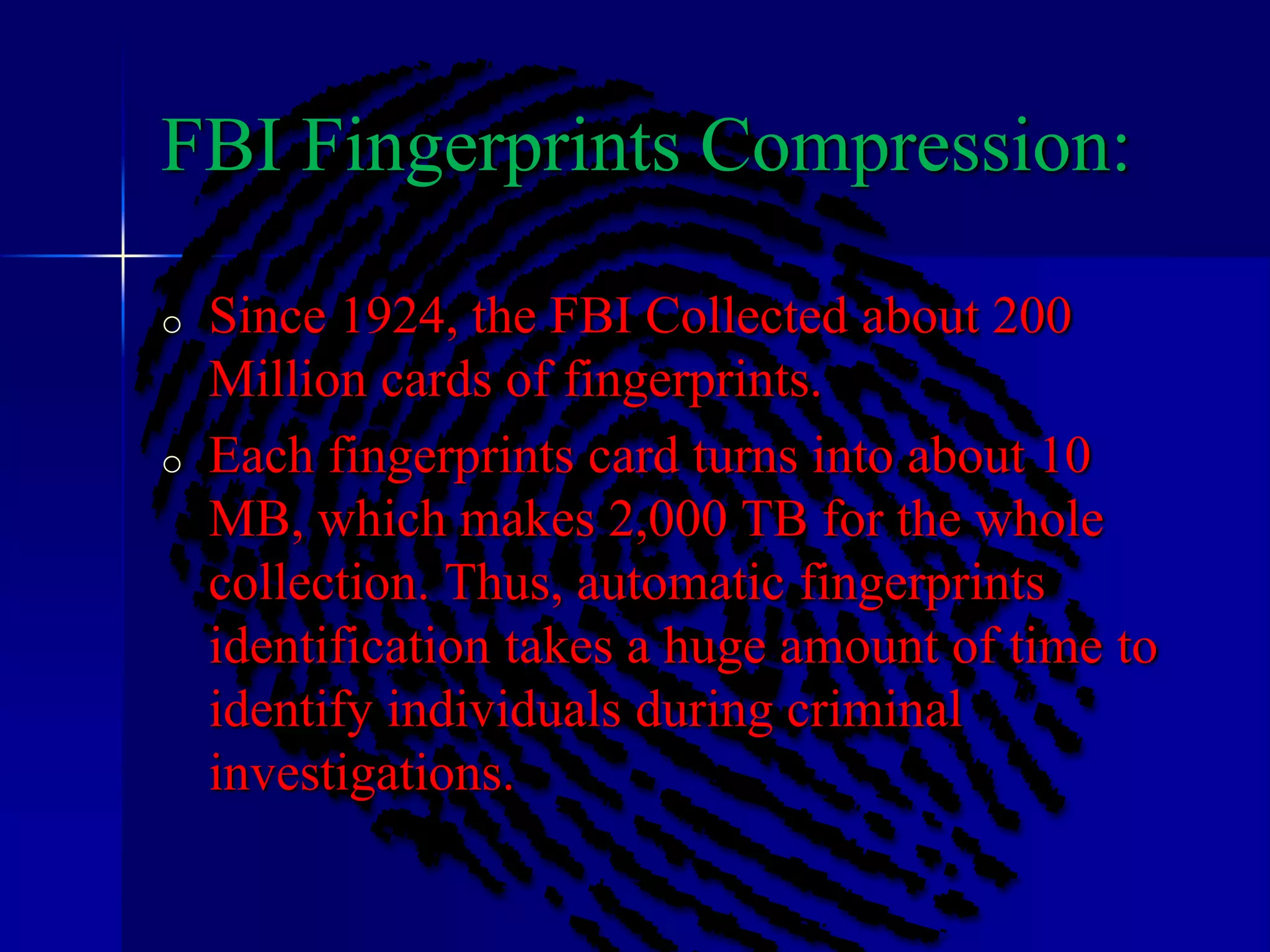
FBI Fingerprints Compression:
o Since 1924, the FBI Collected about 200
Million cards of fingerprints.
o Each fingerprints card turns into about 10
MB, which makes 2,000 TB for the whole
collection. Thus, automatic fingerprints
identification takes a huge amount of time to
identify individuals during criminal
investigations.
 The FBI decided to adopt a wavelet-based
image coding algorithm as a national
standard for digitized fingerprint records.
 The WSQ (Wavelet/Scalar Quantization) developed and
maintained by the FBI, Los Alamos National Lab, and
the National Institute for Standards and Technology
involves:
• 2-dimensional discrete wavelet transform DWT.
• Uniform scalar quantization.
• Huffman entropy coding.
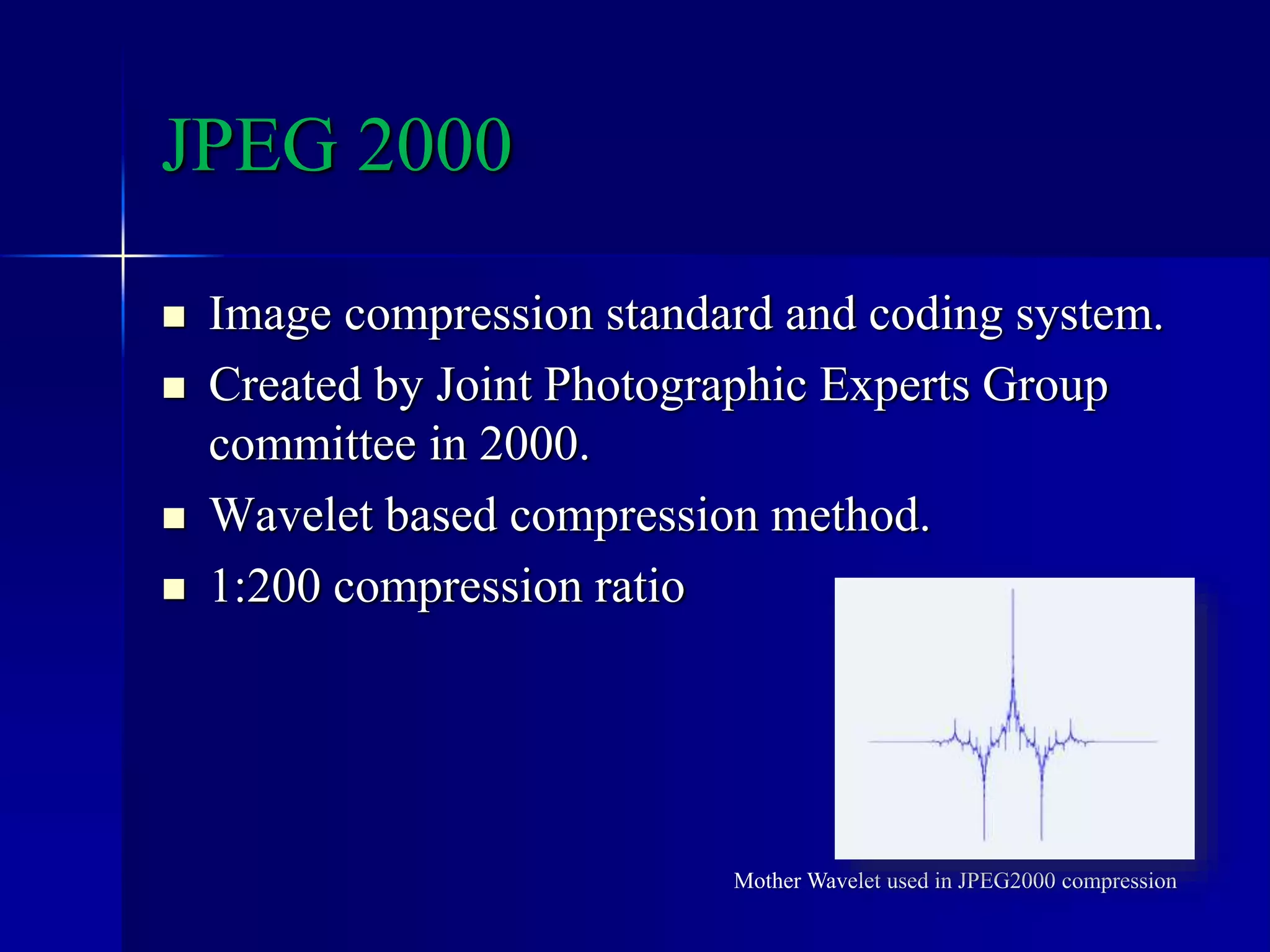
JPEG 2000
 Image compression standard and coding system.
 Created by Joint Photographic Experts Group
committee in 2000.
 Wavelet based compression method.
 1:200 compression ratio
Mother Wavelet used in JPEG2000 compression
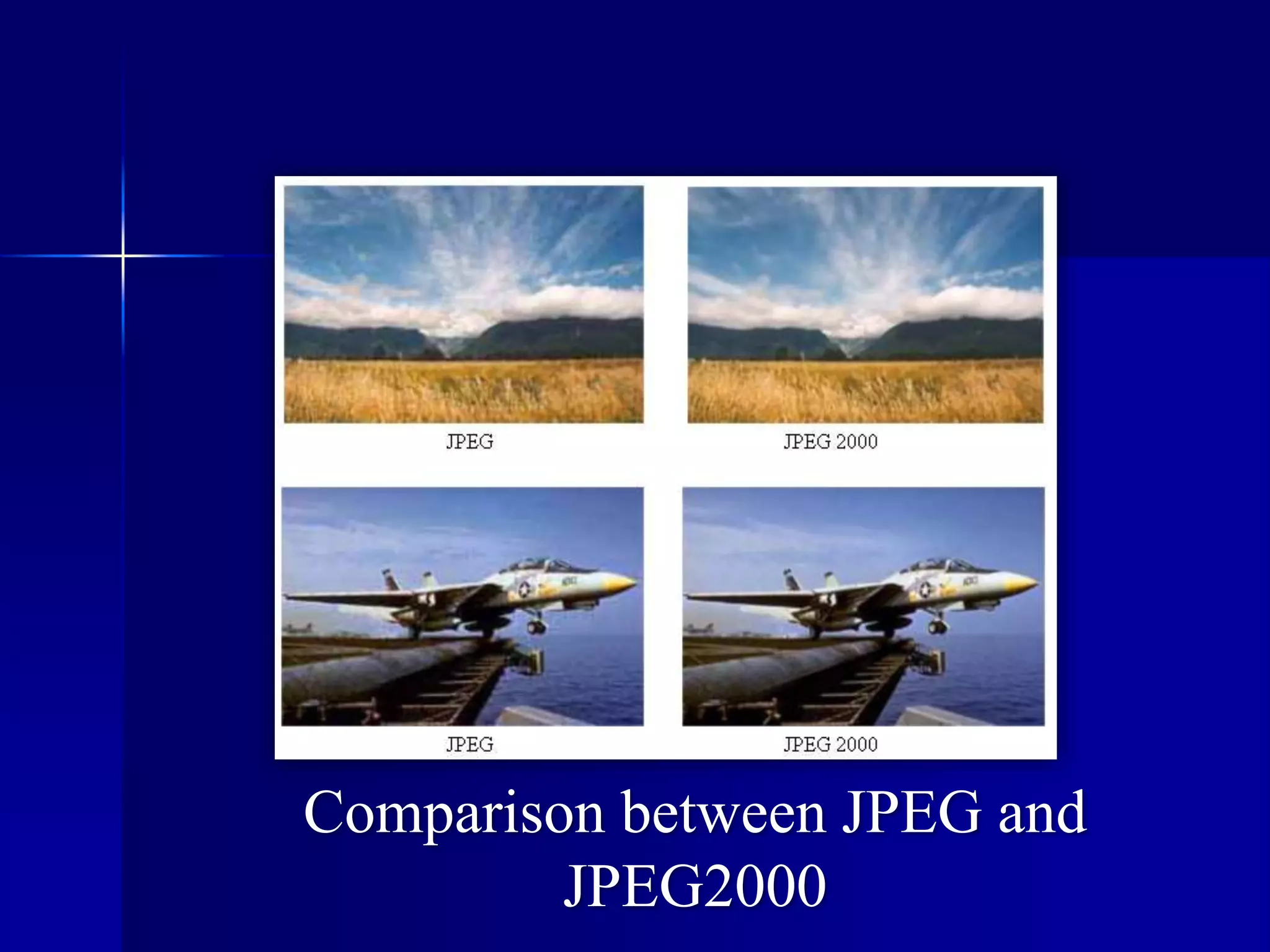
Comparison between JPEG and
JPEG2000
Wavelets can be applied for many
different purposes :
 Audio compression.
 Speech recognition.
 Image and video compression
 Denoising Signals
 Motion Detection and tracking
 Overview
 Historical Development
 Limitations of Fourier Transform
 Principle of Wavelet Transform
 Examples of Applications
 Conclusion
 References
Wavelet is a relatively new theory, it has enjoyed
a tremendous attention and success over the last
decade, and for a good reason.
Almost all signals encountred in practice call for a
time-frequency analysis, and wavelets provide a
very simple and efficient way to perform such an
analysis.
Still, there’s a lot to discover in this new theory,
due to the infinite variety of non-stationary signals
encountred in real life.
Conclusion :
 Overview
 Historical Development
 Limitations of Fourier Transform
 Principle of Wavelet Transform
 Examples of Applications
 Conclusion
 References
References :
 [1] :https://www. en.wikipedia.org/wiki/Wavelet.
 [2] : Introduction to Wavelet : Bhushan D Patil PhD Research Scholar.
 [3] : Introduction to Wavelets : Amara Graps : http:www.ieee.org.
 [4] : The FBI Wavelet : Los Alamos National Laboratory – TOM Hopper
–.
 [5] : Some Applications of Wavelets : Anna Rapoport.
 [6] : https://www.en.wikipedia.org/wiki/Daubechies_wavelet
 [7] : http://en.wikipedia.org/wiki/Chirp
 [8]: http://en.wikipedia.org/wiki/Haar_wavelet
 [9]: http://en.wikipedia.org/wiki/Discrete_wavelet_transform
 [10] : Chapter 2, Wavelets Theory and applications for manufacturing,
by Gao, R.X.; Yan, R.

Introduction to Wavelet Transform with Applications to DSP

  • 1.
  • 2.
    Introduction to Wavelet Transformwith Applications to DSP Hicham BERKOUK Tarek Islam SADMI E08/Computer Engineering IGEE – Boumerdes.
  • 3.
    OUTLINE  Overview  HistoricalDevelopment  Limitations of Fourier Transform  Principle of Wavelet Transform  Examples of Applications  Conclusion  References
  • 4.
     Overview  HistoricalDevelopment  Limitations of Fourier Transform  Principle of Wavelet Transform  Examples of Applications  Conclusion  References
  • 5.
    Overview: What does Waveletmean? Oxford Dictionary: A wavelet is a small wave. Wikipedia: A wavelet is a mathematical function used to divide a given function or continuous-time signal into different scale components. A Wavelet Transform is the representation of a function by wavelets.
  • 6.
    Advantages of usingWavelets:  Provide a way for analysing waveforms in both frequency and duration.  Representation of functions that have discontinuities and sharp peaks.  Accurately deconstructing and reconstructing finite, non-periodic and/or non-stationary signals.  Allow signals to be stored more efficiently than by Fourier transform.
  • 7.
     Overview  HistoricalDevelopment  Limitations of Fourier Transform  Principle of Wavelet Transform  Examples of Applications  Conclusion  References
  • 8.
    Historical Development:  1909: Alfred Haar – Dissertation “On the Orthogonal Function Systems” for his Doctoral Degree. The first wavelet related theory .  1910 : Alfred Haar : Development of a set of rectangular basis functions.  1930s : - Paul Levy investigated “The Brownian Motion”. - Littlewood and Paley worked on localizing the contributing energies of a function.  1946 : Dennis Gabor : Used Short Time Fourier Transform .  1975 : George Zweig : The first Continuous Wavelet Transform CWT.
  • 9.
     1985 :Yves Meyer : Construction of orthogonal wavelet basis functions with very good time and frequency localization.  1986 : Stephane Mallat : Developing the Idea of Multiresolution Analysis “MRA” for Discrete Wavelet Transform “DWT”.  1988 : The Modern Wavelet Theory with Daubechies and Mallat.  1992 : Albert Cohen, Jean fauveaux and Daubechies constructed the compactly supported biorthogonal wavelets.
  • 11.
     Overview  HistoricalDevelopment  Limitations of Fourier Transform  Principle of Wavelet Transform  Examples of Applications  Conclusion  References
  • 12.
    Limitations of FourierTransform:  To show the limitations of Fourier Transform, we chose a well-known signal in SONAR and RADAR applications, called the Chirp.  A Chirp is a signal in which the frequency increases (‘up-chirp’) or decreases (‘down- chirp’).
  • 13.
    Fourier Transform ofChirp Signals:
  • 14.
     Different intime but same frequency representation!!!  Fourier Transform only gives what frequency components exist in a signal.  Fourier Transform cannot tell at what time the frequency components occur.  However, Time-Frequency representation is needed in most cases.
  • 15.
  • 16.
  • 17.
     Overview  HistoricalDevelopment  Limitations of Fourier Transform  Principle of Wavelet Transform  Examples of Applications  Conclusion  References
  • 18.
    Principle of WaveletTransform:  The Continuous Wavelet Transform is given by : 𝑋 𝑊𝑇 τ, 𝑠 = 1 𝑠 −∞ +∞ 𝑥 𝑡 ѱ∗ 𝑡 − τ 𝑠 𝑑𝑡 Where: • τ is the translation parameter. • s is the scale parameter. • ψ is the Mother Wavelet.
  • 19.
     Here aresome of the most popular mother wavelets :
  • 20.
    Each Mother Wavelethas its own equation :  Haar’s basis equation :  Daubechies’ basis equation:  Morlet’s (Mexican Hat) basis equation:
  • 21.
    Steps to computeCWT of a given signal : 1. Take a wavelet and compare it to section at the start of the original signal, and calculate a correlation coefficient C.
  • 22.
    2. Shift thewavelet to the right and repeat step 1 until the whole signal is covered.
  • 23.
    3. Scale (stretch)the wavelet and repeat steps 1 through 2. 4. Repeat steps 1 through 3 for all scales.
  • 24.
    Time-frequency representation of« up-chirp » signal using CWT :
  • 25.
     The DiscreteWavelet Transform (DWT) is given by: 𝑔 𝑡 = 𝑚∊ℤ 𝑛∊ℤ 𝑥, ѱ 𝑚,𝑛 . ѱ 𝑚,𝑛[𝑡] Where : ѱ 𝑚,𝑛 𝑡 = 𝑠0 −𝑚/2 ѱ(𝑠0 −𝑚 𝑡 − 𝑛τ0).
  • 26.
     The Multi-ResolutionAnalysis : Analyzing a signal at different frequencies with different resolutions. By applying bank filters :
  • 27.
    MRA time-frequency representation:  Goodtime resolution for high frequencies.  Good frequency resolution for low frequencies.
  • 28.
  • 29.
     Overview  HistoricalDevelopment  Limitations of Fourier Transform  Principle of Wavelet Transform  Examples of Applications  Conclusion  References
  • 31.
    FBI Fingerprints Compression: oSince 1924, the FBI Collected about 200 Million cards of fingerprints. o Each fingerprints card turns into about 10 MB, which makes 2,000 TB for the whole collection. Thus, automatic fingerprints identification takes a huge amount of time to identify individuals during criminal investigations.
  • 32.
     The FBIdecided to adopt a wavelet-based image coding algorithm as a national standard for digitized fingerprint records.  The WSQ (Wavelet/Scalar Quantization) developed and maintained by the FBI, Los Alamos National Lab, and the National Institute for Standards and Technology involves: • 2-dimensional discrete wavelet transform DWT. • Uniform scalar quantization. • Huffman entropy coding.
  • 33.
    JPEG 2000  Imagecompression standard and coding system.  Created by Joint Photographic Experts Group committee in 2000.  Wavelet based compression method.  1:200 compression ratio Mother Wavelet used in JPEG2000 compression
  • 34.
  • 35.
    Wavelets can beapplied for many different purposes :  Audio compression.  Speech recognition.  Image and video compression  Denoising Signals  Motion Detection and tracking
  • 36.
     Overview  HistoricalDevelopment  Limitations of Fourier Transform  Principle of Wavelet Transform  Examples of Applications  Conclusion  References
  • 37.
    Wavelet is arelatively new theory, it has enjoyed a tremendous attention and success over the last decade, and for a good reason. Almost all signals encountred in practice call for a time-frequency analysis, and wavelets provide a very simple and efficient way to perform such an analysis. Still, there’s a lot to discover in this new theory, due to the infinite variety of non-stationary signals encountred in real life. Conclusion :
  • 38.
     Overview  HistoricalDevelopment  Limitations of Fourier Transform  Principle of Wavelet Transform  Examples of Applications  Conclusion  References
  • 39.
    References :  [1]:https://www. en.wikipedia.org/wiki/Wavelet.  [2] : Introduction to Wavelet : Bhushan D Patil PhD Research Scholar.  [3] : Introduction to Wavelets : Amara Graps : http:www.ieee.org.  [4] : The FBI Wavelet : Los Alamos National Laboratory – TOM Hopper –.  [5] : Some Applications of Wavelets : Anna Rapoport.  [6] : https://www.en.wikipedia.org/wiki/Daubechies_wavelet  [7] : http://en.wikipedia.org/wiki/Chirp  [8]: http://en.wikipedia.org/wiki/Haar_wavelet  [9]: http://en.wikipedia.org/wiki/Discrete_wavelet_transform  [10] : Chapter 2, Wavelets Theory and applications for manufacturing, by Gao, R.X.; Yan, R.