Wavelet Analysis
By Sam Luxenberg
23rd March 2017, Tel Aviv
INTRODUCTION TO WAVELETS
Applications:
▪ Data Compression
▪ Signal Analysis
▪ Smoothing/De-noising Data
▪ Modeling Abrupt Changes
▪ Pattern Recognition
▪ Solutions to Partial Differential Equations
WAVELETS AND FINANCIAL MARKETS
▪Markets are complex chaotic systems that have self-similarity properties.
▪Financial signals can be thought of as fractal signals having self-similarity properties
which allows for analysis with wavelets.
SIGNAL PROCESSING AND ANALYSIS
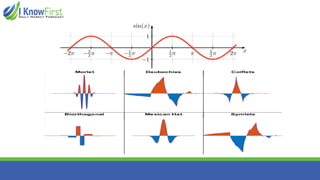
▪ The conventional tool is Fourier Analysis which can represent a signal (e.g. audio
signal, images, seismic signal, financial signal) as a sum of sinusoids (think cosine and
sine curves).
▪ We may be interested in certain cyclic or frequency components present in a signal.
▪ The Fourier Transform allows us to study the signal not just as it relates to time, but
also these frequency components.
REPRESENTATION OF SIGNALS
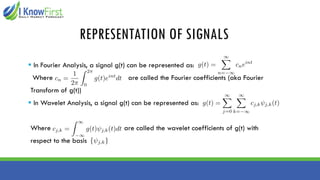
▪ In Fourier Analysis, a signal g(t) can be represented as:
Where are called the Fourier coefficients (aka Fourier
Transform of g(t))
▪ In Wavelet Analysis, a signal g(t) can be represented as:
Where are called the wavelet coefficients of g(t) with
respect to the basis
SIGNAL PROCESSING AND ANALYSIS
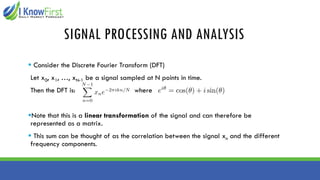
▪ Consider the Discrete Fourier Transform (DFT)
Let x0, x1, …, xN-1 be a signal sampled at N points in time.
Then the DFT is: where
▪Note that this is a linear transformation of the signal and can therefore be
represented as a matrix.
▪ This sum can be thought of as the correlation between the signal xn and the different
frequency components.
SIGNAL PROCESSING AND ANALYSIS
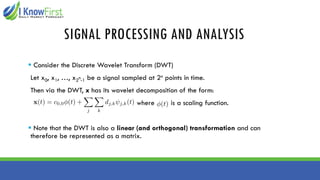
▪ Consider the Discrete Wavelet Transform (DWT)
Let x0, x1, …, x2n-1 be a signal sampled at 2n points in time.
Then via the DWT, x has its wavelet decomposition of the form:
where is a scaling function.
▪ Note that the DWT is also a linear (and orthogonal) transformation and can
therefore be represented as a matrix.
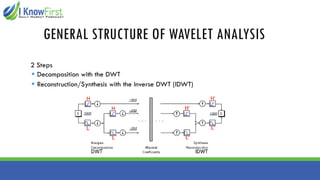
GENERAL STRUCTURE OF WAVELET ANALYSIS
2 Steps
▪ Decomposition with the DWT
▪ Reconstruction/Synthesis with the Inverse DWT (IDWT)
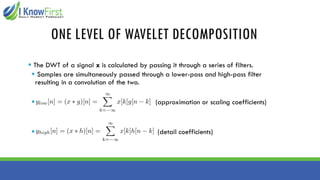
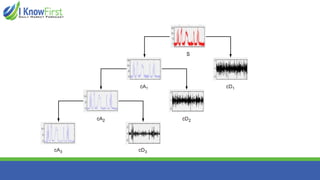
ONE LEVEL OF WAVELET DECOMPOSITION
▪ The DWT of a signal x is calculated by passing it through a series of filters.
▪ Samples are simultaneously passed through a lower-pass and high-pass filter
resulting in a convolution of the two.
▪ (approximation or scaling coefficients)
▪ (detail coefficients)
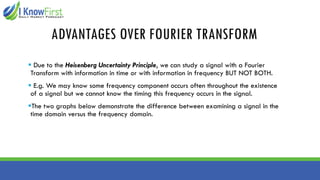
ADVANTAGES OVER FOURIER TRANSFORM
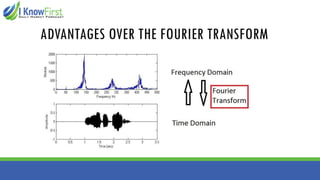
▪ Due to the Heisenberg Uncertainty Principle, we can study a signal with a Fourier
Transform with information in time or with information in frequency BUT NOT BOTH.
▪ E.g. We may know some frequency component occurs often throughout the existence
of a signal but we cannot know the timing this frequency occurs in the signal.
▪The two graphs below demonstrate the difference between examining a signal in the
time domain versus the frequency domain.
ADVANTAGES OVER THE FOURIER TRANSFORM
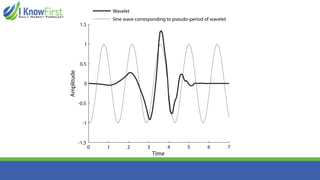
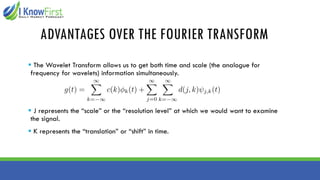
▪ The Wavelet Transform allows us to get both time and scale (the analogue for
frequency for wavelets) information simultaneously.
▪ J represents the “scale” or the “resolution level” at which we would want to examine
the signal.
▪ K represents the “translation” or “shift” in time.
ADVANTAGES OVER THE FOURIER TRANSFORM
▪ The Fourier Transform does NOT represent abrupt changes efficiently
▪ To accurately analyze signals and images with abrupt changes, use the wavelet
transform which is localized in time and frequency
WAVELET ANALYSIS AND TIME SERIES
“Time Series Forecasts Via Wavelets: An Application to Car Sales in the Spanish
Market” by Miguel Ariño, Ph.D.
GENERAL OUTLINE
▪ We will first forecast the time series using conventional time series modeling tools
such as Autoregressive Integrated Moving Average (ARIMA) and Seasonal ARIMA
(SARIMA).
▪ We want to compare the accuracy of these forecasts to forecasts combining wavelet
analysis and ARIMA models.
COMBINING WAVELET ANALYSIS AND ARIMA
▪ Decompose the time series into its long-term trend and seasonal component using
wavelet decomposition and reconstruction.
▪ Using ARIMA models, forecast each component separately.
▪ Combine these forecasted components to get the forecast for the original time series.
DATA
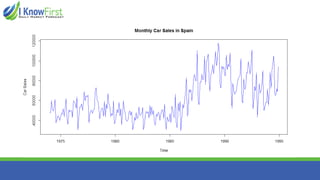
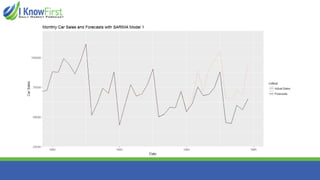
▪ Monthly Car Sales in Spain from January 1974 to December 1994.
▪ 252 total observations
▪ We will use the first 240 observations to build the models and the last 12 to
compare our forecasts with the actual number of sales during 1994.
ARIMA MODELS
▪ There are general rules of thumb to follow when identifying ARIMA models.
▪ Examine the Autocorrelation (correlation between each observation and the past
observations) and Partial Autocorrelation (correlation not accounted for by lags in-
between)
▪ Take differences (if necessary) to remove non-stationarity of the time series
▪ Two good models describe our time series:
▪ ARIMA(0, 1, 1)x(0, 1, 1)12
▪ ARIMA(2, 1, 0)x(0, 1, 1)12
ARIMA (0, 1, 1) X (0, 1, 1)12
▪ While both models give similar forecasts, the first model is simpler so we will use this
one.
▪ No AR component, 1 non-seasonal difference, 1 moving average component
▪ No seasonal AR component, 1 seasonal difference, 1 seasonal moving average
component with seasonal frequency being 12 months
▪ The out-of-sample root mean square error (RMSE) is 16,963.9
WAVELET MODEL – PREPARING TO USE DWT
▪ In order to use the DWT, we need the number of data points to be a power of 2
▪ Center the time series by subtracting its mean 60,603
▪ This centered or zero-mean series is called x = (xt)
▪ Daubechies of order 8 Wavelet basis
WAVELET MODEL - DWT
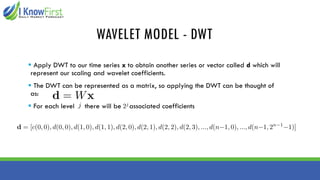
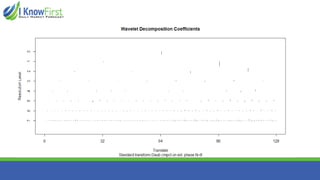
▪ Apply DWT to our time series x to obtain another series or vector called d which will
represent our scaling and wavelet coefficients.
▪ The DWT can be represented as a matrix, so applying the DWT can be thought of
as:
▪ For each level there will be associated coefficients
LONG-TERM TREND AND SEASONAL COMPONENT
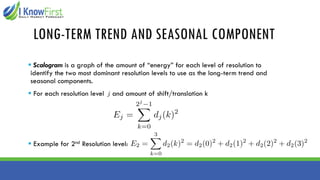
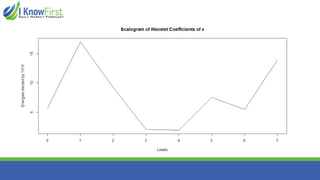
▪ Scalogram is a graph of the amount of “energy” for each level of resolution to
identify the two most dominant resolution levels to use as the long-term trend and
seasonal components.
▪ For each resolution level and amount of shift/translation k
▪ Example for 2nd Resolution level:
SPLITTING THE COEFFICIENTS INTO 2 SETS
▪ There are two major peaks in the scalogram at levels 1 (7th decomposition) and 7
(1st decomposition).
▪ Existence of peaks at high or low levels indicates the existence of high or low
frequency components.
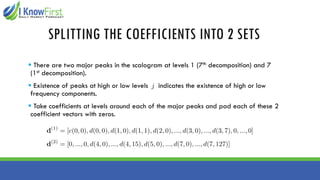
▪ Take coefficients at levels around each of the major peaks and pad each of these 2
coefficient vectors with zeros.
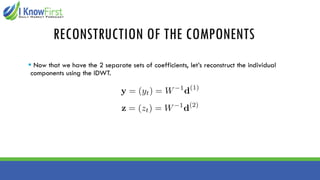
RECONSTRUCTION OF THE COMPONENTS
▪ Now that we have the 2 separate sets of coefficients, let’s reconstruct the individual
components using the IDWT.
BACK TO FORECASTING
▪ We have decomposed our time series into simpler and easier-to-forecast
components.
▪ In order to forecast y we need to add back in the mean of the original time series
that we subtracted before doing the wavelet analysis.
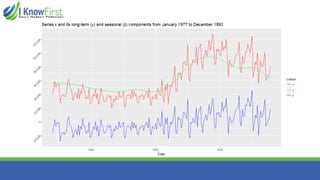
▪ Decomposition and Reconstruction on the boundary
▪ Delete first 36 and last 16 data points of each of our series x, y, and z.
▪ Left with car sales from January 1977 to December 1993
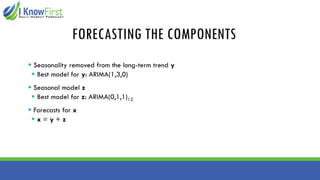
FORECASTING THE COMPONENTS
▪ Seasonality removed from the long-term trend y
▪ Best model for y: ARIMA(1,3,0)
▪ Seasonal model z
▪ Best model for z: ARIMA(0,1,1)12
▪ Forecasts for x
▪ x = y + z
COMPARISON OF THE MODELS
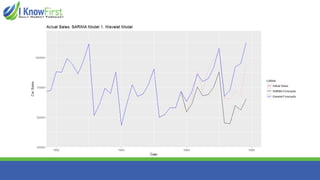
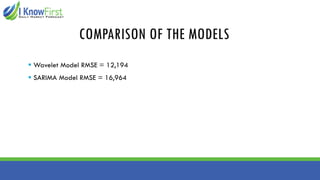
▪ Wavelet Model RMSE = 12,194
▪ SARIMA Model RMSE = 16,964
POTENTIAL APPLICATIONS FOR I KNOW FIRST
▪ Could provide more confidence to investment forecasts
▪ Overlay current forecasting systems on top of each of the decomposed wavelet
components.
▪ Wavelet analysis does not have to be constrained to 1-dimensional problems
▪Could be used for n-dimensional problems which could include considering an entire
portfolio of investments.
USEFUL RESOURCES
▪ Wavelet Toolbox User’s Guide
▪http://web.mit.edu/1.130/WebDocs/wavelet_ug.pdf
▪The Discrete Wavelet Transform in S
▪http://www.stat.ucla.edu/~cocteau/stat204/readings/nasonsilverman.pdf
▪Wavelet Scalograms and Their Applications in Economic Time Series
▪https://www.ime.usp.br/~pam/amv.pdf
▪“Conceptual Wavelets in Digital Signal Processing: An In-Depth, Practical Approach
for the Non-Mathematician” by D. Lee Fugal

Financial Forecasting Using Wavelet Analysis

  • 1.
    Wavelet Analysis By SamLuxenberg 23rd March 2017, Tel Aviv
  • 2.
    INTRODUCTION TO WAVELETS Applications: ▪Data Compression ▪ Signal Analysis ▪ Smoothing/De-noising Data ▪ Modeling Abrupt Changes ▪ Pattern Recognition ▪ Solutions to Partial Differential Equations
  • 3.
    WAVELETS AND FINANCIALMARKETS ▪Markets are complex chaotic systems that have self-similarity properties. ▪Financial signals can be thought of as fractal signals having self-similarity properties which allows for analysis with wavelets.
  • 4.
    SIGNAL PROCESSING ANDANALYSIS ▪ The conventional tool is Fourier Analysis which can represent a signal (e.g. audio signal, images, seismic signal, financial signal) as a sum of sinusoids (think cosine and sine curves). ▪ We may be interested in certain cyclic or frequency components present in a signal. ▪ The Fourier Transform allows us to study the signal not just as it relates to time, but also these frequency components.
  • 5.
    REPRESENTATION OF SIGNALS ▪In Fourier Analysis, a signal g(t) can be represented as: Where are called the Fourier coefficients (aka Fourier Transform of g(t)) ▪ In Wavelet Analysis, a signal g(t) can be represented as: Where are called the wavelet coefficients of g(t) with respect to the basis
  • 6.
    SIGNAL PROCESSING ANDANALYSIS ▪ Consider the Discrete Fourier Transform (DFT) Let x0, x1, …, xN-1 be a signal sampled at N points in time. Then the DFT is: where ▪Note that this is a linear transformation of the signal and can therefore be represented as a matrix. ▪ This sum can be thought of as the correlation between the signal xn and the different frequency components.
  • 7.
    SIGNAL PROCESSING ANDANALYSIS ▪ Consider the Discrete Wavelet Transform (DWT) Let x0, x1, …, x2n-1 be a signal sampled at 2n points in time. Then via the DWT, x has its wavelet decomposition of the form: where is a scaling function. ▪ Note that the DWT is also a linear (and orthogonal) transformation and can therefore be represented as a matrix.
  • 10.
    GENERAL STRUCTURE OFWAVELET ANALYSIS 2 Steps ▪ Decomposition with the DWT ▪ Reconstruction/Synthesis with the Inverse DWT (IDWT)
  • 11.
    ONE LEVEL OFWAVELET DECOMPOSITION ▪ The DWT of a signal x is calculated by passing it through a series of filters. ▪ Samples are simultaneously passed through a lower-pass and high-pass filter resulting in a convolution of the two. ▪ (approximation or scaling coefficients) ▪ (detail coefficients)
  • 13.
    ADVANTAGES OVER FOURIERTRANSFORM ▪ Due to the Heisenberg Uncertainty Principle, we can study a signal with a Fourier Transform with information in time or with information in frequency BUT NOT BOTH. ▪ E.g. We may know some frequency component occurs often throughout the existence of a signal but we cannot know the timing this frequency occurs in the signal. ▪The two graphs below demonstrate the difference between examining a signal in the time domain versus the frequency domain.
  • 14.
    ADVANTAGES OVER THEFOURIER TRANSFORM
  • 15.
    ADVANTAGES OVER THEFOURIER TRANSFORM ▪ The Wavelet Transform allows us to get both time and scale (the analogue for frequency for wavelets) information simultaneously. ▪ J represents the “scale” or the “resolution level” at which we would want to examine the signal. ▪ K represents the “translation” or “shift” in time.
  • 16.
    ADVANTAGES OVER THEFOURIER TRANSFORM ▪ The Fourier Transform does NOT represent abrupt changes efficiently ▪ To accurately analyze signals and images with abrupt changes, use the wavelet transform which is localized in time and frequency
  • 17.
    WAVELET ANALYSIS ANDTIME SERIES “Time Series Forecasts Via Wavelets: An Application to Car Sales in the Spanish Market” by Miguel Ariño, Ph.D.
  • 18.
    GENERAL OUTLINE ▪ Wewill first forecast the time series using conventional time series modeling tools such as Autoregressive Integrated Moving Average (ARIMA) and Seasonal ARIMA (SARIMA). ▪ We want to compare the accuracy of these forecasts to forecasts combining wavelet analysis and ARIMA models.
  • 19.
    COMBINING WAVELET ANALYSISAND ARIMA ▪ Decompose the time series into its long-term trend and seasonal component using wavelet decomposition and reconstruction. ▪ Using ARIMA models, forecast each component separately. ▪ Combine these forecasted components to get the forecast for the original time series.
  • 20.
    DATA ▪ Monthly CarSales in Spain from January 1974 to December 1994. ▪ 252 total observations ▪ We will use the first 240 observations to build the models and the last 12 to compare our forecasts with the actual number of sales during 1994.
  • 22.
    ARIMA MODELS ▪ Thereare general rules of thumb to follow when identifying ARIMA models. ▪ Examine the Autocorrelation (correlation between each observation and the past observations) and Partial Autocorrelation (correlation not accounted for by lags in- between) ▪ Take differences (if necessary) to remove non-stationarity of the time series ▪ Two good models describe our time series: ▪ ARIMA(0, 1, 1)x(0, 1, 1)12 ▪ ARIMA(2, 1, 0)x(0, 1, 1)12
  • 23.
    ARIMA (0, 1,1) X (0, 1, 1)12 ▪ While both models give similar forecasts, the first model is simpler so we will use this one. ▪ No AR component, 1 non-seasonal difference, 1 moving average component ▪ No seasonal AR component, 1 seasonal difference, 1 seasonal moving average component with seasonal frequency being 12 months ▪ The out-of-sample root mean square error (RMSE) is 16,963.9
  • 25.
    WAVELET MODEL –PREPARING TO USE DWT ▪ In order to use the DWT, we need the number of data points to be a power of 2 ▪ Center the time series by subtracting its mean 60,603 ▪ This centered or zero-mean series is called x = (xt) ▪ Daubechies of order 8 Wavelet basis
  • 26.
    WAVELET MODEL -DWT ▪ Apply DWT to our time series x to obtain another series or vector called d which will represent our scaling and wavelet coefficients. ▪ The DWT can be represented as a matrix, so applying the DWT can be thought of as: ▪ For each level there will be associated coefficients
  • 28.
    LONG-TERM TREND ANDSEASONAL COMPONENT ▪ Scalogram is a graph of the amount of “energy” for each level of resolution to identify the two most dominant resolution levels to use as the long-term trend and seasonal components. ▪ For each resolution level and amount of shift/translation k ▪ Example for 2nd Resolution level:
  • 30.
    SPLITTING THE COEFFICIENTSINTO 2 SETS ▪ There are two major peaks in the scalogram at levels 1 (7th decomposition) and 7 (1st decomposition). ▪ Existence of peaks at high or low levels indicates the existence of high or low frequency components. ▪ Take coefficients at levels around each of the major peaks and pad each of these 2 coefficient vectors with zeros.
  • 31.
    RECONSTRUCTION OF THECOMPONENTS ▪ Now that we have the 2 separate sets of coefficients, let’s reconstruct the individual components using the IDWT.
  • 32.
    BACK TO FORECASTING ▪We have decomposed our time series into simpler and easier-to-forecast components. ▪ In order to forecast y we need to add back in the mean of the original time series that we subtracted before doing the wavelet analysis. ▪ Decomposition and Reconstruction on the boundary ▪ Delete first 36 and last 16 data points of each of our series x, y, and z. ▪ Left with car sales from January 1977 to December 1993
  • 34.
    FORECASTING THE COMPONENTS ▪Seasonality removed from the long-term trend y ▪ Best model for y: ARIMA(1,3,0) ▪ Seasonal model z ▪ Best model for z: ARIMA(0,1,1)12 ▪ Forecasts for x ▪ x = y + z
  • 36.
    COMPARISON OF THEMODELS ▪ Wavelet Model RMSE = 12,194 ▪ SARIMA Model RMSE = 16,964
  • 37.
    POTENTIAL APPLICATIONS FORI KNOW FIRST ▪ Could provide more confidence to investment forecasts ▪ Overlay current forecasting systems on top of each of the decomposed wavelet components. ▪ Wavelet analysis does not have to be constrained to 1-dimensional problems ▪Could be used for n-dimensional problems which could include considering an entire portfolio of investments.
  • 38.
    USEFUL RESOURCES ▪ WaveletToolbox User’s Guide ▪http://web.mit.edu/1.130/WebDocs/wavelet_ug.pdf ▪The Discrete Wavelet Transform in S ▪http://www.stat.ucla.edu/~cocteau/stat204/readings/nasonsilverman.pdf ▪Wavelet Scalograms and Their Applications in Economic Time Series ▪https://www.ime.usp.br/~pam/amv.pdf ▪“Conceptual Wavelets in Digital Signal Processing: An In-Depth, Practical Approach for the Non-Mathematician” by D. Lee Fugal