International Research Journal of Engineering and Technology (IRJET) e-ISSN: 2395-0056
Volume: 09 Issue: 10 | Oct 2022 www.irjet.net p-ISSN: 2395-0072
© 2022, IRJET | Impact Factor value: 7.529 | ISO 9001:2008 Certified Journal | Page 759
Area Efficient 9/7 Wavelet Coefficient based 2-D DWT using Modified
CSLA Technique
Megha Chaturvedi1, Prof. Gurpreet Singh2
1 Research Scholar, Trinity Institute of Technology & Research, Bhopal, India
2 Professor Electronics’ & Communication Dept., Trinity Institute of Technology & Research, Bhopal, India
---------------------------------------------------------------------***---------------------------------------------------------------------
Abstract - The DWT is expressed in a generalized form
know as discrete wavelet transform which analyzes both the
low and high sub bands at every levelof breakdownwithequal
priority. A pragmatic approach to signal processing is
provided by the DWT mathematical technique. It is frequently
utilized in many signal and image processing applications
because of its many beneficial qualities, suchasadaptivetime-
frequency window, decreased aliasing distortion, andefficient
computing complexity. In order to compress images and
videos, 2-D DWT is frequently utilized. But in some DWT
architectures, flipping approach adds considerable design
complexity. In order to give multiplier-less implementation
and ensure that our suggested work would function for every
bit, we have included the BK adder and MDA approach. In
comparison to the previous approach, the suggestedMDA and
MCSLA-based 2-D DWT algorithm exhibits goodperformance.
The suggested architecture for DWT implementation
minimizes the maximum combinational path delay while also
reducing chip size and computation time.
Key Words: VHDL Simulation, 2-D DWT, MDA, Low-pass
Sub-band (LPSB), High-pass Sub-band (HPSB)
1. INTRODUCTION
Engineering professionals choose digital signal processing
methods based on the characteristics of the signal being
studied. The two main methods utilizedcommonlyforsignal
analysis are frequency-based and time-frequency-based
methods. A stationarysignal isanalyzedusingthefrequency-
based method (FBT), while non-stationary signals are
typically analyzed using time-frequency techniques (TFT),
such as the short time Fourier transform (STFT), wavelet
transform, etc. Although no information is obtained in the
time domain, the FBT offers energy information of the
function in the frequency domain. A musical note or a
vehicle's noises are examples of non-stationary signalsfrom
which the TFT captures the transient properties and
represents them in a time-frequency map forsignal analysis.
[1, 2].
Over the years wavelet transform has emerged as a
predominant tool for time-frequency decomposition of a
signal. Wavelet is designed especially to study the non-
stationary data, and due to its generality and accurate
results, it has become useful in a number of areas. For a non-
stationary signal, the frequency content at a particular point
in time is different from the frequency content at another
point, e.g., a sudden transient [3]. The Fourier transform is
not able to specify accurately at what point in time the
transient occurs becausetheFourierbasesaresinusoidsthat
are infinite in extent and can give information only based on
the entire duration of the signal.Hence,theFourierbases are
not able to localize the important events of the signal.Onthe
contrary, wavelet has bases of finite duration, and this
property enables it to identify and locate in time the
important events in the signal which can be used to
differentiate one signal from the other efficiently [4, 5].
Wavelet analysis allows researchers to isolate and
manipulate the specific type of in formation hidden in the
data, similar to the human ear picking the sound of the flute
in a symphony. A diverse variety of wavelets can be used to
analyze a signal, the type of wavelet to be used depends on
the application. Wavelet is found in different branches from
the signal analysis to the problems in engineering, physics,
and mathematics. In the signal processing application,
wavelet is mainly used in analyzing the non-stationary
signals to provide the time-frequency information of an
important transient [6]. In the bio-medical engineering,
earth or ocean engineering the transient always carry a
significant amount of information for therespectivedomain.
The wavelet transform is found to be particularly useful for
analyzing the signals that are considered to beaperiodicand
noisy. The ability to analyze a signal distinctly both in time
and frequency simultaneously has set wavelet transform
apart from the STFT. Hence, wavelet transform is used to
investigate a variety of physical phenomena such as climate
change analysis, heart monitoring, seismicsignal de-noising,
astronomical image de-noising, video and image
compression [7, 8].
2. DISCRETE WAVELET TRANSFORM
The history of DWT goes back to the year 1976 when a
technique was invented by Croiser, Galand, and Esteban to
decompose the discrete time signals. In the same year,
Flanagan, Crochiere, and Weberconducteda similaranalysis
on the voice signal. The technique was named as sub-band
coding. Burt developeda methodknownaspyramidal coding
in 1983 that is comparable to sub-band coding, sometimes
referred to as multi-resolution analysis. The pyramidal
coding system still had redundant information thatmightbe
removed. By removing the redundant code from the
International Research Journal of Engineering and Technology (IRJET) e-ISSN: 2395-0056
Volume: 09 Issue: 10 | Oct 2022 www.irjet.net p-ISSN: 2395-0072
© 2022, IRJET | Impact Factor value: 7.529 | ISO 9001:2008 Certified Journal | Page 760
pyramidal coding in 1989, Vetterli and Le Gall improved the
sub-band coding [9]. The DWT, when compared with the
CWT is considerably easier to develop and implement.
Although the CWT can be discretized and computed for
DWT, the accurate discrete transform is not obtained. The
information provided by this sampled version of the CWT is
highly redundant. On the other hand, analyzing this
redundant information takes a lot of time and energy. The
DWT, on the other hand, speeds up processing while still
extracting enough usable data from the signal for analysis
and synthesis. The DWT decomposes the input spectrum
into two sub-bands, namely the high-pass sub band and the
low-pass sub-band. A low-pass filter is used to filter the
input signal to produce a low-pass sub-band, while a high-
pass filter is used to produce a high-pass sub-band [10]. A
finite impulse response (FIR) filter with a short length is
used to create the low-pass and high-pass filters.Thispair of
low-pass and high-pass filter form a quadraturemirrorfilter
(QMF) for the perfect signal reconstruction. The
computation of the DWT using low pass andhigh-passfilters
is performed either by the convolution scheme or lifting
scheme [11].
Fig -1: Two Level Diagram of Discrete Wavelet Transform
3. PROPOSED ARCHITECTURE
Particular focus is placed on system performanceandcostin
digital systems. Effectiveperformancetypicallycomeswitha
larger price cost. However, with a moderate increase in the
hardware, better performance canbeobtained.Inthecourse
of a computation, addition and multiplication are the
fundamental operations that are performed frequently. The
speed with which these operations are performed has a
great impact on the overall performance of the digital
system. Since the beginning of the digital computers, many
fast algorithms for the basicarithmetic operations havebeen
developed and implemented [12, 13].
There has been continuous research and development
towards the newer algorithms. The main reason for the
emerging algorithms is the rapid change in the technology
used to implement these arithmetic operations. Besides the
dependence on the technology used to implement the
algorithm, it is the unique feature of the algorithm that
affects the performance of the arithmetic operator [14].
In this stream graph, the double information is connected to
the serial in serial out register. In the DWT design, all whole
numbers are related to the twofold frame. The word length
of two pieces of information, in this case 3 down to 0, means
that the range of the information is from 0 to 15.
Fig -2: Block Diagram of 9/7 Wavelet Coefficient based
Discrete Wavelet Transform
If takes the LPS coefficients h0, h1, h2, h3, and h4 multiply by
u1, u2, u3, u4 and u5 then multiplier-less 1-D DWT LPS output
is
 


















5
4
3
2
1
4
3
2
1
0
u
u
u
u
u
h
h
h
h
h
YLPS
Where,
)
8
(
)
(
1 

 n
X
n
X
u
)
7
(
)
1
(
2 


 n
X
n
X
u
)
6
(
)
2
(
3 


 n
X
n
X
u
)
5
(
)
3
(
4 


 n
X
n
X
u
)
4
(
5 
 n
X
u
 




















5
4
3
2
1
3
2
10
34
77
u
u
u
u
u
YLPS
So,
International Research Journal of Engineering and Technology (IRJET) e-ISSN: 2395-0056
Volume: 09 Issue: 10 | Oct 2022 www.irjet.net p-ISSN: 2395-0072
© 2022, IRJET | Impact Factor value: 7.529 | ISO 9001:2008 Certified Journal | Page 761
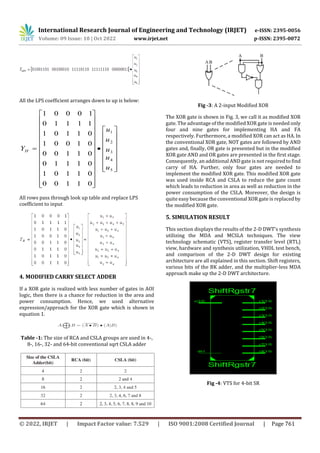
All the LPS coefficient arranges down to up is below:












































5
4
3
2
1
0
1
1
0
0
0
1
1
0
1
0
1
1
1
0
0
1
1
0
0
0
1
0
0
1
0
1
1
0
1
1
1
1
1
0
1
0
0
0
1
u
u
u
u
u
YH
All rows pass through look up table and replace LPS
coefficient to input
4. MODIFIED CARRY SELECT ADDER
If a XOR gate is realized with less number of gates in AOI
logic, then there is a chance for reduction in the area and
power consumption. Hence, we used alternative
expression/approach for the XOR gate which is shown in
equation 1.
Table -1: The size of RCA and CSLA groups are used in 4-,
8-, 16-, 32- and 64-bit conventional sqrt CSLA adder
Fig -3: A 2-input Modified XOR
The XOR gate is shown in Fig. 3, we call it as modified XOR
gate. The advantage of the modified XOR gate is needed only
four and nine gates for implementing HA and FA
respectively. Furthermore, a modified XOR can act as HA. In
the conventional XOR gate, NOT gates are followed by AND
gates and, finally, OR gate is presented but in the modified
XOR gate AND and OR gates are presented in the first stage.
Consequently, an additional AND gate is not required to find
carry of HA. Further, only four gates are needed to
implement the modified XOR gate. This modified XOR gate
was used inside RCA and CSLA to reduce the gate count
which leads to reduction in area as well as reduction in the
power consumption of the CSLA. Moreover, the design is
quite easy because the conventional XOR gate is replaced by
the modified XOR gate.
5. SIMULATION RESULT
This section displays the results of the 2-D DWT's synthesis
utilizing the MDA and MCSLA techniques. The view
technology schematic (VTS), register transfer level (RTL)
view, hardware and synthesis utilization, VHDL test bench,
and comparison of the 2-D DWT design for existing
architecture are all explained in this section. Shift registers,
various bits of the BK adder, and the multiplier-less MDA
approach make up the 2-D DWT architecture.
Fig -4: VTS for 4-bit SR
International Research Journal of Engineering and Technology (IRJET) e-ISSN: 2395-0056
Volume: 09 Issue: 10 | Oct 2022 www.irjet.net p-ISSN: 2395-0072
© 2022, IRJET | Impact Factor value: 7.529 | ISO 9001:2008 Certified Journal | Page 762
Fig -5: RTL for 4-bit SR
Fig -6: VHDL Test-bench in Shift Register
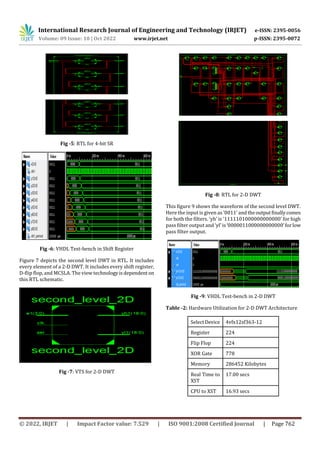
Figure 7 depicts the second level DWT in RTL. It includes
every element of a 2-D DWT. It includes every shift register,
D-flip flop, and MCSLA. The view technologyisdependent on
this RTL schematic.
Fig -7: VTS for 2-D DWT
Fig -8: RTL for 2-D DWT
This figure 9 shows the waveform of the second level DWT.
Here the input is given as ‘0011’ andtheoutputfinallycomes
for both the filters. ‘yh’ is ‘1111101000000000000’ for high
pass filter output and ‘yl’is‘0000011000000000000’forlow
pass filter output.
Fig -9: VHDL Test-bench in 2-D DWT
Table -2: Hardware Utilization for 2-D DWT Architecture
SelectDevice 4vfx12sf363-12
Register 224
Flip Flop 224
XOR Gate 778
Memory 286452 Kilobytes
Real Time to
XST
17.00 secs
CPU to XST 16.93 secs
International Research Journal of Engineering and Technology (IRJET) e-ISSN: 2395-0056
Volume: 09 Issue: 10 | Oct 2022 www.irjet.net p-ISSN: 2395-0072
© 2022, IRJET | Impact Factor value: 7.529 | ISO 9001:2008 Certified Journal | Page 763
5. CONCLUSION
For this MDA technique is used which provides approach for
multiplier less implementation. It contains adder, shift
registers and free of multiplier.
Finally we have designed the 1-D and 2-D DWT using MCSLA
and MDA technique which provide better efficiency and
shows better results than the previous design.
DWT has been an important technique of multimedia
applications. This is not only the key algorithm of signal
processing, but has also led to revolutions inimageandvideo
coding algorithms. There are many DWT architectures of
flipping type, folded type andpipeline architecture forsignal
transform. Each structure has its own advantages and
disadvantages. However, an efficient architecture design of
DWT in JPEG 2000 is an important area of research to
explore.
REFERENCES
[1] Jhilam Jana, Sayan Tripathi, Ritesh Sur Chowdhury,
Akash Bhattacharya and Jaydeb Bhaumik, “An Area
Efficient VLSI Architecture for 1-D and 2-D Discrete
WaveletTransform(DWT)andInverseDiscrete Wavelet
Transform (IDWT)”, Devices for IntegratedCircuit,IEEE
2021.
[2] Zhang, W., Wu, C., Zhang, P. and Liu, Y., “An Internal
Folded Hardware-Efficient Architecture for Lifting-
Based Multi-Level 2-D 9/7 DWT”, 2019, Applied
Sciences, 9(21), p.4635.
[3] Samit Kumar Dubey, Arvind Kumar Kourav and Shilpi
Sharma, “High Speed 2-D Discrete Wavelet Transform
using Distributed Arithmetic and Kogge Stone Adder
Technique”, International Conference on
Communication and Signal Processing, April 6-8, 2017,
India.
[4] Rakesh Biswas, Siddarth Reddy Malreddy and Swapna
Banerjee, “A High Precision-Low Area Unified
Architecture for Lossy and Lossless 3D Multi-Level
Discrete Wavelet Transform”, IEEE Transactions on
Circuits and Systems for Video Technology, Vol. 45, No.
5, pp. 01-11, May 2017.
[5] Mamatha I, Shikha Tripathi and Sudarshan TSB,
“Pipelined Architecture for Filter Bank based1-DDWT”,
International Conference on Signal Processing and
Integrated Networks (SPIN), pp. 47-52, May 2016.
[6] Maurizio Martin and Guido Masera, Massimo Ruo Roch
and Gianluca Piccinini, “Result-Biased Distributed-
Arithmetic-BasedFilterArchitecturesforApproximately
Computing the DWT”, IEEE TransactionsonCircuitsand
Systems—I: Regular Papers, Vol. 62, No. 8, pp. 2103-
2113, August 2015.
[7] Basant Kumar Mohanty, Pramod Kumar Meher,
“Memory-Efficient High- Speed Convolution-based
Generic Structure for Multilevel 2-D DWT”, IEEE
transactions on Circuits, Systems for Video Technology,
Vol. 23, No. 2, pp. 353-363, February 2013.
[8] Basant K. Mohanty, Anurag Mahajan, Pramod K. Meher,
“Area- and Power-Efficient Architecture for High-
Throughput Implementation of Lifting 2-DDWT”, IEEE
Transactions on Circuits and Systems-II: Express Briefs,
Vol.59, No.7, pp. 434-438, July 2012.
[9] Chengjun Zhang, Chunyan Wang, M. Omair Ahmad, “A
Pipeline VLSI Architecture for High-Speed Computation
of the 1-D Discrete Wavelet Transform”, IEEE
transactions on Circuits and Systems-I; Regular Papers,
Vol.57, No.10, pp. 2729-2740, October 2010.
[10]Zhang, Chengjun, Chunyan Wang, and M. Omair Ahmad,
“A pipeline VLSI architecture for high-speed
computation of the 1-D discrete wavelet transform”,
IEEE Transactions on Circuits and Systems I: Regular
Papers, Vol.57, No. 10,pp: pp. 2729-2740, October2010.
[11]S. M. M. Rahman, M. O. Ahmad, and M. N. S. Swamy, “A
New Statistical Detector for DWT-Based AdditiveImage
Watermarking usingtheGauss-HermitExpansion,”IEEE
Transactions Image Processing, Vol. 18, No. 8, pp.
1782−1796, August 2009.
[12]P. K. Meher, B. K. Mohanty and J. C. Patra, “Hardware-
Efficient Systolic-Like Modula Design for Two-
Dimensional Discrete Wavelet Transform”, IEEE
Transactions on Circuits and Systems—Ii: Express
Briefs, Vol. 55, No. 2, pp. 1021-1029, February 2008.
[13]Chao Cheng, Keshab K. Parhi, “High-Speed VLSI
Implementation of 2-D Discrete Wavelet Transform”,
IEEE Transactions on Signal Processing,Vol.56,No.1, pp.
393-403, January 2008.
[14]C. C. Cheng, C.-T. Huang, C.-Y. Cheng, C.-Jr.Lian and L.-G.
Chen, “On-chip Memory Optimization scheme for VLSI
Implementation of Line-Based 2-D Discrete Wavelet
Transform,” IEEE TransactionsoncircuitandSystemfor
Video Technology, vol.17,no.7, pp. 814-822, July 2007.
[15]M. Martina, and G. Masera,“Multiplier less, folded 9/7-
5/3 wavelet VLSI Architecture, ”IEEE Transactions on
Circuits and System, Express Brief Vol. 54, No. 9, pp.
770- 774, September 2007.

Area Efficient 9/7 Wavelet Coefficient based 2-D DWT using Modified CSLA Technique

  • 1.
    International Research Journalof Engineering and Technology (IRJET) e-ISSN: 2395-0056 Volume: 09 Issue: 10 | Oct 2022 www.irjet.net p-ISSN: 2395-0072 © 2022, IRJET | Impact Factor value: 7.529 | ISO 9001:2008 Certified Journal | Page 759 Area Efficient 9/7 Wavelet Coefficient based 2-D DWT using Modified CSLA Technique Megha Chaturvedi1, Prof. Gurpreet Singh2 1 Research Scholar, Trinity Institute of Technology & Research, Bhopal, India 2 Professor Electronics’ & Communication Dept., Trinity Institute of Technology & Research, Bhopal, India ---------------------------------------------------------------------***--------------------------------------------------------------------- Abstract - The DWT is expressed in a generalized form know as discrete wavelet transform which analyzes both the low and high sub bands at every levelof breakdownwithequal priority. A pragmatic approach to signal processing is provided by the DWT mathematical technique. It is frequently utilized in many signal and image processing applications because of its many beneficial qualities, suchasadaptivetime- frequency window, decreased aliasing distortion, andefficient computing complexity. In order to compress images and videos, 2-D DWT is frequently utilized. But in some DWT architectures, flipping approach adds considerable design complexity. In order to give multiplier-less implementation and ensure that our suggested work would function for every bit, we have included the BK adder and MDA approach. In comparison to the previous approach, the suggestedMDA and MCSLA-based 2-D DWT algorithm exhibits goodperformance. The suggested architecture for DWT implementation minimizes the maximum combinational path delay while also reducing chip size and computation time. Key Words: VHDL Simulation, 2-D DWT, MDA, Low-pass Sub-band (LPSB), High-pass Sub-band (HPSB) 1. INTRODUCTION Engineering professionals choose digital signal processing methods based on the characteristics of the signal being studied. The two main methods utilizedcommonlyforsignal analysis are frequency-based and time-frequency-based methods. A stationarysignal isanalyzedusingthefrequency- based method (FBT), while non-stationary signals are typically analyzed using time-frequency techniques (TFT), such as the short time Fourier transform (STFT), wavelet transform, etc. Although no information is obtained in the time domain, the FBT offers energy information of the function in the frequency domain. A musical note or a vehicle's noises are examples of non-stationary signalsfrom which the TFT captures the transient properties and represents them in a time-frequency map forsignal analysis. [1, 2]. Over the years wavelet transform has emerged as a predominant tool for time-frequency decomposition of a signal. Wavelet is designed especially to study the non- stationary data, and due to its generality and accurate results, it has become useful in a number of areas. For a non- stationary signal, the frequency content at a particular point in time is different from the frequency content at another point, e.g., a sudden transient [3]. The Fourier transform is not able to specify accurately at what point in time the transient occurs becausetheFourierbasesaresinusoidsthat are infinite in extent and can give information only based on the entire duration of the signal.Hence,theFourierbases are not able to localize the important events of the signal.Onthe contrary, wavelet has bases of finite duration, and this property enables it to identify and locate in time the important events in the signal which can be used to differentiate one signal from the other efficiently [4, 5]. Wavelet analysis allows researchers to isolate and manipulate the specific type of in formation hidden in the data, similar to the human ear picking the sound of the flute in a symphony. A diverse variety of wavelets can be used to analyze a signal, the type of wavelet to be used depends on the application. Wavelet is found in different branches from the signal analysis to the problems in engineering, physics, and mathematics. In the signal processing application, wavelet is mainly used in analyzing the non-stationary signals to provide the time-frequency information of an important transient [6]. In the bio-medical engineering, earth or ocean engineering the transient always carry a significant amount of information for therespectivedomain. The wavelet transform is found to be particularly useful for analyzing the signals that are considered to beaperiodicand noisy. The ability to analyze a signal distinctly both in time and frequency simultaneously has set wavelet transform apart from the STFT. Hence, wavelet transform is used to investigate a variety of physical phenomena such as climate change analysis, heart monitoring, seismicsignal de-noising, astronomical image de-noising, video and image compression [7, 8]. 2. DISCRETE WAVELET TRANSFORM The history of DWT goes back to the year 1976 when a technique was invented by Croiser, Galand, and Esteban to decompose the discrete time signals. In the same year, Flanagan, Crochiere, and Weberconducteda similaranalysis on the voice signal. The technique was named as sub-band coding. Burt developeda methodknownaspyramidal coding in 1983 that is comparable to sub-band coding, sometimes referred to as multi-resolution analysis. The pyramidal coding system still had redundant information thatmightbe removed. By removing the redundant code from the
  • 2.
    International Research Journalof Engineering and Technology (IRJET) e-ISSN: 2395-0056 Volume: 09 Issue: 10 | Oct 2022 www.irjet.net p-ISSN: 2395-0072 © 2022, IRJET | Impact Factor value: 7.529 | ISO 9001:2008 Certified Journal | Page 760 pyramidal coding in 1989, Vetterli and Le Gall improved the sub-band coding [9]. The DWT, when compared with the CWT is considerably easier to develop and implement. Although the CWT can be discretized and computed for DWT, the accurate discrete transform is not obtained. The information provided by this sampled version of the CWT is highly redundant. On the other hand, analyzing this redundant information takes a lot of time and energy. The DWT, on the other hand, speeds up processing while still extracting enough usable data from the signal for analysis and synthesis. The DWT decomposes the input spectrum into two sub-bands, namely the high-pass sub band and the low-pass sub-band. A low-pass filter is used to filter the input signal to produce a low-pass sub-band, while a high- pass filter is used to produce a high-pass sub-band [10]. A finite impulse response (FIR) filter with a short length is used to create the low-pass and high-pass filters.Thispair of low-pass and high-pass filter form a quadraturemirrorfilter (QMF) for the perfect signal reconstruction. The computation of the DWT using low pass andhigh-passfilters is performed either by the convolution scheme or lifting scheme [11]. Fig -1: Two Level Diagram of Discrete Wavelet Transform 3. PROPOSED ARCHITECTURE Particular focus is placed on system performanceandcostin digital systems. Effectiveperformancetypicallycomeswitha larger price cost. However, with a moderate increase in the hardware, better performance canbeobtained.Inthecourse of a computation, addition and multiplication are the fundamental operations that are performed frequently. The speed with which these operations are performed has a great impact on the overall performance of the digital system. Since the beginning of the digital computers, many fast algorithms for the basicarithmetic operations havebeen developed and implemented [12, 13]. There has been continuous research and development towards the newer algorithms. The main reason for the emerging algorithms is the rapid change in the technology used to implement these arithmetic operations. Besides the dependence on the technology used to implement the algorithm, it is the unique feature of the algorithm that affects the performance of the arithmetic operator [14]. In this stream graph, the double information is connected to the serial in serial out register. In the DWT design, all whole numbers are related to the twofold frame. The word length of two pieces of information, in this case 3 down to 0, means that the range of the information is from 0 to 15. Fig -2: Block Diagram of 9/7 Wavelet Coefficient based Discrete Wavelet Transform If takes the LPS coefficients h0, h1, h2, h3, and h4 multiply by u1, u2, u3, u4 and u5 then multiplier-less 1-D DWT LPS output is                     5 4 3 2 1 4 3 2 1 0 u u u u u h h h h h YLPS Where, ) 8 ( ) ( 1    n X n X u ) 7 ( ) 1 ( 2     n X n X u ) 6 ( ) 2 ( 3     n X n X u ) 5 ( ) 3 ( 4     n X n X u ) 4 ( 5   n X u                       5 4 3 2 1 3 2 10 34 77 u u u u u YLPS So,
  • 3.
    International Research Journalof Engineering and Technology (IRJET) e-ISSN: 2395-0056 Volume: 09 Issue: 10 | Oct 2022 www.irjet.net p-ISSN: 2395-0072 © 2022, IRJET | Impact Factor value: 7.529 | ISO 9001:2008 Certified Journal | Page 761 All the LPS coefficient arranges down to up is below:                                             5 4 3 2 1 0 1 1 0 0 0 1 1 0 1 0 1 1 1 0 0 1 1 0 0 0 1 0 0 1 0 1 1 0 1 1 1 1 1 0 1 0 0 0 1 u u u u u YH All rows pass through look up table and replace LPS coefficient to input 4. MODIFIED CARRY SELECT ADDER If a XOR gate is realized with less number of gates in AOI logic, then there is a chance for reduction in the area and power consumption. Hence, we used alternative expression/approach for the XOR gate which is shown in equation 1. Table -1: The size of RCA and CSLA groups are used in 4-, 8-, 16-, 32- and 64-bit conventional sqrt CSLA adder Fig -3: A 2-input Modified XOR The XOR gate is shown in Fig. 3, we call it as modified XOR gate. The advantage of the modified XOR gate is needed only four and nine gates for implementing HA and FA respectively. Furthermore, a modified XOR can act as HA. In the conventional XOR gate, NOT gates are followed by AND gates and, finally, OR gate is presented but in the modified XOR gate AND and OR gates are presented in the first stage. Consequently, an additional AND gate is not required to find carry of HA. Further, only four gates are needed to implement the modified XOR gate. This modified XOR gate was used inside RCA and CSLA to reduce the gate count which leads to reduction in area as well as reduction in the power consumption of the CSLA. Moreover, the design is quite easy because the conventional XOR gate is replaced by the modified XOR gate. 5. SIMULATION RESULT This section displays the results of the 2-D DWT's synthesis utilizing the MDA and MCSLA techniques. The view technology schematic (VTS), register transfer level (RTL) view, hardware and synthesis utilization, VHDL test bench, and comparison of the 2-D DWT design for existing architecture are all explained in this section. Shift registers, various bits of the BK adder, and the multiplier-less MDA approach make up the 2-D DWT architecture. Fig -4: VTS for 4-bit SR
  • 4.
    International Research Journalof Engineering and Technology (IRJET) e-ISSN: 2395-0056 Volume: 09 Issue: 10 | Oct 2022 www.irjet.net p-ISSN: 2395-0072 © 2022, IRJET | Impact Factor value: 7.529 | ISO 9001:2008 Certified Journal | Page 762 Fig -5: RTL for 4-bit SR Fig -6: VHDL Test-bench in Shift Register Figure 7 depicts the second level DWT in RTL. It includes every element of a 2-D DWT. It includes every shift register, D-flip flop, and MCSLA. The view technologyisdependent on this RTL schematic. Fig -7: VTS for 2-D DWT Fig -8: RTL for 2-D DWT This figure 9 shows the waveform of the second level DWT. Here the input is given as ‘0011’ andtheoutputfinallycomes for both the filters. ‘yh’ is ‘1111101000000000000’ for high pass filter output and ‘yl’is‘0000011000000000000’forlow pass filter output. Fig -9: VHDL Test-bench in 2-D DWT Table -2: Hardware Utilization for 2-D DWT Architecture SelectDevice 4vfx12sf363-12 Register 224 Flip Flop 224 XOR Gate 778 Memory 286452 Kilobytes Real Time to XST 17.00 secs CPU to XST 16.93 secs
  • 5.
    International Research Journalof Engineering and Technology (IRJET) e-ISSN: 2395-0056 Volume: 09 Issue: 10 | Oct 2022 www.irjet.net p-ISSN: 2395-0072 © 2022, IRJET | Impact Factor value: 7.529 | ISO 9001:2008 Certified Journal | Page 763 5. CONCLUSION For this MDA technique is used which provides approach for multiplier less implementation. It contains adder, shift registers and free of multiplier. Finally we have designed the 1-D and 2-D DWT using MCSLA and MDA technique which provide better efficiency and shows better results than the previous design. DWT has been an important technique of multimedia applications. This is not only the key algorithm of signal processing, but has also led to revolutions inimageandvideo coding algorithms. There are many DWT architectures of flipping type, folded type andpipeline architecture forsignal transform. Each structure has its own advantages and disadvantages. However, an efficient architecture design of DWT in JPEG 2000 is an important area of research to explore. REFERENCES [1] Jhilam Jana, Sayan Tripathi, Ritesh Sur Chowdhury, Akash Bhattacharya and Jaydeb Bhaumik, “An Area Efficient VLSI Architecture for 1-D and 2-D Discrete WaveletTransform(DWT)andInverseDiscrete Wavelet Transform (IDWT)”, Devices for IntegratedCircuit,IEEE 2021. [2] Zhang, W., Wu, C., Zhang, P. and Liu, Y., “An Internal Folded Hardware-Efficient Architecture for Lifting- Based Multi-Level 2-D 9/7 DWT”, 2019, Applied Sciences, 9(21), p.4635. [3] Samit Kumar Dubey, Arvind Kumar Kourav and Shilpi Sharma, “High Speed 2-D Discrete Wavelet Transform using Distributed Arithmetic and Kogge Stone Adder Technique”, International Conference on Communication and Signal Processing, April 6-8, 2017, India. [4] Rakesh Biswas, Siddarth Reddy Malreddy and Swapna Banerjee, “A High Precision-Low Area Unified Architecture for Lossy and Lossless 3D Multi-Level Discrete Wavelet Transform”, IEEE Transactions on Circuits and Systems for Video Technology, Vol. 45, No. 5, pp. 01-11, May 2017. [5] Mamatha I, Shikha Tripathi and Sudarshan TSB, “Pipelined Architecture for Filter Bank based1-DDWT”, International Conference on Signal Processing and Integrated Networks (SPIN), pp. 47-52, May 2016. [6] Maurizio Martin and Guido Masera, Massimo Ruo Roch and Gianluca Piccinini, “Result-Biased Distributed- Arithmetic-BasedFilterArchitecturesforApproximately Computing the DWT”, IEEE TransactionsonCircuitsand Systems—I: Regular Papers, Vol. 62, No. 8, pp. 2103- 2113, August 2015. [7] Basant Kumar Mohanty, Pramod Kumar Meher, “Memory-Efficient High- Speed Convolution-based Generic Structure for Multilevel 2-D DWT”, IEEE transactions on Circuits, Systems for Video Technology, Vol. 23, No. 2, pp. 353-363, February 2013. [8] Basant K. Mohanty, Anurag Mahajan, Pramod K. Meher, “Area- and Power-Efficient Architecture for High- Throughput Implementation of Lifting 2-DDWT”, IEEE Transactions on Circuits and Systems-II: Express Briefs, Vol.59, No.7, pp. 434-438, July 2012. [9] Chengjun Zhang, Chunyan Wang, M. Omair Ahmad, “A Pipeline VLSI Architecture for High-Speed Computation of the 1-D Discrete Wavelet Transform”, IEEE transactions on Circuits and Systems-I; Regular Papers, Vol.57, No.10, pp. 2729-2740, October 2010. [10]Zhang, Chengjun, Chunyan Wang, and M. Omair Ahmad, “A pipeline VLSI architecture for high-speed computation of the 1-D discrete wavelet transform”, IEEE Transactions on Circuits and Systems I: Regular Papers, Vol.57, No. 10,pp: pp. 2729-2740, October2010. [11]S. M. M. Rahman, M. O. Ahmad, and M. N. S. Swamy, “A New Statistical Detector for DWT-Based AdditiveImage Watermarking usingtheGauss-HermitExpansion,”IEEE Transactions Image Processing, Vol. 18, No. 8, pp. 1782−1796, August 2009. [12]P. K. Meher, B. K. Mohanty and J. C. Patra, “Hardware- Efficient Systolic-Like Modula Design for Two- Dimensional Discrete Wavelet Transform”, IEEE Transactions on Circuits and Systems—Ii: Express Briefs, Vol. 55, No. 2, pp. 1021-1029, February 2008. [13]Chao Cheng, Keshab K. Parhi, “High-Speed VLSI Implementation of 2-D Discrete Wavelet Transform”, IEEE Transactions on Signal Processing,Vol.56,No.1, pp. 393-403, January 2008. [14]C. C. Cheng, C.-T. Huang, C.-Y. Cheng, C.-Jr.Lian and L.-G. Chen, “On-chip Memory Optimization scheme for VLSI Implementation of Line-Based 2-D Discrete Wavelet Transform,” IEEE TransactionsoncircuitandSystemfor Video Technology, vol.17,no.7, pp. 814-822, July 2007. [15]M. Martina, and G. Masera,“Multiplier less, folded 9/7- 5/3 wavelet VLSI Architecture, ”IEEE Transactions on Circuits and System, Express Brief Vol. 54, No. 9, pp. 770- 774, September 2007.