Engineering Drawings
Gary Trowles
ISOMETRIC DRAWINGS
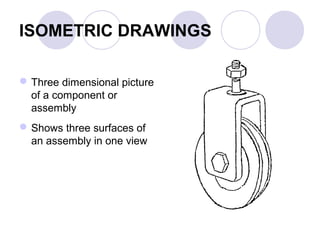
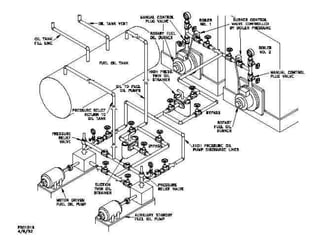
Three dimensional picture
of a component or
assembly
Shows three surfaces of
an assembly in one view
ISOMETRIC DRAWINGS
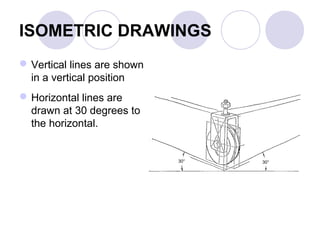
Vertical lines are shown
in a vertical position
Horizontal lines are
drawn at 30 degrees to
the horizontal.
30° 30°
ISOMETRIC DRAWINGS
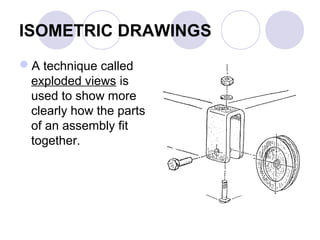
A technique called
exploded views is
used to show more
clearly how the parts
of an assembly fit
together.
Isometric projection : Drawing a box
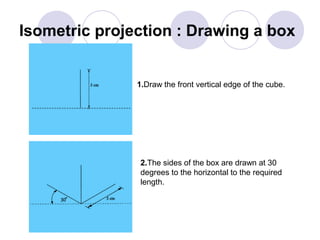
1.Draw the front vertical edge of the cube.
2.The sides of the box are drawn at 30
degrees to the horizontal to the required
length.
Isometric projection : Drawing a box
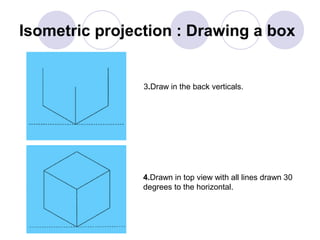
3.Draw in the back verticals.
4.Drawn in top view with all lines drawn 30
degrees to the horizontal.
Isometric projection : Drawing more
complicated shapes
5
1
3
5
5
1
Isometric projection : Drawing more
complicated shapes
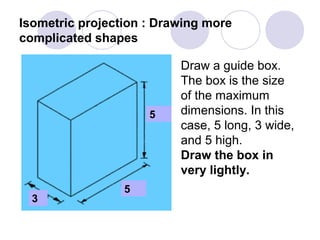
Draw a guide box.
The box is the size
of the maximum
dimensions. In this
case, 5 long, 3 wide,
and 5 high.
Draw the box in
very lightly.
5
5
3
Isometric projection : Drawing more
complicated shapes
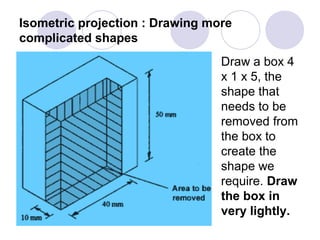
Draw a box 4
x 1 x 5, the
shape that
needs to be
removed from
the box to
create the
shape we
require. Draw
the box in
very lightly.
Isometric projection : Drawing more
complicated shapes
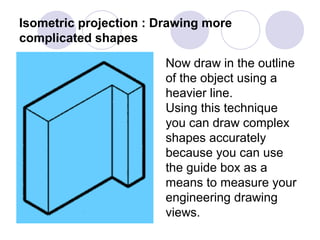
Now draw in the outline
of the object using a
heavier line.
Using this technique
you can draw complex
shapes accurately
because you can use
the guide box as a
means to measure your
engineering drawing
views.
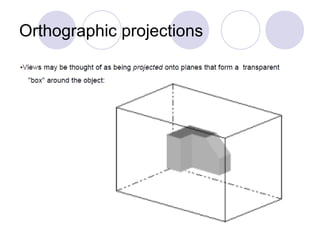
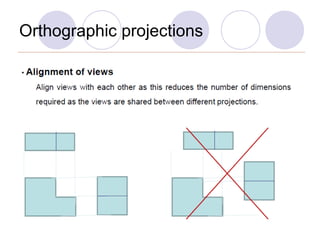
Orthographic projections
Six views of orthographic projection
Orthographic projections
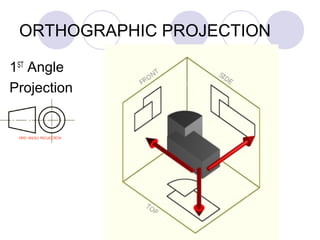
ORTHOGRAPHIC PROJECTION
1ST
Angle
Projection
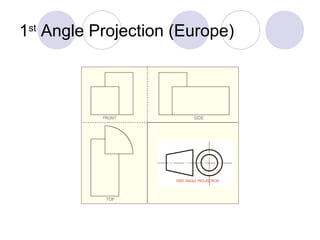
1st
Angle Projection (Europe)
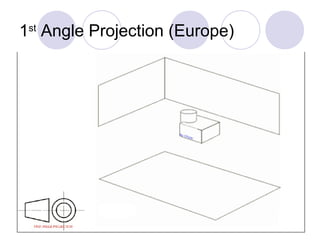
1st
Angle Projection (Europe)
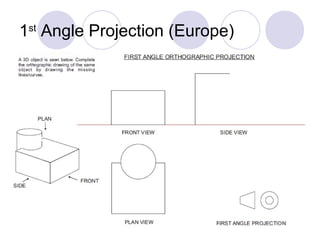
1st
Angle Projection (Europe)
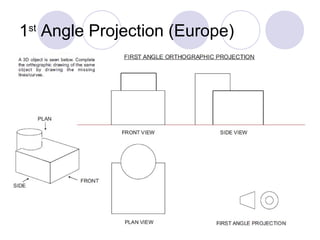
1st
Angle Projection (Europe)
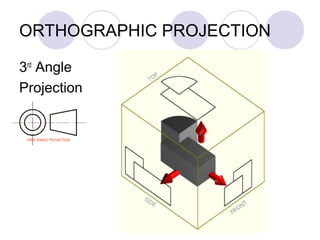
ORTHOGRAPHIC PROJECTION
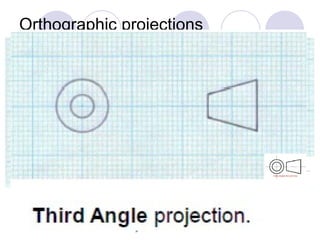
3rd
Angle
Projection
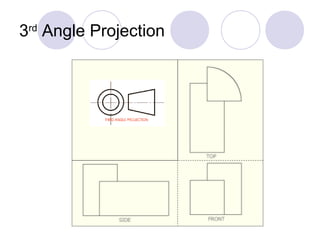
3rd
Angle Projection
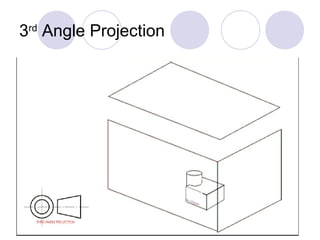
3rd
Angle Projection
3rd
Angle Projection
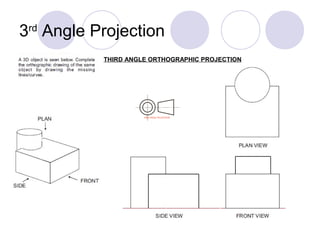
THIRD ANGLE ORTHOGRAPHIC PROJECTION
3rd
Angle Projection
THIRD ANGLE ORTHOGRAPHIC PROJECTION
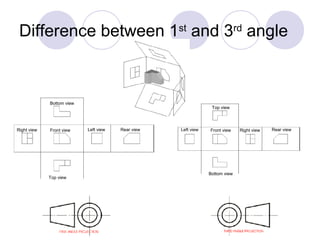
Difference between 1st
and 3rd
angle
Bottom view
Right view Rear viewLeft view
Top view
Front view
Bottom view
Top view
Front view Right viewLeft view Rear view
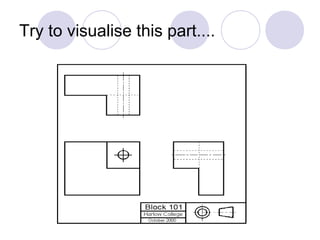
Try to visualise this part....
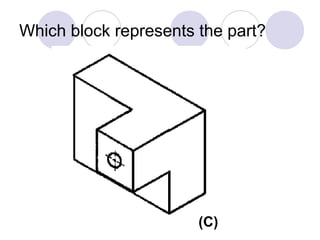
Which block represents the part?
(C)
(B)(A)
(D)
(C)
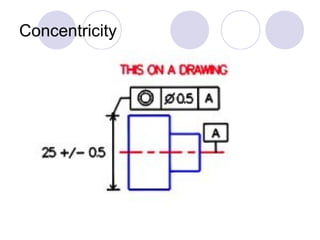
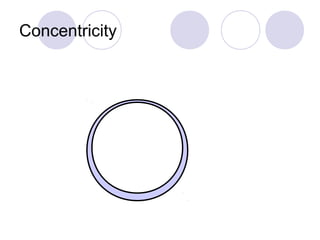
Concentricity
Concentricity
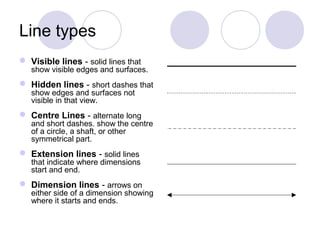
Line types
 Visible lines - solid lines that
show visible edges and surfaces.
 Hidden lines - short dashes that
show edges and surfaces not
visible in that view.
 Centre Lines - alternate long
and short dashes. show the centre
of a circle, a shaft, or other
symmetrical part.
 Extension lines - solid lines
that indicate where dimensions
start and end.
 Dimension lines - arrows on
either side of a dimension showing
where it starts and ends.
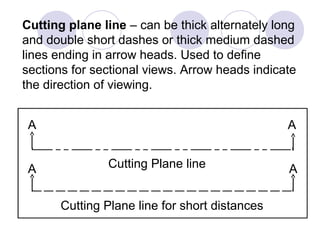
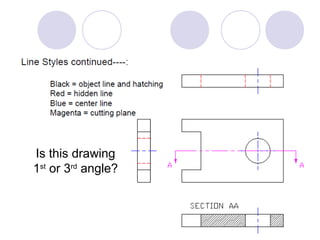
Cutting Plane line
Cutting Plane line for short distances
AA
AA
Cutting plane line – can be thick alternately long
and double short dashes or thick medium dashed
lines ending in arrow heads. Used to define
sections for sectional views. Arrow heads indicate
the direction of viewing.
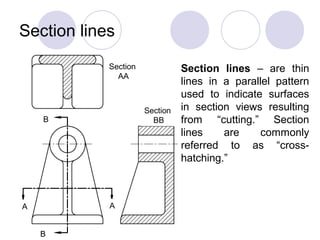
Section lines
A A
B
B
Section
AA
Section
BB
Section lines – are thin
lines in a parallel pattern
used to indicate surfaces
in section views resulting
from “cutting.” Section
lines are commonly
referred to as “cross-
hatching.”
Is this drawing
1st
or 3rd
angle?
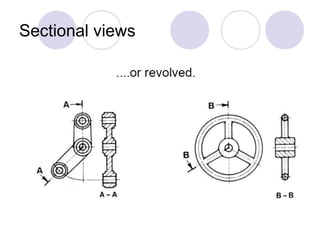
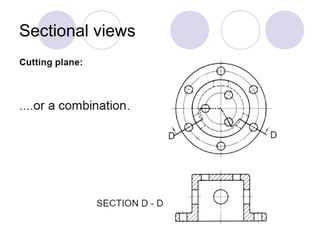
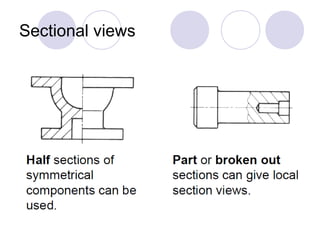
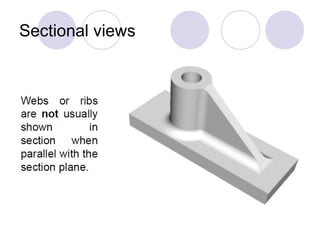
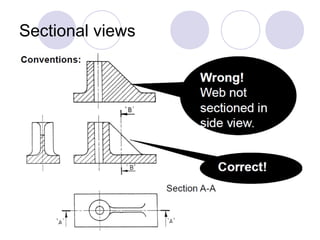
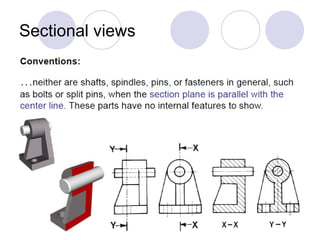
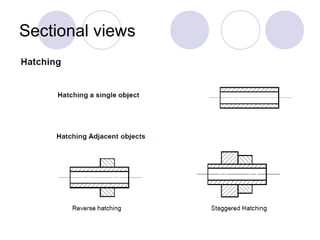
Sectional views
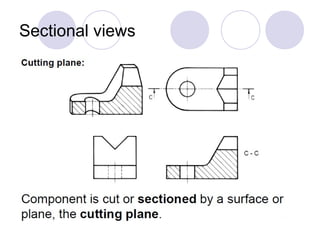
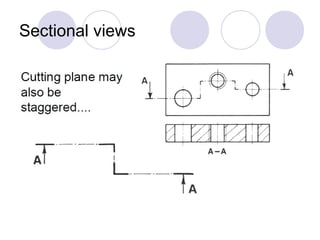
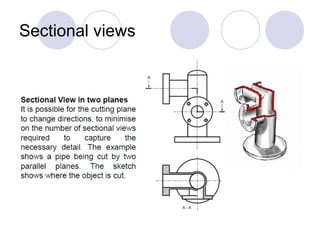
Sections and sectional views are used to
show hidden detail more clearly
Created by using a cutting plane to cut the
object
A section view shows how the object
would appear if it was cut along the line of
the cutting plane.
Sectional views
Sectional views are produced to:
clarify details
show internal features clearly
reduce number of hidden detail lines
aid dimensioning
show cross-section shape
clarify an assembly
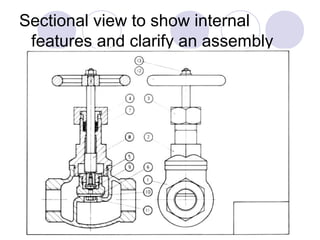
Sectional view to show internal
features and clarify an assembly
Sectional views
Sectional views
Sectional views
Sectional views
Sectional views
Sectional views
Sectional views
Sectional views
Sectional views
Sectional views
Sectional views
Sectional views
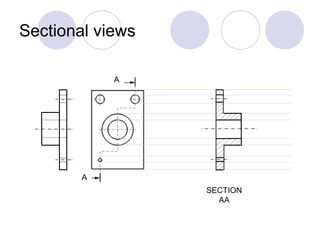
A
A
SECTION
AA
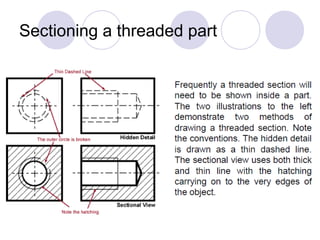
Drawing a threaded part
Sectioning a threaded part
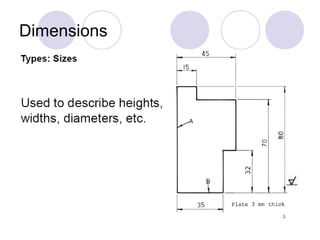
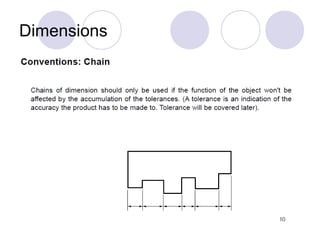
Dimensions
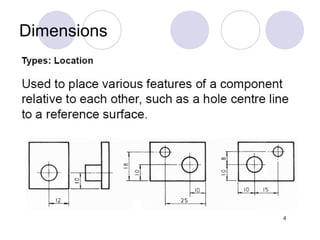
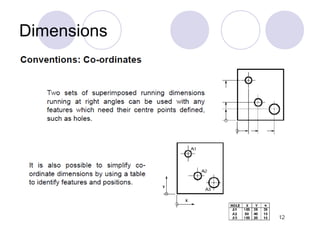
Dimensions
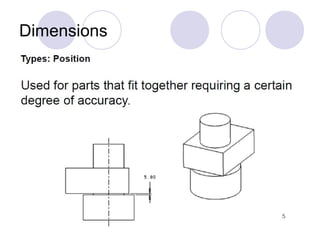
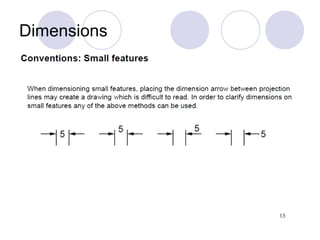
Dimensions
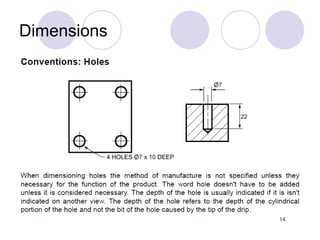
Dimensions
Dimensions
Dimensions
Dimensions
Dimensions
Dimensions
Dimensions
Dimensions
Dimensions
Dimensions
Dimensions
Dimensions
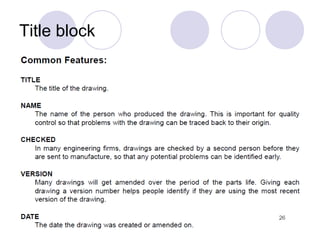
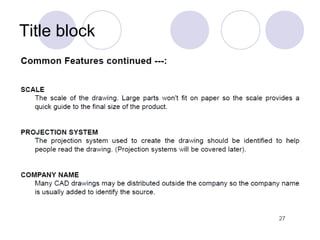
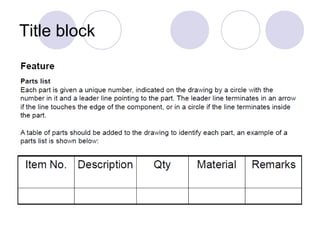
Title block
Title block
Title block
Title block
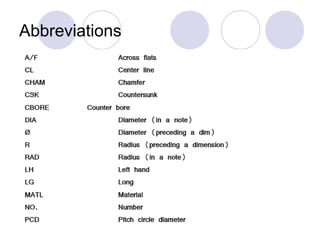
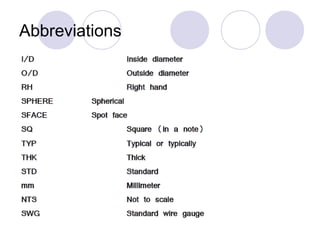
Abbreviations
Abbreviations
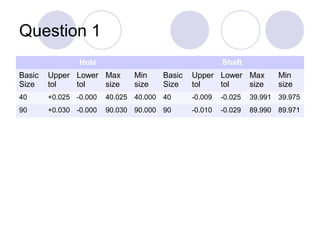
Question 1
Hole Shaft
Basic
Size
Upper
tol
Lower
tol
Max
size
Min
size
Basic
Size
Upper
tol
Lower
tol
Max
size
Min
size
40 +0.025 -0.000 40.025 40.000 40 -0.009 -0.025 39.991 39.975
90 +0.030 -0.000 90.030 90.000 90 -0.010 -0.029 89.990 89.971
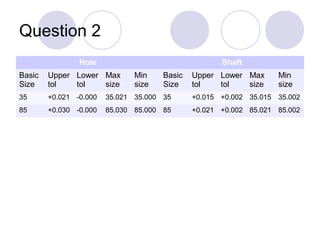
Question 2
Hole Shaft
Basic
Size
Upper
tol
Lower
tol
Max
size
Min
size
Basic
Size
Upper
tol
Lower
tol
Max
size
Min
size
35 +0.021 -0.000 35.021 35.000 35 +0.015 +0.002 35.015 35.002
85 +0.030 -0.000 85.030 85.000 85 +0.021 +0.002 85.021 85.002
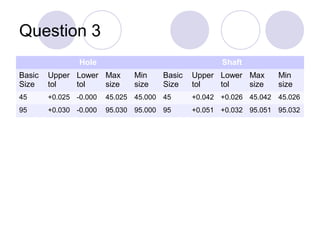
Question 3
Hole Shaft
Basic
Size
Upper
tol
Lower
tol
Max
size
Min
size
Basic
Size
Upper
tol
Lower
tol
Max
size
Min
size
45 +0.025 -0.000 45.025 45.000 45 +0.042 +0.026 45.042 45.026
95 +0.030 -0.000 95.030 95.000 95 +0.051 +0.032 95.051 95.032

Engineering drawings

Editor's Notes

  • #3 Will show two sides and the top or the bottom.
  • #4 When drawn at 30 degrees all lines can be drawn to their true length.
  • #5 Show how two or more parts of an assembly fit together Allow you to see where parts are assembled by providing 'centre lines' that you can 'follow' (with your eyes or fingers) Locate component parts or subassemblies within an assembly Show how one component part or subassembly is assembled to another Aid you in visualising what the text of the Process plan says you must do next in the assembly sequence Show how an assembly could be taken apart, e.g. a repair situation
  • #18 1st Angle mnemonic The Object comes first, (in front of the paper) 3rd Angle mnemonic The object comes third, (eye, paper, object)
  • #19 To remember the projection angle rotate the rear of the cone to the right and draw what you see
  • #24 To remember the projection angle rotate the rear of the cone to the right and draw what you see
  • #30 This is third angle projection
  • #37 It’s 3rd angle