Coaching
Part 1- Coaching
fundamentals
Part 4- What is self
coaching?
Part 3- What are the
qualities and roles of a
coach?
Explore - Learn - Grow
Part 2- How to coach?
Four techniques
Do you know your Happiness Score? Get your Life Satisfaction Report. Free, no registration required. I Contact
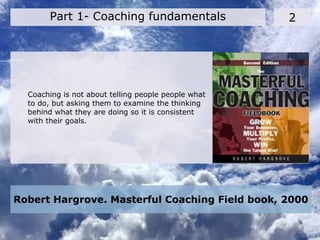
Robert Hargrove. Masterful Coaching Field book, 2000
2Part 1- Coaching fundamentals
Coaching is not about telling people people what
to do, but asking them to examine the thinking
behind what they are doing so it is consistent
with their goals.
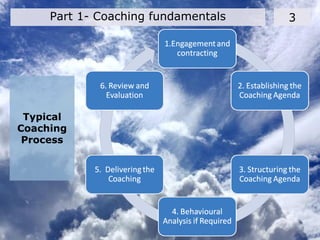
Typical
Coaching
Process
3Part 1- Coaching fundamentals
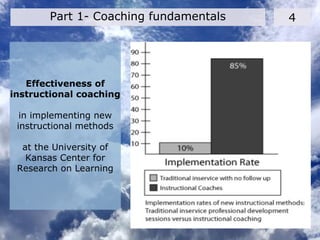
Effectiveness of
instructional coaching
in implementing new
instructional methods
at the University of
Kansas Center for
Research on Learning
4Part 1- Coaching fundamentals
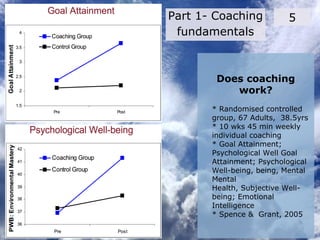
Does coaching
work?
* Randomised controlled
group, 67 Adults, 38.5yrs
* 10 wks 45 min weekly
individual coaching
* Goal Attainment;
Psychological Well Goal
Attainment; Psychological
Well-being, being, Mental
Mental
Health, Subjective Well-
being; Emotional
Intelligence
* Spence & Grant, 2005
5Part 1- Coaching
fundamentals
Active
listening
6Part 2- Coaching techniques
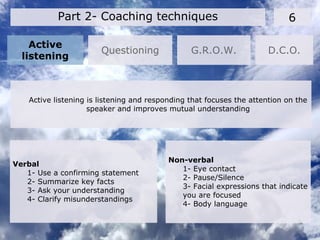
Active listening is listening and responding that focuses the attention on the
speaker and improves mutual understanding
Questioning G.R.O.W. D.C.O.
Verbal
1- Use a confirming statement
2- Summarize key facts
3- Ask your understanding
4- Clarify misunderstandings
Non-verbal
1- Eye contact
2- Pause/Silence
3- Facial expressions that indicate
you are focused
4- Body language
Active
listening
7Part 2- Coaching techniques
Questioning G.R.O.W. D.C.O.
3 types of questions:
1- Open
What? How? Get someone to talk openly.
2- Probing
Could you expand? Could you give me an
example?
Probe further to find out more information
3- Closed
who, which, would, are, can, have, do, is, will?
Solicit a “yes” or “no” or other one-word respons
Active
listening
8Part 2- Coaching techniques
Questioning G.R.O.W. D.C.O.
Goal: 1) set a time limit for the session
2) state the goal for the issue after defining the Reality
Reality: define current reality & desired reality & agree on any gap(s),
explore reasons (active listening and open questions)
Options: explore alternative strategies/ courses of action for
eliminating the gaps (open and probing questions)
Wrap up: agree on WHAT is to be done,
WHEN & by WHOM – set a date for review
Active
listening
9Part 2- Coaching techniques
Questioning G.R.O.W. D.C.O.
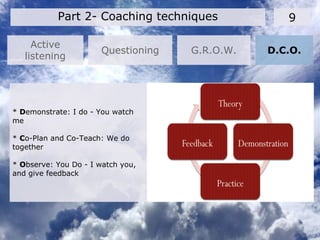
* Demonstrate: I do - You watch
me
* Co-Plan and Co-Teach: We do
together
* Observe: You Do - I watch you,
and give feedback
Click on the screen
10Part 3- Qualities and role of a coach
3 types of coaches:
* Change coaches
Help build leadership and understanding related to
organization goals and transformation
* Content coaches
Help learn new ideas, to implement them during
instruction, and they provide formative feedback
* Performance coaches
Help drive high performance or challenge low
performance issues
11Part 3- Qualities and role of a coach
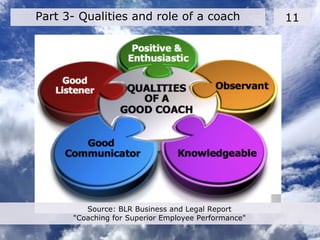
Source: BLR Business and Legal Report
"Coaching for Superior Employee Performance"
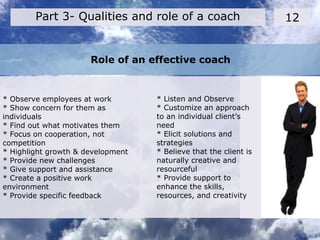
Role of an effective coach
12
* Observe employees at work
* Show concern for them as
individuals
* Find out what motivates them
* Focus on cooperation, not
competition
* Highlight growth & development
* Provide new challenges
* Give support and assistance
* Create a positive work
environment
* Provide specific feedback
Part 3- Qualities and role of a coach
* Listen and Observe
* Customize an approach
to an individual client’s
need
* Elicit solutions and
strategies
* Believe that the client is
naturally creative and
resourceful
* Provide support to
enhance the skills,
resources, and creativity
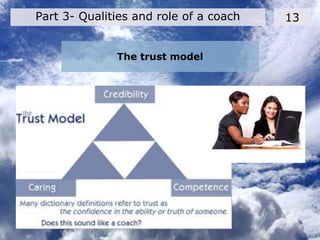
The trust model
13Part 3- Qualities and role of a coach
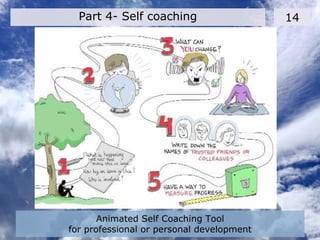
Animated Self Coaching Tool
for professional or personal development
14Part 4- Self coaching
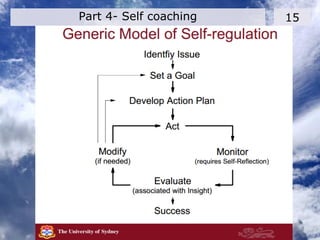
15Part 4- Self coaching
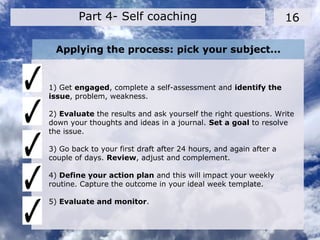
Applying the process: pick your subject...
1) Get engaged, complete a self-assessment and identify the
issue, problem, weakness.
2) Evaluate the results and ask yourself the right questions. Write
down your thoughts and ideas in a journal. Set a goal to resolve
the issue.
3) Go back to your first draft after 24 hours, and again after a
couple of days. Review, adjust and complement.
4) Define your action plan and this will impact your weekly
routine. Capture the outcome in your ideal week template.
5) Evaluate and monitor.
16Part 4- Self coaching
Click on the screen
* wikipedia.com
* Creating a Coaching Culture research report I-l-m.com 2011
* Excellence in Coaching: The Industry Guide, by Jonathan Passmore, 2010
* www.opm.gov/WIKI/training/Mentoring-and-Coaching.ashx
* sjsdcoaching.wikispaces.com (instructional coaching)
* www.avca.org/.../Developing-a-Functional-Coaching-Philosophy.ppt
* www.pbis.org
* www.edlabgroup.org (peer coaching)
* curry.virginia.edu (coaching models)
* www.outward-bound.org (active listening and effective coaching)
* www.instituteofcoaching.org
Sources and References 17
In the note section of this slide
Participant Notes 18

Coaching and coaches

  • 1.
    Coaching Part 1- Coaching fundamentals Part4- What is self coaching? Part 3- What are the qualities and roles of a coach? Explore - Learn - Grow Part 2- How to coach? Four techniques Do you know your Happiness Score? Get your Life Satisfaction Report. Free, no registration required. I Contact
  • 2.
    Robert Hargrove. MasterfulCoaching Field book, 2000 2Part 1- Coaching fundamentals Coaching is not about telling people people what to do, but asking them to examine the thinking behind what they are doing so it is consistent with their goals.
  • 3.
  • 4.
    Effectiveness of instructional coaching inimplementing new instructional methods at the University of Kansas Center for Research on Learning 4Part 1- Coaching fundamentals
  • 5.
    Does coaching work? * Randomisedcontrolled group, 67 Adults, 38.5yrs * 10 wks 45 min weekly individual coaching * Goal Attainment; Psychological Well Goal Attainment; Psychological Well-being, being, Mental Mental Health, Subjective Well- being; Emotional Intelligence * Spence & Grant, 2005 5Part 1- Coaching fundamentals
  • 6.
    Active listening 6Part 2- Coachingtechniques Active listening is listening and responding that focuses the attention on the speaker and improves mutual understanding Questioning G.R.O.W. D.C.O. Verbal 1- Use a confirming statement 2- Summarize key facts 3- Ask your understanding 4- Clarify misunderstandings Non-verbal 1- Eye contact 2- Pause/Silence 3- Facial expressions that indicate you are focused 4- Body language
  • 7.
    Active listening 7Part 2- Coachingtechniques Questioning G.R.O.W. D.C.O. 3 types of questions: 1- Open What? How? Get someone to talk openly. 2- Probing Could you expand? Could you give me an example? Probe further to find out more information 3- Closed who, which, would, are, can, have, do, is, will? Solicit a “yes” or “no” or other one-word respons
  • 8.
    Active listening 8Part 2- Coachingtechniques Questioning G.R.O.W. D.C.O. Goal: 1) set a time limit for the session 2) state the goal for the issue after defining the Reality Reality: define current reality & desired reality & agree on any gap(s), explore reasons (active listening and open questions) Options: explore alternative strategies/ courses of action for eliminating the gaps (open and probing questions) Wrap up: agree on WHAT is to be done, WHEN & by WHOM – set a date for review
  • 9.
    Active listening 9Part 2- Coachingtechniques Questioning G.R.O.W. D.C.O. * Demonstrate: I do - You watch me * Co-Plan and Co-Teach: We do together * Observe: You Do - I watch you, and give feedback
  • 10.
  • 11.
    10Part 3- Qualitiesand role of a coach 3 types of coaches: * Change coaches Help build leadership and understanding related to organization goals and transformation * Content coaches Help learn new ideas, to implement them during instruction, and they provide formative feedback * Performance coaches Help drive high performance or challenge low performance issues
  • 12.
    11Part 3- Qualitiesand role of a coach Source: BLR Business and Legal Report "Coaching for Superior Employee Performance"
  • 13.
    Role of aneffective coach 12 * Observe employees at work * Show concern for them as individuals * Find out what motivates them * Focus on cooperation, not competition * Highlight growth & development * Provide new challenges * Give support and assistance * Create a positive work environment * Provide specific feedback Part 3- Qualities and role of a coach * Listen and Observe * Customize an approach to an individual client’s need * Elicit solutions and strategies * Believe that the client is naturally creative and resourceful * Provide support to enhance the skills, resources, and creativity
  • 14.
    The trust model 13Part3- Qualities and role of a coach
  • 15.
    Animated Self CoachingTool for professional or personal development 14Part 4- Self coaching
  • 16.
  • 17.
    Applying the process:pick your subject... 1) Get engaged, complete a self-assessment and identify the issue, problem, weakness. 2) Evaluate the results and ask yourself the right questions. Write down your thoughts and ideas in a journal. Set a goal to resolve the issue. 3) Go back to your first draft after 24 hours, and again after a couple of days. Review, adjust and complement. 4) Define your action plan and this will impact your weekly routine. Capture the outcome in your ideal week template. 5) Evaluate and monitor. 16Part 4- Self coaching
  • 18.
  • 19.
    * wikipedia.com * Creatinga Coaching Culture research report I-l-m.com 2011 * Excellence in Coaching: The Industry Guide, by Jonathan Passmore, 2010 * www.opm.gov/WIKI/training/Mentoring-and-Coaching.ashx * sjsdcoaching.wikispaces.com (instructional coaching) * www.avca.org/.../Developing-a-Functional-Coaching-Philosophy.ppt * www.pbis.org * www.edlabgroup.org (peer coaching) * curry.virginia.edu (coaching models) * www.outward-bound.org (active listening and effective coaching) * www.instituteofcoaching.org Sources and References 17
  • 20.
    In the notesection of this slide Participant Notes 18