

Coaching and mentoring 
by Toronto Training and HR 
September 2014 
1
CONTENTS 
3-4 Introduction 
5-6 Definitions 
7-8 Manager-as-coach 
9-10 Executive coaching 
11-12 Formal mentoring 
13-14 Coaching practices to master 
15-16 Being an effective coach 
17-18 Coaching considerations for the independent operator 
19-20 How much do external coaches cost? 
21-22 Managing different types of change resistance 
23-24 Key considerations for change 
25-29 Breaking through the behaviour barriers holding back executives 
30-31 Skills needed by a mentor 
32-33 Mentoring techniques 
34-38 Establishing mentoring in the organization 
39-40 Creating a modern mentoring program 
41-42 What should mentors and mentees include in their contracts? 
43-44 Generational differences around mentoring 
45-46 Pressure points which can undo mentoring 
47-48 Common mistakes made by mentors 
49-50 Conclusion, summary and questions 
2
Introduction 
3
Introduction to Toronto Training 
and HR 
Toronto Training and HR is a specialist training and 
human resources consultancy headed by Timothy Holden 
10 years in banking 
15 years in training and human resources 
Freelance practitioner since 2006 
The core services provided by Toronto Training and HR 
are: 
Training event design 
Training event delivery 
HR support with an emphasis on reducing 
costs, saving time plus improving employee 
engagement and morale 
Services for job seekers 
4
Definitions 
5
• Coaching 
• Mentoring 
• Coach 
• Mentor 
6 
Definitions
Manager-as-coach 
7
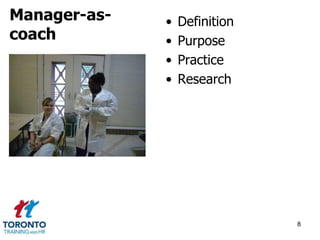
• Definition 
• Purpose 
• Practice 
• Research 
8 
Manager-as-coach
Executive coaching 
9
• Definition 
• Purpose 
• Practice 
• Research 
10 
Executive 
coaching
Formal mentoring 
11
• Definition 
• Purpose 
• Practice 
• Research 
12 
Formal 
mentoring
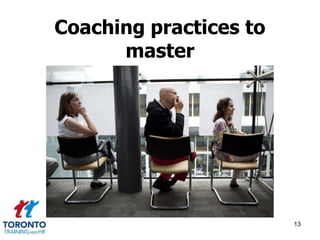
Coaching practices to 
master 
13
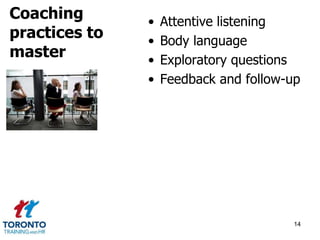
• Attentive listening 
• Body language 
• Exploratory questions 
• Feedback and follow-up 
14 
Coaching 
practices to 
master
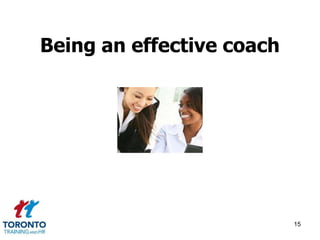
Being an effective coach 
15
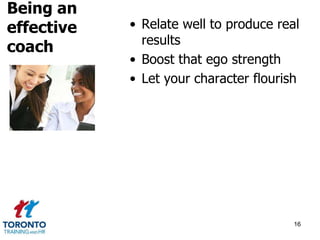
• Relate well to produce real 
results 
• Boost that ego strength 
• Let your character flourish 
16 
Being an 
effective 
coach
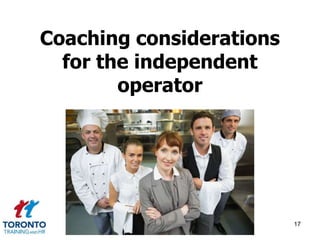
Coaching considerations 
for the independent 
operator 
17
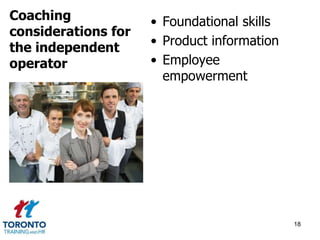
• Foundational skills 
• Product information 
• Employee 
empowerment 
18 
Coaching 
considerations for 
the independent 
operator
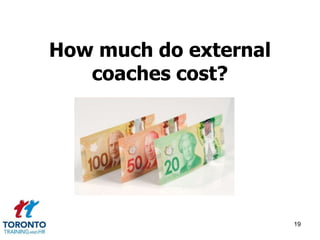
How much do external 
coaches cost? 
19
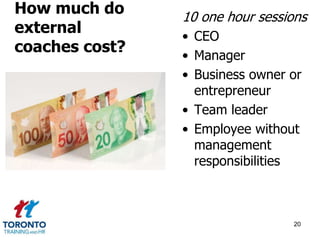
10 one hour sessions 
• CEO 
• Manager 
• Business owner or 
entrepreneur 
• Team leader 
• Employee without 
management 
responsibilities 
20 
How much do 
external 
coaches cost?
Managing different types 
of change resistance 
21
• Complacency 
• Resignation 
• Cynicism 
22 
Managing different 
types of change 
resistance
Key considerations for 
change 
23
• Convey change as 
positive 
• Coach to comfortable 
levels of acceptance 
• Be prepared to be 
challenged 
• Listen at different 
levels 
24 
Key 
considerations 
for change
Breaking through the 
behaviour barriers holding 
back executives 
25
• Identify the behaviours that 
are holding the leader back 
from achieving key results-this 
assessment can be 
done by hiring an executive 
coach to implement a 360 
survey, who may conduct 
one-on-one interviews with 
each of the people who 
work most closely with the 
top leader 
26 
Breaking 
through the 
behaviour 
barriers 
holding back 
executives 
1 of 4
• Share the results with the 
leader and decide upon the 
plan of action, which would 
ideally be implemented 
during the next nine months 
• Include four to seven other 
peers, colleagues, bosses 
and direct reports as part of 
the coaching process 
• Get honest feedback every 
30 days and watch changes 
occur within all who are 
involved, not just the leader 
27 
Breaking 
through the 
behaviour 
barriers 
holding back 
executives 
2 of 4
Ask each of the influencers 
this question: 
• “If you could master one 
behaviour that would make 
the biggest impact in your 
work with others inside and 
outside the organization, 
what would it be?” 
28 
Breaking 
through the 
behaviour 
barriers 
holding back 
executives 
3 of 4
Then ask them to make four 
commitments: 
• 1. Let go of the past with 
my client 
• 2. Support and encourage 
my client 
• 3. Be willing to give honest 
feedback every 30 days to 
my client 
• 4. Pick a behaviour to 
change 
29 
Breaking 
through the 
behaviour 
barriers 
holding back 
executives 
4 of 4
Skills needed by a mentor 
30
• Listening skills 
• Questioning skills 
• Advising skills 
• Storytelling skills 
• Resourcing skills 
31 
Skills 
needed by a 
mentor
Mentoring techniques 
32
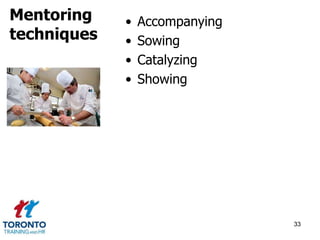
• Accompanying 
• Sowing 
• Catalyzing 
• Showing 
33 
Mentoring 
techniques
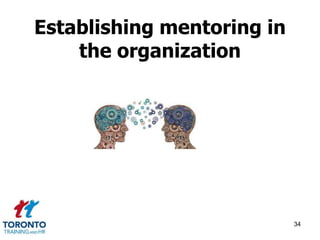
Establishing mentoring in 
the organization 
34
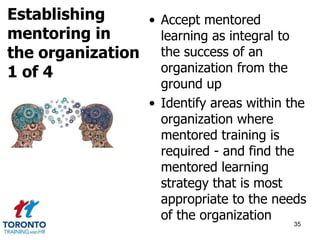
• Accept mentored 
learning as integral to 
the success of an 
organization from the 
ground up 
• Identify areas within the 
organization where 
mentored training is 
required - and find the 
mentored learning 
strategy that is most 
appropriate to the needs 
of the organization 
35 
Establishing 
mentoring in 
the organization 
1 of 4
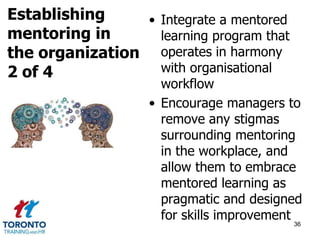
• Integrate a mentored 
learning program that 
operates in harmony 
with organisational 
workflow 
• Encourage managers to 
remove any stigmas 
surrounding mentoring 
in the workplace, and 
allow them to embrace 
mentored learning as 
pragmatic and designed 
for skills improvement 
36 
Establishing 
mentoring in 
the organization 
2 of 4
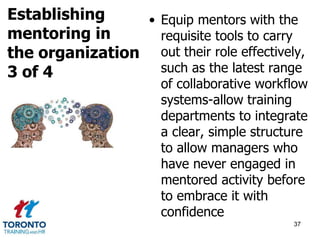
• Equip mentors with the 
requisite tools to carry 
out their role effectively, 
such as the latest range 
of collaborative workflow 
systems-allow training 
departments to integrate 
a clear, simple structure 
to allow managers who 
have never engaged in 
mentored activity before 
to embrace it with 
confidence 
37 
Establishing 
mentoring in 
the organization 
3 of 4
• Monitor every step of 
the mentoring process 
to ensure effective 
collaboration and 
participation between 
mentors and mentees 
and evaluate program 
results to ensure skills 
targets are achieved 
38 
Establishing 
mentoring in 
the organization 
4 of 4
Creating a modern 
mentoring program 
39
Concepts to consider 
• Open and egalitarian 
• Diverse 
• Flexible 
• Self-directed and personal 
40 
Creating a 
modern 
mentoring 
program
What should mentors and 
mentees include in their 
contracts? 
41
• A promise to meet 
regularly 
• A promise to focus 
during the meeting 
• A promise to focus 
on discussing 
business 
• A promise to speak 
honestly 
• A promise to speak 
fairly 
42 
What should 
mentors and 
mentees 
include in 
their 
contracts?
Generational differences 
around mentoring 
43
• Millennials 
• Generation Y 
• Generation X 
• Baby boomers 
44 
Generational 
differences 
around 
mentoring
Pressure points which can 
undo mentoring 
45
• Support 
• Potential 
• Leadership 
• Outcomes 
• Measurement 
46 
Pressure points 
which can undo 
mentoring
Common mistakes made 
by mentors 
47
• Mentors don’t 
understand their 
roles 
• Organizations 
mismatch mentors 
and mentees 
• Organizations pick 
the wrong mentees 
• Organizations let 
the programs go 
unattended 
48 
Common 
mistakes 
made by 
mentors
Conclusion, summary and 
questions 
49
Conclusion, summary and 
questions 
Conclusion 
Summary 
Videos 
Questions 
50

Coaching and mentoring September 2014

  • 1.
    Coaching and mentoring by Toronto Training and HR September 2014 1
  • 2.
    CONTENTS 3-4 Introduction 5-6 Definitions 7-8 Manager-as-coach 9-10 Executive coaching 11-12 Formal mentoring 13-14 Coaching practices to master 15-16 Being an effective coach 17-18 Coaching considerations for the independent operator 19-20 How much do external coaches cost? 21-22 Managing different types of change resistance 23-24 Key considerations for change 25-29 Breaking through the behaviour barriers holding back executives 30-31 Skills needed by a mentor 32-33 Mentoring techniques 34-38 Establishing mentoring in the organization 39-40 Creating a modern mentoring program 41-42 What should mentors and mentees include in their contracts? 43-44 Generational differences around mentoring 45-46 Pressure points which can undo mentoring 47-48 Common mistakes made by mentors 49-50 Conclusion, summary and questions 2
  • 3.
  • 4.
    Introduction to TorontoTraining and HR Toronto Training and HR is a specialist training and human resources consultancy headed by Timothy Holden 10 years in banking 15 years in training and human resources Freelance practitioner since 2006 The core services provided by Toronto Training and HR are: Training event design Training event delivery HR support with an emphasis on reducing costs, saving time plus improving employee engagement and morale Services for job seekers 4
  • 5.
  • 6.
    • Coaching •Mentoring • Coach • Mentor 6 Definitions
  • 7.
  • 8.
    • Definition •Purpose • Practice • Research 8 Manager-as-coach
  • 9.
  • 10.
    • Definition •Purpose • Practice • Research 10 Executive coaching
  • 11.
  • 12.
    • Definition •Purpose • Practice • Research 12 Formal mentoring
  • 13.
  • 14.
    • Attentive listening • Body language • Exploratory questions • Feedback and follow-up 14 Coaching practices to master
  • 15.
  • 16.
    • Relate wellto produce real results • Boost that ego strength • Let your character flourish 16 Being an effective coach
  • 17.
    Coaching considerations forthe independent operator 17
  • 18.
    • Foundational skills • Product information • Employee empowerment 18 Coaching considerations for the independent operator
  • 19.
    How much doexternal coaches cost? 19
  • 20.
    10 one hoursessions • CEO • Manager • Business owner or entrepreneur • Team leader • Employee without management responsibilities 20 How much do external coaches cost?
  • 21.
    Managing different types of change resistance 21
  • 22.
    • Complacency •Resignation • Cynicism 22 Managing different types of change resistance
  • 23.
  • 24.
    • Convey changeas positive • Coach to comfortable levels of acceptance • Be prepared to be challenged • Listen at different levels 24 Key considerations for change
  • 25.
    Breaking through the behaviour barriers holding back executives 25
  • 26.
    • Identify thebehaviours that are holding the leader back from achieving key results-this assessment can be done by hiring an executive coach to implement a 360 survey, who may conduct one-on-one interviews with each of the people who work most closely with the top leader 26 Breaking through the behaviour barriers holding back executives 1 of 4
  • 27.
    • Share theresults with the leader and decide upon the plan of action, which would ideally be implemented during the next nine months • Include four to seven other peers, colleagues, bosses and direct reports as part of the coaching process • Get honest feedback every 30 days and watch changes occur within all who are involved, not just the leader 27 Breaking through the behaviour barriers holding back executives 2 of 4
  • 28.
    Ask each ofthe influencers this question: • “If you could master one behaviour that would make the biggest impact in your work with others inside and outside the organization, what would it be?” 28 Breaking through the behaviour barriers holding back executives 3 of 4
  • 29.
    Then ask themto make four commitments: • 1. Let go of the past with my client • 2. Support and encourage my client • 3. Be willing to give honest feedback every 30 days to my client • 4. Pick a behaviour to change 29 Breaking through the behaviour barriers holding back executives 4 of 4
  • 30.
    Skills needed bya mentor 30
  • 31.
    • Listening skills • Questioning skills • Advising skills • Storytelling skills • Resourcing skills 31 Skills needed by a mentor
  • 32.
  • 33.
    • Accompanying •Sowing • Catalyzing • Showing 33 Mentoring techniques
  • 34.
    Establishing mentoring in the organization 34
  • 35.
    • Accept mentored learning as integral to the success of an organization from the ground up • Identify areas within the organization where mentored training is required - and find the mentored learning strategy that is most appropriate to the needs of the organization 35 Establishing mentoring in the organization 1 of 4
  • 36.
    • Integrate amentored learning program that operates in harmony with organisational workflow • Encourage managers to remove any stigmas surrounding mentoring in the workplace, and allow them to embrace mentored learning as pragmatic and designed for skills improvement 36 Establishing mentoring in the organization 2 of 4
  • 37.
    • Equip mentorswith the requisite tools to carry out their role effectively, such as the latest range of collaborative workflow systems-allow training departments to integrate a clear, simple structure to allow managers who have never engaged in mentored activity before to embrace it with confidence 37 Establishing mentoring in the organization 3 of 4
  • 38.
    • Monitor everystep of the mentoring process to ensure effective collaboration and participation between mentors and mentees and evaluate program results to ensure skills targets are achieved 38 Establishing mentoring in the organization 4 of 4
  • 39.
    Creating a modern mentoring program 39
  • 40.
    Concepts to consider • Open and egalitarian • Diverse • Flexible • Self-directed and personal 40 Creating a modern mentoring program
  • 41.
    What should mentorsand mentees include in their contracts? 41
  • 42.
    • A promiseto meet regularly • A promise to focus during the meeting • A promise to focus on discussing business • A promise to speak honestly • A promise to speak fairly 42 What should mentors and mentees include in their contracts?
  • 43.
  • 44.
    • Millennials •Generation Y • Generation X • Baby boomers 44 Generational differences around mentoring
  • 45.
    Pressure points whichcan undo mentoring 45
  • 46.
    • Support •Potential • Leadership • Outcomes • Measurement 46 Pressure points which can undo mentoring
  • 47.
    Common mistakes made by mentors 47
  • 48.
    • Mentors don’t understand their roles • Organizations mismatch mentors and mentees • Organizations pick the wrong mentees • Organizations let the programs go unattended 48 Common mistakes made by mentors
  • 49.
  • 50.
    Conclusion, summary and questions Conclusion Summary Videos Questions 50