COACHING SKILLS WHAT TO DO AND WHEN TO DO
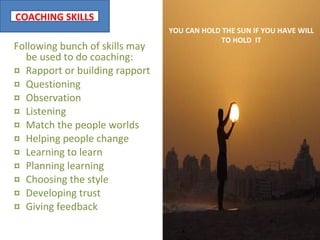
Following bunch of skills may be used to do coaching: Rapport or building rapport Questioning Observation Listening Match the people worlds Helping people change Learning to learn Planning learning Choosing the style Developing trust Giving feedback YOU CAN HOLD THE SUN IF YOU HAVE WILL TO HOLD  IT
COACHING IS BUILT ON THE BASIS OF CREATING AND MAINTAINING FRIENDLY RELATIONSHIPS. THE SUCCESS OF COACHING WILL DEPEND ON THE AMOUNT OF RAPPORT THAT EXISTS BETWEEN THOSE INVOLVED, WITHOUT IT THERE WILL BE SUSPICION; WITH IT THERE ARE BASIS OF TRUST. RAPPORT MEANS GETTING YOUR BEHAVIOR IN HARMONY WITH OTHERS.  IT IS NOT SIMPLY GETTING PEOPLE TO LIKE YOU, BUT HAVING FLEXIBILITY TO BEHAVE IN THE SAME WAY AS OTHERS. RAPPORT
PEOPLE IN RAPPORT TYPICALLY “MATCH” ONE ANOTHER. DON’T MAKE TOO OBVIOUS, AS RAPPORT THAT WORKS IS AN UNCONSCIOUS PROCESS. YOU MAY BE DOING IT ANYWAY WITHOUT BEING AWARE OF IT, AS IT HAPPENS QUITE NATURALLY. RAPPORT IS A POWERFUL FORM OF INFLUENCING AND KEY SKILL AT ALL STAGES OF THE COACHING SEQUENCE. WHEN YOU CAN MATCH AND PACE YOU CAN LEAD , SO DON’T EXPECT OTHERS TO COME TO YOU UNLESS YOU FIRST GO TO THEM. BUILDING RAPPORT
When coaching you need information to help you find out where the person is coming from, what they have tried and what works. Good information will increase your chances of providing appropriate help. However, you do need to be skilled at asking an using a range of question. QUESTIONING
Blockbusting: When you are looking for more precise information. Challenging: Questions to people who make generalisations. Testing understandings: When you want to establish whether or not an earlier contribution has been understood. Summarising: Restating in a compact from what has gone before. QUESTIONING  TECHNIQUES
The real art of discovery consist not of finding new land but of seeing it with new eyes To be skilled coach you may well to change the way you look at both people and situations. We have a habit of: Putting individuals in boxes,ie: we form judgments about their abilities potential and personalities. Failing to spot situations where coaching may be appropriate, failing to match people accordingly. Successful coaches open their eyes to all sorts of possibilities. OBSERVATIONS
Observation is a key of coaching skill. Many of us watch, but how many actually see what’s happening? Observation is a very powerful, especially when it brings to people’s notice behaviour that is normally commented upon. As a coach you need to be able to: Spot what’s happening and what’s not. Work out specifically what people are doing and how/why they do. Feed it back in a way that is constructive and helpful. OBSERVATIONS
Most people are not trained to listen. We r all guilty of daily displaying our lack of skills when we: Hear only what we want to hear. Fail to put ourselves in other people’s shoes. Think we know what people are talking about. Listen to the words but miss the “music”, ie: emotions behind them “ Already listen”, which means that we have made up our minds and only hear what we want to hear. All are disastrous mistakes if u  want to succeed as a coach LISTENING
What to do: Paying attention and showing an interest. Reflecting back what you think they r saying. Matching the behaviour of the speaker. Avoiding distractions. Recognising that it is a hard work. Keeping your mouth shut and not talking. It is as though he listened and such listening as his enfolds us in a silence in which at last we begin to hear what we r meant to be. LISTENING
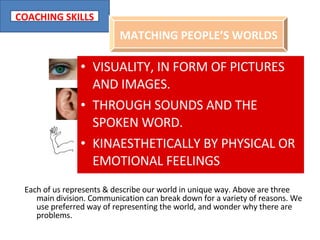
VISUALITY, IN FORM OF PICTURES AND IMAGES. THROUGH SOUNDS AND THE SPOKEN WORD. KINAESTHETICALLY BY PHYSICAL OR EMOTIONAL FEELINGS MATCHING PEOPLE’S WORLDS Each of us represents & describe our world in unique way. Above are three main division. Communication can break down for a variety of reasons. We use preferred way of representing the world, and wonder why there are problems.
AS A COACH WE OFTEN SEE POTENTIAL AND ABILITIES IN OTHERS THAT THEY DON’T SEE IN THEMSELVES, WHILST A LOT OF OUR EFFORTS ARE DIRECTED TOWARDS ENCOURAGING PEOPLE TO HAVE A GO, THEY MIGHT SAY “I CAN’T DO THAT”. THIS CAN PROVE TO BE STUMBLING BLOCK TO PROGRESS; WHERE DO YOU GO FROM HERE. BREAK DOWN WHAT THEY ARE SAYING AND THINK OF IMPLICATIONS. DON’T BE AFRAID TO CHALLENGE WORDS LIK”NEVER” AND “ALWAYS” HELPING PEOPLE CHANGE
ASK QUESTIONS “HOW DO YOU KNOW THAT. IF PEOPLE SAY  THAT WILL NEVER WORK HERE  TRY REPLYING  WHAT WOULD HAPPEN IF IT COULD HAPPEN. THE ROLE OF A COACH IS TO ENCOURAGE PEOPLE TO TAKE ON NEW BEHAVIOURS. WHEN FACED WITH AN OBJECTION TRY SAYING “WHY NOT?” HENER FORD SAID” IF YOU BELIEVE YOU CAN OR CAN’T DO SOMETHING , YOU ARE RIGHT.”   DON’T LET WHAT YOU CANT DO INTERFERE WITH WHAT YOU CAN DO HELPING PEOPLE CHANGE
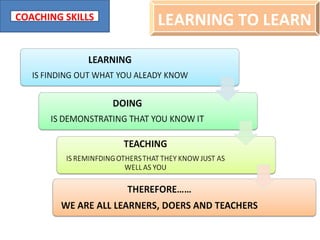
Coaching is turning problems into learning situations and how one’s get all parties to learn? Learning is about gaining knowledge or skill by study, experience or being taught. Learning to learn from every day experience, from change, and helping others to learn and learning ourselves is not the same as teaching and being taught.. In particular learning is a key skill for individuals, teams, & organizations. LEARNING
Help people, develop their learning skills by  Consciously looking and recognizing for every day opportunities to learn. Raising its importance within organizations. Create an environment which supports and encourages individuals to learn from each other and daily happenings. Don’t try to teach but create a situations in which others can learn. LEARNING TO LEARN
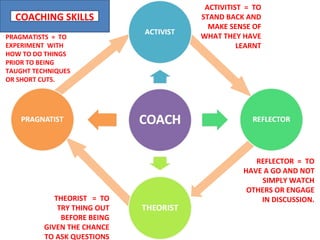
PRAGMATISTS  =  TO EXPERIMENT  WITH HOW TO DO THINGS PRIOR TO BEING TAUGHT TECHNIQUES OR SHORT CUTS. THEORIST  =  TO TRY THING OUT BEFORE BEING GIVEN THE CHANCE TO ASK QUESTIONS ACTIVITIST  =  TO STAND BACK AND MAKE SENSE OF WHAT THEY HAVE LEARNT REFLECTOR  =  TO HAVE A GO AND NOT SIMPLY WATCH OTHERS OR ENGAGE IN DISCUSSION.
LEARNING TO LEARN
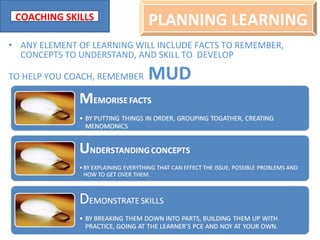
ANY ELEMENT OF LEARNING WILL INCLUDE FACTS TO REMEMBER, CONCEPTS TO UNDERSTAND, AND SKILL TO  DEVELOP TO HELP YOU COACH, REMEMBER  MUD PLANNING LEARNING
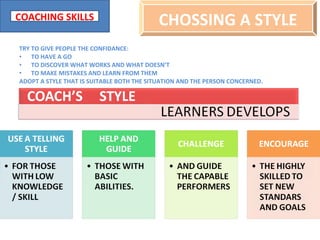
TRY TO GIVE PEOPLE THE CONFIDANCE: TO HAVE A GO TO DISCOVER WHAT WORKS AND WHAT DOESN’T TO MAKE MISTAKES AND LEARN FROM THEM ADOPT A STYLE THAT IS SUITABLE BOTH THE SITUATION AND THE PERSON CONCERNED. CHOSSING A STYLE
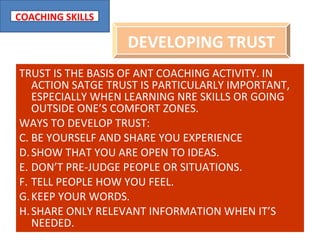
TRUST IS THE BASIS OF ANT COACHING ACTIVITY. IN ACTION SATGE TRUST IS PARTICULARLY IMPORTANT, ESPECIALLY WHEN LEARNING NRE SKILLS OR GOING OUTSIDE ONE’S COMFORT ZONES. WAYS TO DEVELOP TRUST: BE YOURSELF AND SHARE YOU EXPERIENCE SHOW THAT YOU ARE OPEN TO IDEAS. DON’T PRE-JUDGE PEOPLE OR SITUATIONS. TELL PEOPLE HOW YOU FEEL. KEEP YOUR WORDS. SHARE ONLY RELEVANT INFORMATION WHEN IT’S NEEDED. DEVELOPING TRUST
FEEDBACK IS MAKING PEOPLE AWARE OF WHAT THEY ARE DOING AND THE EFFECT THAT IT’S HAVING. REMEMBER THAQT YOU CAN GIVE FEEDBACK ON WHAT’S WORKING AND WHAT IS NOT.THE MAIN POINT IS TO MAKE IT RELEVANT AND USEFUL. GIVING FEEDBACK IS ABOUT PROVIDING PLENTY OF REASSURANCE AND APPROPRIATE PRAISE. TAKE CARE NOT TO DEMOTIVATE PEOPLE OR REVERT TO SIMPLY TELLING THEM HOW TO DO THINGS. SHOW EMPATHY AND TRY TO APPRECIATE WHAT THEY ARE FEELING AND WHAT DIFFCULTIES THEY ARE HAVING. ONCE THERY ARE ARMED WITH FEEDBACK , LET THEM HAVE ANOTHER GO. GIVING FEEDBACK
 

Coaching Skills

  • 1.
    COACHING SKILLS WHATTO DO AND WHEN TO DO
  • 2.
    Following bunch ofskills may be used to do coaching: Rapport or building rapport Questioning Observation Listening Match the people worlds Helping people change Learning to learn Planning learning Choosing the style Developing trust Giving feedback YOU CAN HOLD THE SUN IF YOU HAVE WILL TO HOLD IT
  • 3.
    COACHING IS BUILTON THE BASIS OF CREATING AND MAINTAINING FRIENDLY RELATIONSHIPS. THE SUCCESS OF COACHING WILL DEPEND ON THE AMOUNT OF RAPPORT THAT EXISTS BETWEEN THOSE INVOLVED, WITHOUT IT THERE WILL BE SUSPICION; WITH IT THERE ARE BASIS OF TRUST. RAPPORT MEANS GETTING YOUR BEHAVIOR IN HARMONY WITH OTHERS. IT IS NOT SIMPLY GETTING PEOPLE TO LIKE YOU, BUT HAVING FLEXIBILITY TO BEHAVE IN THE SAME WAY AS OTHERS. RAPPORT
  • 4.
    PEOPLE IN RAPPORTTYPICALLY “MATCH” ONE ANOTHER. DON’T MAKE TOO OBVIOUS, AS RAPPORT THAT WORKS IS AN UNCONSCIOUS PROCESS. YOU MAY BE DOING IT ANYWAY WITHOUT BEING AWARE OF IT, AS IT HAPPENS QUITE NATURALLY. RAPPORT IS A POWERFUL FORM OF INFLUENCING AND KEY SKILL AT ALL STAGES OF THE COACHING SEQUENCE. WHEN YOU CAN MATCH AND PACE YOU CAN LEAD , SO DON’T EXPECT OTHERS TO COME TO YOU UNLESS YOU FIRST GO TO THEM. BUILDING RAPPORT
  • 5.
    When coaching youneed information to help you find out where the person is coming from, what they have tried and what works. Good information will increase your chances of providing appropriate help. However, you do need to be skilled at asking an using a range of question. QUESTIONING
  • 6.
    Blockbusting: When youare looking for more precise information. Challenging: Questions to people who make generalisations. Testing understandings: When you want to establish whether or not an earlier contribution has been understood. Summarising: Restating in a compact from what has gone before. QUESTIONING TECHNIQUES
  • 7.
    The real artof discovery consist not of finding new land but of seeing it with new eyes To be skilled coach you may well to change the way you look at both people and situations. We have a habit of: Putting individuals in boxes,ie: we form judgments about their abilities potential and personalities. Failing to spot situations where coaching may be appropriate, failing to match people accordingly. Successful coaches open their eyes to all sorts of possibilities. OBSERVATIONS
  • 8.
    Observation is akey of coaching skill. Many of us watch, but how many actually see what’s happening? Observation is a very powerful, especially when it brings to people’s notice behaviour that is normally commented upon. As a coach you need to be able to: Spot what’s happening and what’s not. Work out specifically what people are doing and how/why they do. Feed it back in a way that is constructive and helpful. OBSERVATIONS
  • 9.
    Most people arenot trained to listen. We r all guilty of daily displaying our lack of skills when we: Hear only what we want to hear. Fail to put ourselves in other people’s shoes. Think we know what people are talking about. Listen to the words but miss the “music”, ie: emotions behind them “ Already listen”, which means that we have made up our minds and only hear what we want to hear. All are disastrous mistakes if u want to succeed as a coach LISTENING
  • 10.
    What to do:Paying attention and showing an interest. Reflecting back what you think they r saying. Matching the behaviour of the speaker. Avoiding distractions. Recognising that it is a hard work. Keeping your mouth shut and not talking. It is as though he listened and such listening as his enfolds us in a silence in which at last we begin to hear what we r meant to be. LISTENING
  • 11.
    VISUALITY, IN FORMOF PICTURES AND IMAGES. THROUGH SOUNDS AND THE SPOKEN WORD. KINAESTHETICALLY BY PHYSICAL OR EMOTIONAL FEELINGS MATCHING PEOPLE’S WORLDS Each of us represents & describe our world in unique way. Above are three main division. Communication can break down for a variety of reasons. We use preferred way of representing the world, and wonder why there are problems.
  • 12.
    AS A COACHWE OFTEN SEE POTENTIAL AND ABILITIES IN OTHERS THAT THEY DON’T SEE IN THEMSELVES, WHILST A LOT OF OUR EFFORTS ARE DIRECTED TOWARDS ENCOURAGING PEOPLE TO HAVE A GO, THEY MIGHT SAY “I CAN’T DO THAT”. THIS CAN PROVE TO BE STUMBLING BLOCK TO PROGRESS; WHERE DO YOU GO FROM HERE. BREAK DOWN WHAT THEY ARE SAYING AND THINK OF IMPLICATIONS. DON’T BE AFRAID TO CHALLENGE WORDS LIK”NEVER” AND “ALWAYS” HELPING PEOPLE CHANGE
  • 13.
    ASK QUESTIONS “HOWDO YOU KNOW THAT. IF PEOPLE SAY THAT WILL NEVER WORK HERE TRY REPLYING WHAT WOULD HAPPEN IF IT COULD HAPPEN. THE ROLE OF A COACH IS TO ENCOURAGE PEOPLE TO TAKE ON NEW BEHAVIOURS. WHEN FACED WITH AN OBJECTION TRY SAYING “WHY NOT?” HENER FORD SAID” IF YOU BELIEVE YOU CAN OR CAN’T DO SOMETHING , YOU ARE RIGHT.” DON’T LET WHAT YOU CANT DO INTERFERE WITH WHAT YOU CAN DO HELPING PEOPLE CHANGE
  • 14.
    Coaching is turningproblems into learning situations and how one’s get all parties to learn? Learning is about gaining knowledge or skill by study, experience or being taught. Learning to learn from every day experience, from change, and helping others to learn and learning ourselves is not the same as teaching and being taught.. In particular learning is a key skill for individuals, teams, & organizations. LEARNING
  • 15.
    Help people, developtheir learning skills by Consciously looking and recognizing for every day opportunities to learn. Raising its importance within organizations. Create an environment which supports and encourages individuals to learn from each other and daily happenings. Don’t try to teach but create a situations in which others can learn. LEARNING TO LEARN
  • 16.
    PRAGMATISTS = TO EXPERIMENT WITH HOW TO DO THINGS PRIOR TO BEING TAUGHT TECHNIQUES OR SHORT CUTS. THEORIST = TO TRY THING OUT BEFORE BEING GIVEN THE CHANCE TO ASK QUESTIONS ACTIVITIST = TO STAND BACK AND MAKE SENSE OF WHAT THEY HAVE LEARNT REFLECTOR = TO HAVE A GO AND NOT SIMPLY WATCH OTHERS OR ENGAGE IN DISCUSSION.
  • 17.
  • 18.
    ANY ELEMENT OFLEARNING WILL INCLUDE FACTS TO REMEMBER, CONCEPTS TO UNDERSTAND, AND SKILL TO DEVELOP TO HELP YOU COACH, REMEMBER MUD PLANNING LEARNING
  • 19.
    TRY TO GIVEPEOPLE THE CONFIDANCE: TO HAVE A GO TO DISCOVER WHAT WORKS AND WHAT DOESN’T TO MAKE MISTAKES AND LEARN FROM THEM ADOPT A STYLE THAT IS SUITABLE BOTH THE SITUATION AND THE PERSON CONCERNED. CHOSSING A STYLE
  • 20.
    TRUST IS THEBASIS OF ANT COACHING ACTIVITY. IN ACTION SATGE TRUST IS PARTICULARLY IMPORTANT, ESPECIALLY WHEN LEARNING NRE SKILLS OR GOING OUTSIDE ONE’S COMFORT ZONES. WAYS TO DEVELOP TRUST: BE YOURSELF AND SHARE YOU EXPERIENCE SHOW THAT YOU ARE OPEN TO IDEAS. DON’T PRE-JUDGE PEOPLE OR SITUATIONS. TELL PEOPLE HOW YOU FEEL. KEEP YOUR WORDS. SHARE ONLY RELEVANT INFORMATION WHEN IT’S NEEDED. DEVELOPING TRUST
  • 21.
    FEEDBACK IS MAKINGPEOPLE AWARE OF WHAT THEY ARE DOING AND THE EFFECT THAT IT’S HAVING. REMEMBER THAQT YOU CAN GIVE FEEDBACK ON WHAT’S WORKING AND WHAT IS NOT.THE MAIN POINT IS TO MAKE IT RELEVANT AND USEFUL. GIVING FEEDBACK IS ABOUT PROVIDING PLENTY OF REASSURANCE AND APPROPRIATE PRAISE. TAKE CARE NOT TO DEMOTIVATE PEOPLE OR REVERT TO SIMPLY TELLING THEM HOW TO DO THINGS. SHOW EMPATHY AND TRY TO APPRECIATE WHAT THEY ARE FEELING AND WHAT DIFFCULTIES THEY ARE HAVING. ONCE THERY ARE ARMED WITH FEEDBACK , LET THEM HAVE ANOTHER GO. GIVING FEEDBACK
  • 22.