An introduction
to
animal camouflage
Why camouflage?
Remember the four basic needs of animals:




Why camouflage?
Remember the four basic needs of animals:
 Food
 Water
 Shelter
 Space
Animals need to find all of these things in
their habitats.
Why camouflage?
Camouflage helps animals to blend in with
their environment so that they can find what
they need and raise their young.
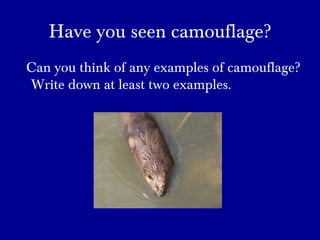
Have you seen camouflage?
Can you think of any examples of camouflage?
Write down at least two examples.
Four kinds of camouflage
One way to understand camouflage is to think
about four different kinds of camouflage:
• Cryptic coloration
• Disruptive coloration
• Mimicry
• Countershading
Four kinds of camouflage
One way to understand camouflage is to think
about four different kinds of camouflage:
• Cryptic coloration
• Disruptive coloration
• Mimicry
• Countershading
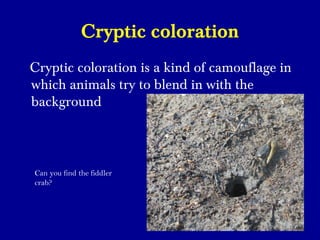
Cryptic coloration
Cryptic coloration is a kind of camouflage in
which animals try to blend in with the
background
Can you find the fiddler
crab?
Cryptic coloration
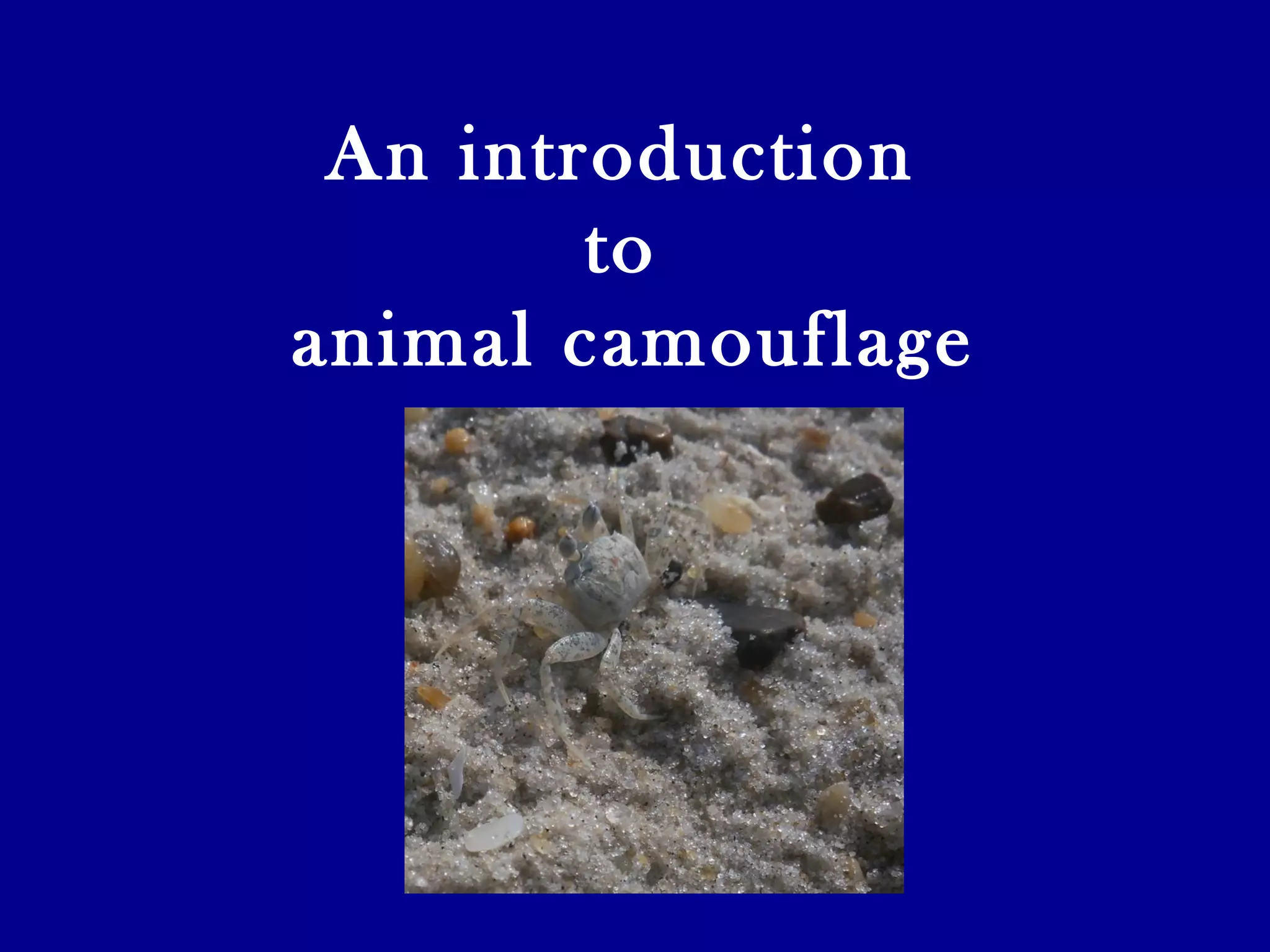
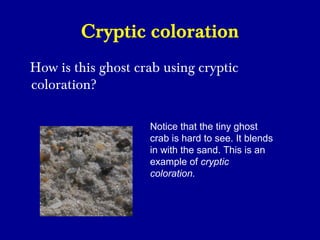
How is this ghost crab using cryptic
coloration?
Notice that the tiny ghost
crab is hard to see. It blends
in with the sand. This is an
example of cryptic
coloration.
Cryptic coloration
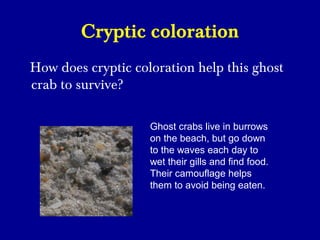
How does cryptic coloration help this ghost
crab to survive?
Ghost crabs live in burrows
on the beach, but go down
to the waves each day to
wet their gills and find food.
Their camouflage helps
them to avoid being eaten.
Cryptic coloration
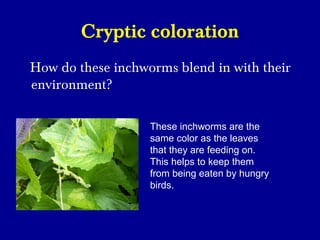
How do these inchworms blend in with their
environment?
These inchworms are the
same color as the leaves
that they are feeding on.
This helps to keep them
from being eaten by hungry
birds.
Cryptic coloration
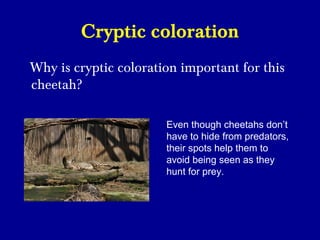
Why is cryptic coloration important for this
cheetah?
Even though cheetahs don’t
have to hide from predators,
their spots help them to
avoid being seen as they
hunt for prey.
Cryptic coloration
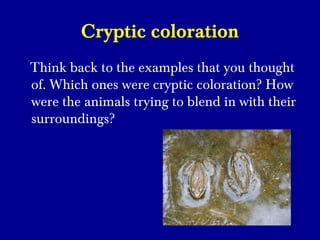
Think back to the examples that you thought
of. Which ones were cryptic coloration? How
were the animals trying to blend in with their
surroundings?
Four kinds of camouflage
• Cryptic coloration
• Disruptive coloration
• Mimicry
• Countershading
Disruptive coloration
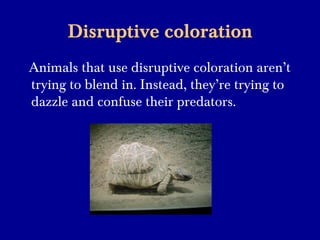
Animals that use disruptive coloration aren’t
trying to blend in. Instead, they’re trying to
dazzle and confuse their predators.
Disruptive coloration
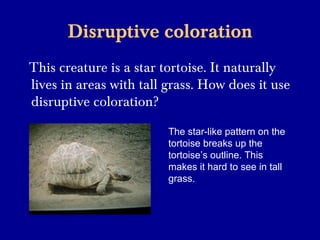
This creature is a star tortoise. It naturally
lives in areas with tall grass. How does it use
disruptive coloration?
The star-like pattern on the
tortoise breaks up the
tortoise’s outline. This
makes it hard to see in tall
grass.
Disruptive coloration
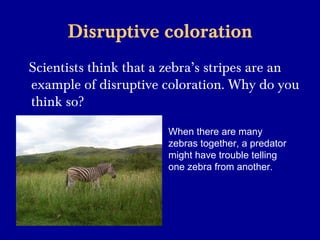
Scientists think that a zebra’s stripes are an
example of disruptive coloration. Why do you
think so?
When there are many
zebras together, a predator
might have trouble telling
one zebra from another.
Disruptive coloration
How is disruptive coloration different from
cryptic coloration?
How is disruptive coloration similar to cryptic
coloration?
Four kinds of camouflage
• Cryptic coloration
• Disruptive coloration
• Mimicry
• Countershading
Mimicry
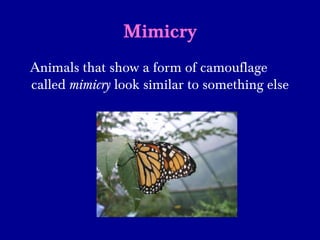
Animals that show a form of camouflage
called mimicry look similar to something else
Mimicry
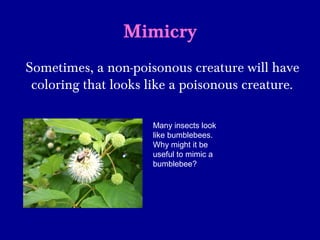
Sometimes, a non-poisonous creature will have
coloring that looks like a poisonous creature.
Many insects look
like bumblebees.
Why might it be
useful to mimic a
bumblebee?
Mimicry
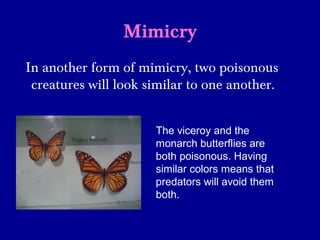
In another form of mimicry, two poisonous
creatures will look similar to one another.
The viceroy and the
monarch butterflies are
both poisonous. Having
similar colors means that
predators will avoid them
both.
Review
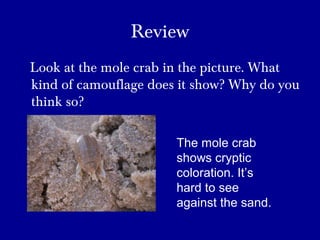
Look at the mole crab in the picture. What
kind of camouflage does it show? Why do you
think so?
The mole crab
shows cryptic
coloration. It’s
hard to see
against the sand.
Review
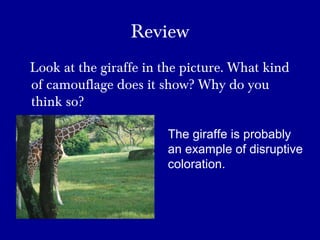
Look at the giraffe in the picture. What kind
of camouflage does it show? Why do you
think so?
The giraffe is probably
an example of disruptive
coloration.
Review
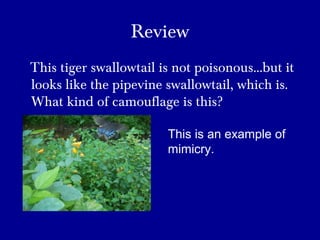
This tiger swallowtail is not poisonous…but it
looks like the pipevine swallowtail, which is.
What kind of camouflage is this?
This is an example of
mimicry.
Four kinds of camouflage
• Cryptic coloration
• Disruptive coloration
• Mimicry
• Countershading
Countershading
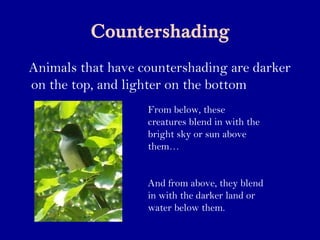
Animals that have countershading are darker
on the top, and lighter on the bottom
From below, these
creatures blend in with the
bright sky or sun above
them…
And from above, they blend
in with the darker land or
water below them.
Countershading
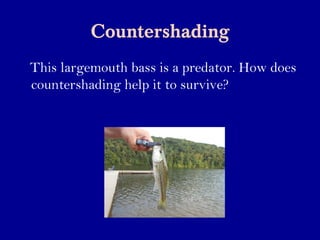
This largemouth bass is a predator. How does
countershading help it to survive?
Countershading
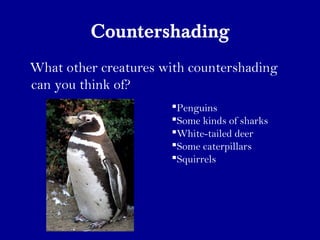
What other creatures with countershading
can you think of?
Penguins
Some kinds of sharks
White-tailed deer
Some caterpillars
Squirrels
Review
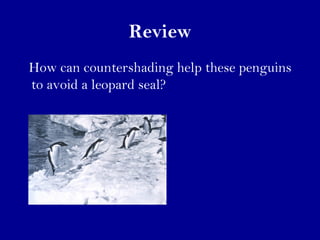
How can countershading help these penguins
to avoid a leopard seal?
Review
• Cryptic coloration
• Disruptive coloration
• ___________________
• Countershading
Which kind of
camouflage is
missing?
Review
• Cryptic coloration
• Disruptive coloration
• Mimicry
• Countershading
Review
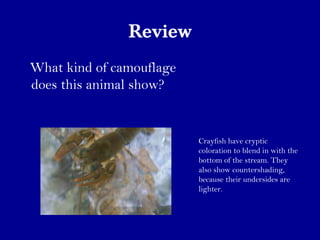
What kind of camouflage
does this animal show?
Crayfish have cryptic
coloration to blend in with the
bottom of the stream. They
also show countershading,
because their undersides are
lighter.
Review
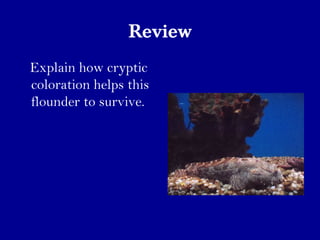
Explain how cryptic
coloration helps this
flounder to survive.
More camouflage!
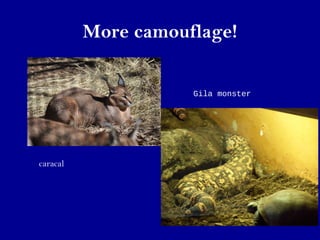
caracal
Gila monster
More camouflage!
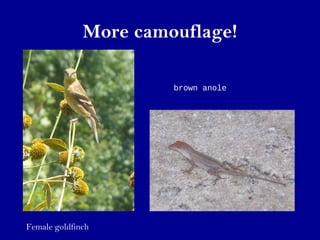
Female goldfinch
brown anole
What have you learned?
Go back to your list of animals with
camouflage.
 What kinds of camouflage do these animals
show?
 What have you learned about animal
camouflage?

Understanding Camouflage

  • 1.
  • 2.
    Why camouflage? Remember thefour basic needs of animals:    
  • 3.
    Why camouflage? Remember thefour basic needs of animals:  Food  Water  Shelter  Space Animals need to find all of these things in their habitats.
  • 4.
    Why camouflage? Camouflage helpsanimals to blend in with their environment so that they can find what they need and raise their young.
  • 5.
    Have you seencamouflage? Can you think of any examples of camouflage? Write down at least two examples.
  • 6.
    Four kinds ofcamouflage One way to understand camouflage is to think about four different kinds of camouflage: • Cryptic coloration • Disruptive coloration • Mimicry • Countershading
  • 7.
    Four kinds ofcamouflage One way to understand camouflage is to think about four different kinds of camouflage: • Cryptic coloration • Disruptive coloration • Mimicry • Countershading
  • 8.
    Cryptic coloration Cryptic colorationis a kind of camouflage in which animals try to blend in with the background Can you find the fiddler crab?
  • 9.
    Cryptic coloration How isthis ghost crab using cryptic coloration? Notice that the tiny ghost crab is hard to see. It blends in with the sand. This is an example of cryptic coloration.
  • 10.
    Cryptic coloration How doescryptic coloration help this ghost crab to survive? Ghost crabs live in burrows on the beach, but go down to the waves each day to wet their gills and find food. Their camouflage helps them to avoid being eaten.
  • 11.
    Cryptic coloration How dothese inchworms blend in with their environment? These inchworms are the same color as the leaves that they are feeding on. This helps to keep them from being eaten by hungry birds.
  • 12.
    Cryptic coloration Why iscryptic coloration important for this cheetah? Even though cheetahs don’t have to hide from predators, their spots help them to avoid being seen as they hunt for prey.
  • 13.
    Cryptic coloration Think backto the examples that you thought of. Which ones were cryptic coloration? How were the animals trying to blend in with their surroundings?
  • 14.
    Four kinds ofcamouflage • Cryptic coloration • Disruptive coloration • Mimicry • Countershading
  • 15.
    Disruptive coloration Animals thatuse disruptive coloration aren’t trying to blend in. Instead, they’re trying to dazzle and confuse their predators.
  • 16.
    Disruptive coloration This creatureis a star tortoise. It naturally lives in areas with tall grass. How does it use disruptive coloration? The star-like pattern on the tortoise breaks up the tortoise’s outline. This makes it hard to see in tall grass.
  • 17.
    Disruptive coloration Scientists thinkthat a zebra’s stripes are an example of disruptive coloration. Why do you think so? When there are many zebras together, a predator might have trouble telling one zebra from another.
  • 18.
    Disruptive coloration How isdisruptive coloration different from cryptic coloration? How is disruptive coloration similar to cryptic coloration?
  • 19.
    Four kinds ofcamouflage • Cryptic coloration • Disruptive coloration • Mimicry • Countershading
  • 20.
    Mimicry Animals that showa form of camouflage called mimicry look similar to something else
  • 21.
    Mimicry Sometimes, a non-poisonouscreature will have coloring that looks like a poisonous creature. Many insects look like bumblebees. Why might it be useful to mimic a bumblebee?
  • 22.
    Mimicry In another formof mimicry, two poisonous creatures will look similar to one another. The viceroy and the monarch butterflies are both poisonous. Having similar colors means that predators will avoid them both.
  • 23.
    Review Look at themole crab in the picture. What kind of camouflage does it show? Why do you think so? The mole crab shows cryptic coloration. It’s hard to see against the sand.
  • 24.
    Review Look at thegiraffe in the picture. What kind of camouflage does it show? Why do you think so? The giraffe is probably an example of disruptive coloration.
  • 25.
    Review This tiger swallowtailis not poisonous…but it looks like the pipevine swallowtail, which is. What kind of camouflage is this? This is an example of mimicry.
  • 26.
    Four kinds ofcamouflage • Cryptic coloration • Disruptive coloration • Mimicry • Countershading
  • 27.
    Countershading Animals that havecountershading are darker on the top, and lighter on the bottom From below, these creatures blend in with the bright sky or sun above them… And from above, they blend in with the darker land or water below them.
  • 28.
    Countershading This largemouth bassis a predator. How does countershading help it to survive?
  • 29.
    Countershading What other creatureswith countershading can you think of? Penguins Some kinds of sharks White-tailed deer Some caterpillars Squirrels
  • 30.
    Review How can countershadinghelp these penguins to avoid a leopard seal?
  • 31.
    Review • Cryptic coloration •Disruptive coloration • ___________________ • Countershading Which kind of camouflage is missing?
  • 32.
    Review • Cryptic coloration •Disruptive coloration • Mimicry • Countershading
  • 33.
    Review What kind ofcamouflage does this animal show? Crayfish have cryptic coloration to blend in with the bottom of the stream. They also show countershading, because their undersides are lighter.
  • 34.
    Review Explain how cryptic colorationhelps this flounder to survive.
  • 35.
  • 36.
  • 37.
    What have youlearned? Go back to your list of animals with camouflage.  What kinds of camouflage do these animals show?  What have you learned about animal camouflage?

Editor's Notes

  • #2 Note: There are many different ways to categorize camouflage. This presentation is meant to be a simple classroom introduction to encourage students to learn more.
  • #11 Ghost crabs are a favorite food of sea gulls. Their coloring helps them to avoid being eaten.
  • #23 Scientists used to think that only the monarch was poisonous. However, further research has shown that both butterflies are toxic, to varying degrees.
  • #29 Photo from Wikimedia Commons
  • #30 Photo:http://commons.wikimedia.org/wiki/File:Magellanic-penguin02.jpg
  • #31 Photo:http://commons.wikimedia.org/wiki/File:Penguinsjumping.jpg
  • #38 Emily Kissner 2015 All photos by the author unless otherwise noted For classroom use only