Engaging Readers:
Managing Independent Reading
Emily Kissner
Bendersville Elementary School
@ELKissner
elkissn@gmail.com
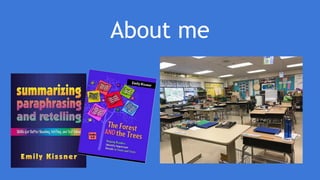
About me
What do you think?
Use this Google Form so that we
can find out about participants.
Benefits of reading choice
There is a strong correlation
between time spent reading and
reading achievement. (Allington,
2014)
Students who engage in recreational
literacy at school read more books at home
(Block and Mangieri, 2002)
Benefits of reading choice
Fifteen minutes of
reading in-school per
day can lead to gains,
especially with
on-grade and below
level readers (Block
and Mangieri, 2002)
Benefits of reading choice
Access to a wide variety of
books, both fiction and
nonfiction, and choice of what
to read are both correlated
with increased motivation to
read. (Allington and Gabriel,
2012)
Challenges of reading
choice
Instead of being
engaged with books,
kids will just “pretend
read”.
Challenges of reading
choice
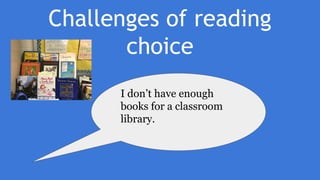
I don’t have enough
books for a classroom
library.
Challenges of reading
choice
I have so much to cover,
there’s no time for
reading!
Setting the scene
Build a classroom
library so that your
students ALWAYS
have access to books.
Setting the scene
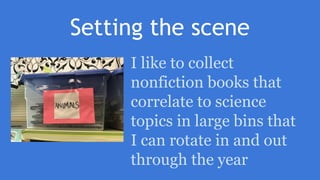
I like to collect
nonfiction books that
correlate to science
topics in large bins that
I can rotate in and out
through the year
Setting the scene
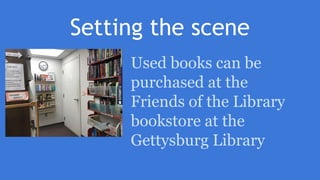
Used books can be
purchased at the
Friends of the Library
bookstore at the
Gettysburg Library
Setting the scene
This year’s Used Book
Sale will be August 1-4
at Redding Auction
House, with the bag
sale on Saturday
Book Sale Details
Book Clubs
Scholastic book orders
can be a way to get
books. One or two
parent purchases can
get you bonus points!
Book Clubs home page
Selecting Books
● Mix of fiction and nonfiction
● Picture books and novels
● Graphic novels
● Books that showcase diversity
○ Favorite authors…
○ Anthology links…
○ Student requests
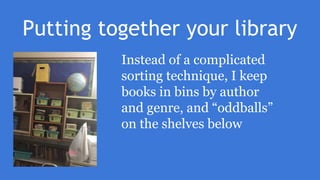
Putting together your library
Instead of a complicated
sorting technique, I keep
books in bins by author
and genre, and “oddballs”
on the shelves below
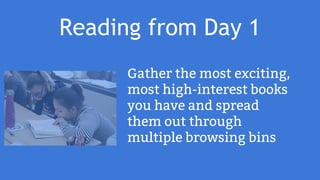
Reading from Day 1
Gather the most exciting,
most high-interest books
you have and spread
them out through
multiple browsing bins
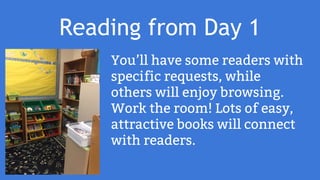
Reading from Day 1
You’ll have some readers with
specific requests, while
others will enjoy browsing.
Work the room! Lots of easy,
attractive books will connect
with readers.
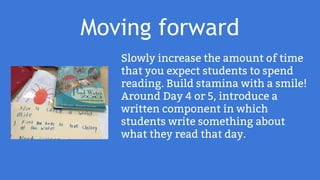
Moving forward
Slowly increase the amount of time
that you expect students to spend
reading. Build stamina with a smile!
Around Day 4 or 5, introduce a
written component in which
students write something about
what they read that day.
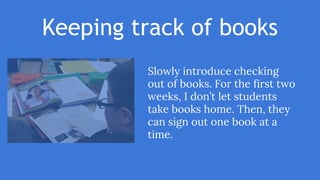
Keeping track of books
Slowly introduce checking
out of books. For the first two
weeks, I don’t let students
take books home. Then, they
can sign out one book at a
time.
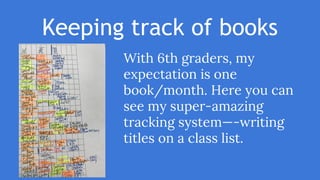
Keeping track of books
With 6th graders, my
expectation is one
book/month. Here you can
see my super-amazing
tracking system—-writing
titles on a class list.
Building a routine
Work with your readers to create a list of
non-negotiables for independent reading
time. Usually:
● Everyone is reading
● The room is quiet
● Stick with a book for the entire session
● No unnecessary movement
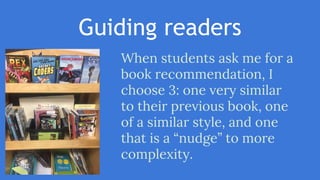
Guiding readers
When students ask me for a
book recommendation, I
choose 3: one very similar
to their previous book, one
of a similar style, and one
that is a “nudge” to more
complexity.
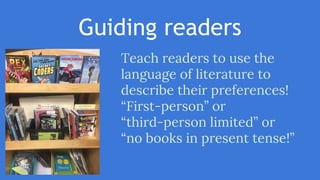
Guiding readers
Teach readers to use the
language of literature to
describe their preferences!
“First-person” or
“third-person limited” or
“no books in present tense!”
Adding accountability
Written responses to reading are totally
OPTIONAL! If you have kids reading 15
minutes daily and completing books, you
have already completed a challenge!
These next steps are your level-up.
Long term goals
Wide reading
OR
Narrow reading?
Exploring Books
What books do you want to check
out? This is your chance!
References
The Value of Independent Reading: Analysis of Research.
https://www.hmhco.com/~/media/sites/home/classroom/shop-
by-subject/summer-school/2017/resources/hmh_independent_re
ading_libraries_white_paper.pdf?la=en
The Case for Narrow Reading. Stephen Krashen.
http://www.sdkrashen.com/content/articles/narrow.pdf

Engaging readers: Managing independent reading

  • 1.
    Engaging Readers: Managing IndependentReading Emily Kissner Bendersville Elementary School @ELKissner elkissn@gmail.com
  • 2.
  • 3.
    What do youthink? Use this Google Form so that we can find out about participants.
  • 4.
    Benefits of readingchoice There is a strong correlation between time spent reading and reading achievement. (Allington, 2014) Students who engage in recreational literacy at school read more books at home (Block and Mangieri, 2002)
  • 5.
    Benefits of readingchoice Fifteen minutes of reading in-school per day can lead to gains, especially with on-grade and below level readers (Block and Mangieri, 2002)
  • 6.
    Benefits of readingchoice Access to a wide variety of books, both fiction and nonfiction, and choice of what to read are both correlated with increased motivation to read. (Allington and Gabriel, 2012)
  • 7.
    Challenges of reading choice Insteadof being engaged with books, kids will just “pretend read”.
  • 8.
    Challenges of reading choice Idon’t have enough books for a classroom library.
  • 9.
    Challenges of reading choice Ihave so much to cover, there’s no time for reading!
  • 10.
    Setting the scene Builda classroom library so that your students ALWAYS have access to books.
  • 11.
    Setting the scene Ilike to collect nonfiction books that correlate to science topics in large bins that I can rotate in and out through the year
  • 12.
    Setting the scene Usedbooks can be purchased at the Friends of the Library bookstore at the Gettysburg Library
  • 13.
    Setting the scene Thisyear’s Used Book Sale will be August 1-4 at Redding Auction House, with the bag sale on Saturday Book Sale Details
  • 14.
    Book Clubs Scholastic bookorders can be a way to get books. One or two parent purchases can get you bonus points! Book Clubs home page
  • 15.
    Selecting Books ● Mixof fiction and nonfiction ● Picture books and novels ● Graphic novels ● Books that showcase diversity ○ Favorite authors… ○ Anthology links… ○ Student requests
  • 16.
    Putting together yourlibrary Instead of a complicated sorting technique, I keep books in bins by author and genre, and “oddballs” on the shelves below
  • 17.
    Reading from Day1 Gather the most exciting, most high-interest books you have and spread them out through multiple browsing bins
  • 18.
    Reading from Day1 You’ll have some readers with specific requests, while others will enjoy browsing. Work the room! Lots of easy, attractive books will connect with readers.
  • 19.
    Moving forward Slowly increasethe amount of time that you expect students to spend reading. Build stamina with a smile! Around Day 4 or 5, introduce a written component in which students write something about what they read that day.
  • 20.
    Keeping track ofbooks Slowly introduce checking out of books. For the first two weeks, I don’t let students take books home. Then, they can sign out one book at a time.
  • 21.
    Keeping track ofbooks With 6th graders, my expectation is one book/month. Here you can see my super-amazing tracking system—-writing titles on a class list.
  • 22.
    Building a routine Workwith your readers to create a list of non-negotiables for independent reading time. Usually: ● Everyone is reading ● The room is quiet ● Stick with a book for the entire session ● No unnecessary movement
  • 23.
    Guiding readers When studentsask me for a book recommendation, I choose 3: one very similar to their previous book, one of a similar style, and one that is a “nudge” to more complexity.
  • 24.
    Guiding readers Teach readersto use the language of literature to describe their preferences! “First-person” or “third-person limited” or “no books in present tense!”
  • 25.
    Adding accountability Written responsesto reading are totally OPTIONAL! If you have kids reading 15 minutes daily and completing books, you have already completed a challenge! These next steps are your level-up.
  • 26.
    Long term goals Widereading OR Narrow reading?
  • 27.
    Exploring Books What booksdo you want to check out? This is your chance!
  • 28.
    References The Value ofIndependent Reading: Analysis of Research. https://www.hmhco.com/~/media/sites/home/classroom/shop- by-subject/summer-school/2017/resources/hmh_independent_re ading_libraries_white_paper.pdf?la=en The Case for Narrow Reading. Stephen Krashen. http://www.sdkrashen.com/content/articles/narrow.pdf